
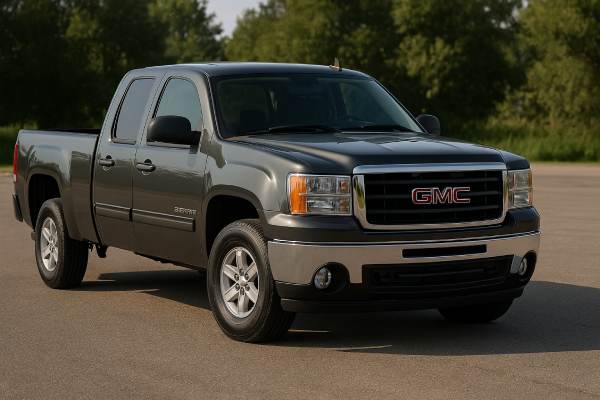
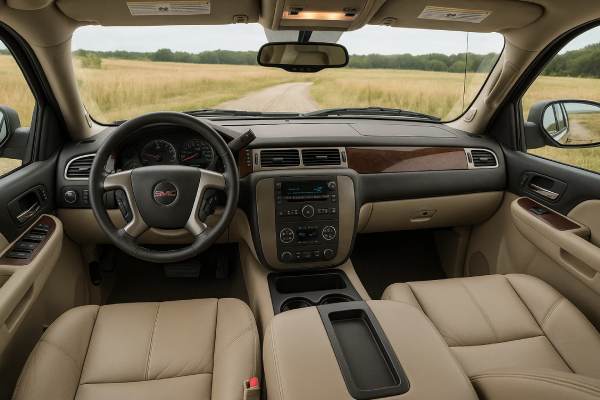
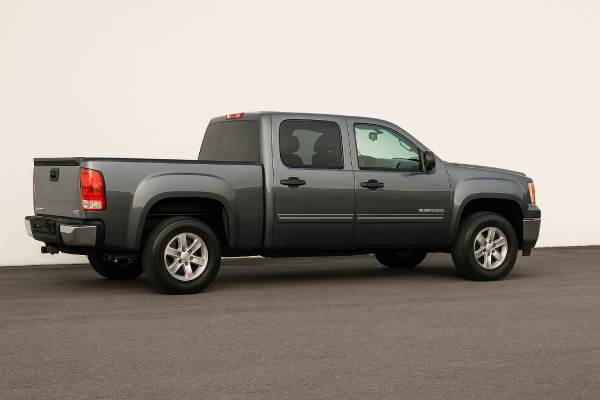
The 2007–2009 GMC Sierra 1500 RWD with the L76 6.0 litre V8 sits in a sweet spot between workhorse and performance truck. Built on the GMT900 platform, this generation brought a stiffer frame, cleaner styling and much better refinement than the outgoing Sierra, while the Vortec 6000 L76 package delivered 367 hp and 375 lb-ft in half-ton form. In rear-wheel-drive configuration it offers a simpler driveline, slightly better fuel economy than 4×4 versions and strong towing ability when properly equipped.
For owners and shoppers, the key questions are straightforward: how does the 6.0 compare to the more common 5.3, what are the real-world running costs, and which cab, bed and axle combinations make sense for mixed daily use, towing and light hauling? This guide focuses on the Sierra 1500 RWD with the L76 6.0l from 2007–2009 and aims to cover the engineering detail, reliability trends, maintenance expectations and how it stacks up against rivals in today’s used-truck market.
At a Glance
- Strong 6.0l L76 V8 with about 367 hp and 375 lb-ft gives relaxed towing and confident highway passing in a half-ton package.
- GMT900 chassis brings improved ride, steering and cabin refinement versus earlier Sierras, with good payload and tow ratings when properly optioned.
- RWD layout reduces complexity and service costs compared with 4×4, but traction aids and proper tyres are important in winter.
- Age-related issues include AFM lifter problems, rust in salt-belt trucks and wear in front suspension and steering components.
- Plan engine oil and filter changes every 8,000–10,000 km or 6–12 months, sooner for heavy towing or hot-climate use.
Section overview
- GMC Sierra L76 overview
- L76 Sierra specs and data
- Trims, options and safety
- Reliability and common issues
- Maintenance and buying guide
- Driving performance impressions
- Sierra 1500 rivals compared
GMC Sierra L76 overview
The GMT900-generation GMC Sierra 1500 arrived for the 2007 model year and quickly earned a reputation as one of the more refined full-size pickups of its time. Compared with the previous GMT800 trucks it offered a fully boxed frame on most models, tighter body construction and much improved noise isolation. Cabin design moved closer to SUV levels of comfort while still retaining the durability expected from a work truck.
The L76 6.0l V8 engine slotting into this platform is a member of GM’s LS-based “Gen IV” small-block family. In Sierra 1500 RWD applications it produces roughly 367 hp at around 5,500 rpm and 375 lb-ft of torque near 4,300 rpm, depending on exact model year and calibration. It uses aluminium block and heads, variable valve timing and Active Fuel Management (AFM) cylinder deactivation, allowing it to run on four cylinders under light load to reduce fuel consumption.
Within the Sierra range, the 6.0l L76 was positioned above the volume 4.8 and 5.3 litre V8s. It typically appeared in higher trims or “Max Trailering”/VortecMAX-style packages aimed at buyers who towed heavier loads or wanted stronger performance without stepping up to three-quarter-ton trucks. In RWD form, it allowed high tow ratings while keeping curb weight and driveline complexity down compared with 4×4 versions.
Configuration choices in 2007–2009 were broad. Most L76 RWD trucks you will find are extended or crew cabs with the 6.5 ft bed, automatic transmission and mid- to upper-level trims. Regular cabs with the 6.0 are rarer. Typical payloads for half-ton models range around 1,500–1,800 lb, while tow ratings in properly optioned RWD L76 trucks can approach or exceed 8,500–9,500 lb, depending on axle ratio and equipment.
From an ownership point of view, the draw is clear: a smooth, torquey V8 with enough power to feel unstressed when towing, backed by widely available parts and established service procedures. The flip side is that these are now 15–18-year-old vehicles. Rust, ageing plastics, electronic glitches and the long-term effects of AFM must be weighed carefully when assessing a used example.
In the used market today, an L76-equipped Sierra 1500 RWD can make sense as a relatively affordable tow rig, weekend truck or light commercial vehicle. It is less ideal as a city commuter because of its size and thirst but can be a comfortable long-distance hauler if maintained well and fitted with suitable tyres and suspension components.
L76 Sierra specs and data
This section focuses on a typical 2008 GMC Sierra 1500 RWD on the GMT900 platform with the 6.0l L76 V8 and automatic transmission. Exact figures vary slightly by cab style, trim and axle ratio, but the tables below give a realistic picture of what to expect.
Engine and performance
| Item | Value |
|---|---|
| Engine code | L76 (Vortec 6000 VVT with AFM) |
| Layout and valvetrain | 90° V8, aluminium block/heads, OHV, 2 valves/cyl, variable cam phaser |
| Displacement | 6.0 l (5,967 cc) |
| Bore × stroke | 101.6 × 92.0 mm |
| Induction | Naturally aspirated |
| Fuel system | Sequential multi-port fuel injection |
| Compression ratio | ~10.4:1 |
| Max power | ≈ 367 hp @ 5,500 rpm (Sierra 1500 VortecMAX) |
| Max torque | ≈ 375 lb-ft (508 Nm) @ ~4,300 rpm |
| Timing drive | Chain |
| Emissions / standard | US Tier 2 / Bin 5-era compliance (market dependent) |
| Rated economy (EPA, 2WD) | Around 13–15 mpg city / 17–20 mpg highway, spec dependent |
EPA figures for 2WD 6.0l trucks of this era cluster in the low-teens city and high-teens to around 20 mpg highway, depending on axle ratio and cab/bed configuration. In real use, heavy towing, tall accessories (racks, caps) and aggressive driving can reduce these numbers significantly.
Transmission and driveline
| Item | Value |
|---|---|
| Available transmissions | 4-speed 4L70E automatic; later 6-speed 6L80 automatic on some models |
| Drive type | Rear-wheel drive (RWD) |
| Typical axle ratios | Commonly 3.73 or 4.10 in tow-focused packages |
| Differential | Open or locking rear differential depending on option (G80) |
Early GMT900 L76 half-tons tended to use the 4L70E four-speed automatic, with some later trucks gaining the stronger and more efficient 6L80 six-speed. The extra ratios help keep the engine closer to its torque peak while reducing revs at highway speeds.
Chassis and dimensions
Figures below reflect a typical 2008 Sierra 1500 Extended or Crew Cab RWD with a 6.5 ft bed; regular cab dimensions differ slightly.
| Item | Value (approximate) |
|---|---|
| Platform | GMT900 body-on-frame half-ton pickup |
| Front suspension | Independent coil-over shock with control arms |
| Rear suspension | Solid axle with leaf springs |
| Steering | Hydraulic power-assisted recirculating ball |
| Front brakes | Ventilated discs |
| Rear brakes | Drums (on most trims) |
| Overall length | ≈ 5,600–5,800 mm (220–228 in) |
| Width (without mirrors) | ≈ 2,030 mm (80 in) |
| Height | ≈ 1,870–1,890 mm (74–75 in) |
| Wheelbase | ≈ 3,644 mm (143.5 in) crew / ext cab |
| Ground clearance | Roughly 230–250 mm (9–10 in), tyre dependent |
| Curb weight | ≈ 2,200–2,350 kg (4,850–5,200 lb) |
| GVWR | Around 3,175–3,221 kg (7,000–7,100 lb) |
| Fuel tank | ~98 l (26 US gal) |
Performance and capability
| Metric | Value (typical L76 RWD half-ton) |
|---|---|
| 0–60 mph | Roughly mid-7-second range (unloaded) |
| Top speed | Limited, generally around 160–170 km/h |
| Braking 100–0 km/h | Around 43–47 m, tyre and load dependent |
| Max towing (properly equipped) | Up to about 8,500–10,500 lb across range |
| Typical payload | Approximately 1,500–1,800 lb |
Exact tow ratings depend heavily on axle ratio, cooling package, brakes and whether the truck is set up with a dedicated max-trailering configuration. GMC marketing material for the 2008 Sierra 1500 range quoted tow ratings up to 10,500 lb for the most favourable combinations.
Fluids and service capacities
Values here are approximate and may vary by model year and configuration. Always confirm against the owner’s manual or service data for your VIN.
| System | Specification (typical) | Capacity (approx.) |
|---|---|---|
| Engine oil | 5W-30 meeting GM6094M (later dexos1 equivalent) | ~5.7–6.0 l (6.0–6.3 qt) |
| Engine coolant | Extended-life Dex-Cool, 50/50 with demineralised water | ~15–16 l (≈ 4 gal) |
| Automatic transmission | Dexron-VI ATF | ~11–13 l total, 4–6 l for pan drain |
| Rear axle | 75W-90 synthetic gear oil (check G80 requirements) | ~2.0–2.5 l |
| Power steering | GM-approved power steering fluid | ~1.0 l |
| Brake fluid | DOT 3 (later DOT 4 compatible); flush every 2–3 years | As required |
| A/C refrigerant | R-134a | ~0.8–0.9 kg (28–32 oz) |
Electrical
| Item | Value (typical) |
|---|---|
| Alternator | ~145–160 A on many L76 trucks |
| 12 V battery | ~600–700 CCA, group 48/78 type |
| Spark plugs | Iridium, ~0.040 in (1.0 mm) gap |
Safety and driver assistance
The GMT900 Sierra predates modern ADAS suites. Typical safety spec includes dual front airbags, available head-curtain and side airbags, ABS, traction control and stability control (StabiliTrak) on many trims. IIHS testing of comparable 2007–2008 crew cab Sierras shows “Good” ratings in moderate-overlap frontal and side tests, with less favourable head restraint ratings, while NHTSA frontal and side ratings for many 2WD crew and extended cabs reach four or five stars in most categories.
Trims, options and safety
During 2007–2009, the Sierra 1500 line was offered in several trims: Work Truck, SLE (in multiple levels), SLT and the more upscale Denali. The L76 6.0l V8 typically appeared in higher trims or special trailering packages rather than base models.
On the RWD side, you are most likely to encounter:
- SLE with VortecMAX or similar package – cloth interior, body-coloured or chrome trim, optional buckets, and the 6.0l engine paired with heavy-duty cooling, higher-capacity alternator and tow package.
- SLT – leather upholstery, more sound insulation, dual-zone climate control, upgraded audio and more comfort features. The 6.0l was often available as an option here in rear-wheel-drive extended or crew cabs.
- Regional or appearance packages – chrome or off-road styling bundles that may not change the core running gear but add different wheels, step bars and cosmetic changes.
Key mechanical option codes to look for include the L76 engine itself, G80 locking differential, trailering packages (often including upgraded hitch, wiring and transmission cooler) and higher axle ratios for towing.
From a safety perspective, equipment improved during the model run. Early trucks often had front airbags as standard and curtain/side airbags as options, while later years made some of these items more common. Electronic stability control (StabiliTrak) was progressively rolled into more configurations, particularly crew cabs, and is highly desirable if you are towing or driving in wet or icy conditions.
Crash-test performance depends on cab style and model year:
- IIHS testing of crew cab pickups in this generation shows strong structure in moderate-overlap frontal and side impact tests but weaker scores for head restraints and seats, reflecting the era rather than any single major flaw.
- NHTSA results for 2008–2009 Sierra 1500 2WD models commonly show four- and five-star ratings in frontal and side categories, with rollover ratings in the three- to four-star range typical of tall pickups.
There are no sophisticated driver-assistance systems such as automatic emergency braking or lane-keeping on these trucks. Instead, safety rests on basic crash structure, braking hardware, stability control, tyre condition and the driver’s habits. For family use, rear-seat space and head-curtain airbags in crew cab models are worth prioritising, especially if you regularly carry passengers.
In terms of trim-level differences that affect day-to-day use:
- Work Truck models tend to have vinyl floors and simpler electronics, which can age better in harsh environments but may lack desirable comfort and safety options.
- SLE/SLT models add better seats, power accessories and more complete gauge packages, which make long trips noticeably less tiring.
- Denali-branded trucks of this era tended to use the 6.2l L92 rather than the 6.0l L76, so they fall outside the exact scope of this guide but share many chassis and cabin features.
When evaluating any Sierra 1500 RWD L76, confirm the presence of side-curtain airbags, stability control and the tow package on the specific VIN. These affect both safety and suitability for towing and are more important than minor cosmetic trim differences.
Reliability and common issues
Overall, the GMT900 Sierra 1500 platform has a decent reliability reputation, but age and mileage now matter more than initial build quality. The L76 engine itself can run very high mileages if serviced properly, yet several recurring issues are worth understanding.
Engine and AFM system
The L76’s combination of AFM cylinder deactivation and traditional lifter design can lead to:
- AFM lifter failures – often showing up as misfires, ticking noises or a rough-running engine. In more severe cases the lifter collapses or the cam lobe wears. Many owners choose to disable AFM through tuning or perform a full AFM delete (new camshaft and lifters) during top-end repairs.
- Oil consumption – some AFM-era small-block V8s develop higher-than-normal oil use, especially if oil change intervals were stretched. Sticking piston rings, PCV issues and AFM behaviour can all play a role.
Keeping oil changes conservative and watching oil level between services are the best mitigations. Engines that have already had quality AFM delete work and cam/lifter replacements can be more appealing on the used market, provided the work is documented.
Cooling and fluids
Radiators, water pumps and hoses on 15–18-year-old trucks are well into the age range where leaks and failures become common. Dex-Cool coolant generally performs well when maintained, but neglected systems can show internal deposits and gasket wear. Overheating under load is often a sign of a partially clogged radiator or a failing fan clutch rather than an immediate head-gasket issue.
Transmission and driveline
The 4L70E automatic is an evolution of the 4L60 family and responds well to clean fluid, reasonable temperatures and respectful towing practice. Common age-related issues include:
- Harsh shifts or slipping due to worn clutches and valves
- Torque-converter clutch shudder when fluid is old or contaminated
- Leaks at cooler lines and the pan gasket
The later 6L80 six-speed is stronger but more complex, with its own set of valvebody and converter issues if neglected. In both cases, fluid changes at intervals shorter than “filled for life” suggestions help prolong service life.
Rear axles are generally robust, though trucks that towed at or near maximum capacity for years may develop gear whine or wheel bearing noise. A neglected G80 locking differential can chatter or lock inconsistently.
Suspension, steering and brakes
Front suspension components—ball joints, control-arm bushings, tie-rod ends and idler/pitman arms—are consumables on heavy trucks driven on poor roads. Clunks over bumps, vague steering and uneven tyre wear are all clues. Rear leaf springs and shackles can rust in harsh climates, sometimes leading to squeaks or broken leaves.
Factory front disc and rear drum brakes are adequate but can feel marginal when towing near the truck’s limits. Warped front rotors, seized caliper slide pins and handbrake issues are all common service items at this age.
Corrosion and body
In salt-belt regions, rust is a major concern:
- Frame rails and crossmembers
- Rear bumper and tow hitch assembly
- Cab corners and rocker panels under plastic trim
- Brake and fuel lines along the frame
A clean, rust-free underbody is now a strong differentiator between trucks, even if mechanical components are similar.
Electronics and interior
Instrument-cluster issues (dim or dead backlighting, stepper motor faults), door lock actuators, window regulators and ageing radio or HVAC controls are all fairly common but generally manageable. Airbag and ABS lights can arise from sensor faults or damaged wiring; proper diagnosis is important, especially if the truck has seen off-road or work use.
Maintenance and buying guide
A sensible maintenance plan is the best way to extend the life of an L76-powered Sierra 1500 and keep ownership costs predictable.
Baseline maintenance schedule (typical, confirm locally)
For a mostly stock RWD truck used for mixed commuting, light hauling and occasional towing:
- Engine oil and filter – Every 8,000–10,000 km or 6–12 months, whichever comes first. Shorten to 5,000–7,000 km if towing often, idling a lot or driving in hot climates.
- Engine air filter – Inspect annually, replace around 30,000–40,000 km or sooner in dusty conditions.
- Cabin air filter (if equipped) – Every 2 years.
- Spark plugs – Iridium plugs can often run 160,000 km, but at this age many are due if still original; replacement around 100,000–130,000 km is a reasonable preventative interval.
- Coolant – Replace every 5 years or 160,000 km, then at shorter intervals as the truck ages.
- Automatic transmission fluid and filter – 50,000–80,000 km change intervals are a good target, especially for trucks that tow.
- Rear axle fluid – Every 80,000 km in light use; halve that if towing heavy or carrying near-GVWR loads regularly.
- Brake fluid – Flush every 2–3 years.
- Brake pads and rotors – Inspect at each service; replace as needed. Trucks that tow or descend long grades will wear them faster.
- Steering and suspension – Inspect ball joints, tie rods and bushings annually; align the truck after replacing components or tyres.
- 12 V battery – Test yearly from about year 4–5; replace when cranking speed slows or test results decline.
Timing is chain-driven, so there is no scheduled belt replacement. Chain rattle, cam/crank correlation codes or metal in the oil are bigger red flags than simple mileage.
Fluid choices and key torques
Using quality fluids that meet GM specifications matters more than any single brand:
- Engine oil – A good 5W-30 that meets or exceeds GM’s requirements (dexos1-equivalent for replacement oils) is appropriate.
- Transmission – Use genuine Dexron-VI or a direct equivalent approved for GM automatics.
- Axle and transfer case – Use the specified gear oil weight and friction modifiers where required for locking differentials.
Common torque references (always verify for your exact truck):
- Wheel nuts typically sit around 135–190 Nm (100–140 lb-ft) depending on wheel type.
- Oil drain plug is usually in the 25–30 Nm range.
Buyer’s checklist
When shopping for a 2007–2009 Sierra 1500 RWD with the L76:
- Confirm the engine and options
- Check the RPO sticker (often in the glovebox) for L76 and desirable codes like G80 and tow packages.
- Verify cab, bed and axle ratio match your intended use.
- Inspect for rust
- Look underneath at frame rails, brake and fuel lines, leaf-spring mounts and cab mounts.
- Examine cab corners and rockers for bubbling under paint or behind plastic covers.
- Assess engine health
- Cold start: listen for knocks, chain rattle or loud ticking. A brief light tick can be normal, but sustained noise is not.
- Warm idle and test drive: check for misfires, warning lights and smooth power delivery.
- Look for evidence of AFM-related repairs or deletes; quality work with invoices is a positive.
- Evaluate transmission and driveline
- Shifts should be smooth and predictable, with no slipping or harsh engagements.
- On a road test, listen for axle whine and feel for vibrations under load and at cruising speed.
- Check suspension and steering
- Drive over uneven surfaces and listen for clunks.
- Check tyre wear patterns; severe inner or outer wear suggests alignment or worn components.
- Review history and recalls
- Ask for a full service history, focusing on fluid changes and any major engine or transmission work.
- Run the VIN through your national safety-agency database and the manufacturer’s recall checker to confirm recall completion.
A well-maintained, largely rust-free Sierra 1500 RWD with the L76 makes a strong candidate as a tow vehicle or long-term work truck. Trucks with extensive rust, vague service history and active warning lights are best avoided unless priced with substantial room for repairs.
Driving performance impressions
On the road, an L76-equipped Sierra 1500 RWD feels noticeably stronger than its smaller-engined siblings. The 6.0l V8 delivers a broad, easy torque curve; even with a heavy crew cab body, it pulls cleanly from low rpm and builds power in a smooth, linear way. Passing manoeuvres at highway speeds require less planning than in 4.8 or 5.3 litre trucks, especially when the bed is loaded or a trailer is attached.
With the four-speed 4L70E automatic, the truck often drops one or two gears when you ask for full throttle, letting the engine climb quickly into its mid-range. The later six-speed 6L80 improves this behaviour, keeping revs closer to the sweet spot and reducing hunting on gentle grades. Either transmission feels more relaxed when paired with sensible axle gearing; very short ratios improve towing and launch feel but can keep engine revs high and fuel consumption up on long highway trips.
Ride quality on GMT900 trucks is generally better than on the preceding generation, though it is still a body-on-frame pickup with leaf springs. Unloaded, the rear can hop over sharp bumps and expansion joints, but the front end feels stable and reasonably planted. With a moderate load in the bed or a well-balanced trailer on the hitch, the suspension settles and the truck rides with more composure.
Noise, vibration and harshness are mostly dominated by tyre and wind noise at speed. The 6.0l V8 is quiet at cruise but makes a classic small-block growl under load. If the exhaust has been modified, cabin boom at certain rpm can become tiring; stock or mild systems balance character and comfort better for long distances.
Braking performance is adequate when the truck is in good mechanical condition. Firm pedal feel and straight stops depend on healthy front rotors, pads and rear drums. For regular towing close to the truck’s limit, many owners upgrade pads and occasionally front rotors to gain additional margin against fade on long descents.
In terms of real-world economy, most owners see low-to-mid-teens mpg in mixed driving. Short trips, cold starts, city routes and heavy trailers can drag figures into single digits. Highway cruising near legal speeds with an empty bed can nudge consumption into the high teens, but this is not a fuel-sipping powertrain.
Handling is predictable rather than sporty. The steering is slower and heavier than modern electric systems but communicates load and grip reasonably well. On dry pavement, RWD traction is fine with decent tyres and an engaged G80 locker; in rain, snow or on loose surfaces, stability control and careful throttle application matter. Winter use in snow-belt areas almost always calls for dedicated tyres and ballast in the bed.
As a long-distance tow vehicle for moderate loads—a car on a trailer, a mid-size boat or a dual-axle camper—the Sierra 1500 L76 RWD is confident provided you remain within its rated limits and use a quality brake controller and weight-distributing hitch where appropriate. Engine and transmission temperatures must be monitored on long grades, particularly in hot weather, but with proper cooling and sensible driving the combination is very workable.
Sierra 1500 rivals compared
When new, the 2007–2009 GMC Sierra 1500 competed directly with the Chevrolet Silverado 1500 (its corporate twin), Ford F-150 of the same era, Dodge Ram 1500 and Toyota Tundra. In today’s used market, those same trucks—plus later generations—serve as alternatives.
Chevrolet Silverado 1500 (GMT900)
The Silverado is essentially the same truck underneath, sharing the GMT900 platform, engines and many components. Choice between Sierra and Silverado often comes down to styling, trim and price. For an L76 RWD configuration, availability and condition may matter more than badge; both can be maintained with the same parts and procedures.
Ford F-150 (2004–2008 generation)
The contemporary F-150 emphasised a very stiff frame and good crash performance, but its modular 5.4l V8 lacks the simplicity and tuning headroom of GM’s LS-based engines. Known issues with cam phasers and spark plugs on those engines are a consideration. If you value chassis stiffness and do not need LS-style aftermarket support, an F-150 can be compelling, but the Sierra’s 6.0l offers a more straightforward path to power and long-term parts availability.
Dodge Ram 1500 (third generation)
Ram trucks of this era often ride more smoothly when unladen thanks to their suspension tuning, and the 5.7l Hemi offers strong performance. However, interior quality and rust resistance can be more variable. For buyers planning mild modifications and occasional towing, the Sierra’s blend of refinement and LS-based powertrain may prove easier to live with over many years.
Toyota Tundra (second generation)
The 5.7l V8 Tundra is a serious contender for heavy towing. It combines strong factory tow ratings with a reputation for durability, but used prices can be higher, and running gear and body parts may be more costly in some regions. If you expect to keep a truck for 10+ more years with minimal modifications, a clean Tundra is attractive; if you value low parts prices, tuning options and widespread knowledge, the Sierra L76 is hard to overlook.
In summary, the 2007–2009 GMC Sierra 1500 RWD with the L76 6.0l V8 is a compelling used choice for buyers who want a traditional full-size pickup with strong, understressed power, good tow potential and straightforward serviceability. It demands attention to rust, AFM-related issues and general age-related wear, but rewards that care with a comfortable cabin, robust running gear and the wide support network that comes with a popular GM platform.
References
- GMC Sierra 1500 crew cab pickup 2007 2007 (Safety Rating)
- 2008 GMC SIERRA 1500 2 WD 2008 (Crash Test Database)
- Fuel Economy of 2008 GMC Sierra 1500 2008 (Fuel Economy Data)
- GMC Sierra 1500 Crew Cab IV 8 6.0 V8 4WD 367HP 2008 (Technical Specifications)
- 2008 GMC Sierra 1500 Trim Levels 2008 (Trim and Equipment Guide)
Disclaimer
This article is for informational purposes only and is not a substitute for professional diagnosis, repair or purchase advice. Specifications, torque values, service intervals and available equipment can vary by model year, market, trim level and individual vehicle history. Always confirm critical data against the official owner’s manual, workshop or service documentation for your vehicle and consult a qualified technician before performing maintenance, modifications or repairs.
If you found this guide useful, please consider sharing it with other owners or enthusiasts on social media or forums. Thoughtful sharing helps support the creation of accurate, independent technical resources.