
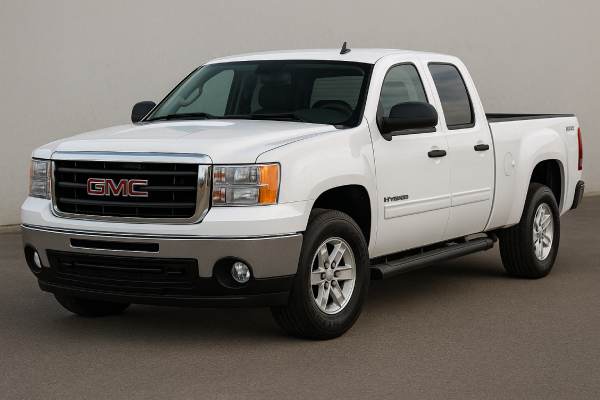
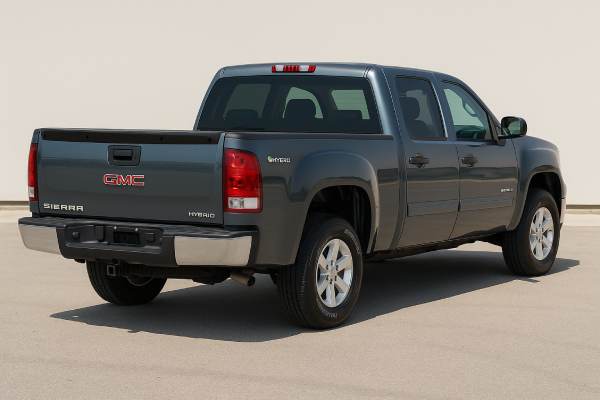
The GMT900-generation GMC Sierra 1500 Hybrid 4WD is an interesting mix of traditional full-size pickup engineering and early two-mode hybrid technology. Sold from the 2008 to 2013 model years, it combined a 6.0-litre V8 with an electrically variable transmission and a high-voltage battery pack, aiming to deliver real fuel savings in city and stop-start driving without sacrificing towing or payload entirely.
Unlike today’s mild hybrids, this truck can move off under electric power at low speeds, shut the V8 down when coasting or stopped, and blend electric assist back in as you accelerate. Yet underneath it remains a body-on-frame, leaf-sprung half-ton with familiar GMC ergonomics and 4WD hardware.
For a used buyer, the big questions are predictable: how efficient is it in real use, how complex is the hybrid system to maintain, which issues show up with age, and how does it stack up against non-hybrid Sierra models or rival pickups. This guide walks through those points in detail.
Fast Facts
- 6.0 l Vortec V8 with two-mode hybrid system, rated around 332 hp from the engine and strong low-rpm torque for towing and hauling.
- Full hybrid capable of low-speed electric driving, with meaningful gains in city fuel economy versus a standard Sierra 1500 4WD.
- Crew-cab short-box layout with 4WD and automatic transmission only, aimed at mixed family, work, and light-duty towing roles.
- Hybrid system, high-voltage battery and cooling components add complexity; ageing trucks benefit from specialist inspection before purchase.
- Engine oil and filter changes are sensible at 5,000–7,500 miles (8,000–12,000 km) or 12 months, with driveline fluids around 60,000 miles (100,000 km) in normal use.
Explore the sections
- Hybrid Sierra 1500 4WD background
- Sierra Hybrid powertrain and specs
- GMC Sierra Hybrid trims and safety
- Hybrid reliability and common faults
- Maintenance and buying guide
- Driving performance and efficiency
- Hybrid Sierra versus competitors
Hybrid Sierra 1500 4WD background
The Sierra 1500 Hybrid 4WD sits in a very specific niche. When GMC launched the GMT900-series hybrids in the late 2000s, the target was clear: fleet and private owners who wanted a full-size truck with better fuel economy, especially in urban duty cycles, without switching to a smaller vehicle. Rather than a simple start/stop system, GMC used a complex two-mode hybrid architecture that could drive the truck electrically at low speeds and blend torque from both the 6.0 l V8 and electric motors when needed.
The hybrid was only offered as a crew-cab short-box with a well-equipped interior, 4WD, and a single powertrain specification. Under the hood you get a 6.0 l Vortec V8 (LZ1 in later years, closely related to the earlier LFA hybrid V8), using aluminium construction, variable valve timing, and active fuel management to shut down cylinders under light loads. The engine is paired with an electrically variable transmission (EVT) that integrates two substantial electric motors and four fixed gears.
A 300-volt nickel-metal hydride (NiMH) battery pack sits behind or under the rear seat, cooled by dedicated ducting and fans. This pack is sized for hybrid assist rather than long electric-only range, but it can propel the truck quietly at low speeds and provides strong electric torque for pulling away with a trailer or a full load of passengers and gear.
The hybrid system is designed so that, from behind the wheel, you still feel like you are driving a conventional GMC truck. The shifter is on the column, there is no separate “EV mode” button to manage, and 4WD operation remains familiar. The system handles the blending of engine and electric power, transitioning between electric-only, hybrid, and engine-only drive as conditions change.
From an ownership point of view, the attraction is straightforward: compared with a non-hybrid Sierra 1500 4WD of the same generation, you get better fuel economy in urban and stop-start conditions, a quieter and smoother take-off, and strong low-rpm assistance when towing or hauling. The trade-offs are added complexity, a modest reduction in payload due to hybrid components, and the need to pay attention to high-voltage system health as the truck ages.
If you are looking at a used example, it pays to think of this truck as both a full-size pickup and a hybrid system that is old enough to require careful inspection. Done right, it can be a comfortable, capable daily driver and light-duty work truck with fuel bills closer to a smaller SUV than a traditional V8 half-ton.
Sierra Hybrid powertrain and specs
This section covers the key specifications for the GMT900 GMC Sierra 1500 Hybrid 4WD, focusing on the two-mode hybrid powertrain, 4WD driveline, chassis dimensions, and basic performance figures. Exact numbers can vary slightly by model year and market, but the overall picture is consistent across 2008–2013.
Powertrain and efficiency
| Item | Value |
|---|---|
| Engine codes | LFA (early years), LZ1 (later years) |
| Engine layout and valvetrain | V8, 90°, overhead valves (OHV), 2 valves per cylinder |
| Displacement | 6.0 l (5,967 cc) |
| Bore × stroke | Approx. 101.6 × 92.0 mm |
| Induction | Naturally aspirated |
| Fuel system | Sequential multi-port fuel injection |
| Compression ratio | Around 10.8:1 |
| Max engine power | ≈ 332 hp (engine rating) |
| Max engine torque | Around 367 lb-ft (≈ 497 Nm) |
| Hybrid system type | Two-mode full hybrid, electrically variable |
| Electric motors | Two motor-generators integrated in transmission |
| Battery chemistry | Nickel-metal hydride (NiMH) |
| Battery nominal voltage | ≈ 300 V |
| Combined system output | Roughly mid-300 hp range (engine + electric assist) |
| Emissions / efficiency | EPA-rated full-hybrid truck, ULEV-type compliance |
| Typical fuel economy | Often around low-20s mpg US combined if driven gently |
Real-world economy depends heavily on duty cycle. Used mostly in city traffic, many owners see clear gains versus a non-hybrid 5.3 or 6.0 l 4WD truck. At steady highway speeds, the benefit shrinks because there are fewer opportunities for engine shut-off or regenerative braking.
Transmission and driveline
| Item | Value |
|---|---|
| Transmission | Electrically variable transmission (EVT), 4 fixed gears + 2 motor-generators |
| Drive type | 4WD with 2-speed transfer case |
| Transfer case functions | 2HI, Auto 4WD, 4HI, 4LO (availability can vary by year/market) |
| Rear differential | Typically locking or automatic locking rear differential (G80-type) |
| Final drive ratios | Optimised for hybrid system and towing balance |
The two-mode EVT can operate as a continuously variable transmission at low speeds and then blend in fixed gear steps at higher loads or speeds. From the driver’s perspective, it behaves like an automatic with some unusual but generally smooth shift patterns, especially in gentle driving.
Chassis and dimensions
Most Sierra Hybrid 4WD trucks were sold as crew-cab short-box models.
| Item | Approximate value |
|---|---|
| Platform | GMT900 body-on-frame full-size pickup |
| Cab / bed configuration | Crew-cab, short box |
| Front suspension | Independent torsion bar (or coil) arrangement |
| Rear suspension | Solid axle with leaf springs |
| Steering | Hydraulic power steering |
| Front brakes | Ventilated discs |
| Rear brakes | Discs or drums (by year) |
| Wheelbase | Around 143.5 in (3,643 mm) |
| Overall length | Roughly 229–230 in (≈ 5,820–5,840 mm) |
| Width | About 79–80 in (≈ 2,010 mm) |
| Height | Around 73–75 in (≈ 1,850–1,900 mm) |
| Curb weight | Typically in the 5,800–6,000 lb range |
| GVWR | Around 7,000 lb (varies by spec) |
| Fuel tank | Approximately 26 US gal (≈ 98 l) |
Hybrid hardware adds weight versus a non-hybrid crew-cab, which affects payload and tow rating slightly, but the truck still sits firmly in light-duty full-size territory.
Performance and capability
| Metric | Typical range |
|---|---|
| 0–60 mph | Roughly high-7 to low-8 seconds |
| Top speed | Limited, typical for US-market pickups |
| Towing capacity (4WD hybrid) | Often around 5,900–6,100 lb, depending on spec |
| Payload | Typically in the 1,400–1,600 lb range |
These numbers place the hybrid a little below the highest-spec non-hybrid Sierras for towing and payload, but still adequate for small to medium trailers, boats, or work equipment.
Fluids, service capacities and electrical
Values vary by year and exact configuration; always verify for your VIN.
| System | Specification / notes |
|---|---|
| Engine oil | 5W-30 meeting GM specifications, quantity ≈ 6–7 qt |
| Engine coolant | Long-life coolant to GM spec |
| Transmission / EVT | Dexron-VI or hybrid-specific ATF (GM-approved only) |
| Transfer case / axles | Gear oil to GM spec, typically synthetic 75W-90 |
| A/C refrigerant | R-134a (charge varies with system) |
| 12 V battery | High-capacity lead-acid with appropriate CCA rating |
| High-voltage battery | NiMH pack, service and replacement are specialist jobs |
Hybrid-specific components add extra cooling circuits and electrical hardware, which require more careful attention than on a conventional truck.
GMC Sierra Hybrid trims and safety
The Sierra 1500 Hybrid 4WD did not follow the same wide trim spread as the broader Sierra 1500 line. Instead, GMC positioned it as a reasonably premium, well-equipped model with a limited set of configurations, making used-market decoding a bit easier.
Trims and equipment
In most markets, the hybrid was offered as a single main trim level roughly comparable to an SLE or mid-level Sierra, often with a few option packages. Key points:
- Cab and bed: almost always crew-cab with a short box. Other configurations were not widely sold.
- Driveline: hybrid powertrain with either 2WD or 4WD; this guide focuses on the 4WD version.
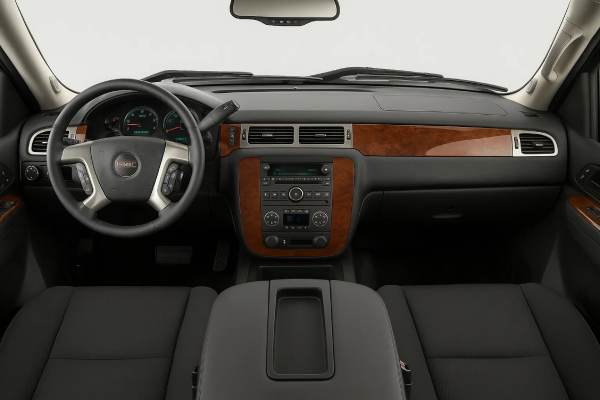
- Interior: cloth or leather upholstery depending on package, dual-zone climate control on many trucks, and later models gaining improved infotainment and connectivity compared with early years.
- Hybrid-specific displays: instrument cluster and driver information systems usually include battery charge, power flow, and economy displays to help you drive efficiently.
Option packages could add features such as upgraded audio systems, navigation, rear-park assist, and cosmetic enhancements. Mechanically, however, all hybrids share the same basic two-mode system, V8, and 4WD hardware for a given drive type.
Quick identifiers for a hybrid Sierra include:
- Hybrid badging on the doors and tailgate.
- Distinctive wheels or aero tweaks (such as specific steps or tonneau covers in some trims) aimed at reducing drag.
- A battery cooling intake and venting, often visible near the rear seat area.
- Special labelling under the hood indicating high-voltage components and service precautions.
Safety ratings and structure
The Sierra 1500 Hybrid 4WD shares its core body-in-white, crash structure, and restraint systems with other GMT900 crew-cab Sierra and Silverado models. Those trucks generally scored well for their time in frontal and side-impact testing by US safety bodies, with performance typical of large full-size pickups built to mid-2000s standards.
Passive safety features usually include:
- Front airbags for driver and passenger.
- Side-impact and curtain airbags (availability depends on year and market).
- Three-point belts for all seating positions.
- LATCH/ISOFIX-style anchors for child seats in the rear.
Because the hybrid uses the same basic crash structure, you can treat safety ratings for equivalent crew-cab Sierra or Silverado 1500 models from the same era as a useful guide. Always check truck-specific crash and rollover ratings for the exact year you are considering.
Safety systems and driver assistance
Compared with today’s pickups, driver-assistance technologies are modest:
- ABS and stability control are standard and tuned to work with the hybrid’s regenerative braking.
- Traction control helps manage wheelspin when pulling away in 2WD or 4WD on low-grip surfaces.
- Tire pressure monitoring is generally fitted.
- Later years may offer rear parking sensors and backup cameras, but lane-keeping aids, automatic emergency braking, or adaptive cruise control are not typical on these trucks.
After body repairs, suspension work, or windshield replacement, it is important to ensure that basic safety systems (airbags, ABS, stability control) are correctly reset and that any diagnostic trouble codes are fully resolved. Hybrid-specific warning lights relating to the battery, high-voltage system, or regenerative braking should never be ignored.
Overall, the Sierra Hybrid 4WD is a product of its time: structurally solid for a full-size truck of that era, but without the advanced collision-avoidance tech common on newer models. Buyers should evaluate safety primarily on structure, size, and basic electronic assistance, rather than expecting modern active systems.
Hybrid reliability and common faults
Reliability for the Sierra 1500 Hybrid 4WD can be thought of in two layers: the conventional GMT900 truck underneath, and the hybrid system on top. The underlying chassis, frame, and basic V8 architecture are well understood and broadly durable when serviced properly. The high-voltage components and two-mode transmission add complexity and some unique failure modes.
Engine and conventional systems
The 6.0 l Vortec V8 is a robust pushrod design with millions of units produced in various forms. Common age-related issues include:
- Oil consumption or leaks: valve-cover gaskets, oil pan gaskets, and rear main seals can seep over time. Regular level checks and timely gasket replacement prevent bigger problems.
- Cooling system wear: radiators, hoses, water pumps, and thermostats can fail with age and mileage. Overheating is more damaging on a hybrid because of additional heat-sensitive electronics nearby.
- Exhaust manifold bolts: broken manifold bolts and resulting leaks are not unusual on GM V8 trucks. They present as ticking noises at cold start and can be labour-intensive repairs.
These issues are usually manageable and not unique to the hybrid; any competent shop experienced with GM trucks can handle them.
Hybrid system and transmission
The two-mode hybrid system and EVT are more specialised:
- High-voltage battery degradation: as with any NiMH pack, capacity and performance can decline over time, especially in hot climates or with heavy towing. Symptoms may include reduced electric assist, more frequent engine cycling, warning lights, or poor fuel economy. Remedies range from software updates and cooling-system checks to module replacement or full pack replacement.
- Transmission or motor issues: the EVT integrates planetary gearsets with electric motor-generators. Unusual noises, harsh engagement, slipping, or repeated fault codes require attention from a hybrid-qualified technician. Ignoring these symptoms can lead to expensive failures.
- Battery cooling problems: blocked vents, failed fans, or damaged ducting can lead to high battery temperatures and warning lights. Cleaning ducts and replacing fans or sensors as needed is important for pack life.
Because relatively few shops see these hybrids regularly, it is worth seeking out a technician with specific GM hybrid experience for diagnosis and repair.
Driveline, suspension, and chassis
As a full-size truck, the Sierra Hybrid 4WD also shows typical GMT900 wear patterns:
- Front suspension components: ball joints, control arm bushings, and tie-rod ends can wear, especially on trucks that see rough roads, heavy loads, or larger aftermarket wheels.
- Steering gear and pump: play in the steering or leaks from the steering system are not unusual with age.
- Rear leaf springs and shackles: corrosion and wear can appear in rusty climates, affecting ride height and noise.
- Frame and underbody corrosion: areas that see winter road salt can experience rust on frame rails, brake lines, and crossmembers. Hybrid components mounted to the frame are also vulnerable if rust spreads.
Recalls, TSBs, and extended coverage
Over its production life, the GMT900 Sierra line saw various recalls and technical service bulletins (TSBs) covering items ranging from steering and brake lines to electronics and airbag system updates. Hybrid-specific campaigns have included software updates and system checks for the battery and control modules.
Before buying, you should:
- Run the VIN through official recall databases and GMC’s own portal.
- Ask for documentation that any hybrid-specific campaigns or software updates have been completed.
- Check for evidence of past high-voltage or transmission repairs and verify that they were carried out by suitable specialists.
If a truck has had major hybrid repairs under warranty, that is not a reason to walk away automatically—but you should examine the quality of work and any remaining warranties or goodwill arrangements.
Maintenance and buying guide
Practical maintenance and careful pre-purchase checks make a big difference with a Sierra 1500 Hybrid 4WD. Treat it like a work truck and a hybrid simultaneously: robust but deserving of attentive service intervals and specialist input when needed.
Practical maintenance schedule
Always confirm details with the owner’s manual and service information for your year and market, but the following is a sensible baseline:
- Engine oil and filter: every 5,000–7,500 miles (8,000–12,000 km) or 12 months, whichever comes first. Severe use (towing, hot climates, lots of idling) justifies the shorter interval.
- Engine air filter: inspect at 15,000 miles (25,000 km), replace by 30,000 miles (50,000 km) or sooner in dusty conditions.
- Cabin air filter (if equipped): around every 20,000–25,000 miles (30,000–40,000 km) or 2 years.
- Spark plugs: typically 100,000 miles (160,000 km) for long-life plugs, but replacement earlier is reasonable on older trucks or if misfires occur.
- Coolant: long-life coolant generally around 5 years / 100,000 miles initially, then at shorter intervals thereafter. Hybrid components may have additional cooling requirements.
- Transmission / EVT fluid: check manufacturer guidance; around 60,000–90,000 miles (100,000–150,000 km) is a common window for preventative service, with dealer-grade fluid and procedures.
- Transfer case and axle fluids: 50,000–60,000 miles (80,000–100,000 km) is a good target, sooner if you tow.
- Brake fluid: every 2–3 years to protect ABS and hybrid regenerative braking interfaces.
- Brake pads and discs: inspect at every service; regen braking can extend pad life in city use, but heavy towing still wears components.
- Serpentine belts and hoses: inspect from 60,000 miles up; replace on condition or around 100,000 miles.
- 12 V battery: test annually after year 4–5; replacement often falls between years 5–7.
- High-voltage battery and hybrid system: follow GM guidance for inspections, cooling-system checks, and software updates. Replacement or module-level repair is specialist work.
Timing is chain-driven on the 6.0 l V8, so there is no cambelt interval. Instead, watch for timing-related fault codes, noise on start-up, or performance issues that could indicate wear.
Fluid specs and torque references
For decision-making:
- Use engine oil that meets GM’s recommended specifications for the model year, typically synthetic 5W-30 in North American climates.
- Only use GM-approved ATF for the hybrid EVT; generic fluid is not acceptable.
- For axles and transfer case, use the specified synthetic gear oils with friction modifiers where required.
Common torque references (always verify for your model):
- Wheel nuts: typically in the 130–140 Nm (95–105 lb-ft) range on similar GM trucks.
- Oil drain plug: usually in the 25–35 Nm (18–26 lb-ft) range, with a new washer when required.
Buyer’s checklist
When evaluating a used Sierra 1500 Hybrid 4WD:
- Service history
- Look for regular oil changes, coolant service, and driveline fluid changes.
- Confirm hybrid-system services or inspections are recorded.
- Hybrid health
- Ensure no hybrid or check-engine warning lights are active.
- Listen for unusual noises from the transmission area.
- Test low-speed operation in traffic: the engine should shut off and restart smoothly, with electric assist evident.
- Frame and underbody
- Inspect frame rails, crossmembers, brake lines, and mounting points for corrosion.
- Check the condition of underbody wiring and hybrid-system shielding.
- Suspension and steering
- Look for uneven tyre wear, clunks over bumps, and steering play.
- Check for leaks at shocks, steering rack, and power steering lines.
- Towing and work use
- Hitch wear, aftermarket brake controllers, and heavily worn load beds suggest regular towing or heavy hauling.
- Hard use is not a deal-breaker if matched with strong maintenance; price should reflect condition.
- Recalls and updates
- Run the VIN through official recall databases.
- Ask for proof that hybrid-specific software updates and campaigns have been applied.
A well-maintained truck with documented hybrid care and minimal rust can be a solid long-term tool. A neglected one with warning lights and corrosion can be costly very quickly.
Driving performance and efficiency
On the road, the Sierra 1500 Hybrid 4WD feels very much like a conventional GMT900 truck at first. You sit high, the steering is relaxed but predictable, and the cabin prioritises space and comfort over flash. The differences emerge as you move through city traffic and low-speed environments.
Powertrain character
From a standstill, the truck can move off using electric power alone if the battery is charged and you are gentle with the throttle. The transition to V8 power is usually smooth, with the engine starting unobtrusively as speed or load demands rise. Under moderate acceleration, the hybrid system blends electric torque with the V8 to provide a strong, continuous pull without frequent gear hunting.
At highway speeds, the two-mode transmission settles into an efficient operating window, and the hybrid system focuses on maintaining speed with minimal fuel use. Active fuel management can shut down half the cylinders under light load, further trimming consumption. In these conditions, the truck behaves much like a well-tuned conventional automatic, with the hybrid system largely in the background.
Ride, handling, and refinement
Ride quality is typical for a half-ton crew-cab truck of this era: composed on the highway, a bit busy over broken pavement when unladen, and more settled with some weight in the bed. Leaf springs at the rear are tuned to balance comfort with payload capability, so sharp bumps can still be felt in the cabin.
Steering is on the light side but predictable, with a relatively large turning circle that reflects the long wheelbase. Wind and tyre noise are acceptable for a body-on-frame truck, and the hybrid’s ability to shut the engine off at stops makes urban driving noticeably quieter than in a non-hybrid V8.
Braking feel is slightly different from a purely hydraulic system, because regenerative braking blends with the friction brakes. In a healthy truck the pedal should feel consistent and progressive. Any grabbiness, unusual noises, or inconsistency at low speeds deserves inspection, as it can indicate issues with regen blending, ABS sensors, or conventional brake components.
Real-world economy and towing behaviour
Fuel economy is the Sierra Hybrid’s main reason for existing. In mixed city and suburban driving, owners often see clear gains over a non-hybrid 4WD V8 of the same era—think high-teens to low-20s mpg US instead of low- to mid-teens. On long highway runs at steady speeds, the difference narrows, and figures may align more closely with a well-maintained non-hybrid truck.
When towing or carrying heavy loads, the hybrid assist still helps with low-speed pull-away and grade climbing, but fuel consumption rises as expected. Towing within the roughly 6,000 lb range that many hybrid 4WD models are rated for, you should expect a meaningful drop in mpg compared with solo running, as with any gas-powered half-ton.
Noise levels under load are similar to other 6.0 l GMC trucks: the V8 has a deep, smooth tone when worked hard, and the transmission’s ability to hold efficient ratios reduces unnecessary revving. Stability at speed with a properly set-up trailer is generally good, owing to the long wheelbase, 4WD traction, and weight of the truck.
Overall, the driving experience balances the familiarity of a traditional Sierra with the subtle advantages of hybridisation. If your usage involves a lot of stop-start or low-speed running, the hybrid benefits are most obvious; if you mostly tow on the highway, a conventional Sierra may be simpler and just as effective.
Hybrid Sierra versus competitors
When new, the Sierra 1500 Hybrid 4WD had relatively few direct rivals. Today, the used market offers a wider range of trucks and powertrains, from conventional V8 half-tons to modern turbocharged and diesel options, as well as more advanced hybrid systems.
Versus non-hybrid Sierra 1500
Compared with a similar-year non-hybrid Sierra 1500 4WD:
- Pros for the hybrid
- Better fuel economy in urban and stop-start use.
- Smoother, quieter operation in traffic thanks to engine shut-off and electric assist.
- Strong low-speed torque feel when pulling away with a load.
- Cons for the hybrid
- More complex powertrain and electronics.
- Slightly lower payload and towing ratings in many configurations.
- Fewer independent shops comfortable with hybrid diagnosis and repair.
If your driving is heavily weighted toward city use and light towing, the hybrid’s advantages are more compelling. For primarily highway towing and work, a conventional Sierra can be simpler to own and maintain.
Versus other full-size pickups
Against contemporary full-size rivals such as the Ford F-150, Ram 1500, and Toyota Tundra of the late 2000s and early 2010s, the Sierra Hybrid 4WD offers:
- A unique two-mode hybrid system when most competitors relied on non-hybrid V8s or early cylinder-deactivation strategies.
- Fuel economy that is competitive with or better than similar V8 4WD trucks in city driving, albeit with comparable highway figures.
- Interior quality and ride comfort on par with other GMT900 trucks, which were generally well regarded for refinement at the time.
Modern rivals with newer hybrid or turbocharged powertrains can match or exceed its efficiency and performance, but they also come with higher purchase prices. In the used market, the Sierra Hybrid 4WD can be an appealing choice for buyers who value its particular balance of age, cost, and technology—provided they are comfortable with the additional complexity.
Who the Sierra Hybrid 4WD suits best
This truck makes the most sense if you:
- Need a full-size crew-cab 4WD with light- to medium-duty towing ability.
- Spend a significant amount of time in urban or suburban traffic where the hybrid system can work.
- Are prepared to maintain both the conventional truck systems and the hybrid hardware to a high standard.
- Have access to a shop or dealership with genuine GM hybrid experience.
For buyers who prioritise maximum towing, extreme off-roading, or absolute simplicity above all, a non-hybrid V8 or a later-generation truck may be a better fit. For those who like the idea of a full-size pickup that consumes less fuel around town and offers a smoother low-speed drive, the Sierra 1500 Hybrid 4WD remains a distinctive option.
References
- 2013 GMC Sierra Owner Manual 2013 (Owner’s Manual)
- 2011 GMC Sierra and Sierra Denali Owner Manual 2011 (Owner’s Manual)
- 2013 GMC Sierra 1500 Trailering Guide 2013 (Trailering and Specifications)
- 2011 Fuel Economy Guide 2011 (Fuel Economy Data)
- NHTSA Vehicle Recall Search 2025 (Recall Database)
Disclaimer
This article is for informational purposes only and is not a substitute for professional diagnosis, repair, or purchase advice. Specifications, torque values, service intervals, and available equipment can vary by model year, market, trim level, hybrid configuration, and individual vehicle history. Always confirm critical data against the official owner’s manual, workshop or service information, and documentation specific to your vehicle’s VIN. Consult a qualified technician, ideally with GM hybrid experience, before carrying out maintenance, modifications, or repairs.
If you found this guide useful, you are welcome to share it with other owners or enthusiasts on social media or forums to help support accurate, independent technical information.