
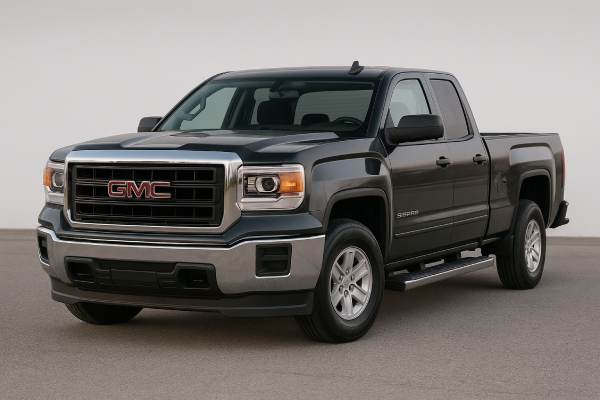
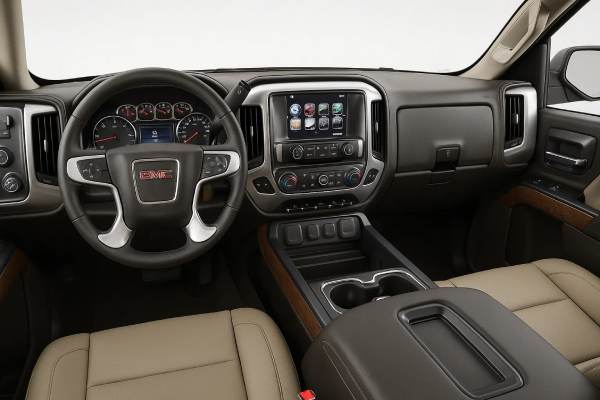
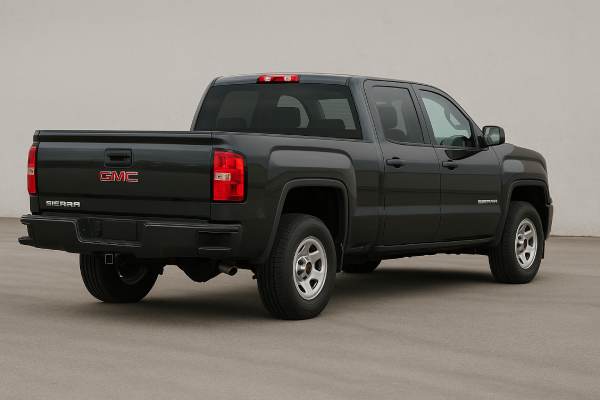
The 2014–2018 GMC Sierra 1500 RWD with the LV3 4.3-litre V6 sits in a sweet spot between work-truck simplicity and modern engineering. When GMC moved from the GMT900 to the GMTK2XX platform, the Sierra gained a stiffer frame, better noise isolation, improved interiors, and the new EcoTec3 engine family. The LV3 is not just a “base V6” in name; it brings direct injection, variable valve timing, and cylinder deactivation to a truck engine that still feels robust and uncomplicated.
In rear-wheel-drive form, this Sierra is aimed at owners who spend more time on pavement and light job sites than in deep mud, but still need a full-size bed and respectable towing. It can be a smart choice for small business fleets, homeowners with trailers, and buyers who want a full-size truck without V8 fuel bills. This guide walks through specs, real-world performance, reliability patterns, and what to look for when buying used.
Fast Facts
- Strong LV3 4.3 V6 with 285 hp and good low-rpm torque for daily hauling and light towing.
- GMTK2XX chassis brings a quieter cabin, better ride, and more modern interior than the previous GMT900 trucks.
- Simpler RWD layout reduces weight and complexity compared with 4WD versions, which helps economy and maintenance costs.
- Watch for 6-speed automatic shift quality, AFM lifter issues, and rust on frame and brake lines in high-salt regions.
- Plan engine oil and filter changes every 5,000–7,500 miles (8,000–12,000 km) or 12 months, depending on use and oil-life monitor.
Contents and shortcuts
- GMC Sierra 4.3 RWD story
- Sierra 4.3 LV3 technical data
- Trims equipment and safety features
- Reliability issues and service actions
- Maintenance schedule and buying guide
- On-road behaviour and economy
- Sierra 4.3 versus key rivals
GMC Sierra 4.3 RWD story
The 2014 model year was a turning point for GMC’s half-ton pickup. The Sierra 1500 moved to the GMTK2XX platform with a deeper hydroformed front frame section, high-strength steel in key areas, and a more aerodynamic body. The 4.3-litre LV3 V6 was introduced as part of the EcoTec3 engine family, sharing architecture with the small-block V8s rather than the older 90-degree truck V6.
In rear-wheel-drive form, this Sierra 1500 targets buyers who mainly drive on road: tradespeople commuting with tools, owners pulling small boats or utility trailers, and drivers who simply prefer the feel of a full-size pickup to a crossover. RWD reduces curb weight, improves fuel economy, and cuts service complexity by losing the front differential, transfer case, and extra driveshafts found on 4WD versions.
The LV3 engine itself is a key selling point. It combines a traditional cast-iron block and pushrod valvetrain with modern features: direct fuel injection, variable valve timing on a single camshaft, and Active Fuel Management (cylinder deactivation) in many calibrations. That gives better part-throttle efficiency without relying on turbocharging, which some buyers prefer for long-term durability.
Inside, the 2014–2018 trucks brought a much more car-like cabin compared with the previous generation. Seats are more supportive, the dash layout is simpler, and most models include a colour infotainment screen with Bluetooth and available navigation. Long-bed, standard-bed, regular cab, double cab, and crew cab versions were offered, though the LV3 V6 is most common in regular and double cabs in lower and mid trims.
From an ownership perspective, this truck is about balance. It is not the most powerful Sierra, nor the highest tow-rated, but it is easier on fuel than the 5.3 and 6.2 V8s and tends to be cheaper on the used market. For many drivers who rarely push beyond about 6,000–7,000 lb of trailer, the 4.3 RWD configuration offers enough capability with fewer running costs.
Sierra 4.3 LV3 technical data
Engine and performance
The LV3 is a 4.3-litre EcoTec3 V6 based on GM’s Gen V small-block architecture. Key technical data:
| Item | Value |
|---|---|
| Engine code | LV3 EcoTec3 |
| Layout and cylinders | 90° V6, pushrod, 2 valves per cylinder (12 valves total) |
| Valvetrain | Single cam-in-block with variable valve timing |
| Bore × stroke | 99.6 mm × 92.0 mm (3.92 in × 3.62 in) |
| Displacement | 4.3 l (4,300 cc) |
| Induction | Naturally aspirated |
| Fuel system | Direct injection (DI) gasoline |
| Compression ratio | About 11.0 : 1 |
| Max power | 285 hp (approx. 212 kW) @ ~5,300 rpm |
| Max torque | 305 lb-ft (approx. 414 Nm) @ ~3,900 rpm |
| Timing drive | Chain, designed as “lifetime” component with proper service |
| Emissions standard | US EPA / CARB compliant for its model years |
Factory fuel economy ratings for a 2WD Sierra 1500 with the 4.3 and 6-speed automatic typically fall around the high-teens mpg (US) in the city and mid-20s mpg (US) on the highway, depending on cab, bed, and axle ratio. Real-world numbers often land slightly lower in mixed use, especially with larger wheels or heavy loads.
Aerodynamic details are not heavily advertised, but compared with the previous generation, the K2 trucks gained a more raked windshield, tighter panel gaps, and active grille shutters on many models to cut drag at highway speeds.
Transmission and driveline
For this specific variant, the drivetrain is straightforward:
| Item | Value |
|---|---|
| Transmission | 6-speed automatic (6L80) with tow/haul mode |
| Gear ratios | 1st 4.03, 2nd 2.36, 3rd 1.53, 4th 1.15, 5th 0.85, 6th 0.67, Reverse 3.06 (typical 6L80 set) |
| Final drive ratios | Commonly 3.23 or 3.42, some trucks 3.08 or 3.73 (varies by towing package) |
| Drive type | Rear-wheel drive (RWD) |
| Differential | Open rear differential; optional locking rear differential (G80) on many trims |
The locking rear differential is a very desirable option for traction in snow, gravel, and work sites, especially on RWD trucks.
Chassis and dimensions
Dimensions vary by cab and bed, but typical figures for a 2014–2018 Sierra 1500 2WD with the LV3 are:
| Item | Approximate value and range |
|---|---|
| Front suspension | Independent coil-over shock with aluminum control arms |
| Rear suspension | Solid axle with leaf springs |
| Steering | Electric power-assisted rack-and-pinion |
| Front brakes | Ventilated disc, around 330–345 mm (13.0–13.6 in) diameter |
| Rear brakes | Solid or ventilated disc, around 327–338 mm (12.9–13.3 in) |
| Common wheel/tyre sizes | 17–20 in rims; e.g. 255/70 R17, 265/65 R18 |
| Ground clearance | Around 210–230 mm (8.3–9.1 in), depending on trim and wheel/tyre |
| Length | Roughly 5,200–6,000 mm (205–236 in), cab and bed dependent |
| Width (without mirrors) | About 2,030 mm (80 in) |
| Height | Around 1,880–1,900 mm (74–75 in) |
| Wheelbase | Approx. 3,645–3,957 mm (143.5–155.8 in) |
| Turning circle | Typically 12.5–13.5 m (41–44 ft), configuration dependent |
| Curb weight | Roughly 2,100–2,350 kg (4,630–5,180 lb) |
| GVWR | Commonly 3,100–3,300 kg (6,800–7,200 lb) |
| Fuel tank | Around 98 l (26 US gal; 21.7 UK gal) |
These ranges are wide because GMC offered several cab, bed, and payload configurations with the LV3.
Performance and capability
Again, exact numbers depend on configuration, but the LV3 RWD Sierra typically delivers:
| Item | Typical figure |
|---|---|
| 0–100 km/h (0–62 mph) | About 7.5–8.2 s when unloaded |
| Top speed | Limited to around 160–175 km/h (100–109 mph), depending on calibration |
| Towing capacity (braked) | Roughly 2,700–3,450 kg (6,000–7,600 lb) depending on axle ratio, cab, and tow package |
| Payload | Commonly 700–900 kg (1,550–2,000 lb) |
| Roof load | Typically 75–100 kg (165–220 lb), check specific rating for racks |
For serious towing near the upper end of the tow ratings, the 5.3 or 6.2 V8 trucks are a better fit, but the LV3 is comfortable with small to medium trailers.
Fluids and service capacities (typical)
Always confirm by VIN and service data, but approximate values:
| System | Specification and capacity (approximate) |
|---|---|
| Engine oil | Dexos1-approved 0W-20 or 5W-30; about 5.7–6.0 l (6.0–6.3 US qt) with filter |
| Engine coolant | Long-life OAT (Dex-Cool type), typically 50/50 mix; around 11–13 l (11.6–13.7 US qt) for full system |
| Transmission | Dexron-VI ATF; roughly 9–10 l (9.5–10.6 US qt) for full refill, much less on a simple pan service |
| Rear differential | 75W-90 synthetic gear oil; about 2.0–2.5 l (2.1–2.6 US qt) |
| A/C refrigerant | R-134a, charge and oil amounts vary slightly by cab; refer to under-hood label |
Electrical system
| Item | Value |
|---|---|
| Alternator | Typically 150–170 A units on LV3 trucks, higher on tow/HD packages |
| 12 V battery | Group 48/94R style in most trucks, 70–80 Ah with high cold-cranking amps |
| Spark plugs | Iridium plugs, long-life; factory gap roughly 0.8–0.9 mm (0.032–0.035 in) |
Safety and driver assistance
Safety features evolved over the 2014–2018 run:
- Six standard airbags (front, side, and curtain) in most models.
- Electronic stability control, traction control, and ABS standard.
- Available rear-view camera on early trucks; became more common and later standard.
- Optional Lane Departure Warning and Forward Collision Alert on higher trims and packages.
- Tire pressure monitoring system standard.
Crash-test performance is generally solid for crew and double-cab models, with variations by year and specific test protocol. Later K2 trucks received improved ratings in updated small-overlap tests relative to older GMT900s.
Trims equipment and safety features
The LV3 4.3 V6 in RWD form usually appears in the more utilitarian trims, but equipment can still be fairly generous depending on options.
Trims and options
Typical trim structure for 2014–2018 Sierra 1500:
- Base / Sierra (sometimes called “Work Truck”)
- Vinyl or cloth seats, rubber or basic carpet flooring.
- Simple audio system, but often still with a touchscreen in later years.
- Manual climate controls, steel wheels or basic alloys.
- LV3 4.3 V6 is standard in many base configurations, especially regular and double cabs.
- SLE
- Cloth seats with more adjustment, improved sound insulation.
- 8-inch IntelliLink infotainment on many models, Bluetooth, USB ports.
- Alloy wheels, chrome exterior trim, and more steering-wheel controls.
- LV3 often standard in RWD SLE with 5.3 V8 optional; RWD plus LV3 is common for fleet SLE trucks.
- SLT / Denali
- These trims usually pair with V8s; finding an LV3 in them is rare. Denali is effectively V8-only and heavily optioned.
Key option packages that affect function rather than cosmetics:
- Max Trailering or heavy-duty cooling packages (where offered with the V6) add enhanced cooling, better axle ratios, and integrated trailer brake controller.
- Z71 off-road package is far more common on 4WD trucks, but some RWD trucks can have off-road-style wheels and tyres.
- Convenience and protection packages bundle parking sensors, power seats, bedliner, bed lighting, and steps.
Quick ways to identify an LV3 RWD truck:
- Under the bonnet, the plastic engine cover and intake layout differ from the V8s; the emissions label will list 4.3 l displacement and LV3 engine code.
- VIN engine code is typically “H” for the 4.3 EcoTec3 V6 in these years.
- Window sticker (if available) or RPO (Regular Production Option) codes in the glovebox list LV3 and the rear axle ratio.
Safety ratings
Safety ratings depend on cab style and model year, but K2-generation Sierra 1500s generally perform well in moderate overlap front, side-impact, and roof-strength tests. Small-overlap front ratings varied more, especially for earlier years, and the headlight performance on many trims is only average.
NHTSA testing for many configurations of the 2014–2018 Sierra 1500 shows strong overall scores, with some variations for rollover ratings depending on cab, bed, and drivetrain. Crew cabs tend to score slightly better than regular cabs in certain metrics due to weight and structure.
When researching a specific truck:
- Look up crash-test ratings by year, cab style, and drivetrain—they are not always identical.
- Check whether the truck has optional safety packages, since Lane Departure Warning and Forward Collision Alert were optional, not standard, in these years.
Safety systems and ADAS
Core safety and assistance systems across the run:
- Standard: front and side airbags, head curtain airbags, ABS, stability and traction control, tyre pressure monitoring, daytime running lights.
- Available:
- Lane Departure Warning (LDW).
- Forward Collision Alert (FCA).
- Rear park assist sensors.
- Rear-view camera (standard on more trims in later years).
These systems may require calibration after windscreen replacement, collision repair, or front-end alignment. Owners should ensure any body shop or glass shop follows proper calibration procedures and, where needed, uses OEM-equivalent scan tools.
Reliability issues and service actions
Overall, the LV3-equipped Sierra 1500 has a decent reputation when maintained, but there are patterns worth understanding before you buy or as you plan long-term ownership.
Engine and fuel system
Common or notable points:
- Active Fuel Management (AFM) lifters
- Symptoms: ticking or misfire on one bank, especially under light load; persistent misfire codes.
- Cause: AFM lifter collapse or sticking.
- Remedy: lifter and often camshaft replacement, updated parts where available. Some owners choose AFM-disabling tunes, though this must be balanced with emissions compliance and warranty status.
- Carbon build-up on intake valves (direct injection)
- Symptoms: rough idle, hesitation, or reduced fuel economy at higher mileages.
- Cause: lack of fuel wash on the intake valves in DI engines.
- Remedy: periodic intake cleaning (walnut blasting or chemical cleaning) around 80,000–120,000 miles if symptoms appear.
- Oil consumption on extended intervals
- Symptoms: low oil level between services, sometimes with no visible leaks.
- Cause: long oil-change intervals combined with heavy use and AFM operation.
- Remedy: shorter oil intervals, correct Dexos-rated oil, and careful monitoring; engine repair only if consumption is excessive and documented.
Cooling system reliability is generally solid, but radiators, hoses, and heater cores can age like any truck. Overheating issues are more often tied to neglected coolant or physical damage than inherent design faults.
Transmission and driveline
The 6L80 6-speed automatic is robust when serviced, but it has its quirks:
- Harsh shifts, shudder, or flare
- Symptoms: rough 1–2 or 2–3 shifts, shudder under light throttle in higher gears, or hunting between gears.
- Likely causes: aged fluid, torque converter clutch behaviour, or internal wear.
- Remedy: fluid and filter service with correct Dexron-VI, adaptation resets, and software updates. Severe cases may need converter or transmission repair.
- Rear differential noise
- Symptoms: whining or rumbling on cruise or decel.
- Cause: wear in gears or bearings, often made worse by old or contaminated fluid.
- Remedy: fluid change and, if noise persists, differential rebuild.
Being RWD, this truck avoids front-axle and transfer-case issues seen on some 4WD trucks, which is a real reliability plus if you do not need four-wheel drive.
Chassis, steering, and body
Typical issues by age and mileage:
- Electric power steering assist problems in some early K2 trucks, leading to sudden loss and return of assist. Many were covered by recall or service campaigns, so verifying recall completion is important.
- Front suspension wear (ball joints, control-arm bushings) on higher-mileage or heavily loaded trucks, causing clunks and vague steering.
- Frame and brake line corrosion in rust-belt regions, especially above the rear axle and along the frame rails. Thorough inspections are vital if the truck has seen winter road salt.
- Door lock actuators and window regulators can fail with age, leading to intermittent central locking or slow window operation.
- Paint and clear-coat wear on heavily exposed trucks or those that lived outdoors.
Recalls, TSBs, and extended coverage
Across the 2014–2018 period, Sierra 1500s have had several recalls and technical service bulletins covering items such as:
- Loss of electric power steering assist.
- Seat or seat-belt mounting hardware issues.
- Airbag or sensing system problems.
Exact campaigns depend on model year, plant, and VIN range. For any used truck:
- Run the VIN through the official recall database in your region.
- Ask the seller for dealer service printouts showing completed recall and campaign work.
- Check that software updates for engine, transmission, and safety systems are up to date, especially if the truck has a history of drivability complaints.
Pre-purchase checks to request
Before buying:
- Full service history, especially oil changes and any transmission services.
- Documentation of any engine, lifter, or AFM-related repairs.
- Evidence of brake fluid, coolant, and differential services rather than just oil changes.
- Under-body photos or an in-person lift inspection showing frame, brake lines, and fuel lines.
- Scan-tool report for stored or pending fault codes, even if the check-engine light is off.
Maintenance schedule and buying guide
Suggested maintenance schedule
Always default to the official maintenance schedule for your market and duty cycle, but a conservative, practical pattern for the LV3 RWD Sierra looks like this:
- Engine oil and filter
- Normal use: every 7,500 miles (12,000 km) or 12 months, whichever comes first.
- Heavy towing, short trips, or dusty conditions: every 5,000 miles (8,000 km) or 6 months.
- Engine air filter
- Inspect every 15,000 miles (24,000 km). Replace every 30,000–40,000 miles (48,000–64,000 km) or more often in dusty environments.
- Cabin air filter
- Replace every 20,000–25,000 miles (32,000–40,000 km) or 2 years.
- Spark plugs
- Iridium plugs typically last up to around 90,000–100,000 miles (145,000–160,000 km). Inspect earlier if misfires or rough running appear.
- Coolant
- Long-life coolant typically at 5 years / 150,000 miles (240,000 km) for the first change, then every 3–5 years depending on condition.
- Transmission fluid (6L80)
- Pan and filter service every 50,000–60,000 miles (80,000–96,000 km) is a good preventive step, especially for towing or heavy use.
- Rear differential fluid
- Every 50,000–60,000 miles under heavy use; 75,000–100,000 miles for lighter use.
- Brake fluid
- Replace every 3 years regardless of mileage to maintain corrosion protection and pedal feel.
- Brake pads and rotors
- Inspect at least annually; replace pads when lining thickness is low and address any rotor scoring or warping.
- Tyre rotation and alignment
- Rotate every 6,000–8,000 miles (10,000–13,000 km). Check alignment yearly, especially after pothole impacts or tyre replacements.
- Serpentine belt and hoses
- Inspect from 60,000 miles (96,000 km) onwards; replace if cracked, glazed, or swollen.
- 12 V battery
- Load-test annually after year four. Many original batteries last 4–6 years depending on climate.
The engine uses a timing chain, not a belt, so there is no scheduled replacement, but chain wear should be investigated if timing-correlation codes or unusual noise appear.
Fluid and torque notes
Some useful numbers when planning work (always verify for your VIN):
- Engine oil: Dexos1 0W-20 or 5W-30; around 5.7–6.0 l including filter.
- Transmission pan bolt torque and drain plug torque are modest; overtightening can damage threads.
- Wheel lug nuts are typically around 190 Nm (140 lb-ft); tighten in a star pattern and re-check after wheel or tyre work.
Buyer’s checklist
When inspecting a used 2014–2018 Sierra 1500 RWD 4.3:
- Body and frame
- Look along the frame rails, crossmembers, and above the rear axle for rust.
- Check bed supports, cab corners, and rockers for bubbling or previous repairs.
- Engine and transmission
- Listen for ticking or tapping at warm idle that might suggest valvetrain issues.
- Test drive from cold: watch for harsh or delayed shifts, shudder at light throttle, or clunks when shifting from park to drive.
- Steering and brakes
- Confirm no warning messages for power steering.
- Assess brake pedal feel and look at brake lines where they run along the frame.
- Interior and electronics
- Test all windows, locks, infotainment functions, and backup camera.
- Check that steering-wheel buttons, cruise control, and any safety alerts work correctly.
- Towing and work use clues
- Look for heavy hitch wear, aftermarket brake controller wiring, or sagging rear springs that hint at a hard towing life.
Long-term durability outlook
With sensible maintenance, the LV3 V6 and GMTK2XX chassis can easily pass 200,000 miles (320,000 km). The RWD layout removes several potential 4WD failure points, and the naturally aspirated V6 avoids the added complexity of turbocharged alternatives. The biggest threats to longevity tend to be neglected fluids, severe rust, and unresolved AFM-related issues on high-mileage engines.
On-road behaviour and economy
Ride, handling, and refinement
On the road, the RWD Sierra 4.3 feels lighter on its feet than some V8 or 4WD siblings. The electric power steering is light at parking speeds and firms up reasonably well on the highway. Straight-line stability is good, and the truck tracks confidently at typical motorway speeds.
Ride quality depends heavily on cab, bed length, and wheel/tyre package. Regular-cab long-bed trucks with empty beds can feel bouncy on rough surfaces, while crew or double cabs with some weight in the bed ride more smoothly. Compared with the older GMT900 trucks, the K2 Sierra is generally quieter, with less wind and road noise entering the cabin.
Cornering is predictably truck-like: moderate body roll, safe understeer at the limit, and stability control stepping in early if you push too hard. The locking rear differential, if fitted, improves traction when pulling away from wet junctions or climbing a gravel drive, but you can still spin the inside rear tyre if you are aggressive with the throttle on unloaded RWD trucks.
Braking feel is usually firm and reassuring, though rusted rear rotors or heavily worn pads can cause pulsation. The large front discs and ABS calibrations are tuned to handle moderate towing without drama, provided you keep pads and fluid in good condition.
Powertrain character
The LV3 feels more muscular than many older truck V6s. There is solid torque from low rpm, and the engine pulls smoothly to its power peak. At light throttle, cylinder deactivation can cut fuel use, and switchover between 6- and 3-cylinder modes is generally subtle.
The 6L80 automatic has wide ratios that help both launch and cruising. Downshifts under heavy throttle are decisive, especially in tow/haul mode, which also holds gears longer and favours a lower gear on descents for engine braking. Around town, some trucks show the familiar GM 6-speed traits: slightly firm 1–2 upshifts or occasional hesitation when rolling back on the throttle. Software updates and clean fluid help.
Noise levels from the engine are well controlled in cruise, with a muted V6 note. Under full throttle, it sounds purposeful without being harsh.
Real-world efficiency and range
Official ratings for a 2WD Sierra 1500 4.3 with the 6-speed automatic fall roughly into:
- City: around 13–14 l/100 km (17–18 mpg US; 20–22 mpg UK).
- Highway: around 9–10 l/100 km (23–26 mpg US; 27–31 mpg UK).
- Combined: roughly 11–12 l/100 km (19–21 mpg US; 23–25 mpg UK).
Actual consumption depends heavily on use:
- Steady highway driving at 65–70 mph (105–115 km/h) with an empty bed can match or slightly beat official highway figures.
- Short-trip city driving, idling on job sites, and heavy cargo can push consumption into the mid-teens l/100 km (mid-teens mpg US).
- Larger wheels, aggressive tyres, and roof racks all hurt fuel economy.
Load and towing behaviour
With a moderate trailer—say a small camper or open car trailer—this RWD LV3 Sierra remains stable and predictable when properly set up with correct tongue weight and trailer brakes. Expect:
- Noticeably more downshifting on hills compared with a 5.3 or 6.2 V8, especially with taller (numerically lower) axle ratios.
- Fuel consumption rising into the mid-teens mpg (US) on the highway with a 3,000–4,000 lb trailer.
- Good braking feel as long as the truck’s brakes and the trailer’s electric brakes are in good condition.
Traction on wet ramps or grassy fields is more limited than on a 4WD truck, so planning where you park and using the locking differential wisely makes a big difference.
Sierra 4.3 versus key rivals
When comparing the 2014–2018 GMC Sierra 1500 RWD 4.3 to other half-ton trucks, it helps to focus on how you actually use a pickup.
Versus Ford F-150 base and V6 models
Ford’s F-150 range in the same era offered a 3.5-litre naturally aspirated V6, later joined by 2.7 and 3.5 EcoBoost turbo V6 engines. The EcoBoost engines outperform the LV3 in towing and outright acceleration, especially at altitude or under heavy load, and Ford’s aluminium-body generation also saved weight.
However, the Sierra’s LV3 appeals to owners who prefer:
- A naturally aspirated engine without turbochargers and associated plumbing.
- A cast-iron block and simple pushrod valvetrain that feels familiar and straightforward to service.
- A driving feel that many describe as more “traditional truck” with a linear throttle and a relaxed character.
If you tow near maximum ratings often, the F-150 EcoBoost engines may be the better tool. For mixed use with modest towing, the Sierra 4.3 is competitive and often cheaper on the used market.
Versus Ram 1500 3.6 Pentastar
Ram’s 3.6-litre Pentastar V6 with the 8-speed automatic is a strong competitor. The 8-speed gearbox gives Ram an advantage in low-rpm highway cruising and responsive acceleration, and the coil-spring rear suspension (or optional air suspension) often rides more smoothly than the Sierra’s leaf-spring setup when unladen.
Where the Sierra 4.3 stands out:
- The LV3’s torque curve feels more truck-oriented, with good pull at lower rpm.
- The Sierra’s steering and handling feel slightly more tied-down when loaded, especially with heavier tow or suspension packages.
- Some owners prefer the Sierra’s interior layout and switchgear durability over the Ram of this era.
For buyers prioritising ride comfort above all else, the Ram has an edge. For those who value a slightly more “work ready” feel, the Sierra is still very attractive.
Versus Toyota Tundra and Nissan Titan base models
Toyota Tundra and Nissan Titan base models in this period mostly used V8 engines rather than V6s. They typically deliver stronger towing and acceleration but with higher fuel consumption. Their reputations for durability are good, although parts prices and availability can be higher in some regions.
The Sierra 4.3 positions itself as:
- More fuel-efficient than many V8-only rivals in everyday use.
- Widely supported for parts and service, including extensive aftermarket options.
- Often better-equipped at a given used-price point than similarly priced Tundra or Titan trucks, especially in North American markets where GM trucks are abundant.
Who the Sierra 4.3 RWD suits best
- Drivers who want a full-size truck feel but do not routinely tow at the upper limit of half-ton ratings.
- Small business owners, tradespeople, and fleets who value simple RWD hardware and straightforward serviceability.
- Buyers stepping up from a midsize pickup or SUV who want more bed space without committing to V8 fuel bills.
If you regularly tow heavy, drive off-road, or demand maximum acceleration, a V8 Sierra or a competitor with a more powerful engine is a better fit. If your needs sit in the broad, everyday middle, the LV3 RWD Sierra 1500 is a very rational and satisfying choice.
References
- 2022 GMC Sierra 1500 crew cab pickup 2022 (Safety Rating)
- Safety Recalls PG6-10 GMT900 Front Passenger Airbag Recalls Dealer Frequently Asked Questions 2021 (Recall Database)
- Chevrolet 90° V6 engine 2023 (Technical Reference)
Disclaimer
This article is intended for general informational purposes and does not replace professional diagnosis, repair procedures, or official service information. Specifications, torque values, fluid capacities, and maintenance intervals can vary by VIN, production date, market, and equipment level. Always confirm details against your vehicle’s owner’s manual, official service literature, and current technical bulletins before performing work or making purchase decisions.
If you found this guide helpful, please consider sharing it with other owners and enthusiasts on social platforms such as Facebook or X/Twitter. Your support helps keep detailed, independent technical content available for more readers.