
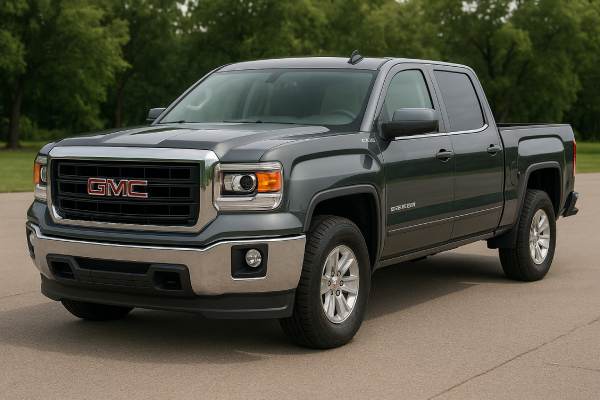
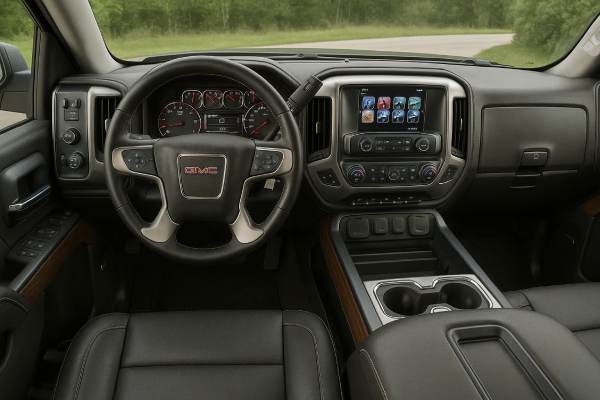
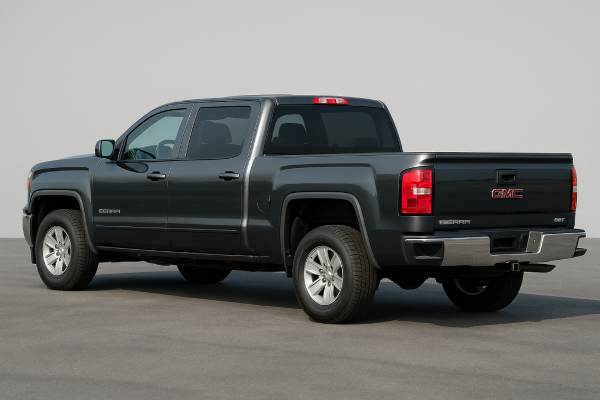
If you are looking at a 2014–2018 GMC Sierra 1500 with the L83 5.3-litre V8 and rear-wheel drive, you are shopping one of the core half-ton work and family trucks of the last decade. This generation, built on the GMTK2XX platform, introduced EcoTec3 engines with direct injection, cylinder deactivation, and a much more refined cabin than its predecessor.
In rear-drive form, the 5.3 V8 strikes a useful balance: strong torque for towing and highway merging, decent real-world fuel economy for a full-size truck, and relatively simple, proven mechanicals underneath. At the same time, these trucks are now old enough that maintenance history, rust, and a few known weak points matter more than brochure numbers. This guide walks through specs, capability, safety, reliability, and what to look for so you can decide whether a Sierra 1500 L83 RWD fits your budget, workload, and expectations.
Fast Facts
- Strong 5.3L L83 V8 (355 hp, 383 lb-ft) with direct injection and cylinder deactivation; respectable fuel economy for a gas half-ton when driven sensibly.
- Quiet, comfortable cabin and solid tow ratings (around 9,000–9,800 lb when properly equipped with the right axle ratio and tow package).
- Known issues include AFM lifter problems, 6-speed/8-speed torque-converter shudder, and corrosion in harsh climates—maintenance records are important.
- Recall history covers air-bag module software, electric power steering, seat-belt tensioner cables, and seat track welds; VIN checks are essential.
- Typical service rhythm: engine oil and filter every 7,500 mi / 12,000 km or 12 months (shorter if heavy towing); coolant every 5 years/150,000 mi (240,000 km) with Dex-Cool, if not already renewed.
Quick navigation
- GMC Sierra 1500 L83 Overview
- GMC Sierra 5.3 Specs and Data
- Trims, Equipment, and Safety Tech
- Reliability, Known Issues, and Fixes
- Maintenance Schedule and Buying Tips
- Driving Feel and Performance
- Sierra 1500 Versus Key Rivals
GMC Sierra 1500 L83 Overview
For 2014, GMC launched an all-new Sierra 1500 on the GMTK2XX platform with three EcoTec3 engines, including the L83 5.3-litre V8. This engine became the volume choice, combining traditional small-block V8 character with direct injection, variable valve timing, and Active Fuel Management (AFM) cylinder deactivation. In rear-wheel-drive form, it suits owners who mainly tow and haul on-road, live in warmer climates, or simply prefer a simpler driveline than 4×4.
Across 2014–2018, you could pair the 5.3 with several body styles (regular, double/extended, and crew cab) and box lengths. The common configuration many buyers seek is a 2WD crew cab short-box, which balances manoeuvrability with bed volume and cabin space. Wheelbases range roughly from 119 to over 153 inches, with overall length up to about 239 inches depending on cab and box.
Early trucks (2014–2015) use the 6L80 six-speed automatic transmission. From 2016 onward, some higher-trim 5.3-litre trucks gained the 8L90 eight-speed automatic, especially when ordered with Max Trailering or Denali packages. Both transmissions share a conventional hydraulic torque converter and electronic control, with tow/haul mode and grade-braking logic to manage downhill loads.
On the chassis side, the Sierra 1500 uses an independent front suspension with coil-over shocks and a traditional solid rear axle with multi-leaf springs. Electric power steering, four-wheel disc brakes, and stability control are standard. The cab structure and doors were designed to improve crash performance and to reduce noise, and GMC marketed the truck heavily on its quiet cabin and “Professional Grade” fit and finish.
For a shopper today, this generation’s main appeal is its combination of a still-modern cabin, strong V8, and relatively analogue feel compared with newer turbocharged or 10-speed-equipped trucks. The trade-off is age: most examples now have six-figure mileage, so condition and maintenance history matter more than trim badges.
GMC Sierra 5.3 Specs and Data
This section focuses on a typical 2014–2018 Sierra 1500 RWD with the L83 5.3-litre V8, crew cab short box, and 6L80 automatic. Exact numbers vary slightly by cab, axle ratio, and equipment, but the tables give you a realistic baseline.
Engine and Performance (L83 5.3L V8)
| Item | Specification |
|---|---|
| Engine code | L83 EcoTec3 V8 (often Flex Fuel capable) |
| Layout and valvetrain | 90° V8, cam-in-block (OHV), 2 valves per cylinder, variable valve timing |
| Displacement | 5.3 L (5,328 cc) |
| Bore × stroke | 96.0 mm × 92.0 mm (3.78 in × 3.62 in) |
| Compression ratio | 11.0:1 |
| Induction | Naturally aspirated |
| Fuel system | Direct fuel injection with Active Fuel Management (cylinder deactivation) |
| Max power | 355 hp (265 kW) @ 5,600 rpm (gasoline) |
| Max torque | 519 Nm (383 lb-ft) @ 4,100 rpm (gasoline) |
| Emissions/efficiency | Designed to meet contemporary US EPA/Tier 2 light-duty truck standards |
| Rated economy (typical 2WD 5.3) | Around 12–13 L/100 km combined (approx. 18–20 mpg US; 22–24 mpg UK) depending on axle ratio and configuration |
| Real-world highway (120 km/h / 75 mph) | Often 11–13 L/100 km (18–21 mpg US), depending on load, tyres, and axle ratio (3.08 vs 3.42) |
| Timing drive | Chain |
| Firing order | 1-8-7-2-6-5-4-3 (Gen V small-block family) |
Transmission and Driveline
| Item | Specification |
|---|---|
| Transmission | 6L80 6-speed automatic on most 2014–2018 5.3 RWD; 8L90 8-speed automatic on some 2016+ higher trims |
| 6L80 key ratios | 1st 4.03, 2nd 2.36, 3rd 1.53, 4th 1.15, 5th 0.85, 6th 0.67, Rev 3.06 |
| Final drive ratios | Commonly 3.08 or 3.42:1 on RWD 5.3 trucks (check glovebox RPO codes) |
| Drive type | Rear-wheel drive (RWD) |
| Differential | Open rear differential; G80 automatic locking rear differential available/standard on many SLE/SLT/Denali trims |
| Tow/haul mode | Yes, with grade-braking and revised shift schedules for heavy loads |
Chassis and Dimensions (typical crew cab 2WD)
| Item | Specification |
|---|---|
| Front suspension | Independent coil-over shock with aluminium control arms and stabiliser bar |
| Rear suspension | Solid axle with semi-elliptic leaf springs |
| Steering | Electric power-assisted rack-and-pinion |
| Brakes | 4-wheel disc with ABS; front and rear rotors around 13 in depending on trim |
| Tyres (common) | 255/70R17, 265/65R18, or 275/55R20 all-season, load-rated for half-ton duty |
| Length | Roughly 5,830 mm (229.5 in) for crew cab short box 2WD |
| Width (without mirrors) | Around 2,030 mm (80.0 in) |
| Height | About 1,880–1,900 mm (74–75 in), depending on tyres and suspension |
| Wheelbase | About 3,644 mm (143.5 in) for crew cab short box; longer for long-box variants |
| Curb weight | Approx. 2,250–2,400 kg (4,960–5,300 lb) depending on trim and options |
| Fuel tank | Typically around 98 L (26 US gal / about 21.6 UK gal) |
| Cargo volume (short box) | Roughly 1,510 L (53.4 ft³), SAE basis |
Performance and Capability
| Item | Typical value (5.3 RWD, properly equipped) |
|---|---|
| 0–100 km/h (0–62 mph) | Roughly 6.5–7.0 s, depending on cab, axle, and tyres |
| Top speed (limited) | Around 175 km/h (109 mph), electronically governed |
| Braking 100–0 km/h | In the region of 40–43 m (130–140 ft) with good tyres and brakes |
| Max towing (5.3 RWD) | Up to about 9,800 lb (4,445 kg) with Max Trailering and 3.42 axle ratio; lower for base gearing and lighter trims |
| Payload | Roughly 1,700–2,000 lb (770–910 kg), configuration dependent |
Fluids, Capacities, and Key Torques
(Always confirm by VIN, under-hood labels, and official service data before service.)
| System | Spec and capacity (approximate) |
|---|---|
| Engine oil | dexos1-approved 0W-20; about 8.0 L (8.5 US qt) including filter for 5.3 L83 |
| Engine coolant | Dex-Cool OAT coolant, 50/50 mix; around 15 L (16 qt) depending on cab and HVAC |
| ATF (6L80) | Dexron-VI; pan service typically 5–6 L, full dry fill around 11–12 L |
| Rear axle | SAE 75W-90 GL-5 synthetic; roughly 2–2.5 L depending on axle |
| A/C refrigerant | R-134a, often in the 700–750 g range (varies by cab and dual-zone HVAC) |
| Wheel lug nuts | Typically around 190 Nm (140 lb-ft); confirm in owner’s manual or service data |
Electrical and Ignition
| Item | Specification |
|---|---|
| Alternator | Around 150 A output on many L83 trims; higher on tow/HD-electrical packages |
| 12V battery | Group 48 or similar, around 70–80 Ah and roughly 700+ CCA |
| Spark plugs | Long-life iridium; typical gap about 1.0 mm (0.040 in); service interval around 160,000 km (100,000 mi) in normal use |
Safety and Driver Assistance
| Area | Key points |
|---|---|
| Crash ratings | Crew cab Sierra/Silverado 1500 of this era achieve strong ratings in major crash categories with a robust cab structure and effective restraints. |
| Front crash prevention | Optional forward collision warning/front crash prevention systems earn basic credit when fitted. |
| NHTSA | Many configurations achieve high star ratings; check specific year and cab on the NHTSA site. |
| ADAS | Depending on year/trim: forward collision alert, lane departure warning, rear vision camera, and front/rear park assist are available; later years see wider availability and some features becoming standard. |
Trims, Equipment, and Safety Tech
The 5.3-litre RWD Sierra 1500 could be ordered in several trims from 2014–2018: Base, SLE, SLT, and Denali. Each trim affects not only comfort features but also mechanical specification, tow rating, and available safety tech.
Trim and options overview (L83-capable RWD trucks)
- Base/“Sierra”
- Steel wheels, simpler interior, minimal chrome.
- 5.3 V8 available on many Regular/Double/Crew cabs, often bundled with towing or appearance packages.
- Fewer electronics can mean fewer potential long-term electrical issues.
- SLE
- Common “value” trim, usually with cloth bench or split bench, alloy wheels, and upgraded audio/infotainment.
- 5.3 is standard or a popular upgrade; G80 locking rear diff frequently fitted.
- Good balance of comfort and cost for owners who tow but do not need luxury touches.
- SLT
- Adds leather, more chrome, power seats, and often Bose audio and dual-zone climate.
- 5.3 widely fitted; higher tow ratings when paired with Max Trailering and 3.42 axle ratio.
- Larger wheels and extra equipment improve comfort and appearance but introduce more components to maintain.
- Denali
- Top trim with unique grille, interior finishes, and the highest levels of technology (navigation, advanced audio, front and rear park assist, power-sliding rear window).
- Late-run Denali RWD 5.3 trucks may be paired with the 8-speed automatic.
Quick identifiers
- Exterior: Denali grille and badges, chrome mirror caps, and 20-inch wheels distinguish Denali from SLE/SLT.
- Interior: Denali has distinctive seat stitching and wood-grain trim, whereas Base/SLE trucks keep a more utilitarian look.
- VIN/build codes: The glovebox SPID label lists engine (L83), axle ratio (e.g., GU6 for 3.42), and G80 locking diff presence.
Year-to-year highlights (2014–2018)
- 2014: Launch year. New cab, frame, EcoTec3 engines, and upgraded interiors. Backup cameras and certain safety features are less widespread.
- 2015: Incremental refinements and wider availability of safety options like forward collision alert and lane departure warning on higher trims.
- 2016: Infotainment update with available Apple CarPlay/Android Auto; some 5.3 trucks gain optional 8L90 8-speed automatic, especially in upscale trims.
- 2017–2018: Package reshuffling; active safety becomes more common, and the lineup is adjusted in preparation for the next-generation truck.
Safety ratings and what they mean
Crash-test organisations generally rate this generation of Sierra well in key frontal and side-impact tests, particularly for crew cabs. That reflects a strong cab structure and effective restraint systems. However, the LATCH child-seat anchor design scores poorly for ease-of-use, mainly because of access and location challenges, so expect to spend extra time installing child seats correctly.
NHTSA’s recall database lists multiple campaigns for 2014–2018 trucks involving items such as seat-belt tensioner cables, electric power steering, seat track welds, and air-bag module software. These are typically resolved through dealer software updates or component replacement and should be fully addressed on any truck you are considering.
Safety systems and ADAS
- Airbags: Front, side-impact, and side curtain airbags are standard.
- Structural notes: High-strength steel is used strategically in the cab to manage crash forces, which contributes to good test performance.
- Child-seat provisions: LATCH/ISOFIX lower anchors and top tether points are present in the rear, but anchor access can be tight.
- Electronic safety systems: Four-wheel ABS, traction control, and stability control (StabiliTrak) are standard. Depending on year and trim, you may also find:
- Forward collision alert
- Lane departure warning
- Rear vision camera
- Front and rear park assist
When front sensors or windshields are replaced, some ADAS systems may require calibration; this is especially important if the truck has had body repairs.
Reliability, Known Issues, and Fixes
Overall, the 2014–2018 Sierra 1500 has a generally positive reputation for durability, with many trucks comfortably surpassing 200,000 mi (320,000 km). At the same time, several recurring issues have emerged as the fleet has aged. Understanding these helps you separate a well-cared-for example from a potential money pit.
Common, moderate–high impact issues
- AFM lifter and cam wear (5.3 L83)
- Symptoms: Ticking noise from the valley area, misfires on specific cylinders, rough idle, and AFM-related fault codes.
- Likely cause: Wear or collapse of AFM lifters and, in severe cases, damage to the camshaft lobes.
- Remedy: Replacement of affected lifters and, if necessary, the camshaft. Many owners choose AFM-delete cam kits and updated tuning, but this must align with local emissions regulations.
- 6L80/8L90 torque-converter shudder and harsh shifts
- Symptoms: Shudder at light throttle in upper gears, surging, or shift flare.
- Likely cause: Fluid breakdown and torque-converter clutch issues.
- Remedy: Complete fluid exchange with the latest approved formulation, followed by torque-converter replacement if shudder persists. Transmission control module software updates can also improve shift quality.
- Front suspension and steering wear
- Symptoms: Clunks over bumps, looseness or wandering in the steering, uneven tyre wear.
- Likely cause: Worn ball joints, tie-rod ends, or intermediate steering shaft play.
- Remedy: Replace worn components with quality parts, perform a full alignment, and re-zero the steering angle sensor where required.
- Rust and corrosion (frame, brake lines, rockers)
- Symptoms: Flaking underbody coating, rusty brake lines, bubbling paint on rocker panels and wheel arches in salt-belt regions.
- Likely cause: Age, winter road salt, and lack of underbody washing.
- Remedy: Thorough inspection and early treatment of surface rust, replacement of heavily corroded brake lines, and serious consideration before buying any truck with frame perforation.
Occasional issues
- Electric power steering behaviour (recall-related)
- Symptoms: Brief loss of steering assist at low speeds, usually returning quickly.
- Likely cause: Software issues in the EPS control module, addressed by recalls and service campaigns.
- Remedy: Confirm recall completion through an official VIN check; dealers can reflash or replace the EPS module.
- Air-bag control module software
- Symptoms: Typically none in daily driving, but under certain conditions a crash could coincide with the module’s self-test, affecting deployment.
- Remedy: Dealer software updates to the sensing and diagnostic module (SDM) under recall. Always confirm that the truck has received the required updates.
- Ignition lock issues (early trucks)
- Symptoms: Key hard to turn or returning too far after starting, occasionally causing engine stall.
- Remedy: Replacement of the ignition lock housing under recall or service bulletin where applicable.
Less common but high-cost concerns
- Rear main seal and oil cooler leaks
- Symptoms: Oil around the rear of the engine, bellhousing, or lower block, and drips on the driveway.
- Remedy: Rear main seal replacement (which requires transmission removal) and renewal of oil cooler lines if they are weeping.
- Differential noise or failure under heavy towing
- Symptoms: Whine during cruise, clunks when shifting into gear, or metallic debris in differential oil.
- Remedy: Bearing and gear replacement or complete axle assembly replacement. Regular fluid changes with the correct synthetic gear oil help prevent issues.
Software and calibration points
- Engine and transmission control module updates can refine shift timing, improve throttle response, and address minor drivability complaints.
- Infotainment module updates improve Bluetooth stability and smartphone integration, especially on 2016+ trucks with Apple CarPlay/Android Auto.
- ADAS and EPS systems may receive updated calibrations as part of recall campaigns or service actions, so checking for the latest updates is worthwhile.
Pre-purchase checks
When inspecting a used Sierra 1500 L83 RWD:
- Run an official VIN recall check through the national safety agency or manufacturer website and request documentation of completed recall work.
- Review service records for consistent oil changes, coolant and brake fluid replacement, and at least one transmission and differential fluid service by 100,000 mi (160,000 km).
- Listen for engine noise on cold start and at warm idle, and perform a thorough road test for transmission shudder or harsh shifting.
- Inspect underneath for frame and brake-line corrosion, damp shocks, and leaks from the engine, transmission, and differential.
- Scan for fault codes with a capable diagnostic tool, paying attention to misfires, AFM-related codes, transmission faults, and ABS/ESC issues.
A truck that passes these checks and has a clean, consistent service history is far more likely to deliver trouble-free service than one with patchy records and unresolved recalls.
Maintenance Schedule and Buying Tips
Because these trucks are now 7–11 years old, a conservative, proactive maintenance plan is key to long-term reliability. The original manual intervals assume ideal conditions; real-world use, especially towing, idling, or short trips, often justifies shorter intervals.
Practical maintenance schedule (typical use)
- Engine oil and filter – Every 5,000–7,500 mi (8,000–12,000 km) or 12 months using dexos1-approved 0W-20. Shorten intervals if you tow, idle extensively, or drive in dusty conditions.
- Engine air filter – Inspect every 15,000 mi (24,000 km); replace around 30,000 mi (48,000 km) or sooner if dirty.
- Cabin air filter – Replace every 20,000–25,000 mi (32,000–40,000 km) or 2 years.
- Spark plugs – Long-life iridium plugs typically at 97,500–100,000 mi (160,000 km); use OEM-equivalent parts and confirm gap.
- Coolant (Dex-Cool) – First change usually at 5 years/150,000 mi (240,000 km), then every 5 years or 100,000 mi (160,000 km) thereafter.
- Automatic transmission fluid (6L80/8L90) – Aim for 50,000–60,000 mi (80,000–100,000 km) drain-and-fill or fluid exchange, especially if towing or if any shudder appears.
- Rear axle fluid – 50,000–60,000 mi (80,000–100,000 km) for light use; 30,000 mi (50,000 km) or less for frequent towing.
- Brake fluid – Flush every 3 years regardless of mileage to maintain corrosion resistance and pedal feel.
- Brake pads and rotors – Inspect at least yearly; replace pads before they are fully worn to avoid rotor damage.
- Serpentine/auxiliary belt – Inspect from 60,000 mi (100,000 km); replace if cracked, noisy, or glazed.
- Hoses and cooling hardware – Inspect annually for swelling, seepage, or crusted fittings; replace suspect parts early.
- Tyre rotation and alignment – Rotate every 6,000–8,000 mi (10,000–13,000 km); check alignment with any steering or suspension work or after a major pothole impact.
- 12 V battery – Load-test annually after 5 years; many original batteries in this generation are already due for replacement.
- Timing chain – No fixed interval; monitor for rattle, timing correlation codes, or excessive cam/crank variance in scan data.
Fluid specifications and torques
While exact specs can vary by market and update, a practical rule is to use OEM or equivalent fluids:
- dexos1-approved 0W-20 engine oil.
- Dex-Cool OAT coolant mixed 50/50 with distilled water unless conditions dictate otherwise.
- Dexron-VI for the 6L80 (and the appropriate newer fluid for 8-speed units as specified by GM).
- Full synthetic 75W-90 GL-5 gear oil in the rear differential, and friction-modified where required.
- Wheel lug nuts are typically torqued around 140 lb-ft (about 190 Nm). Always confirm with the owner’s manual or service data for your specific truck.
Buyer’s checklist
When evaluating a specific truck:
- Body and frame
- Inspect rocker panels, cab corners, and frame rails for bubbling paint, flaking coating, or perforation.
- Check the bed floor, crossmembers, and rear frame around the hitch and spare tyre cradle.
- Engine bay
- Look for oil seepage at the front cover, rear main area, and oil cooler lines.
- Check coolant colour and level; avoid trucks with sludged or contaminated coolant.
- Driveline
- On a road test, perform steady 45–65 mph (70–105 km/h) cruising and gentle accelerations to feel for torque-converter shudder.
- Listen for hums that rise with speed (differential or wheel bearings) versus sounds tied to engine rpm (engine or transmission).
- Electronics and interior
- Verify all power windows, locks, seats, and mirrors.
- Test the infotainment system, USB ports, Bluetooth, backup camera, and parking sensors.
- Confirm that no warning lights remain illuminated after start-up.
Recommended years and trims
- 2016–2018 SLE/SLT RWD 5.3 – Often the sweet spot for many buyers: updated infotainment, some safety upgrades, and slightly newer hardware.
- 2014–2015 trucks – Mechanically similar but more likely to have unaddressed recalls and higher rust exposure in salt-belt regions; condition varies more widely.
- Base vs luxury trims – For pure work use, a simpler Base or SLE with 5.3, G80 locking diff, and tow package is often easier and cheaper to own than a fully loaded Denali.
Taken together, a Sierra 1500 5.3 RWD that has had regular fluid changes, completed recalls, and minimal corrosion can be a very durable long-term truck.
Driving Feel and Performance
The L83-powered RWD Sierra 1500 feels like a modernised version of a traditional full-size pickup. The 5.3 V8 starts quietly, idles smoothly, and delivers a broad, easy torque curve. You rarely need to spin it to redline; everyday thrust arrives from around 1,500 rpm and builds strongly through the mid-range, which suits towing and highway passing.
Ride and handling
On standard 17- or 18-inch wheels, the suspension tuning is controlled without being punishing. The independent front suspension helps the truck stay composed over smaller bumps, while the rear leaf springs must juggle unladen comfort with payload capacity. With an empty bed, some hop over sharp expansion joints is normal, but overall ride comfort is good for a half-ton of this era.
Electric power steering is light at parking speeds and settles into a moderate weight on the highway. Steering feel is not sports-car sharp, but the truck tracks confidently and maintains straight-line stability at typical motorway speeds when tyres and alignment are in good shape.
Transmission behaviour
The 6L80 tends to shift early in day-to-day driving, keeping engine speeds low to save fuel. In normal mode it quickly reaches top gear and may occasionally hunt between gears on rolling terrain. Tow/haul mode sharpens the shift behaviour and holds lower gears longer on grades, improving engine braking with a trailer.
Where fitted, the 8L90 eight-speed gives closer spacing between gears and can keep the engine in its sweet spot more consistently. However, its more complex calibration and earlier fluid formulations have contributed to the shudder issues already mentioned, so maintenance and updated fluid are especially important.
Braking and noise
Brakes provide adequate stopping power for the truck’s weight, with a firm pedal feel and progressive response. Repeated hard stops, especially when towing, can induce some fade, so quality pads, rotors, and proper break-in are important for anyone who regularly carries heavy loads.
Noise suppression is one of this truck’s strengths. Double seals, improved insulation, and careful body design keep wind and road noise low. At highway speeds, engine noise recedes into the background unless you demand full throttle, making the Sierra a comfortable long-distance companion.
Real-world fuel economy
Owners of 2WD 5.3 trucks commonly report:
- City: 14–16 mpg US (17–20 mpg UK), or about 15–17 L/100 km.
- Highway (65–75 mph / 105–120 km/h): 18–21 mpg US (22–25 mpg UK), or roughly 11–13 L/100 km.
- Mixed driving: Around 17–19 mpg US (20–23 mpg UK), broadly in line with official combined ratings.
Larger wheels, all-terrain tyres, lift kits, roof racks, and aggressive driving can all push consumption significantly higher, and towing a moderate-to-heavy trailer can raise fuel use by 20–40% or more.
Towing and load behaviour
With a properly set up weight-distribution hitch and functional trailer brakes, a 5.3 RWD Sierra tows confidently within its rated limits. Oil and coolant temperatures remain stable under load, provided the cooling system is healthy and fluids are fresh. Payload (people, cargo, and tongue weight combined) often becomes the limiting factor before the headline tow rating, so it is critical to calculate real-world weights.
When towing near capacity, fuel economy can fall into the 8–11 mpg US (21–29 L/100 km) range depending on speed and terrain. Downhill grades are handled well with tow/haul mode, but you should still downshift proactively when necessary.
Traction is the main constraint of RWD in poor weather. In wet or snowy conditions, good tyres, a locking G80 differential, and 150–250 lb (70–115 kg) of ballast near the tailgate make a noticeable difference. If you live in severe winter climates or frequently launch boats on slick ramps, it may be worth comparing the RWD Sierra with 4×4 versions or rival trucks that better suit your conditions.
Sierra 1500 Versus Key Rivals
When comparing a 2014–2018 Sierra 1500 RWD L83 to similarly aged rivals such as the Ford F-150, Ram 1500, Toyota Tundra, and Nissan Titan, its strengths and compromises become clearer.
Against the Ford F-150 (aluminium-body generation)
Ford’s move to an aluminium body and widespread turbocharged EcoBoost V6 engines delivered weight savings and strong performance. Many F-150s achieve slightly better fuel economy in comparable use and offer an extremely broad range of trims and technology options. However, the turbo/DI combination adds complexity, and some buyers prefer the simpler, naturally aspirated V8 approach. The Sierra’s L83 offers traditional V8 character with modern efficiency, and its steel body simplifies collision repairs for some body shops.
Against the Ram 1500
The Ram 1500 is known for its coil-spring or optional air-spring rear suspension, which provides a notably smoother empty-bed ride. The available diesel option offers excellent long-distance economy but brings its own emissions-system maintenance considerations. The Sierra counters with a robust small-block V8, frame and axle hardware that many shops are familiar with, and a cabin that, especially in SLT and Denali trims, feels competitive for comfort and materials.
Ram’s rotary shifter and unique suspension may appeal to some drivers; others favour the Sierra’s more conventional layout and proven hardware.
Against Toyota Tundra and Nissan Titan
The Toyota Tundra’s 5.7-litre V8 has a reputation for longevity but consumes more fuel and is paired to older transmission technology in this era, resulting in higher running costs. The Nissan Titan feels more niche in many markets, and while it can be a solid truck, parts availability and aftermarket support are typically stronger for GM half-tons.
The Sierra usually offers a more modern interior than these rivals for the same age, plus a very deep pool of parts, tuning options, and accessories.
Where the Sierra 1500 L83 RWD shines
- Balanced tow and payload capability for typical half-ton workloads.
- Refined, quiet cabin suitable for both work and family duties.
- Widely used engine and transmission family with strong parts availability and repair knowledge.
- Strong passive safety performance and the availability of useful driver aids on many trims.
Where it lags
- Active safety and infotainment tech are now a generation behind, even on late-run trucks.
- AFM lifter and transmission shudder issues require careful screening and sometimes significant repairs.
- RWD traction limitations in snow or mud may be a deal-breaker in certain climates or use cases.
For many buyers, a well-maintained 2016–2018 Sierra 1500 RWD with the L83 engine represents an excellent compromise between purchase price, capability, comfort, and complexity—especially if you value a naturally aspirated V8 and a comfortable, quiet interior over cutting-edge digital features.
References
- 2014 GMC Sierra 1500 Specifications 2014 (Specifications)
- 2015 GMC Sierra 1500 2015 (Safety Rating)
- Vehicle Detail Search – 2014 GMC Sierra 1500 | NHTSA 2014 (Safety Rating and Recalls)
- 2015 CHEVROLET SILVERADO 1500 DOUBLE CAB SPECIFICATIONS 2014 (Service Spec Tables)
- 2014 GMC Sierra 1500 Owner’s Manual PDF (522 Pages) 2014 (Owner’s Manual)
Disclaimer
This article is for informational purposes only and is not a substitute for professional diagnosis, repair, or official service literature. Specifications, torque values, maintenance intervals, and procedures can vary by VIN, production date, market, and installed equipment. Always confirm details against the official owner’s manual, factory service information, and under-hood labels for your specific vehicle before performing any work.
If you found this guide useful, you are welcome to share it with other owners or shoppers on Facebook, X/Twitter, forums, or group chats. Sharing helps other drivers make informed decisions and supports the effort that goes into creating detailed resources like this.