
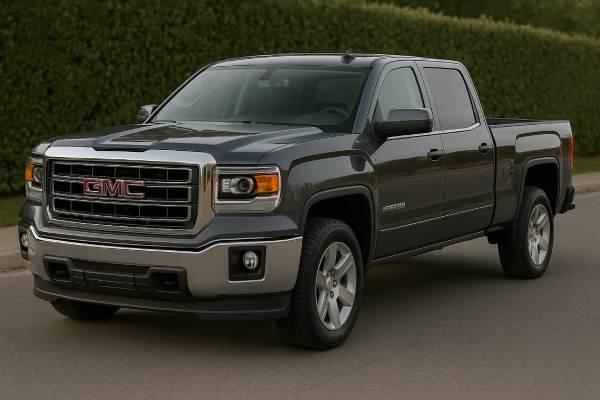
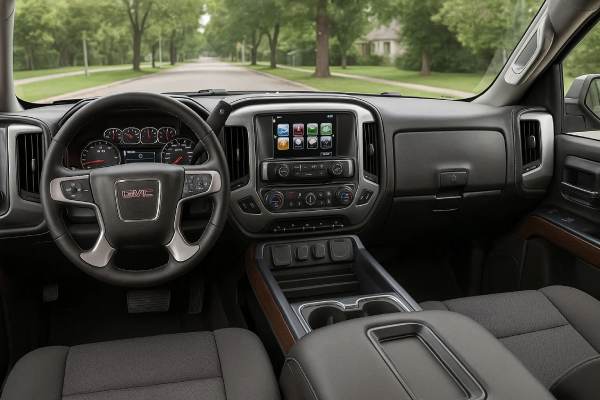
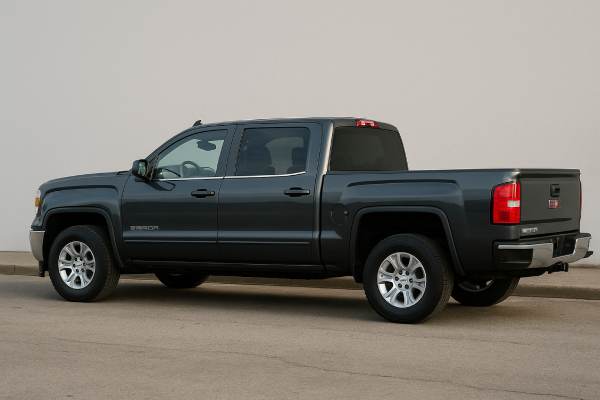
If you are looking at a 2014–2018 GMC Sierra 1500 RWD with the L86 6.2-litre V8, you are shopping the most powerful factory gas half-ton GMC offered in this generation. The GMTK2XX platform brought a stiffer frame, better crash performance, and a much quieter cabin than the outgoing truck, and the 6.2-litre EcoTec3 V8 turned the Sierra into a genuinely quick full-size pickup with serious towing capability.
In rear-wheel-drive form, the 6.2 Sierra suits owners who tow heavy on pavement, want strong highway performance, and live where 4×4 is nice to have but not essential. You get 420 hp, 460 lb-ft, and a broad torque curve, but you also take on higher fuel use and the need for careful maintenance of the transmission and rear axle. This guide walks through specs, performance, reliability, safety ratings, maintenance planning, and how the 6.2 RWD compares to rivals so you can decide whether this high-output Sierra is the right fit.
Top Highlights
- L86 6.2L V8 delivers 420 hp and 460 lb-ft, giving the Sierra 1500 RWD genuinely strong straight-line performance for a full-size truck.
- When properly equipped with Max Trailering, RWD 6.2 trucks can tow in roughly the 11,000–12,500 lb range, ideal for heavier campers and car haulers.
- Cabin refinement, Denali/SLT trims, and strong passive safety scores make these trucks comfortable long-distance machines.
- Common pain points include AFM lifter wear, transmission shudder, and corrosion in salt-belt trucks—service history matters more than trim level.
- Aim for engine oil and filter changes every 5,000–7,500 mi (8,000–12,000 km), and transmission, axle, and rear differential fluids roughly every 50,000–60,000 mi (80,000–100,000 km) for long-term durability.
Navigate this guide
- L86 Sierra 1500 RWD in context
- Engine specs and chassis data
- Trims, packages and safety equipment
- Reliability patterns and common problems
- Maintenance plan and used-buy guide
- On-road performance and efficiency
- Sierra 6.2 RWD versus competitors
L86 Sierra 1500 RWD in context
Within the 2014–2018 Sierra 1500 range, the L86 6.2-litre V8 sits at the top of the gas engine lineup. While the 5.3-litre L83 is the volume motor, the 6.2-litre is the “halo” powertrain, aimed at buyers who tow heavier trailers, value brisk acceleration, or simply want the most capable configuration GMC offered in a half-ton truck. In rear-wheel-drive form, it emphasises on-road performance and payload rather than off-road traction.
The L86 belongs to GM’s Gen V EcoTec3 small-block family. It is closely related to the LT1 used in the sports-car range of the era, sharing bore, stroke, and core architecture, but with truck-specific intake, exhaust, lubrication, and calibration tailored for towing and sustained load. Compression ratio is high (around 11.5:1), with direct injection, variable valve timing, and Active Fuel Management (AFM) cylinder deactivation to improve efficiency when cruising. Officially, output is 420 hp at 5,600 rpm and 460 lb-ft at 4,100 rpm, which was class-leading for a naturally aspirated light-duty truck when new.
In practice, you are most likely to see the 6.2 V8 in higher trims: Denali models, some richly optioned SLT trucks, and certain special packages focused on towing or appearance. It was not a common fleet engine, so used-market supply is narrower than for 5.3 trucks. As a result, clean 6.2 RWD Sierras often command a noticeable price premium.
The GMTK2XX platform underneath is shared with other Sierras and Silverados of the same years: fully boxed frame rails, improved torsional stiffness, and a cab engineered for better crash performance and noise isolation. Rear-wheel-drive examples carry a robust live rear axle on multi-leaf springs, an independent front suspension, and electric power steering. Compared with 4WD models, RWD 6.2 trucks are lighter and mechanically simpler, with fewer driveline components to maintain.
From an ownership perspective, this configuration suits drivers in milder climates, those who tow on pavement more than they venture off-road, and enthusiasts wanting “big V8” power in a practical package. The trade-offs are higher fuel consumption than a 5.3 or V6, as well as the need to prioritise cooling, tyres, and braking if you regularly use the full performance or tow near the limit.
Engine specs and chassis data
This section focuses on a typical 2014–2018 Sierra 1500 RWD with the L86 6.2-litre V8, crew cab, short box, and 6L80 automatic. Exact figures vary by cab, axle ratio, and package, but these tables provide a realistic technical picture.
Engine and Performance (Engine and Performance)
| Item | Specification |
|---|---|
| Engine code | L86 EcoTec3 V8 |
| Layout and valvetrain | 90° V8, aluminium block and heads, OHV (cam-in-block), 2 valves per cylinder, variable valve timing |
| Displacement | 6.2 L (6,162 cc) |
| Bore × stroke | 103.25 mm × 92.0 mm (4.06 in × 3.62 in) |
| Compression ratio | About 11.5:1 |
| Induction | Naturally aspirated |
| Fuel system | Direct fuel injection with AFM cylinder deactivation |
| Max power | 420 hp (313 kW) @ 5,600 rpm |
| Max torque | 460 lb-ft (623 Nm) @ 4,100 rpm |
| Recommended fuel | Premium recommended for best performance; can run on regular with reduced output |
| EPA economy, 2WD 6.2 | Around 15 mpg US city / 21 mpg US highway (about 15.7 / 11.2 L/100 km) for early 2014 2WD trucks |
| Real-world highway @ 120 km/h | Commonly in the 12–14 L/100 km range (17–20 mpg US) depending on gearing, load, and tyres |
| Timing drive | Chain |
| Firing order | 1-8-7-2-6-5-4-3 |
Transmission and Driveline
| Item | Specification |
|---|---|
| Transmission | 6L80 6-speed automatic for most 2014–2018 6.2 RWD trucks; 8L90 8-speed appears on some later high-trim trucks |
| 6L80 gear ratios | 1st 4.03, 2nd 2.36, 3rd 1.53, 4th 1.15, 5th 0.85, 6th 0.67, Reverse 3.06 |
| Final drive ratios | Commonly 3.23 or 3.42:1 in 6.2 RWD Max Trailering setups |
| Drive type | Rear-wheel drive (RWD) |
| Differential | Open rear diff on some trucks; G80 automatic locking differential on many tow-focused trims |
| Tow/haul mode | Yes, with grade-braking behaviour for downhill control when towing |
Chassis and Dimensions
| Item | Approximate specification (crew cab, short box, RWD) |
|---|---|
| Front suspension | Independent coil-over shock with aluminium control arms and stabiliser bar |
| Rear suspension | Solid axle with semi-elliptic leaf springs |
| Steering | Electric power-assisted rack-and-pinion |
| Brakes | 4-wheel disc with ABS; front and rear rotors around 13 in |
| Tyres | Typically 265/65R18, 275/55R20, or similar all-season/all-terrain tyres |
| Length | Around 5,830–5,840 mm (about 229.5–230 in) |
| Width (without mirrors) | About 2,030 mm (80.0 in) |
| Height | Roughly 1,880–1,900 mm (74–75 in) |
| Wheelbase | About 3,645 mm (143.5 in) for crew cab short box |
| Curb weight | Approximately 2,330–2,480 kg (5,140–5,470 lb), depending on trim |
| Fuel tank | Around 98 L (26 US gal, roughly 21.6 UK gal) |
| Cargo volume (short box) | Around 1,510 L (53.4 ft³), SAE basis |
Performance and Capability
| Item | Typical value (6.2 RWD, properly equipped) |
|---|---|
| 0–100 km/h (0–62 mph) | Roughly low-6-second range in independent testing, depending on spec |
| Top speed (limited) | Around 175 km/h (109 mph), electronically governed |
| Max towing (2WD 6.2) | Up to about 11,000–12,500 lb (4,990–5,670 kg) with Max Trailering, correct axle ratio, and the right cab/bed combination |
| Typical payload | Roughly 1,700–1,900 lb (770–860 kg) depending on configuration |
Fluids and Service Capacities (approximate)
Always verify exact values and specs against the owner’s manual or service documentation for your VIN.
| System | Specification and capacity |
|---|---|
| Engine oil | dexos1-approved 0W-20; about 8.0 L (8.5 US qt) including filter |
| Coolant | Dex-Cool OAT coolant, 50/50 mix; roughly 15 L (16 qt) |
| ATF (6L80) | Dexron-VI; pan service ~5–6 L; full fill ~11–12 L |
| Rear axle | Synthetic 75W-90 GL-5; around 2–2.5 L depending on axle |
| A/C refrigerant | R-134a; charge amount varies slightly by cab and HVAC |
Electrical and Safety Highlights
| Item | Details |
|---|---|
| Alternator | Typically around 150 A output; higher with certain tow/HD electrical packages |
| 12 V battery | Group 48 or similar, ~70–80 Ah and 700+ CCA |
| Spark plugs | Long-life iridium, ~0.040 in (1.0 mm) gap, 100,000 mi class interval |
| Safety ratings | Sierra/Silverado 1500 crew cabs of this era earn strong crash-test scores, including high ratings in major frontal and side-impact tests and five-star overall NHTSA ratings on many variants. |
Trims, packages and safety equipment
The 6.2-litre L86 was never a “base engine.” It was deliberately tied to upper trims and towing-focused packages, which shapes how these trucks appear on the used market.
Where the 6.2 RWD shows up
- Denali – The most common home for the 6.2. Denali models stack the strongest powertrain with luxury features: distinctive grille, chrome accents, high-grade interior materials, often 20-inch wheels, and the most advanced infotainment and driver aids available for the generation.
- SLT with Max Trailering – Some SLT RWD trucks, especially with the Max Trailering package, carry the 6.2. These are slightly less flashy than Denali but mechanically similar, focused on towing performance and capability.
- Special packages – In some markets, appearance or “All Terrain” style packages may be paired with the 6.2, but this is less common in RWD than in 4WD configurations.
Because the L86 required higher trims and option groups, 6.2 RWD Sierras usually come well equipped: power seats, dual-zone climate, upgraded audio, navigation or smartphone mirroring on later trucks, and a full range of interior convenience features. For buyers, that means you are rarely choosing between “basic 6.2” and “fully loaded 6.2”; most examples lean heavily toward the latter.
Mechanical and package differences
Compared with a 5.3 truck, a typical 6.2 RWD Sierra may add:
- Higher-capacity cooling and, in Max Trailering versions, additional transmission and engine oil cooling.
- Shorter (numerically higher) axle ratios such as 3.23 or 3.42 to exploit the extra torque.
- Larger wheels and tyres, sometimes with performance- or tow-oriented rubber.
- Integrated trailer brake controller, heavy-duty hitch, and wiring as part of a tow package.
These changes give the 6.2 RWD a different character: more eager acceleration, stronger hill-climb performance with a trailer, and often firmer ride quality thanks to wheel and tyre choices.
Safety ratings
Structurally, 6.2 RWD Sierras share their cab and frame with other GMTK2XX half-tons. Crew cab models achieve high ratings in moderate frontal overlap, side impact, and roof strength tests from major safety bodies, and they were among the first full-size pickups of their era to earn strong overall ratings from NHTSA.
Extended and regular cabs may carry slightly different ratings, especially in certain frontal tests, so if you are choosing between body styles with young passengers in mind, it is worth checking the specific cab configuration.
Airbags, restraints, and child-seat provisions
All 2014–2018 Sierras include front and side airbags plus head-protecting side curtains. Isofix/LATCH anchorages in the rear make child-seat installation possible, though access to anchors can be awkward and may require patience and careful routing of straps.
ADAS and driver aids
The availability of driver assistance systems depends heavily on year and trim:
- Early years (2014–2015) – Forward collision alert and lane departure warning are optional on high trims like SLT and Denali. Rear-view cameras and park assist become more common but are not universally standard.
- Mid-cycle (2016–2018) – Camera and sensor availability expands, and infotainment systems gain features like Apple CarPlay and Android Auto on many trims. Forward collision alert, lane departure warning, and front/rear park assist are more frequently fitted on Denali and SLT trucks.
Any time a 6.2 RWD Sierra has had front-end repairs or windshield replacement, forward collision and lane systems may need recalibration. Similarly, steering or suspension repairs can affect stability-control behaviour if the steering angle sensor is not properly reset.
Overall, 6.2 RWD trucks tend to be among the best-equipped Sierras of this era, combining high power with strong passive safety and a solid, if not cutting-edge, suite of driver aids.
Reliability patterns and common problems
The L86 6.2-litre Sierra 1500 RWD has a generally solid reputation, especially when maintained correctly, but it shares several issues with other EcoTec3 V8 trucks and adds some considerations related to its higher output.
Engine-related concerns
- AFM lifter and camshaft wear – Like the 5.3 L83, the L86 uses AFM lifters to enable cylinder deactivation. Over time, some engines develop collapsed lifters or unusual wear on AFM-related components. Symptoms include ticking or knocking from the valley area, persistent misfires on specific cylinders, rough idle, and associated fault codes. The fix typically involves replacing lifters and, in severe cases, the camshaft—an involved, costly repair. Some long-term owners opt for AFM-delete camshaft kits and updated tuning, but this must be weighed against emissions rules and inspection requirements in your area.
- Oil consumption and carbon build-up – Direct injection can contribute to intake valve deposits over high mileage, especially with short-trip use and extended oil-change intervals. Moderate oil consumption is tolerated by the engine design, but higher than expected usage may point to ring or PCV issues. Regular oil changes with quality dexos1 oil, occasional high-load highway runs, and, where appropriate, professional intake cleaning can help manage deposit formation.
- Cooling system and leaks – Age and heat cycles can lead to seepage at radiator end tanks, hoses, and oil cooler lines. In a 6.2 that tows regularly, catching minor leaks early is important because the engine is often working harder and generating more heat than a 5.3 in the same situation.
Transmission and driveline
- 6L80/8L90 shudder and harsh shifting – The 6.2’s torque can highlight weaknesses in transmission calibration or fluid condition. Drivers may feel a shudder at light throttle in higher gears, or experience flare and inconsistent shift quality. Updated fluid formulations and complete exchanges, plus software updates, can significantly improve behaviour. Neglected trucks may need torque-converter replacement or, in severe cases, transmission rebuilds.
- Rear differential stress – RWD 6.2 trucks with short axle ratios and frequent heavy towing put considerable load on the differential. Whining, clunks, or metal-laden fluid during changes can signal bearing or gear wear. Regular fluid changes with appropriate synthetic gear oil, especially in Max Trailering configurations, are important.
Chassis and corrosion
- Front suspension and steering wear – As mileage builds, ball joints, tie rods, and the intermediate steering shaft can loosen, creating clunks and vague steering. On a powerful truck like the 6.2 Sierra, that vague front end can be more noticeable because acceleration loads the chassis more strongly. Replacing worn components and performing quality alignments restore stability and reduce tyre wear.
- Rust in salt-belt regions – Frame rails, crossmembers, brake lines, and rocker panels remain vulnerable if the truck sees winter salt and no underbody washing. Because many 6.2 RWD trucks are weekend tow rigs or enthusiast vehicles, some owners store them, but others daily-drive them year-round, so actual corrosion levels vary widely.
Electronics and accessories
- Infotainment quirks – Early infotainment systems may suffer from occasional freezes or Bluetooth instability. Later software updates often improve this, but some trucks never receive them.
- Power equipment – Denali and SLT 6.2s pack heated/cooled seats, power steps, and other features that add comfort and potential failure points as they age. Replacement of these components can be expensive compared with more basic trims.
Recalls and service campaigns
The 6.2 RWD trucks fall under broader Sierra 1500 recalls for issues like electric power steering assist loss, airbag module software, seat-belt tensioner cables, and seat track weld quality. These remedies typically involve updated software or replacement of specific components and should be completed at no charge when performed under recall. Always run an official VIN check and review documentation for recall completion before purchase.
In short, a well-maintained L86 Sierra 1500 RWD can be very durable, but the combination of complex valvetrain technology, high output, and upscale equipment means that neglected examples can generate large repair bills. Screening for fluid service, driveline cleanliness, and evidence of timely repairs is essential.
Maintenance plan and used-buy guide
Because these trucks are now several model years old, a conservative maintenance approach is the best way to protect the 6.2-litre engine and driveline.
Practical maintenance schedule
For mixed use with some towing and highway driving:
- Engine oil and filter – Every 5,000–7,500 mi (8,000–12,000 km) or 12 months with dexos1-approved 0W-20, whichever comes first. If the truck tows often or makes many short trips, stay closer to 5,000 mi.
- Engine air filter – Inspect around 15,000 mi (24,000 km), replace at roughly 30,000 mi (48,000 km), or sooner in dusty use.
- Cabin air filter – Replace every 20,000–25,000 mi (32,000–40,000 km) or 2 years to keep HVAC performance strong.
- Spark plugs – Long-life iridium plugs roughly at 97,500–100,000 mi (160,000 km), using OEM-equivalent parts.
- Coolant – Dex-Cool typically first at 5 years/150,000 mi (240,000 km), then every 5 years or 100,000 mi (160,000 km).
- Automatic transmission fluid – For 6L80/8L90, aim for 50,000–60,000 mi (80,000–100,000 km) fluid service intervals; shorter if towing heavy.
- Rear axle fluid – 50,000–60,000 mi (80,000–100,000 km) for general use; 30,000 mi (50,000 km) or less for frequent towing.
- Brake fluid – Flush every 3 years regardless of mileage.
- Brake pads/rotors – Inspect annually; prioritise quality pads and rotors on 6.2 trucks that see heavy towing or spirited driving.
- Serpentine belt and hoses – Inspect from 60,000 mi (100,000 km) and yearly thereafter.
- Tyres, alignment, and suspension – Rotate every 6,000–8,000 mi (10,000–13,000 km); check alignment after any suspension work or when you notice uneven wear or pull.
- 12 V battery – Load-test yearly after 5 years; replace at the first sign of weakness to avoid no-starts.
- Timing chain – No scheduled interval, but listen for rattles at start-up and watch for timing correlation codes; address promptly if they appear.
Fluid and torque considerations
Use fluids that meet or exceed GM specifications and pay attention to:
- Engine oil quality – Good oil and sensible intervals reduce AFM lifter and timing-chain stress.
- Transmission fluid – Correct Dexron specification (or later superseding fluid for 8-speed units) is essential for avoiding converter shudder.
- Gear oils – Use appropriate synthetic 75W-90 in differentials; add limited-slip additive only where required.
- Wheel lug torque – Typical torque is around 140 lb-ft (about 190 Nm), but confirm with official data for your truck.
Used-buy inspection checklist
When shopping for a 6.2 RWD Sierra 1500:
- Verify it is truly an L86 truck
- Check the VIN and glovebox RPO label (look for L86, appropriate axle codes, and G80 if fitted).
- Look for modifications and tuning
- Many 6.2 trucks attract performance modifications: intake, exhaust, tunes, and suspension lifts. Quality work with supporting documentation can be positive; poorly executed mods are a red flag, particularly aggressive tunes on stock transmissions and axles.
- Inspect for leaks and rust
- Crawl underneath and inspect the oil pan, rear main area, transmission, and rear axle.
- Examine frame rails, crossmembers, and brake lines for corrosion, especially in rust-prone regions.
- Check driveline behaviour on a long test drive
- Cruise at 40–80 km/h (25–50 mph) to feel for transmission shudder.
- Perform several full-throttle merges (once warmed up) to judge shift quality and engine smoothness.
- Listen for differential whine or clunks when shifting into gear.
- Review service and recall records
- Look for evidence of regular oil, coolant, transmission, and differential services.
- Confirm recall completion using an official VIN search and request printouts or invoices from prior work.
Which years and trims to target
- 2016–2018 Denali/SLT 6.2 RWD – Often the sweet spot, with updated infotainment, more refined tuning, and slightly more time for issues to surface and be addressed under warranty.
- 2014–2015 6.2 trucks – Early adopters; can be excellent if maintained but are more likely to have missed updates or suffered early transmission issues if fluids were neglected.
A 6.2 RWD Sierra that has been cared for properly can provide many years of strong performance and heavy towing ability. A neglected example, particularly one used hard without adequate fluid service, can be expensive to bring back, so due diligence is key.
On-road performance and efficiency
The main reason to choose an L86 6.2 Sierra 1500 RWD over a 5.3 truck is how it drives. The power difference is more than just a number on paper; it noticeably changes the character of the truck.
Acceleration and power delivery
With 420 hp and 460 lb-ft, the 6.2 moves a crew cab Sierra with surprising urgency. Independent tests of early trucks recorded 0–60 mph times in the low six-second range for 2WD models, which is very quick for a full-size pickup. The engine pulls strongly from low rpm and feels particularly muscular from 2,000 to 4,500 rpm, where towing and highway passing happen. Throttle response is crisp, and AFM transitions are largely seamless in stock form.
The 6L80 six-speed shifts early in gentle driving to control fuel use, but with the 6.2’s torque there is little sense of strain even at low rpm. Under heavy throttle, the transmission kicks down eagerly and holds gears longer. Trucks equipped with the later 8L90 eight-speed benefit from closer ratios, keeping the engine closer to its sweet spot, though 8-speed trucks can be more sensitive to fluid condition and calibration.
Ride, handling, and braking
In RWD form, the Sierra feels slightly lighter and more agile than its 4WD counterparts. The independent front suspension and well-tuned rear leaf springs provide a controlled, slightly firm ride that becomes more settled with some weight in the bed. Large wheels and low-profile tyres on Denali models can sharpen steering response but may introduce extra impact harshness over broken pavement.
Electric power steering is light at low speeds for easy parking and gains reassuring weight at highway speeds. Straight-line stability is strong, and crosswind behaviour is predictable. Brakes are adequate for daily driving and towing within ratings, though frequent heavy-tow users should pay attention to pad and rotor quality and consider higher-performance components if they notice fade.
Noise and refinement
One of the strengths of the GMTK2XX platform is cabin quietness. Door seals, acoustic glass (on many high trims), and additional sound insulation keep wind and road noise low. The 6.2’s exhaust note is present but not overwhelming; at steady cruise it fades into the background, returning only when you dip into the throttle.
Fuel economy in the real world
The 6.2 uses more fuel than the 5.3, and RWD trucks see slightly better numbers than 4WD equivalents. Official ratings for early 2WD 6.2 Sierras are around 15 mpg city and 21 mpg highway, with 14/20 mpg for 4WD.
In everyday use, many owners of RWD 6.2 trucks report:
- City: roughly 13–15 mpg US (17–19 mpg UK), depending on driving style and tyre choice.
- Highway (65–75 mph / 105–120 km/h): often 18–20 mpg US (22–24 mpg UK) when stock, dropping with larger tyres, lifts, or heavy accessories.
- Mixed driving: around 16–18 mpg US (19–22 mpg UK) is common.
Towing a substantial trailer (e.g., 7,000–9,000 lb) can reduce economy into the 8–11 mpg US (21–29 L/100 km) range, which is typical for gas half-tons at these loads.
Overall, the 6.2 RWD Sierra offers a blend of strong acceleration, confident towing performance, and respectable refinement. If you value effortless power and do not mind paying for extra fuel, it is one of the most satisfying drivetrains in this generation of half-ton trucks.
Sierra 6.2 RWD versus competitors
When cross-shopping the Sierra 1500 RWD L86 with other 2014–2018 full-size pickups, you are usually considering:
- Ford F-150 5.0 V8 or 3.5 EcoBoost
- Ram 1500 5.7 Hemi
- Toyota Tundra 5.7
- Nissan Titan 5.6
Power and performance
The 6.2 Sierra’s 420 hp and 460 lb-ft made it one of the strongest gas half-ton engines of its time, particularly among naturally aspirated V8s. While Ford’s 3.5 EcoBoost can rival or surpass it in some tests, especially at higher altitudes or with aggressive tunes, the Sierra delivers its performance with a simpler, naturally aspirated layout. Compared with the Ram 5.7 and Tundra 5.7, the Sierra usually accelerates harder and tows more confidently when fully loaded, given the right axle and Max Trailering setup.
Fuel economy
The 6.2 uses more fuel than the Sierra’s 5.3 and more than some rival powertrains. Ford’s smaller turbo engines and Ram’s eight-speed 5.7 combinations can match or beat the 6.2’s economy in many scenarios. However, the difference shrinks when towing heavy, where all gas trucks suffer and where the Sierra’s extra displacement can keep it operating at lower, less stressed rpm.
Towing and payload
Max Trailering 6.2 RWD Sierras boast tow ratings that meet or exceed many rivals in the same era, provided they are properly configured. In practice, the limiting factor is often payload: occupants, cargo, and trailer tongue weight together must stay within GVWR and axle ratings. Here, the Sierra is competitive, though some F-150 configurations with lighter aluminium bodies can carry more. The key advantage for the 6.2 is how relaxed it feels near its rated towing capacity.
Ride, refinement, and interior
Ram 1500’s coil-spring rear end (and optional air suspension) often wins subjective ride-quality comparisons, especially unloaded. Ford’s and GM’s leaf-spring trucks feel slightly firmer but respond well with some bed weight. In terms of interior quality, high-trim Sierra 6.2 Denali models compare well with top F-150 and Ram trims of the time, offering quiet cabins and strong material quality.
Long-term ownership
All major competitors have known issues: Ford’s turbo engines bring complexity and some timing/chain concerns; Ram’s Hemi and transmissions have their own patterns of failures; Tundra’s 5.7 is famously durable but thirsty; Titan sometimes suffers from parts availability and weaker resale. The Sierra 6.2’s strengths are its widely supported small-block architecture, plentiful aftermarket, and broad repair knowledge in independent shops. Its weaknesses are AFM complexity, potential transmission shudder, and high fuel use.
If you want a half-ton that feels unstrained towing serious weight, accelerates strongly while remaining quiet and comfortable, and relies on a naturally aspirated V8 rather than forced induction, the GMC Sierra 1500 RWD L86 is a standout choice in this generation—provided you choose a well-maintained example and budget sensibly for fuel and preventive maintenance.
References
- 2014 GMC Sierra Owner Manual M 2014 (Owner’s Manual)
- 2015 GMC Sierra 1500 2015 (Safety Rating)
- 2014 GMC SIERRA 1500 4WD 4dr Crew Cab 2014 (Safety Rating)
- GM 6.2 Liter V8 EcoTec3 L86 Engine 2021 (Engine Technical Overview)
- GMC Sierra 1500 Towing & Trailering Guide 2020 (Towing Specifications)
Disclaimer
This article is for informational purposes only and is not a substitute for professional diagnosis, repair, or official service literature. Specifications, torque values, fluid types, and maintenance intervals can vary by VIN, production date, market, and installed equipment. Always verify details against the official owner’s manual, factory service information, technical bulletins, and under-hood labels for your specific vehicle before performing any work.
If you found this guide helpful, please consider sharing it with other owners or shoppers on Facebook, X/Twitter, forums, or group chats. Sharing helps other drivers make informed decisions and supports the effort involved in producing detailed, technically accurate resources like this.