
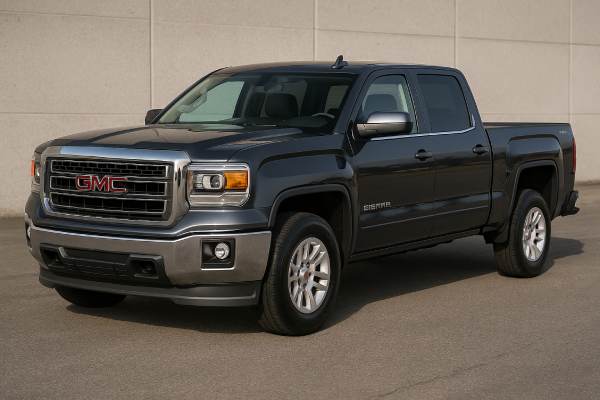
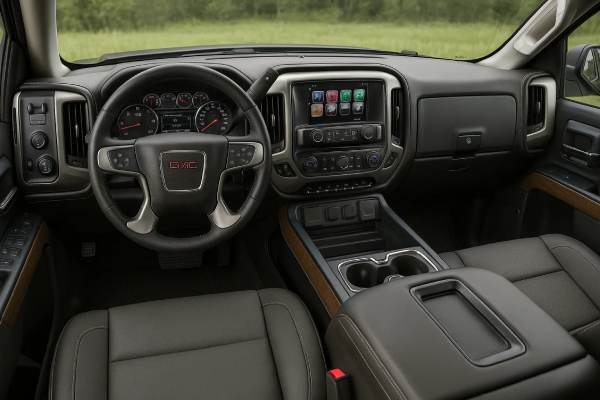
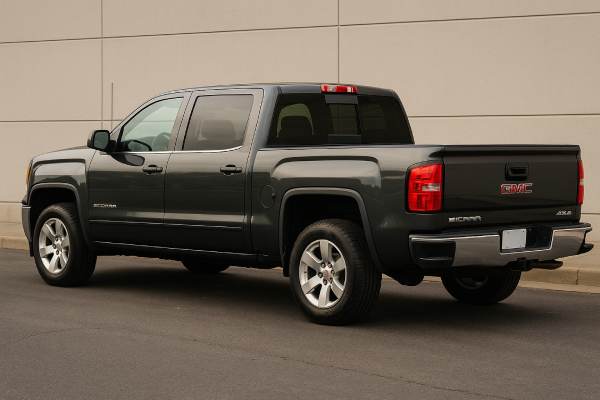
The 2014–2018 GMC Sierra 1500 4WD with the L86 6.2 litre V8 is the “max capability” configuration of the GMTK2XX platform. It combines a high-compression, direct-injected V8 with a robust 4×4 driveline, sophisticated traction controls, and a relatively refined cabin for a half-ton pickup. For many owners, this is the ideal blend of work ability and long-distance comfort: strong towing, confident highway passing, and usable off-road traction without stepping up to a heavy-duty truck.
This guide focuses specifically on the 4WD, 6.2 L86 Sierra 1500 built from 2014 to 2018. You will find the key specifications, towing and payload capabilities, safety ratings, known issues, and a realistic maintenance and buyer’s checklist. The aim is to help you decide if this truck fits your needs and to give current owners a clear roadmap to keep it reliable, whether it will mostly tow, commute, or handle mixed duty on job sites and forest roads.
Quick Specs and Notes
- Strong naturally aspirated 6.2 L V8 (about 420 hp and 460 lb-ft) gives confident towing and high-speed passing, even in hilly terrain.
- 4WD hardware, available Max Trailering package, and integrated trailer brake controller make it a very competent factory tow vehicle when properly equipped.
- Crew Cab models with 4WD earned top-tier crash scores from major safety bodies in this era.
- Like other EcoTec3 V8s, it is sensitive to oil quality and change intervals; neglect can accelerate lifter and timing-chain wear.
- Typical engine oil change interval is about 7,500 miles / 12,000 km or 12 months under normal use, shorter under heavy towing or severe service.
What’s inside
- GMC Sierra 6.2 4WD overview
- Technical specs and hardware
- Trim levels, options and safety tech
- Reliability issues and service history
- Maintenance schedule and buying tips
- Driving experience and off-road performance
- How this 6.2 4WD compares
GMC Sierra 6.2 4WD overview
The L86 6.2-litre EcoTec3 engine is the range-topping petrol V8 for the K2-generation Sierra 1500. In 4WD form, it targets buyers who need half-ton manoeuvrability but want near three-quarter-ton power and confident traction. The engine delivers about 420 hp at 5,600 rpm and 460 lb-ft of torque at roughly 4,100 rpm, using direct injection, variable valve timing, and cylinder deactivation to balance performance and reasonable economy for its size.
On the chassis side, the 4WD Sierra 6.2 uses an independent front suspension and solid rear axle with leaf springs. Most trucks pair the engine with a 6-speed automatic initially, moving to an 8-speed in later years, and a two-speed transfer case that offers 2HI, 4HI, 4LO, and often an Auto 4WD mode. This layout lets the truck cruise in rear-wheel drive when grip is good, then bring in the front axle when needed for snow, mud, or light off-road work.
Compared with the 5.3-litre trucks, 6.2-equipped Sierras frequently come with higher-content trims (SLT and Denali), larger brakes on some configurations, and heavy-duty cooling with the correct tow packages. Owners who tow mid-size to large travel trailers or equipment appreciate the stable combination of 4WD traction, an integrated trailer brake controller, and available higher-capacity hitches.
The trade-offs are straightforward: the 6.2 4WD is thirstier around town, more expensive to purchase and insure, and demands premium-grade fuel for best performance because of its high compression ratio. For drivers who mainly commute or tow small loads, the 5.3 can be more rational. But if you frequently haul near the top of half-ton limits, the 6.2 4WD configuration feels noticeably more relaxed and less stressed, especially in hot weather or at altitude.
Technical specs and hardware
This section focuses on the 2014–2018 Sierra 1500 4WD with the L86 6.2 EcoTec3 V8, primarily in Crew Cab form. Figures can vary slightly with cab, box length, axle ratio, and tow package, so always confirm against the specific VIN.
Engine and performance (L86 EcoTec3 V8)
| Item | Specification (typical L86 6.2) |
|---|---|
| Engine code | L86, Gen V EcoTec3 V8 |
| Layout | 90° V8, aluminium block and heads |
| Displacement | 6.2 L (approx. 6,162 cc) |
| Valvetrain | Cam-in-block pushrod with 2 valves/cyl, variable valve timing |
| Induction | Naturally aspirated |
| Fuel system | Direct injection (DI) |
| Compression ratio | Around 11.5 : 1 |
| Max power | About 420 hp @ 5,600 rpm |
| Max torque | About 460 lb-ft (≈ 624 Nm) @ 4,100 rpm |
| Cylinder deactivation | Active Fuel Management (4-cyl mode under light load) |
| Recommended fuel | Premium petrol (91+ octane) for full output |
| Rated economy (approx.) | Up to about 15 mpg city / 21 mpg highway (US), depending on year/axle and test cycle |
Transmission and driveline
| Item | Specification |
|---|---|
| Gearbox | 6-speed automatic (early years) or 8-speed automatic (later years) |
| Drive type | Part-time 4×4 with optional Auto 4WD |
| Transfer case | Two-speed, 4HI / 4LO, often with Auto mode |
| Axle ratios (typical) | 3.08, 3.42, or 3.73 depending on tow package and trim |
| Rear differential | Open or automatic locking rear diff; some tow/Max Trailering packages include higher-capacity axle hardware |
Chassis, dimensions and capacities
Values here are typical for a 4WD Crew Cab short box with the 6.2, and will vary slightly with configuration.
| Item | Approximate figure |
|---|---|
| Overall length | ≈ 5,830 mm (≈ 229.5 in) |
| Width (excluding mirrors) | ≈ 2,030 mm (≈ 80 in) |
| Height | ≈ 1,880 mm (≈ 74 in) |
| Wheelbase (Crew Cab short box) | ≈ 3,645 mm (≈ 143.5 in) |
| Ground clearance | Around 230 mm (≈ 9 in), depending on tyres and skid plates |
| Curb weight (4WD 6.2) | Roughly 2,450–2,550 kg (≈ 5,400–5,600 lb) depending on trim |
| GVWR | Often around 3,266 kg (7,200 lb) on 4WD models with 6.2 and tow packages |
| Fuel tank | ≈ 98 L (26 US gal) |
Suspension is independent with coil-over shocks at the front and leaf springs at the rear; heavy-duty trailering packages add firmer damping and larger anti-roll bars. Brakes are four-wheel discs with ABS and stability control.
Towing and payload (typical ranges)
Exact numbers depend on axle ratio, cab, bed, and whether the truck is equipped with the Max Trailering package.
| Capability | Approximate range (properly equipped 4WD 6.2) |
|---|---|
| Braked towing capacity | Up to roughly 11,700–12,000 lb in ideal configurations |
| Payload | Often 1,600–1,900 lb depending on trim and options |
| GCWR | Around the high 15,000s to 17,000 lb for many Max Trailering trucks |
Fluids, electrical and key service data
| System | Typical spec (check VIN-specific manual) |
|---|---|
| Engine oil | 0W-20, Dexos-approved; capacity ≈ 8.0 US qt with filter |
| Coolant | Dex-Cool-type, long-life OAT coolant |
| Transmission fluid | GM-spec ATF for 6-speed/8-speed (e.g., Dexron-VI / later approved fluids) |
| Differentials / transfer case | GM-approved gear oil or AutoTrak-type fluid as specified by axle/TC variant |
| Alternator | Often around 150 A output on many tow-oriented trims |
| 12 V battery | Group size and CCA vary; higher-output batteries on tow/off-road packages |
Safety hardware includes multiple airbags, stability and traction control, available hill descent control, and a suite of available driver-assist systems covered in the next section.
Trim levels, options and safety tech
From 2014 to 2018, the 6.2-litre 4WD Sierra 1500 was mostly tied to upper trims, especially SLT and Denali, though some markets saw other combinations. Understanding trims and option packages matters because they significantly change equipment, tow ratings, and safety/driver-assist coverage.
Trims and feature content
Common pairings for the 6.2 4WD include:
- SLT 4WD
Typically leather interior, dual-zone climate, power seats, larger alloy wheels, chrome exterior details, and a mid- to high-level infotainment system. The 6.2 is often bundled with heavy-duty cooling, an upgraded alternator, and tow-friendly gearing. - Denali 4WD
Flagship trim with Denali-specific grille and bumpers, high-grade leather, wood or metal trim, Bose audio, advanced driver aids (in later model years), and often 20-inch wheels. Denali trucks are a common place to find the 6.2L 4×4 combination.
Key option packages to look for:
- Max Trailering Package – higher-capacity hitch and receiver, larger rear axle or specific axle ratio, integrated trailer brake controller, and heavy-duty cooling; on the 6.2 4WD this package is what enables the highest tow ratings.
- Off-Road / Z71-type content (GMC All-Terrain / similar) – monotube shocks, skid plates, tow hooks, and all-terrain tyres, plus cosmetic tweaks. These packages improve rough-road durability but can reduce payload and tow capacity slightly.
Visual identifiers for a 6.2 4WD truck include “6.2L” badging in some markets, Denali or All-Terrain branding, and specific wheel designs. The VIN’s 8th digit “J” indicates the L86 engine.
Safety ratings
Crew Cab 4WD models in this generation performed well in crash testing, with many configurations achieving top ratings in frontal and side-impact tests and strong overall scores from major testing agencies. Double Cab models also fare well, though specific ratings can vary by year and configuration.
Head restraint and seat ratings are generally good, but headlight performance on many trims ranges from average to below average in modern evaluations. Trucks with projector or HID lamps, especially on higher trims and later years, may do better; however, owners frequently upgrade bulbs or housings to improve night visibility.
Driver-assistance and safety systems
Across the 2014–2018 run, driver-assist technology evolves noticeably:
- Standard core systems on most 6.2 4WD trims:
- ABS and electronic stability control
- Traction control
- Trailer sway control
- Hill-start assist (on many 4WD trucks)
- Multiple airbags, including side-curtain coverage for outboard occupants
- Available features by trim/year (often optional or Denali-only early on):
- Forward collision alert (visual and audible)
- Lane departure warning (later, some lane keep support)
- Front and rear park assist
- Rear-view camera (standard by later years on most trims)
- Integrated trailer brake controller with trailer gain display
For service, remember that collision repairs involving bumpers, windshields, or grilles can require recalibration of cameras and radar sensors. Alignments, ride-height changes, or significant suspension modifications can also affect ADAS performance; it is good practice to request a calibration check after such work.
Reliability issues and service history
The 6.2-litre L86 4WD Sierra is generally capable, but like any complex modern truck it has patterns of issues you should understand. Problems vary by use: frequent towing, short trips in cold climates, and lack of maintenance are the most common accelerants of wear.
Engine and fuel system
1. AFM lifter and valvetrain problems (occasional to common, medium–high cost)
- Symptoms: Misfire under light load, tick or tap from the top end, rough idle, or cylinder-specific misfire codes.
- Likely causes: Failure of Active Fuel Management (AFM) lifters, especially on cylinders that frequently deactivate; oil aeration or contamination can worsen this.
- Remedy: Replace affected lifters and often the camshaft; many owners also choose an updated lifter design or AFM-delete cam when out of warranty. Preventive strategies include using correct 0W-20 Dexos oil, following (or tightening) change intervals, and avoiding extended operation with low oil levels.
2. Carbon build-up on intake valves (occasional, medium cost)
Direct injection can allow deposits to form on intake valves over time, especially with short-trip use. Symptoms include rough idle, hesitation, or power loss. Walnut-shell blasting of intake valves or carefully applied solvent cleaning can restore performance. Good oil quality and regular highway runs help slow this process.
3. Cooling system and thermostat issues (occasional, low–medium cost)
Some owners report thermostats sticking open or closed, leading to slow warm-up or overheating. Radiator and hose leaks also appear with age. Watch coolant level trends and temperature behaviour; address any small leaks promptly to avoid knock, pre-ignition, or head-gasket stress.
Transmission, transfer case and 4×4 hardware
1. 6-speed / 8-speed shift feel and shudder (occasional, medium cost)
Harsh shifts, flare on upshifts, or torque-converter shudder can occur, particularly on 8-speed units when fluid is old or contaminated. Updated fluid types and reprogrammed shift logic often improve behaviour; in more severe cases a torque converter or internal repair may be needed.
2. Transfer case and front diff wear (occasional, medium cost)
On 4WD trucks that tow heavily or see frequent off-road use, neglected transfer-case and differential fluid changes can lead to bearing noise, vibration, or metal in the oil. Regular fluid service and avoiding long, high-speed runs in 4HI on grippy pavement are key.
3. 4×4 actuator and mode-selector faults (occasional, low cost)
Symptoms include flashing 4×4 indicator lights, inability to shift between modes, or the truck being stuck in one range. Causes range from failed transfer-case shift motors and front-axle actuators to wiring and switch faults. Diagnosis with a scan tool helps avoid unnecessary parts replacement.
Chassis, electronics and corrosion
- Front suspension wear: Ball joints, tie-rod ends, and control-arm bushings can wear early on trucks that tow heavy or run off-road often. Listen for clunks over bumps and feel for looseness in the steering.
- Steering-assist and column-related noises: Some K2 trucks experience intermittent assist issues or clunks; there are known updates and repair procedures in service documentation.
- Body and frame corrosion: In salt-belt regions, pay attention to frame sections near the rear axle, brake lines, cab-to-box joints, and rocker panels. Rusted brake or fuel lines are a safety concern and can be expensive to repair.
- Electrical / infotainment quirks: Touchscreen glitches, backup camera issues, and sensor faults appear in owner reports. Software updates and proper ground cleaning fix many of these.
Recalls, TSBs and extended coverage
Across 2014–2018 Sierra 1500s there have been multiple recalls and technical service bulletins (TSBs) touching on:
- Airbag and seat-belt-related updates
- Power steering assist loss on certain vehicles
- Software updates for stability control and instrument-cluster functions
- Issues with brake system components on some build ranges
To check whether a specific 6.2 4WD truck has had recall work completed, use the VIN on official recall lookup pages and ask a dealer to print the service history.
For a pre-purchase inspection, ask for:
- Complete service records (especially for oil, coolant, and transmission fluid)
- Documentation of any engine, transmission, or steering repairs
- A clean recall and TSB status report from a franchised dealer
Maintenance schedule and buying tips
A well-maintained L86 6.2 4WD Sierra can cover high mileage with few surprises. The key is timely fluid changes, attention to early warning signs, and realistic expectations about running costs for a powerful petrol V8.
Practical maintenance roadmap (typical intervals)
Always verify against the owner’s manual for your market and VIN, but the following schedule works well for most mixed-use trucks:
- Engine oil and filter – Every 7,500 miles / 12,000 km or 12 months, whichever comes first; reduce to 5,000 miles / 8,000 km if you tow frequently, idle a lot, or operate in dusty or very cold climates. Use Dexos-approved 0W-20.
- Engine air filter – Inspect at 15,000 miles / 24,000 km; replace around 30,000–45,000 miles depending on dust level.
- Cabin air filter – Replace roughly every 2 years or 20,000–25,000 miles if fitted.
- Spark plugs – Iridium plugs often go to around 97,500–100,000 miles under ideal conditions, but replacement around 80,000–100,000 miles is prudent.
- Coolant – Long-life coolant can go 5 years/150,000 miles in mild service; consider earlier change (for example 5–6 years or 100,000 miles) on hard-working trucks.
- Automatic transmission fluid – On frequently towed or worked trucks, change ATF and filter around 45,000–60,000 miles; on lightly used trucks, 60,000–75,000 miles is common.
- Transfer case fluid – Often 45,000–60,000 miles for mixed-use 4WD; more often if you tow in 4LO or drive off-road regularly.
- Front/rear differential oil – 45,000–60,000 miles, or earlier with heavy towing; trucks with locking diffs benefit from fresh fluid to preserve clutch packs.
- Brake fluid – Flush every 2–3 years regardless of mileage.
- Serpentine/aux belts and hoses – Inspect annually after 60,000 miles; replace proactively by 90,000–100,000 miles or at first signs of cracking/noise.
- Alignment and tyre rotation – Rotate tyres every 6,000–8,000 miles and align whenever tyre wear is uneven, or after suspension repairs.
- 12 V battery – Test yearly after year 4–5; replacement typically around 5–7 years in most climates.
For torque-sensitive tasks (wheel nuts, drain plugs, suspension components), refer to the service manual or a trusted data source. Do not rely on generic figures; confirm values for your specific truck before tightening.
Buyer’s guide: what to check
When evaluating a used 2014–2018 Sierra 1500 6.2 4WD:
- VIN and configuration
- Confirm L86 engine (8th VIN digit “J”) and 4WD driveline.
- Use the VIN to pull factory options, including axle ratio and tow/Max Trailering packages.
- Engine health
- Listen for cold-start ticks that persist when warm; brief tick on start can be normal, but persistent tapping may indicate lifter wear.
- Check for misfires, hesitation, rough idle, or check-engine lights.
- Look for oil leaks around the oil pan, valve covers, and front cover.
- Transmission and 4×4 system
- On a test drive, feel for smooth shifts, with no flare or shudder.
- Confirm that 2HI, Auto, 4HI and 4LO all engage and disengage without grinding or warning lights.
- Note any clunks or binding in tight parking maneuvers, which could indicate driveline wear.
- Chassis, frame and brakes
- Inspect frame rails, crossmembers, and rear spring hangers for rust, especially in salt-belt trucks.
- Look for weeping shocks, uneven tyre wear, or steering wander that suggest alignment or suspension issues.
- Check brake rotor condition and note any pulsing under firm stops.
- Interior, electronics and safety systems
- Test all power features, infotainment functions, and the backup camera.
- Confirm warning lights illuminate on key-on and then go out after start.
- On trucks with driver-assist systems, verify that forward collision and lane alerts can be toggled and that no ADAS warning messages are present.
Long-term durability outlook
With appropriate fluids and care, the L86 6.2 and its 4WD hardware can deliver a long service life. Trucks that see consistent maintenance, have had recalls and software updates completed, and have not been over-loaded or heavily modified tend to hold up well. The main risk factors are lifter issues in neglected engines, corrosion in harsh climates, and transmission wear in heavily worked trucks that never had fluid serviced.
For a long-term keeper, a lightly used, well-documented Denali or SLT with the 6.2 4WD, a sensible axle ratio, and Max Trailering (if you tow) is a strong choice.
Driving experience and off-road performance
The 6.2 4WD Sierra feels different from lower-output half-tons. Even at part throttle, the engine delivers strong low- to mid-range torque, so the truck moves briskly without downshifting constantly. On-ramps and passing manoeuvres are reassuring; with the right axle ratio and 8-speed automatic, it accelerates hard enough that most owners never feel that they “need more truck” for towing within half-ton limits.
Ride quality is typical body-on-frame pickup, firm but controlled. Empty, some trucks feel slightly bouncy over sharp bumps, especially with heavy-duty or off-road suspension packages. With a moderate load in the bed or a trailer on the hitch, the suspension settles nicely. Steering is light but reasonably accurate, and on-centre stability on the highway is good once the alignment and tyres are in shape.
Cabin noise is acceptable for a pickup of this era. Wind and road noise are present at motorway speeds, but conversation is easy, especially in Denali trims with better sound insulation. The V8 produces a muted but satisfying growl under load; AFM four-cylinder mode can introduce a subtle exhaust note change, which some owners address with updated exhaust systems or AFM-tuned mufflers.
Real-world fuel economy
In everyday mixed driving, most owners see:
- City use: roughly 13–15 mpg (US) depending on traffic, load, and driving style.
- Highway at 65–75 mph (105–120 km/h): typically 18–21 mpg (US) when unloaded, with the best results on flat routes at moderate speeds.
- Towing moderate travel trailers: fuel economy can drop into the 9–12 mpg (US) range, depending on trailer size, speed, and terrain.
These figures align fairly well with published ratings for comparable 6.2-litre 4WD trucks of the era when driven sensibly.
4WD behaviour, traction and off-road use
The part-time 4×4 system with Auto mode is designed for changing road conditions:
- 2HI: best for dry pavement, minimising wear and fuel use.
- Auto 4WD (if equipped): useful in mixed conditions (wet patches, light snow) where traction changes frequently. The system engages the front axle as needed.
- 4HI: for snow-covered or muddy roads where constant four-wheel traction is desired.
- 4LO: for slow, technical terrain, boat ramps, or steep grades with heavy loads.
With appropriate tyres, the Sierra 6.2 4WD handles dirt tracks, moderate ruts, and winter conditions confidently. Skid plates and tow hooks in off-road packages add security on rocky ground, while hill descent control (where fitted) helps on steep, loose descents. This is not a dedicated rock-crawler, but it is well-suited for access roads, hunting tracks, and construction sites.
Load and towing dynamics
Under tow, the 6.2’s broad torque band and multi-speed automatics give relaxed cruising. With a properly adjusted trailer brake controller and weight-distribution hitch (where appropriate), the truck feels stable up to realistic half-ton trailer weights. Important points:
- Long, steep grades can highlight cooling-system condition; ensure coolant and transmission fluids are fresh.
- Side-winds and poorly loaded trailers affect stability; correct tongue weight and trailer setup are as important as raw tow rating.
- Expect a notable fuel-economy penalty – often 30–50% – when towing large boxy campers at motorway speeds.
For many owners, the driving experience is what justifies choosing the 6.2 4WD version: it feels strong and unstrained in situations where smaller-engine half-tons work much harder.
How this 6.2 4WD compares
Within the 2014–2018 full-size pickup field, the Sierra 1500 6.2 4WD sits near the top for petrol-engine performance while offering competitive safety and comfort.
Versus other Sierra 1500 engines
- Versus the 5.3 V8:
The 5.3 is more common, cheaper to buy, and a bit more economical in real use. But when towing near the top of half-ton ranges or driving in hilly country, the 6.2 feels noticeably stronger and often requires fewer downshifts. Buyers who tow only light to moderate loads or prioritise running costs can be well served by the 5.3; those who routinely pull heavier trailers or want more effortless acceleration lean toward the 6.2. - Versus the 4.3 V6 or later small turbo engines (in other years):
The big V8 provides a more relaxed character and more towing margin, at the cost of higher fuel bills and purchase price.
Versus key rivals (same era)
- Chevrolet Silverado 1500 6.2 4WD – Mechanically almost identical, differing mainly in styling, trim names, and feature mixes. Your decision between the two often comes down to brand preference and specific truck condition.
- Ford F-150 3.5 EcoBoost / 5.0 V8 (similar years):
The turbocharged EcoBoost engines deliver strong torque and often slightly better towing performance on paper, with good high-altitude performance. However, they add turbo and high-pressure fuel-system complexity. The 5.0 Coyote V8 is a strong naturally aspirated rival. The Sierra’s 6.2 is competitive for outright performance and has the appeal of a large, high-compression NA V8. - Ram 1500 Hemi:
The Hemi 5.7 V8 competes closely but usually offers slightly less peak output than the 6.2 while providing good towing and a comfortable ride. Air-suspension options on some Rams improve unloaded ride but add complexity.
Strengths and compromises in context
Strengths:
- One of the strongest naturally aspirated half-ton petrol engines of its time, with excellent towing and passing capability.
- High safety scores for crew cab models and solid structural performance in crash tests.
- Comfortable, feature-rich cabins in SLT and Denali trims, often with advanced infotainment and driver-assist options for the era.
Compromises:
- Higher fuel consumption than smaller-displacement or diesel competitors, particularly in city driving and towing.
- Potential AFM lifter-related issues in neglected engines, plus the usual wear items (suspension, brakes, driveline) seen in hard-worked trucks.
- Headlight performance on many trims is only average; auxiliary lighting upgrades are common.
For buyers who value strong, naturally aspirated V8 power, a capable 4×4 system, and a well-equipped interior, the 2014–2018 GMC Sierra 1500 6.2 4WD remains a compelling choice, provided you choose a well-maintained example and budget appropriately for fuel and maintenance.
References
- 2014 GMC Sierra Owner Manual M 2013 (Owner’s Manual)
- Manuals and Guides | Vehicle Support | GMC 2025 (Owner’s Manual Portal)
- GM 6.2L EcoTec3 L86 V-8 Specs and Information 2022 (Technical Overview)
- Vehicle Detail Search – 2014 GMC SIERRA 1500 4WD 4dr Crew Cab | NHTSA 2014 (Safety Rating and Recalls)
- 2014 GMC Sierra 1500 Crew cab pickup 2014 (Safety Rating)
Disclaimer
This article is for informational purposes only and is not a substitute for professional diagnosis, repair, or safety advice. Specifications, torque values, service intervals, and repair procedures can vary by VIN, model year, market, and installed equipment. Always confirm data against the official service documentation and owner’s manual for your specific vehicle, and consult a qualified technician before performing maintenance or repairs.
If you found this guide useful, please consider sharing it with other owners or shoppers on social platforms such as Facebook or X/Twitter. It helps support the creation of more detailed, independent technical guides like this one.