
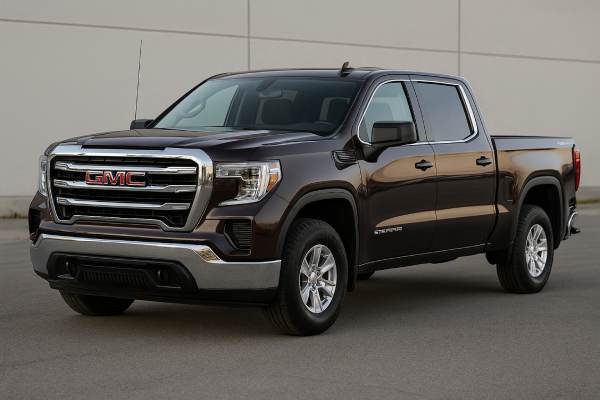
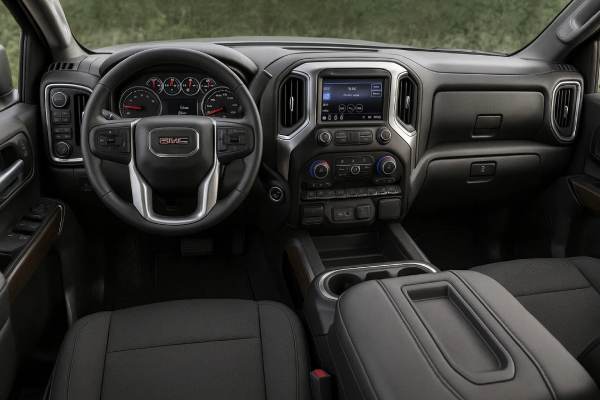
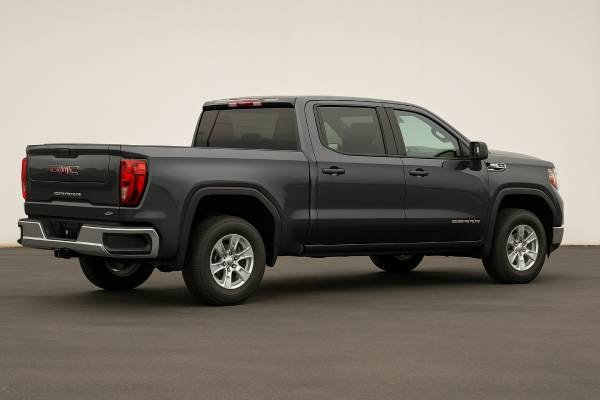
The 2019–2021 GMC Sierra 1500 4WD with the L84 5.3 litre V8 is a core configuration in the T1XX lineup. It combines a modern small-block V8, a two-speed Autotrac transfer case, and a stiffer, lighter chassis than the previous generation. For many owners, this is the “do almost everything” truck: it will tow, haul, commute, and handle winter and light off-road duty without feeling oversized or overcomplicated.
The L84 delivers 355 hp and 383 lb-ft, paired to 8- or 10-speed automatics depending on year and trim. In 4WD form, the Sierra carries extra weight and slightly lower fuel economy than the 2WD version, but it gains all-weather traction and better resale in many markets. This guide walks through the details that matter in real ownership: specs and capacities, trims and safety, reliability patterns, maintenance planning, and how the Sierra 1500 4WD stacks up against key rivals.
Top Highlights
- Full-time-capable 4WD with Autotrac two-speed transfer case gives strong traction in snow, mud, and steep boat ramps.
- 5.3 L L84 V8 and 10-speed automatic balance smooth power delivery with reasonable highway fuel use for a half-ton 4×4.
- Properly equipped 4WD Sierras can still tow close to 11,000 lb while keeping payload high enough for family and gear.
- Ownership caveat: more driveline components (front differential, CVs, transfer case) mean extra fluids and more to inspect over time.
- Plan engine oil and filter changes roughly every 7,500 miles or 12 months, adjusting for heavy towing and severe use.
Section overview
- GMC Sierra 1500 4WD L84 in detail
- Engine and specs for Sierra 4WD
- Sierra 1500 4×4 trims and safety
- Reliability issues and service actions
- Maintenance planning and buyer guidance
- On-road and off-road performance
- Sierra 4WD versus key rivals
GMC Sierra 1500 4WD L84 in detail
The T1XX-generation Sierra 1500 introduced for 2019 brought a lighter, stronger frame, more aluminium bodywork, and a more upscale design that better separates it from the Silverado. In 4WD form, the truck uses an Autotrac transfer case with 2HI, 4HI, 4LO and Auto modes (availability varies by trim and package). Auto mode effectively behaves like an on-demand all-wheel drive, engaging the front axle when rear slip is detected, which is especially useful in mixed conditions.
The L84 5.3 litre EcoTec3 V8 is the heart of this configuration. It is an all-aluminium small block with direct injection, variable valve timing, and Dynamic Fuel Management. Under light load, the engine can drop to fewer cylinders to save fuel, then smoothly return to full eight-cylinder operation when needed. For most drivers, these transitions are subtle, but they make a noticeable difference in highway consumption, especially in a 4×4 truck.
Across 2019–2021, the transmission pairing evolved. Early trucks commonly used the 8-speed automatic, while later and higher trims increasingly adopted a 10-speed joint-development gearbox that keeps the engine in its torque band more effectively. Axle ratios typically range from 3.23 to 3.42, with off-road and max-tow packages often using the shorter 3.42 for stronger pull off the line and better control when towing.
Compared with the 2WD Sierra, you get:
- Extra weight from the front differential, driveshafts, and transfer case, which slightly reduces payload and efficiency.
- Higher ground clearance in many trims and, in off-road packages, better approach/departure angles and underbody protection.
- Improved resale value and wider appeal in snow-belt and rural markets.
For owners who regularly see winter weather, unpaved roads, or boat ramps, the 4WD L84 configuration offers a balanced compromise between capability, running costs, and drivability.
Engine and specs for Sierra 4WD
This section summarises key technical details for 2019–2021 Sierra 1500 4WD trucks equipped with the L84 5.3L V8. Exact figures can vary with cab style, bed length, and packages, so always confirm against the specific VIN and door-jamb labels.
Engine and performance (5.3L L84 V8)
| Item | Specification |
|---|---|
| Engine code | L84 EcoTec3 V8 |
| Layout | 90° V8, OHV (pushrod), 2 valves per cylinder |
| Displacement | 5.3 L (5,328 cc) |
| Bore × stroke | 96.0 × 92.0 mm (3.78 × 3.62 in) |
| Compression ratio | 11.0:1 |
| Induction | Naturally aspirated |
| Fuel system | Direct injection |
| Cylinder deactivation | Dynamic Fuel Management (multiple firing patterns) |
| Maximum power | 355 hp (265 kW) @ ~5,600 rpm |
| Maximum torque | 383 lb-ft (519 Nm) @ ~4,100 rpm |
| Timing drive | Chain |
| Recommended oil | SAE 0W-20, dexos1 specification |
| Oil capacity | About 7.6 L (8.0 US qt) with filter |
Typical official fuel economy values for 4WD 5.3L trucks sit around 15–16 mpg US city and 20–22 mpg US highway, depending on cab, bed, and axle ratio. In metric terms, that’s roughly 14–16 L/100 km combined. Owners commonly report high-teens mpg on steady highway drives and a noticeable drop into the low teens when towing or driving hard off-road.
Transmission and 4×4 driveline
| Item | Specification |
|---|---|
| Transmission | 8-speed automatic (8L90 family) on many 2019–early 2020 trucks; 10-speed automatic (10L80/10L90 family) increasingly standard on later and higher trims |
| Transfer case | Autotrac two-speed electronic transfer case (mode set varies by trim; usually 2HI, 4HI, 4LO, Auto, and Neutral) |
| Drive type | Part-time 4×4 with automatic mode |
| Front axle | Independent front suspension with front differential and CV shafts |
| Rear axle | Solid axle with leaf springs; various ring-gear sizes depending on tow/off-road package |
| Typical axle ratios | 3.23:1 or 3.42:1 on 4WD L84 trucks |
The 4WD hardware adds roughly 80–120 kg (175–265 lb) over equivalent 2WD versions. That weight, plus added driveline drag, explains much of the small fuel-economy penalty between 2WD and 4WD Sierras.
Chassis, dimensions, and off-road geometry
Values below are typical for crew-cab short-bed 4WD trucks; regular and Double Cab models differ slightly.
| Item | Approximate figure |
|---|---|
| Wheelbase (crew cab, short bed) | ~3,745 mm (~147.5 in) |
| Overall length | ~5,885–5,890 mm (~231.7–232 in) |
| Width (without mirrors) | ~2,060 mm (~81.1 in) |
| Height | ~1,920–1,950 mm (~75.6–76.8 in), higher on off-road trims |
| Ground clearance | Around 225–260 mm (8.9–10.2 in), depending on package |
| Front suspension | Independent coil-over shock, aluminium control arms |
| Rear suspension | Solid axle with leaf springs |
| Brakes | Four-wheel disc with ABS (front and rear vented discs) |
| Turning circle | Roughly 14–14.5 m (46–48 ft), depending on wheelbase |
Off-road packages (such as AT4 and some Z71-style GMC packages) typically add:
- 2-inch suspension lift compared with standard 4WD trucks.
- Altered bumpers and tow hooks that improve approach angle.
- Skid plates for the transfer case, fuel tank, and under-engine area.
- All-terrain tyres that trade a bit of road quiet for better loose-surface traction.
Performance and capability
| Metric | Typical range (5.3L 4WD) |
|---|---|
| 0–60 mph | About 6.5–7.2 seconds, depending on configuration |
| 0–100 km/h | Around 7–7.5 seconds |
| 60–0 mph braking | Roughly 38–40 m (125–131 ft) |
| Max towing (properly configured) | Up to roughly 10,800–11,000 lb for certain Double/Crew Cab 4WD setups with max-tow equipment |
| Typical payload | Approximately 1,700–2,000 lb; off-road trims towards the lower end due to added equipment |
Key fluids and electrical
| System | Specification (typical) |
|---|---|
| Engine oil | 0W-20 dexos1; ~7.6 L with filter |
| Engine coolant | Long-life Dex-Cool-type; capacity in mid-teens of litres for V8 4WD trucks |
| Automatic transmission | Low-viscosity synthetic ATF specified for the 8- or 10-speed family |
| Transfer case fluid | GM transfer case fluid; small capacity, but critical for 4×4 longevity |
| Front and rear differential | GL-5 gear oil; some locking diffs may need friction modifiers |
| Alternator output | Around 170–220 A depending on trim and tow/off-road package |
| 12 V battery | Typically ~70–80 Ah, mid-700s cold cranking amps |
Exact fluid types and capacities are always best confirmed in the owner’s manual or service documentation for the specific year and drivetrain.
Sierra 1500 4×4 trims and safety
For 2019–2021, 4WD with the L84 engine could be paired with several trims, from work-ready to near-luxury. Availability varies by market, but the general structure is consistent.
Trims and options for 4WD L84 trucks
- Base/Pro (or similar work-truck trim)
Often ordered in 2WD, but many fleets and rural buyers specify 4WD for winter use. Expect vinyl or cloth seats, a simpler 7-inch infotainment unit, steel wheels, and fewer convenience features. The 5.3L V8 is usually optional over smaller gas engines. - SLE and Elevation
These are common starting points for private owners wanting 4WD. Features typically include alloy wheels, improved interior materials, larger touchscreen with smartphone integration, and better sound insulation. Elevation adds body-colour trim and blacked-out details. 4WD versions often include or offer off-road suspension and underbody shields. - SLT
Moves into leather seating, more power adjustment, and a wider suite of tech features. The 10-speed automatic is more common here when paired with the L84. 4WD SLT trucks can be configured either as comfortable tow rigs or as mild off-roaders, depending on option packages. - AT4 and Denali (where paired with 5.3L L84)
AT4 is the focused off-road trim, generally 4WD-only, with a factory lift, skid plates, and all-terrain tyres. Denali is the luxury flagship, usually paired with 4WD and richer interior appointments, advanced audio, and more driver aids. Some Denalis use the 6.2L V8 or diesel, but 5.3L 4WD combinations exist in certain markets and years.
Key mechanical differences as you climb the trim ladder include:
- Larger wheel and tyre packages.
- Off-road suspension and skid plates (AT4 and relevant packages).
- Electronically controlled locking rear differential availability.
- Heavier-duty cooling and alternators with trailering packages.
Quick visual tells:
- Elevation: monochrome paint schemes and black wheels.
- AT4: red tow hooks, dark trim, raised stance.
- Denali: signature grille, chrome exterior accents, upscale interior with real wood and metal details.
Safety ratings
Crash-test bodies generally evaluate the Silverado/Sierra twins together, so results for a crew-cab 4WD Silverado usually apply to an equivalent Sierra. In this generation, crew-cab models typically score well in:
- Moderate-overlap front, side-impact, and roof-strength tests.
- Head restraints and seat evaluations.
Small-overlap tests are more mixed: driver-side results are usually strong, while passenger-side ratings may be one step lower in some years due to structure and restraint performance. Headlight ratings vary widely by trim and headlamp type; base halogen or simple reflector LEDs often score worse than projector or advanced LED systems on higher trims.
Government crash ratings commonly show four or five stars overall for crew-cab 4WD models, but exact figures depend on body style and year. Because 4WD hardware adds weight and can change front impact dynamics slightly, always check safety ratings for the specific cab and drivetrain you are considering.
Safety systems and driver assistance
Standard safety hardware on most 4WD trims includes:
- Front airbags, seat-mounted side airbags, and side-curtain airbags.
- Four-wheel ABS with electronic brakeforce distribution.
- Stability and traction control systems tuned for truck and towing use.
- Tyre pressure monitoring, often with individual readouts.
Available driver-assistance systems include:
- Forward collision alert and automatic emergency braking.
- Lane keep assist with lane departure warning.
- Adaptive cruise control on higher trims or packages.
- Blind-spot monitoring with rear cross-traffic alert.
- Front and rear park assist, surround-view or multiple-angle camera systems.
These features are often grouped into “Driver Alert” packages. On 4WD trucks, calibration after windshield replacement, radar sensor replacement, or major collision repair is crucial, so budget for this if you are buying used and see signs of bodywork.
For families, the rear seats of Double and Crew Cabs include LATCH/ISOFIX anchor points for child seats, with top tether anchors behind the seat backs. As always, verify that your specific child seat fits and that anchors are accessible around any optional rear under-seat storage.
Reliability issues and service actions
The Sierra 1500 4WD L84 shares many reliability patterns with the 2WD version but adds a few four-wheel-drive-specific concerns. Overall, the platform has a generally solid reputation with some well-known weak spots.
Engine and valvetrain
Lifter and Dynamic Fuel Management issues – occasional to common, medium to high cost
Some owners report ticking noises, misfires, or loss of power, later traced to collapsed lifters or related valvetrain components on engines with cylinder deactivation. This typically appears at moderate to high mileage or after extended operation under severe conditions. Repairs often involve replacing lifters and associated hardware, which is labour intensive and expensive once warranty coverage ends.
Oil quality and consumption – occasional, moderate cost
Running the oil too long between changes, especially with frequent cold starts or towing, can lead to deposit formation in a direct-injection engine. A few owners note mild oil consumption over long intervals. The safest strategy is to service the oil when the Oil Life Monitor is around 20–30% remaining, or every 5,000–7,500 miles for mixed use, rather than pushing to absolute maximum intervals.
Transmission and 4×4 driveline
8-speed automatic shudder – occasional, moderate cost
In some trucks with the 8-speed automatic, owners describe a low-speed or light-throttle shudder that feels like driving over rumble strips. The usual remedy is updated fluid and software; persistent cases may require torque converter replacement. The 10-speed box generally sees fewer complaints of this specific behaviour but is not immune to issues if fluid changes are neglected.
Transfer case and front axle – occasional, mostly lower-cost if addressed early
Four-wheel-drive hardware introduces its own potential failure points:
- Transfer case fluid breakdown if service is neglected, leading to harsh engagement or unusual noises.
- Front differential fluid contamination or leakage at seals.
- CV joint or boot wear, especially on lifted trucks or those used off-road frequently.
Catching these issues early often limits repairs to fluid changes, seals, or boots rather than full component replacement.
Brakes, steering, and suspension
In normal use, the brake system is robust, but heavy towing, larger tyres, or mountain driving can accelerate pad and rotor wear. The electric power steering rack is generally reliable; however, heavy off-road use or impacts can shorten the life of tie-rod ends and ball joints.
On off-road oriented trims with all-terrain tyres and lifts, expect:
- Faster wear of suspension bushings.
- More frequent alignment needs after hard use.
- Slightly higher noise and vibration levels that can mask early signs of component wear.
Corrosion and frame protection
Like other recent GM full-size trucks, the Sierra 1500 4WD can show wax-coat peeling on frame rails and surface rust in salt-heavy regions. While this is often cosmetic if caught early, unchecked corrosion on the frame, suspension mounts, and brake lines can become a serious safety concern over many winters. Regular underbody washing and periodic rustproofing treatments are recommended if you live where roads are salted.
Recalls, TSBs, and extended coverage
During the 2019–2021 run, Sierra 1500s were subject to various recalls and technical bulletins, including:
- Brake system electronic control issues and pedal feel concerns on certain trucks.
- Seat belt fastener or retractor campaigns.
- Driveshaft, wheel, or tyre-related recalls where specific combinations could affect durability or instrumentation.
- Software updates for engine, transmission, or driver-assistance modules.
For any used 4WD Sierra, you should:
- Run the VIN through your local official recall database and GM’s recall checker.
- Ask a dealer to print the warranty and campaign history.
- Confirm that previous owners addressed any open campaigns, particularly brake and driveline updates.
Maintenance planning and buyer guidance
A 4WD Sierra 1500 has more components to look after than a comparable 2WD truck, but the maintenance schedule is still straightforward if you plan ahead. Below is a practical framework; always cross-check with the owner’s manual and adjust for severe use such as frequent towing, heavy loads, or extensive off-road driving.
Practical service schedule (4WD L84)
Every 7,500 miles or 12 months (or per Oil Life Monitor):
- Change engine oil and filter (0W-20 dexos1).
- Rotate tyres, including the spare if part of the rotation plan.
- Inspect brakes, steering components, suspension, and exhaust.
- Check all fluid levels, including engine coolant, brake fluid, power steering (if applicable), and washer fluid.
Every 15,000–22,500 miles (~24,000–36,000 km):
- Replace cabin air filter.
- Inspect engine air filter; replace if dirty.
- Check 4WD system operation in all modes (2HI, 4HI, 4LO, Auto).
Every 45,000 miles (~72,000 km):
- Replace engine air filter if not already changed.
- Inspect and, if fluid condition warrants, service automatic transmission fluid. For trucks that tow, many owners choose to change ATF by this point even if not strictly required.
- Inspect transfer case and differential fluid condition; change if discoloured or if the truck tows or off-roads regularly.
Every 90,000 miles (~145,000 km):
- Replace spark plugs.
- Perform a more complete transmission service (fluid and filter, as applicable).
- Replace front and rear differential oils and transfer case fluid.
- Flush brake fluid.
Around 150,000 miles (~240,000 km):
- Replace engine coolant following GM’s recommended coolant type and concentration.
- Inspect serpentine belt, tensioner, and idlers; replace if cracked, noisy, or worn.
Regularly, you should also:
- Check wheel alignment when new tyres are installed, after major pothole hits, or if the truck pulls to one side.
- Test the 12 V battery every few years and consider replacement at 5–7 years.
- On off-road trims, inspect skid plates, crossmembers, and lower control arms for impacts and rust.
Key fluid overview
- Engine oil: 0W-20 synthetic, dexos1-approved, roughly 8 qt with filter.
- Coolant: Dex-Cool-type extended-life coolant, typically mixed 50/50 with distilled water unless local conditions dictate otherwise.
- ATF: GM-specified low-viscosity fluid for the 8- or 10-speed, depending on model year.
- Transfer case: GM transfer case fluid; follow manual for capacity and change intervals, and shorten intervals for frequent 4LO use.
- Differentials: GL-5 gear oil; viscosity may change with climate (e.g., 75W-90 or 75W-85) and axle type.
Buyer’s guide for used 4WD Sierra 1500 L84
When shopping for a used 2019–2021 Sierra 1500 4WD with the 5.3L V8:
- Service records
Look for documented oil changes at sensible intervals, plus proof of transmission, transfer case, and differential services as mileage climbs. A 4×4 that has never had driveline fluids changed by 100,000 miles has likely been neglected. - 4WD system check
On a test drive, verify smooth engagement of Auto, 4HI, and 4LO on suitable surfaces. Listen for grinding, binding, or delayed engagement. A properly functioning system should engage cleanly, without loud clunks or excessive delay. - Underbody inspection
Check frame rails, crossmembers, skid plates, and suspension mounting points for rust, scrapes, and bent components. Off-road use is fine when parts are maintained; bent or heavily scraped underbody hardware suggests hard impacts. - Engine and transmission behaviour
From a cold start, listen for persistent valvetrain tick or knocks. During the drive, feel for 8-speed shudder or harshness when shifting. The 10-speed should generally be smooth, with only mild firmness in tow/haul mode. - Tyres and wheels
Uneven tyre wear may indicate alignment issues, worn suspension or steering parts, or past accident damage. All-terrain tyres are common on 4WD trucks, but mismatched sets or extreme mud tyres can hide noise and vibration. - Trim and equipment choice
For most buyers, a mid-trim 4WD truck (SLE, Elevation, or SLT) with tow package and either the 8- or 10-speed is a smart balance. AT4 offers great off-road capability but sacrifices some payload and fuel economy; Denali emphasises comfort over rugged use.
If you prioritise long-term durability, a gently used Sierra 1500 4WD that has lived in a mild climate, has documented fluid changes, and shows minimal underbody corrosion or off-road damage is an excellent candidate.
On-road and off-road performance
Everyday driving impressions
On paved roads, the Sierra 1500 4WD L84 feels composed and confident. The independent front suspension and well-tuned rear leaf springs give a firm but controlled ride. Unladen, the rear can be a little busy over sharp bumps, as with most pickups, but a moderate load in the bed smooths things out nicely.
The steering is light at low speeds and gains weight on the highway. Straight-line stability is strong, and the truck tracks well even in crosswinds. Cabin noise is competitive for the class; tyre choice plays a major role, with aggressive all-terrain tyres adding more hum and some vibration compared with highway-terrain rubber.
Braking performance is solid, although some drivers describe the pedal as slightly soft on initial application. Under repeated stops, such as descending a long grade with a trailer, proper use of tow/haul mode and downshifts helps keep braking temperatures in check.
Powertrain character
The L84 V8 offers a broad spread of torque, making the truck feel relaxed in daily driving. It pulls cleanly from low revs and delivers a satisfying surge when you press deeper into the throttle. Cylinder deactivation is largely seamless; you might notice a mild change in exhaust note or a subtle vibration, but it does not significantly affect drivability when working correctly.
The 8-speed automatic is competent but can occasionally hunt between gears at light throttle or feel hesitant to downshift. Updated calibrations and fluid help, but some owners still prefer the behaviour of the 10-speed, which generally keeps the engine in its sweet spot with smaller ratio steps and smoother transitions.
Real-world fuel use and towing
Expect real-world fuel economy for a 5.3L 4WD Sierra in these ranges:
- Light commuting and mixed driving: 15–17 mpg US (14–16 L/100 km).
- Steady highway at 65–70 mph: 18–20 mpg US (11.5–13 L/100 km), depending on tyres, load, and wind.
- Towing 5,000–8,000 lb: 9–13 mpg US (18–26 L/100 km), heavily influenced by trailer shape and speed.
Compared with a similar 2WD Sierra, the 4WD typically uses about 1 mpg more in the same conditions. Off-road packages and larger tyres add further penalty, especially at highway speeds.
With proper tow equipment and load distribution, the Sierra 1500 4WD feels stable and confident up to its rated capacities. The long wheelbase of crew-cab trucks helps stability, while the 4×4 hardware provides better traction on wet boat ramps or loose surfaces at campsites and job sites.
Off-road traction and control
While the Sierra 1500 4WD is not a hardcore rock crawler, it is very capable for:
- Snow and ice, especially with quality winter or all-terrain tyres.
- Muddy job sites and forest tracks.
- Steep gravel roads and boat ramps.
Key strengths off-road include:
- Stable, predictable behaviour in 4HI and 4LO.
- A useful Auto mode for changing conditions.
- Available skid plates and tow hooks on off-road packages.
Limitations come mainly from ground clearance, tyre choice, and front bumper design on non-AT4 trims. If you plan frequent off-road trips, an AT4 or similarly equipped truck with all-terrain tyres and underbody protection is worth seeking out.
Sierra 4WD versus key rivals
The 2019–2021 GMC Sierra 1500 4WD with the 5.3L L84 competes directly with 4×4 versions of the Chevrolet Silverado, Ford F-150, Ram 1500, and Toyota Tundra.
Versus Chevrolet Silverado 1500 4×4
Mechanically, the Sierra and Silverado share engines, transmissions, and 4×4 hardware. The main differences are:
- Styling and interior design: the Sierra presents a more upscale look with distinct grille and trim themes.
- Trim and feature packaging: GMC often positions equivalent trims slightly higher in perceived refinement.
- Resale and brand perception: in some regions, Sierra 4WD trucks hold value slightly better among buyers who associate GMC with a more professional or premium image.
If price is a top concern and you find a well-spec’d Silverado 4×4 at a lower cost, it may be the more economical choice. If you prefer the styling and branding of GMC, the Sierra justifies its typically small premium.
Versus Ford F-150 4×4
The F-150 offers a wide engine lineup, including turbocharged EcoBoost V6s and a 5.0L V8, plus an aluminium-intensive body that saves weight.
- Performance: Turbo V6 F-150s often out-accelerate and sometimes out-tow the Sierra 5.3, especially at altitude.
- Fuel economy: Lightly loaded, EcoBoost engines can match or beat the L84; under heavy towing, their advantage may shrink or reverse.
- Ride and interior: Both trucks offer comfortable cabins; many reviewers place the F-150 slightly ahead in infotainment and interior modernity for certain trims, while the Sierra competes strongly in higher trims like Denali.
Buyers wary of turbocharged complexity may see the naturally aspirated L84 as a simpler, long-term proposition, especially if they plan to keep the truck well past warranty.
Versus Ram 1500 4×4
Ram 1500 is renowned for:
- Very refined ride quality, thanks to rear coils or air suspension.
- High-quality interior materials and design.
The HEMI V8 is strong and characterful, with fuel economy in a similar ballpark to the L84. However, air suspension and more complex rear suspension designs add potential maintenance costs over time. In contrast, the Sierra’s more traditional leaf-spring rear end may be easier and cheaper to keep in top shape for heavy hauling and rough use.
Versus Toyota Tundra 4×4 (previous generation)
The older V8 Tundra is known for durability and simplicity but is often thirstier than the Sierra 5.3L and less refined in ride and interior quality. The Sierra offers more modern driver-assistance systems, better fuel economy, and more efficient powertrain options, while the Tundra trades on reputation for long-term robustness.
Where the Sierra 1500 4WD L84 fits best
The GMC Sierra 1500 4WD L84 stands out for:
- Balanced capability: strong towing and hauling for a gas half-ton 4×4 without extreme fuel consumption.
- Simple, proven V8 architecture with modern fuel-saving features.
- Attractive trims that cover work-truck, off-road, and luxury needs.
Its weaknesses are mainly:
- Known potential for lifter issues and 8-speed shudder on some trucks.
- Headlight performance that can lag top-rated rivals in certain trims.
- Extra costs over time from maintaining additional 4×4 hardware versus a 2WD truck.
For many buyers, especially those in snow-prone or rural areas, the added security and versatility of the 4WD system more than justify these trade-offs. With careful selection and maintenance, a 2019–2021 GMC Sierra 1500 4WD L84 can be a dependable, comfortable partner for workdays and weekends alike.
References
- 5.3L V-8 L84 Small-Block Engine 2023 (Technical Overview)
- 2019 GMC Trailering Guide 2019 (Towing Guide)
- 2019 GMC Sierra/Sierra Denali 1500 Owner’s Manual 2019 (Owner’s Manual)
- 2019 GMC Sierra 1500 Crew cab pickup 2019 (Safety Rating)
- Check for Recalls: Vehicle, Car Seat, Tire, Equipment 2025 (Recall Database)
Disclaimer
This article is provided for informational purposes only and does not replace professional diagnosis, repair, or official service literature. Specifications, fluid types and capacities, torque values, safety ratings, and maintenance intervals can vary by VIN, production date, market, and installed equipment. Always verify information against your vehicle’s owner’s manual, official workshop documentation, and current manufacturer or regulatory data before performing work or making purchasing decisions.
If you found this guide helpful, please consider sharing it with other owners or shoppers on platforms such as Facebook or X (Twitter). Your support helps more readers access accurate, practical information when choosing and maintaining their trucks.