
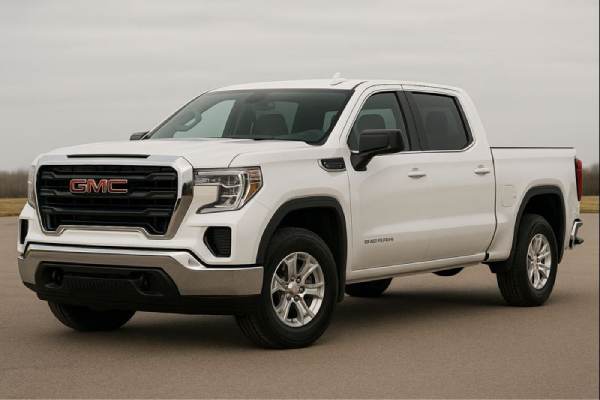
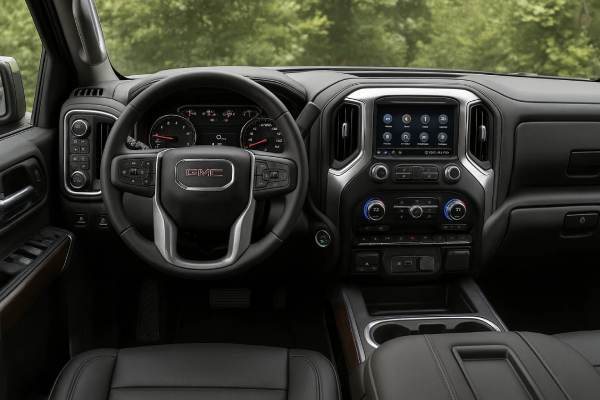
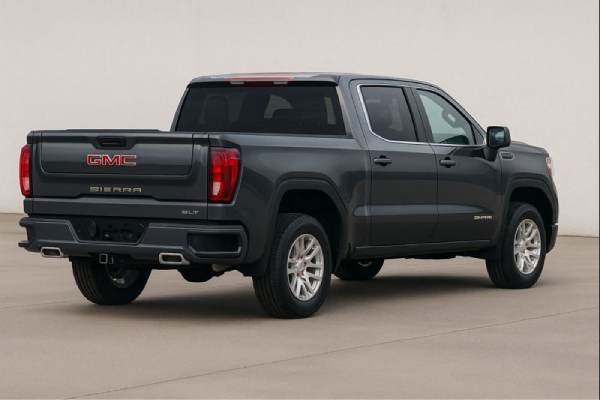
The GMC Sierra 1500 4WD with the L87 6.2 litre V8 is one of the most capable half-ton pickups of its generation. Built on the T1XX platform and paired mainly with a 10-speed automatic, this configuration blends big-displacement V8 power with a modern four-wheel-drive system, advanced driver assistance, and a more refined cabin than many work-oriented trucks. Owners choose it for confident towing near the top of half-ton ratings, strong acceleration even at altitude, and the assurance of 4WD traction for winter or off-pavement use.
Because the 6.2 was typically reserved for higher trims and specific packages, most of these trucks come well-equipped—often with features like advanced trailering aids, premium sound, and multi-mode 4×4 systems. At the same time, they inherit the same core engineering as other EcoTec3 V8 Sierras, including direct injection and cylinder deactivation, which brings both efficiency benefits and a few known reliability considerations. This guide walks through specs, ownership experience, and how the 6.2 4WD Sierra 1500 compares if you are shopping in this segment.
Essential Insights
- 6.2 L L87 EcoTec3 V8 delivers about 420 hp and 460 lb-ft, giving brisk 0–60 mph performance even in heavy 4WD crew-cab form.
- 4WD hardware, suitable gearing, and tow packages allow conventional towing up to roughly the 11,000–12,000 lb range in ideal configurations.
- More complex valvetrain and 4×4 systems mean lifter/DFM issues and transfer case or transmission fluid neglect are key ownership watchpoints.
- A practical service interval for mixed use is around 7,500 miles (12,000 km) or 12 months for oil and filter, with shorter intervals for frequent towing.
What’s inside
- GMC Sierra 6.2 4WD context
- Engine details and 4×4 specs
- 4WD trims, equipment and safety
- Durability, weak points and fixes
- Care schedule and buying tips
- Driving feel and real-world use
- How the 6.2 4WD stacks up
GMC Sierra 6.2 4WD context
The 2019–2021 GMC Sierra 1500 4WD with the L87 6.2 litre V8 sits at the top of the gasoline lineup. While smaller engines cater to fleet and value buyers, the 6.2 is aimed at owners who want maximum performance, upscale features, and serious towing capability without stepping into a heavy-duty truck. Most examples are crew-cab models with higher trims, so you will often see them with leather interiors, larger wheels, upgraded infotainment, and sophisticated trailering aids.
On the T1XX platform, GMC cut weight with more aluminium in the body and optimized the fully boxed frame, then paired it with modern suspension tuning. The 6.2 4WD configuration adds a two-speed transfer case, front differential, and 4×4 control electronics, giving selectable high-range 4×4 for slippery roads and low-range gearing for steep grades or off-road work. Compared with the rear-drive version, the 4WD truck carries more weight and parasitic losses, but it also offers much better traction in poor conditions and on unpaved terrain.
This configuration is particularly popular with:
- Owners who tow medium to heavy trailers—travel trailers, enclosed car haulers, boats—in varied weather.
- Drivers in snow-belt regions who want big V8 power and four-season capability.
- Buyers who want a genuinely quick truck but also need 4×4 to access cabins, worksites, or rural property.
Compared with the 5.3-litre Sierra 4WD, the 6.2 delivers noticeably stronger acceleration, especially when loaded or climbing. It maintains speed on long grades with fewer downshifts and more reserve torque. Fuel consumption is higher, but for owners who regularly use the power, the extra capability can be worth the added running cost.
The 6.2 4WD Sierra also competes directly with high-output V8 and turbocharged V6 configurations from Ford and Ram. Its value proposition is a large, naturally aspirated small-block V8 with advanced controls but relatively straightforward hardware, plus a four-wheel-drive system that will feel familiar to anyone who has owned GM trucks in the past. For shoppers who see the truck as both a tool and a long-term companion, that combination is attractive.
Engine details and 4×4 specs
This section summarizes the key technical data for the L87 6.2 V8, the typical transmissions and four-wheel-drive hardware, and representative dimensions and capacities for 2019–2021 Sierra 1500 4WD models.
Engine and performance: L87 6.2L EcoTec3 V8
| Item | Specification (approximate) |
|---|---|
| Engine code | L87 EcoTec3 V8 |
| Layout | 90° V8, pushrod OHV, 2 valves per cylinder |
| Displacement | 6.2 L (6,162 cc) |
| Bore × stroke | 103.25 × 92.0 mm (4.06 × 3.62 in) |
| Compression ratio | About 11.5:1 |
| Induction | Naturally aspirated |
| Fuel system | High-pressure direct injection |
| Cylinder deactivation | Dynamic Fuel Management, variable cylinder patterns |
| Maximum power | 420 hp around 5,600 rpm |
| Maximum torque | 460 lb-ft (~624 Nm) around 4,100 rpm |
| Recommended fuel | Regular unleaded acceptable, premium sometimes preferred for heavy loads |
| Recommended oil | SAE 0W-20, GM dexos1 |
| Oil capacity | Around 8.0 L (about 8.5 US qt) with filter |
Rated fuel consumption varies by cab, bed, and axle ratio, but typical 6.2 4WD crew-cab figures are:
- City: roughly 15 mpg US (about 15.7 L/100 km).
- Highway: around 20 mpg US (about 11.8 L/100 km).
- Combined: about 17 mpg US (around 13.8 L/100 km).
Real-world economy depends strongly on driving style, terrain, and trailer use.
Transmission, transfer case and driveline
Most 6.2-equipped 4WD Sierras use a 10-speed automatic transmission, with some early or specific units having 8-speed gearboxes. The 10-speed is the more common and desirable pairing.
| Item | Specification (typical) |
|---|---|
| Automatic transmission | 10-speed (10L80/10L90 family), electronic control |
| Drive type | Part-time or automatic 4WD, depending on transfer-case option |
| Transfer case | Two-speed unit with 2HI, 4HI, 4LO, and sometimes Auto 4WD mode |
| Axle ratios | Commonly 3.23:1 or 3.42:1 with 6.2; some tow-focused trucks may use 3.73:1 |
| Differentials | Front and rear open diffs, available automatic locking rear (G80) |
In 4HI, the truck runs in locked high-range four-wheel drive for slippery surfaces. In Auto 4WD (where fitted), the system engages the front axle as needed, which can be useful in mixed-traction conditions. 4LO provides extra torque and low-speed control off-road or when manoeuvring heavy trailers.
Chassis, dimensions and weights (crew-cab short-bed 4WD, representative)
Exact numbers vary, but many 6.2 4WD crew cabs fall near the following:
| Item | Approximate value |
|---|---|
| Wheelbase | Around 3,745 mm (~147.5 in) |
| Overall length | About 5,885–5,900 mm (~231.7–232.3 in) |
| Width (without mirrors) | Roughly 2,060 mm (~81.1 in) |
| Height | Around 1,900–1,950 mm (~74.8–76.8 in), higher on off-road trims |
| Curb weight | Often 4,800–5,100 lb depending on trim and equipment |
| GVWR | Typically around 7,000–7,100 lb |
| Fuel tank | About 24–26 US gal (roughly 90–98 L) |
Performance, towing and payload
| Metric | Typical range (6.2 4WD crew cab) |
|---|---|
| 0–60 mph | Approximately 5.7–6.1 seconds |
| 0–100 km/h | Roughly 6.2–6.6 seconds |
| 60–0 mph braking | Around 38–41 m (125–135 ft), tyre-dependent |
| Maximum conventional tow rating | Up to about 11,000–12,000 lb in select configurations |
| Typical payload | Commonly around 1,600–1,900 lb depending on options |
Tow ratings depend on cab, bed, axle ratio, trim, and trailering packages. Always verify numbers on the door jamb label and the official trailering guide for the exact truck.
Fluids, capacities and electrical (decision-level overview)
| System | Typical specification |
|---|---|
| Engine oil | 0W-20 synthetic dexos1, ~8.0 L (8.5 US qt) with filter |
| Engine coolant | Dex-Cool long-life coolant, mixed per manual; capacity in mid-teens of litres |
| Transmission fluid | GM-specified low-viscosity ATF for the 10-speed or 8-speed |
| Transfer case fluid | Specific GM-approved transfer-case fluid, small capacity; sensitive to neglect |
| Front and rear axles | GL-5 gear oil, viscosity by climate and axle spec |
| A/C refrigerant | R-134a or R-1234yf depending on market and build year |
| Alternator | Often 170–220 A, higher on tow or premium trims |
| 12 V battery | Around 70–80 Ah, with CCA typically in the 700–800 A range |
Exact values can change by VIN, so confirm with official documentation before servicing.
4WD trims, equipment and safety
The 6.2 4WD powertrain was not available on every Sierra 1500 trim; it was deliberately positioned as a premium and performance option. That means most trucks with this configuration come with better interior finishes, more technology, and more advanced safety and towing features than base models.
Trims commonly offering the 6.2 4WD
Availability differed by year and market, but typical patterns were:
- SLT 4WD
Frequently the entry point for the 6.2. SLT 4×4 trucks usually bring leather seating, dual-zone climate, upgraded infotainment with smartphone integration, and a broad selection of driver-assistance options. They tend to be more comfort and tow-focused than off-road oriented. - AT4 4WD
The off-road-leaning trim, pairing the 4WD system with a factory lift, all-terrain tyres, skid plates, and sometimes specialized shocks. When combined with the 6.2, AT4 gives you a truly strong off-road-capable truck that still rides well on pavement. - Denali 4WD
The luxury flagship. Denali 6.2 4WD trucks typically include premium audio, more elaborate exterior trim, advanced cameras, and the highest level of standard or available driver aids in the range. They are often chosen by buyers who want a premium SUV-like interior in a capable pickup.
Depending on year and package, the 6.2 might be standard or optional on these trims, and often requires specific groups such as a max trailering package or premium convenience package.
Mechanical and functional differences by trim
While the core engine and 4×4 system are shared, trims can differ in:
- Axle ratios and tow ratings – Tow-focused packages may combine the 6.2 with a higher numerical axle ratio and enhanced cooling to reach the upper tow ratings.
- Suspension tuning – AT4 gets off-road tuning and more ground clearance; Denali emphasises comfort with unique dampers and often larger wheels.
- Brakes and cooling – Certain packages add heavier-duty cooling, larger alternators, and additional hardware to handle sustained towing.
- Wheels and tyres – Street-oriented all-season tyres on SLT and Denali versus all-terrain patterns on AT4, which influence noise, range, and snow/off-road traction.
Safety ratings overview
Safety ratings for these trucks are assigned primarily by cab style and series, not by engine or driven wheels. Crew-cab Sierras from this generation generally do well in moderate-overlap frontal and side-impact testing, with solid structure performance and low injury measures. Small-overlap results vary more, with good to acceptable scores depending on the exact test and position.
Headlight ratings can be a weak point, especially on trims with basic reflector-type lamps. Some LED packages and certain trims score better than base lighting, but buyers concerned with night-time driving may want to prioritize vehicles with higher-rated headlamp systems or consider legal upgrades where permitted.
Government crash ratings for crew-cab half-ton pickups of this era typically land in the four-to-five-star range overall. When comparing specific trucks, focus on cab style, presence of side curtain airbags, and any year-to-year improvements rather than engine size alone.
Safety systems and ADAS equipment
Most 6.2 4WD Sierras come from the factory with an expanded safety feature set, such as:
- Front, side, and curtain airbags with rollover sensing.
- Electronic stability control, traction control, and trailer sway control.
- Tyre pressure monitoring with individual readouts.
Depending on trim and packages, driver-assistance features can include:
- Forward collision alert and automatic emergency braking.
- Lane keep assist with lane departure warning.
- Adaptive cruise control (mainly on higher trims and later model years).
- Blind-spot monitoring with rear cross-traffic alert.
- Front and rear parking sensors, plus multi-angle or surround-view camera systems.
These systems rely on cameras, radar, and ultrasonic sensors. After any collision repair, suspension modification, or windshield replacement, verifying ADAS calibration is crucial. When test-driving a used truck, make sure warning lights are off, all assistance systems can be turned on and off as expected, and interventions feel smooth and predictable.
For families, rear seating in Double and Crew Cab models offers LATCH/ISOFIX anchors and top tethers on specific positions. Space and access are generally good in the crew cab, which is typically preferred if you regularly carry rear passengers or rear-facing child seats.
Durability, weak points and fixes
Overall, the 6.2 4WD Sierra has a good durability record when maintained correctly, but like any complex modern truck, it has a handful of recurring issues owners should understand. It is helpful to think in terms of prevalence and severity.
Engine and valvetrain
Lifter and Dynamic Fuel Management issues (occasional to common, potential high cost)
Some L87 engines develop valvetrain tick or misfire related to cylinder-deactivation lifters. Symptoms can include:
- Persistent ticking that does not fade as the engine warms.
- Misfire codes on specific cylinders.
- Rough running at light load when cylinder deactivation is active.
Light, intermittent noise can be normal, but clearly abnormal tick plus misfire usually warrants inspection. Remedies range from updated lifters and related hardware to full bank replacement. Early diagnosis is important; continuing to drive with a failing lifter increases the risk of collateral damage and larger bills.
Carbon build-up and fuel-system sensitivity (occasional, medium cost)
As a direct-injection engine, the 6.2 can build deposits on intake valves over time, especially with predominantly short-trip driving. Mild build-up may cause rough cold starts or loss of smoothness; severe cases may call for professional cleaning. Using quality fuel, keeping up with oil changes, and periodically driving on longer trips at stable speeds helps reduce accumulation.
Transmission, transfer case and axles
8-speed shudder and 10-speed maintenance needs (occasional)
Where the 6.2 is paired with an older 8-speed automatic, some owners report torque-converter shudder under light throttle. Updated fluid and calibration often improve it; neglected units can require mechanical repair. The 10-speed is less commonly associated with shudder but still benefits from timely fluid changes, particularly on trucks that tow often.
Transfer case and front axle fluid neglect (occasional, medium severity)
Because these components are “out of sight, out of mind,” some owners delay fluid service far beyond recommended intervals. Symptoms of trouble include:
- Growling or whine at certain speeds in 4×4 modes.
- Difficulty engaging or disengaging 4LO.
- Fluid leaks from case or axle seals.
Regular fluid changes using the correct GM-approved fluids and checking for leaks can prevent expensive failures.
Cooling, brakes and chassis
The 6.2’s extra power can expose weaknesses in neglected cooling systems. Trucks that tow heavy loads in hot or hilly environments are especially sensitive. Warning signs include coolant smell, creeping temperatures under load, or visible staining around hose joints. Preventive coolant replacement, radiator cleaning, and inspection of hoses and clamps reduce the risk of overheating.
Brake systems are generally robust, but frequent heavy towing can accelerate pad and rotor wear. Any pulling, vibration, or unusual noises during braking should be investigated. Trucks that see winter use in heavily salted regions may also develop corrosion on brake lines or calipers; early treatment is cheaper than large-scale hard-line replacement.
Corrosion hotspots
Like other half-ton pickups, Sierra 1500s can suffer from:
- Surface rust on frame rails and crossmembers in harsh climates.
- Corrosion around rear wheel arches, bed seams, and underbody mounting points if not washed regularly.
Underbody rinsing after winter, periodic inspection, and, where appropriate, rust protection treatments can extend the life of the chassis.
Recalls, TSBs and special coverage
Specific recalls and Technical Service Bulletins can affect 2019–2021 Sierra 1500s for issues ranging from seat-belt components to brake hardware or software updates. For a used 6.2 4WD truck, it is important to:
- Run the VIN through the official recall database and confirm there are no open safety recalls.
- Ask a dealer for a printout of completed campaigns and special-coverage programs.
- Pay attention to any bulletins related to engine internals, transmission behaviour, or brake system performance.
Some issues are addressed by updated software or revised parts under warranty or goodwill programs, so a well-documented truck that has had campaigns completed is more reassuring than one with no recorded dealer visits.
Care schedule and buying tips
A disciplined maintenance routine and careful pre-purchase inspection are the best ways to enjoy long, trouble-free service from a 6.2 4WD Sierra 1500.
Practical maintenance schedule (L87 6.2 4WD)
The following intervals are a realistic baseline for mixed use. Adjust based on severe-duty guidelines if you tow, idle, or drive in dust or extreme temperatures frequently.
Every 7,500 miles or 12 months (or per Oil Life Monitor):
- Replace engine oil and filter with 0W-20 dexos1-approved oil.
- Rotate tyres; check pressures, including spare.
- Inspect brakes, steering joints, suspension bushings and shocks.
- Check fluid levels (coolant, brake, washer, axles, transfer case if accessible).
Every 15,000–22,500 miles (24,000–36,000 km):
- Replace cabin air filter.
- Inspect engine air filter; replace if dirty or at longer end of interval.
- Inspect serpentine belt and coolant hoses.
Every 45,000 miles (~72,000 km):
- Replace engine air filter if not already done.
- Check automatic transmission fluid condition; consider drain and refill, especially on trucks that tow or haul frequently.
- Inspect transfer case and front/rear axle fluids; refresh per severe-duty recommendations.
- Evaluate brake fluid and flush if discoloured.
Every 90,000 miles (~145,000 km):
- Replace spark plugs.
- Perform more complete transmission service (fluid and filter if applicable).
- Replace front and rear axle fluids.
- Flush brake fluid.
Around 150,000 miles (~240,000 km):
- Replace engine coolant with the correct Dex-Cool-type formulation.
- Replace serpentine belt and tensioner if not done earlier.
Regular alignment checks (especially after off-road use or hard impacts), 12 V battery testing starting around the five-year mark, and more frequent fluid changes under heavy towing are all sensible precautions.
Fluid specifications and key torque considerations (high level)
- Engine oil: 0W-20 dexos1 synthetic, about 8.0 L (8.5 US qt).
- Coolant: Long-life Dex-Cool-type; typical 50/50 mix with distilled water.
- Transmission fluid: GM-specified low-viscosity ATF matched to the specific 8- or 10-speed.
- Transfer case and axles: GM-approved fluids; using the wrong type can cause noise or premature wear.
- Wheel lug nuts: Commonly around 140 ft-lb (about 190 Nm), but always confirm for the specific wheel and model.
For any critical fastener or fluid capacity, official service information should be treated as the final authority.
Buyer’s guide: what to look for
When shopping for a used 2019–2021 Sierra 1500 4WD with the 6.2, consider the following checklist:
- Ownership and service history
Look for evidence of regular oil changes (around 7,500 miles or less), transmission and axle services by 60–90k miles, and prompt attention to any repairs. Long gaps or missing records are a red flag on a high-output V8 with 4×4 hardware. - Engine condition
Start from cold and listen for unusual knocks or persistent ticking. On the test drive, verify smooth power, absence of misfire, and stable idle. Check for oil leaks at the pan, valve covers, and front/rear seals. - Transmission and 4×4 operation
In 2HI, the truck should accelerate smoothly, with clean shifts. Engage Auto 4WD and 4HI at low speeds to ensure modes engage without grinding or delay. Test 4LO where safe; the truck should crawl smoothly without strange noises. Any clunks, binding, or flashing 4×4 indicator lights warrant further diagnosis. - Underbody and corrosion
Inspect frame rails, crossmembers, brake and fuel lines, and the area around rear spring mounts and cab mounts. Surface rust is common; heavy scaling or perforation suggests hard winter use with little underbody washing. - Tyres, wheels and suspension
Uneven tyre wear may indicate alignment issues or worn components. During the drive, feel for vibration, steering wander, or clunks over bumps. Off-road trims with lifts or larger tyres require extra scrutiny. - Interior and electronics
Confirm that infotainment, cameras, parking sensors, and driver-assistance systems operate as expected. Check for warning lights on start-up and settling after a few seconds. - Trim and options
Decide whether you prefer the more rugged AT4 feel, the plush Denali environment, or the balanced SLT. Off-road tyres and lifts may affect ride, noise, and fuel economy; lux trims cost more to repair if high-end electronics or trim pieces fail.
A well-maintained 6.2 4WD Sierra with solid records and minimal corrosion can deliver many years of capable service, especially if you continue the same disciplined maintenance.
Driving feel and real-world use
Powertrain character
The 6.2 4WD Sierra feels effortlessly strong in everyday driving. Even with the added weight of the 4×4 system and heavy options, the 420 hp V8 moves the truck smartly away from lights and provides confident passing power. Throttle response is linear and immediate, without the lag sometimes associated with small turbocharged engines.
Cylinder deactivation engages frequently at steady speeds, especially on flat highway stretches. You may notice a subtle change in exhaust note or an indicator in the cluster, but the transition between modes is generally smooth. Under heavier throttle or in tow/haul mode, the engine spends more time with all eight cylinders firing to maximize performance and cooling.
The 10-speed automatic keeps the engine in its sweet spot, dropping multiple gears quickly when you need passing power and settling into taller ratios for quiet, efficient cruising. In tow/haul, the gearbox holds lower gears longer, downshifts earlier on descents, and works with the engine to provide engine braking, reducing brake wear.
Ride, handling and NVH
Ride quality in 6.2 4WD trucks is firmly controlled but comfortable for long trips. Crew-cab models with longer wheelbases track straight and stable at highway speeds. AT4 variants, with their off-road focus and all-terrain tyres, ride a bit more busily over small bumps and generate more tyre noise, but offer better compliance and grip off pavement. Denali and many SLT trucks feel more road-biased, especially on larger, lower-profile tyres.
Steering is light at low speeds and gains reassuring weight as speed increases. The truck is not small, but good visibility and available camera systems make manoeuvring in traffic and parking lots manageable. Wind noise is kept in check; road noise depends heavily on tyre choice, with aggressive off-road rubber adding hum.
At typical motorway speeds, the cabin is a quiet place to spend hours, with the V8 only really making its presence known when you lean into the throttle. Very tall overall gearing at cruise drops engine revs, supporting both comfort and fuel economy.
Efficiency, towing and load behaviour
In mixed driving with no trailer, many owners see mid-teens mpg in city use and high-teens to low-20s mpg on extended highway runs, provided speeds are reasonable and the truck is not heavily lifted or fitted with very aggressive tyres. The 4×4 system adds some parasitic losses compared with RWD, so expect slightly lower numbers than a comparable 6.2 RWD truck.
With a trailer in the 7,000–10,000 lb range, real-world consumption commonly falls into the 9–13 mpg US band. The 6.2’s generous torque and well-spaced gearing keep the truck from feeling strained, particularly on moderate grades and at altitude, where naturally aspirated displacement still has an advantage in responsiveness and heat management.
When loaded correctly—with proper tongue weight and trailer-brake settings—a 6.2 4WD Sierra is stable and confidence-inspiring at typical towing speeds. The long wheelbase helps prevent twitchiness, and the truck’s weight gives it authority over the trailer. Enhanced camera systems and trailer monitoring features on better-equipped trims further reduce towing stress.
Traction and off-road capability
The 4×4 system shines in slippery or soft conditions. In 4HI, the truck confidently negotiates snow, mud, and gravel roads, backed up by stability control and traction systems that step in smoothly when needed. AT4 trims add ground clearance, underbody protection, and more aggressive tyres, which make them genuinely capable for moderate trail use.
4LO is valuable for slow manoeuvres with heavy trailers, backing up steep drives, or descending rough tracks. Used correctly, it reduces strain on the drivetrain and brakes. As always, careful driving, appropriate tyres, and common sense matter as much as hardware.
How the 6.2 4WD stacks up
The 6.2 4WD Sierra 1500 competes in a crowded field of high-output full-size pickups. Its main rivals include other Sierra and Silverado configurations, Ford F-150 models with powerful V6 turbos, and Ram 1500 trucks with large V8s.
Versus 5.3 and smaller Sierra engines
Within GMC’s own range, the key question is whether the 6.2 4WD is worth it over a 5.3 4WD or smaller turbo motor.
- Performance: The 6.2 is substantially more responsive, particularly when towing or climbing hills. Acceleration feels relaxed and authoritative, and you have more power in reserve for merging or passing.
- Fuel economy: The 5.3 and smaller engines use less fuel in city and light-duty use. For drivers who rarely tow or rarely use full power, the smaller engines may be more sensible.
- Cost and content: The 6.2 is often bundled with higher trims and option packages. You pay more upfront but usually receive better interiors, infotainment, and driver assistance.
If you tow regularly in the mid to upper half-ton range, drive in mountainous areas, or simply enjoy strong performance, the 6.2 4WD can justify its higher running costs. For primarily light commuting, a smaller engine may make more sense.
Versus Ford F-150 and Ram 1500 high-output options
Ford F-150 offers powerful turbocharged V6 engines that match or exceed the Sierra 6.2 in torque and, in some cases, in rated towing numbers. They deliver strong low-end pull and good performance, but add turbo complexity. The Sierra’s naturally aspirated 6.2 appeals to buyers who prefer simpler hardware and the character of a large-displacement V8.
Ram 1500 with its 5.7 HEMI V8 and available mild hybrid system competes closely with the 6.2 in power and towing. Ram often wins praise for ride quality and interior design, especially on higher trims. Against that, the Sierra counters with a modern small-block V8, well-resolved 10-speed transmission pairings, and distinct styling.
Who is the 6.2 4WD Sierra 1500 for?
This configuration is particularly well-suited to:
- Drivers who tow medium to heavy trailers across varied terrain and seasons.
- Owners who live in regions with real winter weather and unpaved access roads.
- Buyers who want a well-equipped, comfortable truck that still feels quick and capable.
It may be less ideal for:
- Urban drivers with short commutes and limited towing needs, where smaller engines can save fuel and cost.
- Owners who rarely need 4×4 and might be better served by the lighter, slightly more efficient 6.2 RWD configuration.
For many buyers, the 6.2 4WD Sierra 1500 strikes a desirable balance: it is fast for a full-size pickup, reassuring in poor conditions, competent at towing, and available with the comfort and technology expected of a modern premium truck. With careful selection and proper maintenance, it can serve as both daily driver and long-distance tow rig for many years.
References
<a href="https://poweredsolutions.gm.com/products/engines/l87-engine">6.2L V-8 L87 Small-Block Engine - GM Powered Solutions</a> 2023 (Technical Overview)<a href="https://www.gmc.com/support/vehicle/manuals-guides">Manuals and Guides | Vehicle Support</a> 2024 (Owner’s Documentation Portal)<a href="https://www.gmc.com/content/dam/gmc/na/us/english/index/about/trailering-towing/02-pdfs/03-pdfs/GMTB21CT100_2021_GMC_Trailering%20Guide_DIGITAL.pdf">GMC Trailering Guide</a> 2021 (Trailering Guide)<a href="https://www.iihs.org/ratings/vehicle/gmc/sierra-1500-crew-cab-pickup/2019">2019 GMC Sierra 1500 Crew cab pickup</a> 2019 (Safety Rating)<a href="https://www.nhtsa.gov/recalls">Check for Recalls: Vehicle, Car Seat, Tire, Equipment</a> 2025 (Recall Database)
Disclaimer
This article is intended for informational purposes only and does not replace professional diagnosis, repair, or official service procedures. Specifications, capacities, torque values, ratings, and maintenance intervals can vary by VIN, production date, market, and installed equipment. Always confirm details using your vehicle’s owner’s manual, official workshop information, and current manufacturer or regulatory resources before performing any work or making purchase decisions.
If this guide helped you better understand the GMC Sierra 1500 6.2 4WD, please consider sharing it with fellow owners or shoppers on platforms such as Facebook or X (Twitter). Your support helps more drivers access clear, practical information when choosing and maintaining their vehicles.