
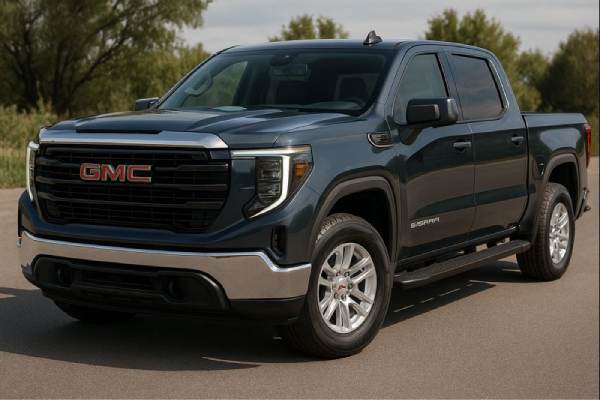
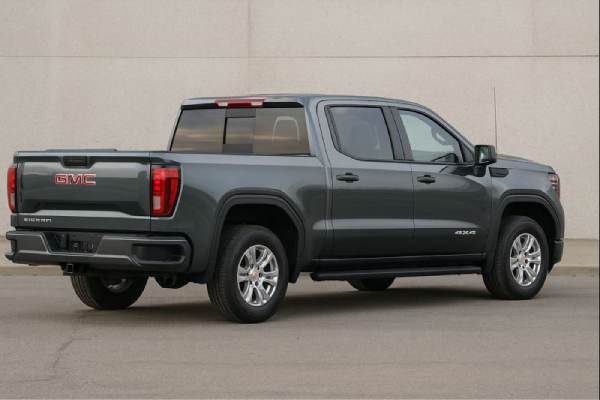
The facelifted 2024–present GMC Sierra 1500 with the LZ0 3.0-litre Duramax diesel moves the half-ton diesel formula into its second generation. Power climbs to about 305 hp and 495 lb-ft, while fuel efficiency and refinement remain standout strengths. In rear-wheel-drive (RWD) form, this truck targets owners who want the smooth, long-legged character of a modern inline-six diesel without the extra complexity and weight of a four-wheel-drive system.
Compared with the earlier LM2 diesel, the LZ0 brings internal hardware changes such as revised pistons, optimised turbocharging, and updated emissions tuning. The result is stronger towing performance and easier passing while maintaining excellent cruising economy. Inside, the Sierra continues with its wide digital displays, modern driver-assistance systems, and a broad trim spread from work-ready Pro models to luxurious Denali and Denali Ultimate variants.
This guide focuses on the LZ0 RWD configuration: what it is, how it performs in the real world, what to watch for on reliability, and how it stacks up against rivals in today’s full-size pickup market.
Essential Insights
- 3.0-litre LZ0 Duramax inline-six delivers about 305 hp and 495 lb-ft with a 10-speed automatic and RWD for strong low-rpm pulling power.
- RWD LZ0 Sierras can tow up to roughly 13,300 lb when properly configured, with stable highway manners and long range between fuel stops.
- Simplified RWD driveline reduces weight and complexity versus 4WD, but diesel emissions hardware still demands clean fuel and attentive maintenance.
- A sensible oil and filter interval is around 7,500 miles (12,000 km) or 12 months, shortened if you tow or idle heavily.
Guide contents
- GMC Sierra LZ0 RWD Briefing
- Sierra LZ0 RWD Specifications
- Trims, Safety and Driver Assists
- LZ0 Diesel Reliability Insights
- Ownership Costs and Care Guide
- Real-World Driving and Dynamics
- RWD LZ0 Sierra vs Rivals
GMC Sierra LZ0 RWD Briefing
The LZ0 3.0-litre Duramax is the second-generation light-duty diesel for the GMC Sierra 1500. It replaces the earlier LM2 engine and is tuned for higher output and improved efficiency. Power climbs to roughly 305 hp, while torque rises to about 495 lb-ft. The basic recipe remains familiar: a smooth inline-six layout, aluminium block, dual overhead cams, four valves per cylinder, and a variable-geometry turbocharger working with high-pressure common-rail injection.
For 2024 and onward, the LZ0 typically pairs with the 10-speed Hydra-Matic automatic transmission and rear-wheel drive in many trims. Four-wheel drive is still widely available, but this article focuses on owners who prefer the lighter, simpler RWD configuration. Choosing RWD reduces driveline losses and curb weight, which helps both fuel economy and payload. It also lowers purchase cost and can mean fewer components to service over the truck’s life.
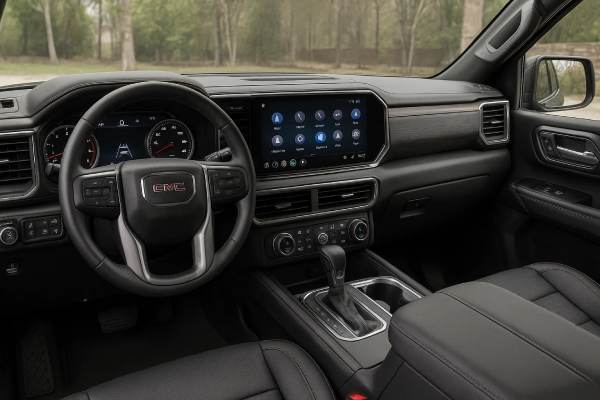
The Sierra’s T1XX platform underpins a wide variety of body and bed combinations, but many RWD diesel trucks are Crew Cab or Double Cab models aimed at long-distance drivers and light-duty fleets. The 2024-on trucks continue with the major interior and technology overhaul introduced for the 2022 facelift: a 13.4-inch central touchscreen, 12.3-inch digital driver cluster on most trims, improved materials, and expanded driver-assistance availability.
The LZ0 itself brings internal engineering updates over the LM2. These include revised pistons, updated combustion tuning, and changes in the turbocharger and emissions system calibration. The goals are faster transient response, slightly better economy under load, and greater durability under heavy towing. For owners, the key benefit is a truck that feels more eager when accelerating onto highways or climbing grades, yet still sips fuel compared with gasoline V8 options.
Overall, a 2024-present Sierra 1500 RWD with the LZ0 diesel is tailored to drivers who do significant highway mileage, value long range on a tank, and tow regularly but do not need 4WD for their daily environment.
Sierra LZ0 RWD Specifications
The following figures reflect typical 2024–present GMC Sierra 1500 RWD configurations equipped with the 3.0-litre LZ0 Duramax diesel. Exact values depend on cab style, bed length, trim, axle ratio, tyres, and region, so always confirm against your specific truck’s documentation and door-jamb labels.
Engine and Performance – LZ0 3.0-litre Duramax
| Parameter | Value |
|---|---|
| Engine code | LZ0 Duramax turbo-diesel |
| Layout and cylinders | Inline-6, aluminium block, DOHC, 4 valves per cylinder |
| Displacement | 3.0 L (≈2,993–3,000 cc) |
| Bore × stroke | ≈84.0 × 90.0 mm (3.30 × 3.54 in) |
| Induction | Single variable-geometry turbocharger with intercooler |
| Fuel system | High-pressure common-rail direct injection |
| Compression ratio | Around 15:1 |
| Max power | ≈305 hp (≈227 kW) @ ~3,750 rpm |
| Max torque | ≈495 lb-ft (≈671 Nm) @ ~1,500–3,000 rpm |
| Timing drive | Chain-driven cams with a wet belt driving the oil pump |
| Emissions hardware | DPF, SCR with DEF, EGR, oxidation catalyst |
| Typical combined fuel economy | Often mid-20s mpg US (around 9–10 L/100 km) in RWD highway-biased use |
| Real-world highway @ 120 km/h | Commonly 8–9 L/100 km (26–29 mpg US) in favourable conditions |
Transmission and RWD Driveline
| Parameter | Value |
|---|---|
| Transmission | Hydra-Matic 10-speed automatic (10L80/10L90 family) |
| Gear ratios (1st→10th) | Approx. 4.7 / 2.99 / 2.15 / 1.8 / 1.52 / 1.28 / 1.00 / 0.85 / 0.69 / 0.64 |
| Reverse | ≈4.9 |
| Drive type | Rear-wheel drive |
| Axle ratios (typical) | Around 3.23, 3.31 or 3.73 depending on trim and trailering package |
| Rear differential | Open or automatic locking; limited-slip or electronic lockers in some packages |
Chassis, Dimensions and Capacities (Typical RWD Crew Cab Short Box)
| Parameter | Value |
|---|---|
| Platform | T1XX light-duty body-on-frame pickup |
| Front suspension | Independent coil-over strut, aluminium control arms |
| Rear suspension | Solid axle with leaf springs |
| Steering | Electric power-assisted rack-and-pinion |
| Brakes | Four-wheel discs with ABS and stability control |
| Wheels / tyres | 18–22 in alloys with highway-terrain or all-season tyres |
| Length | ≈5,886–5,918 mm (231.9–233 in) |
| Width (without mirrors) | ≈2,063 mm (81.2 in) |
| Height | ≈1,900–1,970 mm (74.8–77.6 in), trim-dependent |
| Wheelbase | ≈3,745 mm (147.4 in) crew cab short box |
| Ground clearance | Around 210–230 mm (8.3–9.0 in) in RWD road-oriented trims |
| Curb weight | Typically 2,200–2,400 kg (4,850–5,300 lb) in RWD diesel crew cabs |
| GVWR | Roughly 3,130–3,260 kg (6,900–7,200 lb) |
| Fuel tank | About 91 L (24 US gal) |
Performance and Towing (Typical RWD LZ0)
| Parameter | Value |
|---|---|
| 0–100 km/h (0–62 mph) | Roughly 7.3–7.8 s depending on configuration and test conditions |
| Top speed (governed) | Around 180 km/h (≈112 mph) |
| Maximum towing (properly equipped) | Up to about 13,300 lb (≈6,035 kg) with Double Cab 2WD and Max Trailering |
| Typical RWD tow ratings (crew cabs) | Often in the 8,500–11,000 lb (3,850–4,990 kg) range |
| Payload | Commonly 800–1,000+ kg (1,800–2,200+ lb) depending on trim and options |
Fluids and Electrical – Approximate Guidance
| System | Specification and capacity (approximate – confirm by VIN) |
|---|---|
| Engine oil | DexosD-approved low-ash synthetic (commonly 0W-20); ≈6.6–7.0 L |
| Engine coolant | Long-life OAT coolant; total capacity roughly 18–20 L |
| Transmission fluid | Dexron ULV ATF; ≈12–13 qt for full change |
| Rear axle | Synthetic gear oil (e.g., 75W-90); capacity varies with axle |
| A/C refrigerant | R-1234yf; charge depends on HVAC configuration |
| Alternator | High-output units (≈200–220 A) common on diesel/tow models |
| 12 V battery | AGM type, high cold-cranking rating suited to diesel starting |
These values give a realistic picture of the LZ0 RWD Sierra’s hardware and capabilities; always defer to official manuals and labels for exact numbers on a specific truck.
Trims, Safety and Driver Assists
The LZ0 Duramax RWD powertrain is available across much of the Sierra 1500 lineup, though exact combinations depend on market and order timing. In many regions, the 3.0 diesel can be specified on trims such as Elevation, SLE, SLT, AT4, Denali and Denali Ultimate, with RWD commonly offered on mainstream and luxury trims rather than the most off-road-oriented variants.
Trim and option structure
Broadly, you can think of the LZ0 RWD offerings as falling into three groups:
- Practical and fleet-friendly (Pro, SLE, Elevation in some markets):
Cloth interiors, simpler wheel packages, and fewer luxury features. RWD diesel here prioritises efficiency and range over maximum towing or off-road hardware. - Comfort and tow-oriented (SLT and well-equipped Elevation/SLE):
Leather seats, advanced infotainment, and tow-oriented packages such as integrated trailer-brake controllers, heavier-duty cooling, and higher-capacity hitches. - Upscale long-distance haulers (Denali and Denali Ultimate RWD where offered):
Premium materials, advanced audio, extra sound insulation, and full safety/ADAS suites. These make the most of the diesel’s relaxed highway character.
Key mechanical differences between trims may include axle ratios, wheel and tyre sizes, rear-suspension tuning, and the availability of limited-slip or automatic-locking differentials. For example, a Max Trailering-equipped truck might pair the diesel with a shorter axle ratio and specific cooling components to unlock the highest tow ratings, while a comfort-oriented Denali may prioritise ride quality and noise suppression.
Safety ratings and structure
Crash-test organisations typically evaluate representative crew-cab Sierra 1500 models rather than every engine or driveline combination. As a result, safety ratings published for 2024–present Sierra 1500 crew cabs generally apply to LZ0 RWD trucks with similar cab and bed configurations.
The safety structure includes:
- High-strength steel in the cab structure and key frame areas.
- Multiple airbags: front, side-impact, and head-curtain coverage for both seating rows.
- Advanced seat-belt pretensioners and load limiters.
- Standard electronic stability control and traction control.
Headlight and crash-avoidance ratings can vary considerably with trim level and headlamp technology. Higher trims with advanced LED projector lamps, adaptive lighting, and full camera suites tend to perform better in safety-body sub-ratings than base models with simpler lighting.
ADAS systems and calibration
GMC’s Pro Safety and Pro Safety Plus packages (naming varies by market and trim) group many important driver-assistance systems, including:
- Forward collision alert and automatic emergency braking.
- Front pedestrian and often cyclist detection.
- Lane-keep assist with lane-departure warning.
- Following-distance indicator and automatic high beams.
- Blind-spot monitoring and rear cross-traffic alert (often with trailer coverage).
Higher trims may add:
- Adaptive cruise control.
- More sophisticated surround-view camera systems.
- Rear pedestrian alert and parking assist functions.
- On certain configurations, hands-free highway driving features on validated road networks.
From a servicing standpoint, any work affecting bumpers, windscreens, suspension height, or wheel alignment may require ADAS camera and radar recalibration. Buyers should confirm that post-collision or modification work has included proper calibration with supporting documentation, especially on trucks that show signs of accident repair or aftermarket suspension changes.
LZ0 Diesel Reliability Insights
Because the LZ0 diesel is a relatively new evolution in the Sierra 1500, it does not yet have as long a track record as some gasoline engines. However, it builds directly on the architecture of the earlier LM2 unit, which provides useful lessons. Most early impressions suggest strong overall reliability when trucks are maintained correctly, but there are areas worthy of attention.
Engine and fuelling
The LZ0’s high-pressure fuel system and injectors are sensitive to fuel quality and contamination, as with any modern common-rail diesel. Water or debris in fuel can lead to expensive injector or pump damage. Practical implications for owners include:
- Treating regular fuel-filter changes as non-negotiable.
- Avoiding running the tank very low, which can stir sediment.
- Preferring high-turnover, reputable fuel stations.
The internal updates over LM2 — including revised pistons and combustion tuning — are intended to improve durability under sustained load. Even so, oil quality remains critical. Extended oil-change intervals, especially on trucks that tow or idle extensively, can accelerate wear in bearings, turbochargers and timing components.
Some light-duty diesels show occasional reports of misfire or rough-running events traced to software calibration, injector issues, or sensor faults. For LZ0 trucks, owners should address any check-engine lights promptly, rather than continuing to drive for long periods with an active fault.
Emissions and aftertreatment
The emissions system combines a diesel particulate filter, selective catalytic reduction with DEF, and exhaust-gas recirculation. Typical risk points over time include:
- DPF loading: Frequent short trips that never fully warm the exhaust can prevent complete regenerations, leading to soot accumulation and more frequent active regen cycles.
- NOx and differential-pressure sensors: These live in hot, harsh environments and can fail, triggering fault codes and derate modes.
- DEF system components: Heaters, pumps, level sensors and lines are exposed to temperature extremes; failures can eventually limit engine power or prevent engine restarts if not addressed.
Owners who regularly drive at steady highway speeds give the system the best chance to self-clean via passive regeneration and tend to report fewer DPF-related issues.
Transmission and RWD driveline
The 10-speed automatic has matured over several years of service across various GM trucks and SUVs. Most issues stem from fluid degradation, software irregularities, or valve-body wear rather than fundamental mechanical weakness. Early detection of harsh shifts, flares, or delayed engagement, followed by fluid analysis and software updates, can often prevent larger problems.
The RWD layout simplifies the driveline compared with 4WD: there is no transfer case, front differential or front half-shafts to service. However, the rear differential still depends on clean lubricant and can suffer from noise, wear or locking-mechanism issues if neglected. Trucks that tow heavy loads benefit from more frequent axle-fluid changes than basic commuting duty would suggest.
Chassis, electronics and corrosion
The rest of the truck shares common Sierra 1500 concerns:
- Wear in ball joints, tie-rod ends and bushings on high-mileage or heavily loaded trucks.
- Intermittent infotainment or camera glitches that may respond to software updates or module replacements.
- Corrosion on frames, brake lines and underbody components in road-salt regions without regular washing and protective treatments.
Prevalence and cost considerations
- Common, lower-cost items: DEF sensors, batteries, some suspension components, minor electrical repairs.
- Occasional, medium-cost items: DPF replacements, EGR valves or coolers, transmission valve-body work, differential repairs after fluid neglect.
- Rare, high-cost failures: High-pressure fuel-pump damage from contamination, internal engine work due to lubrication failures, or full transmission replacement.
Because the LZ0 is newer, a significant portion of trucks will remain under powertrain warranty for a few years. Checking in-service dates, remaining warranty coverage, and recall/TSB completion provides useful protection when buying used.
Ownership Costs and Care Guide
Thoughtful maintenance is especially important with a modern diesel like the LZ0. The following schedule is a practical baseline; always cross-check with the official maintenance schedule and adjust for your operating conditions.
Practical maintenance schedule (typical guidance)
- Engine oil and filter:
Every 7,500 miles (12,000 km) or 12 months under mixed use. Shorten to around 5,000 miles (8,000 km) for frequent towing, idling, or heavy city driving. - Fuel filter:
Roughly every 22,500–30,000 miles (36,000–50,000 km). If you suspect contaminated fuel or often refuel in remote areas, err on the shorter interval. - Engine air filter:
Inspect at 15,000 miles (24,000 km); replace 30,000–45,000 miles (48,000–72,000 km) depending on dust and off-road exposure. - Cabin air filter:
Every 20,000–30,000 miles or about every 2 years. - Coolant:
Long-life OAT coolant often first changed around 5 years or 150,000 miles (240,000 km), then at shorter intervals if the truck tows heavily or operates in extreme temperatures. - Transmission fluid (10-speed):
While some factory schedules permit longer intervals, many owners and independent specialists favour a 60,000–75,000-mile (96,000–120,000 km) change, especially for trucks that tow or run hot. - Rear axle fluid:
Around every 45,000–60,000 miles (72,000–96,000 km) for towing or heavy-duty use; lighter duty can stretch intervals, but more frequent changes are cheap insurance. - Brake fluid:
Every 3 years regardless of mileage. - Brakes and tyres:
Inspect at each service; rotate tyres every 5,000–7,500 miles (8,000–12,000 km). Perform an alignment check yearly or after significant impacts or suspension changes. - Serpentine belt and hoses:
Inspect by around 60,000 miles (96,000 km) and replace if cracking, glazing or noise appears. - 12 V battery:
Load-test annually from the fourth year; pre-emptive replacement before a harsh winter can prevent inconvenient failures.
The timing chains and oil-pump belt do not have simple fixed replacement intervals, but any signs of abnormal timing noise, low oil pressure, or metal in oil samples warrant immediate diagnosis.
Buyer’s checklist for a used LZ0 RWD Sierra
When assessing a used RWD LZ0 Sierra:
- Confirm engine and driveline: Ensure the truck is genuinely LZ0 and RWD, not an earlier LM2 or a 4WD conversion. Build sheets, VIN decoders and under-bonnet labels help here.
- Review service history: Look for proof of regular oil changes, fuel-filter replacements, and any transmission or axle services. Gaps or extended intervals are warning flags.
- Check for towing and modifications: Inspect the hitch, wiring, rear-suspension components and tyres. Heavy towing or aftermarket tunes/lifts are not automatic deal-breakers but increase your need for documentation.
- Inspect for corrosion and leaks: Focus on frame rails, crossmembers, brake and fuel lines, and the underside of the bed. Look for dampness around the engine’s front and rear seals, transmission pan, and differential cover.
- Scan for stored codes: A pre-purchase diagnostic scan can reveal pending emissions or sensor faults even when the check-engine light is off.
- Test-drive thoroughly: Confirm smooth shifts, straight tracking, and the absence of vibration. Pay attention to hot-restart behaviour and any unusual regeneration behaviour such as frequent, aggressive regens in normal use.
Well-maintained RWD LZ0 trucks are strong candidates for long-term ownership, combining the inherent efficiency of the diesel with fewer driveline components than their 4WD counterparts.
Real-World Driving and Dynamics
The RWD LZ0 Sierra offers a distinct driving character: relaxed and muscular rather than overtly sporty, with the diesel’s low-rpm strength setting the tone.
Ride, handling and NVH
On the road, RWD Sierras generally ride a touch more softly and feel slightly lighter on their feet than comparable 4WD models. There is less unsprung and rotating mass, and the front end does not house a driven differential. On sensible tyre and wheel packages, the truck tracks confidently at highway speeds and soaks up expansion joints and minor surface imperfections without fuss.
Cabin noise is well controlled. Wind and road noise are moderate for a full-size truck, and the diesel settles into a subdued hum once at cruise. At idle and low speeds, you can still tell it is a diesel, but the inline-six layout and tuning make it smoother and less gruff than many older diesel pickups.
Steering is light but predictable, especially in town and when parking. On the highway, there is good straight-line stability, aided by the long wheelbase. Body roll is noticeable in tighter bends, but never alarming if you drive with realistic expectations for a body-on-frame truck.
Powertrain character
The LZ0’s torque defines the driving experience. From a standstill, the truck moves off briskly with modest throttle. The 10-speed automatic quickly short-shifts into higher gears to keep the engine around its torque plateau, often between 1,500 and 2,000 rpm in normal driving.
Turbo lag is minimal in day-to-day use. When you call for rapid acceleration to merge or overtake, the transmission downshifts decisively, the turbo spools, and the truck surges forward with a solid mid-range push rather than a high-rev rush. For drivers who tow or carry heavier loads, this sense of effortless torque is often more reassuring than the busier feel of a smaller turbocharged petrol engine.
Efficiency and towing behaviour
Real-world fuel economy will always depend on driving style, load, and environment, but many RWD LZ0 owners can expect:
- City or urban-mixed driving: Roughly 11–13 L/100 km (18–21 mpg US) with light loads.
- Highway cruising around 100–120 km/h: Often in the 8–9 L/100 km band (26–29 mpg US) in favourable conditions.
- Mixed commuting and light towing: Frequently low-to-mid-20s mpg US, or about 9–11 L/100 km.
With a fuel tank around 24 US gallons, practical highway range can exceed 900 km (550+ miles) between fills, especially on steady highway runs with conservative speeds.
When towing medium to heavy trailers, such as travel trailers or equipment in the 3,000–3,500 kg (6,600–7,700 lb) range, expect fuel economy to drop by roughly 30–40% depending on aerodynamics and speed. The diesel’s torque and the 10-speed’s ratios help the truck maintain speed on grades without constantly hunting between gears, limiting driver fatigue on long trips.
Because this article focuses on RWD models, ultimate traction in slippery conditions depends more on tyres and weight distribution than on drive-mode tricks. A limited-slip or auto-locking rear differential, quality all-season or winter tyres, and appropriate ballast in the bed can provide surprisingly strong real-world traction in many climates. In regions with frequent deep snow or steep, unpaved climbs, however, 4WD remains the better choice.
RWD LZ0 Sierra vs Rivals
The RWD LZ0 Sierra operates in a somewhat specialised niche: full-size half-ton pickups with modern diesels and rear-wheel drive, rather than the more common 4WD configurations or gasoline engines.
Versus gasoline Sierra 1500 engines
Compared with the TurboMax 2.7-litre four-cylinder and the 5.3-litre/6.2-litre V8 petrol engines, the LZ0 RWD Sierra offers:
- Superior highway fuel economy and range, especially on long trips.
- Stronger low-rpm torque, making it feel more relaxed when towing or merging with traffic.
- More complex emissions hardware and maintenance expectations, which introduces additional potential repair items versus a simpler petrol engine.
Drivers who mostly undertake short journeys, rarely tow, and dislike dealing with diesel exhaust fluid might find a petrol V8 more straightforward overall. For those who routinely tow, haul, or drive long distances on the highway, the diesel’s lower fuel consumption and long-range capability make a compelling case.
Versus other diesel half-tons
Some rival brands have reduced or discontinued their half-ton diesel offerings, which leaves the Sierra (and its corporate sibling, the Silverado) in a relatively unique position. Against remaining or recent diesel competitors, the LZ0 Sierra tends to provide:
- Refinement from the inline-six layout.
- Competitive or class-leading fuel economy in comparable configurations.
- Strong towing ratings when paired with appropriate trailering packages.
Rival trucks can counter with different strengths, such as coil-spring rear suspensions that ride more softly when unladen, or broader availability of off-road-focused trims in diesel form. However, the Sierra’s updated cabin, widespread dealer network, and mature 10-speed transmission give it a strong overall balance.
Versus emerging electric and hybrid pickups
Electric pickups are beginning to challenge diesels on torque and refinement, but they face constraints on towing range and charging infrastructure. A diesel Sierra 1500 RWD offers:
- Quick refuelling almost anywhere, without planning charging stops.
- Predictable range and economy penalties when towing, rather than sharp drops that may require careful route planning.
- A familiar maintenance ecosystem in regions where EV service facilities are still sparse.
On the other hand, EVs can offer dramatically smoother and quieter operation, lower local emissions, and strong acceleration. For urban fleets with reliable depot charging, an EV may be increasingly attractive.
Who the RWD LZ0 Sierra suits best
A 2024-present GMC Sierra 1500 RWD diesel is a strong fit if you:
- Cover high annual mileage, particularly on high-speed roads.
- Tow moderate to heavy loads regularly but do not need 4WD for terrain or weather.
- Prefer the long-range, low-rpm character of a diesel over the higher-revving feel of petrol engines.
- Value a modern cabin and strong safety/ADAS offerings, particularly in mid- and high-level trims.
It is less ideal if you mostly drive very short trips, rarely leave the city, or anticipate significant time in deep snow or off-road conditions where 4WD would pay for itself in reduced stress and extra capability.
For many drivers, however, the RWD LZ0 Sierra occupies a sweet spot: serious capability and efficiency without the extra cost and complexity of a front driveline, wrapped in a thoroughly modern full-size truck platform.
References
- sierra models 2024 (Brochure and Specifications)
- Sierra/Sierra Denali 1500 2024 (Owner’s Manual)
- 3.0L Duramax Turbo-Diesel I-6 LZ0 2023 (Engine Technical Overview)
- 2024 GMC Sierra Specifications PDF Brochure 2024 (Specifications Summary)
Disclaimer
This article is intended for informational purposes only and does not replace professional diagnosis, repair, or official service information. Specifications, torque values, service intervals, and procedures can vary by VIN, model year, market, trim level, and equipment. Always verify details against your vehicle’s owner’s manual, official workshop documentation, current technical bulletins, and guidance from a qualified technician or authorised dealer.
If you found this guide useful, feel free to share it on platforms such as Facebook or X (Twitter) to help other owners and support our work.