
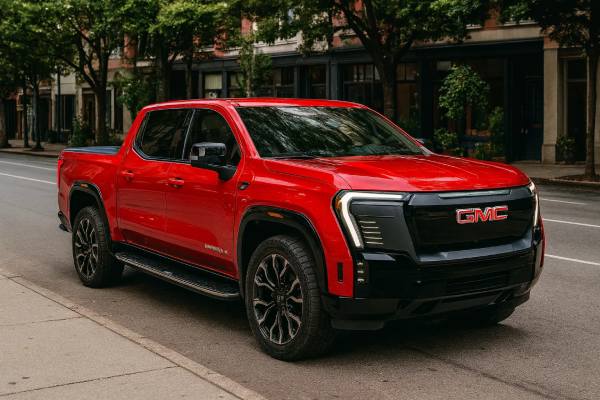
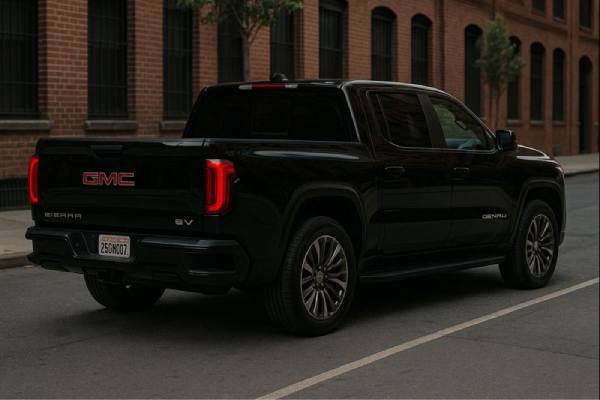
The Sierra EV Denali Standard Range is the “luxury truck first, EV second” take on a full-size pickup—quiet, heavy, and impressively capable when you use it as intended. In this 605 hp dual-motor e4WD form, it leans on GM’s Ultium platform, strong low-speed torque, and a high-voltage fast-charging architecture to make daily driving easy and towing realistic, without turning every trip into a charging strategy session. The Denali’s real value is how it blends EV smoothness with work-truck practicality: a power-open eTrunk, flexible bed access with the Midgate on equipped trucks, and available off-boarding power for tools or campsite loads. The trade-offs are predictable for a very large EV pickup—mass, tire costs, and software complexity—so smart ownership is about setup, charging habits, and keeping updates current.
What to Know
- Strong everyday shove and confident traction in wet or snow thanks to dual-motor e4WD and instant torque delivery.
- Premium truck utility: power-open eTrunk plus available off-boarding power up to 10.2 kW for gear and jobsite loads.
- Standard Range is the most “normal routine” fit if you mostly drive locally and charge at home, not cross-country weekly.
- Ownership caveat: early-life issues are often software- or calibration-related—stay current on OTA updates and service campaigns.
- Rotate tires about every 12,000 km (7,500 mi) or 6 months to control wear and noise on a heavy EV pickup.
Explore the sections
- Denali Standard Range deep dive
- Tables: specs, charging, and dimensions
- Trims, packages, and driver assist
- Reliability issues and service campaigns
- Maintenance plan and buying checklist
- Real range, charging, and performance feel
- Denali Standard Range versus rivals
Denali Standard Range deep dive
Think of the Denali Standard Range as the Sierra EV’s “everyday luxury + real truck duties” baseline. GMC positions the Sierra EV lineup around a two-motor e4WD system, and the Denali inherits that core layout: one drive unit at each axle for true all-wheel traction and predictable control in rain, snow, or loose surfaces. In practice, it feels less like a lifted car and more like a modern luxury pickup that happens to be electric—quiet at low speeds, smooth in stop-and-go, and remarkably relaxed when you’re just cruising.
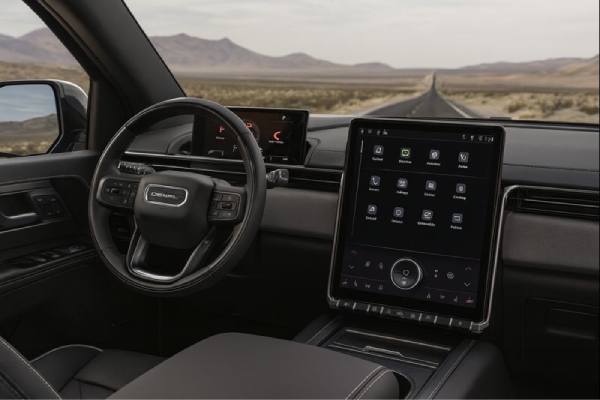
Where this trim earns its keep is usability. The cabin is designed for long stints: supportive seating, a big infotainment screen, and the kind of driver-assistance availability that reduces fatigue on highway runs. On the cargo side, the power-open eTrunk is a genuinely useful “secure trunk” for charging gear, backpacks, and tools you don’t want sliding in the bed. And if you option the right package, the truck’s off-boarding power can turn it into a rolling power source—handy for tailgates, remote work sites, or emergency household loads.
Standard Range matters because it changes how you should think about the truck. You buy it when your routine supports home charging and your longer trips are occasional rather than constant. It’s also the version that’s easiest to live with in dense suburbs or city edges where you may not want the cost, weight, and tire burden of the biggest battery. The flip side is simple: at highway speeds, a tall, wide pickup spends energy pushing air, and winter HVAC loads add more. So while official range can look reassuring, your “real” number depends heavily on speed, temperature, tire choice, and whether you haul heavy cargo.
Finally, set expectations about complexity. A modern EV truck combines high-voltage systems, thermal management, ADAS sensors, cameras, and frequent software updates. Many early complaints across new EVs are not “broken parts” but calibration issues—charging behavior, warning messages, camera glitches, or infotainment bugs that improve with updates. If you’re the type who wants a truck that never changes, you’ll need to adjust. If you’re comfortable keeping software current, the Sierra EV experience usually improves over time.
Tables: specs, charging, and dimensions
Below are specs tailored to the Sierra EV Denali Standard Range concept (dual-motor e4WD, 605 hp). Some values are not consistently published for the Standard Range Denali specifically; where that happens, the table notes Not published and gives a practical ownership-oriented estimate when appropriate.
Powertrain, Battery, and Efficiency
| Item | Spec |
|---|---|
| Code | BT1CG (as specified) |
| Motor | Dual motor (front + rear e-drive units); traction control via e4WD torque management |
| Battery chemistry | Not consistently published for this exact variant (Ultium lithium-ion family) |
| Nominal system voltage | 800V-class architecture (high-voltage fast-charging capable) |
| Traction battery (gross / usable) | Not published for Denali Standard Range; commonly reported as a smaller “Standard Range” pack vs Extended/Max |
| Max power | 605 hp (451 kW) |
| Max torque | Not published for this exact 605 hp state; higher-output Sierra EVs are commonly listed at 785 lb-ft (1,064 Nm) in performance modes |
| Thermal management | Liquid-cooled battery and power electronics; active conditioning for performance and charging |
| Efficiency / test standard | EPA (where EPA estimates are provided) |
| Rated efficiency | Not published consistently for this exact configuration |
| Rated range | EPA-estimated up to 283 mi (455 km) for standard-range Sierra EV lineup; verify by model year and build |
| Real-world highway @ 120 km/h (75 mph) | Expect roughly 33–40 kWh/100 km (530–640 Wh/mi) and 290–360 km (180–225 mi) depending on temperature, wind, tires, and load |
Driveline and Charging
| Item | Spec |
|---|---|
| Transmission / drive unit | Single-speed reduction gearing per axle drive unit (typical for GM e-axles) |
| Drive type | e4WD (dual-motor AWD) |
| Differential / torque distribution | Electronically managed front/rear torque; brake-based stability control support |
| Charging connector (AC) | J1772 (North America typical) |
| Charging connector (DC) | CCS (public fast charging); NACS access via GM-supported adapter on many GM EVs (availability varies by market and year) |
| Charging port location | Not published consistently; varies by body-side packaging—confirm on vehicle |
| Onboard charger (AC) | Commonly 11.5 kW class; higher-capacity home EVSE options exist—verify your build sheet |
| DC fast-charge peak | Up to 350 kW is cited for Sierra EV high-voltage fast charging capability (best-case charger dependent) |
| Typical DC charging curve | Not published as a full curve; expect strong early power that tapers notably as SOC rises |
| Replenishment time | DC 10–80%: not officially fixed (depends on battery size, temperature, charger); AC 0–100%: typically overnight on 11.5 kW home charging |
| Battery preconditioning | Available on many EVs via route planning / charging navigation; confirm by model year software |
| Bidirectional capability | Vehicle-to-load / off-boarding power available up to 10.2 kW on equipped trucks; vehicle-to-home depends on GM Energy hardware and a properly equipped home |
Performance and Capability
| Item | Spec |
|---|---|
| Acceleration | 0–60 mph (0–97 km/h): Not published for 605 hp Denali Standard Range. Denali high-output configurations cite low-4-second capability; a realistic expectation for 605 hp is roughly ~4.8–5.4 s depending on tires, payload, and launch strategy |
| 0–100 km/h (0–62 mph) | Estimate ~5.0–5.7 s (same caveats) |
| Top speed | Not consistently published for Standard Range; large EV pickups are commonly electronically limited—expect ~170–180 km/h (105–112 mph), verify on-road or in official documentation |
| Braking distance | Not published; heavy curb weight makes tire choice and brake condition critical |
| Towing capacity | Up to 10,500 lb (4,763 kg) is cited for Sierra EV Denali in GMC materials; confirm by year, battery, and tow package |
| Payload | Not consistently published; expect roughly 500–700 kg (1,100–1,550 lb) depending on configuration |
| Roof load | Not published / not commonly specified for this vehicle type |
Chassis and Dimensions
| Item | Spec |
|---|---|
| Suspension | Not fully published for Standard Range Denali; higher trims offer adaptive air suspension and damping packages |
| Steering | Electric power steering; available rear-steer on some trims/packages |
| Wheels/tires | Denali commonly ships with large-diameter wheels; verify 22″ vs 24″ by package |
| Ground clearance | Not published consistently (varies by wheel/tire and suspension package) |
| Length | About 233.2 in (5,923 mm) for Sierra EV body (varies slightly by trim details) |
| Width / height | Not published consistently in one official place; verify per build sheet |
| Wheelbase | Not published consistently |
| Turning circle | Not published; rear-steer options materially reduce low-speed maneuvering effort |
| Curb weight | Not published for Standard Range Denali; heavier batteries increase weight significantly |
| GVWR | Not published consistently for this variant |
| Cargo volume | eTrunk: 11 cu ft (311 L) is cited for Sierra EV |
| Additional storage | Underfloor and bed storage varies with options; confirm by vehicle |
Safety and Driver Assistance
| Item | Spec |
|---|---|
| Crash ratings | Sierra EV-specific ratings may be pending depending on model year; verify by VIN in official databases |
| ADAS suite | Forward AEB, lane support features, blind zone systems, and available hands-free highway assist (package-dependent) |
| Towing ADAS | Trailer camera provisions and towing aids available with trailering packages |
Electrical
| Item | Spec |
|---|---|
| HV architecture | High-voltage system designed for fast charging; isolation monitoring and HV interlocks standard for modern EVs |
| DC–DC converter | Not published (supports 12V system from HV pack) |
| 12V battery | AGM or lithium 12V varies by EV design; confirm by service parts listing |
| OTA updates | Supported for infotainment and many vehicle modules; update cadence varies |
Fluids and Service Capacities (decision-useful items)
| Item | Spec |
|---|---|
| Battery/power electronics coolant | Type/spec varies—use only OEM-approved coolant; capacity not consistently published |
| Brake fluid | DOT 3/4 class typical—follow OEM interval guidance |
| A/C refrigerant | Not published here; EVs often use R-1234yf—verify by underhood label |
| Washer fluid | Fill as needed |
| Key torque specs | Wheel lug torque is model-specific—verify in the owner/service documentation before tightening |
Trims, packages, and driver assist
The Sierra EV lineup is structured around a shared electric foundation with trim- and battery-driven differences that affect how the truck drives, tows, and rides. For the Denali Standard Range buyer, the key is separating what’s “trim luxury” from what’s “hardware that changes the truck.” In many cases, the most important differences are not leather vs wood—they’re battery size, suspension hardware, wheel/tire package, and trailering equipment.
Start with trims and batteries. Denali sits above Elevation and AT4 in luxury, and it can be paired with multiple battery packs depending on model year and market strategy. Standard Range is the most routine-friendly choice if you charge at home and don’t need maximum road-trip legs. Extended and Max Range packs generally add real highway flexibility but also weight and cost. That extra mass can increase tire wear and make pothole impacts harsher unless the suspension package is tuned to compensate.
Packages matter because Denali equipment is often “available,” not universal. If you want the most relaxed ride, look for adaptive suspension content (air ride and/or continuously controlled damping where offered). If you want the most confident towing experience, focus on trailering packages: integrated trailer brake controller, trailer camera provisions, hitch guidance views, and blind-zone support that’s calibrated for a trailer. These features reduce stress far more than a premium audio upgrade ever will.
Driver assistance (ADAS) is another place where build details matter. Hands-free highway assistance can be transformative for long-distance comfort, but it’s tied to subscription terms, mapping coverage, and sensor calibration. Also, trucks with large wheels and aggressive tires can generate more road noise that you’ll notice more in an EV because the powertrain is quiet. If your priority is silence and ride comfort, a slightly smaller wheel with a taller sidewall can be the smarter long-term choice—especially on rough pavement.
Safety systems generally include modern essentials: automatic emergency braking, lane support, blind zone alerts, and rear cross-traffic functionality. The practical point for owners is that ADAS relies on cameras and radar/ultrasonic sensors that can be misaligned by minor bumper impacts or windshield replacements. After repairs, insist on proper calibration—if the dealer or body shop doesn’t have the procedure, the features may still “work,” but not at factory accuracy.
Finally, year-to-year changes can matter more on EVs than on gas trucks because software, charging access, and feature bundling evolve quickly. When shopping, use the VIN and build sheet to confirm battery designation (Standard/Extended/Max), charger capability, and whether the truck includes the off-boarding power equipment you actually want. A Denali badge alone doesn’t guarantee the hardware that makes the Sierra EV unique.
Reliability issues and service campaigns
It’s still early for long-term data on the Sierra EV, so the most honest reliability guidance is to focus on what typically shows up first in complex EV trucks: software behavior, charging consistency, and “support systems” like 12V power and sensors. The good news is that many of these issues are fixable with updates or targeted component replacements. The frustrating part is that symptoms can feel random until you learn the patterns.
Common (low to medium cost tier)
- Infotainment glitches or slow restarts → often a software build issue or a module needing a reflash.
Remedy: install OTA updates; if persistent, dealer reprogramming and module health checks. - Camera/parking sensor warnings → dirt, ice, or miscalibration can trigger false alerts.
Remedy: clean sensors first; then check for calibration after body work or windshield replacement. - Phone key / app connectivity dropouts → typically account pairing or network handoff behavior.
Remedy: re-pair devices, update the app, and confirm vehicle software is current.
Occasional (medium cost tier)
- Inconsistent DC fast charging speed → battery temperature, charger quality, or charging curve logic.
Remedy: precondition before arrival when possible; try another station; confirm latest charging-related updates. - HVAC performance swings in very cold weather → heat demand can reduce range and trigger aggressive battery conditioning.
Remedy: preheat while plugged in; use seat and wheel heat to reduce cabin load.
Rare but high-impact
- High-voltage isolation or “service high voltage system” warnings → can indicate moisture ingress, connector issues, or sensor faults.
Remedy: treat as urgent; do not ignore persistent warnings. Diagnosis requires proper HV procedures. - Drive unit noise or vibration → could be half-shaft alignment, mount issues, or a drive unit bearing concern.
Remedy: document conditions (speed, torque, temperature) and pursue dealer diagnosis early.
Battery health and degradation
For most modern EVs, the most important “reliability” factor is how the battery is treated. Frequent high-power DC fast charging is not automatically bad, but repeated hot charging (high battery temperature + high charging power) can increase long-term stress. The practical approach is simple:
- Use home AC charging for routine needs.
- Use fast charging for trips, but don’t habitually charge to 100% and let it sit full for days.
- In hot climates, avoid back-to-back DC sessions when the pack is already very warm unless you truly need it.
Recalls, TSBs, and extended coverage
Because EV trucks rely heavily on software, some fixes show up as service campaigns or recalibrations rather than “broken parts.” The right habit is to verify completion by VIN in official recall databases and keep dealer service records. If you’re buying used, request a printout that shows campaign completion and module software status. For many owners, this is the difference between a truck that feels “buggy” and one that feels polished.
Pre-purchase checks to request
- A battery health snapshot (range at a known %SOC, recent charging behavior, and any module/pack service history).
- Proof of completed recalls/service campaigns and any charging-related updates.
- Inspection of charge port condition (latch feel, seal integrity, any corrosion signs).
- Test drive focusing on sensor behavior: cameras, parking aids, lane features, and any warning messages.
Maintenance plan and buying checklist
EVs delete oil changes, but they do not delete maintenance. A heavy electric pickup asks more of tires, suspension joints, brakes (yes, even with regeneration), and software health. A good maintenance plan is mainly about inspections on schedule and doing small items before they become expensive.
Practical maintenance schedule (typical, verify by VIN)
- Tire rotation: every 12,000 km (7,500 mi) or 6 months.
Heavy curb weight + high torque can scallop tires quickly if rotations slip. - Alignment check: every 20,000 km (12,000 mi) or 12 months, and after any pothole impact.
Misalignment costs you range and tires. - Brake inspection: every 20,000 km (12,000 mi) or 12 months.
EV regen reduces pad wear, but calipers and sliders can corrode if friction brakes are underused. - Brake fluid: every 2 years (typical industry practice), sooner in humid climates or heavy towing use.
Brake fluid absorbs moisture; that’s about safety, not miles. - Cabin air filter: inspect around 24,000–40,000 km (15,000–25,000 mi) or 12–24 months depending on dust/pollen load; replace as needed.
- 12V battery test: annually after year 2; replacement window often 3–5 years depending on climate and usage.
A weak 12V battery causes weird errors and “no-start” behavior in EVs more often than people expect. - Coolant system inspection: annually; coolant replacement interval varies by OEM and loop design.
Do not “top off with whatever.” Use only the correct spec. - Underbody and battery enclosure inspection: annually, especially in salt-belt regions.
Look for fastener corrosion, torn aero panels, and damaged shields. - Software/OTA check: monthly habit—confirm updates and install promptly.
Many drivability and charging improvements arrive this way.
Fluids, specs, and torque values (what to insist on)
- Coolant: OEM-specified coolant only, correct mix ratio—ask the shop to document the part number/spec.
- Brake fluid: OEM-recommended DOT class—document what was used.
- Wheel lug torque: confirm in official documentation before tightening; correct torque prevents rotor warping and wheel damage.
Buyer’s guide: how to shop a used Sierra EV wisely
- Confirm the battery designation in writing.
“Standard Range” vs “Extended/Max” changes value, road-trip usability, and sometimes wheel/suspension packaging. - Check real range quickly during inspection.
Ask the seller to charge to a known state (for example 70–80%) and note the displayed miles. Then compare to ambient temperature and expected seasonal hit. A winter test will always look worse—focus on consistency and absence of warnings. - Observe DC fast-charging behavior (if possible).
A short public charging session can reveal charge port issues, handshake errors, or abnormal taper behavior. - Inspect tires like a cost item, not a detail.
Large-diameter tires are expensive. Uneven wear often signals alignment or suspension bushing issues. - Verify ADAS calibration health.
If the truck had windshield replacement or front-end repairs, confirm calibrations were done. Poor calibration leads to annoying and unsafe behavior. - Ask for campaign completion proof.
EVs are update-driven. A “fully updated” truck is typically a better truck.
Long-term durability outlook: If you keep tires aligned, avoid chronic “full and hot” battery habits, and stay current on software, the Sierra EV’s powertrain should be low-drama compared with complex combustion drivetrains. The likely high-cost items over time are tires, suspension wear (because of mass), and any out-of-warranty module failures that require specialized diagnostics.
Real range, charging, and performance feel
Ride, handling, and NVH: The Sierra EV’s first impression is mass—and how well it hides it at normal speeds. The battery pack sits low, so the truck feels planted on the highway with a calm, settled body motion. In town, the quiet powertrain makes the cabin feel more premium than many gas trucks because there’s no engine vibration or gear hunting. On rough pavement, wheel and tire choice becomes the deciding factor: large wheels with short sidewalls can send sharper impacts into the cabin and add more tire roar. If you care most about comfort, prioritize the most compliant tire package available and keep pressures correct.
Power delivery: Dual-motor e4WD gives you immediate step-off response. The truck can feel deceptively quick because it doesn’t build speed with noise—it just surges. Smoothness is excellent, but traction management is doing a lot behind the scenes to prevent wheelspin and to keep the truck tracking straight. In rain or light snow, that’s a big advantage: torque is metered faster than mechanical systems can react. For daily driving, you’ll likely prefer a calmer throttle map (often “Normal” or “Tour”) and a regen setting you can modulate easily.
Regenerative braking and one-pedal feel: On a heavy EV pickup, regen is both a range tool and a brake-wear tool. The best setups allow predictable modulation so the handoff to friction brakes is smooth. In stop-and-go traffic, one-pedal driving can be a fatigue reducer once you adjust. If you rarely use friction brakes, occasionally do a few firm stops in a safe area to keep rotors clean—especially after wet weather.
Real-world efficiency and range: This is where expectations must be realistic. A full-size EV pickup faces two major drains: aerodynamic drag at highway speeds and rolling resistance from wide, heavy tires. As a result:
- City/slow suburban use: often the best-case range scenario because regen recovers energy.
- Highway at 120 km/h (75 mph): typically the worst-case because aero drag dominates.
- Cold weather: cabin heat and battery conditioning can noticeably reduce range, especially on short trips where the system never stabilizes.
A practical Standard Range routine is charging at home to a daily target (often 70–80%) and only going to 100% right before a long trip. If you tow, plan for a major range hit—often 30–50% depending on trailer shape, speed, and wind. The Sierra EV’s towing ability can be excellent, but towing is where the “Standard Range vs bigger battery” decision becomes most obvious.
Charging in real life: Home charging is the ownership “make or break.” If you can reliably charge overnight, the truck feels effortless. Public fast charging is for trips and busy weeks. Expect fast-charging speed to vary with battery temperature, state of charge, and charger quality. The most time-efficient strategy is usually charging in the middle SOC band rather than pushing to very high SOC unless you need it.
Denali Standard Range versus rivals
The Denali Standard Range sits in a very specific competitive pocket: premium full-size EV pickup feel, but without the biggest battery. That makes the comparison less about “which truck is best” and more about “which truck matches your charging reality and use case.”
Versus Chevrolet Silverado EV (related platform): The closest alternative is often the Silverado EV, which targets similar utility with different styling, trim strategy, and feature packaging. If you want maximum range and a work-first spec sheet, Silverado EV variants can be compelling. The Sierra EV Denali typically counters with Denali luxury identity, interior presentation, and GMC-specific packaging.
Versus Ford F-150 Lightning: The Lightning is the most proven mainstream electric pickup in terms of market time. It’s an excellent daily driver with strong practicality, and it can be a better fit if you want a more traditional pickup footprint and a wide service ecosystem. Where the Sierra EV can pull ahead is high-voltage fast-charging capability on compatible infrastructure and the “big-truck” premium presence—though your real decision should hinge on range needs and charging access, not brochure claims.
Versus Rivian R1T: Rivian’s truck is sportier, more adventure-focused, and generally feels smaller and more agile. If you want a pickup that drives like a performance SUV, Rivian is hard to ignore. The Sierra EV Denali is the opposite: it’s the luxury full-size truck experience—bigger, calmer, more couch-like, and often better aligned with towing and full-size passenger comfort.
Versus Tesla Cybertruck: Cybertruck is its own category with a unique shape, ecosystem advantages for charging, and a very different interior philosophy. If your priority is fast, frequent road trips and you value the charging network experience above all, Tesla has an edge. If your priority is traditional truck usability, familiar premium truck ergonomics, and features like a conventional luxury-truck cabin feel, Denali’s approach can be easier to live with.
Bottom line: Choose Denali Standard Range when you want premium truck comfort and real EV torque, you can charge at home, and your longest trips are occasional. If you tow heavy often or road-trip weekly, a larger battery variant (or a competitor optimized for long-distance charging convenience) may be the better match.
References
- The 2026 Sierra EV | Electric Truck | GMC 2025 (Manufacturer Specs)
- Introducing the First-Ever 2024 Sierra EV 2022 (Manufacturer Announcement)
- How GM Energy and the GMC Sierra EV Denali can help in outages 2024 (Manufacturer Technical Overview)
- Vehicle Detail Search – 2025 GMC Sierra EV | NHTSA 2025 (Safety and Recalls Database)
Disclaimer
This article is for informational purposes only and is not a substitute for professional diagnosis, inspection, or repair. Specifications, torque values, service intervals, and procedures can vary by VIN, model year, market, and equipment. Always verify details using official owner and service documentation for your exact vehicle.
If this guide helped, please consider sharing it on Facebook, X (Twitter), or your favorite forum to support our work.