
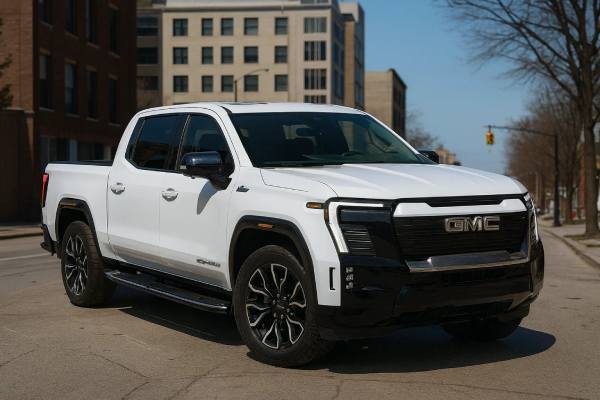
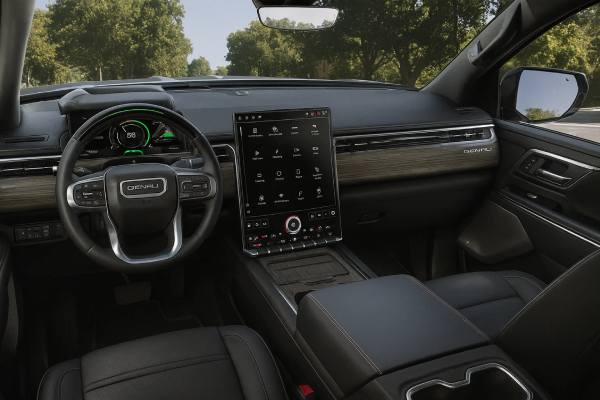
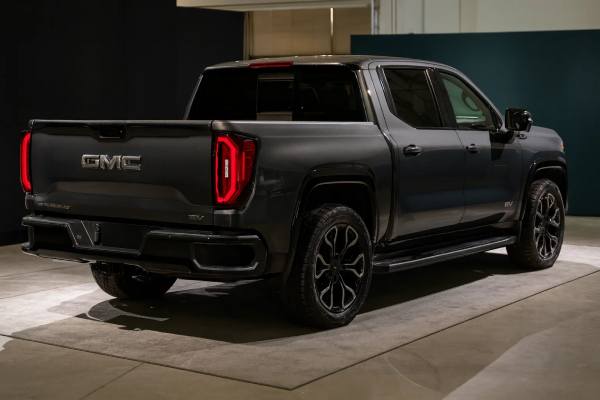
The Sierra EV Elevation Standard Range is the “work-ready” entry point into GMC’s electric full-size pickup lineup, built around a dual-motor e4WD setup tuned for strong everyday shove rather than headline-grabbing peak output. In this configuration, GMC emphasizes standard horsepower and usable range over the biggest battery, which helps keep weight and cost in check while still delivering real truck capability—towing, payload, and a large crew-cab footprint. It’s also a vehicle where software matters: charging behavior, driver-assistance calibration, and even warning-telltale logic can be update-driven, so ownership is as much about keeping systems current as it is about rotating tires. If you’re shopping this model, the key is separating “standard-range hardware” from optional upgrades (battery size, power outlets, steer modes, and towing equipment) that can materially change range, performance, and charging speed.
What to Know
- Strong baseline output for a full-size EV truck, with effortless passing power even when loaded.
- Standard e4WD traction makes it easy to manage wet pavement, snow, and gravel without drivetrain drama.
- Real highway range drops noticeably at 120 km/h (75 mph), so plan charging stops for long trips.
- Treat software updates as part of ownership—charging and warning behaviors can change after campaigns.
- Rotate tires about every 12,000 km (7,500 mi) to protect range and keep steering feel consistent.
Contents and shortcuts
- Elevation Standard Range explained
- Spec tables and key numbers
- Packages, trims, and driver assist
- Reliability, issues, and recalls
- Maintenance and buying checklist
- Real driving, range, and charging
- How it stacks up against rivals
Elevation Standard Range explained
Think of the Elevation Standard Range as the Sierra EV that aims to feel familiar to pickup owners—quiet, stable, and powerful—without forcing you into the largest battery and the highest price point. The core layout is dual-motor e4WD (electric all-wheel drive), which gives consistent traction because the truck can meter torque to front and rear axles far faster than a mechanical transfer case. In normal driving, that means smoother launches on slick surfaces and less wheelspin when you roll into the throttle mid-corner or on a wet on-ramp.
Where buyers sometimes get tripped up is the “standard-range” label. It usually means two things at once: (1) the smaller traction battery compared with the Extended/Max packs, and (2) charging limits that may be lower than the top-battery versions. That matters because two Sierra EV Elevations can look identical on a dealer lot but behave very differently on a road trip if one has an upgraded battery and charging package.
Is it really “2025–present”? The Sierra EV family launched for the 2025 model year in higher trims, while Elevation broadens availability as the lineup expands. In practical shopping terms, you’ll most commonly see Elevation Standard Range tied to the newer, more affordable build strategy. So the safest approach is VIN-based verification: confirm battery type (Standard vs Extended), charging hardware, and power-outlet package on the build sheet.
Engineering highlights that matter in ownership:
- High mass, low center of gravity: the battery is under the floor, which helps stability and reduces pitch compared with many ICE trucks.
- Regenerative braking: reduces brake wear in routine commuting, but can also hide friction-brake issues until you intentionally test them.
- Software-defined behavior: charging curves, warning logic, and driver-assistance tuning can change with updates—treat them like maintenance.
Spec tables and key numbers
Below are the most relevant published specs for the Sierra EV Elevation Standard Range (BT1CG). Where manufacturers do not publish a value (common for aero Cd, some fluid capacities, and some performance metrics by battery), the table clearly notes it.
Powertrain, battery, and efficiency
| Item | Specification |
|---|---|
| Code | BT1CG (platform/architecture reference used for this variant) |
| Motor | Dual motor e4WD (front + rear electric drive units) |
| Battery chemistry | Not publicly specified (Ultium-family pack) |
| Traction battery (capacity) | 119 kWh (battery capacity) |
| System voltage | 400 V architecture (published for standard-range spec set) |
| Max power | 605 hp (451 kW) (system) |
| Max torque | 820 Nm (605 lb-ft) (system) |
| Thermal management | Liquid-cooled battery and power electronics (heat-pump fitment varies by equipment/market) |
| Efficiency / test standard | EPA (U.S. listings) |
| Rated efficiency | 50 kWh/100 mi (EPA) (≈ 31.1 kWh/100 km) |
| Rated range | 283 mi (455 km) EPA-estimated (standard range) |
| Real-world highway @ 120 km/h (75 mph) | Typical 36–40 kWh/100 km (≈580–640 Wh/mi); 300–330 km (185–205 mi) depending on wind, temperature, tires, and payload |
| Aerodynamics (Cd / frontal area) | Not published for this trim/battery |
Driveline and charging
| Item | Specification |
|---|---|
| Transmission / drive unit | Single-speed reduction gear (front and rear drive units) |
| Drive type | e4WD (electric AWD) |
| Charging connector (AC) | J1772 (typical North American spec) |
| Charging connector (DC) | CCS (North American spec) |
| Onboard charger (AC) | 11 kW max AC acceptance |
| DC fast-charge peak | Up to 220 kW (standard-range published figure) |
| Typical DC charging curve | Not fully published; expect strong early power and taper as SOC rises |
| Replenishment time | Not consistently published by trim; a practical expectation is ~35–50 min (10–80%) when conditions are favorable |
| Battery preconditioning for DC charging | Available; best results when navigating to a fast charger and arriving with a warm pack |
| Bidirectional capability | V2H capable with compatible GM energy hardware; export outlets depend on option content |
Performance and capability
| Item | Specification |
|---|---|
| Acceleration | 0–60 mph: ~4.8 s (estimate); 0–100 km/h: ~5.0 s (estimate) (varies with battery, tires, state of charge, and temperature) |
| Top speed | 112 mph (180 km/h) (governed) |
| Braking distance | Not published for this exact trim; heavy curb weights make tire choice a major factor |
| Towing capacity | 12,500 lb (5,670 kg) (when properly equipped) |
| Payload | Not consistently published as one value; varies with options and GVWR |
| Roof load | Not published / depends on approved accessories |
Chassis and dimensions
| Item | Specification |
|---|---|
| Suspension (front/rear) | Independent front; rear layout varies by configuration (published details vary by source) |
| Steering | Electric power steering; ratio not published |
| Brakes (front/rear) | 14.5 in / 13.5 in rotors (published) |
| Wheels/tires | LT265/70R18 (published spec set) |
| Ground clearance | Not published as a single figure for this trim |
| Length / Width / Height | 233.4 in / 83.8 in / 78.7 in (overall) |
| Wheelbase | 145.7 in |
| Turning circle (kerb-to-kerb) | 44.0 ft |
| Kerb (curb) weight | Varies by equipment; published examples exist by build |
| GVWR | 9,900 lb (4,491 kg) |
| Cargo volume (bed) | 57.3 ft³ |
| Additional storage | eTrunk: 11.0 ft³ (published) |
Safety and driver assistance
| Item | Specification |
|---|---|
| Crash ratings | May be not yet published for this exact trim/year by major bodies; verify by VIN and rating agency database |
| Headlight rating (IIHS) | Not consistently published for this exact configuration |
| ADAS suite | Typical availability includes AEB, lane support, blind-spot monitoring, rear cross-traffic alert; exact content depends on package |
Electrical
| Item | Specification |
|---|---|
| High-voltage architecture | 400 V (standard-range spec set) |
| DC–DC converter / inverter | Not typically published in consumer specs |
| 12V battery | Type/capacity varies; verify by VIN/service info |
| OTA updates | Supported for key modules; update cadence varies |
Fluids and service capacities
| Item | Specification |
|---|---|
| Drive unit / reduction gear oil | Service fluid and capacity not publicly standardized in consumer specs |
| Battery and power electronics coolant | GM-approved coolant; capacity varies by circuit |
| Brake fluid | DOT specification per GM guidance; interval depends on market schedule |
| A/C refrigerant | Type and charge vary by build and market |
| Key torque specs | Always verify by service documentation for your VIN (wheel fasteners, suspension, HV service points) |
Packages, trims, and driver assist
The Elevation trim exists to broaden the Sierra EV audience—buyers who want the platform’s refinement and utility without paying for every luxury or off-road feature. That makes option discipline unusually important, because the difference between a “base-feeling” EV truck and a fully loaded one can come down to just a few line items.
Trims and option structure
In most markets, Sierra EV shopping breaks into three practical buckets:
- Elevation (value-focused): the trim most likely to be paired with the Standard Range battery. The cabin and tech are modern, but some signature “showpiece” features may be optional.
- AT4 (off-road emphasis): typically pushes you toward larger batteries and higher capability packages.
- Denali (luxury flagship): where you’re most likely to see the biggest battery options and the most standard equipment.
Because the same trim badge can hide battery differences, use these quick checks:
- Battery label on the build sheet: Standard vs Extended (and sometimes Max on other trims).
- Charging spec callout: Standard-range builds may list lower DC peak kW than top-battery versions.
- Power-outlet content: some trucks list basic 120V outlets; others list higher-output export power.
Safety systems and ADAS
Most Sierra EV configurations include a strong baseline of active safety: automatic emergency braking (AEB), lane-keeping or lane-departure assist, and blind-spot monitoring are common. The details that matter in real ownership are:
- Calibration after glass, alignment, or bumper work: camera and radar systems often require recalibration after repairs.
- Tire size changes: upsizing tires or switching to aggressive tread can affect AEB stopping distances and lane-keeping confidence.
- Trailer towing: blind-spot zones and rear cross-traffic logic can behave differently with a trailer; use trailer profiles if equipped.
Safety ratings reality check
For newly introduced trims and batteries, it’s genuinely possible that public crash ratings are not yet posted for your exact configuration. That doesn’t mean the truck is “unrated” in a safety sense—it means the testing body may not have published a result for that exact variant or model year. For buyers, the practical move is to verify:
- Whether a rating exists for the same body style and restraint configuration, and
- Whether any campaign or recall affects stability control, braking, or warning indicators.
Reliability, issues, and recalls
With any first-generation EV truck platform, reliability is less about “engine problems” and more about software maturity, high-voltage component integrity, and thermal management consistency. The good news is that EV drivetrains eliminate many wear items (no engine oil, fewer heat cycles in an ICE sense). The caution is that issues can present as warnings, charging limits, or intermittent faults that require structured diagnosis.
Common vs occasional vs rare patterns
Common (low to medium cost tier):
- Software-related warnings (infotainment glitches, driver-assistance alerts, charging session quirks).
- Symptoms: phantom messages, connectivity drops, reduced charge rate on some stations.
- Likely root cause: module software needing an update, network handshake issues with certain chargers, or sensor calibration drift.
- Remedy: dealer update/OTA update; verify all modules are current.
Occasional (medium cost tier):
- Charge-port and latch concerns (especially in winter grime).
- Symptoms: difficulty latching, charge-session interruptions, “port door” or “connector” messages.
- Root cause: contamination, seal wear, or alignment issues.
- Remedy: inspection, cleaning, seal replacement if needed.
Rare (high cost tier):
- High-voltage isolation or coolant intrusion faults (any EV can experience these, but they’re uncommon).
- Symptoms: “service high-voltage system,” reduced power, charge refusal.
- Root cause: moisture ingress, connector pin issues, or component failure within HV architecture.
- Remedy: dealer isolation test, targeted replacement, and strict sealing verification.
Recalls, service actions, and how to verify
Yes—important items can be “published” but not always on the consumer brochure, especially when they’re compliance-related. A clear example is an ESC (electronic stability control) telltale noncompliance campaign affecting certain Sierra EV builds, where the warning behavior may not meet required illumination logic after a key cycle. For owners, the takeaway is simple: even if the truck drives normally, warning-telltale logic is a safety feature and should be corrected.
Verification steps you should always do:
- Run an official VIN recall check (don’t rely on dealer stickers alone).
- Ask for the dealer repair order showing completion date and remedy (software update vs module replacement).
- After the remedy, confirm warning lights, stability control messages, and drive modes behave normally.
Maintenance and buying checklist
An EV truck still needs real maintenance; it just shifts from engine-centric tasks to tires, brakes, cooling loops, and electronics health. The Sierra EV’s mass and torque make tire and alignment discipline the single biggest “hidden cost” lever—more than cabin filters or wiper blades.
Practical maintenance schedule
Use this as a sensible baseline for daily-driven trucks (adjust for towing, extreme heat/cold, frequent DC fast charging, or rough roads):
- Tire rotation: every 12,000 km (7,500 mi) or 12 months.
- Severe use: every 8,000–10,000 km if you tow often or drive abrasive surfaces.
- Alignment check: every 20,000 km (12,000 mi) or annually if you see uneven wear, steering pull, or frequent potholes.
- Brake inspection (pads/rotors): every 20,000 km (12,000 mi).
- EV regen reduces wear, but corrosion can build if friction brakes aren’t exercised.
- Brake fluid: every 24 months is a common best practice; confirm your market schedule.
- Cabin air filter: every 20,000–30,000 km or 12 months (dusty climates shorten this).
- Battery and power-electronics cooling system: inspect at least annually for leaks, debris-blocked radiators, and correct coolant condition; service intervals vary by VIN.
- 12V battery test: annually after year 2; replacement window often 3–5 years depending on climate and accessory load.
Buyer’s guide: what to inspect before purchase
Battery health and range reality
- Ask for the rated range shown at a consistent state of charge (for example, 80%) and compare it to what you’d expect for the season.
- On a test drive, watch for aggressive range drops at steady speed—big deviations can indicate tire issues, cold-soaked battery, or calibration problems rather than “bad battery.”
Charging hardware
- Inspect the charge port pins, latch, and seals. A port that feels loose or fails to latch smoothly can become a recurring annoyance.
- If possible, do a short DC fast-charge session and confirm the truck ramps power normally before tapering.
Cooling and thermal management
- Check for fan noise anomalies, warning messages, or coolant odors after the drive.
- Verify the front heat exchangers aren’t packed with debris—airflow matters for sustained power and charging.
Chassis and body
- Look underneath for battery-housing damage, missing underbody panels, and bent jack points.
- Confirm even tire wear; heavy EV trucks punish neglected alignments.
Electronics and updates
- Verify driver-assist features function without persistent alerts.
- Ask whether the truck has received current update campaigns and whether any modules were replaced.
Real driving, range, and charging
The Sierra EV Elevation Standard Range can feel deceptively quick because electric torque arrives instantly and stays strong through normal passing speeds. The bigger day-to-day story, though, is how speed, temperature, and tires reshape range in a full-size EV pickup.
Ride, handling, and NVH
Expect a planted, “heavy but calm” character. The battery mass low in the chassis reduces body roll and pitch, so the truck tracks straight on the highway with less wander than many body-on-frame ICE trucks. Steering is typically light-to-moderate, tuned for stability rather than feedback. Cabin noise is mostly wind and tire roar; the motor sound is subdued. If you swap to aggressive all-terrain tires, the noise and energy use penalty is real—and often larger than owners expect.
Brake feel depends on regen blending. In gentle stops, regen does most of the work; in harder stops, friction brakes join in. The best ownership habit is to occasionally perform a few firm stops (safely) to keep rotors clean, especially in wet climates.
Real-world range expectations
EPA-estimated range is 283 miles (455 km) for the Standard Range setup, but real usage clusters like this:
- City and suburban (mixed speeds): often close to rating if temperatures are mild and tires are efficient.
- Highway at 120 km/h (75 mph): plan for roughly 185–205 miles (300–330 km) in many real conditions.
- Cold weather: heating demand and battery conditioning can cut range significantly, especially on short trips where the pack never fully warms.
A helpful way to think about it: if your routine includes fast highway cruising, treat the EPA number as an upper bound and build your charging plan around the highway number.
Charging in daily life
On AC home charging at 11 kW, the truck is realistically an “overnight” charger. If you arrive home at a low state of charge, you can often recover most of the battery by morning.
On DC fast charging, published standard-range peak power is up to 220 kW. Real session speed still depends heavily on:
- Starting state of charge (lower is faster),
- Battery temperature (warm pack is faster),
- Charger capability and sharing,
- Whether preconditioning was active.
For road trips, the fastest strategy is usually repeated shorter sessions (for example, arriving low and leaving around 70–80%) instead of trying to charge to 100% on DC.
How it stacks up against rivals
The Sierra EV Elevation Standard Range sits in a competitive spot: it’s a full-size electric pickup with modern cabin tech and strong torque, but it’s also battling rivals that either undercut it on price, beat it on charging infrastructure, or offer different “truck identities.”
Versus Ford F-150 Lightning
The Lightning’s biggest advantage is ecosystem maturity—broad real-world owner data, abundant service familiarity, and a well-understood trim ladder. Depending on battery, it can be a better “city contractor” truck because it’s slightly easier to place in tight areas and has a long track record in fleet use. The Sierra EV typically counters with newer tech, a fresh interior approach, and a different feel at highway speeds due to platform tuning and battery placement.
Versus Rivian R1T
The Rivian is more “sport truck” than traditional full-size pickup. It’s generally easier to maneuver, feels quicker in transient handling, and has a strong adventure brand identity. The Sierra EV fights back with true full-size cabin/bed proportions and a more familiar pickup stance—better if your daily life involves adult passengers, wide cargo, or towing stability.
Versus Tesla Cybertruck
Cybertruck draws buyers who prioritize charging network convenience and unique design. The Sierra EV Elevation is the more conventional ownership play: traditional pickup ergonomics, familiar dealer service pathways, and a cabin that aligns with mainstream truck expectations. If you want “truck normal,” the GMC approach is easier to live with; if you want maximum charging-network simplicity and headline attention, Tesla’s ecosystem can be compelling.
Versus Silverado EV
Because these trucks share corporate DNA, the comparison often comes down to equipment packaging and styling rather than fundamental capability. Shop the exact battery, charging limits, and tow equipment rather than assuming one badge is automatically “better.”
Bottom line: the Elevation Standard Range is strongest for buyers who want a full-size EV pickup feel without committing to the largest battery. If your driving is mostly regional with occasional towing and you have home charging, it’s a very logical spec. If you do frequent long-distance highway trips at high speed, you may prefer a larger pack—or you’ll need to plan more charging stops.
References
- The 2026 Sierra EV – electric pickup truck 2026 (Manufacturer Specs)
- 2026 GMC Sierra EV Specs & Features 2026 (Specs Database)
- 2026 GMC Sierra EV Standard Range Elevation e4WD Crew Cab Features and Specs 2026 (Specs Database)
- 2026 GMC Sierra EV Review, Pricing, and Specs 2026 (Performance and Overview)
- RCLRPT-25V594-0234.pdf 2025 (Recall Database)
Disclaimer
This article is for informational purposes only and is not a substitute for professional diagnosis, inspection, or repair. Specifications, torque values, service intervals, charging behavior, and procedures can vary by VIN, market, software version, and installed equipment. Always verify details using your official owner’s literature and service documentation for your exact vehicle.
If this guide helped you, please consider sharing it on Facebook, X (Twitter), or your favorite forum to support our work.