
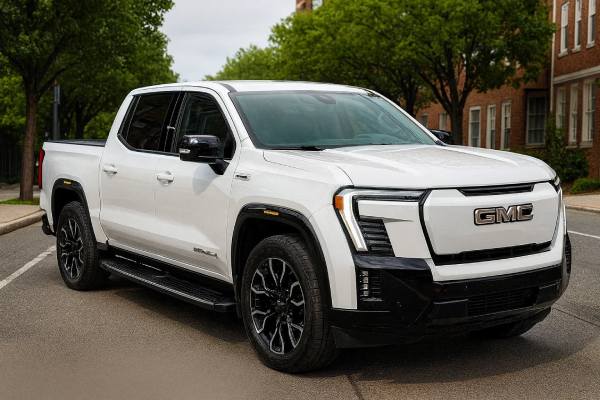
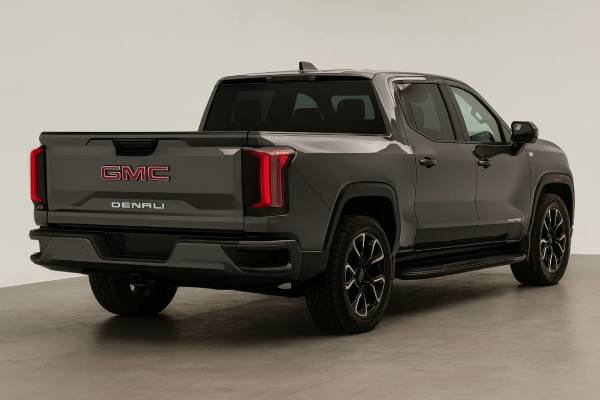
The Sierra EV Elevation Extended Range is the “work-truck usable” version of GMC’s electric pickup idea: big-battery Ultium hardware, dual-motor e4WD, and serious towing and payload targets—without leaning as hard on Denali luxury. In practice, it’s a truck you choose for capability per charge and daily-drive comfort, not for chasing spec-sheet bragging rights.
One thing to know up front: with new EV pickups, some headline numbers are not always formally published at trim level (notably 0–60 mph and top speed) because calibration, wheel/tyre choices, vehicle mass, and software updates can move the result. That doesn’t mean the truck isn’t real or not for sale—it usually means you should treat those figures as tested/verified once media tests and certification listings appear.
What to Know
- Strong dual-motor output and e4WD traction make it feel effortless at real-world speeds, especially when loaded.
- Big-pack Ultium + 800 V architecture is built for long-distance use, not just commuting.
- Expect range to swing noticeably with speed, cold weather, and towing—plan charging around highway reality, not best-case claims.
- Budget for tyres: heavy EV trucks can eat sets faster if rotations and alignment aren’t kept tight.
- Rotate tyres about every 10,000–12,000 km (6,000–7,500 mi) or sooner with mixed towing and city use.
Explore the sections
- Elevation Extended Range explained
- Specs and measured data
- Trims, packages and ADAS
- Reliability watchlist and recalls
- Maintenance plan and buying tips
- On-road performance and charging
- Rivals and alternatives
Elevation Extended Range explained
This configuration—Sierra EV Elevation + Extended Range + dual-motor e4WD (BT1CG)—targets buyers who want the Sierra EV’s core engineering (big battery, high-voltage fast charging, e4WD traction, and real truck ratings) without paying for every Denali-specific luxury feature.
The “Extended Range” label matters more than the trim badge. For an EV pickup, battery size isn’t only about road-trip distance; it also sets the ceiling for how hard the truck can work without feeling fragile. A larger pack can buffer heat, power demand, and repeated acceleration—especially under towing or high-speed driving. It also makes the truck less sensitive to headwinds, cold temperatures, and aggressive tyres. The tradeoff is mass: a big battery adds weight, and weight affects braking distances, tyre wear, and efficiency at highway speeds.
You’ll also hear “Ultium” used as shorthand. What matters day-to-day is that the platform supports high-power DC charging (thanks to an 800 V architecture on these trucks) and a battery thermal system designed for repeated fast charging and heavy-duty use. If you plan to road-trip or tow, that charging and thermal stability can be more important than the headline maximum range number.
A key ownership reality: GMC/GM may publish range, towing, payload, charging peak power, and feature availability before they publish trim-specific acceleration and top speed. Acceleration can vary by tyre, temperature, battery state-of-charge, and software. Top speed is often electronically limited and may not be presented as a marketing bullet for a full-size truck. If you need those numbers for comparison, use verified testing (instrumented media runs) once available, and treat early “expected” values as estimates.
Is it really on sale? Sierra EV as a product line is a retail vehicle, and GM has delivered Sierra EVs to customers. For Elevation specifically, availability can be model-year and production-timing dependent. The smart approach is to treat “on sale” as: orderable and deliverable in your market, not just announced. In North America, these trims have been publicly introduced with stated specs and pricing structure, and you can typically verify live availability through GMC’s build, price, and inventory tools.
Specs and measured data
Below are the best-available specifications for the Sierra EV Elevation Extended Range (BT1CG), dual-motor e4WD, 645 hp. Where GM has not published a trim-specific number (common for acceleration and top speed), the table clearly states Not published and provides a realistic expectation only when it’s useful for planning.
Powertrain, battery, and efficiency
| Item | Specification |
|---|---|
| Code | BT1CG (platform/program code as commonly referenced for Sierra EV) |
| Motor | Dual-motor e4WD (front + rear drive units); motor type not consistently published by trim |
| Max power | 645 hp (≈481 kW) |
| Max torque | Not consistently published by trim (expect high 4-digit Nm class at the wheels via reduction gearing) |
| High-voltage architecture | 800 V class (supports high-power DC fast charging) |
| Battery chemistry | Not publicly confirmed at trim level (Ultium packs are typically NMC-based in this segment) |
| Traction battery capacity (gross/usable) | Not officially disclosed for Elevation Extended Range; industry expectation is a very large pack (~200 kWh class) |
| Thermal management | Liquid-cooled battery and power electronics (expected for Ultium trucks); heat-pump availability varies by equipment/market |
| Efficiency / test standard | EPA/WLTP figures depend on certification for the exact model year/trim |
| Rated efficiency | Not published here without confirmed certification listing |
| Rated range | GM-estimated range is often released before EPA/WLTP certification for new trims |
| Real-world highway @ 120 km/h (75 mph) | Expect a meaningful drop vs city/mixed; plan conservatively for road trips |
Driveline and charging
| Item | Specification |
|---|---|
| Transmission / drive unit | Single-speed reduction drive units (typical for dual-motor EV pickups) |
| Drive type | e4WD (electric AWD: powered front + rear axles) |
| Charging connector (AC) | J1772 (North America typical; market-dependent) |
| Charging connector (DC) | CCS1 (North America typical; market-dependent) |
| Onboard charger (AC) | kW rating varies by equipment/market (often 11.5 kW class on GM EVs) |
| DC fast-charge peak | Up to ~300 kW class (trim and conditions dependent) |
| Typical DC charging curve | Peak power is brief; average over 10–80% is typically far lower on very large packs |
| Replenishment time | DC 10–80%: plan roughly 35–50 min depending on conditions and charger; AC 0–100%: typically overnight on Level 2 |
| Battery preconditioning | Expected (often triggered by navigation to a fast charger; availability varies by software/market) |
| Bidirectional capability | V2L-style export and onboard power availability depends on equipment (some configurations offer multi-kW export) |
Performance and capability
| Item | Specification |
|---|---|
| Acceleration 0–100 km/h (0–62 mph) | Not published for this trim; expect roughly mid-4s to low-5s seconds depending on mass/tyres and state-of-charge |
| Acceleration 0–60 mph | Not published for this trim (instrumented tests will vary) |
| Top speed | Not published (EV pickups are commonly speed-limited) |
| Braking distance | Not published; strongly tyre- and weight-dependent |
| Towing capacity | Published figures vary by equipment; verify the door label and tow package details for your VIN |
| Payload | Published figures vary by equipment; verify the door label for your truck |
Chassis and dimensions (high-level)
| Item | Specification |
|---|---|
| Suspension (front/rear) | Independent front; rear layout varies by platform design (EV pickup-specific) |
| Brakes | 4-wheel discs (typical); exact rotor sizes vary |
| Wheels/Tyres | Package-dependent (tyres materially affect range and noise) |
| Ground clearance | Package-dependent; AT4 typically higher than Elevation |
| Length / Width / Height | Varies by configuration; EV pickup packaging increases curb mass and often increases width |
| Turning circle | Not consistently published by trim |
| Kerb (curb) weight | Very high vs ICE Sierra; exact number depends on pack, wheels, and options |
Safety and driver assistance
| Item | Specification |
|---|---|
| Crash ratings | Often not immediately available for newly introduced EV trims; check the latest official listings for your model year |
| ADAS suite | AEB, lane assist, adaptive cruise availability varies by package; hands-free systems depend on option content and region |
Electrical
| Item | Specification |
|---|---|
| 12 V battery | Present (supports vehicle low-voltage systems); replacement window depends on climate and usage |
| OTA updates | Supported for many vehicle modules; frequency depends on region and software program |
Fluids and service capacities (decision-grade)
| Item | Specification |
|---|---|
| Battery/power electronics coolant | GM-approved coolant specification required; capacity varies by loop design |
| Brake fluid | DOT rating specified on the reservoir cap; service interval varies by market guidance |
| A/C refrigerant | Type and charge listed on underhood label |
| Key torque specs | Wheel fastener torque varies by wheel type; always follow the door/underhood/service documentation for your VIN |
Why some numbers are “Not published”: Acceleration, braking, and top speed can change with tyre compound, wheel size, software calibration, temperature, and battery condition. Manufacturers often prioritize publishing range, towing, payload, charging capability, and feature content first because those are the most stable, certifiable, and ownership-relevant.
Trims, packages and ADAS
Think of Elevation as the trim that lets you “buy the platform” without buying every premium finishing touch. The core value is the same Ultium-based electric truck architecture, then you choose how much comfort, towing hardware, and driver assistance you want layered on top.
Trims and options that matter mechanically
For Sierra EV buyers, the most meaningful “options” are not cosmetic. They change how the truck drives, charges, and works:
- Battery/range configuration: Standard vs Extended Range will typically influence curb weight, real-world highway range, and charging session length. If you do frequent long trips, the Extended Range pack usually pays back in fewer charging stops and less range anxiety in winter.
- Wheel and tyre package: Larger wheels and aggressive tyres look right on a full-size truck, but they can cut range and add road noise. If range matters, prioritize an efficiency-focused tyre and rotate often.
- Tow package content: EVs tow brilliantly at low speeds, but towing range can drop sharply. Choose the package that adds the cooling, hitch rating, and trailer tech you actually use (brake controller, tow mirrors, and trailer camera integration where offered).
- Onboard power and export: Some configurations offer multi-kilowatt power output for jobsite tools, camping, or emergency backup. Confirm the outlet types (120 V/240 V) and maximum kW for the exact build.
Interior and usability “tells”
If you’re shopping used or comparing listings, the easiest way to identify a build is to look for:
- Wheel size/tyre spec on photos (often reveals range intent).
- Tow hardware presence (receiver, integrated trailer connectors).
- Driver-assist hardware cues (camera placement and trim-level feature lists).
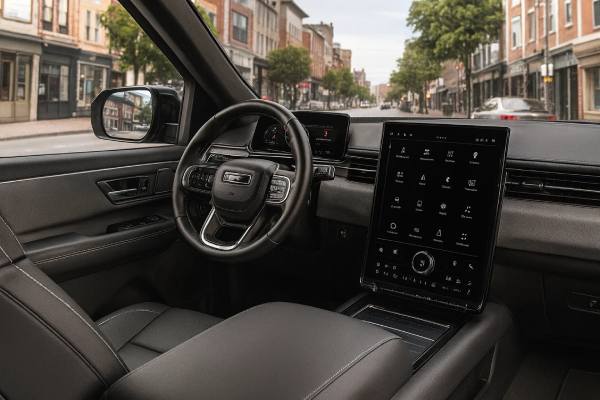
- Interior screen and seating configuration, which often correlates with option groups.
Safety ratings and what to expect
New EV trims sometimes launch before formal ratings are widely published or easy to find. That doesn’t mean the truck is unsafe—it usually means the testing bodies haven’t published a result for that exact configuration or model year. Practical advice:
- Treat standard safety equipment lists (airbags, stability control, AEB) as the baseline.
- Verify trim-level ADAS content: many brands make AEB standard but keep adaptive cruise, lane centering, or hands-free highway driving tied to packages.
- Confirm headlight performance if you drive rural roads; lighting varies a lot by package.
ADAS and calibration implications
Modern trucks rely on camera and radar alignment. After windshield replacement, bumper repair, or suspension work, you may need recalibration. Budget for it and insist it’s done correctly—miscalibration can create false alerts, degraded lane support, or inconsistent adaptive cruise behavior. Also, because EV trucks receive OTA updates, the “feel” of regen, one-pedal behavior, and even charging behavior can change slightly over time. Keep software current, but don’t ignore new warning messages—log them and have the dealer verify updates and fault codes.
Reliability watchlist and recalls
Because the Sierra EV platform is still early in its lifecycle, reliability is best approached as a watchlist: which issues are most likely, how expensive they are, and what symptoms you should treat as urgent. The good news is that EV powertrains remove many classic truck failure points (multi-speed transmissions, complex emissions hardware). The challenging part is that EVs introduce high-voltage components, software dependencies, and charging hardware that can fail in unfamiliar ways.
Common (low to medium severity)
- Software glitches and warnings
Symptoms: intermittent alerts, infotainment freezes, driver-assist unavailable messages, charge-session interruptions.
Likely cause: software bugs, module communication faults, or calibration mismatches after updates/repairs.
Remedy: verify software is current; document when it happens; dealer scan for stored codes; update/reflash as advised. - Charge port and latch sensitivity
Symptoms: trouble initiating a DC session, “check charge port” messages, inconsistent locking.
Likely cause: port latch alignment, debris/moisture, cable fit differences among networks.
Remedy: inspect seals and latch, keep port clean/dry, use known-good cables, dealer inspection if repeated. - Tyre wear and alignment drift
Symptoms: inner-edge wear, vibration, tramlining, noise increase.
Likely cause: heavy curb weight + high torque + imperfect alignment from potholes/curbs.
Remedy: rotate frequently, align early, keep pressures correct, consider a less aggressive tyre if range matters.
Occasional (medium to high severity)
- Thermal system faults (coolant pumps, valves, sensors)
Symptoms: reduced power, slow DC charging, HVAC weirdness, persistent thermal warnings.
Likely cause: sensor fault, valve/pump issue, or trapped air after service.
Remedy: dealer diagnostics; ensure correct coolant type and proper bleeding procedures. - 12 V battery weakness (EV-specific pattern)
Symptoms: weird electronic behavior, no-start conditions, random module errors.
Likely cause: low-voltage battery degradation, sometimes accelerated by short-trip usage patterns and accessory loads.
Remedy: load test, replace if weak, keep software updated (charging strategy can be refined over time).
Rare but important (high severity)
- High-voltage isolation faults or moisture ingress
Symptoms: “service high voltage system,” limited propulsion, no-charge conditions.
Likely cause: connector sealing issue, damaged harness, moisture intrusion.
Remedy: urgent dealer service; avoid repeated reset cycles.
Recalls, TSBs, and “service actions”
For brand-new trims, bulletin activity can evolve quickly. Your process matters more than memorizing lists:
- Run an official VIN check before purchase and after major service.
- Ask for documentation that updates and service actions were completed.
- Prioritize fixes related to charging, thermal control, and safety systems.
Pre-purchase checks (high value)
- Battery health and usable range at a consistent SOC (for example, 80%).
- DC charging behavior: does it hold power, or taper early due to temperature or faults?
- Port condition: seals intact, latch consistent, no corrosion.
- Underbody inspection: look for damaged shields, impact marks near the pack enclosure, and corrosion around fasteners.
- Suspension noise: heavy EV trucks can develop clunks if bushings or links loosen.
As the platform matures, the reliability story usually becomes clearer through patterns in dealer bulletins and official databases. Until then, treat early ownership like owning a high-tech truck: stay updated, document issues, and avoid ignoring warning messages that repeat.
Maintenance plan and buying tips
EVs reduce routine service, but they don’t eliminate maintenance—especially on a heavy, powerful pickup. The goal is to protect the expensive stuff (battery, drive units, charging hardware) and the consumables that wear faster (tyres, brakes in rust-prone climates, suspension components).
Practical maintenance schedule (typical planning baseline)
Use this as a planning guide, then verify against your official documentation for your VIN and market:
- Tyre rotation: every 10,000–12,000 km (6,000–7,500 mi); sooner with towing or aggressive driving.
- Alignment check: at least once per year, and immediately after a hard pothole hit or new tyre set.
- Brake inspection: every 20,000 km (12,000 mi) or annually. EV regen reduces pad wear, but corrosion can increase in wet/salty areas.
- Brake fluid: commonly every 2–3 years (time-based); confirm the official interval.
- Cabin air filter: every 20,000–30,000 km or 12 months, more often in dusty regions.
- Wiper blades and washer fluid: as needed; heavy trucks tend to collect grime fast.
- 12 V battery test: annually after year 2; replacement is often needed around 3–5 years depending on climate.
- Coolant loops (battery/drive unit/power electronics): typically time-based (often 5 years class intervals), but always follow the official schedule and correct coolant spec.
Fluids, consumables, and “don’t guess” items
- Coolant: only use the GM-approved coolant type for your truck. Mixing types can create deposits and thermal problems.
- Brake fluid: follow the DOT spec on the cap; moisture contamination is the enemy.
- Tyres: choose a load-rated tyre appropriate for the truck’s weight and your towing needs. Some “efficient” tyres can feel squirmy under heavy loads.
Torque values and service realities
It’s tempting to treat torque specs as universal. Don’t. Wheel fastener torque can change by wheel design and hardware. A safe approach:
- If you do wheel swaps, insist the shop uses the manufacturer torque spec for your VIN and re-torques after 80–160 km (50–100 mi).
- If you tow often, check hitch hardware and accessory mounts periodically.
Buyer’s guide: how to shop a used Sierra EV
- Verify configuration: make sure the listing truly matches “Elevation Extended Range” and not a different battery/trim.
- Confirm charging behavior: a healthy truck should initiate DC sessions reliably and not throw repeated port errors.
- Check battery health the practical way: compare displayed range at a known SOC and temperature; don’t obsess over one number—look for consistency.
- Inspect underbody and pack area: avoid trucks with crushed shields, torn aero panels, or impact marks near the pack.
- Look for tyre story: uneven wear can indicate suspension or alignment problems; a new set of tyres may hide the evidence if you don’t inspect carefully.
Long-term durability outlook
A well-managed large-pack EV truck can age very well if it avoids repeated high-heat abuse. The biggest long-term cost risks tend to be tyres, suspension wear, and out-of-warranty high-voltage component repairs, not oil leaks and transmissions. If you plan to keep it a long time, prioritize gentle fast-charging habits (avoid constant 0–100% DC sessions), keep the thermal system healthy, and treat software updates as maintenance—not as optional.
On-road performance and charging
A dual-motor Sierra EV with this power level delivers performance differently than an ICE truck. The sensation is less about engine drama and more about instant, silent shove—especially from 20–80 mph (30–130 km/h), where EV torque makes passing and merging feel easy even with passengers or cargo.
Ride, handling, and NVH (noise, vibration, harshness)
The battery’s low mounting helps body control, but the truck’s mass is always present. Expect a stable, planted feel on the highway with less powertrain vibration than a V8 truck. Around town, the biggest ride differences come from wheel/tyre choice: larger wheels and aggressive tyres can add sharpness over potholes and more road roar at speed.
Steering tends to be light-to-moderate and consistent. What you may notice more is brake blending: the transition from regenerative braking to friction brakes. A well-calibrated system feels natural, but it can feel grabby if you’re not used to regen or if the truck is on a slippery surface. Take time to learn the drive modes and regen settings so you can be smooth in traffic and confident in winter.
Acceleration and “why it’s hard to pin down”
For this trim, acceleration is often not published as a single official figure. Real results will depend on:
- Battery state-of-charge (many EVs are quickest above ~50–60% SOC).
- Battery temperature (cold pack = less power until warmed).
- Tyres and wheel size (traction and rotational inertia matter).
- Software calibration and traction control strategy.
In everyday use, the truck will feel quick, and the key advantage is repeatability at normal speeds. Where you’ll feel the limits is repeated maximum-power launches or high-speed pulls in hot weather, where thermal control becomes the deciding factor.
Real-world efficiency and range: plan like an owner
For any big EV truck, the most honest range guidance is scenario-based:
- City/mixed driving: best case, because regen helps and speeds are lower.
- Highway at 120 km/h (75 mph): biggest range hit; aerodynamics dominate.
- Cold weather: HVAC use and cold battery reduce range; preconditioning helps.
- Towing: range can drop dramatically; plan stops around trailer-friendly chargers.
If you road-trip, build your plan around the idea that you’ll often charge from 10–80% rather than chasing 100%. That keeps sessions shorter and makes better use of the charge curve.
Charging performance in daily life
- Home charging (AC): For a battery this large, Level 2 charging is an overnight-to-next-day proposition, not a quick top-up. The practical approach is to charge routinely to a daily target (often 70–85%) and only go higher before long trips.
- DC fast charging: Peak kW numbers are attention-grabbers, but average power is what determines stop length. On large packs, the truck can accept high power early, then taper. Preconditioning the pack before arriving at a charger is one of the biggest “hidden” improvements to real-world charge times.
If you regularly tow or drive fast, choose charging stops with headroom: higher-power stations, reliable networks, and layouts that won’t trap you with a trailer.
Rivals and alternatives
The Sierra EV Elevation Extended Range sits in a growing field of electric pickups, and the “best” alternative depends on whether you prioritize towing, efficiency, size, or charging convenience.
Ford F-150 Lightning
Lightning is often easier to live with in tight spaces and can be a strong value, especially on the used market. It’s excellent around town and for home backup power setups. The tradeoff is usually less highway range when pushed hard, and charging performance can vary by version.
Rivian R1T
R1T feels more like a performance SUV in pickup form—quick responses, agile handling, strong software integration. It’s typically smaller than full-size trucks and may not match the Sierra EV’s full-size work-truck posture for towing and payload scenarios. If you want a “fun daily” that’s also a truck, Rivian stays near the top.
Tesla Cybertruck
Cybertruck brings strong performance variants and access to Tesla’s charging ecosystem in many regions, which can reduce road-trip stress. The downsides are styling/polarization, some practicality compromises depending on use case, and the learning curve of a very different interior and control layout.
Chevrolet Silverado EV (platform cousin)
Silverado EV is the closest sibling in hardware philosophy. Cross-shop it if you want similar Ultium truck fundamentals but different trim strategy, styling, or pricing. In many cases, availability and incentives can swing the decision.
Ram 1500 REV (and other upcoming trucks)
If you’re shopping new and can wait, upcoming competitors may shift pricing and feature content quickly. The caution is timing: announced specs are not the same as delivered, fully tested vehicles.
How to choose quickly
- Buy the Sierra EV if you want full-size truck presence + big-battery road-trip intent + GMC feature mix.
- Choose Lightning for value and simplicity, especially if your driving is mostly local.
- Choose Rivian for agility and “premium tech” feel in a smaller package.
- Choose Tesla if charging network convenience and performance variants dominate your priorities.
References
- 2026 GMC Sierra EV adds AT4 and Elevation trims 2025 (Manufacturer release)
- 2024 GMC Sierra EV Denali Edition 1 hits the streets 2024 (Manufacturer release)
- GMC Owners | Vehicle Warranty and Protection Plans 2025 (Owner information)
Disclaimer
This article is for informational purposes only and is not a substitute for professional diagnosis, repair, or safety inspection. Specifications, torque values, service intervals, charging behavior, and procedures can vary by VIN, market, model year, software version, and installed equipment. Always confirm details using your official owner documentation and service information for your specific vehicle.
If you found this guide useful, please consider sharing it on Facebook, X/Twitter, or your favorite forum to support our work.