
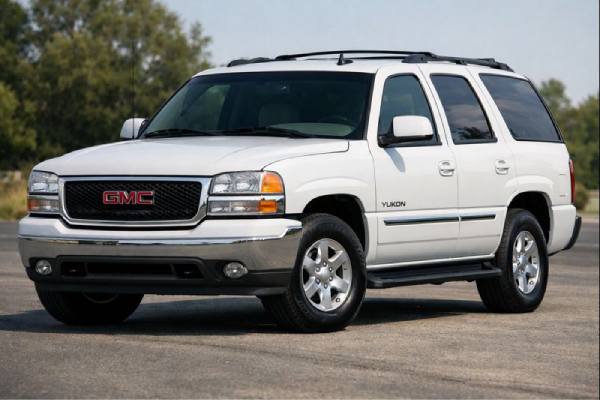
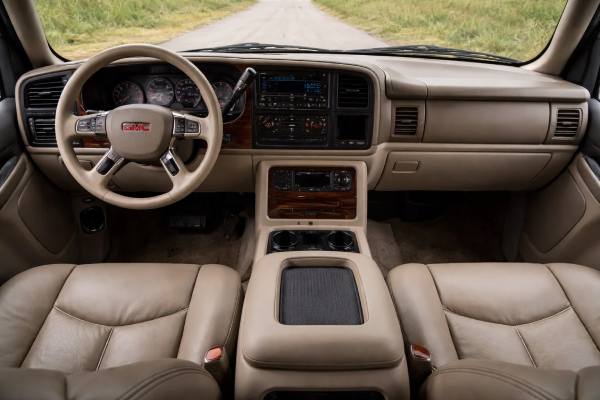
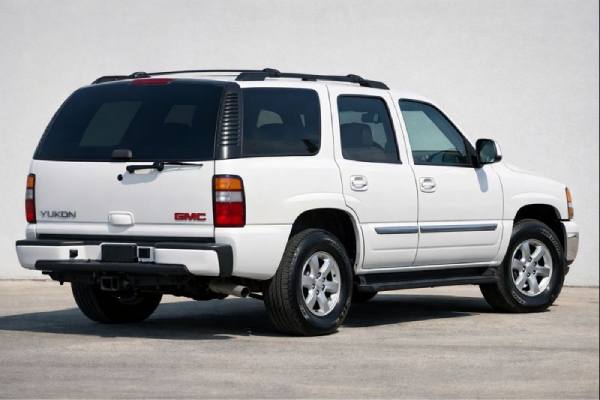
A 2000–2006 GMC Yukon RWD on the GMT800 platform is a classic full-size, body-on-frame SUV built from GM’s truck parts bin—simple layout, strong towing manners, and easy access to repairs. With the LM7 5.3L V8 rated at 285 hp in this configuration, you get the drivetrain many owners consider the “sweet spot”: enough torque for daily use and moderate towing, without the added complexity of 4WD components. RWD also makes the truck lighter, a bit more efficient, and cheaper to maintain over time. The ownership experience is usually decided by fundamentals rather than fancy tech: transmission temperature control, a tight front end, healthy cooling, and consistent fluid service. Buy on condition and records, not just mileage. When maintained and kept stock-ish on tire size, this Yukon can deliver long-term durability, comfortable road manners, and straightforward DIY friendliness—exactly what many shoppers want from a full-size SUV of this era.
Owner Snapshot
- Strong, proven truck platform with wide parts availability and straightforward repairs
- LM7 5.3L delivers better everyday torque than the 4.8L while staying simple (port injection, timing chain)
- RWD layout reduces driveline complexity and long-term maintenance compared with 4WD versions
- Plan for front suspension and steering wear as the truck ages (alignment and tire wear are your early warning signs)
- Change engine oil about every 8,000–12,000 km (5,000–7,500 mi) or 6 months, depending on use
Navigate this guide
- LM7 Yukon RWD fundamentals
- Specs for LM7 5.3
- Trims, tow gear, and safety
- What breaks and why
- Maintenance roadmap and buying tips
- Real driving and fuel use
- Shopping alternatives to the Yukon
LM7 Yukon RWD fundamentals
The GMT800 Yukon is a truck-first design: a full frame under the body, independent front suspension, and a solid rear axle. That recipe brings two ownership advantages that still matter today. First, the structure tolerates rough roads and heavy use better than many car-based SUVs from the same era. Second, the components are serviceable in a traditional way—separate frame and driveline pieces, lots of room under the hood, and a huge supply of replacement parts.
In RWD form, the Yukon keeps the same core strengths while trimming complexity. There’s no transfer case, front differential, front driveshaft, or CV axles to maintain. That doesn’t make it “maintenance-free,” but it reduces the number of wear points and the number of places leaks and vibrations can develop over time. If you live in a mild climate or you don’t need off-road traction, RWD is often the most cost-effective way to own a GMT800.
The LM7 5.3L V8 is part of GM’s Gen III small-block family. Practically, that means an iron block, pushrod valvetrain, port fuel injection (PFI), and a timing chain. It’s not exotic, but it’s durable and forgiving if you keep up with basics: oil changes, cooling system health, and addressing small leaks before they become big ones. The 285 hp rating in this configuration also translates to a useful everyday advantage: the Yukon doesn’t have to work as hard during merges, hill climbs, or when carrying passengers and cargo. That can reduce constant downshifting, which is easier on the transmission—especially if the truck has tall axle gearing.
Because these Yukons are now older vehicles, the “feel” on a test drive is a major clue. A good one should track straight, brake confidently, and shift without flare or hesitation. If the steering feels vague or the truck wanders, it’s usually not “just how trucks drive.” It’s often worn steering linkage, tired shocks, or wheel hub play—fixable, but important for safety and tire costs.
Specs for LM7 5.3
The specifications below focus on a 2000–2006 GMC Yukon 1500 RWD with the LM7 5.3L V8 rated at 285 hp. Exact figures can vary by year, axle ratio, tire size, and option content, so use this as a practical baseline and confirm with your VIN and RPO codes.
Engine and performance
| Item | Spec |
|---|---|
| Code | LM7 (Vortec 5300, Gen III) |
| Engine layout and cylinders | V8, OHV pushrod, 2 valves/cyl |
| Displacement | 5.3 L (5,328 cc) |
| Bore × stroke | 96.0 × 92.0 mm (3.78 × 3.62 in) |
| Induction | Naturally aspirated |
| Fuel system | Sequential MPFI (port injection) |
| Compression ratio | ~9.5:1 (varies slightly by year/calibration) |
| Max power | 285 hp (213 kW) @ ~5,200 rpm |
| Max torque | ~441 Nm (325 lb-ft) @ ~4,000 rpm |
| Timing drive | Chain |
| Emissions / efficiency standard | EPA (North America) |
Transmission and driveline
| Item | Spec |
|---|---|
| Transmission | 4-speed automatic (4L60-E family) |
| Gear ratios | 1st 3.06 / 2nd 1.63 / 3rd 1.00 / 4th 0.70 / Rev 2.29 |
| Final drive ratio | Commonly 3.42 or 3.73 (verify RPO) |
| Drive type | RWD |
| Differential | Usually open; G80 locker depends on build content |
Chassis and dimensions
| Item | Spec |
|---|---|
| Suspension (front/rear) | Independent torsion-bar front / solid axle rear with coil springs and links |
| Steering | Power steering, recirculating ball; ratio varies |
| Brakes | 4-wheel disc ABS (sizes vary by year/package) |
| Ground clearance | Around ~200 mm (~8 in), tire- and suspension-dependent |
| Length / width / height | ~5,050 / 2,010 / 1,880 mm (~198.9 / 79.1 / 74.0 in) |
| Wheelbase | ~2,946 mm (~116.0 in) |
| Turning circle | ~12.3 m (~40 ft), varies |
| Curb weight | Often ~2,250–2,450 kg (~4,960–5,400 lb), build-dependent |
| Fuel tank | ~98 L (26 US gal / 21.6 UK gal) |
Performance and capability
| Metric | Typical range (stock, condition-dependent) |
|---|---|
| Acceleration 0–100 km/h (0–62 mph) | ~9–10.5 s |
| Top speed | ~165–175 km/h (103–109 mph), gearing-limited |
| Braking 100–0 km/h (62–0 mph) | Often ~44–50 m (~144–164 ft), tire and brake dependent |
| Towing capacity | Commonly ~3,400–3,600 kg (7,500–8,000 lb) with tow package and proper axle ratio |
| Payload | Often ~600–750 kg (1,300–1,650 lb), trim-dependent |
Fluids and service capacities
| Item | What matters | Notes |
|---|---|---|
| Engine oil | Correct viscosity and quality filter | Typical fill ~5.7 L (6.0 US qt) with filter |
| Coolant | Correct long-life coolant type and mix | Capacity varies; verify service info |
| Transmission/ATF | Heat management and correct spec | Pan service is less than total fill |
| Rear differential oil | Correct gear oil for axle | Shorten interval if towing or water exposure |
| A/C refrigerant | Correct type and charge | Verify under-hood label |
Electrical and key torque specs
| Item | Spec (typical) |
|---|---|
| Alternator output | Often ~105–145 A (varies by equipment) |
| 12V battery | Commonly Group 78; CCA varies by brand |
| Spark plug gap | Often ~1.0 mm (0.040 in), verify for your plug and year |
| Wheel lug nuts | ~190 Nm (140 lb-ft) |
Trims, tow gear, and safety
For a GMT800 Yukon, “trim” matters most when it changes hardware: axle ratio, cooling, tow equipment, and brake/wheel packages. A clean RWD LM7 truck can be a comfortable family SUV, a highway commuter, or a weekend tow rig—but only if it has the right supporting equipment.
Trims and option packages that affect capability
- Tow package (high priority): Look for a factory receiver, integrated wiring, and evidence of added cooling. On these trucks, cooling is not just for comfort—transmission temperature is one of the biggest predictors of long-term drivetrain life.
- Axle ratio choice: With the 5.3L, a 3.73 ratio usually feels more responsive and reduces hunting on grades compared with a 3.42, especially with passengers or a trailer. If you plan to tow, the axle ratio can matter as much as engine size.
- G80 locking rear differential (when equipped): On a RWD Yukon, a locker can be a real advantage in rain, light snow, or steep gravel driveways. It’s not a substitute for winter tires, but it can reduce one-wheel spin and improve launch stability.
- Wheel and tire packages: Large aftermarket wheels and heavy all-terrain tires can increase steering wear and reduce fuel economy. If your goal is durability and comfort, stock-style sizes are usually the smarter long-term choice.
Interior and seating configurations
You’ll see 7–9 passenger setups depending on second-row bench vs captain’s chairs and third-row equipment. Check the practical details that affect daily use:
- Third-row latches and seatbelts function smoothly
- Rear HVAC (if equipped) blows cold and hot without odd noises
- Power seat tracks move evenly (binding can hint at water intrusion or worn mechanisms)
Safety ratings and what they mean here
These Yukons were engineered before modern driver assistance became common. Some model years and configurations have public crash-test results, while others may have limited data. The important ownership move is to look up your exact model year in official databases rather than relying on generalized claims.
Safety systems to verify on a 2000–2006 Yukon
- Airbags and SRS health: Confirm the airbag light illuminates at key-on and goes out normally. A lit or missing bulb is a red flag.
- ABS function: Make sure the ABS light is off and the brakes feel consistent and straight under firm stops.
- Child-seat anchors: Verify tether anchors and lower anchors are present and not damaged if this is family transport.
- Stability and traction systems: Availability varies by year and build. If equipped, confirm the system engages and the warning lights behave correctly.
What breaks and why
Most GMT800 ownership costs come from wear, not mystery. The smart approach is to anticipate the common failure points, recognize early symptoms, and fix issues before they cascade into bigger repairs. Below is a practical map of what tends to fail on a RWD LM7 Yukon, organized by prevalence and cost tier.
Common issues (high prevalence)
- Front steering and suspension wear (medium cost, high payoff):
Symptoms: wander at speed, clunks over bumps, steering play, uneven tire wear, brake shimmy.
Likely causes: idler arm, pitman arm, tie rods, ball joints, worn shocks, and sometimes wheel hubs.
Remedy: inspect on the ground (loaded), replace worn parts in matched sets when appropriate, then align. On these trucks, a tight front end transforms safety and comfort. - 4L60-E transmission aging (medium to high cost):
Symptoms: delayed engagement, shift flare, shudder, slipping 3–4, harsh downshifts.
Likely causes: heat, old fluid, valve body wear, tired converter, worn clutches.
Remedy: treat “heat control” as prevention—correct fluid, clean cooler flow, and no towing on marginal transmission behavior.
Occasional issues (still worth budgeting for)
- Knock sensor and harness water intrusion: Can set codes and reduce performance. Fix is usually straightforward but should be done correctly to avoid repeat problems.
- Fuel pump module fatigue: Long crank, stumbling under load, or a no-start can point here.
- Instrument cluster faults: Erratic gauges can mislead you into chasing the wrong diagnosis (for example, “overheating” that’s really a gauge issue).
Cooling, leaks, and age-related rubber
Even a strong LM7 will suffer if the cooling system is neglected. Watch for:
- Coolant smell, damp radiator seams, or crusting at hose connections
- Temperature creeping in traffic or under load
- Aged belts, tensioners, and hoses that look fine until they don’t
Recalls, service bulletins, and how to verify
Rather than guessing which recalls apply, use your VIN:
- Run an official recall lookup.
- Ask for documents showing completion.
- Confirm warning lights (ABS and SRS) work correctly and are not being masked.
A Yukon with consistent fluid services and a documented recall history is usually a safer purchase than a lower-mile truck with no records.
Maintenance roadmap and buying tips
If you want a GMT800 Yukon to feel dependable in 2025 and beyond, maintenance has to be proactive. The goal is to keep lubricants fresh, keep temperatures under control, and stop small problems before they wear out expensive assemblies.
Maintenance schedule you can actually follow
- Engine oil and filter: every 8,000–12,000 km (5,000–7,500 mi) or 6 months. Shorten the interval for short trips, heavy idle time, hot weather, or towing.
- Engine air filter: inspect every oil change; replace about every 24,000–48,000 km (15,000–30,000 mi) depending on dust.
- Cabin air filter (if equipped): every 24,000–32,000 km (15,000–20,000 mi) or annually.
- Coolant: if service history is unknown, baseline it; then follow long-life intervals only after the system is clean and stable.
- Spark plugs: baseline if you don’t have proof. Replace with correct heat range and inspect wires/boots at the same time.
- Transmission fluid: condition-based, but many owners do well with 40,000–80,000 km (25,000–50,000 mi) depending on use and temperature exposure.
- Rear differential fluid: about every 80,000–120,000 km (50,000–75,000 mi), sooner with towing or water exposure.
- Brake fluid: every 2–3 years.
- Tire rotation and alignment checks: rotate every 8,000–12,000 km (5,000–7,500 mi); align after steering work or when wear patterns appear.
Buyer checklist: what to inspect before money changes hands
- Transmission behavior: smooth engagement, no slip, no flare, no burnt smell. A long test drive matters more than a short loop.
- Cooling stability: steady temperature at idle and on a longer climb; heater output consistent.
- Front-end tightness: minimal steering play, no clunks over sharp bumps, no humming wheel-bearing noise.
- Brake and fuel lines (rust regions): corrosion here can turn a “cheap SUV” into a sudden project.
- Electrical sanity: gauges believable, windows and locks consistent, no hack wiring for trailer or audio.
First-month baseline for unknown-history trucks
If records are thin, assume nothing and baseline the big-ticket prevention items: engine oil, transmission service (done correctly), rear diff fluid, brake fluid, cooling system inspection, belts and hoses, and a front-end inspection with alignment. This is the fastest way to turn an old truck into a predictable one.
Real driving and fuel use
A RWD GMT800 Yukon drives like what it is: a full-size truck platform tuned for comfort and stability. When it’s in good shape, the Yukon feels calm at highway speed, absorbs broken pavement well, and doesn’t get pushed around as easily as lighter crossovers. When it’s worn, you feel it immediately—steering play, body float, and braking inconsistency—and those symptoms are usually traceable to specific parts rather than “character.”
Powertrain character with the LM7
The 5.3L’s advantage over the 4.8L is not just peak horsepower—it’s usable torque at everyday rpm. In traffic and on two-lane roads, that usually means fewer wide-open throttle moments and less downshifting. The 4-speed automatic is a simple, durable design when kept cool, but it will show its age if the truck has been driven hard with old fluid. On a test drive, pay attention to 2–3 and 3–4 shifts under light throttle; that’s where early wear often reveals itself.
Ride, handling, and braking feel
- Ride quality: best on stock-style tire sizes and fresh shocks. Oversize tires can make the Yukon feel heavier and less controlled.
- Steering feel: naturally lighter and less direct than modern rack-and-pinion setups, but it should still be steady and consistent.
- Brakes: adequate when maintained, but the truck’s mass means pads, rotors, and fluid condition matter more than on smaller vehicles. If pedal feel is soft, assume brake fluid service is overdue.
Real-world fuel economy expectations
Official EPA estimates for a 2005 Yukon 1500 2WD with a 5.3L and 4-speed automatic appear in multiple calibrations, commonly around 14 mpg city and 19 mpg highway, with some configurations showing 18 mpg highway. In everyday terms:
- City-heavy driving: often feels like 15–20 L/100 km (12–16 mpg US), depending on traffic and trip length
- Highway at 100–120 km/h (60–75 mph): often 13–16 L/100 km (15–18 mpg US) when stock and well maintained
- Towing: expect a noticeable penalty; plan fuel stops early and don’t ignore transmission heat
Advantages of RWD for daily use
If you don’t need 4WD traction, RWD keeps costs down. Fewer driveline parts means fewer fluids, fewer seals, fewer joints to wear out, and fewer opportunities for vibration troubleshooting. Pair that with quality tires suited to your climate and you can have a very usable year-round SUV with lower long-term complexity.
Shopping alternatives to the Yukon
A RWD LM7 Yukon typically competes with other early-2000s full-size SUVs: the Ford Expedition, Toyota Sequoia, and (slightly later) Nissan Armada, plus the wildcard option of buying a similar GMT800 platform vehicle under a different badge (Tahoe, Suburban, Yukon XL). The smartest “rival” often ends up being the best-maintained example, but there are real differences in what you’re buying.
Ford Expedition (RWD/4×4, 4.6/5.4 era)
The Expedition can be a strong family hauler with good space and comfort. Where the Yukon often wins is the size of the GM truck parts ecosystem and the sheer familiarity most independent shops have with GMT800 steering, suspension, and drivetrain service. Where the Expedition can win is in finding a clean, rust-free example with excellent maintenance at the right price—condition still rules the outcome.
Toyota Sequoia (4.7 V8)
Sequoias often command higher prices for their durability reputation. If you’re comparing a Sequoia to a Yukon, compare apples to apples: maintenance history, rust exposure, and driveline behavior. The Yukon’s advantage is usually value and repair accessibility; the Sequoia’s advantage is often long-term consistency when cared for. Either one can be a great buy—either one can be a headache if neglected.
Nissan Armada (5.6 V8, early years)
The Armada offers strong power and towing feel, but it can be more sensitive to parts availability and local specialist knowledge depending on your region. If you’re the type of owner who wants maximum DIY documentation and easy cross-shopping of parts, the GMT800 ecosystem is hard to beat.
The “same platform” alternatives
If you like the GMT800 formula, don’t ignore closely related models. A well-kept Tahoe or Yukon XL can be a better purchase than a rough Yukon simply because maintenance history is stronger or rust is lower. Focus on drivetrain behavior, cooling stability, front-end tightness, and records. That’s what decides whether ownership feels easy or expensive.
References
- GM Owner Manuals 2006 (Owner’s Manual)
- Gas Mileage of 2005 GMC Yukon 2005 (Fuel Economy)
- Check for Recalls: Vehicle, Car Seat, Tire, Equipment | NHTSA 2025 (Recall Database)
- Car Safety Ratings | Vehicles, Car Seats, Tires | NHTSA 2025 (Safety Rating)
Disclaimer
This article is for informational purposes only and is not a substitute for professional inspection, diagnosis, or repair. Specifications, torque values, fluid types, capacities, and service intervals can vary by VIN, market, model year, and installed equipment—verify details using your vehicle’s official owner information and service documentation.
If this guide was useful, please consider sharing it on Facebook, X (Twitter), or your favorite forum or community to support our work.