
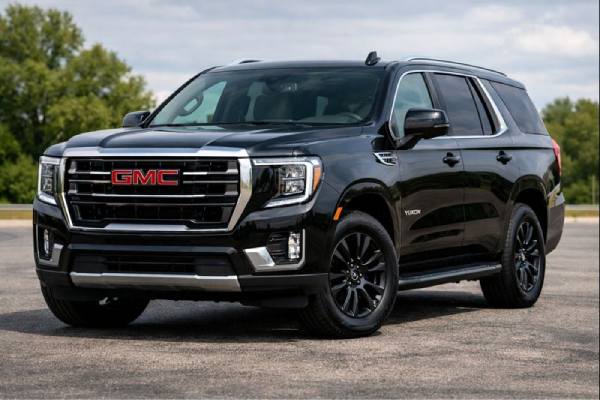
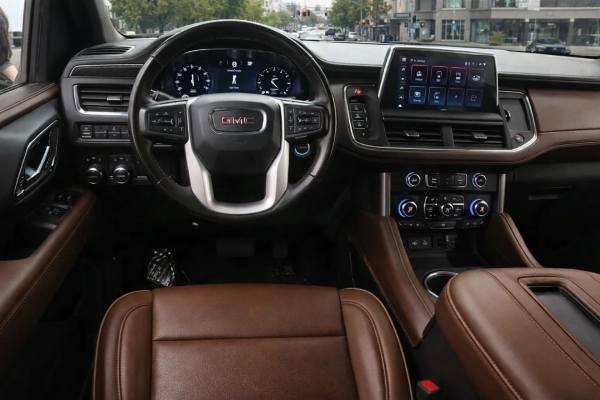
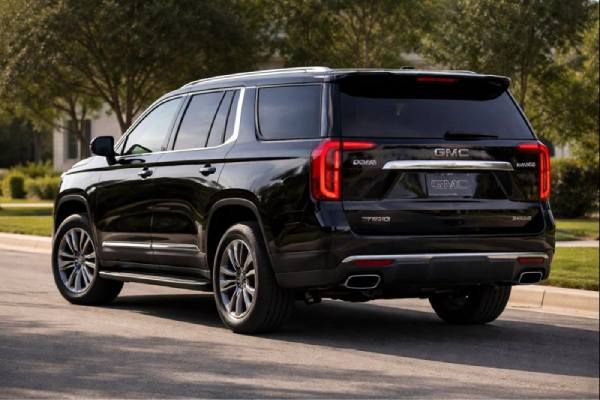
The 2021–2024 GMC Yukon RWD on the T1UG platform is a traditional body-on-frame SUV that still feels modern where it counts: ride control, cabin isolation, and driver-assistance tech. In L84 5.3L form, it leans into smooth, low-stress torque rather than headline acceleration, and the 10-speed automatic keeps the V8 in its comfort zone at highway speeds. RWD is the quietly smart pick for owners who tow on pavement, rack up long-distance miles, or want less driveline complexity than 4WD.
Ownership comes down to two themes: staying ahead of maintenance (especially fluids under towing or heat) and understanding the “new-school” features in an “old-school” layout—Dynamic Fuel Management (cylinder deactivation), a highly networked electrical system, and available air suspension on higher trims.
Owner Snapshot
- Smooth V8 power delivery and stable towing manners suit long highway drives and family hauling.
- RWD keeps weight and complexity down versus 4WD, which can help ride quality and service costs.
- Cabin packaging is a strong point: adult-usable third row and genuinely large cargo volume.
- Plan for occasional high-cost fixes on modern GM V8s (lifter and valvetrain issues can happen).
- Rotate tires about every 12,000 km (7,500 mi) to protect ride quality and keep handling consistent.
Navigate this guide
- 2021–2024 Yukon RWD overview
- L84 5.3 technical specs
- Trims, packages, and safety tech
- Reliability and common problems
- Maintenance plan and buying tips
- Road manners and real efficiency
- Yukon RWD vs key rivals
2021–2024 Yukon RWD overview
Think of the T1UG Yukon as a truck platform refined for everyday comfort. It rides on a body-on-frame structure (shared broadly across GM full-size trucks and SUVs), which is why it can tow with confidence and shrug off rough roads that would beat up a unibody crossover. The tradeoff is size and mass: it is wide, tall, and heavy, so you feel it in tight parking lots and during quick direction changes.
With the L84 5.3L V8, the Yukon’s personality is “effortless” rather than “fast.” Peak power arrives high in the rev range, but most owners live in the midrange, where the engine is quiet and the 10-speed transmission can keep rpm low. On RWD models, power goes to the rear axle only, so traction depends heavily on tire choice. If you live in a winter climate, budget for true cold-weather tires; that single change does more than any drive mode.
Where this Yukon shines is as a long-haul family and towing tool. The third row is adult-usable, and the cargo area is large enough to matter even with all seats up. The independent rear suspension (newer generation versus older Yukons) improves ride compliance and frees up packaging space, especially behind the third row. Higher trims can add adaptive dampers and air suspension, which noticeably smooth out broken pavement and can help keep the vehicle level under load.
Ownership also means understanding how “feature-rich” this Yukon can be. It is packed with cameras, radar, ultrasonic sensors, network modules, and convenience electronics. When everything is healthy, it feels premium. When a weak battery, corroded connector, or outdated software shows up, symptoms can look unrelated—parking sensor warnings, camera dropouts, or driver-assist faults that vanish after a restart. A solid maintenance approach and a careful pre-purchase inspection make a bigger difference here than on older, simpler SUVs.
L84 5.3 technical specs
Below are model-relevant specifications for the 2021–2024 GMC Yukon RWD with the L84 5.3L V8 and 10-speed automatic. Real-world numbers vary with trim, wheels/tires, options, and towing equipment.
Engine and performance
| Item | Spec |
|---|---|
| Code | L84 |
| Engine layout and cylinders | V8, OHV (pushrod), VVT, 2 valves/cyl |
| Bore × stroke | 96 × 92 mm (3.78 × 3.62 in) |
| Displacement | 5.3 L (5,328 cc) |
| Induction | Naturally aspirated |
| Fuel system | Direct injection (DI) |
| Compression ratio | 11.0:1 |
| Max power | 355 hp (265 kW) @ 5,600 rpm |
| Max torque | 519 Nm (383 lb-ft) @ 4,100 rpm |
| Timing drive | Chain |
| Emissions and efficiency standard | EPA (US market) |
| Rated efficiency (EPA, typical) | 14.7 / 11.8 / 13.1 L/100 km (16 / 20 / 18 mpg US) city/hwy/comb |
Transmission and driveline
| Item | Spec |
|---|---|
| Transmission | Hydra-Matic 10L80 10-speed automatic |
| Drive type | RWD |
| Final drive ratio | 3.23 (common on 5.3L RWD) |
| Gear ratios | 1st 4.70, 2nd 2.99, 3rd 2.15, 4th 1.77, 5th 1.52, 6th 1.28, 7th 1.00, 8th 0.85, 9th 0.69, 10th 0.64, Rev 4.87 |
Chassis and dimensions
| Item | Spec |
|---|---|
| Suspension (front/rear) | Independent front coil; independent rear coil (trim-dependent dampers) |
| Steering | Electric power-assisted rack-and-pinion |
| Steering ratio | ~16.6:1 (varies by configuration) |
| Brakes | Four-wheel disc with ABS (rotor sizes vary by trim; base setups commonly ~343 mm (13.5 in) front and 345 mm (13.6 in) rear) |
| Wheels/tires (common) | 18–22 in wheels depending on trim and packages |
| Ground clearance | Approximately 216 mm (8.5 in) on common configurations (varies with tires and suspension) |
| Length / width / height | 5,335 / 2,058 / 1,943 mm (210.0 / 81.0 / 76.5 in) |
| Wheelbase | 3,071 mm (120.9 in) |
| Turning circle (kerb-to-kerb) | 38.1 ft (18 in wheels) to 39.7 ft (20–22 in wheels) |
| Fuel tank | Approx. 91 L (24.0 US gal) |
Performance and capability
| Item | Spec |
|---|---|
| 0–100 km/h (0–62 mph) | Typically ~7.0–7.8 s (trim and tires matter) |
| Top speed | Typically limited around 175–185 km/h (109–115 mph) |
| Towing capacity | Up to 3,810 kg (8,400 lb) when properly equipped; lower without max trailering equipment |
| Payload | Up to ~813 kg (1,792 lb) on some configurations |
| GVWR | Up to ~3,357 kg (7,400 lb) on some configurations |
Fluids and service capacities (verify by VIN)
| Item | Typical spec |
|---|---|
| Engine oil | GM dexos1 (latest spec), commonly 0W-20; capacity often around 7.6 L (8.0 US qt) with filter (varies by cooler and sump) |
| Coolant | GM Dex-Cool (as specified); capacity varies with HVAC and cooling package |
| Transmission | Dexron ULV (10-speed) as specified; service fill differs from total dry fill |
| Differential | Gear oil per GM spec (often 75W-90); limited-slip additives only if equipped |
| Key torque specs | Use GM service information for critical fasteners (lug nuts, caliper brackets, suspension arms) |
Electrical and ignition
| Item | Typical spec |
|---|---|
| Alternator output | Varies by option content (towing, audio, cooling) |
| 12 V battery | Group and CCA vary; many issues trace back to weak batteries in feature-rich builds |
| Spark plugs | Type and gap per GM service information; replacement interval commonly around 160,000 km (100,000 mi) on modern GM V8s |
Safety and driver assistance (availability varies)
| Item | Notes |
|---|---|
| Crash ratings | Configuration-dependent; check NHTSA listing for the exact year and driveline |
| ADAS | AEB, lane support, blind spot monitoring, rear cross-traffic alert (standard/optional depends on trim and packages) |
| Camera systems | Rear camera standard; surround-view and trailering cameras are package-dependent |
Trims, packages, and safety tech
For the 2021–2024 Yukon, trims are less about “powertrain choices” (the L84 is widely available) and more about suspension, towing equipment, interior features, and driver-assistance packaging. For a RWD buyer, the short version is: SLE and SLT are the value trims, while Denali adds comfort, materials, and high-end tech. AT4 is typically aimed at off-pavement use and is commonly tied to 4WD; it is usually not the natural home for a RWD build.
SLE (RWD available) is the entry point and often the best match for owners who care more about capability than luxury. You can still get essential towing equipment, the core infotainment system, and the same basic structure and braking hardware. Watch the wheel and tire package: smaller wheels can ride better on rough roads and cost less to replace.
SLT (RWD available) is where the Yukon starts to feel properly premium. It commonly adds comfort features, upgraded seating and trim, and more package flexibility (panoramic roof, better audio, convenience features). If you plan to keep the vehicle long-term, SLT can be a sweet spot because it feels “complete” without automatically forcing the highest-cost options.
Denali (RWD available) focuses on refinement. Expect more standard features, more available technology, and more sound isolation. In many markets it is also where you’ll find the most advanced driver-assistance options and the most complete camera and trailering tech.
Options that matter for owners
- Max trailering equipment: Look for the hardware, cooling, and integrated trailering features that change tow ratings and stability. If you tow frequently, this package matters more than cosmetic upgrades.
- Adaptive dampers and air suspension (where available): These can improve ride comfort and load leveling. They also increase complexity and long-term repair cost, so weigh comfort against ownership horizon.
- Wheel size: 20–22 inch wheels look great but can reduce impact compliance and raise tire cost. If ride comfort is your priority, keep wheels reasonable and choose tires with a strong load rating.
Safety systems and ADAS considerations
Most Yukons in this era include a baseline set of active safety features, then expand via packages. Common features include automatic emergency braking, forward collision alert, lane keeping support, and blind-spot monitoring. More advanced functions—adaptive cruise control, enhanced lane centering, or hands-free driving systems on supported roads—tend to be trim- and package-dependent.
Two practical ownership points:
- Calibration after repairs: Windshield replacement, alignment work, and front-end repairs can require camera and radar recalibration. Budget time and money for it if you rely on driver assists.
- Sensor cleanliness and tire matching: ADAS can be sensitive to mismatched tires, incorrect alignments, or blocked sensors (snow, mud, heavy rain). Keeping the basics right prevents many “ghost” warnings.
Reliability and common problems
A modern Yukon is reliable in the “big systems” sense—strong frame, proven transmission family, and a V8 that is not stressed for output. Most problems owners report are a mix of (1) modern emissions and fuel management complexity, and (2) the sheer number of electronic modules. Below is a practical way to think about issues by prevalence and cost tier, focusing on the L84 5.3L RWD configuration.
Common (watch closely)
- Intermittent electrical warnings (low to medium cost)
Symptoms: random alerts, camera dropouts, parking sensor faults, start-stop oddities, infotainment resets.
Likely root cause: weak 12 V battery, poor ground, module software needing updates, or connector issues.
Remedy: battery test with proper load and conductance tools, check grounds, scan for network codes, apply dealer updates where relevant. - Ride and tire-related vibration (low to medium cost)
Symptoms: steering wheel shimmy at 90–110 km/h (55–70 mph), droning, “seat vibration.”
Likely root cause: tire balance, tire uniformity, bent wheel, or alignment drift; larger wheels can amplify it.
Remedy: road-force balance, inspect wheel runout, verify alignment, rotate tires on schedule.
Occasional (can be expensive)
- Dynamic Fuel Management lifter and valvetrain issues (high cost)
Symptoms: ticking, misfire codes, rough running, loss of power, check-engine light—sometimes more noticeable after lots of short trips.
Likely root cause: lifter collapse, oil control issues, or component wear in the cylinder deactivation hardware.
Remedy: diagnostic confirmation (misfire counters, compression/leak-down where needed), then component replacement; in some cases, updated parts or calibration. - 10-speed shift quality complaints (medium cost)
Symptoms: harsh 1–2, flare, delayed engagement, or inconsistent downshifts.
Likely root cause: adaptive learning out of range, old fluid under severe duty, or calibration needs; rarely, internal wear.
Remedy: scan for TCM codes, verify fluid condition and level, apply updates, perform relearn procedures; fluid service under severe use helps.
Rare (but notable)
- Rear axle or driveline noise (medium to high cost)
Symptoms: whine on decel, clunk on takeoff, vibration under load.
Likely root cause: gear pattern issues, worn U-joints, or mount wear.
Remedy: confirm with road test and chassis ears; repair depends on the source.
Recalls, service actions, and how to verify
Even if your specific Yukon drives perfectly, you should treat recall and service-action verification as part of ownership. The correct workflow is:
- Run the official VIN recall check and review dealer service history printouts.
- Ask for proof of completion (repair order numbers, dates, mileage).
- Confirm software campaigns were applied, especially if the vehicle has ADAS packages.
If you are shopping used, request a scan report and match it to the build: many “issues” are simply features the vehicle does not have, or they trace back to a weak battery rather than a failed module.
Maintenance plan and buying tips
The Yukon rewards owners who service it like a working truck—especially if you tow, idle often, or drive short trips. Below is a practical schedule that fits most mixed-use owners, with “severe duty” notes where it matters. Always confirm exact fluids, capacities, and torque values for your VIN and equipment.
Practical maintenance schedule (distance and time)
- Engine oil and filter: follow the oil life monitor, or 12 months / ~12,000 km (7,500 mi) as a simple baseline.
- Severe use (heavy towing, lots of idling, short trips): shorten intervals.
- Tire rotation: every 12,000 km (7,500 mi); check alignment annually or when tires show uneven wear.
- Engine air filter: inspect every 24,000 km (15,000 mi); replace as needed (dusty areas may be much sooner).
- Cabin air filter: every 24,000–36,000 km (15,000–22,500 mi) depending on environment.
- Brake inspection: at every tire rotation; measure pad and rotor condition rather than guessing.
- Brake fluid: about every 3 years (or sooner in humid climates/heavy mountain use).
- Coolant: follow GM’s interval for Dex-Cool systems; many owners treat 5 years as a sensible time-based checkpoint.
- Spark plugs: commonly around 160,000 km (100,000 mi); sooner if misfires or drivability issues appear.
- Transmission fluid:
- Light duty: periodic checks; service intervals vary by duty cycle.
- Towing, high heat, frequent city use: consider proactive servicing (fluid condition matters).
- Rear differential fluid (RWD): inspect and service earlier if towing frequently or if you see discoloration or odor.
Fluids and specs: what to insist on
- Use the correct dexos-approved engine oil grade for the L84 and your climate.
- Use the correct Dexron specification for the 10-speed transmission (do not substitute).
- Use GM-approved coolant and the proper mix ratio; incorrect coolant chemistry can shorten component life.
Buyer’s guide: what to check before purchase
Paperwork and verification
- VIN recall check and dealer repair history
- Evidence of consistent oil changes
- Proof of any major driveline or suspension work (especially if equipped with air suspension)
Hands-on inspection
- Cold start: listen for abnormal ticking, persistent misfire, or rough idle.
- Test drive: confirm smooth, consistent 10-speed shifts at light throttle and during moderate kickdown.
- Highway cruise: check for tire-induced vibration and steering shimmy.
- Electronics: verify every camera view, parking sensors, and driver-assist features actually work (warnings are a negotiation point).
- Undercarriage: inspect for leaks, damaged skid areas, and signs of heavy towing (worn hitch, wiring splices).
Long-term durability outlook
A well-kept L84 Yukon can be a high-mileage vehicle, but it is not the “ignore it and it will forgive you” SUV that older generations could be. Treat oil quality, battery health, and fluid servicing as core reliability tools. If you do, the platform’s strengths—structure, towing stability, and interior usability—tend to hold up very well.
Road manners and real efficiency
The Yukon’s driving experience is shaped by mass and wheelbase. On the highway, that is an advantage: it tracks straight, feels planted in crosswinds for its class, and stays calm over long expansion-joint stretches. Around town, you notice the size—especially the width—and the steering is tuned more for stability than quick response. Still, for a full-size SUV, it is easy to place once you rely on the camera systems and get used to the turning circle.
Ride, handling, and NVH
Ride quality depends heavily on wheels and suspension spec. A Yukon on smaller wheels with more tire sidewall tends to feel more forgiving and quieter over sharp impacts. Higher trims with adaptive damping or air suspension can reduce float and keep the body level over rolling bumps, which makes the vehicle feel more expensive than its truck roots suggest.
Noise and vibration are generally well managed at cruise. Where you may hear more is under heavy throttle (V8 induction and exhaust) or on coarse pavement with aggressive tires. If you plan to tow, prioritize tires that balance load rating with road noise—some all-terrain patterns can drone.
Powertrain character
The L84 V8 is smooth and predictable. Throttle response is strongest in the midrange, and the 10-speed does a good job of keeping the engine from hunting—provided the transmission calibration is up to date and the adaptive learning is in good shape. In normal driving, the Yukon often uses tall gearing to keep rpm down, which improves comfort more than it improves fuel economy.
Drive modes mainly change throttle mapping and shift behavior. If you tow, use the tow mode consistently; it holds gears more intelligently and can reduce unnecessary heat.
Real-world fuel economy
EPA ratings for the 5.3L RWD commonly land around 16 mpg city, 20 mpg highway, 18 mpg combined (about 14.7 / 11.8 / 13.1 L/100 km). In the real world:
- City-heavy driving: expect a noticeable drop, especially with short trips and cold starts.
- Highway at 120 km/h (75 mph): many owners see mileage closer to the mid-teens mpg US, depending on wind, grade, tires, and load.
- Towing: fuel use climbs quickly; a 25–45% increase is common under moderate towing loads, and more under heavy, high-speed towing.
If your priority is minimizing fuel cost, the Yukon’s strengths are not efficiency. Its advantage is that it can do big-vehicle tasks (people, cargo, towing) without feeling strained.
Yukon RWD vs key rivals
The Yukon RWD with the 5.3L sits in a competitive space: large family SUVs with real towing ability. Choosing well comes down to what you value most—ride refinement, powertrain simplicity, interior packaging, or long-term operating cost.
Chevrolet Tahoe and Suburban (closest relatives)
These are the most direct alternatives because the structure and many systems are shared. The difference is usually price, styling, trim philosophy, and how packages are grouped. If you find a Tahoe with the same towing and safety equipment for less money, it can be the rational buy. If you prefer the Yukon’s interior presentation and feature packaging, the premium can make sense.
Yukon advantage: upscale feel at comparable mechanical spec, strong packaging, widely available trailering tech.
Watch for: similar maintenance realities and electronics complexity, since the bones are shared.
Ford Expedition (RWD-based)
The Expedition’s turbocharged V6 brings strong low-end torque and often feels quicker in passing maneuvers. It can also be very capable for towing. If you like boosted power delivery and want strong acceleration, the Ford is a compelling alternative.
Yukon advantage: naturally aspirated V8 character, predictable power delivery, and a mature towing feel.
Expedition advantage: strong torque and often better passing performance, depending on configuration.
Toyota Sequoia (hybrid) and Nissan Armada (V8)
The Sequoia hybrid can deliver strong torque and a different ownership profile, but packaging choices and the hybrid system change the equation (especially for cargo and long-term complexity). The Armada offers a simpler, older-school V8 feel, but it may not match the Yukon’s interior space efficiency or available tech.
Yukon advantage: balance of modern comfort, towing tech, and usable third-row packaging.
Rival advantage: depending on model, either simpler electronics (older design) or stronger efficiency and torque (hybrid).
The bottom line
Choose the Yukon RWD if your use case is mostly pavement, long trips, and towing without needing 4WD hardware. It is one of the best “do everything big” SUVs when equipped thoughtfully—especially if you focus on tire choice, towing package content, and a maintenance plan that treats fluids and battery health as reliability tools.
References
- 2021 GMC YUKON and YUKON XL SPECIFICATIONS 2021 (Specifications)
- 2024 FEATURES, SPECS AND OPTIONS 2024 (Brochure)
- Gas Mileage of 2021 GMC Yukon 2021 (Fuel Economy)
- Vehicle Detail Search – 2021 GMC YUKON SUV 4WD 2021 (Safety Rating and Recalls)
- December 11, 2024 Subject: REVISION: N242454441-01 – Special Coverage N242454441 Momentary Rear Wheel Lock-Up 2024 (Service Action)
Disclaimer
This article is for informational purposes only and is not a substitute for professional diagnosis, inspection, or repair. Specifications, torque values, fluid capacities, service intervals, and procedures can vary by VIN, market, build date, and installed equipment—verify all details using the official owner’s and service documentation for your exact vehicle.
If this guide helped, please consider sharing it on Facebook, X (Twitter), or your favorite forum to support our work.