
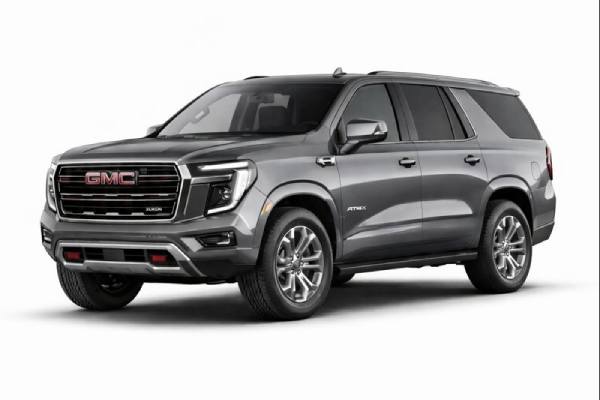
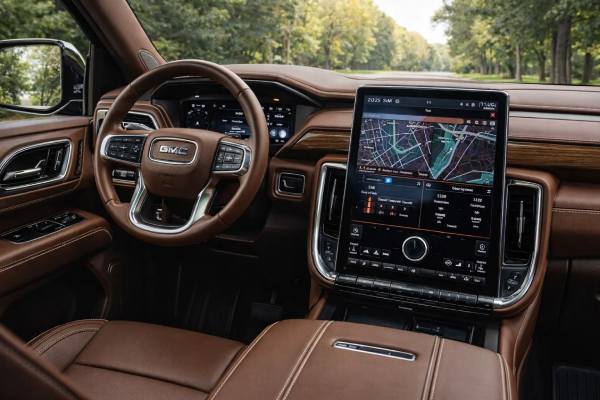

The 2025–present GMC Yukon Denali 4WD (T1UG) with the L87 6.2-liter V8 targets buyers who want full-size SUV space without giving up strong towing manners and refined road comfort. The facelift generation keeps the proven body-on-frame recipe—independent front suspension, solid rear axle, and a two-speed transfer case—but leans harder into quietness, cabin tech, and towing assistance. The L87’s main appeal is simple: effortless power delivery with a broad midrange, especially when merging, passing, or pulling trailers. Denali trim adds premium suspension tuning, larger wheel-and-tire packages, and a more feature-rich interior that can be configured for family duty or executive transport.
If you’re shopping this exact variant, the “right” Yukon often comes down to axle ratio and tow equipment choices, plus how you plan to use 4WD in winter or off-pavement travel.
Top Highlights
- Strong, naturally aspirated V8 response and confident passing power, especially under load.
- Denali-focused ride isolation and cabin quietness make long highway trips less tiring.
- 4WD adds year-round traction and resale appeal in snow-belt and mountain regions.
- Ownership caveat: the 6.2 V8 family has a history of high-cost failures on some prior-year vehicles—verify recall status and service records.
- Typical interval: rotate tires every 10,000–12,000 km (6,000–7,500 mi) to protect expensive 20–22 in sets.
Section overview
- Yukon Denali 4WD essentials
- L87 specs and measurements
- Denali 4WD trims and ADAS
- Reliability watchlist and recalls
- Maintenance plan and buying
- On-road feel and economy
- Denali 4WD vs competitors
Yukon Denali 4WD essentials
This Yukon Denali 4WD sits at the “luxury-meets-workhorse” end of the full-size SUV market. Under the chrome and leather, it’s still a body-on-frame truck platform designed to carry people, cargo, and tongue weight without feeling overwhelmed. For owners, that means two practical advantages: (1) it tends to stay composed with a full cabin and luggage, and (2) it can be equipped to tow in a way many unibody crossovers simply cannot.
The L87 6.2-liter V8 is a naturally aspirated engine, so its throttle response is predictable—no turbo lag and no sudden torque spike mid-corner. That matters in daily driving (parking-lot smoothness, easy modulation) and while towing (steadier pull on grades). It also simplifies heat management compared with some high-output turbo engines, although cooling system condition still matters when you tow frequently.
Denali trim is about refinement more than ruggedness. You’re paying for sound insulation, nicer materials, a more “planted” road feel, and a deeper feature list—often including higher-end audio, camera systems, and towing assists. The 4WD system adds a two-speed transfer case, giving you a low range for controlled movement on steep, slick surfaces or while maneuvering slowly with a trailer on a ramp.
Two buying realities shape this exact model. First, wheel-and-tire choice changes the ride more than many expect: 22-inch packages look great, but they can ride firmer and cost more to replace. Second, tow ratings and towing confidence hinge on equipment: the right hitch setup, cooling, and axle ratio matter more than trim badges. If you plan to tow regularly, shop the tow package details as carefully as you shop the interior.
L87 specs and measurements
Below are practical, ownership-focused specifications for the 2025–present Yukon Denali 4WD with the L87 6.2 V8. Some values can vary by market, wheelbase (Yukon vs Yukon XL), axle ratio, and option packages—always verify by VIN and build sheet for final numbers.
Engine and performance (ICE)
| Item | Specification |
|---|---|
| Code | L87 (6.2 V8, naturally aspirated) |
| Layout | V8, aluminum block and heads, pushrod valvetrain (OHV) |
| Displacement | 6.2 L (≈ 6,162 cc) |
| Induction | Naturally aspirated |
| Fuel system | Direct injection |
| Max power | 420 hp (313 kW) varies by calibration/market |
| Max torque | Typically around 624 Nm (460 lb-ft) market dependent |
| Timing drive | Chain |
| Efficiency standard | EPA (US) / market-specific elsewhere |
| Rated efficiency | Expect roughly 13–16 L/100 km combined (≈ 15–18 mpg US) depending on tires, axle ratio, and climate |
| Real-world highway @ 120 km/h | Often 11–13 L/100 km (≈ 18–21 mpg US) in calm conditions |
Transmission and driveline
| Item | Specification |
|---|---|
| Transmission | 10-speed automatic (GM family) |
| Drive type | 4WD with two-speed transfer case (2HI / Auto / 4HI / 4LO depending on configuration) |
| Differential | Rear limited-slip may be available with tow/off-road packages (market and equipment dependent) |
| Final drive ratio | Varies by tow package/axle ratio option |
Chassis and dimensions (typical Yukon wheelbase)
| Item | Specification |
|---|---|
| Platform | T1UG body-on-frame |
| Suspension (front) | Independent, coil-over style |
| Suspension (rear) | Solid axle with multi-link/coil setup (equipment dependent) |
| Steering | Electric power steering |
| Wheels/tires | Commonly 20 in standard; 22 in optional (package dependent) |
| Ground clearance | Varies by suspension and tire package |
| Length / wheelbase | Varies by Yukon vs Yukon XL body length |
| Fuel tank | Typically around 90–95 L (≈ 24–25 US gal) |
Capability (ownership-relevant ranges)
| Item | Typical range |
|---|---|
| 0–100 km/h (0–62 mph) | Mid–6 to low–7 seconds depending on tires/conditions |
| Towing capacity | Often 3,400–3,900 kg (7,500–8,600 lb) with proper equipment |
| Payload | Commonly 600–800 kg (1,300–1,750 lb) depending on trim/options |
Fluids and service capacities (verify by VIN)
| Item | What to use (typical) |
|---|---|
| Engine oil | dexos-approved oil (often 0W-20); capacity varies by service method |
| Coolant | Dex-Cool type, 50/50 mix (market equivalent) |
| Transmission fluid | GM low-viscosity ATF family (verify exact spec) |
| Transfer case | GM transfer case fluid (verify exact spec and unit type) |
| Differentials | Gear oil (often 75W-90 class; verify limited-slip additive needs) |
Safety and driver assistance (hardware level varies)
| Item | Notes |
|---|---|
| Crash ratings | Ratings may not be updated for every model year/trim; check by exact year on official databases |
| ADAS | Forward AEB, lane support, blind-spot features and trailer aids typically available; some features may be package-locked |
Denali 4WD trims and ADAS
Even within “Denali 4WD,” equipment can differ meaningfully by seating layout, wheelbase, and packages—so it helps to think in functional buckets: comfort hardware, towing hardware, and driver assistance.
Trims and options that change how the vehicle drives
- Wheel size (20 vs 22 in): Larger wheels can sharpen steering response slightly, but they often reduce sidewall cushion. If your roads are rough or you value quietness, the smaller wheel option tends to ride better and is cheaper to replace.
- Suspension upgrades: Denali models may offer adaptive damping and/or air suspension packages depending on market. Air suspension can improve leveling under load and highway composure, but it introduces long-term leak and compressor wear risk.
- Tow packages: These are not just a hitch. Look for added cooling provisions, integrated trailer brake controller, hitch guidance, and trailering camera features. If you tow often, prioritize the tow package over appearance packages.
Seating and interior identifiers
- Second-row setup: Bench vs captain’s chairs changes passenger access, car-seat positioning, and cargo flexibility. For families using child seats, captain’s chairs can simplify third-row access, while a bench can maximize total seating count.
- Denali cues: Unique grille, badging, higher-grade interior trim, and (often) upgraded audio and infotainment. These cues help verify you’re looking at a true Denali rather than a lower trim with cosmetic add-ons.
Safety ratings: how to interpret them
Safety rating bodies test different things, and results can change with test protocols and equipment. For a facelift year, it’s common to see:
- Ratings published for the underlying generation but not refreshed immediately for the newest model year.
- Ratings that apply to a broader “Yukon” family without separating Denali-specific lighting or tire packages.
The practical approach: treat ratings as a baseline and then confirm whether your exact build has the optional safety equipment you care about (adaptive cruise, lane centering, upgraded headlights, 360 cameras, trailer monitoring).
ADAS and driver assistance: what’s typically standard vs package-based
Most modern full-size SUVs offer core features—automatic emergency braking (AEB), forward collision alert, lane departure warning/assist, and blind-spot monitoring. On a Denali, the “nice-to-have” features are often package-gated:
- Adaptive cruise control (ACC): Great for highway miles, but sensor alignment matters after bumper work.
- Enhanced lane support / lane centering: Depends on camera calibration and windshield condition; replacement glass quality can affect performance.
- Trailer-aware features: Blind-spot adjustments, trailer brake integration, camera views, and stability logic can materially reduce towing stress.
If you service the vehicle after a collision or windshield replacement, ask the shop to document any ADAS calibrations performed—this matters for both safety and resale.
Reliability watchlist and recalls
A 2025–present facelift model can be too new to have a long public track record, so reliability planning should blend (1) known patterns from the platform and engine family and (2) how you intend to use it—short trips, towing, idling, winter salt, or heavy city driving.
Common to occasional issues (what owners notice first)
- Infotainment glitches (common, low–medium cost): Freezes, camera dropouts, or phone-connection instability often trace to software updates rather than hardware failure. Remedy is typically an update or module reset; persistent issues can require a head-unit replacement under warranty.
- Brake feel changes (common, low cost): Noise or inconsistent bite can happen with heavy vehicles, especially if driven gently in damp climates. Regular bedding and periodic harder stops can help keep rotors clean, but persistent vibration needs a rotor/runout inspection.
Drivetrain and chassis concerns (cost can climb)
- 10-speed shift quality (occasional, medium cost): Hesitation, busy shifting, or harsh downshifts may improve with software updates. If you feel shudder under light throttle, insist on a structured diagnosis (fluid condition, adaptation reset, torque-converter checks).
- 4WD transfer case behavior (occasional, medium cost): Binding, clunks, or service messages can come from low fluid, wrong fluid, or actuator issues. These systems are sensitive to tire circumference—mismatched tire wear front-to-rear can cause driveline stress.
- Air suspension leaks (occasional, medium–high cost): If equipped, watch for overnight sagging, frequent compressor cycling, or uneven ride height. Early repair prevents compressor burnout.
6.2 V8 (L87) family watch items (severity varies)
- Lifter and valvetrain wear (occasional, high cost): Cylinder deactivation systems can be associated with lifter failures on some GM V8 applications. Symptoms include ticking, misfires, rough idle, or a check-engine light. Early diagnosis matters because prolonged misfire can damage the catalytic converters.
- Bottom-end failures on some prior-year vehicles (rare but high cost): There have been recalls affecting certain vehicles equipped with the 6.2-liter engine in earlier model years due to internal engine damage risk. Even if your 2025+ build is not included, it’s a reminder to verify recalls by VIN and keep oil change discipline tight.
Recalls, TSBs, and how to verify completion
- Verify by VIN: Always use an official VIN lookup and request dealer service history printouts for warranty/recall actions.
- Ask for proof: For any major engine-related campaign on prior-year vehicles, confirm whether the vehicle received inspection, repair, or replacement as required.
- Software matters: Powertrain and ADAS updates can change drivability and prevent false sensor faults. If you buy used, ask whether the latest calibrations were applied.
Bottom line: this platform can be very durable when maintained, but it rewards “preventive ownership.” If you plan heavy towing or lots of short trips, shorten oil intervals and stay on top of driveline fluids.
Maintenance plan and buying
A Yukon Denali 4WD is expensive to neglect because many consumables are large and many systems are option-dependent. A simple plan—done consistently—protects the engine, the transmission, and the 4WD hardware.
Practical maintenance schedule (baseline, adjust for severe use)
Every 10,000–12,000 km (6,000–7,500 mi) or 6–12 months
- Engine oil and filter (shorten interval for towing, idling, short trips, or extreme heat/cold)
- Tire rotation; check alignment if you see edge wear
- Inspect brakes, steering joints, and suspension bushings
Every 24,000–30,000 km (15,000–18,000 mi)
- Engine air filter (sooner in dusty areas)
- Cabin air filter
- Inspect serpentine belt, coolant hoses, and battery condition
Every 48,000–60,000 km (30,000–37,000 mi)
- Brake fluid test; many owners replace around every 2 years regardless of mileage
- Driveline inspection: CV boots (front), axle seals, transfer case leaks
Every 72,000–96,000 km (45,000–60,000 mi)
- Transmission fluid service strategy depends on use: frequent towing benefits from earlier service
- Transfer case and differential fluids (especially if you use 4WD often or tow)
- Coolant condition check; replace per official interval for your market
Around 150,000–160,000 km (93,000–100,000 mi)
- Spark plugs (typical modern V8 interval—verify exact spec)
- Full ignition and induction inspection
Fluids, specs, and “decision-useful” torque values (verify in service info)
- Engine oil: Use the correct dexos-approved grade for the L87; wrong viscosity can affect lifter behavior and cold-start lubrication.
- Wheel lug torque: Large SUVs are sensitive to improper lug torque; insist on torque-wrench use (not just an impact gun).
- Transfer case fluid: Use only the specified fluid—mix-ups can cause chatter or accelerated wear.
Buyer’s guide: what to inspect before purchase
- Build details: Confirm it is Denali 4WD with L87 by VIN/build sheet, not just badge appearance.
- Tire match: Ensure all four tires match brand, model, size, and similar tread depth. Mismatched tires can strain the 4WD system.
- Service proof: Oil changes, driveline services, and any engine-related campaigns should be documented.
- Cold-start behavior: Listen for abnormal ticking, rough idle, or misfire on a cold start—walk away from anything that sounds “off” unless it’s fully diagnosed and priced accordingly.
- 4WD operation: Test mode engagement on a straight, low-speed roll. Binding or warning messages need investigation.
- Suspension (if air-equipped): Check ride height consistency after sitting overnight.
Long-term durability outlook: with disciplined oil changes, proper driveline fluids, and attention to tire matching, the Yukon Denali 4WD can be a long-haul vehicle. The risk is not “routine wear”—it’s costly outliers (engine or air suspension) that become far more likely when maintenance is stretched.
On-road feel and economy
The Denali’s driving personality is shaped by three things: wheelbase mass, suspension tuning, and the L87’s linear power delivery. It feels substantial—more like a luxury truck than a tall crossover—and that’s a compliment when you’re covering highway distance or carrying a full load of passengers.
Ride, handling, and NVH
At city speeds, you notice the Yukon’s size, but the steering is usually light enough to make parking manageable. The Denali tuning tends to isolate sharp impacts better than lower trims, although big wheels can reintroduce harshness over broken pavement. On the highway, the body-on-frame structure and long wheelbase deliver strong straight-line stability, especially in crosswinds. Noise levels are typically low for a full-size SUV, with the V8 settling into a quiet cruise in top gear.
Braking feel is confident, but it’s still a heavy vehicle—brake performance depends heavily on pad condition and tire grip. If you tow, you’ll appreciate how a trailer brake controller and proper trailer setup reduce braking stress.
Powertrain character
The L87’s best trait is the way it makes speed without drama. It pulls cleanly from low rpm and builds power smoothly. The 10-speed automatic generally keeps the engine in its sweet spot, but it may “hunt” on rolling terrain if you’re in an aggressive economy mode. If you notice inconsistent shift behavior, ask a dealer about available powertrain calibration updates before assuming something is mechanically wrong.
Real-world fuel use (what owners actually see)
Expect fuel economy to be strongly influenced by:
- Tire size and tread type (22-inch, wider, or all-terrain tires usually cost mpg)
- Winter fuel and cold starts (bigger penalty than many expect)
- Speed (a full-size SUV’s aerodynamics punish high cruising speeds)
Reasonable real-world expectations:
- Mixed driving: roughly 13–16 L/100 km (15–18 mpg US)
- Highway at 100–120 km/h: roughly 11–13 L/100 km (18–21 mpg US)
- Towing: plan for a 30–60% increase in consumption depending on trailer weight and terrain
Traction, modes, and 4WD behavior
In winter, 4WD improves launch traction and stability when roads are slippery, but tires still matter most. A quality all-season or winter tire set often makes a bigger difference than drivetrain alone. Low range (4LO) is for controlled, low-speed movement—useful for boat ramps, steep icy driveways, or off-pavement crawling—rather than high-speed snow driving.
Denali 4WD vs competitors
Full-size SUVs are about tradeoffs, and the Yukon Denali 4WD with the 6.2 V8 competes in a field where engines, interiors, and towing strategies differ significantly.
Ford Expedition (4×4, turbo V6)
Why some buyers choose it: Strong low-end torque from turbocharging, a lighter-on-its-feet feel in some trims, and a competitive towing story when equipped correctly.
Where the Denali can win: The V8’s linear response and Denali’s upscale cabin feel appeal to drivers who prefer predictable power and a “quiet authority” at highway speeds. Some owners also prefer naturally aspirated simplicity for long-term ownership.
Jeep Wagoneer / Grand Wagoneer (4×4)
Why some buyers choose it: Big interior presence, strong straight-line power, and a distinctly premium presentation on upper trims.
Where the Denali can win: Denali’s blend of luxury and truck-grade usability can feel more cohesive, with a strong dealer/service ecosystem in many regions. For buyers who tow, the GMC trailering interface and camera aids (when equipped) are a major decision point.
Toyota Sequoia (4WD, hybrid)
Why some buyers choose it: Hybrid efficiency advantages in some use cases, strong reliability reputation, and good low-speed torque.
Where the Denali can win: Third-row/cargo packaging preferences, ride feel, and V8 character. Some buyers also prefer the Denali’s towing and highway behavior, especially when the vehicle is heavily loaded for long trips.
Nissan Armada (4WD, V8)
Why some buyers choose it: Often strong value and a traditional V8 feel.
Where the Denali can win: Newer cabin tech, towing-assist sophistication, and Denali’s premium trim execution.
The simplest way to choose
Pick the Yukon Denali 4WD (L87) if you value:
- V8 smoothness and predictable throttle response
- A quiet, premium highway experience in a true full-size body-on-frame package
- A towing-friendly feature ecosystem (when properly optioned)
Consider rivals if you prioritize:
- Best-in-class fuel economy (hybrids)
- A different interior philosophy or brand feel
- Turbocharged torque and tuning preferences
References
- RCLRPT-25V274-6427.PDF 2025 (Recall Bulletin)
- Recalls 2025 (Recall Database)
- Owner Manuals 2025 (Owner’s Manual)
Disclaimer
This article is for informational purposes only and is not a substitute for professional inspection, diagnosis, or repair. Specifications, torque values, service intervals, fluids, and procedures can vary by VIN, market, production date, and equipment. Always verify details using official GMC/GM service information and your vehicle’s documentation.
If this guide helped, please consider sharing it on Facebook, X/Twitter, or your favorite forum to support our work.