
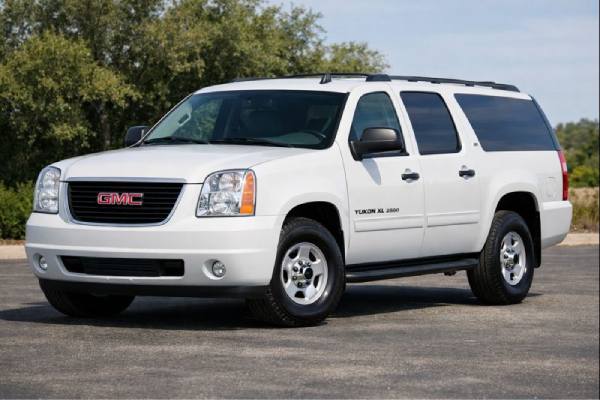
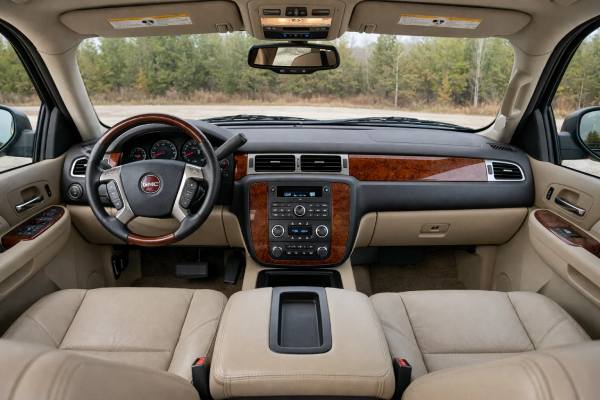
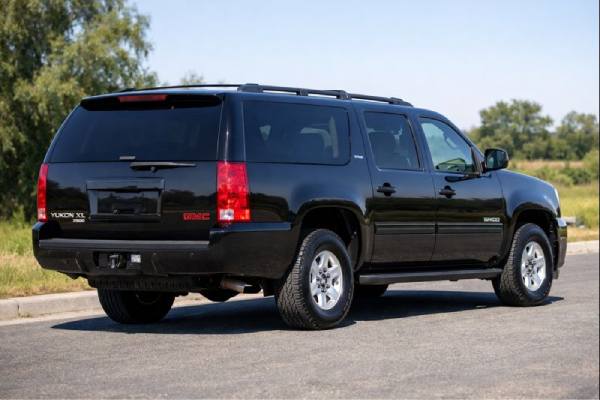
The 2007–2009 GMC Yukon XL 2500 RWD is the “work-credible” version of GM’s full-size family SUV: a long-wheelbase body on a three-quarter-ton chassis, paired with the LY6 6.0-liter V8 and heavy-duty running gear. The result is a truck you buy for margin—more cooling, stronger axles, higher payload headroom, and towing stability that doesn’t depend on optimistic brochure math. It’s also one of the simpler GMT900 combinations to own long-term, because the LY6 avoids some of the cylinder-deactivation complexity found on certain GM V8s of the era.
That said, it’s still a 6,000+ lb SUV with age-related wear: steering and front-end parts take a beating, rust can matter more than miles, and neglected fluid service shows up quickly when you tow. If you want space, honest capability, and straightforward mechanicals, this is the Yukon XL to understand.
Owner Snapshot
- Strong tow and payload foundation thanks to 2500-series axles, brakes, and cooling.
- LY6 6.0 V8 is a simple, durable gas V8 with broad parts availability.
- More stable under load than 1500 SUVs, especially with weight-distributing hitch setup.
- Expect higher running costs: fuel, tires, and front suspension and steering wear add up.
- Change engine oil by the oil-life monitor or at least every 12 months (whichever comes first).
Navigate this guide
- Yukon XL 2500 RWD explained
- LY6 specs and dimensions
- Trims, packages, and safety tech
- Known issues and recalls to watch
- Maintenance plan and buying checklist
- Road feel, towing, and fuel use
- Rivals: where it wins and loses
Yukon XL 2500 RWD explained
Think of the Yukon XL 2500 RWD as a full-size SUV built from heavy-duty pickup priorities. The “XL” body brings true three-row space and long cargo length; the “2500” chassis adds the parts that keep a loaded vehicle composed: higher-rated frame sections, stiffer rear suspension, stronger hubs, and heavier driveline components. In day-to-day use, that shows up as less “wallow” with passengers and luggage, better stability with a trailer, and more tolerance for heat and grade work.
The LY6 6.0-liter V8 is the heart of this configuration. It’s a naturally aspirated, pushrod (OHV) V8 designed for trucks—low drama, easy service access, and predictable behavior under load. Peak horsepower isn’t the point; what you feel is a steady pull and the ability to maintain speed without constant downshifts when the vehicle is correctly geared.
There are two ownership truths that matter more than spec-sheet bragging:
- This SUV rewards correct setup. A Yukon XL 2500 tows best when the hitch, weight distribution, and trailer brake control are set up carefully. The chassis gives you the foundation, but stability still depends on tongue weight (typically 10–15% of trailer weight), quality tires, and properly adjusted trailer brakes.
- Condition beats year. A clean, rust-minimized truck with documented cooling, transmission, and differential service will usually outlast a “low-mileage” example that lived on salted roads or towed heavy without maintenance. These trucks can run deep into high mileage, but they do not forgive chronic overheating, ignored leaks, or worn steering parts.
Why RWD specifically? Two-wheel drive cuts complexity—no front differential, no transfer case, fewer CV joints—and usually reduces vibration and service cost over time. The trade-off is traction: if you live in steep, icy, or unplowed areas, tire choice and ballast matter, and 4WD can be worth the added maintenance.
Bottom line: this is a niche Yukon XL that behaves more like a light commercial vehicle than a soft family crossover. If you need space plus real towing and payload margin, it’s one of the most logical GMT900 picks.
LY6 specs and dimensions
Below are practical, model-relevant specifications for the 2007–2009 Yukon XL 2500 RWD with the LY6 6.0 V8. Some values vary slightly by build codes (RPO), axle ratio, wheels/tires, and emissions certification, so treat exact numbers as “verify by VIN/RPO” where noted.
Engine and performance (LY6 6.0 V8)
| Item | Spec |
|---|---|
| Code | LY6 |
| Engine layout and cylinders | V8, OHV (pushrod), 2 valves/cyl, VVT |
| Displacement | 6.0 L (5,967 cc) |
| Bore × stroke | 101.6 × 92.0 mm (4.00 × 3.62 in) |
| Induction | Naturally aspirated |
| Fuel system | Sequential port fuel injection (PFI) |
| Compression ratio | ~9.6:1 (verify by calibration/emissions label) |
| Max power | 352 hp (263 kW) @ ~5,400 rpm |
| Max torque | ~518 Nm (382 lb-ft) @ ~4,200 rpm |
| Timing drive | Chain |
| Firing order | 1-8-7-2-6-5-4-3 |
Transmission and driveline (RWD)
Because GMT900 2500 SUVs were built with different heavy-duty transmission RPOs over time and across applications, confirm your truck’s exact unit via the glovebox/service-parts label.
| Item | Typical spec (verify by RPO) |
|---|---|
| Drive type | RWD |
| Transmission (common) | Heavy-duty 4-speed automatic (often 4L80-series) |
| Transmission (possible on some builds) | 6-speed automatic in certain applications/RPOs |
| Final drive ratio | Commonly 3.73; 4.10 seen with tow-oriented builds (verify) |
| Differential | Open standard; locking/limited-slip availability varies by axle/RPO |
Practical tip: When shopping, ask for a photo of the RPO label. It’s the fastest way to confirm axle ratio and transmission family without relying on seller descriptions.
Chassis and dimensions (XL body, 2500 running gear)
| Item | Spec (approximate / typical) |
|---|---|
| Suspension (front/rear) | Independent front; solid rear axle with heavy-duty springs |
| Steering | Hydraulic power assist; truck-style feel |
| Brakes | 4-wheel disc with ABS; brake sizing varies by package |
| Wheels/tires | Often 8-lug HD wheels; size varies by trim and year |
| Length | ~5,650 mm (222.4 in) |
| Width | ~2,010 mm (79.1 in) (without mirrors) |
| Height | ~1,950 mm (76.8 in) (varies by tires/suspension) |
| Wheelbase | ~3,300 mm (130.0 in) |
| Turning circle | ~12.7 m (41.7 ft) |
| Ground clearance | ~210 mm (8.3 in) (approx.) |
| Curb weight | ~2,700–2,900 kg (5,950–6,400 lb), equipment-dependent |
| GVWR | Commonly ~3,900 kg (8,600 lb) (verify by door sticker) |
| Fuel tank | ~117 L (31 US gal / 26 UK gal) |
Capability and real-world performance
| Item | Typical range (varies by axle ratio, load, and test) |
|---|---|
| 0–100 km/h (0–62 mph) | ~9.5–11.0 s |
| 0–60 mph | ~9.0–10.5 s |
| Top speed | Electronically limited; typically ~170 km/h (105 mph) |
| Braking 100–0 km/h | Often ~40–47 m (test-dependent) |
| Towing capacity | Often ~3,600–4,300 kg (8,000–9,500 lb) (verify by sticker/manual) |
| Payload | Often ~650–800 kg (1,400–1,800 lb) (verify by tire/loading sticker) |
Fluids and service capacities (decision-useful)
| System | Fluid and spec | Capacity (typical) |
|---|---|---|
| Engine oil | 5W-30 meeting GM gasoline specs | ~6.0 L (6.3 US qt) w/filter |
| Coolant | Dex-Cool type, 50/50 mix | capacity varies by cooling package |
| ATF | Dexron-VI | capacity varies by transmission |
| Rear differential | GL-5 gear oil (often 75W-90) | axle-dependent |
| A/C refrigerant | R-134a | charge varies by sticker |
Because towing, heat, and age amplify small differences, always verify capacities and fluids against the underhood label and the correct service information for your VIN.
Trims, packages, and safety tech
For 2007–2009, Yukon XL 2500 equipment is less about flashy trim names and more about functional configuration: seating, towing provisions, axle ratio, and cooling. In most markets, you’ll see familiar GMC trim labels (commonly SLE and SLT), but the 2500-series SUV was not always offered with every luxury combination you might find on a 1500 Denali. When a seller claims “fully loaded,” ask what that means in practical terms: heated seats are nice; the towing and cooling hardware is what makes the 2500 special.
Trims and options that actually change the truck
Seating and interior layout
- 8–9 passenger setups exist (front bench with center seat) and are valuable if you need maximum seating.
- Second-row configurations vary (bench vs captain’s chairs). Captain’s chairs improve access to the third row, but reduce maximum passenger count.
Towing and thermal management
- A true tow-capable build typically includes a receiver hitch, heavy-duty cooling, a higher-output alternator, and integrated wiring provisions. Some trucks add a factory trailer brake controller; others require an aftermarket unit.
- Axle ratio matters more than horsepower. A 4.10-geared truck (where available) will usually feel more confident with heavy trailers than a 3.73 truck, especially in rolling terrain.
Suspension and wheels/tires
- 2500 trucks often run 8-lug wheels and higher-load-rated tires. Don’t underestimate this: tire load rating is a major safety and stability factor under towing and full payload.
Infotainment and convenience
- Audio systems, rear-seat entertainment, and navigation vary widely. These are easy to retrofit compared with hard mechanical items like gearing and cooling.
Quick identifiers when you’re inspecting one
- Look at the door-jamb labels for GVWR, payload, and tire size/load rating. That sticker tells you what the vehicle can really carry today.
- Find the RPO label (often glove box area). It’s your decode key for axle ratio, towing equipment, and transmission family.
- Count the lugs and confirm tire load range. If a seller installed passenger-rated tires, you’re not getting the chassis capability you’re paying for.
Safety ratings and what “safety” means on this generation
Crash testing and rating systems evolved significantly over time. For 2007–2009 vehicles, you’ll commonly see:
- NHTSA 5-Star Safety Ratings available for many configurations, typically broken down into frontal, side, and rollover components. Ratings can vary by drivetrain and body style, so the safest approach is to check by exact model configuration or VIN.
- IIHS coverage may be limited for certain heavy, truck-based SUVs of this era, and test protocols changed over the years—so compare like with like if you’re cross-shopping.
Safety systems and driver assistance (ADAS)
This generation predates modern automatic emergency braking and lane-keeping assistance. What you should expect instead:
- ABS and electronic stability control (often branded as StabiliTrak) are the baseline safety technologies that matter most for controlling a large SUV in emergency maneuvers.
- Airbags typically include frontal airbags and may include side-impact and curtain airbags depending on trim and build.
- Child-seat anchors (LATCH) are present, but third-row and center-position details can vary—verify if you’re buying this as a family hauler.
If you want modern ADAS, you won’t find it here. If you want a stable platform with solid fundamentals—big brakes, stability control, and a chassis that tolerates load—this Yukon XL 2500 is built for that role.
Known issues and recalls to watch
A well-kept Yukon XL 2500 can be durable, but ownership is smoother when you know what typically fails, when it fails, and what it looks like before it becomes expensive. Below is a practical map of common issues by prevalence and cost tier, followed by the service actions you should confirm on any candidate truck.
Common (plan for it)
Front-end and steering wear (medium cost, high frequency)
- Symptoms: wandering on the highway, uneven tire wear, clunks over bumps, vague on-center steering.
- Likely causes: worn idler and pitman arms, tie rods, ball joints, and sometimes hub/bearing units.
- Remedy: replace worn components as a set where appropriate, then align. If the steering feels “fixed” for 2 weeks then drifts again, suspect tired components rather than alignment alone.
Brake system wear (low–medium cost, high frequency)
- Symptoms: pulsation under braking, longer pedal travel, pulling.
- Likely causes: rotor wear/heat spots (especially with towing), stuck caliper slides, old brake fluid.
- Remedy: service slides, replace pads/rotors as needed, and treat brake-fluid changes as real maintenance (not optional).
Cooling system aging (medium cost, common with age)
- Symptoms: creeping temps on grades, coolant smell, wetness at the water pump, heater performance changes.
- Likely causes: water pump seepage, radiator end-tank aging, tired hoses, neglected coolant.
- Remedy: pressure test, fix leaks early, and keep the cooling system healthy if you tow.
Occasional (watch for inspection clues)
Exhaust manifold bolt leaks (medium cost)
- Symptoms: ticking on cold start that fades as it warms.
- Root cause: broken manifold bolts or small leaks at the flange.
- Remedy: repair before it warps surfaces; use quality hardware.
Oil seepage (low–medium cost)
- Symptoms: oil film at the rear of the engine or around the oil pan area.
- Root cause: normal gasket aging, crank seal seepage, or valve cover leakage.
- Remedy: confirm it’s seepage, not active dripping; clean and recheck after a drive.
EVAP system faults (low–medium cost)
- Symptoms: check-engine light with evap-related codes; occasional fueling “burps.”
- Root cause: vent solenoid issues, cracked hoses, charcoal canister saturation.
- Remedy: smoke test beats guessing.
Rare but high-impact (don’t ignore)
Transmission overheating or neglect (high cost if ignored)
- Symptoms: delayed engagement, flare shifts, burnt fluid odor, temperature spikes when towing.
- Root cause: old fluid, towing beyond setup, restricted cooler, or internal wear.
- Remedy: verify cooler integrity, service fluid appropriately, and use temperature awareness when towing.
Rust in structural or brake-line areas (severity depends on location)
- Symptoms: heavy scale on frame sections, soft brake pedal from line corrosion, seized fasteners everywhere.
- Root cause: salted-road exposure.
- Remedy: treat rust as a buying decision, not a weekend project. Cosmetic rust is different from structural or line corrosion.
Recalls, TSBs, and service actions to verify
Even if the truck “drives fine,” recall completion matters because many fixes are preventative. Two examples that commonly appear in the wider GM truck/SUV population of this era include:
- Heated washer fluid system recall (where equipped): certain vehicles with this option were recalled due to fire risk; many owners had the system disabled or repaired.
- Electrical module contamination/shorting recall coverage on select models/years: some campaigns addressed stalling/no-start or trailer-brake function loss tied to module issues.
How to verify completion
- Run the official VIN lookup through the manufacturer and the NHTSA recall database.
- Ask the seller for dealer repair orders or printed recall-completion records.
- If a seller says “all recalls done” but has no documentation, treat it as “unknown” until proven.
Pre-purchase checks to request (high value)
- A scan tool readout for stored and pending codes (not just “no check engine light”).
- Evidence of cooling system service if the truck towed regularly.
- Transmission fluid condition and service history.
- Tire load rating confirmation (especially if the truck ever towed).
These trucks are forgiving when maintained and brutally expensive when a neglected example is used like a maintained one. Buy the best-maintained chassis you can find.
Maintenance plan and buying checklist
A Yukon XL 2500 is easiest to own when you maintain it like a working truck, not like a casual commuter. That means fluids, heat management, and wear items get attention on schedule—especially if you tow. Use the outline below as a practical baseline, then tighten intervals if your usage is severe (short trips, heavy city use, frequent towing, or hot climates).
Practical maintenance schedule (distance or time)
Engine oil and filter
- Change when the oil-life monitor calls for it, or at least every 12 months.
- If you tow often or idle heavily, shorten the interval (many owners target ~8,000 km / 5,000 mi).
Engine air filter
- Inspect at every oil change; replace roughly every 24,000–48,000 km (15,000–30,000 mi) depending on dust and driving.
Cabin air filter (if equipped)
- Replace about every 20,000–30,000 km (12,000–20,000 mi) or annually in dusty/pollen-heavy areas.
Coolant
- Treat coolant as time-sensitive. A common long-life schedule is 5 years / 240,000 km (150,000 mi), but aging hoses, pumps, and radiators don’t care what the bottle promises—inspect yearly.
Spark plugs
- Many GM truck V8s of this era run long-life plugs; a typical interval is 160,000 km (100,000 mi), but replace sooner if you’re chasing misfires under load.
Transmission fluid (ATF)
- If the truck tows, consider a service interval around 80,000–100,000 km (50,000–60,000 mi).
- If it doesn’t tow and temps are controlled, you may stretch it—just don’t treat “lifetime” fluid as real.
Rear differential
- Inspect for leaks yearly; change gear oil around 80,000–120,000 km (50,000–75,000 mi) if towing or if the oil is dark/metallic.
Brake fluid
- Flush every 2 years, regardless of mileage. This is one of the cheapest ways to protect ABS components and keep pedal feel consistent.
Brakes, tires, alignment
- Rotate tires regularly (often every 8,000–10,000 km / 5,000–6,000 mi).
- Align annually or when tires show uneven wear.
12 V battery
- Plan on a 4–6 year replacement window; test before winter if you rely on the truck daily.
Fluids and “what to use” (owner-level guidance)
- Engine oil: commonly 5W-30 meeting GM gasoline requirements.
- ATF: Dexron-VI is the safe baseline for many GM automatics of this era.
- Coolant: Dex-Cool type with correct mix ratio (commonly 50/50).
Always verify against your underhood label and the correct service information for your VIN—especially if prior owners modified cooling or towing equipment.
Buyer’s checklist (what to inspect in person)
Rust and underbody
- Frame rails, brake lines, fuel lines, and rear suspension mounting points.
- Trailer hitch area: rust plus heavy towing is a red flag without documentation.
Leaks
- Look at the rear of the engine, transmission pan area, and differential seals.
- A light film is normal with age; active dripping that coats components is not.
Front-end integrity
- Test drive at highway speed: straight-line stability should be calm, not nervous.
- Low-speed turns: listen for clunks; feel for steering dead zones.
Towing readiness
- Confirm the hitch type, wiring, and brake-controller provisions.
- Ask what trailer weight it actually pulled and how often.
Paperwork
- Service history matters more than a clean interior.
- Recall-completion documentation is a real value add.
Long-term durability outlook
A cared-for Yukon XL 2500 can be a long-term keeper because its core hardware is truck-grade and the LY6 powertrain is straightforward. The limiting factors are usually corrosion, front-end wear cycles, and heat-related neglect from towing. Buy clean, maintain fluids, and it’s the kind of SUV that can do honest work for a long time.
Road feel, towing, and fuel use
Driving a Yukon XL 2500 RWD is a reminder that “SUV” used to mean “truck with seats,” in both good and not-so-good ways. The upside is stability and load tolerance. The downside is that you feel mass: braking distances grow when you’re not planning ahead, tight parking maneuvers are deliberate, and quick transitions ask more from the tires and suspension than they would in a lighter 1500 or a modern crossover.
Ride, handling, and NVH (noise, vibration, harshness)
At city speeds, the 2500 chassis typically feels firm and controlled rather than plush. Over sharp bumps, the rear can feel busy when unladen, while a loaded truck often settles into its best ride quality. On the highway, the long wheelbase is your friend: straight-line stability is usually excellent when the steering components are healthy and the alignment is correct.
Cabin noise is era-typical for a truck-based SUV. Expect:
- noticeable tire roar if aggressive tread is fitted,
- wind noise around mirrors and roofline at higher speeds,
- and a V8 soundtrack that becomes more obvious under grades and towing.
Powertrain character (LY6 behavior in real life)
The LY6 delivers power in a linear, predictable way. Throttle response is generally clean, with most of the “work” happening when the transmission drops a gear and the engine moves into the midrange. Don’t expect modern, multi-gear quickness; instead, expect a steady pull that holds speed when set up correctly.
Two things change how it feels more than most owners realize:
- Axle ratio: lower (numerically higher) gearing makes the truck feel lighter and less busy under tow.
- Transmission temperature and fluid condition: tired fluid or overheating can make shifts feel inconsistent and can shorten component life.
Real-world efficiency (what to expect)
This is not a fuel-sipping vehicle. Real-world consumption depends heavily on tires, gearing, speed, and load, but a realistic ownership expectation often looks like:
- City: high teens to low 20s L/100 km (roughly low teens mpg US)
- Highway at 100–120 km/h (60–75 mph): mid to high teens L/100 km (often low-to-mid teens mpg US)
- Towing: plan on a meaningful penalty; heavy trailers can push consumption dramatically higher
Cold weather, short trips, and roof racks all hurt efficiency further. If fuel cost is a major constraint, a lighter 1500 or a newer engine family may be a better fit.
Load and towing impressions
Where this truck earns its reputation is composure. With a properly set weight-distributing hitch, correct tongue weight, and trailer brakes dialed in, the Yukon XL 2500 tends to feel planted—less “tail wag” and fewer correction cycles than softer half-ton SUVs. The long wheelbase helps, and the heavy-duty chassis tolerates sustained grades better when the cooling system is healthy.
Owner habits that make towing safer and cheaper:
- Use a transmission temperature readout if available (or add one).
- Downshift early on grades instead of forcing lugging in high gear.
- Keep tire pressures and load ratings appropriate for the actual load.
- Service brakes and fluids on the assumption that you’ll need them—because you will.
If you treat towing as a primary use case rather than an occasional event, this Yukon XL 2500 is one of the most confidence-inspiring full-size SUV platforms of its era.
Rivals: where it wins and loses
Cross-shopping a 2007–2009 Yukon XL 2500 RWD usually means you care about space and capability more than modern tech. Here’s how it typically stacks up against key rivals of the same era.
Ford Expedition EL (long wheelbase)
Where the Yukon XL 2500 wins
- The 2500-series chassis is the advantage: it’s built to carry and tow with more margin.
- Parts availability and truck-based service familiarity are strong in most markets.
Where it loses
- Depending on engine and gearing, the Ford can feel more responsive in some configurations.
- Trim and feature content may compare differently depending on year and package.
Who should pick the Ford instead
- Buyers who prioritize a different ride/steering feel and find a cleaner, better-documented Expedition EL in their market.
Toyota Sequoia (first generation)
Where the Yukon XL 2500 wins
- More interior length and cargo flexibility in XL form.
- Towing stability and payload headroom often favor the heavier-duty GM chassis when similarly equipped.
Where it loses
- Toyota’s reliability reputation is strong, and some owners prefer the Sequoia’s long-term “less fussy” feel—though condition still matters most at this age.
Who should pick the Toyota instead
- Buyers who value simplicity and can accept different packaging and availability.
Nissan Armada (first generation)
Where the Yukon XL 2500 wins
- Heavy-duty underpinnings and the ability to be configured like a working truck.
- Broader ecosystem of towing parts, service knowledge, and fleet-style maintenance familiarity.
Where it loses
- Depending on the exact comparison year and equipment, the Nissan may offer a different comfort/feature balance.
Who should pick the Nissan instead
- Buyers who find a truly exceptional-condition Armada at the right price and don’t need 2500-series payload/tow margin.
GM’s own alternatives: Yukon XL 1500 / Suburban 1500
This is the most important comparison because it’s the easiest substitute.
Why many people should buy the 1500 instead
- Better fuel economy in most real-world driving.
- Softer ride when unladen.
- Often easier to find in high trims and lower miles.
Why the 2500 is worth it
- If you regularly tow, haul, or load the truck with people and gear, the 2500’s stability and component margin can reduce stress and “wear drama.”
- The LY6-based setup is appealing to owners who want a straightforward, truck-grade gas V8.
The smart verdict
Choose the Yukon XL 2500 RWD when you need the XL space and you routinely use the vehicle like a truck: towing, hauling, long trips with full passenger load, or sustained highway work. Choose a half-ton or newer platform when fuel cost, modern safety tech, and everyday comfort matter more than heavy-duty margin.
If you shop carefully—prioritizing rust condition, service history, correct tires, and verified RPO equipment—this generation can still be one of the most useful “do-everything” full-size SUVs on the used market.
References
- 2007 GMC Yukon, Yukon XL Owner Manual M 2007 (Owner’s Manual)
- NHTSA Datasets and APIs | NHTSA 2025 (Ratings API and Recall API)
- Car Safety Ratings | Vehicles, Car Seats, Tires 2025 (Safety Rating)
- Recall Bulletin 2010 (Recall Bulletin)
- Recall Bulletin 2015 (Recall Bulletin)
Disclaimer
This article is for informational purposes only and is not a substitute for professional inspection, diagnosis, or repair. Specifications, torque values, fluid capacities, service intervals, and procedures can vary by VIN, market, emissions certification, and installed equipment; always verify details using the official owner’s manual and the correct service documentation for your specific vehicle.
If you found this guide useful, please consider sharing it on Facebook, X (Twitter), or your favorite forum to support our work.