

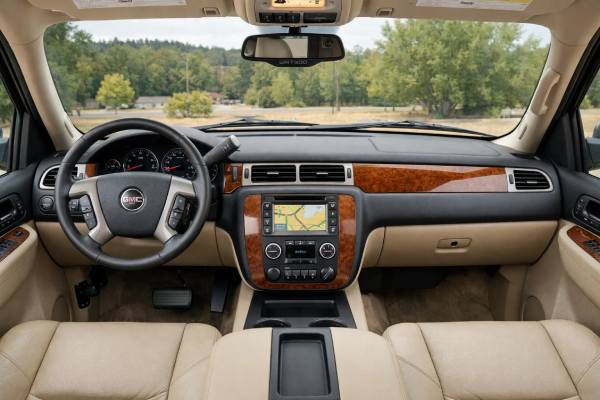

The GMT900 GMC Yukon XL RWD with the 5.3-liter LMG V8 is one of those “do-it-all” full-size SUVs that earned its following through simple strengths: a roomy, usable cabin, a body-on-frame chassis that tolerates real work, and a powertrain that’s easy to service almost anywhere. In this configuration, you get the long-wheelbase packaging of the XL without the extra complexity of 4WD hardware, which can mean lower operating costs and fewer driveline wear items over time.
The main ownership story is balance. The 320 hp LMG delivers confident merging and towing manners for a family-hauler of this size, while Active Fuel Management (AFM) can help on light-load cruising—yet it also introduces a few known long-term risks if oil quality and level are neglected. Buy smart, maintain it on schedule, and this Yukon XL can be a durable, practical “big SUV” for many years.
Essential Insights
- Strong everyday utility: genuine 3-row space plus a long cargo bay that’s easy to load.
- The LMG 5.3 V8 is widely supported for parts and service, even at higher mileage.
- RWD simplicity reduces transfer-case and front-diff maintenance versus 4WD models.
- Watch oil level closely—AFM-related lifter and oil-consumption issues can turn costly if ignored.
- Plan on oil and filter service roughly every 8,000–10,000 km (5,000–6,000 mi) or sooner under towing/short-trip use.
Navigate this guide
- LMG Yukon XL RWD basics
- LMG 5.3 specs tables
- Packages, interiors, and safety gear
- Common failures and service bulletins
- Maintenance plan and buying checklist
- Real driving and fuel economy
- Best alternatives to consider
LMG Yukon XL RWD basics
Think of the 2007–2014 GMC Yukon XL RWD (GMT900) as a full-size SUV built around three priorities: space, stability, and serviceability. The XL body adds meaningful wheelbase and rear overhang compared with the standard Yukon, which translates to a third row that adults can actually tolerate and a cargo area that remains useful even with all seats in place. In day-to-day ownership, that packaging advantage is the reason many people choose an XL over a shorter SUV: you can carry people and gear without playing “roof box Tetris.”
Mechanically, this generation uses a traditional body-on-frame layout derived from GM’s full-size truck platform. That matters because it affects how the Yukon feels on the road and how it holds up under load. The structure is stiff, towing manners are predictable, and suspension parts are generally robust and widely available. The trade-off is size and weight: you’ll live with wide turning habits, more tire cost than a crossover, and fuel consumption that reflects both mass and frontal area.
This specific powertrain—the LMG 5.3-liter V8 rated at 320 hp—sits in a sweet spot for many owners. It’s strong enough to move the XL without feeling strained, yet it avoids the thirst and added complexity that sometimes comes with the biggest engines. The LMG uses an overhead-valve (pushrod) V8 design that’s compact for its displacement and historically easy to service. Where it differs from older “always eight-cylinder” 5.3s is Active Fuel Management (AFM), GM’s cylinder-deactivation strategy that can run the engine on fewer cylinders during light-load cruising.
AFM can help on steady highway runs, but it also changes the ownership conversation. Oil quality, oil level discipline, and maintenance history matter more than they would on a non-AFM engine. If an owner let the oil run low or stretched intervals, the risk of valvetrain problems rises—especially as mileage climbs. That doesn’t mean “avoid,” but it does mean “inspect and verify.”
In RWD form, you also remove the transfer case, front differential, CV axles, and additional driveline joints that 4WD models carry. If you don’t need 4WD traction, that simplicity is a real advantage over the long term: fewer fluids to service, fewer seals to leak, and fewer moving parts to develop vibration or wear.
LMG 5.3 specs tables
Below are practical, ownership-relevant specifications for the GMT900 Yukon XL RWD with the LMG 5.3 V8. Exact figures can vary by model year, emissions certification, axle ratio, wheel package, and towing equipment, so treat these as a decision-making baseline and verify by VIN/RPO codes for a specific vehicle.
Engine and performance (LMG 5.3 V8)
| Item | Specification |
|---|---|
| Code | LMG |
| Layout & cylinders | V8, OHV (pushrod), 2 valves/cyl (16-valve total) |
| Displacement | 5.3 L (5,328 cc) |
| Bore × stroke | 96.0 × 92.0 mm (3.78 × 3.62 in) |
| Induction | Naturally aspirated |
| Fuel system | Port fuel injection (PFI) |
| Compression ratio | ~9.9:1 (varies slightly by calibration/year) |
| Max power | 320 hp (239 kW) @ ~5,400 rpm |
| Max torque | ~454 Nm (335 lb-ft) @ ~4,000 rpm |
| Timing drive | Chain |
| Efficiency standard | EPA (U.S.) |
Rated efficiency (representative EPA figures)
| Fuel / cycle | City | Highway | Combined |
|---|---|---|---|
| Gasoline (mpg US) | 15 | 21 | 17 |
| Gasoline (L/100 km) | 15.7 | 11.2 | 13.8 |
| E85 (mpg US) | 11 | 16 | 13 |
| E85 (L/100 km) | 21.4 | 14.7 | 18.1 |
Real-world highway at 120 km/h (75 mph) typically lands around 13–15 L/100 km (16–18 mpg US) depending on tires, load, wind, and speed discipline. Under towing or heavy load, plan for a meaningful increase.
Transmission and driveline
Because the 2007–2014 run spans mid-cycle updates, you’ll see different automatic transmissions depending on year and build.
| Item | Typical fitment |
|---|---|
| Transmission (early) | 4-speed automatic (commonly referred to as 4L60-family) |
| Transmission (later) | 6-speed automatic (commonly referred to as 6L80-family) |
| Drive type | RWD |
| Final drive ratio | Varies by axle code (commonly ~3.08, ~3.42, or ~3.73) |
| Differential | Open; optional locking rear diff on some builds (RPO-dependent) |
Chassis and dimensions (typical Yukon XL 1500 RWD)
| Item | Typical specification |
|---|---|
| Suspension (front/rear) | Independent front; solid rear axle with coil springs and links |
| Steering | Power-assisted rack-and-pinion (truck-tuned) |
| Brakes | 4-wheel discs with ABS and stability control (sizes vary by year/package) |
| Wheels/tires | Commonly 17–20 in wheels; many trims use 265-section tires |
| Length | ~5,647 mm (~222.3 in) |
| Width | ~2,007 mm (~79.0 in) |
| Height | ~1,950–1,970 mm (~76.8–77.6 in) |
| Wheelbase | ~3,302 mm (~130.0 in) |
| Turning circle | ~12.6–13.0 m (~41–43 ft), trim/tire dependent |
| Fuel tank | ~98 L (~26 US gal) |
Cargo volume (typical Yukon XL packaging)
| Measurement | Volume |
|---|---|
| Behind 3rd row | ~480 L (~17 ft³) |
| Behind 2nd row | ~1,300 L (~46 ft³) |
| Max (seats folded) | ~3,080 L (~109 ft³) |
Performance and capability (typical ranges)
| Item | Typical range |
|---|---|
| 0–100 km/h (0–62 mph) | ~8.5–10.0 s (load and axle ratio matter) |
| Braking 100–0 km/h (62–0 mph) | ~42–45 m (~138–148 ft) |
| Towing capacity | Often up to ~3,400 kg (~7,500 lb) with proper tow package; lower without |
| Payload | Commonly ~600–800 kg (~1,300–1,750 lb), configuration-dependent |
Fluids, service, and key electrical items (common references)
| Item | Typical guidance (verify by VIN/year) |
|---|---|
| Engine oil | GM-approved 5W-30; capacity ~5.7 L (~6.0 qt) with filter |
| Coolant | Dex-Cool type, 50/50 mix (capacity varies by year) |
| ATF | Dexron VI family fluids (capacity varies widely by transmission and service method) |
| Rear differential | 75W-90 gear oil (capacity varies by axle) |
| Alternator | Often ~145–160 A depending on equipment |
| Spark plug gap | 1.02 mm (0.040 in) |
Packages, interiors, and safety gear
For the 2007–2014 GMC Yukon XL RWD with the LMG 5.3, trims tend to cluster around comfort and appearance rather than dramatic mechanical differences—yet the option sheet can change how the vehicle tows, rides, and ages. In most markets, you’ll commonly see SLE and SLT (Denali models generally use different engines, so confirm you’re actually looking at an LMG build if that matters to you). The practical way to identify a Yukon XL’s “true spec” is to check the RPO/build codes (often on a label in the glove box area or another factory label location), then match those codes to equipment.
Trims and options that change ownership
- Seating layouts: You may find 7-, 8-, or 9-passenger setups depending on second-row captain’s chairs vs bench and the third-row configuration. If you routinely carry adults, captain’s chairs improve access; if you carry kids and gear, a bench can be more flexible.
- Tow package (and cooling upgrades): A factory towing package can include the hitch, wiring, transmission cooling, and calibration intended for sustained load. For buyers who tow, this option is more important than leather vs cloth.
- Axle ratio: This is one of the most important “hidden” specs. A shorter (numerically higher) axle ratio generally improves launch and towing confidence but can raise cruising rpm and fuel consumption slightly. If you care about towing performance, prioritize the correct axle ratio over minor trim differences.
- Ride-control features: Some builds include load-leveling rear suspension or upgraded dampers. These can improve towing stability and ride quality but add components that may require attention as the vehicle ages.
- Infotainment and electrical load: Navigation, rear-seat entertainment, premium audio, and power liftgates can make the Yukon feel much newer than its age—but they also add modules, screens, motors, and wiring that you’ll want to verify in a pre-purchase inspection.
Safety ratings and what to expect
Safety “ratings” on older, heavy body-on-frame SUVs can be tricky because test protocols evolved during 2007–2014, and not every year/trim was tested in the same way by every agency. When you research a specific vehicle, focus on three things:
- Which test body issued the result (NHTSA vs IIHS, for example).
- Which model year and configuration was tested (2WD vs 4WD, curb weight differences).
- Which test standard applies (older results aren’t directly comparable to newer protocols).
Safety systems and driver assistance (what’s realistic for 2007–2014)
Expect strong “core” safety hardware for the era:
- Front airbags plus side-curtain airbags on many trims (confirm presence and condition).
- ABS and electronic stability control (often branded by GM as StabiliTrak) that can meaningfully reduce loss-of-control risk, especially in emergency maneuvers.
- Child-seat anchors (LATCH/ISOFIX-equivalent) provisions typical for the class—verify the third-row anchor availability if you depend on it.
What you generally should not expect from this generation is modern ADAS such as automatic emergency braking (AEB), lane-keeping assist, or adaptive cruise. If you see aftermarket driver-assist add-ons, treat them as accessories, not as a substitute for factory-integrated systems.
Common failures and service bulletins
A well-maintained GMT900 Yukon XL can run for a long time, but it has a predictable set of age- and mileage-related problems. The good news is that most issues are well understood, parts are widely available, and many repairs are straightforward for competent shops. The key is separating “annoying but manageable” from “expensive if ignored.”
Common (high prevalence)
- AFM lifter and cam wear (medium to high cost):
Symptoms: ticking/knocking from the valvetrain, misfires, rough idle, flashing check-engine light under load, or a cylinder-specific misfire code.
Likely cause: an AFM lifter sticking/collapsing or damaging a cam lobe, often accelerated by extended oil intervals or running low on oil.
Remedy: diagnosis first (oil level, misfire counters, compression/leak-down), then lifter replacement or a more comprehensive top-end repair if a cam is damaged. If the engine has a history of oil consumption, assume you need extra diligence. - Oil consumption patterns (medium cost if caught early):
Symptoms: low oil between services, smoke on startup (occasionally), increased deposits on plugs, or oily intake tract.
Likely cause: a combination of AFM operation, PCV system behavior, and wear over time.
Remedy: keep oil changes conservative, monitor level, ensure the PCV system and valve covers are correct for the build, and investigate before it becomes a catalyst-damaging issue. - Transmission shift quality and heat stress (medium to high cost):
Symptoms: harsh shifts, delayed engagement, hunting between gears, or shudder under light throttle at cruising speeds.
Likely cause: fluid degradation, torque-converter wear, or calibration/learned-adaptation issues—especially on vehicles that towed without adequate cooling or fluid service.
Remedy: confirm correct fluid, inspect service history, and evaluate with a road test that includes light-load cruise and moderate acceleration. A fluid service can improve behavior, but it can’t reverse hard-part wear. - Front-end wear: ball joints, tie rods, and bearings (low to medium cost):
Symptoms: clunks over bumps, uneven tire wear, wandering steering, or humming noises that change with steering input.
Likely cause: weight, large tires, potholes, and normal wear.
Remedy: inspect thoroughly; align after repairs; choose quality parts.
Occasional (moderate prevalence)
- Cooling system aging: water pump seepage, radiator end-tank issues, thermostat sticking.
- HVAC blend-door actuators: clicking behind the dash, inconsistent temperature.
- Electrical annoyances: door lock actuators, window regulator wear, intermittent sensor faults.
Rare but important (high impact)
- Brake line corrosion in harsh climates: not a “design defect” so much as a regional risk. Inspect lines, fittings, and the underbody carefully if the vehicle lived where roads are salted.
- Fuel pump module failure: often preceded by long crank or intermittent no-start.
Recalls, TSBs, and how to verify
Because recall coverage depends on VIN and prior completion, the most practical approach is:
- Run the VIN through the official recall lookup system.
- Ask the seller for documentation of completed campaigns.
- Confirm at a dealer if the paperwork is unclear.
Also remember the difference between a recall (safety-related and typically no-cost remedy) and a technical service bulletin (TSB), which is guidance for known problems but not automatically free. For this Yukon XL, a clean ownership history with documented fluid services is often more predictive of a good experience than trim level alone.
Maintenance plan and buying checklist
If you want this Yukon XL RWD to feel dependable rather than “old,” maintenance needs to be proactive—especially with AFM in the picture. Use the schedule below as a practical baseline, then adapt it to how the vehicle is used (short trips, towing, hot climates, and heavy idling all shorten service intervals).
Practical maintenance schedule (distance/time)
- Engine oil and filter: follow the oil-life monitor if you trust the history, but many owners choose a conservative interval of 8,000–10,000 km (5,000–6,000 mi) or 6 months. Check level between changes.
- Engine air filter: inspect every 15,000 km (10,000 mi); replace around 45,000–60,000 km (28,000–37,000 mi) depending on dust.
- Cabin air filter: typically 15,000–30,000 km (10,000–20,000 mi), especially in urban/pollen-heavy regions.
- Spark plugs: commonly around 160,000 km (100,000 mi); sooner if misfires appear or maintenance history is unknown.
- Coolant: replace on time—often around 5 years (then at regular intervals). Old coolant accelerates corrosion and gasket problems.
- Transmission fluid: if you tow or drive in heat, treat it as severe service and consider service around 60,000–80,000 km (37,000–50,000 mi).
- Rear differential fluid: around 80,000–100,000 km (50,000–62,000 mi), sooner with towing.
- Brake fluid: every 2 years is a solid rule to protect ABS components.
- Serpentine belt and tensioner: inspect yearly; replace when cracked/noisy or around 160,000–200,000 km as preventive maintenance.
- 12V battery: test annually after year 3; many last 4–6 years depending on climate and electrical load.
Fluids and specs (buyer-friendly summary)
- Use the correct 5W-30 engine oil specification recommended for the model year and market.
- Use the correct Dexron-family ATF specified for the transmission and year.
- Use the specified coolant type (commonly Dex-Cool type) and correct mix ratio.
- For A/C service, verify refrigerant type and charge from the under-hood label—don’t guess.
Pre-purchase checklist (what actually predicts a good one)
- Cold start behavior: listen for valvetrain ticking that persists, rough idle, or misfire. A brief cold-start noise can be normal; persistent ticking under warm idle deserves diagnosis.
- Oil level and condition: check dipstick level and look for evidence of chronic neglect (sludge, burnt smell). Ask how often the owner topped up.
- Road test at steady cruise: torque-converter shudder often shows up as a subtle vibration at light throttle.
- Transmission engagement: ensure clean engagement into Drive/Reverse and consistent shifting under moderate acceleration.
- Front-end inspection: look for uneven tire wear, play in steering, and bearing noise.
- Cooling system check: inspect for dried coolant residue at the water pump and radiator, and confirm stable temperatures on a drive.
- Rust and underbody condition: pay attention to brake/fuel lines, frame seams, and body mounts if the truck lived in salted-road regions.
- VIN and RPO verification: confirm it’s truly an LMG 5.3 build and note axle ratio/tow equipment.
Long-term durability outlook: these trucks reward routine service and honest inspection. The “bad ones” are usually the neglected ones—especially those that ran low on oil, towed on old ATF, or lived a hard life without cooling and brake attention.
Real driving and fuel economy
On the road, the Yukon XL RWD drives like what it is: a large body-on-frame SUV tuned for stability and comfort more than athletic precision. The steering is typically light-to-moderate in effort with a slower ratio than modern crossovers, which helps relaxed highway control but can feel less direct in tight parking maneuvers. The XL wheelbase adds a noticeable “calm” at speed—especially with good tires—so it’s a confidence-inspiring long-distance family vehicle.
Ride, handling, and NVH
- Ride quality: generally compliant over long-wave bumps, with a firmer reaction to sharp potholes due to tire sidewalls and suspension geometry. Higher-trim wheels with lower-profile tires can feel busier.
- Body control: the Yukon XL manages weight transfer reasonably well for its size, but quick transitions remind you it’s a tall, heavy vehicle.
- Cabin noise: wind and tire noise are usually more noticeable than engine noise at steady speed. Exhaust and intake sound stay subdued in stock form.
- Braking feel: solid and predictable when the system is healthy; older brake fluid and heat-soaked pads can make the pedal feel less confident, especially when towing.
Powertrain character (LMG 5.3)
The 5.3 LMG’s personality is torque-first. It doesn’t need high rpm to move the truck, and it responds best to smooth throttle rather than abrupt “stab and lift” driving. AFM operation is usually transparent in steady cruising; you may feel mild changes in tone or vibration if mounts are worn or if the engine is operating at an awkward load point.
Transmission behavior varies by year and condition. A healthy unit shifts cleanly and keeps the engine in a comfortable band. A tired or poorly serviced transmission may hunt between gears on gentle grades or feel reluctant to downshift when you ask for passing power. In test drives, pay attention to how it behaves at light throttle—this is where “small problems” tend to show up.
Real-world efficiency
Owners usually see the best numbers on gentle highway trips at moderate speeds. At 120 km/h (75 mph), the Yukon XL’s size and aerodynamics catch up, and consumption rises. In mixed driving, a realistic expectation for gasoline is often in the 13–17 L/100 km (14–18 mpg US) range depending on traffic, tires, and driving style. City-heavy use can climb higher quickly, and winter conditions (cold starts, snow tires, longer warm-up periods) can add a noticeable penalty.
Towing and load behavior
When properly equipped, the Yukon XL tows in a stable, confidence-building way—especially compared with shorter SUVs. The longer wheelbase helps trailer control, and the V8 has the torque to keep speed on moderate grades. But towing is where maintenance discipline matters most: transmission temperature management, brake condition, correct hitch setup, and trailer brakes are non-negotiable if you want it to feel safe. Expect a significant fuel penalty under tow; even moderate loads can push consumption up by 30–60% depending on trailer shape and speed.
Best alternatives to consider
The Yukon XL RWD with the LMG 5.3 is a specific solution: big space, truck-based strength, and broad service support. When comparing rivals, the most useful approach is to decide which “big SUV” priority matters most for you—towing confidence, third-row comfort, long-term reliability, or fuel economy. Here are the closest real-world alternatives in the same era and mission.
Ford Expedition EL (long wheelbase)
Why cross-shop it: The long-wheelbase Expedition is a direct packaging rival with strong towing capability and a comfortable cabin.
Where the Yukon XL tends to win: GM’s parts ecosystem and familiarity in many service markets can be an advantage, and some owners prefer the GM V8 driving feel.
Where the Ford can win: Depending on year and engine, you may find stronger acceleration or different feature availability. As with any used full-size SUV, maintenance history is the deciding factor.
Toyota Sequoia (full-size SUV)
Why cross-shop it: Strong reputation for durability and a robust drivetrain.
Where the Yukon XL tends to win: The Yukon XL’s cargo space behind the third row and overall “XL-length” utility can be hard to match depending on Sequoia generation and configuration.
Where Toyota can win: Many buyers prioritize Toyota’s long-term reliability track record and resale strength, even if purchase prices are higher for comparable condition.
Nissan Armada (full-size SUV)
Why cross-shop it: Often offers strong value on the used market and a powerful V8.
Where the Yukon XL tends to win: A longer cargo bay, broader parts/service support in many regions, and a wide range of trim and tow configurations.
Where the Armada can win: Purchase price-to-feature ratio can be attractive if you find a well-kept example.
Chevrolet Suburban / Tahoe-based siblings
Why cross-shop it: The Suburban is mechanically very similar (same platform family), so you can often shop condition rather than badge.
Where the Yukon XL tends to win: Depending on market and trim, you may find preferred interior touches or equipment bundles under the GMC label.
Buying tip: If you’re flexible on brand, widening the search to platform siblings can help you find a better-maintained vehicle for the same budget.
Bottom line comparison guidance
- If you tow regularly and want the calmest long-distance behavior, the Yukon XL (and its platform siblings) remain a strong choice—just prioritize tow package, axle ratio, cooling, and service history.
- If you want maximum long-term “set and forget” reliability, a Sequoia may be worth the premium—if you’re comfortable with the packaging trade-offs.
- If you want the best deal per feature, cross-shopping Armada and Expedition EL can uncover bargains, but inspection and documentation become even more important.
References
- 2012 GMC Yukon/Yukon XL Owner Manual 2012 (Owner’s Manual)
- Gas Mileage of 2012 GMC Yukon 2012 (Official MPG Ratings)
- Check for Recalls: Vehicle, Car Seat, Tire, Equipment | NHTSA 2025 (Recall Database)
- VIN Decoder | NHTSA 2025 (VIN Check)
Disclaimer
This article is for informational purposes only and is not a substitute for professional diagnosis, inspection, or repair. Specifications, torque values, service intervals, and procedures can vary by VIN, model year, market, and equipment; always verify details using official service information for the exact vehicle you are working on.
If this guide helped, please consider sharing it on Facebook, X (Twitter), or your preferred platform to support our work.