

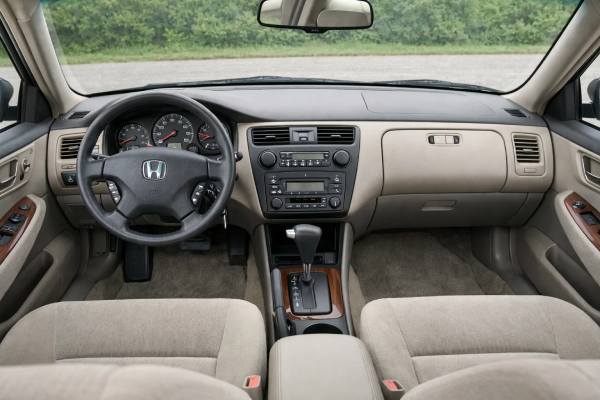
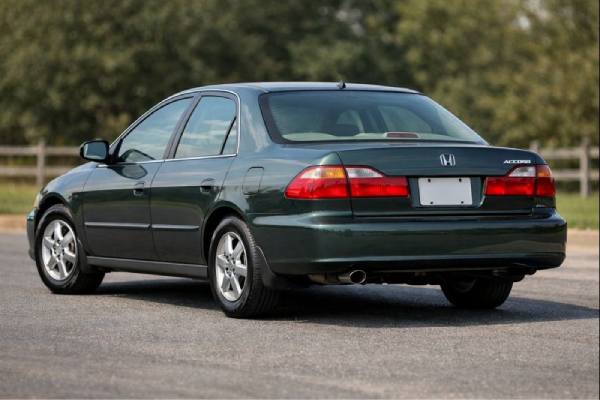
The 1998–2002 Honda Accord (often grouped under the sixth-generation “CG” family) with the F23A1 2.3-liter inline-four is a case study in Honda’s late-1990s priorities: durable everyday engineering, predictable handling, and ownership costs that stay reasonable when the car is maintained on schedule. The F23A1 is a torque-friendly, belt-driven SOHC VTEC engine designed to run happily on regular fuel and to tolerate high mileage, provided oil level and cooling health are taken seriously. Chassis tuning is another highlight—these Accords typically feel more precise than many midsize rivals of the era, especially with the 5-speed manual. The main ownership caveat is that condition matters more than badges: neglected cooling systems, overdue timing belts, and tired automatic transmissions can quickly turn a “reliable Honda” into a project. Buy well, service consistently, and this Accord can still be a smart daily.
Quick Specs and Notes
- Smooth, low-stress 2.3 L powertrain that holds up well when oil and coolant are kept in spec
- Balanced chassis and predictable steering make it easy to drive quickly and safely
- Parts availability and DIY friendliness are strong compared with many same-era midsize cars
- Automatic transmission condition is the biggest risk—road test carefully and verify service history
- Plan on timing-belt service about every 190,000 km (120,000 mi) or 10 years (whichever comes first)
Navigate this guide
- Honda Accord CG5 overview
- F23A1 specs and dimensions
- Trims, options, and safety tech
- Reliability patterns and fixes
- Maintenance plan and buying tips
- Driving feel and real performance
- Accord CG5 vs key rivals
Honda Accord CG5 overview
If you want to understand why so many 1998–2002 Accords are still on the road, start with the design brief: a midsize family car that feels “Honda precise” without being fragile. In this generation, the Accord’s structure and suspension geometry were tuned for stability and clean responses, not just soft comfort. Many cars in this class of the era leaned heavily into isolation; the Accord tried to keep steering and chassis feedback intact while still riding smoothly.
The F23A1 2.3-liter engine fits that theme. It is not a high-strung performance motor; it is a long-stroke inline-four built to make usable torque in normal driving. That matters because it reduces how often the car needs to downshift or rev hard in traffic. With the 5-speed manual, this engine feels honest and linear. With the 4-speed automatic, it is relaxed—but you must prioritize transmission health when buying.
This Accord’s ownership “sweet spot” is consistency. Keep the cooling system strong, change fluids on time, and fix small leaks early. Do that, and the platform rewards you with low drama: predictable cold starts, steady highway manners, and a suspension that can feel surprisingly composed on imperfect roads when bushings and dampers are fresh.
Where it shows its age is not in basic engineering, but in modern expectations: crash-tech has moved on, advanced driver assistance is not part of the package, and older rubber and plastic parts do not forgive neglect. Treat it like a 20+ year old car—inspect thoroughly, service proactively, and it remains one of the more satisfying and sensible midsize ownership plays from its era.
F23A1 specs and dimensions
Below are practical, owner-relevant specifications for the 1998–2002 Accord with the F23A1 2.3 L engine. Some values vary slightly by body style (sedan vs coupe), model year, emissions certification, wheels/tires, and transmission code—use these as a baseline, then confirm against your VIN-specific documentation.
Engine and performance
| Item | Specification |
|---|---|
| Code | F23A1 |
| Engine layout and cylinders | Inline-4, SOHC VTEC, 4 cylinders, 4 valves/cyl |
| Bore × stroke | 86.0 × 97.0 mm (3.39 × 3.82 in) |
| Displacement | 2.3 L (2254 cc) |
| Induction | Naturally aspirated |
| Fuel system | PFI/MPFI (Honda PGM-FI) |
| Compression ratio | 9.3:1 |
| Max power | 150 hp (112 kW) @ ~5700 rpm (some ULEV versions list ~148 hp) |
| Max torque | 206 Nm (152 lb-ft) @ ~4900 rpm |
| Timing drive | Belt |
| Fuel | Regular unleaded gasoline |
| Rated efficiency (EPA examples, 2002) | 4AT: 20/28/23 mpg (city/hwy/combined) • 5MT: 22/29/25 mpg |
Efficiency conversions (approx.): 20 mpg ≈ 11.8 L/100 km, 28 mpg ≈ 8.4 L/100 km, 25 mpg ≈ 9.4 L/100 km.
Transmission and driveline
| Item | Specification |
|---|---|
| Drive type | FWD |
| Transmissions | 5-speed manual (varies by trim/year) • 4-speed automatic (common) |
| Final drive ratio (typical) | ~4.06 (5MT) • ~4.47 (4AT) |
| Gear ratios (typical examples) | 5MT: 1st 3.307, 2nd 1.902, 3rd 1.360, 4th 1.029, 5th 0.787, Rev 3.000 • 4AT: ratios vary by code; verify on transmission tag |
Note: exact ratios can differ by transmission code and year. If you are tuning, swapping, or diagnosing shift behavior, pull the trans code from the case and match it to a verified chart.
Chassis and dimensions
| Item | Specification |
|---|---|
| Suspension (front/rear) | Double wishbone / multi-link (varies by body/trim) |
| Steering | Power rack-and-pinion (ratio varies by year/trim) |
| Brakes | Front discs standard; rear discs or drums depending on trim and year; ABS optional/standard depending on trim |
| Wheels/tires (common) | 195/65 R15 (base) • 205/60 R16 (many EX/SE) |
| Wheelbase | Sedan ~2715 mm (106.9 in) • Coupe often shorter |
| Length / width / height (sedan typical) | ~4795 mm / 1785 mm / 1445 mm (189.4 / 70.3 / 56.9 in) |
| Curb weight (typical range) | ~1350–1500 kg (2975–3300 lb), depending on body/trim/trans |
Fluids and service capacities
| Item | Specification |
|---|---|
| Engine oil | API-grade oil; commonly 5W-20 or 5W-30 by year/market; capacity ~4.4 L (4.6 US qt) with filter |
| Coolant | Honda-type phosphate-based, silicate-free coolant; 50/50 mix; capacity varies by engine and drain method |
| Manual trans fluid | Honda MTF (or equivalent); capacity about 1.9 L (2.0 US qt) |
| Automatic trans fluid | Honda ATF (often cited as ATF-Z1 for this era); capacity varies widely by drain vs overhaul |
| Fuel tank | ~65 L (17.1 US gal) |
Electrical
| Item | Specification |
|---|---|
| 12 V battery | Typically ~50–55 Ah class (varies by market) |
| Spark plugs | Long-life plugs common; gap and type vary by exact engine calibration and year |
Trims, options, and safety tech
Trim naming depends on market, but most 1998–2002 F23A1 Accords cluster around a few familiar identities: value-oriented base trims, midrange comfort trims, and “EX/SE-type” trims that add the features most buyers actually want long-term. For quick shopping, it helps to focus less on the badge and more on three functional questions: which transmission is fitted, which brake system is fitted (ABS and rear disc availability), and whether the car has side airbags.
Common trims and what changes
- Base/DX-style models: usually steel wheels, simpler audio, fewer power features. Great for simplicity, but often missing ABS and may use rear drums.
- LX-type models: the sweet spot for many buyers—power windows/locks, better interior trim, and more “daily comfort” without the highest repair exposure.
- EX/SE-type models: often add a moonroof, upgraded wheels/tires, nicer audio, and in many markets are more likely to include ABS and optional side airbags. Some packages add leather or heated seats.
The important mechanical differences are often subtle: wheel/tire size affects ride and braking feel, and equipment weight changes how lively the 2.3 feels. If you care about highway refinement, the EX/SE equipment level can feel more settled, but only if suspension wear has been addressed.
Safety ratings and what they mean here
For crashworthiness, one commonly cited benchmark is the IIHS moderate overlap frontal test from this generation’s early years; the rating applies broadly across 1998–2002 models in that configuration. That test result is valuable because it reflects structure, restraint performance, and injury measures—not just a marketing checklist. Still, remember you are comparing a late-1990s design to modern crash standards that are far stricter, especially for small-overlap impacts and advanced airbag strategies.
NHTSA also provides star ratings by year/body style, but the most accurate way to use that information is VIN-specific or exact year/trim matching, because equipment (like airbags and ABS) and test protocols can differ.
Safety systems and driver assistance
- Airbags: dual front airbags are standard; side airbags are fitted on some models, typically higher trims or option packages.
- Seat belt tech: front belts commonly include pretensioners; check for proper retraction and any crash history.
- Child seats: later examples include LATCH lower anchors on the outer rear seating positions and tether anchors.
- ABS: available and sometimes standard depending on trim/year; treat ABS as a meaningful safety upgrade on wet roads and during emergency braking.
- ADAS: features like automatic emergency braking, adaptive cruise control, and lane-keeping assistance are not part of this era. Your “driver assistance” is primarily tires, brakes, lighting condition, and suspension integrity.
If safety is a top priority, prioritize: (1) the newest, best-maintained example you can find, (2) ABS-equipped cars, (3) side airbags if available in your market, and (4) modern, high-quality tires in the correct load and speed rating.
Reliability patterns and fixes
A well-kept F23A1 Accord can be extremely durable, but “reliable” does not mean “maintenance-proof.” Below are the issues that most often separate a great daily from a money pit—organized by prevalence and cost risk, with practical symptoms and remedies.
Common and usually low-to-medium cost
- EGR passages clogging (driveability and emissions):
Symptoms: rough idle, hesitation, check-engine light (often EGR-related codes).
Likely cause: carbon buildup restricting EGR flow in the intake path.
Remedy: clean the EGR valve and ports; in stubborn cases, remove components for a thorough cleaning. - Oil leaks (age-related seals and gaskets):
Symptoms: oil smell, wet valve cover area, drips after parking.
Likely cause: valve cover gasket, cam seals, distributor-area sealing surfaces (varies by configuration).
Remedy: reseal early; keep oil level correct to protect the bottom end. - Main relay or aging electrical contacts (no-start when hot):
Symptoms: cranks but does not start, intermittent behavior that improves after cooling.
Remedy: replace with a quality part; confirm fuel pressure and ignition signals to avoid guesswork.
Occasional, but can become expensive
- Automatic transmission wear (highest financial risk on these cars):
Symptoms: delayed engagement, flare on shifts, harsh 2–3 or 3–4 shift, slipping under load, burnt-smelling ATF.
Likely cause: internal clutch wear, valve-body issues, heat and neglected fluid service.
Remedy: avoid problem cars when shopping; if kept, service with correct Honda-spec fluid at sensible intervals and keep the cooling system healthy. - Cooling system fatigue (overheating chain reaction):
Symptoms: temperature creep in traffic, coolant smell, unexplained coolant loss.
Likely cause: old radiator end tanks, weak cap, tired hoses, stuck thermostat, neglected coolant.
Remedy: treat overheating as urgent; one overheat event can warp components and shorten engine life.
Rare, but serious when it happens
- Timing belt neglect (engine damage risk):
Symptoms: belt noise, unknown service history, age over time limit.
Likely cause: overdue belt, tensioner wear, water pump seep leading to belt contamination.
Remedy: replace belt, tensioner, and water pump together on schedule; document the date and mileage.
Recalls and service actions
Because these cars span many years and markets, the right approach is verification—not assumptions. Use an official VIN-based recall tool and dealer history to confirm completion of safety campaigns. The headline item for many older Hondas is airbag inflator recalls (including Takata-related campaigns in various regions). Treat any open airbag recall as a “do not delay” item.
Pre-purchase checks worth requesting
- Proof of timing-belt service (date and mileage), not just verbal assurance
- Transmission fluid condition (color/smell) and road test behavior from cold and fully warm
- Cooling system inspection (radiator condition, fans, pressure test if possible)
- Scan for stored codes and confirm all readiness monitors if emissions testing applies
- Look for collision repairs that affect structure, airbag/SRS lights, and alignment
Maintenance plan and buying tips
A strong maintenance routine is what makes the F23A1 Accord feel “bulletproof.” Below is a practical schedule that leans conservative for age, short trips, and modern traffic—because these conditions are harder than the late-1990s test cycles many manuals assumed.
Practical maintenance schedule
| Item | Interval (distance/time) | Notes |
|---|---|---|
| Engine oil and filter | 8,000–10,000 km (5,000–6,000 mi) or 6 months | Short trips and hot climates benefit from shorter intervals |
| Air filter (engine) | Inspect every oil change; replace ~24,000–32,000 km | More often in dusty areas |
| Cabin air filter | 24,000–32,000 km or 12 months | If equipped; improves HVAC performance |
| Coolant | About every 5 years (then at regular intervals) | Use the correct Honda-type coolant and 50/50 mix |
| Brake fluid | Every 2 years | Prevents moisture-related corrosion and soft pedal |
| Spark plugs | Roughly 160,000–170,000 km (100,000–105,000 mi) | Confirm plug type and gap for your exact engine |
| Timing belt and water pump | About 190,000 km (120,000 mi) or 10 years | Replace tensioner and inspect cam/crank seals |
| Automatic transmission fluid | 40,000–60,000 km intervals (drain-and-fill style) | Use correct Honda-spec ATF; avoid harsh “flush” shortcuts |
| Manual transmission fluid | 60,000–100,000 km | Honda MTF or equivalent |
| Serpentine belts and hoses | Inspect every service; replace by condition | Age cracking is common even at low mileage |
| Tire rotation and alignment | Rotate every 8,000–10,000 km; align annually | Alignment protects tires and improves stability |
| 12 V battery | Test yearly; plan replacement 4–6 years | Heat and short trips shorten life |
Fluid specs and decision-making numbers
- Engine oil: use the viscosity listed for your year/market; many later examples specify 5W-20, while some earlier documentation allows 5W-30 depending on climate.
- ATF (automatic): use the correct Honda-spec fluid for the transmission generation; wrong fluid can worsen shift quality and longevity.
- MTF (manual): Honda MTF (or an equivalent that meets the correct friction characteristics).
Key torque specs
- Engine oil drain bolt: ~44 Nm (32 lb-ft)
- Wheel lug nuts: ~108 Nm (80 lb-ft)
- Spark plugs: ~18 Nm (13 lb-ft)
Buyer’s checklist and best picks
Prioritize condition and documentation over trim bragging rights. A clean, serviced LX with receipts can be a better buy than a neglected top trim.
Inspection highlights:
- Transmission behavior: no flare, no harsh engagement, no slipping under moderate throttle
- Cooling health: stable temperature, fans working, no oil/coolant mixing, no weak heater output
- Suspension wear: listen for clunks over bumps; check ball joints, bushings, and strut mounts
- Rust and corrosion: inspect rear arches, subframes, brake lines (salt climates), and trunk floor
- Electrical sanity: confirm all windows/locks work, and that SRS and ABS lights self-check correctly
Long-term outlook: if you buy a straight car, keep fluids fresh, and handle heat and timing-belt intervals responsibly, the Accord CG5/F23A1 is still one of the more dependable and economical midsize classics to run.
Driving feel and real performance
In daily use, the 2.3-liter Accord rarely feels “fast,” but it often feels more responsive than the numbers suggest because the engine delivers torque in the rev range you actually use. Throttle response is generally clean, and the car settles into highway speed without constant downshifting. With the 5-speed manual, the drivetrain can feel genuinely pleasant: the engine pulls smoothly, and you can keep it in the middle of the rev range without fuss. With the 4-speed automatic, the character is calmer—good for commuting—but you may notice wider gaps between gears and more kickdown in passing maneuvers.
Ride, handling, and NVH
A healthy suspension is what makes these Accords stand out. When bushings and dampers are worn, the car can feel loose and noisy. When refreshed, it tracks straight, resists crosswinds well for its era, and changes direction with a natural balance that many midsize sedans of the time did not match. Steering weight is typically light-to-moderate with decent on-center stability. Braking feel depends heavily on pad quality, rotor condition, and tire grip; ABS-equipped cars are easier to manage at the limit.
Cabin noise at highway speeds is “normal late-1990s midsize”: not harsh, but not modern-quiet. Fresh door seals, correct tire choice, and good wheel bearings can make a surprisingly large difference.
Real-world efficiency
EPA figures (2002 examples) provide a useful baseline:
- 4-speed automatic (2.3 L): 20 city / 28 highway / 23 combined mpg (≈ 11.8 / 8.4 / 10.2 L/100 km)
- 5-speed manual (2.3 L): 22 city / 29 highway / 25 combined mpg (≈ 10.7 / 8.1 / 9.4 L/100 km)
In real driving at 120 km/h (75 mph) on flat highway, expect roughly:
- Manual: about 7.5–8.5 L/100 km (28–31 mpg US)
- Automatic: about 8.0–9.0 L/100 km (26–29 mpg US)
Cold weather, short trips, and aggressive tires can raise consumption noticeably, and a failing thermostat or dragging brakes can quietly destroy mileage.
Performance metrics that matter
Typical stock performance ranges (varies by body style, transmission, and condition):
- 0–100 km/h (0–62 mph): ~9.0–10.5 seconds
- Passing (80–120 km/h): respectable with a downshift; slower if the automatic hesitates
- Braking: highly tire-dependent; well-maintained brakes and quality tires are the difference-maker
The key takeaway: this Accord rewards mechanical health. A strong engine mount set, clean intake/EGR flow, correct fluids, and fresh suspension parts can make the car feel years newer than its odometer suggests.
Accord CG5 vs key rivals
To judge the 1998–2002 Accord F23A1 fairly, compare it to the midsize cars buyers cross-shopped then—and what owners tend to cross-shop now in the used market: Toyota Camry (2.2/2.4 era), Nissan Altima (early 2000s), Mazda 626, Mitsubishi Galant, and even a few “near-midsize” options like the VW Passat 1.8T/2.8 from that time.
Where the Accord tends to win
- Driver confidence: The Accord’s chassis tuning is often more predictable and composed than softer competitors, especially when maintained.
- Mechanical simplicity: The naturally aspirated F23A1 avoids turbo heat and complexity, and routine service access is generally straightforward.
- Ownership ecosystem: Parts availability, community knowledge, and repair familiarity are excellent, which keeps long-term costs controllable.
- Manual transmission appeal: If you find a good 5-speed, it can feel more engaging than many same-era midsize cars.
Where rivals may be stronger
- Automatic transmission durability: Some Camry and certain Altima competitors may have a better reputation for “set-and-forget” automatics, depending on exact year and drivetrain.
- Cabin isolation: The Camry in particular often prioritizes a softer, quieter feel, which some drivers prefer for commuting.
- Safety modernization: Newer rivals (even a few years newer) may offer more advanced airbag strategies or later-era structural improvements.
How to choose based on your priorities
- Choose the Accord CG5/F23A1 if you value balanced road manners, straightforward mechanicals, and the ability to keep a car running well with consistent maintenance.
- Consider a Camry if your top priority is “quiet comfort” and you find a better-maintained example at the same price.
- Consider an Altima/Mazda 626/Galant only if condition is outstanding and the ownership history is clear—many examples of these rivals suffered from harsher depreciation and less consistent maintenance.
In today’s used market, the best “rival” to an Accord CG5 is often another Accord CG5—because the gap between a cared-for example and a neglected one is larger than the gap between brands.
References
- 2002 Honda Accord 2002 (Safety Rating)
- Gas Mileage of 2002 Honda Accord 2002 (Fuel Economy Database)
- Check for Recalls: Vehicle, Car Seat, Tire, Equipment 2025 (Recall Database)
- Car Safety Ratings | Vehicles, Car Seats, Tires | NHTSA 2025 (Safety Ratings)
- 2002 Accord Sedan Owner’s Manual 2002 (Owner’s Manual)
Disclaimer
This article is for informational purposes only and is not a substitute for professional inspection, diagnosis, or repair. Specifications, torque values, service intervals, and procedures can vary by VIN, market, model year, and installed equipment—always verify details using official Honda service documentation for your exact vehicle.
If you found this guide useful, please consider sharing it on Facebook, X (Twitter), or your favorite forum to help others keep these Accords on the road.