
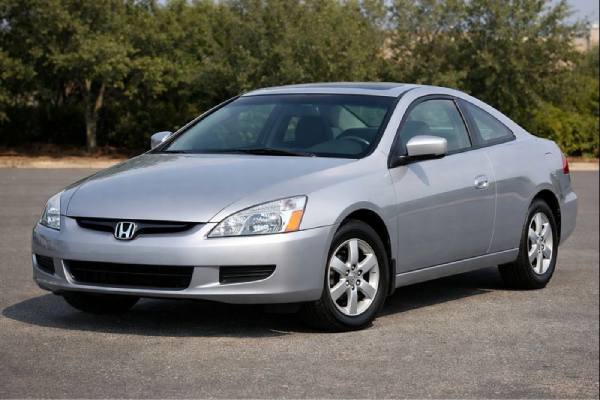
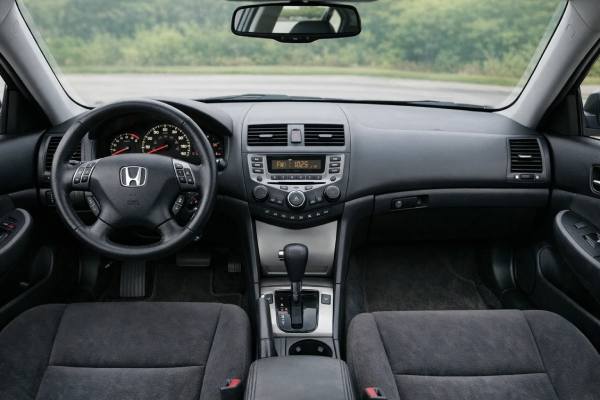
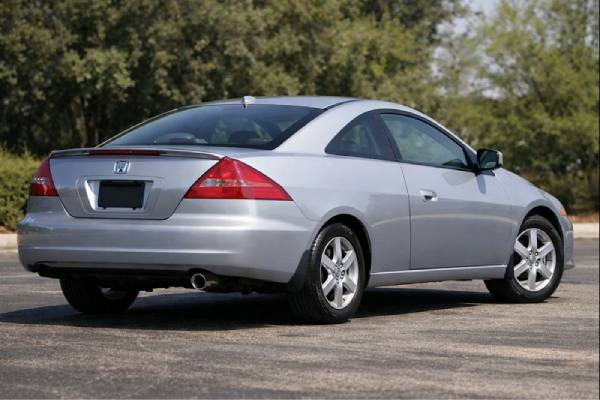
The 2002–2005 Honda Accord Coupe (CM7) with the K24A4 2.4-liter four-cylinder is the “sweet spot” of the early 7th-gen Accord lineup: simple by modern standards, quick enough for daily use, and engineered around long-life fundamentals. The K-series design uses a timing chain (not a belt), a rigid bottom end, and a calm, torque-first tune that suits the coupe’s slightly sportier personality without demanding premium fuel or exotic upkeep. Where owners win is consistency: predictable handling, strong parts support, and a drivetrain that stays happy when fluids are kept fresh and cooling and ignition systems are not neglected. Where owners get surprised is age-related: rubber mounts, suspension bushings, and A/C components can become the real “maintenance schedule” once mileage climbs.
Owner Snapshot
- Strong day-to-day drivetrain with a timing chain and broad midrange pull.
- Coupe packaging feels tighter and quieter than many rivals of the era at highway speed.
- Most ownership costs come from aging rubber, A/C repairs, and neglected fluids—not the engine itself.
- Change engine oil about every 8,000–10,000 km (5,000–6,000 mi) or 12 months, sooner with short trips.
- Plan a transmission drain-and-fill roughly every 40,000–50,000 km (25,000–30,000 mi) if you want the automatic to last.
Navigate this guide
- CM7 coupe ownership and design
- K24A4 specs, tables, and capacities
- Trims, safety, and equipment notes
- Common problems, recalls, and fixes
- Maintenance plan and smart buying
- How it drives and real economy
- Rivals: how the CM7 coupe stacks up
CM7 coupe ownership and design
Think of the CM7 Accord Coupe as Honda’s “grown-up sporty” two-door: not a featherweight, not a track toy, but a well-balanced daily that feels more purposeful than the sedan. The chassis tuning leans toward stability and confidence. The front end is engineered for predictable grip, and the rear suspension keeps the car composed over mid-corner bumps—important on imperfect roads where some coupes get nervous. The payoff is an easy-to-place car with a calm steering attitude and a planted highway feel, even on stock tire sizes.
The K24A4’s role here is underrated. Honda didn’t chase peak numbers; it chased usable torque and smoothness. In real driving, that means fewer downshifts, less stress on the transmission, and a powerband that works whether you’re rolling through city traffic or merging on a short on-ramp. The engine is also physically compact and service-friendly compared with many V6 layouts—access is better for belts, pulleys, and front-of-engine service, and underhood heat is typically lower than in V6 cars, which can help long-term plastics and wiring.
As the car ages, ownership becomes a “systems” story more than an “engine” story. The coupe body and doors add their own wear points: door check straps, window regulators, and lock actuators can start acting up after years of heavy use. Suspension rubber—especially lower control arm bushings, sway bar links, and engine mounts—slowly changes the car’s personality. Many people mistake that for “the Accord is getting sloppy,” when it’s really normal elastomer aging.
Bottom line: a healthy CM7 coupe feels tight, quiet, and eager. A neglected one feels harsh, vague, and noisy. The difference is rarely mysterious—service history and a careful pre-purchase inspection usually explain everything.
K24A4 specs, tables, and capacities
Specs vary by market, model year, and transmission, but the K24A4 coupe formula is consistent: a naturally aspirated 2.4-liter inline-four tuned for daily torque and long-life durability. The tables below focus on what owners actually use for maintenance planning and comparing trims.
Engine and performance (K24A4)
| Item | Specification |
|---|---|
| Code | K24A4 |
| Layout | Inline-4, DOHC, i-VTEC, 16-valve |
| Displacement | 2.4 L (2,354 cc) |
| Bore × stroke | 87.0 × 99.0 mm (3.43 × 3.90 in) |
| Induction | Naturally aspirated |
| Fuel system | Port fuel injection (PFI/MPFI) |
| Compression ratio | ~9.7:1 (varies by market calibration) |
| Max power | 160 hp (119 kW) @ ~5,500 rpm |
| Max torque | 218 Nm (161 lb-ft) @ ~4,500 rpm |
| Timing drive | Chain |
Transmission and driveline
| Item | Specification |
|---|---|
| Drive type | FWD |
| Manual (common) | 5-speed manual |
| Automatic (common) | 5-speed automatic |
| Differential | Open |
Typical 5-speed manual gearing (commonly referenced for early-2000s Accord 2.4 applications) is in the neighborhood of:
- 1st ~3.30, 2nd ~1.81, 3rd ~1.23, 4th ~0.91, 5th ~0.73, final drive ~4.3–4.4
Because gearing can change by year and market, treat these as a comparison baseline and confirm for your VIN if you are sourcing a transmission or rebuilding one.
Chassis and dimensions (coupe)
| Item | Specification (typical range) |
|---|---|
| Suspension (front/rear) | MacPherson strut / multi-link |
| Brakes (front/rear) | Ventilated disc / disc (size varies by trim) |
| Wheelbase | ~2,740 mm (107.9 in) |
| Length | ~4,760–4,770 mm (187.4–187.9 in) |
| Width | ~1,815 mm (71.5 in) |
| Height | ~1,415 mm (55.7 in) |
| Turning circle | ~11.4 m (37.4 ft) |
| Fuel tank | ~65 L (17.1 US gal / 14.3 UK gal) |
| Curb weight | ~1,420–1,520 kg (3,130–3,350 lb) |
| Cargo volume | ~400 L (~14.1 ft³) |
Fluids and service capacities (owner-planning values)
| Item | Specification (typical) |
|---|---|
| Engine oil | 5W-20; ~4.0 L (4.2 US qt) with filter |
| Coolant | Honda Type 2 or equivalent; ~5.5–6.0 L (5.8–6.3 US qt) |
| Automatic transmission fluid | Honda ATF (modern equivalent often DW-1); drain/fill commonly ~2.5–3.0 L (2.6–3.2 US qt) |
| Manual transmission fluid | Honda MTF; ~2.0 L (2.1 US qt) |
| Brake fluid | DOT 3/4 (follow cap/manual guidance) |
Key torque values owners commonly need:
- Wheel lug nuts: 108 Nm (80 lb-ft)
- Spark plugs: ~18 Nm (13 lb-ft)
- Engine oil drain bolt: ~39 Nm (29 lb-ft)
Always verify for your exact engine/trans and fastener type, especially if prior repairs changed hardware.
Trims, safety, and equipment notes
Accord Coupe trims and option structure vary a lot by country, but most markets follow a familiar ladder: a base-oriented four-cylinder coupe, a better-equipped mid-trim, and a top trim that adds comfort features and (in some regions) stability control or upgraded brakes/wheels. For shoppers today, the most important trim differences are not cosmetic—they change tire costs, brake hardware, and the presence of traction and stability aids.
Common trim patterns and quick identifiers
- Base / entry trims often keep smaller wheels, simpler audio, and fewer power features. These are usually the cheapest to keep on the road because they use common tire sizes and less expensive brake parts.
- Mid trims typically add better seats, more convenience electronics, and nicer interior materials. This is usually the best balance for most buyers: comfortable without being “feature heavy.”
- Top trims / leather packages may add heated seats, premium audio, sunroof, and upgraded wheels. These are great when everything works, but they can carry higher reconditioning costs (seat heaters, climate control quirks, and premium audio amplifiers are not free to fix).
If you want a fast “parking lot” check, look at:
- Wheel size and tire profile (bigger wheels usually mean pricier tires and sometimes more road noise).
- Brake rotor size and caliper condition (some trims use different front hardware).
- Dashboard warning lamps at key-on (ABS/VSA/airbag lights should illuminate briefly and then go out).
Safety equipment and what “good” looks like today
Most CM7 coupes were built around a strong basic safety package for the time: a stiff passenger cell, front airbags, and side-impact protection that improved across the early-2000s industry. Many cars also include front seat-mounted side airbags and side curtain airbags, but availability depends on year and market.
What you should evaluate now is less “what was fitted,” and more “what still works”:
- SRS system health: airbag warning lights, seat occupancy sensors, and clock spring issues (steering wheel airbag wiring) matter.
- ABS function: a clean, consistent pedal under hard braking is a good sign; warning lights or pulsing at low speed can hint at wheel speed sensor or tone ring issues.
- Child-seat provisions: coupes can be less convenient for child seats, even if anchor systems exist. Check access and belt geometry with your actual seat.
ADAS (automatic emergency braking, lane keeping, adaptive cruise) was not typical for this generation. Your “driver assistance” is mostly good tires, good brakes, and a chassis that behaves predictably—so equipment condition matters more than a brochure list.
Common problems, recalls, and fixes
A CM7 Accord Coupe can be a very reliable car, but it’s old enough now that problems cluster into a few predictable categories. The best way to think about issues is by prevalence and cost tier—because a $20 seal leak and a $1,200 A/C repair do not belong in the same mental bucket.
Common (high prevalence)
- Suspension wear (low to medium cost):
Symptoms: clunks over bumps, wandering on the highway, uneven tire wear.
Likely causes: front lower control arm bushings, sway bar links, strut mounts, rear control arm bushings.
Fix: replace worn arms/bushings, align the car, and don’t skip tire balancing—many “vibrations” start with neglected basics. - Engine mounts (medium cost):
Symptoms: vibration at idle, thump on gear engagement, harshness over sharp bumps.
Likely causes: aged hydraulic mounts and torn rubber.
Fix: replace mounts as a set when possible; mixing new and collapsed mounts can leave the drivetrain sitting crooked. - Power steering seepage (low cost):
Symptoms: fluid smell, dampness around pump lines, gradual fluid drop.
Likely cause: hardened O-rings and hose fittings.
Fix: reseal fittings early—running low fluid can cascade into pump noise and wear.
Occasional (moderate prevalence)
- Cold-start rattle (medium to high cost if ignored):
Symptoms: brief rattle on cold start that fades quickly.
Likely causes: VTC actuator wear or timing chain tensioner wear on K-series engines.
Fix: diagnose carefully; don’t guess. Persistent rattle deserves attention because timing control affects drivability and long-term health. - Automatic transmission shift quality issues (medium to high cost):
Symptoms: flare on shifts, harsh engagement, delayed shifts, shudder under light throttle.
Likely causes: degraded ATF, clogged internal passages, aging solenoids, or prior overheating.
Fix: start with correct fluid and conservative drain-and-fill intervals; avoid aggressive flushes on unknown-history units.
Rare (but high impact)
- Overheating events (high cost):
Symptoms: temperature spikes, coolant loss, heater stops blowing hot.
Likely causes: neglected coolant, radiator aging, stuck thermostat, weak fan control.
Fix: treat cooling as preventive maintenance; one severe overheat can turn a good engine into a head gasket gamble.
Recalls and service actions (what to do)
Because recall coverage changes over time and differs by market, the practical move is:
- Run the VIN through your region’s official recall portal.
- Ask for dealer printouts showing completion dates.
- Treat any open airbag recall as non-negotiable—complete it before daily use.
The CM7 coupe rewards owners who fix small problems early. A little seepage, a little rattle, or a little suspension play tends to get louder, more expensive, and more annoying if you wait.
Maintenance plan and smart buying
If you want a CM7 Accord Coupe that feels “Honda-tight,” you need two things: regular fluid service and a strategy for age-related rubber and electronics. The engine itself is not fragile; neglect is what makes it expensive.
Practical maintenance schedule (distance/time)
Use this as a baseline, then tighten intervals for short trips, dusty areas, extreme heat, or heavy stop-and-go use.
- Engine oil and filter: every 8,000–10,000 km (5,000–6,000 mi) or 12 months (5W-20 is the common spec).
- Engine air filter: inspect every 15,000 km (10,000 mi); replace about 30,000–45,000 km (20,000–30,000 mi) depending on dust.
- Cabin air filter: every 15,000–30,000 km (10,000–20,000 mi) or yearly if you value HVAC performance.
- Coolant: typically long-life; replace around 160,000 km (100,000 mi) or 5 years, then shorter thereafter (confirm for your manual/market).
- Spark plugs: commonly long-life iridium; plan 160,000 km (100,000 mi) unless symptoms appear earlier.
- Valve clearance (if noisy): check if you hear ticking at idle when warm, or during major service intervals.
- Automatic transmission (5AT): drain-and-fill every 40,000–50,000 km (25,000–30,000 mi) for longevity.
- Manual transmission: fluid every 60,000–80,000 km (40,000–50,000 mi).
- Brake fluid: every 2 years regardless of mileage.
- Brake pads/rotors: inspect at every tire rotation; replace based on thickness and vibration, not calendar.
- Tire rotation and alignment: rotate every 8,000–10,000 km (5,000–6,000 mi); align at least yearly or after suspension work.
- 12V battery: test yearly; many last 4–6 years depending on climate and usage.
Buyer’s guide: what to check before you pay
- Cold start behavior: listen for start-up rattle, check idle smoothness, and confirm the charging system holds stable voltage.
- Transmission behavior: test gentle shifts, kickdown, and low-speed creeping. Any shudder or flare is a negotiation point.
- A/C performance: verify cold air at idle and during a drive; weak A/C can signal costly compressor or condenser work.
- Suspension and steering: look for uneven tire wear and feel for clunks; a tight Accord shouldn’t feel loose.
- Leaks: oil around the timing cover area, valve cover seepage, power steering dampness, and coolant crust at hose joints.
- Rust hotspots: rear arches, underbody seams, and subframe areas (region-dependent).
Best long-term buys usually have boring traits: stock wheels, complete records, and owners who changed fluids on time. Modified examples can be fine, but they require more careful inspection and a bigger “unknown history” budget.
How it drives and real economy
The CM7 Accord Coupe’s driving character is more refined than edgy, and that’s why it ages well. The car feels stable at speed, tracks straight, and doesn’t punish you for long commutes. Steering feedback is not sports-car sharp, but it is consistent—what you feel through the wheel matches what the chassis is doing, which makes the coupe easy to trust on wet roads and long sweepers.
Powertrain character
The K24A4 is smooth and flexible rather than dramatic. Throttle response is clean, and the engine pulls best in the midrange where daily driving lives. The 5-speed manual gives the coupe a more lively feel because you can keep it in the meat of the torque band. The 5-speed automatic is usually the better commuter choice when healthy: it’s calm, it upshifts early, and it makes the car feel relaxed. When the automatic is neglected, though, you’ll notice delayed engagement or shift flare long before you get a warning light.
Noise, vibration, and harshness (NVH) is typically good for the era. If it feels buzzy or harsh, suspect engine mounts, tires, and alignment before blaming “old car problems.”
Real-world efficiency
Official economy figures depend on test cycle and transmission, but a realistic planning view looks like this:
- Highway (steady 100–120 km/h / 60–75 mph): many owners see the equivalent of ~7.5–8.5 L/100 km (28–31 mpg US) when the car is well maintained and tires are properly inflated.
- City: ~10–11.5 L/100 km (20–24 mpg US) is common depending on traffic, trip length, and winter warm-up time.
- Mixed driving: around ~9–10 L/100 km (23–26 mpg US) is a reasonable expectation.
Cold weather can add a noticeable penalty—short trips in winter are especially hard on economy and oil life.
Selective performance metrics (typical, varies by test)
- 0–100 km/h (0–62 mph): roughly 8–9 seconds depending on transmission and conditions.
- Passing power: the coupe feels strongest from about 60–120 km/h where torque and gearing align well.
- Braking feel: generally confident with good pads and fresh fluid; a soft pedal is often old brake fluid rather than “bad brakes.”
If you want the coupe to feel at its best, prioritize tires and fresh fluids. These cars respond dramatically to simple maintenance, and the driving experience improves more than most owners expect.
Rivals: how the CM7 coupe stacks up
The CM7 Accord Coupe lives in a space that’s both practical and niche: a midsize two-door with real rear seats (even if access is not as easy as a sedan), real trunk space, and a drivetrain built for commuting. Its rivals tend to fall into three buckets: comfort-first midsize sedans (that happen to be cross-shopped), style-focused coupes, and sportier four-cylinder options.
Versus Toyota Camry Solara (early-2000s)
The Solara often feels softer and more comfort-oriented. If you want relaxed ride quality and a “cruise all day” character, the Toyota is appealing. The Honda usually feels tighter and more neutral in corners, and the K-series engine bay is typically easier to service cleanly. The Honda also tends to reward suspension refresh work more noticeably—restore the bushings and it feels young again.
Versus Nissan Altima (early-2000s) and later Altima Coupe
Altimas can feel more eager in steering and throttle response, depending on year and engine. The Honda counters with consistency: predictable road manners, strong parts availability, and a drivetrain that tolerates high mileage well when serviced. In long-term ownership, small maintenance choices matter more than the brand badge—an Accord with documented ATF service can be a safer bet than a “fast feeling” rival with unknown transmission history.
Versus Mazda6 (four-cylinder)
The Mazda6 is often the driver’s pick for steering feel and chassis balance. The Accord Coupe feels more mature and quieter at speed, with a smoother everyday power delivery. If you value “connected” handling, the Mazda can win; if you value calm commuting with strong durability fundamentals, the Honda often wins.
Why the Accord Coupe still makes sense
- Balanced engineering: it does nothing badly, and that’s the point.
- Ownership ecosystem: parts, knowledge, and repair paths are well known.
- Real practicality: trunk space and real fuel economy are still competitive for a simple gasoline car.
The CM7 coupe is a great choice for buyers who want a two-door without giving up daily usability. Buy the best-maintained example you can, budget for a suspension and mount refresh, and you’ll get a car that feels far more modern than its calendar age suggests.
References
- 2005 Accord Coupe Online Reference Owner’s Manual 2005 (Owner’s Manual)
- 2004 Accord Coupe Online Reference Owner’s Manual 2004 (Owner’s Manual)
- 2003 Accord Coupe Online Reference Owner’s Manual 2003 (Owner’s Manual)
- 2005 Honda Accord 2005 (Official Fuel Economy Ratings)
Disclaimer
This article is for informational purposes only and is not a substitute for professional diagnosis, inspection, or repair. Specifications, torque values, fluid capacities, service intervals, and procedures can vary by VIN, market, model year, and equipment. Always verify details using your official owner’s manual and factory service information for your exact vehicle.
If this guide helped, consider sharing it on Facebook, X (Twitter), or your favorite forum to support our work.