
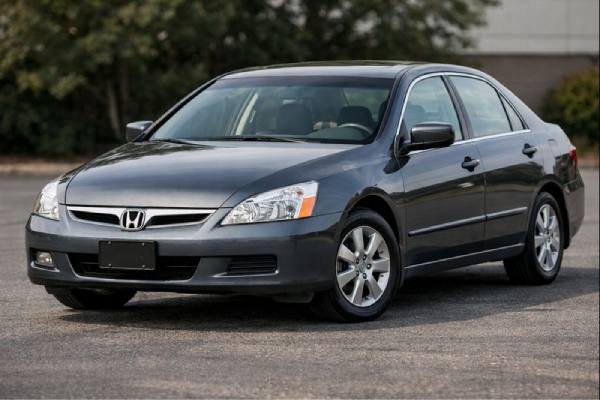
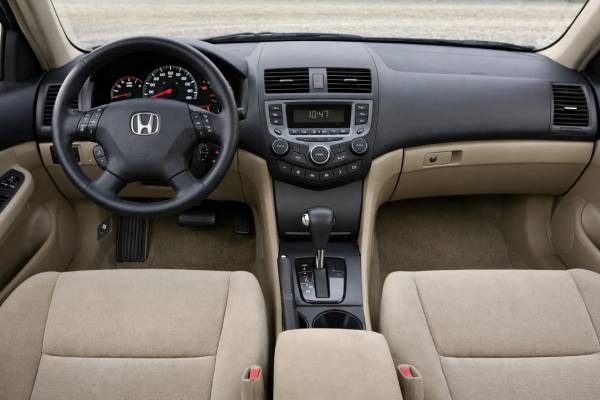
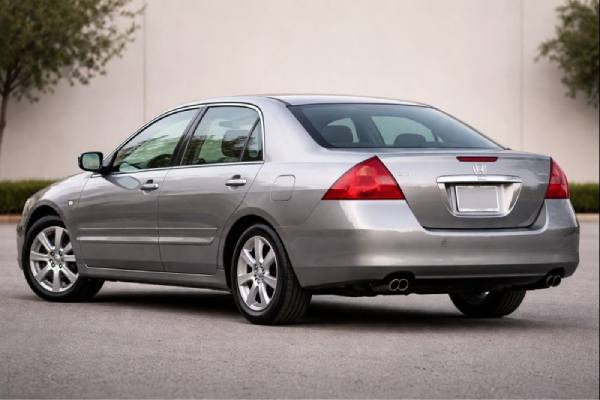
The 2005–2007 Honda Accord (CM6) with the J30A5 3.0-liter V6 is the “fast Accord” of this era, but its real value is how effortlessly it makes speed. The V6 delivers strong, smooth torque without turbo lag, and it pairs with a chassis tuned for stable highway work rather than edgy sport-sedan behavior. Under the hood, the J-series layout is compact for a V6, with a timing belt and a reputation for long service life when fluids and belt intervals are respected.
Ownership is usually defined by two things: transmission health (especially if the automatic has seen neglected fluid) and maintenance history for the timing belt, water pump, and cooling system. If those basics are handled, the CM6 V6 can feel surprisingly modern in daily driving—quiet, quick enough for confident passing, and easy to live with.
Owner Snapshot
- Strong, refined V6 torque for effortless passing and relaxed highway cruising
- Simple naturally aspirated powertrain with excellent parts availability in most markets
- Stable, predictable chassis that rewards good tires and fresh suspension bushings
- Timing belt service is a real ownership cost if overdue—plan it, do not postpone it
- Typical timing belt interval is about 168,000 km (105,000 mi) or 7 years (verify for your VIN and market)
Navigate this guide
- CM6 V6 in real life
- J30A5 technical specification tables
- Equipment, trims, and safety
- Failure patterns and recalls
- Maintenance schedule and buying advice
- Performance and fuel use
- Rival V6 sedans compared
CM6 V6 in real life
The CM6 Accord with the J30A5 V6 is best understood as a comfortable midsize car that happens to be genuinely quick. Honda tuned this 3.0-liter for smooth power delivery and real-world response, not just top-end numbers. In normal driving, you feel a strong midrange that lets the car surge forward with minimal drama—useful for merging, climbing grades, and passing without planning a long run-up.
From an engineering perspective, the J30A5 is a compact, aluminum V6 with a single overhead cam (SOHC) valvetrain and Honda’s variable valve timing and lift strategy (i-VTEC on this variant in many markets). That design keeps packaging tight and service access reasonable for a V6, but it also introduces a key ownership rule: the timing belt is not optional maintenance. Unlike chain-driven four-cylinders, belt service is a scheduled cost, and owners who ignore it risk turning a predictable job into an expensive failure.
The CM6 chassis matches the engine’s character. The car feels planted at highway speed, and the steering tends to be consistent and easy to place. It does not communicate like a dedicated sport sedan, but it inspires confidence with predictable grip and stable braking when the suspension and tires are in good condition. Many used examples feel “older” only because of worn bushings, tired dampers, and budget tires—things that are fixable and often worth doing because the underlying platform is solid.
Where ownership can get complicated is the automatic transmission and the overall condition of the cooling and hydraulic systems. This generation’s automatic can live a long time, but it is far happier with regular fluid drain-and-fills than with a “never touched” history. The power steering system, engine mounts, and A/C components also age in ways that can mimic bigger problems if you diagnose by symptoms alone.
The main advantage of the CM6 V6 is that it delivers near-entry-luxury smoothness at mainstream running costs—if you buy one that has been maintained on schedule. If you buy one that has been “driven, not serviced,” it can still be revived, but you should expect a catch-up phase.
J30A5 technical specification tables
The tables below focus on the 2005–2007 Accord CM6 with the J30A5 3.0L V6 rated at about 244 hp. Exact figures can vary by market, body (sedan vs coupe), and transmission, so use these as practical reference points and confirm details by VIN and owner’s documentation.
Engine and efficiency
| Item | Specification |
|---|---|
| Code | J30A5 |
| Engine layout and cylinders | V6 (60°), 6 cylinders, SOHC, 4 valves/cyl (24-valve) |
| Bore × stroke | 86.0 × 86.0 mm (3.39 × 3.39 in) |
| Displacement | 3.0 L (2,997 cc) |
| Induction | Naturally aspirated |
| Fuel system | Multi-point injection (PGM-FI/MPFI) |
| Compression ratio | ~10.0:1 |
| Max power | 244 hp (182 kW) @ ~6,250 rpm |
| Max torque | ~286 Nm (211 lb-ft) @ ~5,000 rpm |
| Timing drive | Belt |
| Emissions and efficiency standard | Market dependent (U.S. EPA listings common) |
| Rated efficiency (EPA, typical) | 5AT: 13.1 / 9.0 / 11.2 L/100 km (18 / 26 / 21 mpg US) city/hwy/comb; 6MT: 13.1 / 8.7 / 11.2 L/100 km (18 / 27 / 21 mpg US) |
| Real-world highway @ 120 km/h (75 mph) | Often ~9.0–10.0 L/100 km (23–26 mpg US) in good condition |
Transmission and driveline
| Item | Specification |
|---|---|
| Drive type | FWD |
| Transmission (common) | 5-speed automatic |
| Transmission (some markets/body styles) | 6-speed manual (often limited availability) |
| Differential | Open (typical) |
Chassis and dimensions
| Item | Typical specification |
|---|---|
| Suspension (front / rear) | Double wishbone / multi-link (varies by market) |
| Steering | Power rack-and-pinion (often hydraulic on this generation) |
| Brakes | 4-wheel discs; front vented (diameters vary by trim/market) |
| Wheels and tires | Commonly 16–17 in; typical sizes include 205/60 R16 or 215/50 R17 |
| Length / width / height | ~4,810–4,860 mm / ~1,820 mm / ~1,450 mm (189–191 in / 72 in / 57 in) |
| Wheelbase | ~2,740 mm (107.9 in) |
| Turning circle | ~10.8–11.2 m (35–37 ft), equipment dependent |
| Curb weight | ~1,520–1,600 kg (3,350–3,530 lb), equipment dependent |
| Fuel tank | ~65 L (17.2 US gal / 14.3 UK gal) |
| Cargo volume (sedan) | ~390–410 L (13.8–14.5 ft³), method dependent |
Fluids and service capacities
| Item | Typical specification (verify for VIN) |
|---|---|
| Engine oil | 5W-20 common in many markets; ~4.1–4.3 L (4.3–4.5 US qt) with filter |
| Coolant | Honda-compatible long-life coolant; total often ~7.5–8.5 L (7.9–9.0 US qt) |
| Automatic transmission fluid | Honda ATF (DW-1 is the modern service replacement for older specs); drain-and-fill quantity is far less than total |
| Manual transmission fluid | Honda MTF; capacity varies by gearbox |
| A/C refrigerant | R-134a; charge varies by body and equipment |
Electrical and ignition
| Item | Typical specification |
|---|---|
| Alternator output | Often ~100–110 A (equipment dependent) |
| 12 V battery | Commonly 12 V, ~50–60 Ah (CCA varies by market) |
| Spark plugs | Iridium-type plugs common; gap and part number vary by market |
Safety and driver assistance
| Item | Notes |
|---|---|
| Crash ratings | IIHS covers 2003–2007 structural ratings in key tests; results depend on test type and equipment |
| Headlight rating (IIHS) | Headlight performance varies by trim and reflector/projector design |
| ADAS | No modern AEB/ACC/LKA; expect ABS and possibly stability control depending on trim and market |
Equipment, trims, and safety
CM6 V6 trims differ more by comfort and convenience than by core mechanical hardware, but a few choices matter for long-term ownership: transmission type, wheel size, and the presence of stability control and side-curtain airbags. Because trim names vary by region, treat “trim” as a checklist of equipment rather than a badge on the trunk.
Trims and options that change ownership
Common V6 configurations include a well-equipped mainstream trim and a higher “comfort” trim with leather, premium audio, and sometimes factory navigation. Here are the options that affect cost and usability:
- Wheel and tire package: 17-inch wheels sharpen steering response but typically increase tire price and road noise. If you want the most refined ride, a quality touring tire on the smaller wheel option often feels best.
- Sunroof and water management: the sunroof itself is reliable, but clogged drains can cause wet carpets and electrical issues. Always check for dampness under mats and in the trunk.
- Premium audio and factory navigation: older amplifiers and in-dash navigation can fail with age. They are not dealbreakers, but you should test every speaker and function before buying.
- Heated seats and power seat motors: nice to have, but they add failure points. Verify smooth travel and consistent heating.
Year-to-year notes (2005–2007)
This period sits in the “mature” phase of the generation, which usually means fewer early-production quirks and more consistent parts interchange. You may still see equipment changes by year, but they are typically incremental (audio revisions, lighting, or package reshuffles) rather than major mechanical redesign.
Safety ratings and what to focus on
For this generation, safety outcomes are strongly influenced by side airbag and curtain airbag fitment and by seat/head restraint design. Some trims can score well in major crash tests, while whiplash protection may be weaker depending on seat design. Practically, that means:
- Prefer cars with front side airbags and side curtains (confirm via SRS tags on seat sides and headliner labels).
- Adjust head restraints correctly and ensure seatback mechanisms feel solid—looseness matters in real impacts.
Safety systems and driver assistance
Expect a traditional, pre-ADAS safety suite:
- Dual front airbags and, on many trims, side torso and side curtain airbags
- ABS with electronic brakeforce distribution (EBD)
- Traction control and stability control in many markets on V6 trims, but not guaranteed everywhere
Since the CM6 lacks modern automatic braking and lane support, your most meaningful “safety upgrades” are maintenance-driven: high-quality tires, fresh brake fluid, properly sliding calipers, and correct alignment.
Failure patterns and recalls
A well-kept J30A5 Accord can be very dependable, but the V6 version has a few predictable failure patterns that show up as the car ages. The goal is not to fear the list—it’s to recognize symptoms early and budget the big-ticket maintenance before it becomes a surprise.
Common, lower-cost issues
- Valve cover and spool valve oil leaks (common, low/medium): oil smell after a drive, seepage onto hot surfaces, or oil in plug wells. Remedy is typically gasket replacement and checking the PCV valve so pressure does not push oil past seals.
- Power steering pump noise or seepage (common, low/medium): groan at low speed or damp fittings. Often fixed with seals or O-rings and correct fluid, but chronic leaks can contaminate belts and mounts if ignored.
- Engine mounts softening (common, medium): vibration at idle or clunks during throttle transitions. Replacing mounts often restores the “refined” feel people expect from the V6.
Occasional, medium-to-high cost issues
- Automatic transmission shift quality (occasional, medium/high): flare, harsh shifts, or delayed engagement, often worse when hot. Old fluid is a frequent contributor. Start with correct drain-and-fill service and inspection for related pressure switch or solenoid issues if symptoms persist.
- Cooling system aging (occasional, medium): radiators, hoses, and thermostats age like any 15–20 year old car. Slow coolant loss or inconsistent temperature in traffic should be treated as a system problem, not a single-part guessing game.
- A/C performance (occasional, medium): weak cooling can be a leak, a clutch issue, or a compressor problem. Proper diagnosis beats repeated recharges.
Timing belt and why it matters
The timing belt service is the signature V6 maintenance job. If history is unknown, treat it as due. A good belt service usually includes belt, tensioner, idlers, and water pump, plus fresh coolant. Skipping this job is the fastest way to turn a “great deal” into a risky car.
Recalls, TSBs, and verification
Many cars from this era were included in large airbag inflator campaigns, and some markets also saw campaigns related to hydraulic systems. The safe approach is simple:
- Run an official VIN recall check and print the results.
- Ask for dealer documentation showing completion.
- If the seller cannot document recall work, assume it still needs verification.
Pre-purchase checks that prevent expensive surprises
- Cold start: listen for abnormal belt-area noises and observe idle smoothness
- Full warm test drive: confirm transmission behavior under light throttle and kickdown
- Look for wet carpets and trunk moisture (sunroof drains and seals)
- Inspect for oil seepage around the rear bank valve cover area and along the subframe
- Confirm maintenance records for belt service, ATF service, and coolant replacement
Maintenance schedule and buying advice
The CM6 V6 responds extremely well to routine maintenance. The trick is to treat it like a schedule-driven car, not a “fix it when it breaks” car—especially for belts, fluids, and rubber parts.
Practical maintenance schedule
Use the intervals below as a realistic ownership plan, then confirm exact requirements for your VIN and market:
- Engine oil and filter: every 8,000–12,000 km (5,000–7,500 mi) or 6–12 months. Short trips and cold climates justify the shorter end.
- Engine air filter: inspect every 15,000 km (10,000 mi); replace around 30,000–45,000 km (20,000–30,000 mi) based on dust conditions.
- Cabin air filter: replace about every 20,000–30,000 km (12,000–20,000 mi) or yearly if you drive in heavy dust or pollen.
- Coolant: replace on a long-life interval, but reset the clock if history is unknown. A V6 that runs warm in traffic deserves immediate attention.
- Spark plugs (iridium, typical): commonly around 160,000 km (100,000 mi), sooner if misfires or rough running appear.
- Timing belt service: about 168,000 km (105,000 mi) or 7 years is a common interval; include water pump and tensioners unless documentation proves recent work.
- Automatic transmission fluid: drain-and-fill every 40,000–60,000 km (25,000–40,000 mi). Repeated drain-and-fills can be a safer approach than aggressive flushing on unknown-history units.
- Brake fluid: every 3 years regardless of mileage.
- Serpentine belt and hoses: inspect yearly; replacement timing depends on climate and cracking.
- Tires and alignment: rotate about every 8,000–12,000 km (5,000–7,500 mi); check alignment yearly or after suspension work.
- 12 V battery: test yearly after 3 years; replacement often lands around 4–6 years depending on climate.
Fluids and specifications to insist on
- Use the correct Honda-compatible ATF for your market (many owners now use the current Honda service ATF where appropriate).
- Use a Honda-compatible long-life coolant and avoid mixing unknown formulas.
- Match the engine oil viscosity to the official documentation for your region.
Buyer’s guide: what to seek and what to avoid
Prefer cars with proof of the “big three” services: timing belt, ATF, and coolant.
Seek:
- Documented timing belt and water pump service
- Regular ATF drain-and-fill history (automatic)
- Evidence of recent suspension refresh or at least even tire wear
- A dry interior with no mildew smell
Be cautious with:
- Unknown belt history plus any belt-area noise
- Transmission flare or harsh shifts on a fully warmed test drive
- Repeated overheating stories or chronic coolant top-offs
- Wet carpets, water in spare tire well, or electrical oddities after rain
Long-term outlook
If you buy a maintained example and keep up with scheduled belt and fluid work, the CM6 V6 can be a long-term, high-comfort daily driver with very manageable running costs for its performance level. Most “expensive Accords” happen when owners ignore the maintenance calendar.
Performance and fuel use
The J30A5 V6 changes the Accord’s personality more than the spec sheet suggests. It is not just faster; it is more relaxed. You typically use less throttle to do the same job, which reduces stress in everyday traffic and makes the car feel quieter and smoother at speed.
Acceleration and passing response
In good condition, the CM6 V6 is brisk by modern standards for a naturally aspirated midsize sedan:
- 0–100 km/h (0–62 mph): commonly in the mid-6 to low-7 second range depending on transmission, tires, and vehicle condition
- Passing: strong midrange makes 80–120 km/h (50–75 mph) acceleration confident, especially when the transmission downshifts cleanly
The engine’s power delivery is linear and predictable. There is no turbo surge; instead, it pulls harder as revs rise, and it remains smooth near the top of its usable range.
Ride, handling, and braking feel
The CM6 platform is tuned for stability:
- Straight-line stability: a strong point, especially with fresh alignment and quality tires
- Cornering balance: neutral and predictable; it resists mid-corner surprises when suspension bushings are healthy
- Braking: easy to modulate, but braking confidence depends heavily on caliper slide condition and fresh brake fluid
If the car feels loose or noisy over bumps, suspect wear items first: end links, compliance bushings, and dampers. These cars often regain composure after a targeted suspension refresh.
Real-world fuel economy
Official EPA listings for the 3.0 V6 are commonly around 18 mpg city and 26–27 mpg highway (US), with 21 mpg combined depending on transmission. In practical terms:
- City: often 12.5–14.0 L/100 km (17–19 mpg US), heavily influenced by warm-up time and traffic
- Highway at 100–120 km/h: often 9.0–10.5 L/100 km (22–26 mpg US)
- Mixed: commonly around 11.0–12.5 L/100 km (19–21 mpg US)
Cold weather and short trips have a noticeable penalty because the V6 takes longer to reach full operating efficiency. Tire choice also matters: aggressive all-seasons or underinflated tires can quietly cost fuel and steering precision.
Transmission character
- 5-speed automatic: smooth when healthy, but it can feel indecisive if fluid is old or mounts are soft. A well-maintained unit downshifts cleanly and makes the car feel effortlessly quick.
- 6-speed manual (where available): more direct and engaging, and it often improves driver control over fuel use because you can hold higher gears at steady speeds.
The practical verdict is that performance is rarely the reason people sell these cars; condition is. A well-kept CM6 V6 still feels like a strong, confident long-distance tool.
Rival V6 sedans compared
When you shop a 2005–2007 Accord V6 today, you are usually cross-shopping other older V6 midsize sedans that promise the same mix of comfort and speed. The CM6’s main advantage is how “complete” it feels when maintained: quick enough, quiet enough, and simple enough to keep.
Versus Toyota Camry V6 (similar era)
- Accord advantage: often feels more composed at highway speed with more connected steering and a tighter chassis response.
- Camry advantage: tends to prioritize isolation and softness; many owners value its calm ride.
- Decision point: buy the best-maintained example. Both cars punish cooling system neglect, and both reward routine fluid service.
Versus Nissan Altima or Maxima V6
- Accord advantage: typically ages more predictably when comparing unknown-history cars, and it is less likely to feel “tired” if the suspension is kept up.
- Nissan advantage: can feel very quick and eager, especially in stronger VQ-powered models.
- Decision point: the Honda tends to be the safer bet for long-term consistency, while the Nissan may be more performance-forward depending on model.
Versus Mazda6 V6
- Accord advantage: usually wins on refinement and long-distance comfort, with a smoother, quieter powertrain feel.
- Mazda advantage: often more playful handling and a sportier response at everyday speeds.
- Decision point: if you want the sharper drive and accept a firmer feel, Mazda is appealing; if you want the most balanced daily experience, Accord fits well.
Versus European V6 alternatives
Depending on your market, you may also see V6 variants of cars like the Passat or other premium-leaning sedans at similar prices.
- Accord advantage: simpler ownership pattern and strong parts support for routine service in many regions.
- European alternative advantage: features and cabin feel can be higher, but diagnosis and parts costs can rise quickly on neglected examples.
Who should choose the CM6 V6
- Drivers who want a naturally aspirated V6 for smoothness, not just speed
- Buyers who value stability, comfort, and predictable long-term ownership
- Owners willing to follow the timing belt and fluid schedule faithfully
If you prioritize modern driver assistance or the absolute lowest fuel use, the CM6 V6 will not fit. But if you want a proven, refined V6 midsize car that still feels confident on today’s roads, it remains one of the stronger choices—provided you buy on maintenance history, not mileage alone.
References
- 2006 Accord Sedan Online Reference Owner’s Manual 2006 (Owner’s Manual)
- Gas Mileage of 2006 Honda Accord 2006 (Official Fuel Economy)
- 2006 Honda Accord 2006 (Safety Rating)
- Check for Recalls: Vehicle, Car Seat, Tire, Equipment | NHTSA 2025 (Recall Database)
Disclaimer
This article is for informational purposes only and is not a substitute for professional diagnosis, inspection, or repair. Specifications, torque values, service intervals, and procedures vary by VIN, market, model year, and equipment. Always verify details using the official owner’s manual and service documentation for your exact vehicle.
If this guide helped, please consider sharing it on Facebook, X (Twitter), or your preferred community to support our work.