
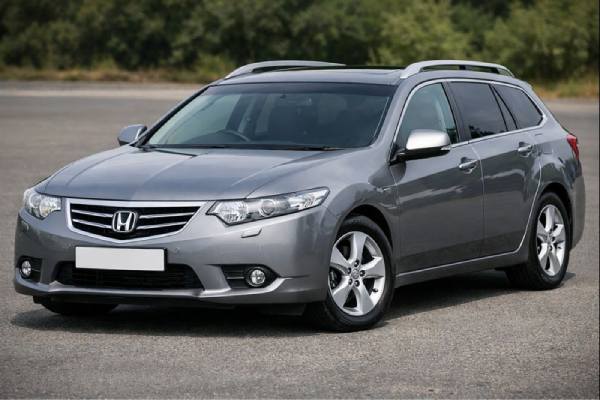
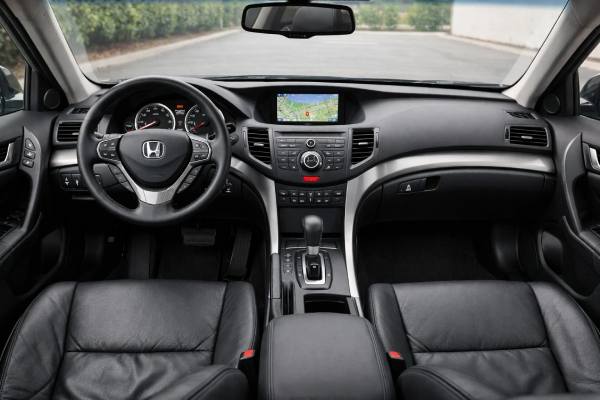
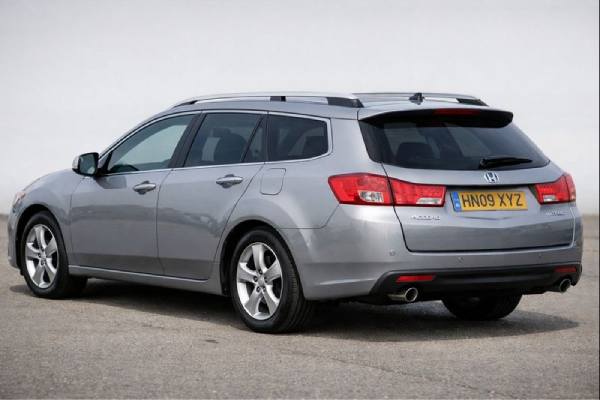
The 2012–2015 Honda Accord Tourer (CW3) with the 180 hp N22B2 2.2 i-DTEC is one of those rare long-roof diesels that blends real load space with a genuinely strong drivetrain. The headline is torque: it pulls hard from low revs and stays relaxed at motorway speeds, especially paired with the 6-speed manual typically fitted to this output level. Under the skin, the Accord’s double-wishbone front suspension and multi-link rear keep it stable and predictable, but wheel and tyre choices (often 18-inch on sportier trims) can make ride comfort more sensitive to worn dampers and bushes.
Ownership is mainly about using the diesel system correctly: regular oil changes with the right low-ash oil, avoiding endless short trips that stress the DPF (diesel particulate filter), and staying ahead of intake/EGR soot build-up. Do that, and it’s a capable, long-distance estate with a premium feel.
What to Know
- Strong 380 Nm pull makes it effortless on highways and when loaded.
- Big-boot practicality with a “proper” wagon driving balance.
- Fuel economy can stay in the mid-5 L/100 km range if the DPF is kept healthy.
- Short-trip use increases risk of EGR/DPF soot issues and forced regenerations.
- Plan oil service about every 10,000–12,000 km (6,000–7,500 mi) or 12 months, depending on use.
Jump to sections
- CW3 180 i-DTEC explained
- N22B2 specs and capacities
- Type S trims and safety tech
- Known problems and fixes
- Maintenance plan and buying tips
- Road feel and efficiency
- CW3 180 vs key rivals
CW3 180 i-DTEC explained
This Accord Tourer variant sits near the top of the diesel range for the 8th-generation European Accord estate. The N22B2 version of Honda’s 2.2 i-DTEC was tuned for higher output than the more common 150 hp setup, and the result is a wagon that feels noticeably more confident in the real world—especially in the 80–120 km/h (50–75 mph) band where overtakes happen.
From an engineering and ownership point of view, there are three defining traits:
- Broad torque delivery: With peak torque around 2,000 rpm and a wide usable band, you do not need to rev it hard. That reduces noise and helps long-distance comfort, but it can hide problems if you never load the engine—diesels still benefit from occasional full-temperature, steady-speed driving to keep emissions hardware clean.
- Chassis sophistication: The Accord platform uses a double-wishbone front layout and a multi-link rear. Compared with many mainstream estates of the same era, it tends to feel more “keyed in” mid-corner and more stable in crosswinds. The trade-off is that it has more bushes and joints that can age, and worn components show up as tyre wear and vibration rather than dramatic clunks.
- Euro 5 diesel reality: This era relies on EGR flow (to reduce NOx) and a DPF (to trap soot). Both systems work well when the car is used as intended—warm, steady driving with proper oil—and become troublesome when the car lives on short trips.
Where the Tourer also stands out is packaging. It is not the biggest estate in absolute litres compared with some class rivals, but it’s easy to load, holds its shape well on long trips, and feels genuinely solid at speed. Many examples are sport-leaning trims with larger wheels, which can sharpen steering response but also place more importance on tyre quality, correct pressures, and fresh dampers.
If you want a simple mental checklist for this model: buy on condition and service history, treat the diesel system with respect, and verify recalls by VIN. Do those three things and the N22B2 Accord Tourer can be a strong “keep it for years” choice.
N22B2 specs and capacities
Below are the core specifications for the Honda Accord Tourer (CW3) 2.2 i-DTEC 180 (N22B2) as typically sold in Europe for 2012–2015 (market equipment can vary).
Engine and performance
| Item | Specification |
|---|---|
| Code | N22B2 |
| Engine layout and cylinders | Inline-4, transverse, DOHC, 16 valves (4 valves/cyl) |
| Displacement | 2.2 L (2,199 cc) |
| Induction | Turbocharged, intercooled |
| Fuel system | Common-rail diesel |
| Compression ratio | 16.3:1 |
| Max power | 180 hp (132 kW) @ 4,000 rpm |
| Max torque | 380 Nm (280 lb-ft) @ 2,000–2,750 rpm |
| Timing drive | Chain |
| Emissions standard | Euro 5 |
Rated efficiency
| Cycle | L/100 km | mpg US | mpg UK |
|---|---|---|---|
| City | 7.2 | 32.7 | 39.2 |
| Extra-urban | 4.9 | 48.0 | 57.7 |
| Combined | 5.7 | 41.3 | 49.6 |
| CO₂ | 150 g/km | — | — |
Transmission and driveline
| Item | Specification |
|---|---|
| Drive type | FWD |
| Transmission | 6-speed manual (typical for 180 output level) |
Chassis and dimensions
| Item | Specification |
|---|---|
| Suspension (front / rear) | Double wishbone / Independent multi-link |
| Length | 4,750 mm (187.0 in) |
| Width (without mirrors) | 1,840 mm (72.4 in) |
| Width (with mirrors) | 2,110 mm (83.1 in) |
| Height | 1,470 mm (57.9 in) |
| Wheelbase | 2,705 mm (106.5 in) |
| Ground clearance (with driver) | 135 mm (5.3 in) |
| Turning radius | 6.05 m (19.9 ft) |
| Kerb weight | 1,629–1,715 kg (3,592–3,781 lb) |
| Fuel tank | 65 L (17.2 US gal / 14.3 UK gal) |
| Cargo volume | 406 / 660 / 1,183 L (14.3 / 23.3 / 41.8 ft³) |
| Wheels and tyres (common) | 235/45 R18 |
Performance
| Item | Specification |
|---|---|
| 0–100 km/h (0–62 mph) | 8.7 s (about 8.8 s to 62 mph in many specs) |
| Top speed | 217 km/h (135 mph) |
Brakes and key torque notes
Brake hardware can vary by trim and VIN. A practical approach is to confirm rotor size by measuring or cross-checking the fitted part number before ordering replacements.
| Axle | Typical rotor types and sizes |
|---|---|
| Front | Ventilated discs; commonly listed as 296 mm (11.7 in) or 320 mm (12.6 in) depending on fitment |
| Rear | Solid discs; commonly listed as 282 mm (11.1 in) in many catalogues |
| Critical fastener (decision-useful) | Typical torque |
|---|---|
| Wheel fasteners | ~108 Nm (80 lb-ft) (verify for your wheels and market) |
Fluids and service capacities
Official capacities and fluid specs can vary by VIN and market. The figures below are common service targets; confirm with the under-hood label and the correct service documentation for your exact car.
| System | Typical specification guidance |
|---|---|
| Engine oil | Low-ash diesel oil suitable for DPF (often ACEA C2); viscosity commonly 0W-30 or 5W-30 by climate |
| Manual gearbox oil | Honda MTF-type fluid (confirm exact spec for your transmission code) |
| Coolant | Honda Type 2–type long-life coolant, typically 50/50 premix |
Type S trims and safety tech
For 2012–2015, the 180 hp i-DTEC is most commonly associated with sport-oriented equipment lines (often marketed as Type S in many European regions). Exact naming and standard equipment differ by country, but the pattern is consistent: the drivetrain is the main differentiator, while the trim layer adjusts comfort and style.
Trims and options that matter mechanically
When comparing listings, prioritize items that affect ownership cost and driving feel rather than cosmetic differences:
- Wheel and tyre package: Many 180 hp cars sit on 235/45 R18. This improves steering response and grip, but it increases sensitivity to alignment and bush wear. If the car “tramlines” (follows road grooves) or chews inner tyre edges, budget for a suspension refresh and alignment.
- Brake fitment: Some cars are fitted with larger front rotors. This matters for replacement cost and wheel clearance. Confirm the fitted size before buying parts.
- Seats and load features: Estates can be optioned with different seat materials and cargo systems. If you use the car as a workhorse, check for intact load covers, smooth seat-fold mechanisms, and a dry spare-wheel well (water ingress is a common “estate problem” across brands).
Safety ratings and what they mean here
The Accord platform was crash-tested under older scoring systems that used points rather than today’s percentage-based categories. In the available reporting for this generation, the car achieved a 5-star overall result with a strong adult-occupant outcome for its era. Pedestrian protection was rated as adequate in period documentation, which is typical for cars designed before modern active-bonnet and AEB-era requirements.
Safety equipment and ADAS reality check
Expect solid “classic safety,” but limited modern ADAS:
- Typically standard: Front airbags, side airbags, curtain airbags, ABS, EBD, and ESC (stability control). Seat belt reminders and good seat belt geometry are highlighted in period testing notes.
- Typically not available on this era: AEB (automatic emergency braking), lane support systems, and today’s more advanced camera/radar-based driver assistance. Some cars may have parking sensors and camera aids depending on market and infotainment options, but they are not the same as collision-mitigation systems.
A practical service note: if your Accord Tourer has stability-control or steering-angle calibration needs after alignment work, make sure the workshop has the right scan tool capability. It’s not exotic, but skipping calibrations can create nuisance warning lights and odd behaviour in slippery conditions.
Known problems and fixes
The N22B2 Accord Tourer is generally durable, but it is not a “neglect-proof” diesel. The most important issues relate to emissions hardware, boost control, and wear items stressed by high torque. Below is a prevalence-and-severity view, followed by symptom-to-fix guidance.
Prevalence and cost tiers
- Common (low to medium cost): EGR/intake soot build-up, tired suspension bushes, brake slider corrosion, battery and charging wear, small vacuum leaks affecting turbo control.
- Occasional (medium to high cost): DPF overload or repeated forced regenerations, turbo vane/actuator faults, clutch and dual-mass flywheel (DMF) wear (especially with towing or urban driving).
- Rare (high cost): Injector failures, major turbo failure, or severe corrosion in structural areas (market- and climate-dependent).
Symptoms → likely causes → recommended remedies
- DPF light, frequent regens, rising oil level
- Likely cause: Short trips preventing complete regeneration; soot loading; diluted oil from repeated post-injection events.
- Remedy: Confirm DPF differential pressure readings, force a proper regeneration if safe, then change oil if dilution is suspected. Adjust driving pattern (longer steady runs). Investigate failed thermostats (engine never warms properly) because they quietly kill DPF health.
- Flat spot, limp mode, or inconsistent boost
- Likely cause: Vacuum leaks, sticking turbo variable-geometry mechanism, boost control solenoid issues, or split intercooler hoses.
- Remedy: Smoke-test intake, vacuum-test control circuit, inspect hoses, and check actuator movement. Fix the simple air leaks first before condemning the turbo.
- Rough idle, hesitation, or smoke under load
- Likely cause: EGR valve sticking, intake manifold soot, MAF/MAP sensor contamination, or injector correction values drifting.
- Remedy: Clean/repair EGR and intake path, verify sensor readings, and run a proper diagnostic with live data before parts swapping.
- Clutch slip in higher gears, vibration at idle, or “diesel rattle” when engaging
- Likely cause: Torque load wearing the clutch and DMF over time, accelerated by lugging (high gear, low rpm) and hard launches.
- Remedy: Replace clutch kit and DMF together when symptoms are clear; check for oil contamination from engine or gearbox seals during the job.
- Front-end shimmy, wandering, inner tyre wear
- Likely cause: Worn lower-arm bushes, ball joints, or rear compliance bushes; alignment out of spec; bent wheel.
- Remedy: Refresh worn bushes/joints, then perform a quality alignment with the correct load condition and tyre pressures.
Recalls, service campaigns, and how to verify
Rather than relying on rumours, verify by VIN through official channels and dealer history. This matters on this generation because safety campaigns (including airbag-related actions in the wider industry) and software updates can change risk and resale value. If a seller cannot prove recall completion, assume it is outstanding until a VIN check confirms otherwise.
Maintenance plan and buying tips
A good maintenance plan for the N22B2 is not complicated; it’s about choosing intervals that match how diesels age in the real world. The schedule below is a practical “owner’s version” that aligns well with long engine life and lower DPF stress.
Practical maintenance schedule
| Item | Interval (distance) | Interval (time) | Notes |
|---|---|---|---|
| Engine oil and filter | 10,000–12,000 km (6,000–7,500 mi) | 12 months | Use low-ash oil suited to DPF; shorten interval for city use. |
| Air filter | 20,000–30,000 km (12,000–18,000 mi) | 12–24 months | Dusty climates need more frequent changes. |
| Cabin filter | 15,000–20,000 km (9,000–12,000 mi) | 12 months | Helps HVAC performance and reduces interior fogging. |
| Fuel filter | 40,000–60,000 km (25,000–37,000 mi) | 24–36 months | Water contamination and poor diesel quality justify earlier changes. |
| Brake fluid | — | 24 months | Critical for pedal feel and ABS/ESC reliability. |
| Coolant | — | 5 years, then 3–5 years | Use correct long-life coolant; avoid mixing types. |
| Manual gearbox oil | 80,000–120,000 km (50,000–75,000 mi) | 6–8 years | Not always “lifetime” in practice; improves shift feel and bearing life. |
| Alignment check | 15,000–20,000 km (9,000–12,000 mi) | 12 months | Especially important on 18-inch tyres. |
| Battery test | — | Yearly after 5 years old | Weak batteries trigger odd electronic faults. |
DPF-friendly driving (simple rules that work)
- Aim for at least one 20–30 minute steady run every 1–2 weeks if your normal use is short trips.
- Avoid repeatedly shutting the car off mid-regeneration (fans running, idle slightly higher, sharper smell). If possible, finish the drive.
- Do not lug the engine at very low rpm in high gears. Use the torque, but keep it in a clean, efficient band.
Buyer’s checklist specific to this model
- Cold start: Listen for abnormal rattles and check for uneven idle or heavy smoke.
- Service history: Look for consistent oil servicing and evidence of correct oil type (DPF-suitable).
- DPF behaviour: Any history of repeated forced regens is a red flag unless the underlying cause was repaired.
- Clutch/DMF: Test for slip (high gear, low rpm, full throttle) and feel for vibration at idle.
- Suspension and tyres: Uneven tyre wear often signals bush wear or poor alignment.
- Water ingress: Check boot floor, spare-wheel well, and tailgate seals.
- Recalls: Run an official VIN check and confirm completion records.
Long-term durability outlook: with correct oil intervals and regular long runs, the N22B2 can cover high mileage well. The “big bills” typically come from ignoring soot management (EGR/DPF) and postponing drivetrain wear items (clutch/DMF) until secondary damage appears.
Road feel and efficiency
In daily driving, the 180 hp Accord Tourer feels defined by effortlessness rather than drama. It is quick enough to surprise people who assume “estate diesel” means slow, and it has the kind of planted stability that encourages long trips.
Ride, handling, and NVH
- Ride: On sportier wheel packages, the ride is firm but controlled. Fresh dampers and correct tyre pressures make a big difference; tired suspension turns firmness into harshness.
- Handling balance: The chassis feels neutral for a front-drive wagon. It resists mid-corner wobble, and it stays composed on motorway sweepers.
- Steering: Weight is typically on the heavier, more “European” side for the class. Feedback is decent, but alignment and tyre choice strongly influence how clean it feels.
- Cabin noise: At a steady cruise, the engine settles down well for a four-cylinder diesel. Excess wind noise or booming usually points to worn door seals, roof bar fitment, or uneven tyres.
Powertrain character
The N22B2 delivers its best work in the midrange. It does not need constant shifting, and it feels strongest when you roll into the throttle rather than stabbing it. Turbo response is generally quick once the engine is warm, but any hesitation, surging, or intermittent limp mode should be treated as a diagnostic problem—not a “diesel quirk.”
Manual gearing suits the engine well: you can use higher gears to cruise and still drop one gear for confident overtakes. The torque plateau (rather than a single spike) makes the car feel consistent on gradients and with passengers aboard.
Real-world fuel economy
If the car is healthy and used sensibly:
- Mixed use: around 5.7 L/100 km (about 41 mpg US / 50 mpg UK) is realistic.
- Motorway cruising: the car can do better than the combined figure in mild weather with steady speeds.
- Urban-heavy driving: consumption rises quickly, and this is also where DPF stress increases. The “cost” is not only fuel—forced regenerations and oil dilution are the real penalties.
For drivers who do frequent short trips, the best “performance mod” is behavioural: plan occasional longer runs and keep maintenance tight. That preserves both economy and reliability.
CW3 180 vs key rivals
In the 2012–2015 used market, the Accord Tourer 2.2 i-DTEC 180 sits among diesel estates that were built for long-distance family duty. Its main competitors usually include:
Volkswagen Passat Variant 2.0 TDI (similar power era)
- Passat advantages: Often larger rear space and a very “easy” ownership ecosystem (parts availability, many specialists). Some drivetrains offer strong low-rpm efficiency.
- Accord advantages: More distinctive chassis feel and, in many markets, a reputation for strong long-term build integrity.
- Decision point: If you want maximum cabin/cargo space and a huge parts network, Passat wins; if you value steering and a more “tight” platform feel, the Accord often feels better.
Ford Mondeo Estate (diesel, similar era)
- Mondeo advantages: Comfortable ride, good value, and excellent practicality.
- Accord advantages: The N22B2’s punchy midrange and Honda’s structural solidity at speed.
- Decision point: Mondeo is often the comfort/value pick; Accord is the “driver’s wagon” pick—provided you maintain the diesel system correctly.
Mazda 6 Wagon 2.2 diesel
- Mazda advantages: Modern-feeling cabin design and sharp handling character.
- Accord advantages: A more conservative, proven-feeling long-distance package and strong midrange with less need to chase revs.
- Decision point: Both reward maintenance discipline; buy the best-kept example with the cleanest service story.
Volvo V70 / other premium diesels
- Volvo advantages: Seating comfort and premium touring character.
- Accord advantages: Often lower running costs and a simpler “keep it healthy” formula without premium-brand parts pricing.
- Decision point: If you prioritize comfort above all, Volvo is hard to beat; if you want a reliable long-distance estate without premium running costs, the Accord is compelling.
Overall, the Accord Tourer 180 is best for drivers who want a stable, quick-enough estate for long trips and who can give a Euro 5 diesel the use pattern it likes. If your driving is mostly cold, short journeys, a petrol wagon (or a newer diesel with better urban strategy) may fit better.
References
- Honda Accord Press Kit 2012 (Press Kit)
- Технически характеристики 2012 (Technical Specifications)
- Honda Accord Euro | Safety Rating & Report | ANCAP 2008 (Safety Rating)
- Crash Test Report 2009 (Safety Report PDF)
- Honda Owners | Recalls and Updates | Honda UK 2025 (Recall Database)
Disclaimer
This article is for informational purposes only and is not a substitute for professional inspection, diagnosis, or repair. Specifications, torque values, service intervals, and procedures can vary by VIN, market, model year, and equipment. Always verify details using official Honda service documentation for your exact vehicle and follow safe workshop practices.
If you found this guide useful, please consider sharing it on Facebook, X (Twitter), or your favourite forum to help others find trustworthy ownership information.