
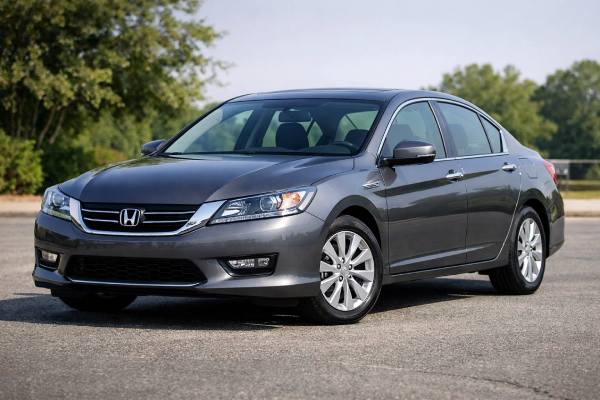
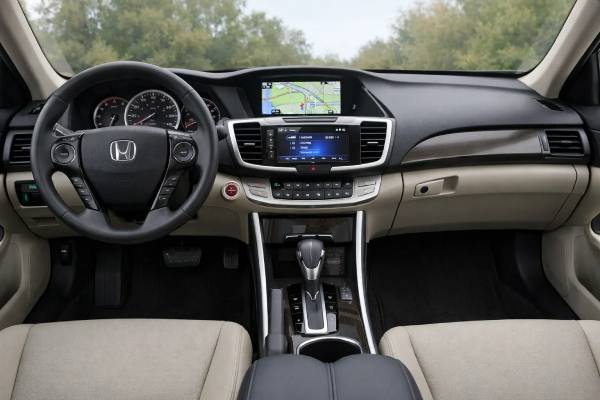

The CR3-generation Honda Accord V6 pairs Honda’s J35Y1 3.5-liter V6 with a traditional 6-speed automatic (and, in some markets and body styles, a 6-speed manual). It’s a rare mix in a midsize sedan and coupe: strong naturally aspirated power, a smooth torque curve, and long-legged highway manners—without the heat and complexity of turbocharging. The trade-off is that V6 ownership is more “systems-aware” than the 4-cylinder Accord. You’ll want to understand the timing belt service, the Variable Cylinder Management (VCM) cylinder-deactivation behavior, and how transmission fluid condition affects shift quality. Get those right, and the CR3 V6 can be an unusually satisfying daily driver that still feels engineered for real-world durability, with a cabin, chassis, and braking package that hold up well as miles accumulate.
At a Glance
- Strong, linear acceleration that stays smooth at highway speeds, especially when passing from 80–120 km/h (50–75 mph).
- Traditional 6-speed automatic feel (or available manual in some trims) makes it more predictable than many CVT-era rivals.
- Cabin, steering, and brake tuning suit long commutes and wet-weather stability without feeling floaty.
- Plan for a timing belt service around 170,000 km (105,000 mi) or 7 years (whichever comes first, market-dependent).
- Refresh brake fluid about every 3 years, and keep ATF service intervals conservative if you drive in heavy traffic.
Contents and shortcuts
- CR3 V6 Accord explained
- J35Y1 specs and capacities
- V6 trims and safety gear
- Reliability: VCM and gearbox
- Maintenance plan for J35Y1
- Driving feel and fuel use
- Accord V6 vs competitors
CR3 V6 Accord explained
Think of the CR3 Accord V6 as the “last of the straightforward fast family cars” in Honda’s midsize lineup. Its character comes from a naturally aspirated 3.5-liter V6 that builds power with revs yet stays calm in normal driving. You do not need to manage turbo lag, boost heat, or high-pressure turbo plumbing. Instead, the driving feel depends on engine calibration, gearing, and how smoothly the car transitions when cylinder deactivation (VCM) turns some cylinders off during light load cruising.
In daily use, the Accord V6 tends to feel stronger and quieter at 100–130 km/h (60–80 mph) than many 4-cylinder competitors because it does not need to work as hard to maintain speed. That also makes it a good match for drivers who carry passengers frequently, climb long grades, or prefer brisk passing power without downshifts that feel frantic. The chassis tuning is still “Accord first”: stable, predictable, and comfortable, with enough steering accuracy that it doesn’t feel numb.
Where ownership differs from a 4-cylinder Accord is service planning. The V6 uses a timing belt rather than a timing chain, which is not a flaw—many durable engines use belts—but it does mean you should budget and schedule the job on time. The VCM system is also worth understanding: it can help highway consumption, but it introduces extra mounts, valving, and control logic that can amplify vibrations if parts wear or software is out of date.
It’s also important to interpret the “2012–2017” label correctly. In many markets, this body and powertrain are sold primarily as the 2013–2017 generation, but early production and registration timing can place some examples into late 2012 paperwork. When buying, focus less on the calendar year alone and more on the VIN build date, trim, body style (sedan vs coupe), and whether it’s the pre-facelift or facelift equipment level—because those factors can change the available safety tech, infotainment hardware, and sometimes transmission pairing.
Advantages owners consistently point to include: strong naturally aspirated response, refined cruising, and a mature interior and chassis that age well. The main drawback is simply that “V6 means you must keep up”—especially with fluids and the belt service—because neglect costs more than it would on the 4-cylinder models.
J35Y1 specs and capacities
Below are the key technical specs for the CR3 Accord V6 in a scannable format. Some values vary slightly by body style (sedan vs coupe), trim, wheel package, and market emissions certification. Use the tables as a decision guide, then confirm any VIN-specific details in your official service literature.
Powertrain and efficiency (V6)
| Item | Specification |
|---|---|
| Engine code | J35Y1 |
| Layout | V6, SOHC i-VTEC, 24 valves |
| Displacement | 3.5 L (3,471 cc) |
| Bore × stroke | 89.0 × 93.0 mm (3.50 × 3.66 in) |
| Induction | Naturally aspirated |
| Fuel system | Direct injection (market-dependent calibration) |
| Max power | 278 hp (207 kW) @ 6,200 rpm (typical rating) |
| Max torque | ~252 lb-ft (342 Nm) @ 4,900 rpm (typical rating) |
| Timing drive | Timing belt |
| Rated economy (example: V6 auto) | 11.4 / 7.4 / 9.6 L/100 km (city / highway / combined) (example rating) |
| Rated economy (example: V6 auto, EPA) | 21 / 34 / 26 mpg (city / highway / combined) (example rating) |
How to read the efficiency numbers: The Accord V6’s real-world results swing mainly with speed and terrain. At 120 km/h (75 mph), expect consumption to rise compared with the official highway figure—especially with wider tyres or a loaded car. The engine is efficient for its displacement when lightly loaded, but aero drag dominates at higher speeds.
Transmission and driveline
| Item | Specification |
|---|---|
| Drive type | FWD |
| Automatic transmission | 6-speed automatic (torque converter) |
| Manual transmission | 6-speed manual (availability depends on year/market/body style) |
Example 6-speed automatic ratios (typical reference set):
| Gear | Ratio |
|---|---|
| 1st | 3.359 |
| 2nd | 2.090 |
| 3rd | 1.484 |
| 4th | 1.185 |
| 5th | 0.855 |
| 6th | 0.690 |
| Reverse | 3.000 |
| Final drive | 3.941 |
Chassis and dimensions (typical sedan reference)
| Item | Specification |
|---|---|
| Suspension (front) | MacPherson strut |
| Suspension (rear) | Multi-link |
| Steering | Electric power steering (EPS) |
| Wheelbase | 2,776 mm (109.3 in) |
| Length | 4,890 mm (192.5 in) |
| Width | 1,849 mm (72.8 in) |
| Height | 1,466 mm (57.7 in) |
| Turning circle | ~11.6 m (38.1 ft) (typical) |
| Curb weight | ~1,610–1,650 kg (3,550–3,640 lb), trim-dependent |
Performance and capability (typical)
| Item | Estimate / typical result |
|---|---|
| 0–100 km/h (0–62 mph) | ~5.8–6.5 s (trim/tyres/conditions) |
| Top speed | Typically limited (market dependent) |
| Towing | Often not rated or limited; confirm by market |
Fluids and service capacities (ownership-friendly guidance)
Exact capacities vary by VIN and procedure (drain-and-fill vs dry fill). These are practical planning ranges:
| Item | Typical guidance |
|---|---|
| Engine oil | 0W-20 (common spec); ~4.3 L (4.5 US qt) with filter (typical) |
| Coolant | Honda long-life coolant; capacity varies—confirm in manual |
| ATF | Honda ATF; service fill varies—confirm in manual |
| Brake fluid | DOT 3 (common Honda spec); flush interval more important than capacity |
V6 trims and safety gear
Because “Accord V6” can mean different equipment depending on year, body style, and market, it helps to identify the car in three steps: (1) sedan vs coupe, (2) pre-facelift vs facelift, and (3) whether it has factory driver-assistance options.
Trims and option patterns you’ll see most often
- Sedan V6 commonly appears in higher trims (often EX-L or Touring equivalents). Expect leather, stronger audio options, and larger brakes/tyres compared with base 4-cylinder trims.
- Coupe V6 is where you’re more likely to find the 6-speed manual option in certain years/markets. If you want the most engaging version of the CR3 platform, this is the configuration enthusiasts hunt for.
- Touring-style packages often bundle premium wheels, upgraded lighting, and infotainment changes. Wheels matter because wider tyres can improve grip but slightly increase road noise and consumption.
Quick identifiers that help on a walkaround:
- Badging: V6 or 3.5 badges vary by market; do not rely on badges alone.
- Wheels and brakes: many V6 trims use larger wheels and front rotors; if a car has unexpectedly small wheels for its trim claim, verify the VIN and build sheet.
- Interior controls: higher trims often include seat memory, upgraded audio, and navigation-era head units. If an “upper trim” cabin looks sparse, confirm equipment by VIN.
Safety structure and ratings
The CR3 Accord benefits from a strong baseline body structure and a comprehensive set of core safety systems: multi-stage airbags, ABS, stability control, and modern seatbelt pretensioners. Where it varies is advanced driver assistance systems (ADAS), which depend heavily on year and trim.
Common safety features:
- Airbags: front, side, and curtain airbags are typical, with additional coverage depending on market.
- Child-seat provisions: LATCH/ISOFIX anchors are standard in most markets; check rear-seat access if you’re buying a coupe for child-seat use.
- Brake and stability systems: ABS and stability control are standard; brake feel and stopping distances depend significantly on tyre quality.
Driver assistance and calibration reality
Even if your Accord V6 includes forward-collision warning or lane-departure assistance (availability varies), remember that older ADAS hardware can be sensitive to:
- Windshield replacement quality (camera alignment where applicable).
- Front bumper repairs (sensor aiming).
- Wheel alignment changes (steering angle sensor calibration).
After a collision repair or a windshield swap, insist on documentation that any required calibrations were performed. It’s not just about warning lights—mis-calibration can reduce the system’s ability to respond correctly.
What to prioritize when shopping
If your priority is maximum simplicity, target a V6 trim with strong passive safety but minimal ADAS complexity, and focus on service history quality. If your priority is modern safety tech, prioritize the newest facelift examples in the range and verify that all recall/service campaigns were completed and that sensors match OEM part numbers.
Reliability: VCM and gearbox
The CR3 Accord V6 has a generally strong reputation, but it’s not “set-and-forget.” The biggest reliability wins come from doing preventive service on schedule and recognizing early symptoms before they turn into expensive repairs.
Common vs occasional vs rare issues (and what they feel like)
Common (watch items)
- Engine mount wear (especially active mounts on VCM cars)
- Symptoms: vibration at idle, shudder during light throttle cruise, or a “buzz” that comes and goes as the engine switches modes.
- Likely cause: mount aging, VCM transitions becoming more noticeable, or uneven combustion from plug wear.
- Remedy: inspect mounts and plugs; verify software updates; use OEM-quality mounts.
- Transmission fluid sensitivity (6-speed automatic)
- Symptoms: harsh 2–3 or 3–4 shifts, shudder on gentle acceleration, delayed engagement when cold.
- Likely cause: degraded ATF, heat cycling, or old fluid that has lost friction characteristics.
- Remedy: conservative drain-and-fill intervals using correct Honda ATF; avoid “universal” fluids.
Occasional (cost varies)
- VCM-related plug fouling or oil use pattern (vehicle-dependent)
- Symptoms: misfire codes, roughness on startup, higher oil consumption than expected between changes.
- Likely cause: cylinder deactivation duty cycle combined with driving pattern (short trips and long idle time can make it worse).
- Remedy: keep oil changes timely, monitor level monthly, and address misfires early rather than driving through them.
- Cooling system aging
- Symptoms: coolant smell, slow loss of coolant, fans running more often than expected.
- Likely cause: hose aging, clamps, radiator end tank seepage (age-related).
- Remedy: pressure test and replace components proactively when seepage begins.
Rare (but high consequence if ignored)
- Timing belt overdue service
- Symptoms: sometimes none—until failure risk rises.
- Likely cause: belt age or mileage beyond the recommended window, or neglected tensioner/water pump.
- Remedy: treat the belt service as a package (belt, tensioner, idlers, and typically water pump).
Service actions, updates, and verification
For this generation, many “reliability” outcomes hinge on whether the car received:
- All recall work (airbags and other campaigns can apply depending on VIN).
- Any software updates that improve drivability or reduce unwanted vibrations.
Best practice before purchase:
- Run an official VIN recall check and ask for dealer completion records.
- Request proof of timing belt service (invoice with parts listed).
- Scan for stored powertrain codes and check readiness monitors.
- During a test drive, hold steady throttle at 70–90 km/h (45–55 mph) and feel for shudder—this is where marginal mounts or ATF issues often show up.
If you treat VCM behavior, timing belt service, and ATF condition as “core ownership items,” the CR3 V6 can be a long-lived car. If you treat it like a basic commuter that can skip major intervals, it becomes expensive quickly.
Maintenance plan for J35Y1
A practical maintenance plan for the Accord V6 should be built around three goals: (1) keep the timing-belt engine safe, (2) keep the transmission shifting cleanly, and (3) prevent small fluid leaks or vibration issues from becoming diagnosis rabbit holes.
Core schedule (distance or time, whichever comes first)
Engine oil and filter
- Follow the maintenance minder if your market uses it, but a safe planning interval is 8,000–10,000 km (5,000–6,000 mi) for mixed driving, shorter for repeated short trips.
- Use the correct viscosity/spec for your market (commonly 0W-20 in many regions).
- Check oil level monthly; it’s cheap insurance on a VCM-equipped engine.
Air filters
- Engine air filter: inspect every 20,000 km (12,000 mi); replace around 30,000–40,000 km (18,000–25,000 mi) depending on dust.
- Cabin filter: replace about every 20,000 km (12,000 mi) or annually if you drive in heavy urban pollution.
Spark plugs
- Plan replacement around 160,000–170,000 km (100,000–105,000 mi), sooner if you see misfires or roughness. Use OEM-equivalent plugs.
Timing belt service (critical)
- Common planning rule: 170,000 km (105,000 mi) or 7 years.
- Do the full kit: belt, tensioner, idlers, and (often recommended) water pump. Replace coolant during the same job to reset the service clock.
Transmission fluid (6AT)
- If you drive in heavy traffic, heat, or hills, consider drain-and-fill service around 50,000–60,000 km (30,000–40,000 mi).
- If you drive mostly highway and gently, 80,000–100,000 km (50,000–60,000 mi) can be reasonable.
- Avoid aggressive “flush” methods unless the service procedure is Honda-approved for your exact transmission.
Brake system
- Brake fluid: flush about every 3 years regardless of mileage.
- Pads/rotors: inspect every tyre rotation; listen for uneven pad wear or pulsation that can indicate rotor thickness variation.
Coolant
- Many Honda long-life coolants run a long first interval, then shorter thereafter. If you lack records, treat coolant as a baseline service and reset the interval.
12V battery
- Test annually after year 3; replacement is often needed in the 4–6 year window depending on climate and usage.
Fluid specs and torque values (decision-useful, verify by VIN)
These values are common planning references; always verify for your exact VIN and market:
- Wheel lug nuts: 108 Nm (80 lb-ft)
- Engine oil drain bolt: typically around 39 Nm (29 lb-ft)
- Tyre pressures: follow door-jamb placard (varies by wheel size)
Buyer’s guide: what to inspect
- Service history quality: timing belt documentation is non-negotiable on higher-mileage cars.
- Vibration check: idle in gear, then steady cruise; note any shudder or booming that comes and goes.
- Transmission behavior: cold start engagement, gentle acceleration, and light throttle downshift response.
- Leaks and seepage: check around front timing covers, valve covers, and under the radiator end tanks.
- Suspension wear: listen for clunks over small bumps (bushings/links), and check for uneven tyre wear indicating alignment issues.
Long-term durability outlook: strong if maintained with “V6 discipline.” The cars that disappoint owners are usually the ones that missed belt service, ran old ATF too long, or were driven for months with vibrations that should have triggered an inspection.
Driving feel and fuel use
The Accord V6’s driving personality is built around smooth torque, predictable gearing, and a chassis that stays calm at speed. It doesn’t feel “sport sedan stiff,” but it also doesn’t float. Instead, it aims for confidence: stable straight-line tracking, controlled body motion, and brakes that feel consistent when the tyres are good.
Ride, handling, and NVH (noise, vibration, harshness)
- Ride: The suspension filters broken pavement well, especially on standard wheel sizes. Larger wheels can sharpen initial response but also bring more impact harshness and road noise.
- Steering: Electric power steering is light-to-medium in effort with good on-center stability. Feedback is adequate, not talkative, but the car places well on the road.
- Braking: Pedal feel is generally progressive. If you feel pulsation, don’t assume “warped rotors” immediately—tyre issues and pad deposits can mimic rotor problems.
- Cabin noise: At highway speed, the V6 often runs at lower rpm than a smaller engine working harder, which can make the car feel more refined during long commutes.
Powertrain character (why it feels different)
Naturally aspirated V6 power is about response and linearity. In light traffic, it pulls without drama; when you ask for passing power, it doesn’t need to wait for boost. The 6-speed automatic’s shift logic is generally smooth, but it rewards clean fluid. If the transmission feels “busy” hunting between gears, it can be a sign of old ATF or a mismatch between driving style and shift mapping (some owners notice this more in rolling hills).
VCM transitions should be subtle. If you can clearly feel the engine “changing personality” during steady cruising, treat it as a diagnostic clue—often mounts, plugs, or calibration condition are involved.
Real-world fuel use and what changes it
Owners often see a wide range because speed, terrain, and tyre choice matter a lot:
- City-heavy driving: expect higher consumption, and VCM benefits may be smaller because stop-and-go loads the engine more often.
- Highway cruising: the V6 can be surprisingly efficient at moderate speeds thanks to tall gearing and deactivation under light load.
- Cold weather: short trips in winter can raise consumption sharply. The engine warms more slowly than a small 4-cylinder, and heaters/defrosters add load.
A practical “what to expect” range:
- Highway at moderate speeds: roughly 8–10 L/100 km (24–29 mpg US) depending on conditions.
- Mixed driving: roughly 10–12 L/100 km (20–24 mpg US).
Performance metrics that actually matter
In real traffic, the Accord V6’s advantage is less about 0–100 km/h bragging rights and more about:
- Confident merging on short ramps
- Strong 80–120 km/h (50–75 mph) passing
- Reduced need for full-throttle kickdown
If you prioritize relaxed speed management over maximum fuel savings, the V6 Accord remains one of the most satisfying “normal” cars to drive in this era.
Accord V6 vs competitors
The CR3 Accord V6 sits in a shrinking category: midsize family cars with a big naturally aspirated engine and traditional transmission choices. Most rivals either moved to smaller turbo engines, leaned heavily into CVTs, or shifted the “quick” trims into sport-luxury pricing.
Versus Toyota Camry V6 (same era)
- Strengths for the Accord: more engaging steering feel for some drivers, and (in certain years/markets) the availability of a manual in the coupe gives Honda a uniqueness advantage.
- Strengths for the Camry: often perceived as softer-riding and simpler in some trims, with a reputation for low-drama ownership when maintained.
- How to choose: pick the Accord if you value driver feel and response; pick the Camry if you prioritize calm comfort and conservative tuning.
Versus Nissan Altima V6 and other CVT-heavy rivals
- Accord advantage: the 6-speed automatic (and manual option in some cases) tends to feel more natural and can age better when serviced correctly, especially compared with early-to-mid 2010s CVT reputations.
- Altima advantage: often lighter feel and sometimes lower purchase price on the used market.
- How to choose: if you dislike CVT behavior or want clearer mechanical feel, the Accord V6 is the safer bet.
Versus turbo-4 competitors (Ford Fusion EcoBoost, Hyundai Sonata 2.0T)
- Accord advantage: naturally aspirated predictability, less heat stress, and often smoother everyday response.
- Turbo-4 advantage: better low-rpm torque in some cases and potentially better fuel economy if you drive gently at low speeds.
- How to choose: if you want consistent, linear power and plan to keep the car for many years, the Accord V6 is compelling—provided you accept the belt service and VCM-related upkeep.
Ownership economics comparison
The Accord V6 can be a value on the used market because many buyers default to “4-cylinder for economy.” But the long-term cost equation depends on whether you:
- Budget for the timing belt package on schedule
- Service ATF conservatively
- Diagnose vibration/misfire symptoms early rather than late
If you are the type of owner who keeps records and prefers proactive maintenance, the CR3 V6 can outperform many rivals in satisfaction-per-dollar. If you want the cheapest possible “run it and forget it” experience, a simpler 4-cylinder configuration—whether Accord or another model—may fit better.
References
- 2016 Accord Sedan Specifications 2016 (Manufacturer Specifications)
- 2016 Accord Coupe Specifications 2016 (Manufacturer Specifications)
- 2017 Honda Accord 4-door sedan 2017 (Safety Rating)
- Vehicle Detail Search – 2017 HONDA ACCORD 4 DR FWD 2017 (Recall and Vehicle Database)
Disclaimer
This article is for informational purposes only and is not a substitute for professional diagnosis, inspection, or repair. Specifications, torque values, fluid types, capacities, and maintenance intervals can vary by VIN, market, model year, and installed equipment; always verify details using your official Honda service documentation and the information label for your specific vehicle.
If you found this guide useful, please consider sharing it on Facebook, X (Twitter), or your favorite forum to help others find reliable ownership information.