
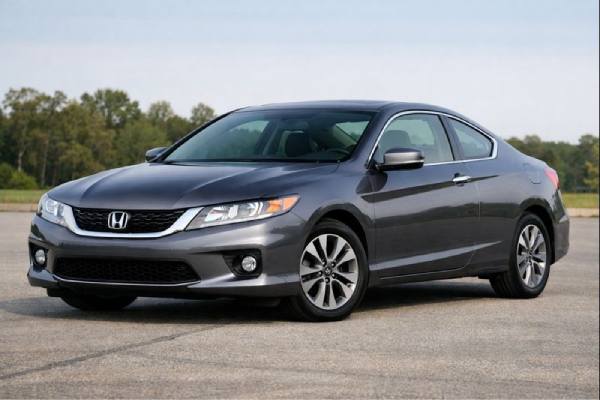
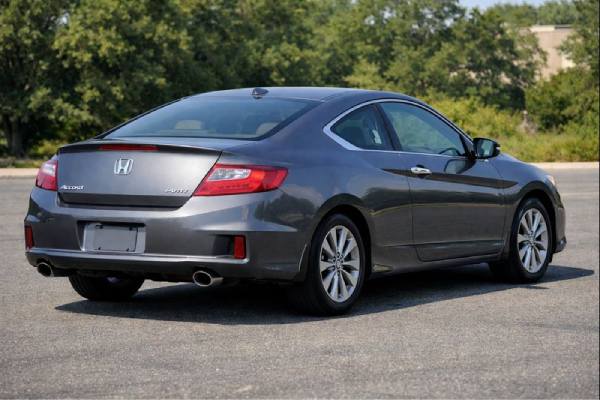
The 2012–2017 Honda Accord Coupe sits in a sweet spot for owners who want a practical daily driver that still feels “engineered,” not merely assembled. In K24W1 form (Honda’s 2.4-liter Earth Dreams inline-four), it focuses on smooth, low-stress power delivery, a broad torque curve, and a chassis that’s easy to live with on real roads. You also get the long-run benefits of a timing chain, widely available parts, and a drivetrain that tolerates mileage well when fluids are serviced on time.
One important nuance: the K24W1 is tied to the 2013–2017 ninth-generation Accord design; some 2012 Accord Coupes use a different 2.4 and different supporting hardware. If you’re shopping “2012–2017,” confirm the engine code on the VIN/build label or service records so your maintenance plan and parts list match your car.
Owner Snapshot
- Strong all-rounder: responsive 2.4 and stable highway manners without premium-fuel demands.
- Practical coupe: usable rear seat for short trips and a trunk that works for weekend luggage.
- Simple ownership: timing chain and common service parts keep long-term costs predictable.
- Watch the CVT (if equipped): fluid condition matters, and neglected service can show up as shudder or noise.
- Plan on oil changes every 8,000–12,000 km (5,000–7,500 miles) or 12 months, depending on driving and oil-life monitoring.
Guide contents
- Accord Coupe CT1 in Context
- K24W1 Specs and Dimensions
- Trims, Tech, and Safety Gear
- Reliability Patterns and Known Fixes
- Maintenance Plan and Buying Tips
- Real-World Driving and Economy
- Rivals: Altima, Camry, and More
Accord Coupe CT1 in Context
Think of the K24W1 Accord Coupe as Honda’s “honest” midsize two-door: not a dedicated sports coupe, but sharper and more personal than the sedan. The steering and suspension tuning aim for confidence and predictability first, with enough body control to feel composed on ramps and back roads. The big ownership advantage is that the car’s core systems are conventional and well-understood: naturally aspirated engine, front-wheel drive, and mainstream brakes and suspension parts.
Where the CT1 coupe earns its reputation is in the way it blends refinement with simplicity. The 2.4-liter Earth Dreams engine (K24W1) is direct-injected and designed to run clean and efficiently while still responding quickly to throttle inputs. Power is not “neck-snapping,” but it is usable—especially in the midrange where most daily driving happens. If you choose the manual transmission, the car feels more eager and connected. If you choose the CVT, it leans into smoothness and efficiency, which suits commuting and long highway trips.
A key shopping note: model-year language can be confusing. The ninth-generation Accord Coupe begins for 2013, and that’s where the K24W1 belongs. Some 2012 Accord Coupes share the broader “Accord Coupe” name but use different engine variants, different calibration details, and sometimes different parts (especially sensors, exhaust pieces, and under-hood packaging). If a seller lists “2012–2017” loosely, treat 2012 as a separate verification step rather than assuming interchangeability.
The coupe body also changes how you should think about wear. Door seals, long doors, and frameless glass alignment (on some trims) can create wind noise if the car has been repaired after a side impact or if hinges are worn. Rear-seat access means more seatback folding and latch use; inspect for broken plastic trim and loose latch hardware. None of these are deal-breakers, but they are “coupe-specific” checks that matter more than on the sedan.
K24W1 Specs and Dimensions
Below are practical, ownership-relevant specifications for the K24W1 2.4-liter Accord Coupe. Exact numbers can vary slightly by year, trim, and market, so treat them as a baseline and verify against your door-jamb label and service literature.
Powertrain and efficiency (K24W1 2.4)
| Item | Spec |
|---|---|
| Code | K24W1 |
| Layout | Inline-4, DOHC, 4 valves/cyl |
| Bore × stroke | 87.0 × 99.1 mm (3.43 × 3.90 in) |
| Displacement | 2.356 L (2356 cc) |
| Induction | Naturally aspirated |
| Fuel system | Direct injection |
| Compression ratio | 11.1:1 |
| Max power | 185 hp (138 kW) @ ~6400 rpm |
| Max torque | ~225 Nm (181 lb-ft) @ ~3900 rpm |
| Timing drive | Chain |
| Rated efficiency (typical) | ~7.5–9.5 L/100 km (25–31 mpg US / 30–37 mpg UK) depending on transmission |
| Real-world highway @ 120 km/h | ~7.0–8.0 L/100 km (29–34 mpg US / 35–41 mpg UK) |
| Aerodynamics | Cd not consistently published for the coupe across all trims/years |
Transmission and driveline
| Item | Spec |
|---|---|
| Transmission | 6-speed manual (some trims/years) or CVT (most automatics) |
| Drive type | FWD |
| Differential | Open (traction aided by brake-based stability/traction control) |
Chassis and dimensions (typical coupe figures)
| Item | Spec |
|---|---|
| Suspension (front/rear) | MacPherson strut / multi-link |
| Brakes | 4-wheel discs (vented front) |
| Common wheel and tire sizes | 215/55 R17 or 235/45 R18 (trim-dependent) |
| Ground clearance | ~146 mm (5.8 in) typical |
| Length / width / height | ~4806 / 1849 / 1436 mm (189.2 / 72.8 / 56.5 in) |
| Wheelbase | ~2725 mm (107.3 in) |
| Turning circle (curb-to-curb) | ~11.6 m (38.1 ft) typical |
| Curb weight | ~1460–1600 kg (3220–3530 lb) by trim and equipment |
| Fuel tank | ~65 L (17.2 US gal / 14.3 UK gal) |
| Cargo volume | ~379 L (13.4 ft³), seats up |
Performance (real-world expectations)
A healthy K24W1 coupe typically runs 0–100 km/h (0–62 mph) in the high-7 to mid-8 second range, with the manual usually feeling quicker in roll-on response and the CVT often posting consistent results when traction is good. Braking performance depends heavily on tire quality and rotor/pad condition; fresh brake fluid and quality tires make a bigger difference than many buyers expect.
Fluids and service capacities (common service fills)
| Fluid | What to use | Typical service fill |
|---|---|---|
| Engine oil | 0W-20 meeting current API/ILSAC spec | ~4.2 L (4.4 US qt) with filter |
| Coolant | Honda long-life coolant (Type 2 equivalent), 50/50 | system fill varies by service |
| CVT fluid (if CVT) | Honda HCF-2 | drain-and-fill varies; measure what drains |
| Brake fluid | DOT 3 / DOT 4 per cap and manual | flush until clear, usually 1+ L total |
Trims, Tech, and Safety Gear
Most K24W1 Accord Coupes are sold in a familiar Honda ladder: a value-focused entry trim, a mid-trim with comfort upgrades, and an upper trim with leather and premium features. Naming varies by market, but the practical differences for a buyer are consistent: wheel size, seat material, infotainment generation, and the availability of driver-assistance tech.
Trims and options that change ownership
- Wheel and tire packages: 17-inch setups ride a touch softer and cost less to re-tire; 18-inch packages look sharper but are more sensitive to pothole damage and alignment drift. If you drive on rough pavement, inspect inner sidewalls and wheel lips carefully.
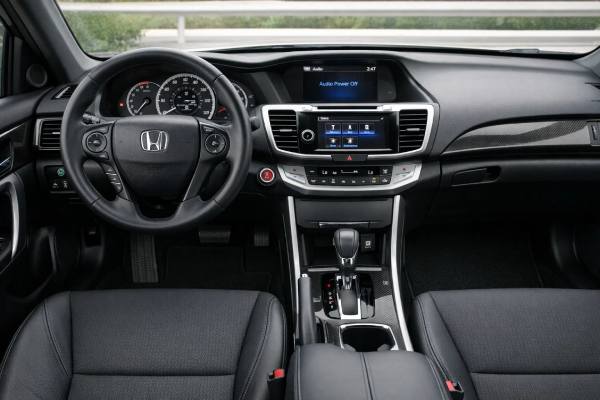
- Audio and infotainment: early systems can feel dated and may have slower Bluetooth response. If the car has factory navigation, check that the screen responds correctly, the backup camera is clean and stable, and the speaker balance is even (amplifier failures are uncommon but expensive).
- Lighting: projector headlights (where equipped) generally improve night visibility, but condition matters. Hazy lenses and tired bulbs can turn a “good headlight” into a poor one in practice.
Safety ratings and what they mean
For the 2013–2014 Accord Coupe, IIHS small overlap front performance is rated Acceptable, while the moderate overlap front, side, roof strength, and head restraints and seats ratings are Good across much of the run. This is a strong showing for a midsize coupe of the era, with the small-overlap result being the main “read the fine print” item. In federal (NHTSA) testing, the Accord Coupe family is commonly listed with a five-star overall rating in period summaries, but always confirm by model year and exact body style when you check official databases.
Airbags and child-seat practicality
Expect front airbags, side torso airbags, and side-curtain airbags (front and rear coverage) on most trims. For child seats, the rear has LATCH/ISOFIX anchors, but coupe access makes daily loading harder than in the sedan. If you plan to use a rear-facing seat often, the coupe is workable but not ideal; confirm the seat fits and that you can tighten it without fighting the door opening arc.
ADAS availability (era-correct)
This generation predates the “everything standard” era. Depending on year and trim, you may find:
- Forward-collision warning and braking support (varies)
- Lane-departure warning on some higher trims/years
- Conventional stability control and traction control across the line
If a car has windshield-mounted cameras or radar sensors (where applicable), budget for calibration if the windshield is replaced or if the front end has been repaired.
Reliability Patterns and Known Fixes
Overall, the K24W1 Accord Coupe has a good durability track record when fluids are serviced on time and the engine is not run low on oil. The most expensive “surprises” tend to be neglected maintenance (especially transmission fluid), collision history, or deferred suspension work rather than inherent engine weakness.
Below is a practical map of what owners and shops most often see, organized by prevalence and typical cost tier. Mileage bands are approximate; driving style and climate matter.
Common (low to medium cost)
- Front suspension wear (80,000–160,000 km / 50,000–100,000 mi): clunks over sharp bumps often point to stabilizer links or worn bushings. Remedy is usually straightforward parts replacement plus alignment.
- Brake vibration: often warped rotors from uneven pad deposits rather than truly “bent” rotors. Remedy is proper pad bedding or new rotors and quality pads, then a brake-fluid refresh.
- Battery and charging complaints: many “electrical issues” are simply an aging 12V battery or poor terminal connections. Load-test the battery before chasing ghosts.
Occasional (medium cost)
- Direct-injection intake carbon buildup (higher mileage, many short trips): symptoms include rough idle, hesitant tip-in, or reduced fuel economy. Remedy is inspection and, if needed, intake-valve cleaning with an appropriate method.
- A/C performance drift: slow leaks are common on many cars this age. Remedy is leak detection and proper repair; avoid repeated “top-offs” without diagnosis.
Occasional to rare (medium to high cost)
- CVT behavior changes (if equipped): a neglected CVT can show shudder on light throttle, high RPM flare, or droning noise. Remedy starts with correct fluid service using the proper Honda fluid, followed by diagnosis if symptoms persist. The best prevention is regular fluid drain-and-fill and avoiding overheating from prolonged high-load driving.
- Oil consumption concerns: not every K24W1 consumes oil, but any high-mile engine can if oil changes were stretched. Remedy is careful monitoring, verifying PCV function, and ensuring the correct oil grade is used.
Recalls, TSBs, and how to verify
This era overlaps major industry-wide recall activity, especially airbag inflators. The safe approach is procedural:
- Run the VIN through an official recall checker.
- Ask for dealer service history showing completion.
- Verify warning lights are off and the SRS system passes its self-check at startup.
Avoid relying on a seller’s verbal assurance. Recall work is free at the dealer, and completing it protects both safety and resale value.
Maintenance Plan and Buying Tips
A K24W1 Accord Coupe rewards routine care more than “hero repairs.” Build your plan around fluid health, rubber wear items, and early detection.
Practical maintenance schedule (distance/time)
- Engine oil and filter: every 8,000–12,000 km (5,000–7,500 mi) or 12 months (shorter interval for short trips, extreme heat/cold, or heavy traffic). Use 0W-20 unless your official documentation specifies otherwise for your market.
- Engine air filter: inspect every oil change; replace roughly 25,000–40,000 km (15,000–25,000 mi) depending on dust.
- Cabin air filter: typically 20,000–30,000 km (12,000–18,000 mi) or yearly for allergy-sensitive owners.
- Brake fluid: every 3 years is a solid best practice, regardless of mileage.
- Coolant: follow the long-life interval in your official documentation; many Honda long-life coolants are first-changed around 160,000 km (100,000 mi) and then more frequently afterward, but confirm for your exact year.
- Spark plugs: commonly 160,000 km (100,000 mi) for iridium plugs, but verify for your calibration and market.
- CVT fluid (if CVT): drain-and-fill on a conservative interval such as 40,000–60,000 km (25,000–37,000 mi), sooner with heavy commuting, heat, or hills.
- Manual transmission fluid (if 6MT): often overlooked; consider 60,000–100,000 km (37,000–62,000 mi) depending on feel and use.
- Tires: rotate every 8,000–12,000 km (5,000–7,500 mi); align annually or after any curb strike.
Buyer’s inspection checklist (high value items)
- Cold start: listen for abnormal rattles, check idle quality, and confirm no warning lights remain on.
- Transmission behavior: CVT should be smooth with no shudder under light throttle; manual should shift cleanly without synchro grind.
- Undercarriage and corrosion: inspect subframes, brake lines, and suspension mounting points—especially in salted-winter regions.
- Accident clues: uneven panel gaps, overspray, or mismatched headlight/date codes can signal repair history that affects wind noise and alignment.
- Service documentation: prioritize cars with proof of regular oil changes and at least one documented transmission fluid service if mileage is above ~80,000 km / 50,000 mi.
Which setup to seek?
- Choose 17-inch wheels for comfort and lower running costs.
- If you like involvement and simplicity, the 6MT is appealing.
- If you want smooth commuting, the CVT is fine—just make sure fluid service history is real, not “assumed.”
Long-term outlook is strong when the car is maintained and not abused: these drivetrains typically age gracefully, and the chassis is straightforward to keep tight with periodic bushing and brake work.
Real-World Driving and Economy
On the road, the K24W1 Accord Coupe feels like a well-sorted midsize car that happens to have two doors. The best word for the chassis is “settled.” It tracks straight at speed, doesn’t fidget over expansion joints, and the steering is light enough for city driving without feeling numb. With good tires and fresh dampers, it has a tidy, confident cornering attitude, though it remains a front-drive coupe—push hard and you’ll eventually feel the front tires do both steering and propulsion.
Powertrain character
The 2.4-liter engine is responsive once it’s moving, with a clean pull from midrange to redline. It does not have turbo surge; instead, it delivers predictable, linear acceleration. That predictability is a real advantage in rain or snow, where sudden torque can overwhelm front tires.
- With CVT: the car is smooth and efficient. Under hard throttle, the CVT will hold engine speed in the power band, which can sound “busy” compared to a geared automatic. If you value calmness, it’s a good match.
- With 6MT: throttle response feels more immediate, and passing maneuvers are more satisfying because you control the gearing. If you drive in hills or like engine braking, the manual also reduces brake workload.
NVH (noise, vibration, harshness)
Wind noise is usually low for a coupe, but it’s sensitive to door alignment, glass seals, and previous bodywork. Tire choice matters: aggressive all-seasons can add a constant hum at highway speeds. Engine vibration is typically well-managed; noticeable shaking at idle often points to worn mounts or maintenance issues rather than “normal Honda behavior.”
Real-world efficiency
In mixed driving, many owners see ~8–9 L/100 km (26–29 mpg US / 31–35 mpg UK) depending on traffic and temperature. At steady highway speeds around 120 km/h (75 mph), ~7–8 L/100 km (29–34 mpg US / 35–41 mpg UK) is a realistic expectation for a healthy car on properly inflated tires. Cold weather often adds a meaningful penalty due to longer warm-up time and denser air; short trips in winter can push consumption into the double digits (L/100 km).
Key performance metrics that affect the verdict
- Passing: the car feels strongest once you’re already rolling; plan a downshift in the manual or a firm throttle request in the CVT.
- Braking feel: consistent when the system is maintained; soft pedal often improves dramatically after a brake-fluid flush.
- Turning circle: not tiny; three-point turns are normal in tight spaces.
Overall, this is a “daily-fast” coupe: not a track tool, but confident, efficient, and easy to place on the road.
Rivals: Altima, Camry, and More
Cross-shopping matters because the Accord Coupe’s value depends on what you want from a midsize two-door. In this era, true coupe choices were already shrinking, so many buyers compare it to sedans (Camry, Sonata, Mazda6) or to sportier coupes (Genesis Coupe, Civic Si) depending on priorities.
Versus Nissan Altima Coupe (where available)
The Altima Coupe can feel sporty and has strong styling, but long-term ownership often hinges on transmission history—especially on CVT-equipped examples. The Accord tends to win on predictable aging and on parts-and-service familiarity at independent shops.
Versus Toyota Camry (mostly sedan shopping)
The Camry’s calling card is low drama and a soft ride. The Accord Coupe generally feels more planted and more driver-focused in steering and chassis response. If your priority is maximum comfort and minimal road feel, the Camry approach may suit you; if you want a more connected drive without sacrificing reliability, the Accord Coupe is compelling.
Versus Hyundai Sonata and Kia Optima (sedan alternatives)
These often offer lots of features for the money, but long-term durability and recall history can vary widely by engine family and year. The Accord’s advantage is consistency: fewer “surprise” system designs and a straightforward maintenance path.
Versus Mazda6 (sedan alternative)
For steering feel and handling balance, the Mazda6 is a strong benchmark. The Accord Coupe counters with a roomier cabin feel up front, a smoother commuter personality, and a larger ecosystem of parts and service knowledge in many regions.
Versus compact sporty coupes (Civic Si, BRZ, GTI)
If you want a lighter, more playful car, compacts often feel more agile. The Accord Coupe answers with comfort, cabin space, and a calmer long-distance character. For many owners, that balance is the point: you can commute all week, road-trip on weekends, and still enjoy a back road without feeling punished.
Bottom line: the K24W1 Accord Coupe is best for buyers who want a reliable, efficient coupe with mature road manners—not maximum speed, but maximum usability per kilometer.
References
- 2013 Honda Accord 2-door coupe 2013 (Safety Rating)
- Takata Air Bag Recall Spotlight | NHTSA 2025 (Safety Recall Information)
- Honda Recall Checker: Safety Recalls & Product Updates | Honda Canada 2025 (Recall Database)
- 2014 Honda Accord LX-S 2dr I4 CVT Features and Specs 2025 (Specifications)
Disclaimer
This article is for informational purposes only and is not a substitute for professional inspection, diagnosis, or repair. Specifications, torque values, fluid types, service intervals, and procedures can vary by VIN, market, model year, and installed equipment. Always verify details using your official owner’s manual and service documentation for your exact vehicle.
If you found this guide useful, please consider sharing it on Facebook, X (Twitter), or your favorite forum to support our work.