
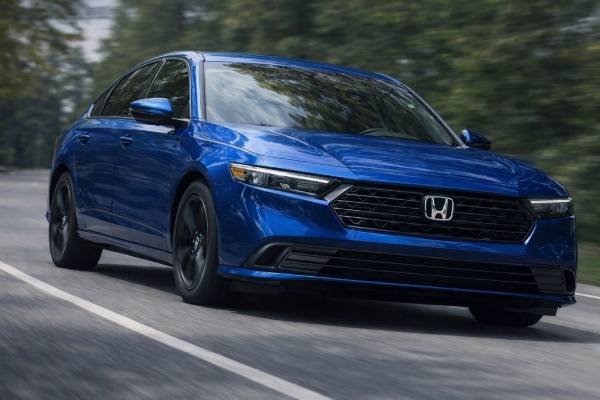
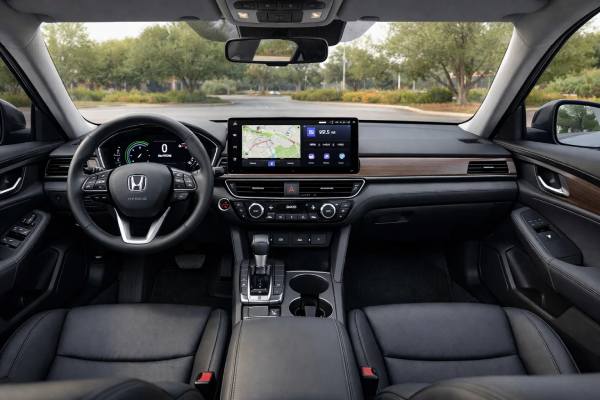
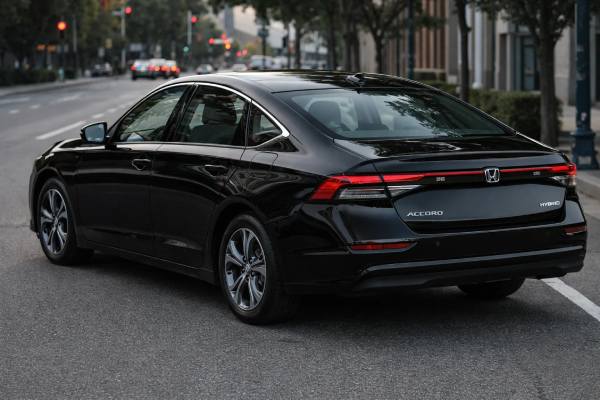
The 2023–present Honda Accord Hybrid (CY2) is built around Honda’s 2.0 e:HEV system: an Atkinson-cycle 2.0-liter four-cylinder paired with two electric motors and an e-CVT. It’s not a plug-in hybrid—so there’s no charging routine—but it still delivers the “electric first” feel most of the time in town, with the engine joining in when speed or load demands it. The result is a sedan that prioritizes smoothness and efficiency without giving up usable passing power.
For owners, the big advantages are low fuel consumption, a simple driveline layout (FWD with no traditional stepped automatic), and generally predictable service needs. The trade-offs are that software, sensors, and infotainment matter more than they used to, and tire choice can noticeably change noise, ride, and real-world economy.
Essential Insights
- Strong real-world fuel economy with no plug-in charging requirements.
- Smooth low-speed response thanks to the dual-motor e:HEV layout.
- Useful cargo space for a hybrid, with sedan-like long-distance comfort.
- Plan for occasional software updates and sensor calibration after some repairs.
- Typical oil service is often triggered around 8,000–12,000 miles (13,000–19,000 km), depending on use.
Quick navigation
- CY2 Accord Hybrid in depth
- 2.0 e:HEV specs and capacities
- Trims, equipment, and ADAS
- Reliability patterns and recalls
- Service schedule and buyer tips
- Driving feel and mpg reality
- Rivals comparison and value
CY2 Accord Hybrid in depth
Honda’s CY2 Accord Hybrid is best understood as an “electric-drive hybrid” rather than a conventional hybrid that simply assists the engine. In most everyday driving, one of the electric motors does the propulsion work, and the gasoline engine acts primarily as a generator. At steady highway speeds, the system can couple the engine more directly to the wheels for efficiency, but it still feels different than a typical automatic transmission because there are no stepped shifts.
That system design brings two practical benefits. First, it keeps low-speed operation smooth and quiet, especially in stop-and-go traffic. Second, it reduces complexity in the transmission hardware: the e-CVT is more about power blending than gear changing, and there is no turbocharger to manage. For owners who do a lot of commuting, short trips, or mixed suburban driving, this architecture tends to deliver the best payoff.
The Accord Hybrid’s packaging is also relatively “normal” for a hybrid. The battery is integrated without eating the trunk the way older hybrids sometimes did, and the cabin remains roomy for adults. Where buyers should pay attention is wheel and tire sizing by trim: larger wheels can improve response but often increase road noise and can trim fuel economy on the highway.
From an ownership perspective, the CY2 platform also leans heavily on cameras, radar, and software. That’s a good thing for safety and fatigue reduction, but it means collision repairs, windshield replacement, or front-end alignment work may require driver-assistance recalibration. If you maintain the car proactively and keep it on factory-spec tires and sensors, it’s an easy sedan to live with for high-mileage use.
2.0 e:HEV specs and capacities
Below are practical, owner-focused specifications for the 2.0 e:HEV Accord Hybrid. Some figures vary by market and trim; where that’s common, the table lists typical ranges or notes.
Powertrain and efficiency
| Item | Specification |
|---|---|
| Code | 2.0 e:HEV (market-dependent internal codes) |
| Engine layout and cylinders | Inline-4 (I-4), DOHC, 4 valves/cyl |
| Bore × stroke | 81.0 × 97.0 mm (3.19 × 3.82 in) |
| Displacement | 2.0 L (1,993 cc) |
| Induction | Naturally aspirated (NA) |
| Fuel system | Direct injection (DI) |
| Compression ratio | 13.9:1 |
| Max power (system) | 204 hp (152 kW) (system-rated) |
| Max torque (system) | up to ~335 Nm (247 lb-ft) @ low rpm (system-rated) |
| Timing drive | Chain |
| Rated efficiency (typical) | ~4.9–5.5 L/100 km (48–43 mpg US / 58–52 mpg UK), trim- and cycle-dependent |
| Real-world highway @ 120 km/h (75 mph) | often ~5.8–6.6 L/100 km (41–36 mpg US / 49–43 mpg UK), speed/temperature/tire dependent |
| Aerodynamics | Cd not consistently published; commonly reported in the ~0.27–0.29 range depending on wheels and market |
Transmission and driveline
| Item | Specification |
|---|---|
| Transmission | e-CVT (dual-motor hybrid drive) |
| Drive type | FWD |
| Differential | Open (front transaxle) |
Chassis and dimensions
| Item | Specification |
|---|---|
| Suspension (front/rear) | MacPherson strut / multi-link |
| Steering | Electric power steering (rack-and-pinion) |
| Brakes | 4-wheel discs; diameters commonly ~300–320 mm (11.8–12.6 in) front and ~280–305 mm (11.0–12.0 in) rear (varies by trim/market) |
| Wheels/tires (typical) | Commonly 235/40 R19 on sport-oriented trims; some markets use smaller wheels for efficiency |
| Ground clearance | ~134 mm (5.3 in) no-load; can be lower when fully loaded by market spec method |
| Length | 4,971 mm (195.7 in) |
| Width | ~1,862 mm (73.3 in) (typical published figure; confirm for your market) |
| Height | 1,449 mm (57.0 in) |
| Wheelbase | 2,830 mm (111.4 in) |
| Turning circle (kerb-to-kerb) | ~5.8 m (19.0 ft) |
| Curb weight | ~1,580–1,610 kg (3,480–3,550 lb), trim dependent |
| Fuel tank | 48.5 L (12.8 US gal / 10.7 UK gal) |
| Cargo volume | ~473 L (16.7 ft³) (method and spare-tire packaging can affect this) |
Performance and capability (typical)
| Item | Specification |
|---|---|
| 0–100 km/h (0–62 mph) | commonly ~6.5–7.5 s (trim/conditions dependent) |
| Braking 100–0 km/h | often in the mid-30 m range on quality tires (test dependent) |
Fluids and service capacities
| Item | Specification |
|---|---|
| Engine oil | 0W-20; ~4.0 L (4.2 US qt) |
| Coolant | Honda Type 2 / premix; ~3.8 L (4.0 US qt) (engine loop; hybrid systems may have additional cooling circuits by design) |
| Transmission fluid | Honda Genuine ATF Type 3.1; ~2.8 L (3.0 US qt) drain/fill reference |
| A/C refrigerant | R-1234yf; ~430 g (15.2 oz) |
| A/C compressor oil | ND-OIL 12 equivalent as specified by Honda service info (amount varies by component replacement) |
| Key torque specs | Wheel nuts commonly ~108 Nm (80 lb-ft); oil drain bolt commonly ~39 Nm (29 lb-ft) (verify for your VIN/market) |
Electrical
| Item | Specification |
|---|---|
| Alternator output | Not applicable in the usual sense; hybrid system uses a DC–DC converter to support the 12 V system |
| 12 V battery | ~34 Ah (around 440 CCA), fitment varies |
| Spark plug | Iridium type (example: NGK ILZKAR8E8S); gap ~1.1 mm (0.044 in) |
Safety and driver assistance (high level)
| Item | Specification |
|---|---|
| Structure and restraints | Multi-airbag system; advanced body structure with crumple management |
| ADAS suite | Honda Sensing (AEB/FCW, ACC, lane support features), with trim-dependent blind-spot and parking aids |
| Crash ratings | IIHS ratings apply by year/configuration; confirm by exact model year and headlight fitment |
Trims, equipment, and ADAS
Trim names vary by country, but the Accord Hybrid range generally splits into three buyer profiles: a value-focused hybrid, a sport-styled hybrid with larger wheels, and a comfort/tech-focused top trim. The mechanical core—2.0 e:HEV, FWD, and e-CVT—stays broadly consistent, while equipment and wheel/tire packages create most of the day-to-day differences.
How to identify trims quickly (practical tells):
- Wheels and tires: Sport-oriented hybrids commonly wear 19-inch wheels; efficiency-focused versions may use smaller wheels depending on market.
- Lighting: Higher trims often add upgraded headlights and more interior ambient lighting.
- Cabin tech: The screen size and audio system branding (and speaker count) are usually the fastest interior clue.
- Badging and trim accents: Sport trims typically add darker exterior accents and a more aggressive wheel design.
Option and equipment differences that matter mechanically:
- Tire width and compound: This affects braking feel, road noise, and range more than many buyers expect. A quiet, touring tire can transform highway refinement; an aggressive all-season can reduce mpg.
- Driver-assistance sensors: Blind-spot monitoring, parking sensors, and low-speed braking aids may be standard on higher trims and optional or absent on lower trims. If you rely on these, confirm before buying—especially on early-year builds and fleet-ordered cars.
- Heated/ventilated seating and windshield features: These influence winter comfort and defrost performance, and they can indirectly affect fuel use because HVAC load changes how often the engine runs.
Safety ratings: what to read carefully
Crash ratings can change based on test year rules and headlight performance. For the Accord Hybrid, the important takeaway is to confirm:
- The exact model year being evaluated.
- Whether the rating assumes a specific headlight system (some testing bodies score headlights by trim).
- Whether an award (such as a “Top Safety Pick” designation) requires optional equipment.
ADAS and service implications
Modern ADAS is excellent when it’s properly calibrated. After windshield replacement, front bumper work, or even some alignment and suspension repairs, the camera and radar system may need recalibration using a scan tool and targets. When shopping used, ask for documentation of calibration if the car had collision work. A well-repaired car can be perfectly safe, but skipping calibration can leave lane and braking systems less consistent than intended.
Reliability patterns and recalls
Because the CY2 Accord Hybrid is still relatively new, the most honest reliability picture combines early trend watching with what we already know about Honda’s hybrid approach. The powertrain layout itself is usually a strong point: no turbocharger, no traditional automatic with multiple clutch packs, and fewer “shift-quality” issues because there are no real shifts. However, the ownership experience can still be shaped by software, sensors, and the growing number of convenience modules.
Common, occasional, and rare issues (with practical symptoms)
Common (low to medium cost tier)
- Infotainment glitches or connectivity dropouts → intermittent screen freezes, audio issues, wireless phone pairing problems → often resolved with software updates, battery reset procedure, or module updates at the dealer.
- 12 V battery sensitivity → slow starts to the infotainment/cluster, random warning lights after sitting, or repeated low-voltage messages → test the 12 V battery and charging behavior; hybrids still rely on a healthy 12 V system even when the HV battery is fine.
- Brake noise or “grabby” feel at low speed → light squeal or a change in pedal feel as regen blends into friction brakes → clean/lube hardware, confirm pad compound, and ensure slide pins are serviced correctly.
Occasional (medium cost tier)
- ADAS sensor misalignment → lane centering feels inconsistent, false forward-collision alerts, or ACC behaving oddly → inspect for windshield changes, front bumper alignment, or non-OE grille pieces; recalibrate if needed.
- Suspension knocks over sharp bumps → typically bushing or link noises → diagnose sway-bar links/bushings first before assuming shocks.
Rare (higher cost tier, but uncommon)
- Hybrid-system fault warnings → reduced power, warning messages, or “check system” alerts → requires scan-tool diagnosis; causes can range from wiring/sensor issues to module faults.
Recalls, TSBs, and software actions
For a modern hybrid, software updates matter. Manufacturers commonly release updates to address warning-light logic, communication faults, or driver-assistance behavior. The best habit is to have the dealer check for open campaigns at least once a year, and always after buying used.
When reading recall descriptions, focus on three points:
- The symptom you would notice (warning light, loss of function, or incorrect display).
- The remedy (often a reprogram/reflash, sometimes a part replacement).
- The affected build range (model year alone is not enough—VIN range is what matters).
Pre-purchase checks to request
- A complete service record showing oil services and brake inspections.
- Proof that any open recalls/campaigns were completed.
- Evidence of ADAS recalibration if the windshield or front bumper was replaced.
- A test drive that includes low-speed stop-and-go, steady 70–75 mph cruising, and at least one long downhill regen event to confirm consistent braking feel.
Service schedule and buyer tips
Honda uses a Maintenance Minder system on many models, and the Accord Hybrid typically follows that approach: the car calculates service timing based on operating conditions. That’s smart, but owners still benefit from understanding the “why” behind the schedule so you can plan ahead and avoid deferred maintenance.
Practical maintenance plan (time and distance)
Engine oil and filter
- Typical interval: often ~8,000–12,000 miles (13,000–19,000 km), but shorter with lots of short trips, extreme heat/cold, or heavy city use.
- Spec: 0W-20.
- Capacity reference: ~4.0 L (4.2 US qt).
Engine and cabin air filters
- Inspect at least every 12 months.
- Replace commonly every 15,000–30,000 miles (24,000–48,000 km) depending on dust/pollen and HVAC use.
Coolant
- Many Honda long-life coolants target long first intervals (often years rather than miles), but always verify your exact schedule in the owner’s manual for your market.
- Use only the specified Honda premix type to avoid corrosion and seal issues.
Transmission fluid (e-CVT)
- Drain/fill reference: ~2.8 L (3.0 US qt) with Honda Genuine ATF Type 3.1.
- If you do lots of mountain driving, hot-weather commuting, or ride-share duty, consider earlier service than a light-use commuter.
Brake fluid
- Time-based service is important: commonly every 3 years is a safe planning baseline for many vehicles, even if mileage is low.
- Hybrids can “hide” brake wear because regen does much of the work, so periodic physical inspection matters.
Spark plugs
- Iridium plugs typically last a long time; plan around 100,000 miles (160,000 km) as a common benchmark, but follow the manual for your exact model year.
Tires, alignment, and wheel balance
- Rotate about every 5,000–7,500 miles (8,000–12,000 km).
- Keep alignment in check—misalignment costs fuel economy quickly on hybrids.
12 V battery
- Test annually after year 3.
- Many owners replace proactively around years 4–6 depending on climate and usage.
Buyer’s guide: what to seek (and what to confirm)
- Best all-around pick: a trim with the comfort and safety equipment you’ll actually use, on the smallest wheel size offered in your market if you prioritize quietness and mpg.
- If you want the sport trim: inspect tires carefully and budget for quieter replacements if road noise bothers you.
- Avoid surprises: confirm blind-spot monitoring, parking sensors, and headlight type—these vary by trim and can be expensive to retrofit.
Long-term, the Accord Hybrid is usually a strong bet if you keep up with fluids and treat software updates as routine maintenance rather than an inconvenience.
Driving feel and mpg reality
On the road, the Accord Hybrid’s personality is defined by two things: quiet torque at low speeds and a smooth, “no-shift” acceleration feel. In city traffic, it often moves like an EV—easy step-off, consistent response, and minimal engine drama. When you ask for more power, the system can run the engine to generate electricity and support the drive motor, which sometimes creates a mismatch between engine sound and road speed. That’s normal for this kind of hybrid, and most drivers adapt quickly.
Ride, handling, and NVH (noise and vibration)
- Ride quality: tuned for comfort first, with enough control to feel stable on the highway. Larger wheels usually sharpen response but can transmit more impact harshness.
- Steering and balance: predictable, easy to place, and generally more “confidence calm” than sporty. Tire choice makes a bigger difference than most owners expect.
- Cabin noise: wind noise is typically well managed; tire roar is the most common complaint on aggressive 19-inch all-seasons.
Powertrain character
- Throttle response: strong at low speeds because the drive motor does the work.
- Passing power: feels immediate up to moderate speeds; at higher speeds the engine contributes more, and the car feels like a very efficient 2.0-liter rather than a high-performance sedan.
- Drive modes: economy modes reduce HVAC aggressiveness and soften response; sport modes tend to hold more available power and can change steering weight.
Real-world efficiency (what owners commonly see)
Fuel economy depends heavily on speed and temperature. Many owners see excellent city results because regen and electric drive thrive there. Highway economy is still good, but it is more sensitive to cruising speed and headwinds than some expect.
A realistic planning range for many drivers:
- City: ~4.5–5.5 L/100 km (52–43 mpg US / 63–51 mpg UK)
- Highway (60–75 mph / 100–120 km/h): ~5.5–6.6 L/100 km (43–36 mpg US / 51–43 mpg UK)
- Mixed: commonly ~4.9–5.7 L/100 km (48–41 mpg US / 58–49 mpg UK)
Cold weather can reduce economy noticeably because the engine runs more for cabin heat and battery temperature management. Using seat heaters (if equipped) and moderating cabin temperature can help.
Key performance metrics that matter
If you care about responsiveness more than numbers, focus on:
- 0–60 mph feel: typically brisk and smooth, often comparable to many non-hybrid midsize sedans.
- Braking consistency: good when tires are quality and pressures are correct; regen blending should feel natural after you acclimate.
Rivals comparison and value
The Accord Hybrid competes in a small group of hybrids that are genuinely good daily drivers, not just “economy specials.” The most common cross-shops are the Toyota Camry Hybrid, Hyundai Sonata Hybrid (where available), and Kia K5 (often non-hybrid in many markets). Here’s how the Accord Hybrid typically stacks up in real ownership terms.
Versus Toyota Camry Hybrid
- Efficiency: both are excellent; which wins depends on trim and driving style. Camry often shines in steady, conservative driving; Accord often feels more “EV-like” in town.
- Driving feel: Accord usually feels smoother in low-speed transitions and more refined in pedal response; Camry can feel more conventional and familiar to drivers who dislike hybrid “engine flare.”
- Maintenance approach: both are low-hassle. Toyota’s system is extremely mature; Honda’s dual-motor layout is simpler in some ways but more software-defined in others.
Versus Hyundai Sonata Hybrid
- Cabin tech: Hyundai often offers feature value; Honda tends to balance tech with simpler day-to-day controls.
- Ride and refinement: Accord commonly feels more “grown-up” in damping and highway stability, while Sonata can be more style-forward.
- Long-term confidence: Honda’s hybrid track record is strong, but shoppers should compare warranty terms and dealer support locally.
Versus non-hybrid midsize sedans
If you’re choosing between the Accord Hybrid and a turbo gasoline alternative, the hybrid’s biggest advantage is how relaxed it feels in real traffic—plus the fuel savings over years of commuting. The turbo alternative may feel stronger at high speed and can be cheaper upfront, but it typically can’t match the hybrid’s calm efficiency in mixed driving.
Who should buy the Accord Hybrid (CY2)?
- Best match: commuters, high-mileage drivers, and anyone who wants a quiet sedan that sips fuel without needing plug-in charging.
- Consider another option if: you prioritize maximum highway power at high speeds, want AWD, or prefer a simple, low-tech cabin with fewer sensors to calibrate after repairs.
Overall, the Accord Hybrid’s value is strongest when you keep it stock, maintain it consistently, and choose a trim whose wheel/tire setup matches your comfort and noise expectations.
References
- 2023 Honda Accord Specifications 2023 (Specifications PDF)
- 2023 Accord Specifications 2023 (Owner’s Manual)
- 2023 Honda Accord 4-door sedan 2025 (Safety Rating)
- 2023 Honda Accord Hybrid 2023 (Fuel Economy)
- Recalls 2025 (Recall Database)
Disclaimer
This article is for informational purposes only and is not a substitute for professional diagnosis, inspection, or repair. Specifications, torque values, fluid capacities, service intervals, and procedures can vary by VIN, market, model year, and equipment. Always confirm details using your official owner’s manual, service information, and vehicle labels before performing maintenance or purchasing parts.
If this guide helped, consider sharing it on Facebook, X (Twitter), or your favorite forum to support our work.