

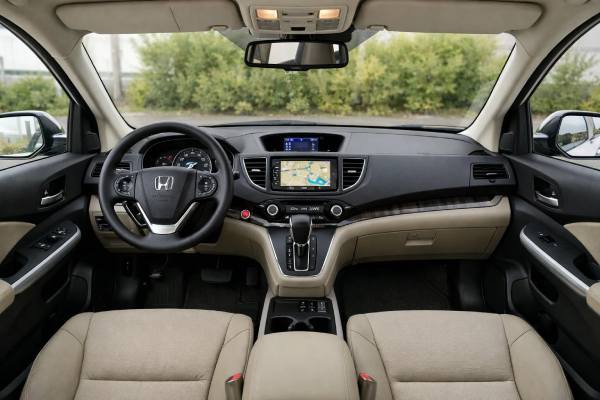

The 2012–2016 Honda CR-V RM4 with Real Time AWD and the 2.4-liter K24Z7 is a practical, engineering-led choice: simple naturally aspirated power, a proven 5-speed automatic in many markets, and an on-demand AWD system tuned more for stability than rock crawling. The K24Z7’s character is “smooth and rev-happy,” with power arriving higher in the rev range than many turbo rivals—great for predictable response, less ideal if you want effortless low-rpm shove. The upside is long-term durability when serviced on time, plus parts availability and broad technician familiarity.
Where owners can get caught out is not the big stuff, but the small stuff: rear differential fluid condition (AWD shudder), suspension wear that creeps in with age, and keeping up with recalls and software updates. Buy well, maintain it consistently, and it tends to reward you with low drama ownership.
Top Highlights
- Predictable AWD traction in rain and snow, with stable highway manners and low steering kickback.
- K24Z7 is mechanically straightforward for a modern SUV: no turbo, no high-voltage hybrid system, and a timing chain.
- Cabin and cargo packaging are a strong point; visibility and daily usability stay excellent even by newer standards.
- Ownership caveat: rear differential fluid condition matters—neglect can cause tight-turn chatter and driveline vibration.
- Typical interval: rear diff fluid service about every 30,000–50,000 km (20,000–30,000 mi) depending on use.
Section overview
- RM4 AWD character guide
- K24Z7 AWD spec tables
- Trim keys and safety suites
- Known weak points and recalls
- Maintenance routine and buying tips
- Road feel and real mpg
- RM4 AWD vs compact SUV rivals
RM4 AWD character guide
Think of the RM4 Real Time AWD CR-V as a “front-drive SUV with extra grip on demand.” In normal cruising, it behaves like a tidy FWD crossover: light effort, easy parking, stable tracking. When the fronts slip, an electronically controlled clutch pack in the rear driveline sends torque rearward to help you launch cleanly, hold a line in wet corners, or climb a slippery incline without drama. It is not designed for sustained off-road torque transfer like a low-range 4×4, and that’s part of why it ages well—there’s less complexity and fewer hard-use expectations.
The K24Z7 2.4-liter i-VTEC (Honda’s variable valve timing and lift strategy) brings a distinct ownership feel compared with modern small turbos. You get linear throttle mapping, a smooth idle, and power that builds with revs rather than a midrange “punch.” Around town, it is calm and quiet; on an on-ramp, it likes a firm pedal and a downshift, then it pulls cleanly to redline. If you mostly drive in city traffic and want effortless low-rpm torque, you may notice it works harder than a turbo competitor. If you value predictable response and long-term simplicity, the naturally aspirated approach is a real advantage.
Why buyers still seek this configuration:
- Low complexity powertrain for its class: no turbocharger, no direct-injection carbon management in many variants, and a timing chain rather than a belt service.
- On-demand AWD that improves real-world confidence without a big fuel-economy penalty for most drivers.
- Practical packaging: a tall roofline, wide-opening doors, and a cargo area that remains genuinely useful even today.
What to watch for with age is less about “will it run,” and more about “will it run correctly”: AWD fluid condition, suspension bushings, brake hardware corrosion if it lived in road-salt regions, and keeping calibration/recall work up to date. If you approach it as a long-term appliance, it tends to behave like one.
K24Z7 AWD spec tables
The tables below focus on the RM4 Real Time AWD CR-V with the K24Z7. Because CR-V equipment and even drivetrains can vary by market and model year, treat these as typical specifications and verify against your VIN label, owner’s documentation, and under-hood stickers.
Powertrain and efficiency (typical)
| Item | Specification |
|---|---|
| Engine code | K24Z7 |
| Layout | Inline-4, aluminum block/head |
| Valvetrain | DOHC i-VTEC, 4 valves/cyl |
| Bore × stroke | 87.0 × 99.1 mm (3.43 × 3.90 in) |
| Displacement | 2.4 L (2354 cc) |
| Induction | Naturally aspirated (NA) |
| Fuel system | PGM-FI (market-dependent port injection) |
| Compression ratio | ~10.4:1 (varies by market calibration) |
| Max power | 185 hp (138 kW) @ ~7000 rpm |
| Max torque | ~221 Nm (163 lb-ft) @ ~4400 rpm |
| Timing drive | Chain |
| Rated efficiency (typical AWD) | ~8.7–9.5 L/100 km (25–27 mpg US / 29–32 mpg UK) |
| Real-world highway @ 120 km/h | ~8.5–9.8 L/100 km (24–28 mpg US) |
| Aerodynamics | Cd ~0.33–0.35 (varies); frontal area market-dependent |
Transmission and driveline
| Item | Specification |
|---|---|
| Transmission | 5-speed automatic (common) |
| Drive type | Real Time AWD (on-demand) |
| Differential | Front open diff; rear coupling/clutch control |
Note: Some regions and later model years may use different engines/transmissions. Confirm by VIN and build plate.
Chassis, dimensions, weights
| Item | Specification |
|---|---|
| Suspension (front/rear) | MacPherson strut / Multi-link |
| Steering | Electric power steering (EPS), rack-and-pinion |
| Brakes (front/rear) | Disc / Disc (sizes vary by trim/market) |
| Wheel/tyre common sizes | 225/65 R17; 235/60 R18 (trim-dependent) |
| Ground clearance | ~165 mm (6.5 in) |
| Length / width / height | ~4529 / 1820 / 1655 mm (178.3 / 71.7 / 65.2 in) |
| Wheelbase | ~2620 mm (103.1 in) |
| Turning circle (kerb-to-kerb) | ~11.8 m (38.7 ft) |
| Kerb weight | ~1540–1620 kg (3395–3570 lb) |
| GVWR | ~2040–2100 kg (4497–4630 lb) |
| Fuel tank | ~58 L (15.3 US gal / 12.8 UK gal) |
| Cargo volume | Commonly ~590 L seats up / ~1650 L seats down (VDA; varies by method/market) |
Performance and capability (typical)
| Item | Specification |
|---|---|
| 0–100 km/h (0–62 mph) | ~9.7–10.8 s (trim/conditions vary) |
| Top speed | ~185–195 km/h (115–121 mph) |
| Braking 100–0 km/h | ~38–41 m (surface/tyres dependent) |
| Towing capacity | Market-dependent; commonly 680–1500 kg braked |
| Roof load | Commonly 75 kg (verify by market rails rating) |
| Payload | Often ~450–550 kg (trim/market dependent) |
Fluids and service capacities (typical)
| System | Spec | Capacity (approx.) |
|---|---|---|
| Engine oil | API spec per market; common viscosity 0W-20 or 5W-20 | ~4.2 L (4.4 US qt) with filter |
| Coolant | Honda Type 2 / equivalent long-life | ~6.0–6.5 L (6.3–6.9 US qt) |
| Automatic transmission | Honda ATF DW-1 (common) | Drain/fill ~3.0–3.5 L; total higher |
| Rear differential (AWD) | Honda Dual Pump Fluid (market dependent) | ~1.0–1.2 L |
| A/C refrigerant | R-134a (typical for era) | Label value, often ~450–550 g |
Key torque specs (critical, typical):
- Wheel lug nuts: 108 Nm (80 lb-ft)
- Engine oil drain plug: ~39 Nm (29 lb-ft)
- Spark plugs: ~18 Nm (13 lb-ft)
Electrical and ignition (typical)
| Item | Specification |
|---|---|
| Alternator output | ~130 A (varies) |
| 12 V battery | Group/size varies; often 51R-class in North America |
| Spark plugs | Iridium type; gap typically ~1.0–1.1 mm (0.039–0.043 in), confirm by VIN |
Safety and driver assistance
| Item | Notes |
|---|---|
| Crash ratings | Euro NCAP (2013-era CR-V): 5-star overall with strong adult protection; IIHS (2012–14 applicability in many tests): generally Good in several tests, with small overlap concerns on early design |
| Airbags | Typically 6 (front, front side, curtain) |
| Stability and braking | ABS, ESC/VSA, traction control; brake assist (market dependent) |
| Child-seat provisions | ISOFIX/LATCH positions (check seat tags and manual) |
| ADAS | Pre-Honda Sensing era in many markets; features depend heavily on trim/year |
Trim keys and safety suites
Trim names vary widely (LX/EX/EX-L/Touring, Elegance/Lifestyle/Executive, etc.), but you can still decode what matters by focusing on hardware: wheels/tyres, lighting, infotainment head unit, seat material, and (most importantly) safety content.
Practical trim identifiers you can use on a walkaround
- Wheels and brakes: 17-inch wheels often signal a base/mid trim, while 18-inch wheels tend to come with higher trims. Larger wheels can sharpen steering response but also make ride more abrupt and tyres more expensive.
- Headlights and fog lights: Look for projector housings, fog lamp presence, and automatic leveling where applicable. Better lighting is one of the highest “daily value” upgrades.
- Cabin tells: Dual-zone climate, heated seats, and steering wheel audio/phone controls often show mid-to-upper trims. Leather upholstery is usually tied to top trims, though some markets offer mixed packages.
- Infotainment tier: Basic units may be Bluetooth-only; higher trims can add navigation, premium audio, and a larger screen. Confirm by checking menus for camera guidelines, phonebook sync, and language options.
Mechanical differences worth caring about
Most RM4 K24Z7 models share the same core powertrain and suspension layout. Differences that affect ownership tend to be:
- Tyre size and compound (affects braking, wet traction, road noise).
- AWD calibration and related sensors are usually the same, but the presence of stability-control subfeatures can vary by market.
- Tow rating can differ by trim and local homologation; don’t assume a high-trim equals higher towing capacity.
Safety ratings: what they mean for this generation
This generation performs strongly in many traditional crash tests for its era, and it benefits from Honda’s body-structure strategy aimed at managing crash energy. However, safety ratings are test-version dependent. A “five-star” result in one region does not automatically transfer to another year, trim, or protocol update.
Safety systems and ADAS: set expectations correctly
Many 2012–2016 RM4 vehicles are from the period before camera/radar suites became common. That means:
- You usually get: stability control, ABS, traction control, multiple airbags, and strong child-seat accommodation.
- You may not get (or it may be rare): automatic emergency braking, adaptive cruise control, and lane centering. If these features matter, verify on the exact vehicle by checking steering wheel buttons, windshield camera housings, radar panels, and the settings menu.
After any collision repair, windshield replacement, steering alignment work, or suspension changes, confirm that steering angle sensors and stability-control calibration were done correctly. On a test drive, a CR-V with poor calibration can feel oddly twitchy in lane changes or trigger warning lights intermittently.
Known weak points and recalls
This CR-V configuration is generally durable, but age and usage patterns create repeatable problem areas. A helpful way to think about it is “common annoyances,” “occasional wallet-hitters,” and “rare but important.”
Common (expect to see eventually)
- Rear differential fluid degradation (AWD chatter):
Symptoms: shudder or “binding” during tight, slow turns (parking lots), sometimes a groan.
Likely cause: fluid shearing/contamination, especially if the wrong fluid was used.
Remedy: correct fluid service; in stubborn cases, multiple drain/refills with proper procedure. - Suspension wear with mileage:
Symptoms: clunks over bumps, vague steering on-center, uneven tyre wear.
Likely cause: stabilizer links, compliance bushings, strut mounts, rear multi-link bushings.
Remedy: replace worn components, then align; use quality parts to avoid repeat repairs. - Brake hardware issues in salted climates:
Symptoms: sticking calipers, uneven pad wear, pulsation.
Cause: corrosion on slide pins/backing plates, neglected brake service.
Remedy: clean/lube service or caliper replacement; refresh brake fluid on schedule.
Occasional (cost varies, but not rare)
- A/C performance problems:
Symptoms: weak cooling, intermittent operation, compressor noise.
Cause: age-related leaks, compressor/clutch wear, condenser damage from road debris.
Remedy: proper leak diagnosis and repair, not just a top-up. - Oil seepage and gasket aging:
Symptoms: minor oil dampness around timing cover/valve cover areas.
Cause: heat cycles and gasket hardening.
Remedy: reseal when leakage becomes active or reaches belts/mounts. - Electrical “small failures”:
Symptoms: door lock actuator inconsistencies, window switch quirks, intermittent sensors.
Remedy: targeted component replacement; avoid cheap aftermarket electronics when possible.
Rare (but pay attention)
- AWD warning light events tied to relay/sensor issues in harsh conditions:
Symptoms: AWD indicator on, stored codes, reduced rear torque contribution.
Remedy: follow the correct diagnostic path; in some cases, updated parts or relay replacement is the official fix.
Recalls, service bulletins, and how to verify
For this era, airbag inflator campaigns are the big one in many regions, but recall coverage depends on VIN and market. Your process should be:
- Run the VIN through the official recall database for your region.
- Ask for dealer printouts showing completion dates.
- If the seller can’t prove it, assume it still needs doing and plan the visit.
Pre-purchase checks worth requesting
- Evidence of rear diff fluid service (date and mileage), plus the correct fluid specification.
- Transmission service history (at least periodic drain/refill).
- A scan for stored codes (even if the dash is clear).
- Underbody inspection for corrosion, especially around suspension mounting points and brake lines in salted climates.
- Tyre condition and matching brand/model across axles (AWD systems prefer consistent rolling radius).
A well-kept RM4 feels tight, quiet, and consistent. A neglected one often feels like “a collection of small problems,” not one big failure—so your inspection needs to be methodical.
Maintenance routine and buying tips
A CR-V like this responds best to “boring, consistent maintenance.” The goal is to protect the systems that are expensive to ignore: lubrication, cooling, braking hydraulics, and the AWD coupling/differential.
Practical maintenance schedule (distance/time)
Use the manufacturer maintenance minder where available, but these intervals work well for real-world ownership:
- Engine oil and filter: every 8,000–10,000 km (5,000–6,000 mi) or 12 months (short trips, cold climate, heavy traffic: shorten).
- Engine air filter: inspect every oil service; replace about 30,000 km (20,000 mi) or sooner in dust.
- Cabin air filter: 15,000–30,000 km (10,000–20,000 mi) depending on environment.
- Coolant: long-life coolant typically 10 years / ~200,000 km (120,000 mi) first, then 5 years thereafter (verify by market).
- Spark plugs: typically ~160,000 km (100,000 mi); replace earlier if misfire appears.
- Automatic transmission fluid: a conservative plan is every 40,000–60,000 km (25,000–40,000 mi) via drain/fill.
- Rear differential fluid (AWD): 30,000–50,000 km (20,000–30,000 mi); shorten if you tow, drive mountains, or do frequent low-speed manoeuvring.
- Brake fluid: every 3 years, regardless of mileage.
- Brake pads/rotors: inspect every tyre rotation; service slide pins/hardware annually in salted climates.
- Tyre rotation and alignment: rotate every 10,000–12,000 km (6,000–7,500 mi); align when tyres are replaced or wear appears.
- 12 V battery test: annually after year 4; replacement commonly 5–7 years depending on climate.
Fluid specifications and “don’t get clever” rules
- Use the correct ATF for your transmission. “Universal” fluids can create shift quality problems over time.
- Use the correct rear diff fluid. This is a common source of AWD shudder when the wrong fluid is installed.
- Coolant should meet the correct long-life standard and mixture ratio; avoid mixing unknown coolants.
Buyer’s guide: what to check on the exact car
Cold start (engine):
- Listen for abnormal timing/VTC noise beyond a brief start-up tick.
- Check for rough idle, misfire, or exhaust smell that suggests oil burning.
Test drive (transmission and AWD):
- Smooth upshifts/downshifts, no flare, no harsh engagement when warm.
- In an empty lot, do slow tight circles: no binding/shudder from the rear.
Underbody and chassis:
- Look for wetness around the engine, transmission pan area, and rear differential.
- Inspect control arm bushings and sway bar links for cracked rubber.
- Check brake lines and subframe areas for corrosion where road salt is common.
Electronics and cabin:
- Confirm all locks/windows work repeatedly.
- Verify backup camera function and steering wheel controls.
Best “value” spec choices for longevity
- Prefer a vehicle with documented AWD diff service and regular oil changes over one with fancy infotainment.
- Moderate wheel size (often 17-inch) can be cheaper long-term: tyres cost less and ride is more forgiving.
- If you live in snow country, prioritize good tyres over chasing a newer AWD badge—tyres change the outcome more than marketing.
With these cars, the long-term durability outlook is usually strong when maintenance is steady. Neglect tends to show up as driveline vibration, noisy suspension, and expensive “catch-up” servicing rather than catastrophic engine failure.
Road feel and real mpg
On the road, the RM4 CR-V’s biggest strength is how “unbusy” it feels. The suspension is tuned to absorb broken pavement without floating, and the steering is light but accurate. It’s not a sporty crossover, yet it stays composed when you change lanes quickly or hit mid-corner bumps—especially on sensible tyre sizes and fresh dampers.
Powertrain character: what it feels like day to day
The K24Z7 is happiest when you drive it like a Honda engine: smooth inputs, then a confident throttle when you need speed. Around town it’s quiet and cooperative. For passing, it typically drops a gear (or two) and climbs into the higher rpm range where it makes its power. That behavior can feel “busy” if you’re coming from a turbocharged SUV that surges at 2,000 rpm, but it’s also predictable and mechanically gentle—no turbo heat load, no boost spikes, and generally fewer expensive supporting parts.
The on-demand AWD is subtle. In normal driving you won’t feel it “push” the car like a performance AWD system. Instead, you notice it when conditions are poor: fewer traction-control flashes pulling away on wet paint lines, and more confidence on snowy residential roads. With good winter tyres, it becomes a genuinely capable winter commuter.
Real-world efficiency (what owners typically see)
Fuel economy depends heavily on speed and temperature. In mixed driving:
- City-heavy use: often 10.0–11.5 L/100 km (20–24 mpg US)
- Highway 100–120 km/h: often 8.5–9.8 L/100 km (24–28 mpg US)
- Mixed average: often 9.0–10.5 L/100 km (22–26 mpg US)
Cold weather can add +1.0 to +2.0 L/100 km due to longer warm-up time, winter fuel blends, and higher rolling resistance.
Key performance metrics that actually matter
- 0–100 km/h: typically high-9s to low-10s seconds—adequate, not quick.
- Passing response: more dependent on transmission kickdown and driver throttle commitment than raw horsepower.
- Braking feel: generally consistent, but older cars benefit a lot from fresh brake fluid and quality pads.
Load, hills, and towing reality
This CR-V can handle small trailers and light utility duty when properly equipped, but it’s not a tow-first platform. If you tow:
- keep speeds conservative,
- service ATF and rear diff fluid more frequently,
- and pay attention to tyre load rating and pressures.
For most owners, the “performance” story is not about numbers. It’s about calm, stable behavior, predictable traction, and a drivetrain that doesn’t punish you with quirks—provided you keep the fluids and wear items current.
RM4 AWD vs compact SUV rivals
When comparing a 2012–2016 CR-V RM4 AWD to its main rivals, focus on the realities of used ownership: powertrain complexity, parts cost, rust risk, and how the AWD system behaves when neglected.
Versus Toyota RAV4 (same era)
- CR-V advantages: smoother high-rpm engine feel, often a more “car-like” cabin layout and visibility, strong practicality.
- RAV4 advantages: typically stronger reputation for low-effort durability and sometimes better low-rpm response depending on engine.
- Used-buy takeaway: choose based on maintenance evidence. A well-serviced CR-V is an excellent bet; a neglected AWD system is where it can lose to Toyota in perceived robustness.
Versus Mazda CX-5
- CR-V advantages: interior space efficiency and easy daily usability; often softer ride on smaller wheels.
- CX-5 advantages: sharper steering, more athletic chassis balance, often more engaging to drive.
- Used-buy takeaway: CX-5 can feel “newer” dynamically, but the CR-V often wins as a long-term appliance—especially if you prefer comfort over edge.
Versus Subaru Forester
- CR-V advantages: simpler on-demand AWD hardware and typically less “AWD-first” maintenance sensitivity for average drivers.
- Forester advantages: more consistent AWD behavior and often better rough-road confidence.
- Used-buy takeaway: Subaru AWD capability is real, but buy only if the service history is strong; neglected maintenance can be more punishing.
Versus Nissan Rogue (older 2.5 era)
- CR-V advantage: many owners prefer the Honda’s long-term drivetrain feel, especially if comparing against older CVT concerns in some rivals.
- Rogue advantage: sometimes lower purchase price.
- Used-buy takeaway: if you keep cars a long time, the CR-V’s resale strength and maintenance simplicity often offset the higher buy-in.
The bottom line
If your priority is predictable ownership, the RM4 CR-V AWD is one of the safer used bets of its era—especially for snow-belt daily driving—so long as you confirm:
- AWD fluid service history,
- recall completion,
- and a clean mechanical baseline (no hidden leaks, no sloppy suspension).
It’s not the most exciting compact SUV in the class, but it remains a highly rational pick because the engineering choices align with what used buyers actually need.
References
- 2014 Honda CR-V 2014 (Safety Rating)
- Vehicle Detail Search – 2014 HONDA CR-V SUV 4WD | NHTSA 2014 (Recall Database)
- Gas Mileage of 2014 Honda CR-V 2014 (Official Fuel Economy)
- New Honda CR-V receives 5-star Euro NCAP Overall Safety Rating | Honda Global Corporate Website 2013 (Safety Rating)
- Owner’s Manual & Warranty | Honda | Honda Owners Site 2026 (Owner’s Manual)
Disclaimer
This article is for informational purposes only and is not a substitute for professional diagnosis, inspection, or repair. Specifications, torque values, fluid capacities, service intervals, and procedures vary by VIN, market, model year, and equipment. Always verify details using your official owner’s manual and service documentation for the exact vehicle you are working on.
If this guide helped you, consider sharing it on Facebook, X (Twitter), or your favorite forum to support our work.