

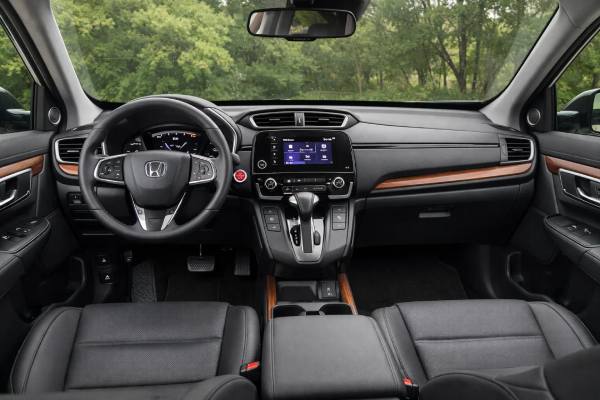

The 2017–2022 Honda CR-V RW2 with Real Time AWD and the 1.5-liter turbo (L15BE) is a “do-everything” compact SUV tuned for daily comfort, predictable winter traction, and low running effort. The key engineering story is the pairing of a small-displacement, direct-injection turbo engine with a CVT (continuously variable transmission) and an on-demand rear driveline. Done right, this combination delivers strong mid-range pull in normal traffic, a roomy cabin for the footprint, and fuel use that stays reasonable for an AWD family SUV.
Ownership outcomes depend on how it’s used. Short, cold trips and skipped drivetrain fluid changes tend to create the loudest complaints, while highway-heavy use with timely service is typically uneventful. If you’re shopping used, focus less on mileage and more on service history, software updates, and signs of careful warm-up and fluid maintenance.
What to Know
- Smooth, confidence-building AWD engagement in rain and snow with minimal driver input.
- Strong low-to-midrange torque for commuting and merging, especially from 2,000 rpm up.
- Practical interior packaging: easy child-seat fitment and square cargo space.
- Watch for fuel dilution tendencies on repeated short trips in cold climates.
- Change rear differential fluid about every 30,000–50,000 km (or sooner with frequent low-speed slip use).
Navigate this guide
- RW2 AWD ownership profile
- L15BE AWD specs and dimensions
- Trims, ADAS, and safety equipment
- Reliability patterns and service actions
- Maintenance plan and buying checklist
- Real-world driving and efficiency
- RW2 CR-V vs compact SUV rivals
RW2 AWD ownership profile
Think of the RW2 CR-V as a comfort-first, traction-assisted crossover rather than a rugged 4×4. The Real Time AWD system is on-demand: it runs primarily as a front-driver and sends torque rearward when the system predicts or detects front slip. That brings two big ownership benefits. First, it stays easygoing in normal driving—light steering, calm ride, and no “binding” sensation on dry pavement. Second, it can rescue traction quickly in wet roundabouts, icy starts, or gravel driveways without asking you to engage modes or lock differentials.
The other defining trait is how the 1.5 turbo and CVT work together. The engine produces its usable shove early, and the CVT can hold the engine near the torque band instead of stepping through gears. If you drive gently, that feels smooth and efficient. If you demand maximum acceleration repeatedly, the CVT will keep revs elevated and can sound busier than a conventional automatic. That’s not a fault; it’s the tradeoff for the ratio flexibility that helps fuel economy.
Cabin and cargo packaging are where this CR-V tends to win owners over. The rear seat space is generous for the class, the load floor is practical, and the driving position suits long stints. For families, the wide door openings and straightforward ISOFIX/LATCH access matter more day-to-day than horsepower figures.
Where the RW2 asks something back from you is in maintenance discipline. AWD adds a rear differential (and often a prop shaft and couplings) that needs periodic fluid service. The 1.5 turbo adds thermal load, crankcase blow-by management, and direct-injection considerations. Most “problem cars” aren’t inherently bad builds—they’re vehicles that did lots of short, cold trips on long oil intervals, skipped rear diff services, or lived on low-quality fuel with no attention to software updates.
If your driving is mostly highway or mixed suburban routes, and you’re willing to service fluids on time, the RW2 CR-V is typically a low-drama ownership proposition with above-average practicality.
L15BE AWD specs and dimensions
The tables below focus on the 2017–2022 CR-V RW2 Real Time AWD with the 1.5L turbo rated at 190 hp. Exact figures vary by market, wheel size, emissions spec, and trim equipment, so treat these as “typical” values to guide shopping, maintenance planning, and comparisons.
Powertrain and efficiency (typical RW2 1.5T AWD)
| Item | Spec |
|---|---|
| Code | L15BE (1.5L turbocharged gasoline) |
| Engine layout and cylinders | Inline-4, DOHC, 16 valves (4 valves/cyl) |
| Bore × stroke | 73.0 × 89.4 mm (2.87 × 3.52 in) |
| Displacement | 1.5 L (1,498 cc) |
| Induction | Turbocharged |
| Fuel system | Direct injection (DI) |
| Compression ratio | ~10.3:1 |
| Max power | 190 hp (142 kW) @ ~5,600 rpm |
| Max torque | ~243 Nm (179 lb-ft) @ ~2,000–5,000 rpm |
| Timing drive | Chain |
| Rated efficiency | Typically ~7.5–9.5 L/100 km (31–25 mpg US / 38–30 mpg UK), trim-dependent |
| Real-world highway @ 120 km/h (75 mph) | Often ~8.0–9.0 L/100 km (29–26 mpg US / 35–31 mpg UK) |
Transmission and driveline
| Item | Spec |
|---|---|
| Transmission | CVT (market-specific code), with manual ratio steps in some modes |
| Drive type | Real Time AWD (on-demand) |
| Differential | Open front; rear torque transfer via clutch-based coupling (no locking diff) |
Chassis and dimensions (typical RW platform)
| Item | Spec |
|---|---|
| Suspension (front/rear) | MacPherson strut / multi-link |
| Steering | Electric power steering (EPS) |
| Brakes | 4-wheel discs (vented front) |
| Wheels/Tyres | Common: 235/60 R18 or 235/65 R17 (varies by trim/market) |
| Ground clearance | ~200–210 mm (7.9–8.3 in), trim-dependent |
| Length / Width / Height | ~4,585–4,600 mm / ~1,855 mm / ~1,675–1,690 mm |
| Wheelbase | ~2,660 mm (104.7 in) |
| Turning circle (kerb-to-kerb) | ~11.8 m (38.7 ft), market-dependent |
| Kerb weight | ~1,580–1,720 kg (3,483–3,792 lb) |
| Fuel tank | ~57 L (15.1 US gal / 12.5 UK gal) |
| Cargo volume | Typically ~1,050–1,120 L seats up, ~2,000–2,150 L seats down (method varies by market: SAE/VDA) |
Performance and capability (typical)
| Item | Spec |
|---|---|
| Acceleration 0–100 km/h (0–62 mph) | ~8.5–10.0 s (trim, tyres, conditions) |
| Top speed | ~200–210 km/h (124–131 mph), market-dependent |
| Towing capacity | Commonly 1,000–1,500 kg braked (2,205–3,307 lb), check VIN/market label |
| Payload | Often ~450–550 kg (992–1,213 lb), configuration-dependent |
| Roof load | Often ~75 kg (165 lb), check roof-rail rating and handbook |
Fluids and service capacities (planning values)
| Item | Spec |
|---|---|
| Engine oil | 0W-20 (typical), ~3.6–3.8 L (3.8–4.0 US qt) with filter |
| Coolant | Honda Type 2 or equivalent long-life, capacity varies by market |
| CVT fluid | Honda CVT fluid spec, service by drain-and-fill (capacity varies) |
| Rear differential | Honda rear differential fluid spec for Real Time AWD, capacity varies |
| A/C refrigerant | R-1234yf or R-134a depending on year/market; charge varies |
| Key torque specs | Wheel nuts often ~108 Nm (80 lb-ft); oil drain plug often ~39 Nm (29 lb-ft) |
Electrical (typical)
| Item | Spec |
|---|---|
| 12V battery | Commonly 60–70 Ah class, CCA varies by market |
| Spark plugs | Iridium type (DI turbo application), gap spec varies by plug family |
Safety and driver assistance (high-level)
| Item | Spec |
|---|---|
| Crash ratings | Vary by year and test body; see Euro NCAP and IIHS results for the generation |
| ADAS suite | Honda Sensing package availability varies by trim/year/market |
If you need exact capacities and torque values for DIY work, match them to your VIN, engine label, and service manual for your market. Even within RW2, wheel size, brakes, and A/C refrigerant can change by year.
Trims, ADAS, and safety equipment
For 2017–2022, trims differ far more in convenience and driver assistance than in mechanical hardware. Most RW2 AWD models share the same basic suspension layout, braking architecture, and powertrain calibration family, while wheels/tyres and option packs can materially affect ride quality and braking feel.
Common trim patterns and quick identifiers
Typical trim naming depends on region, but the equipment ladder usually looks like:
- Entry trims: smaller wheels, fewer cameras/sensors, basic audio, cloth seats, sometimes fewer ADAS features in early years.
- Mid trims: keyless access, heated seats, upgraded infotainment, more common Honda Sensing fitment.
- Upper trims: larger wheels, LED lighting packages, premium audio, power tailgate, leather, panoramic roof in some markets.
How to confirm RW2 Real Time AWD quickly (used shopping):
- Look for AWD/4WD badging (if fitted), but don’t rely on badges alone.
- Check underneath: you should see a prop shaft running rearward and a rear differential assembly.
- In the cabin, some markets show AWD-related screens in the vehicle information display.
- The most reliable method is the VIN/build data and dealer equipment printout.
Safety systems and structural basics
Across this generation, expect a full complement of airbags (front, side, and side curtain), stability control, and modern crash structure design. Child-seat provisions typically include ISOFIX/LATCH outboard with top-tether anchors, and the CR-V’s rear-door opening size makes installation less frustrating than in some rivals.
Honda Sensing and ADAS evolution
Honda Sensing commonly includes:
- AEB (automatic emergency braking) with vehicle and, on many versions, pedestrian detection
- ACC (adaptive cruise control)
- Lane keeping assistance (LKA / lane centering behavior varies by year)
- Road departure mitigation
- Traffic sign recognition in some markets
- Blind-spot monitoring and rear cross-traffic alert often depend on trim/market and may arrive later in the cycle
Two ownership notes matter here:
- Standard vs optional changes by year: Early model years often tie ADAS to mid/high trims or option packs; later years tend to make key items standard. When comparing used listings, verify feature presence by the windshield camera module, radar sensor location, and the exact equipment list—not just trim name.
- Calibration after repairs: Windshield replacement, radar bracket work, wheel alignment changes, or front-end collision repairs can require camera/radar calibration. A CR-V that “drives fine” can still throw intermittent ADAS faults if calibration was skipped, so scan for stored codes and confirm shop documentation after accident repairs.
If safety tech is a priority, prioritize the trim/year combination where AEB and good headlights are standard rather than optional, and make sure the sensors behave consistently on a test drive (no warnings, no lane camera dropouts, no ACC cancellations).
Reliability patterns and service actions
Reliability on the RW2 1.5T AWD tends to be “good with the right usage,” and most issues show recognizable patterns. Below is a practical map by prevalence and cost tier, with symptoms and typical remedies.
Common (low to medium cost)
- Fuel dilution tendencies (cold/short trips)
- Symptoms: Oil level rising, fuel smell on dipstick, rougher cold idle, reduced MPG in winter.
- Likely root cause: Short-trip operation that doesn’t fully warm oil, plus DI turbo blow-by and enrichment during cold starts.
- Remedy: Shorten oil intervals, use correct oil grade, ensure software updates are applied where relevant, and prioritize longer warm-up drives periodically.
- Rear differential “groan” or chatter on tight turns (AWD models)
- Symptoms: Groaning/vibration when turning slowly (parking maneuvers), especially after long intervals.
- Root cause: Degraded rear diff fluid or friction modifier depletion.
- Remedy: Drain and refill with the correct Honda rear differential fluid; repeat service if badly neglected.
- CVT fluid aging and drivability changes
- Symptoms: Shudder, flare-like behavior, hesitation, or “busy” feeling under load.
- Root cause: Fluid shear and heat cycling, sometimes worsened by towing or heavy stop-and-go.
- Remedy: Drain-and-fill at sensible intervals; avoid “universal” fluids unless explicitly approved.
Occasional (medium cost)
- A/C performance issues
- Symptoms: Weak cooling, intermittent cooling, oily residue near condenser lines, compressor noise.
- Root cause: Component seepage, seals, or condenser damage from debris.
- Remedy: Proper leak detection (dye/pressure testing), replace faulty component, evacuate and recharge to the correct spec.
- Direct-injection deposits (usage-dependent)
- Symptoms: Rough idle, hesitation, misfires under load, recurring injector-related codes.
- Root cause: Intake valve deposits on DI engines, poor fuel quality, lots of low-load driving.
- Remedy: Diagnostic confirmation; intake cleaning when needed; keep PCV system healthy and use quality fuel.
Rare to serious (higher cost)
- Turbocharger-related faults
- Symptoms: Loss of boost, whistling, smoke, persistent underboost codes.
- Root cause: Wastegate actuator issues, boost leaks, oiling problems (often tied to poor maintenance).
- Remedy: Pressure test the intake tract, inspect intercooler hoses, confirm turbo health; replace components as required.
- ADAS sensor faults after repairs
- Symptoms: Radar/camera warnings, ACC/LKA unavailable, intermittent alerts.
- Root cause: Calibration not performed, bracket misalignment, non-OE windshield distortions.
- Remedy: Correct calibration procedure and verified mounting geometry.
Recalls, TSBs, and coverage checks (how to handle)
Because recall and service action scope can change by year and region, the safest approach is procedural:
- Run an official VIN check (manufacturer recall site and local regulator database).
- Ask for dealer history printouts showing completion dates.
- Scan modules for stored and pending codes, especially powertrain and ADAS.
A used RW2 that has documented diff/CVT fluid services and shows clean behavior from cold start through full operating temperature is usually a better bet than a lower-mileage example with patchy records.
Maintenance plan and buying checklist
A practical maintenance plan for the RW2 1.5T AWD should respect three realities: the turbo engine runs hotter than a naturally aspirated unit, the CVT relies heavily on fluid condition, and the rear differential is sensitive to neglected fluid. Many markets use an onboard service minder, but you can still anchor your decisions with time-and-distance limits.
Practical schedule (typical, adjust for your climate and duty cycle)
- Engine oil and filter: every 10,000–15,000 km or 12 months; shorten to 7,500–10,000 km for frequent short trips, cold winters, or heavy city use.
- Cabin air filter: every 15,000–30,000 km or yearly if you drive in dusty cities.
- Engine air filter: every 30,000–45,000 km; inspect sooner in dusty regions.
- Brake fluid: every 3 years regardless of mileage.
- Coolant: often first change around 10 years/200,000 km, then about every 5 years/100,000 km (verify by market).
- Spark plugs: commonly around 160,000 km (100,000 miles), sooner if misfire/roughness develops.
- CVT fluid: every 40,000–60,000 km if you plan long ownership, tow, or drive in mountains; don’t wait for symptoms.
- Rear differential fluid (AWD): every 30,000–50,000 km depending on use; sooner if you do frequent low-speed slip (snowy parking lots, gravel climbs).
- Tyre rotation and alignment check: rotate every 10,000–12,000 km; check alignment annually or after curb impacts.
- 12V battery test: annually after year 3; replacement commonly in the 4–6 year window depending on climate.
Fluids: what matters most
- Use the correct spec CVT fluid and correct rear differential fluid. These systems are sensitive to friction characteristics, and “close enough” fluids can create noise or drivability problems.
- For engine oil, prioritize the correct viscosity and API/ACEA spec for your market and emissions equipment.
Buyer’s inspection checklist (RW2-specific)
Before the test drive
- Verify AWD hardware underneath (prop shaft, rear differential).
- Check for uneven tyre wear (a clue to alignment issues and, on AWD, driveline stress).
- Look for coolant residue, oil seepage around the timing cover area, and any signs of A/C oil staining near the condenser.
Cold start and warm-up
- Listen for extended cranking, unstable idle, or misfire stumble.
- Check the oil level and smell: a strong fuel odor can indicate excessive dilution behavior.
- Confirm there are no persistent warning lights for ADAS, ABS, or powertrain.
Low-speed parking maneuvers
- Do tight circles in both directions. Groaning or chatter can suggest overdue rear diff service.
Road test
- Under moderate acceleration, the CR-V should pull smoothly with no surging or shudder.
- At steady cruise, it should settle quietly; if it “hunts” badly or drones excessively, confirm tyre type and check for CVT service history.
- Test ACC and lane features (where equipped) for consistent operation and no warning messages.
Paperwork to request
- Proof of oil changes at sensible intervals (not just “once a year” with mostly short trips).
- Documentation of CVT fluid and rear differential fluid services.
- Any record of windshield replacement and ADAS calibration afterward.
Long-term durability outlook is best when the car has mixed or highway use, correct fluids, and evidence that the AWD and CVT were serviced proactively rather than reactively.
Real-world driving and efficiency
In daily use, the RW2 CR-V is defined by smoothness and predictability. The suspension is tuned to absorb broken pavement without feeling floaty, and the steering is light but accurate enough for confident lane placement. It’s not a “sport SUV,” yet it stays composed on sweeping roads and doesn’t punish you with harsh impacts over expansion joints—especially on smaller wheel packages.
Powertrain character (1.5T + CVT)
The 1.5 turbo’s strength is usable torque where you actually drive: pulling away from junctions, merging at 60–90 km/h, and climbing mild grades without needing high revs. The CVT keeps the engine in its sweet spot, which makes acceleration feel steady rather than “stepped.” Some drivers interpret that steady pull as less dramatic than a geared automatic, but it’s effective.
Two practical tips improve satisfaction:
- Use normal throttle inputs for the smoothest response; abrupt pedal stabs can trigger a rapid ratio change that feels like a surge.
- In hilly areas, a “sport” or “S” mode (if equipped) can reduce ratio hunting by holding more aggressive engine speed targets.
Real Time AWD behavior
Real Time AWD is most noticeable at low speeds on slippery surfaces. On wet paint lines, slushy turns, or icy starts, it can transfer torque rearward quickly to stabilize the front end. It’s not designed for sustained off-road abuse, and it won’t behave like a locked 4×4 on deep ruts. The best way to think about it is traction insurance for normal roads and light trails. Tyres still matter more than AWD for braking and cornering on snow; good winter tyres transform the CR-V’s winter competence.
Real-world efficiency
Fuel use depends heavily on speed, temperature, and tyre choice. Typical patterns owners see:
- City (stop-and-go): roughly 9.0–11.0 L/100 km (26–21 mpg US / 31–26 mpg UK)
- Highway 100–120 km/h: roughly 7.5–9.0 L/100 km (31–26 mpg US / 38–31 mpg UK)
- Mixed driving: roughly 8.5–10.0 L/100 km (28–24 mpg US / 33–28 mpg UK)
Cold weather can add roughly 0.5–1.5 L/100 km depending on trip length and HVAC use. If your routine is lots of short hops, the engine may spend too much time in enrichment and never fully dry out the oil, which affects both economy and long-term cleanliness.
Load and towing notes
When towing (where permitted), expect a noticeable consumption increase and more frequent high-rpm operation because the CVT will prioritize torque and cooling. Use conservative towing weights, service CVT and rear diff fluids more frequently, and watch engine temperatures on long climbs. For roof boxes and bikes, the aerodynamic penalty is often larger than people expect at 120 km/h.
RW2 CR-V vs compact SUV rivals
The RW2 CR-V’s competitive advantage is balance: cabin space, easy manners, and a drivetrain that feels “sorted” for everyday use. But rivals can beat it in specific ways, so the best choice depends on what you value most.
Toyota RAV4 AWD (same era)
- Why choose the RAV4: Often feels more rugged in presentation, with strong resale and broad parts availability. Hybrid options in the range (market-dependent) can reduce fuel costs significantly for urban drivers.
- Why choose the CR-V: Smoother ride quality and an interior that many people find more spacious and airy. The CR-V’s power delivery can feel more effortless at typical traffic speeds.
Mazda CX-5 AWD
- Why choose the CX-5: Sharper steering, more controlled body motions, and a more “premium” cabin feel in many trims.
- Why choose the CR-V: More rear-seat and cargo practicality, and generally a calmer family-car character over rough roads. If you routinely carry adults in the second row, the CR-V’s space advantage is easy to feel.
Subaru Forester (symmetrical AWD)
- Why choose the Forester: AWD is central to the design philosophy, with strong visibility and a reputation for winter confidence.
- Why choose the CR-V: Quieter cruising and a more “car-like” feel in day-to-day driving. If your off-pavement use is mild and you mostly want stability on wet roads, the CR-V’s AWD approach is usually enough.
Nissan Rogue / X-Trail (depending on market)
- Why consider it: Often strong value and good comfort, with modern driver aids.
- Where the CR-V wins: The Honda’s packaging and overall driving cohesion can feel more mature, and many owners prefer its seating comfort on long trips.
Volkswagen Tiguan AWD
- Why consider it: Optional third-row seating in some markets and a European driving vibe.
- Where the CR-V wins: Typically simpler ownership experience, more consistent real-world efficiency, and a drivetrain feel that suits relaxed commuting.
Simple decision rule: If your priorities are rear-seat space, daily comfort, and predictable AWD behavior with sensible maintenance, the RW2 CR-V is a strong default pick. If you care most about sporty handling, look hard at the CX-5. If you want AWD-first identity and visibility, try the Forester. If you want hybrid efficiency and long-term resale confidence, cross-shop RAV4 variants carefully.
References
- 2017 Honda CR-V 2017 (Safety Rating) ([IIHS][1])
- Official Honda CR-V 2019 safety rating 2019 (Safety Rating) ([Euro NCAP][2])
- Vehicle Detail Search – 2019 HONDA CR-V | NHTSA 2019 (Recall Database) ([NHTSA][3])
- Gas Mileage of 2019 Honda CR-V 2019 (Official Fuel Economy) ([fueleconomy.gov][4])
- Honda Owners Manuals | Honda CR-V| Owners | Honda UK 2025 (Owner’s Manual Portal) ([Honda UK][5])
Disclaimer
This article is for informational purposes only and is not a substitute for professional diagnosis, inspection, or repair. Specifications, torque values, fluid capacities, service intervals, and procedures can vary by VIN, market, model year, and equipment. Always verify details against your official Honda service information and owner documentation before purchasing parts or performing work.
If you found this guide helpful, consider sharing it on Facebook, X/Twitter, or your favorite forum to support our work.