

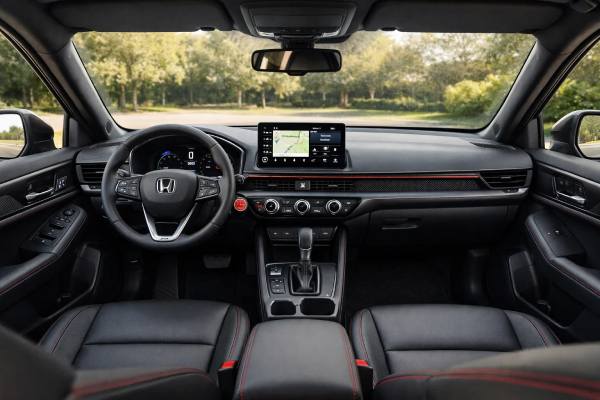

The 2023–present Honda CR-V Hybrid FWD in RS5 form is a family SUV that feels engineered around daily smoothness rather than headline speed. Its two-motor hybrid system can drive the front wheels electrically for much of normal commuting, using the 2.0-liter engine mainly as an efficient generator when extra energy is needed. That design gives the CR-V a calm, consistent response in traffic, with fewer “gearbox moments” than many conventional automatics or belt-type CVTs.
For owners, the big story is balance: practical space, predictable efficiency, and a chassis tuned for stability and low fatigue. The trade-offs are equally modern: more systems depend on software and sensor calibration, and hybrid-specific maintenance habits (brake use, cooling airflow, correct fluids) matter more than they did on older SUVs. This guide focuses on the exact FWD hybrid variant and the ownership decisions that most affect long-term satisfaction.
What to Know
- Smooth low-speed response and quiet commuting are standout strengths for this hybrid layout.
- Practical cabin and cargo packaging suit family use without needing a larger SUV.
- Efficiency stays strong in mixed driving when tyres, alignment, and brake drag are kept in check.
- Keep up with recall and software campaigns; some issues are safety-related and VIN-specific.
- Rotate tyres every 10,000 km (6,000 mi) or 12 months to protect ride quality and economy.
Contents and shortcuts
- CR-V Hybrid FWD deep dive
- RS5 LFC1 specs tables
- RS5 trims and Honda Sensing
- Issues, recalls, and fixes
- Service schedule and buying
- Real-world performance feel
- CR-V Hybrid vs rivals
CR-V Hybrid FWD deep dive
Honda’s latest CR-V Hybrid is easiest to understand as an “electric-first” hybrid. Instead of relying on a traditional multi-gear automatic, it uses a two-motor system controlled by power electronics. In typical city and suburban driving, the traction motor provides most of the propulsion, which is why the car feels immediate off the line and rarely needs high engine revs just to keep pace. The 2.0-liter engine comes in when the battery needs support, when sustained speed demands more energy, or when the system is managing temperature and emissions warm-up.
In real life, that architecture creates three practical ownership traits.
First, it’s smooth where you drive most. Stop-and-go traffic and 30–70 km/h flow are where this system shines. You often get EV-like pull away from intersections, and the car doesn’t “hunt” for gears on gentle hills. When the engine starts, it may rise to a steady rpm that sounds disconnected from road speed; that’s normal for this hybrid strategy, which aims for efficient engine operating points rather than matching rpm to wheel speed.
Second, it rewards consistent maintenance basics. Hybrids are sensitive to rolling resistance and brake drag. A small alignment issue, underinflated tyres, or a sticky caliper can cost more fuel than you’d expect, because the hybrid system is constantly optimizing around the assumption that the car rolls freely. Keep tyres matched and properly inflated, rotate on schedule, and treat unusual pulling or vibration as an early warning.
Third, software and sensor integrity matter. Modern CR-Vs rely on camera and radar inputs for safety systems and for some drivability features. After windshield replacement, front bumper repairs, or suspension work, correct calibration is not optional. A car can “drive fine” and still have degraded lane support or adaptive cruise behavior if sensors are slightly out of position.
For the FWD variant specifically, traction in snow and on wet inclines depends heavily on tyres. With good all-season or winter tyres, the traction control is capable. With worn tyres, FWD hybrids can feel more limited than buyers expect, because the system will reduce torque quickly to prevent wheelspin. If your use case includes frequent steep, slippery climbs, tyre choice becomes part of the drivetrain.
RS5 LFC1 specs tables
The tables below focus on the Honda CR-V Hybrid FWD (RS5) with LFC1 2.0-liter and 184 hp system output as specified in the prompt. Specs can vary by market, emissions certification, and equipment level, so treat this as a structured checklist: confirm any “verify” fields against your local brochure, owner’s manual, or dealer build sheet.
Powertrain and efficiency
| Item | Specification |
|---|---|
| Code | LFC1 (per variant covered) |
| Hybrid type | Full hybrid (HEV), two-motor, e-CVT-style control |
| Engine layout and cylinders | Inline-4 (I-4), DOHC (verify), 4 cylinders |
| Valvetrain | Typically 4 valves/cyl (verify for LFC1 market listing) |
| Bore × stroke | Verify (not consistently published in consumer brochures) |
| Displacement | 2.0 L (≈1993 cc, verify for LFC1) |
| Induction | Naturally aspirated |
| Fuel system | Direct injection / DI (verify by market) |
| Compression ratio | Verify (hybrid Atkinson-cycle engines often run higher ratios) |
| Max power (system) | 184 hp (≈137 kW) combined/system rating |
| Max torque (system) | Verify (often quoted as motor torque rather than combined torque) |
| Timing drive | Chain (typical for Honda K/L-series hybrids; verify for LFC1) |
| Rated efficiency | Verify by market (WLTP/EPA figures differ) |
| Real-world highway @ 120 km/h (75 mph) | Often 6.8–8.0 L/100 km (35–26 mpg US) depending on temperature, tyres, wind, and load |
| Aerodynamics | Cd and frontal area: verify (not always disclosed) |
Motor and battery (HEV)
| Item | Specification |
|---|---|
| Motor type | PMSM (common for Honda hybrids; verify) |
| Motor count and axle | Single main traction motor, front axle |
| System voltage | Verify (varies by generation and market) |
| Battery chemistry | Typically lithium-ion on newer Honda hybrids (verify by market) |
| Battery capacity | Verify (HEVs often list usable capacity inconsistently) |
Transmission and driveline
| Item | Specification |
|---|---|
| Transmission | e-CVT-style fixed-gear hybrid drive (electronic control) |
| Drive type | FWD |
| Differential | Open (typical for FWD) |
Chassis, brakes, and dimensions
| Item | Specification |
|---|---|
| Suspension (front / rear) | MacPherson strut / multi-link independent |
| Steering | Electric power steering (EPS); ratio: verify |
| Brakes | 4-wheel discs; rotor diameters: verify |
| Wheels / tyres | Common RS fitment: 19-inch wheels; tyre size verify (often 235/55 R19) |
| Ground clearance | ~198 mm (7.8 in) (verify by market) |
| Length / width / height | ~4704 / 1866 / 1681 mm (verify by market) |
| Wheelbase | ~2701 mm (verify by market) |
| Turning circle (kerb-to-kerb) | Verify (often listed as radius rather than diameter) |
| Kerb (curb) weight | Verify (equipment and safety packs change it) |
| GVWR | Verify (market dependent) |
| Fuel tank | ~57 L (15.1 US gal / 12.5 UK gal) (verify) |
| Cargo volume | Verify by method (VDA vs SAE), seats up and seats down |
Performance and capability
| Item | Specification |
|---|---|
| 0–100 km/h (0–62 mph) | Typically high-8s to ~10.0 s depending on tyres and conditions (verify by local testing) |
| Top speed | Often limited around ~180–190 km/h (112–118 mph), market dependent |
| Braking distance | Verify via instrumented tests (not usually in brochures) |
| Towing capacity | Market dependent; some regions list modest limits for hybrid |
| Payload / roof load | Verify (varies by market, wheels, and tow package rules) |
Fluids, service capacities, and key torque specs (decision-grade checklist)
For hybrids, the safest approach is to treat capacities and torque specs as VIN-specific. Use this section to know what to look for in official documents:
- Engine oil: commonly 0W-20, specification varies by region; capacity (with filter) verify.
- Coolant: Honda long-life coolant; capacity and bleed procedure verify.
- Transmission fluid: hybrid drive fluid specification and capacity verify (do not substitute “universal ATF”).
- Brake fluid: DOT rating varies by market; follow cap label and manual.
- A/C refrigerant: type and charge mass listed on under-hood label; verify before servicing.
- Critical fasteners: wheel nut torque, brake bracket bolts, and suspension fasteners must match manual; verify before DIY work.
RS5 trims and Honda Sensing
“RS5” typically describes an equipment grade rather than a fundamentally different drivetrain. For a buyer, the important thing is how RS5 packaging changes ownership costs and safety capability: wheel size affects tyre replacement expense, some trims bundle more driver assistance hardware, and comfort upgrades can make the car feel like a class above in day-to-day use.
Trims and options that change the experience
Even when the hybrid system is the same, a few trim differences matter:
- Wheels and tyres: Larger wheels can sharpen initial steering response but increase tyre cost and pothole risk. If your roads are rough, a smaller wheel option (if available in your market) can be a comfort and durability upgrade.
- Lighting: Higher trims may include better headlight performance, but ratings can differ between reflector and projector/LED configurations. If you drive unlit roads, headlight performance is not a cosmetic detail.
- Cabin noise control: Acoustic glass, extra insulation, and different tyre models can change highway noise more than the drivetrain does. If possible, test-drive on the same type of road you use daily.
- Towing and cooling assumptions: Some markets restrict towing for hybrids regardless of trim. Don’t assume “SUV equals tow-ready.” Treat towing rating as a spec you confirm before purchase, not a feature you discover later.
Safety ratings: how to interpret them
Safety ratings can be excellent but still confusing, because they depend on test year, protocol, and equipment. In broad terms:
- Euro NCAP: Recent CR-V results show strong adult and child occupant protection and solid “Safety Assist” performance when fitted with comprehensive driver assistance equipment.
- IIHS: Awards and ratings may depend on headlight configuration and the version of front crash prevention fitted.
- Regional programs: Australia, New Zealand, and other regions may publish separate tests or interpret the same vehicle differently based on local configurations.
If you care about the highest score, match the tested vehicle’s equipment to the one you’re buying: the presence of blind spot monitoring, lane centering sophistication, and headlight performance can shift results more than many people realize.
Driver assistance and calibration ownership
Honda Sensing (and, in some markets, expanded suites) typically includes:
- AEB (car, pedestrian, cyclist detection may vary)
- Adaptive cruise control
- Lane keeping and lane centering support
- Traffic sign recognition (market dependent)
- Blind spot monitoring and rear cross-traffic alert (often trim dependent)
The ownership insight is calibration sensitivity. After windshield replacement, bumper removal, suspension work, or even a minor alignment correction, the vehicle may need camera/radar aiming procedures. If a seller says “it just needs a reset,” treat that as a reason to demand documentation or a pre-purchase inspection. A properly operating system feels quiet and confident; a miscalibrated system feels naggy, inconsistent, or prone to false warnings.
Issues, recalls, and fixes
Reliability on modern hybrids is less about “will the engine survive?” and more about how the whole vehicle ecosystem behaves: electronics, sensors, software, and supplier-driven component quality. The CR-V Hybrid platform is generally mature, but it can still see recall campaigns and service actions, and those matter more than anecdotal forum complaints.
Below is a practical issue map organized by prevalence and cost tier, with symptom-based guidance. The goal is not to scare you—it’s to help you decide what deserves attention during warranty, and what’s normal wear.
Common (low to medium cost)
- Infotainment glitches or phone connectivity instability
- Symptoms: random disconnections, laggy screen, occasional freezes.
- Likely root cause: software bugs, pairing profile corruption, or device compatibility.
- Remedy: update software when available, reset pairing, and document dates and behavior for warranty tracking.
- Brake rotor surface rust and occasional low-speed grab
- Symptoms: light vibration, noise after rain, or a “first stop” bite that feels uneven.
- Root cause: regen reduces friction brake use in gentle driving.
- Remedy: periodic firm braking from safe speeds, and brake inspections if pulsation persists.
- Tyre wear sensitivity
- Symptoms: steering pull, humming noise, uneven wear on inner shoulders.
- Root cause: alignment drift, underinflation, or mismatched tyres.
- Remedy: alignment check, rotate on schedule, and keep tyres matched in size and model.
Occasional (medium cost)
- ADAS warnings after repairs or windshield work
- Symptoms: lane support unavailable messages, erratic adaptive cruise behavior, sensor faults.
- Root cause: calibration needed, wrong glass spec, or bracket misalignment.
- Remedy: proper calibration by a shop equipped for the procedure; insist on a printout or documented result.
- 12 V battery weakness in short-trip patterns
- Symptoms: strange warning lights, weak start-up sequence, intermittent electronic oddities.
- Root cause: repeated short trips and long parking intervals.
- Remedy: load-test the 12 V battery, check for parasitic draw, and consider a maintenance charger if the vehicle sits.
Rare but high consequence (recalls and service actions)
Some campaigns can involve steering feel anomalies or fuel system components depending on market and production window. The safe, ownership-focused approach is:
- Check recall status by VIN at least annually and before any long trip.
- Confirm closure with dealer documentation, not just a verbal assurance.
- Treat symptoms as urgent if they relate to steering effort, fuel smell, or warning lights that persist after restart.
Pre-purchase checks to request (hybrid-specific)
- Full service history and proof of recall completion
- Scan report for stored codes (not just “no lights on”)
- Evidence of proper calibration after any windshield or front-end repair
- A test drive that includes low-speed turns, steady highway cruise, and a few firm braking events
If the vehicle is still within warranty, use it. Modern issues are often solved with updated parts or software revisions, and early documentation helps if a problem repeats.
Service schedule and buying
A CR-V Hybrid can be a low-effort vehicle if you maintain it with a hybrid mindset: preserve efficiency by keeping rolling resistance low, prevent corrosion by using the brakes intentionally, and avoid fluid “experiments.” The schedule below is a practical template that fits typical modern Honda service patterns, but you should always align it with your market’s official maintenance minder and severe-service definitions.
Practical maintenance schedule (distance and time)
- Engine oil and filter: every 10,000–15,000 km (6,000–9,000 mi) or 12 months. Short trips, cold climate use, and frequent idling can justify the shorter interval.
- Tyre rotation: every 10,000 km (6,000 mi); check pressures monthly and before long trips.
- Cabin air filter: every 15,000–30,000 km or 12 months in dusty or polluted environments.
- Engine air filter: inspect around 30,000 km, replace as needed (more often in dust).
- Brake fluid: every 3 years is a conservative, ownership-friendly interval in most climates.
- Brake hardware inspection: at every tyre rotation; look for uneven pad wear and seized slide pins.
- Coolant: follow official interval (often long-life), but never ignore low level or repeated top-ups.
- Spark plugs: typically 100,000–160,000 km depending on engine variant and fuel quality.
- 12 V battery test: annually after year 3; replace when it fails a proper load test rather than waiting for a no-start day.
- Hybrid system check: at services, request software update checks and cooling fan/duct inspection where accessible.
Fluids and parts: what to be strict about
- Use the correct oil viscosity and specification for your market.
- Use the correct Honda coolant type, and follow the bleed procedure.
- Avoid universal transmission fluids unless the official document explicitly allows them.
- Use high-quality tyres in the correct size; hybrids amplify the difference between good and mediocre rubber.
Buyer’s guide: what to inspect
Paperwork
- Confirm recalls and service campaigns are closed for the VIN.
- Verify any windshield replacement came with calibration documentation.
- Check tyre brand and model consistency across all four corners.
Physical checks
- Look for uneven tyre wear and steering wheel off-center (alignment clues).
- Confirm brakes feel smooth under firm stops (not just gentle commuting stops).
- Test all driver assistance features in safe conditions: adaptive cruise engagement, lane support behavior, and warning consistency.
Durability outlook
Long-term durability depends less on the hybrid system itself and more on ownership discipline. Keep tyres aligned, do fluid services on time, and don’t ignore early warning messages. If you follow those basics—and keep recall status current—this CR-V Hybrid is the kind of vehicle that tends to age predictably and remain pleasant rather than becoming a “project.”
Real-world performance feel
On paper, 184 hp doesn’t sound dramatic in a midsize SUV. On the road, the CR-V Hybrid often feels stronger than expected at low speeds because electric torque arrives immediately. The vehicle’s personality is more “confident and smooth” than “fast and sporty,” and that distinction matters for real ownership satisfaction.
Ride and handling
The chassis is tuned for stability and comfort. It stays composed over broken pavement, and it tracks straight on the highway without constant small steering corrections. In corners, it’s predictable rather than eager: there’s decent grip, but the suspension prioritizes control and passenger comfort over sharp turn-in. If your RS5 trim uses larger wheels and lower-profile tyres, you may notice firmer responses on potholes and expansion joints—sometimes worth it for appearance, not always worth it for rough-road commuting.
Steering and braking feel
Electric power steering is light to moderate in effort, with a natural weighting curve for a family SUV. Brake feel is where hybrids differ: initial pedal response can feel slightly “blended,” because the car is combining regenerative braking (motor slowing) with friction braking (pads and rotors). In normal driving you quickly adapt. To keep the system healthy, do occasional firm stops to clean the rotors and confirm the friction brakes can bite evenly when needed.
Powertrain character
In city driving, the CR-V often behaves like it has a single-speed drivetrain: smooth, linear acceleration with minimal shifting sensation. Under harder acceleration or long climbs, the engine can rise to a steady rpm that sounds detached from road speed. That’s not a fault; it’s the system holding the engine in an efficient band while the electric motor provides drive.
Drive modes can noticeably change behavior:
- Eco: calmer throttle, more efficiency-minded logic.
- Normal: best all-around balance.
- Sport: sharper response; can feel more eager on short on-ramps.
Real-world efficiency expectations
Most owners see the hybrid advantage most clearly in mixed driving with frequent deceleration events. Highway consumption at 110–130 km/h (68–80 mph) is typically higher than city consumption because aerodynamic drag dominates, and the engine runs more steadily. Cold weather also reduces efficiency: warm-up, cabin heat, and higher rolling resistance all add up. If you want the best economy, keep speeds steady, use regen smoothly, and avoid unnecessary roof loads.
Light towing and load behavior
Where towing is permitted for this variant in your market, keep expectations realistic. Light trailers are usually fine, but sustained towing reduces hybrid advantage and can add thermal load. If you tow, use conservative speeds, keep tyres and brakes in top condition, and consider more frequent inspections.
CR-V Hybrid vs rivals
The CR-V Hybrid FWD competes in a segment where most options are “good,” but each is good in a different way. The right comparison is not only about fuel economy—it’s also about drivability, noise, interior usability, and how confidently the vehicle handles modern safety tech.
Toyota RAV4 Hybrid
The RAV4 Hybrid is the default cross-shop for many buyers. It often wins on perceived long-term hybrid familiarity and a proven reputation in high-mileage use. The CR-V Hybrid’s counterpoint is refinement: the electric-first feel can be smoother at low speeds, and many drivers prefer how it delivers torque in daily traffic. If your priority is relaxed, quiet commuting with a natural response, the Honda may feel more polished. If you prioritize a “known quantity” hybrid reputation and don’t mind a slightly more mechanical feel, the Toyota remains a strong benchmark.
Hyundai Tucson Hybrid and Kia Sportage Hybrid
These two often compete aggressively on features, infotainment presentation, and value. Depending on market, they can offer strong power delivery and lots of cabin tech for the money. The decision usually comes down to what you value more: a feature-rich experience or a cohesive, conservative integration. The Honda tends to feel tightly calibrated as a system—steering, braking, hybrid transitions, and driver assistance working in harmony—rather than optimized for the most dramatic spec sheet.
Nissan X-Trail e-POWER and other series-hybrid ideas
Series-hybrid-style competitors aim for EV-like behavior by using the engine primarily to generate electricity. If you love quiet low-speed torque and smooth city behavior, these can feel similar in concept. The CR-V’s advantage is a well-rounded package: space, comfort, and a mainstream service ecosystem. The best choice here often depends on local pricing, warranty coverage, and the specific safety equipment included.
Why the CR-V Hybrid FWD makes sense
Choose this CR-V if you want:
- A calm, consistent drive feel in daily traffic
- Good interior and cargo packaging without moving up to a larger SUV
- A modern safety and driver-assistance experience (as long as it’s properly calibrated and maintained)
Consider alternatives if you need:
- Higher towing limits
- AWD traction for frequent severe winter climbs
- The lowest possible highway fuel consumption at high cruising speeds
In short, the CR-V Hybrid FWD is a “useful excellence” vehicle: it’s designed to be easy to live with and quietly competent. If you buy the right trim, confirm recall status, and maintain it like a hybrid, it tends to deliver exactly what its design promises.
References
- Honda CR-V 2024 (Safety Rating)
- Top Safety Picks 2024 (Safety Rating)
- Check for Recalls 2026 (Recall Database)
- FuelEconomy.gov 2026 (Efficiency Database)
Disclaimer
This article is for informational purposes only and is not a substitute for professional inspection, diagnosis, or repair. Specifications, torque values, service intervals, and procedures vary by VIN, market, model year, and equipment. Always verify details using the official owner’s manual and service documentation for your exact vehicle, and follow high-voltage safety procedures when working on hybrid components.
If you found this guide useful, please consider sharing it on Facebook, X (Twitter), or your preferred community channel to support our work.