

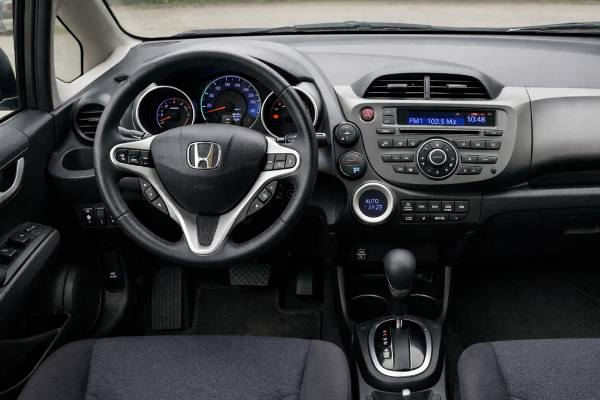

The facelift Honda Jazz Hybrid (GP1) is one of those cars that looks simple but hides a lot of smart engineering. It uses Honda’s Integrated Motor Assist (IMA) layout: a compact electric motor sandwiched between the 1.3 i-VTEC engine and a CVT, helping the petrol engine in the low-to-mid range and recapturing energy on the way back down. The big ownership payoff is smooth, predictable efficiency in town without changing how you refuel or service it—this is a conventional petrol car with hybrid assistance, not a plug-in.
For buyers today, the Jazz Hybrid’s value is less about headline speed and more about packaging: the “Magic Seats,” a tall cabin, and low running costs. The key is choosing a well-maintained example with a healthy hybrid battery and clean service history.
Essential Insights
- Strong city efficiency and easy drivability, especially in stop-start traffic.
- Practical cabin design with versatile rear seating and good visibility for its size.
- Hybrid assist adds low-speed torque feel without needing external charging.
- Battery health matters with age; budget for diagnostics if warning lights appear.
- Plan engine oil service about every 12 months or 10,000–12,000 km (whichever comes first).
Section overview
- GP1 Hybrid system explained
- LDA-MF6 hybrid specs tables
- Facelift equipment and safety
- Hybrid reliability and known faults
- Service plan and buyer checks
- Real-world driving and economy
- Rivals and value comparison
GP1 Hybrid system explained
Honda built the GP1 Jazz Hybrid around a straightforward goal: improve real-world fuel use—especially in city driving—without taking away what makes a Jazz useful. The result is a parallel hybrid with a small electric motor packaged in-line with the drivetrain. In plain terms, the petrol engine still does most of the work, but the motor fills in during pull-away and gentle acceleration, then turns into a generator during deceleration.
How IMA behaves day to day
In normal driving, you’ll notice three main phases:
- Assist: the electric motor adds torque when you tip into the throttle, reducing how hard the petrol engine needs to work. This is most noticeable at urban speeds.
- Regeneration: lifting off or braking turns the motor into a generator to recharge the hybrid battery.
- Idle stop: at a standstill, the engine can shut off to save fuel and restart quickly when you release the brake or request drive.
This matters because it changes “how the car feels efficient.” You don’t need to chase high revs to make progress; the system rewards steady inputs and momentum. The facelift cars also made efficiency-driving easier with ECON mode and Honda’s feedback-style displays in many markets, encouraging smoother pedal use.
Why the Jazz Hybrid is still a Jazz
A common fear with older hybrids is lost practicality. The GP1 avoids most of that: it keeps the tall roofline, wide-opening doors, and the seating flexibility that made the Jazz popular. The hybrid components add complexity, but not a fundamentally different user experience—there’s no external charging routine, and routine maintenance remains familiar.
What owners should watch
Because this is an early-2010s hybrid, age and usage patterns matter. A Jazz Hybrid that lived an easy commuter life with regular servicing can be a better bet than one that sat unused or did endless short trips without proper warm-up. Short trips are not “bad,” but they increase the importance of:
- Clean engine oil at the correct interval
- A healthy 12 V battery (weak 12 V batteries can cause strange hybrid warnings)
- Cooling airflow for battery and electronics (blocked vents and dusty fans raise temperatures)
If you treat the hybrid system as something to verify—rather than something to fear—the GP1 can be a very sensible ownership proposition.
LDA-MF6 hybrid specs tables
Below are practical, owner-relevant specifications for the facelift Honda Jazz Hybrid (GP1) with the LDA-MF6 1.3 i-VTEC IMA powertrain. Figures can vary slightly by market, wheel size, and test standard, so treat them as a strong baseline and verify against the VIN-specific documentation where possible.
Powertrain and efficiency
| Item | Specification |
|---|---|
| Code | LDA-MF6 (IMA petrol-electric hybrid) |
| Engine layout | Inline-4, i-VTEC, naturally aspirated |
| Displacement | 1.3 L (1,339 cc) |
| Fuel system | Port fuel injection (typical for this generation) |
| Max engine power | 88 hp (65 kW) @ rpm (market dependent) |
| Max engine torque | 121 Nm (89 lb-ft) |
| Electric motor assist | +14 hp (10 kW) and 78 Nm (58 lb-ft) (assist output) |
| Hybrid type | Parallel hybrid (motor between engine and transmission) |
| Timing drive | Chain (typical for Honda L-series) |
| Rated efficiency | Commonly ~4.5–4.7 L/100 km (50–52 mpg US / 60–63 mpg UK), depending on test cycle and wheels |
| Real-world highway @ 120 km/h | Often ~5.5–6.5 L/100 km (36–43 mpg US / 43–51 mpg UK), depending on wind, tyres, and load |
Transmission and driveline
| Item | Specification |
|---|---|
| Transmission | CVT (hybrid-tuned) |
| Drive type | FWD |
| Differential | Open |
Chassis and dimensions
| Item | Specification |
|---|---|
| Suspension (front/rear) | MacPherson strut / torsion beam |
| Steering | Electric power steering |
| Brakes | Front discs / rear drums (many markets) |
| Wheels/tyres | Commonly 15–16 in packages (varies by trim) |
| Length | ~3,900 mm (153.5 in) |
| Width | ~1,695 mm (66.7 in) |
| Height | ~1,525 mm (60.0 in) |
| Wheelbase | ~2,500 mm (98.4 in) |
| Turning circle (kerb-to-kerb) | ~10.4 m (34.1 ft) |
| Kerb weight | typically ~1,130–1,180 kg (2,490–2,600 lb) depending on equipment |
| Fuel tank | ~40 L (10.6 US gal / 8.8 UK gal) |
Cargo and practicality
| Item | Specification |
|---|---|
| Cargo volume (seats up) | market dependent; typically strong for class due to tall roof |
| Cargo volume (seats down) | up to ~883 L (about 31.2 ft³) in some published figures, depending on measurement method |
Performance and capability
| Item | Specification |
|---|---|
| 0–100 km/h (0–62 mph) | ~12–13 s (typical) |
| Top speed | ~170–180 km/h (106–112 mph) |
| Towing capacity | Often not rated or very limited; verify locally |
| Roof load | commonly 50–75 kg (110–165 lb) depending on roof system |
Fluids, service capacities, and key torques
These are decision-making figures to help you plan servicing; always verify the exact specification printed in the service literature for your market.
| Item | Typical specification |
|---|---|
| Engine oil | 0W-20 or 5W-30 (market dependent); capacity often ~3.6 L (3.8 US qt) with filter |
| Coolant | Honda long-life coolant; capacity varies with radiator spec |
| CVT fluid | Honda CVT fluid (model-specific type); service quantity varies |
| Brake fluid | DOT 3 or DOT 4 (market dependent) |
| A/C refrigerant | R134a (typical for the era), charge varies by system |
| Critical torque (typical) | Value |
|---|---|
| Wheel lug nuts | ~108 Nm (80 lb-ft) |
| Engine oil drain plug | ~39 Nm (29 lb-ft) |
| Spark plugs | ~18 Nm (13 lb-ft) |
Safety and driver assistance
| Item | Specification |
|---|---|
| Crash ratings | Commonly referenced Euro NCAP 5-star rating for the Jazz of this generation (test version matters) |
| Core safety systems | ABS, stability control (fitment varies by year/market), front and side airbags (typical) |
| ADAS | Limited by era; generally no AEB/ACC/lane centering on GP1 |
Facelift equipment and safety
The 2011 facelift period is where the Jazz range, including the Hybrid, tends to feel “more modern” in daily use. Honda focused on small but meaningful changes: improved ride comfort, a more settled on-centre steering feel, revised bumpers for lower aerodynamic drag, and trim-level tweaks that made the car easier to live with.
Trims and equipment patterns
Exact trim names vary by country, but the Jazz Hybrid was usually positioned as a well-equipped model rather than a bare-bones economy special. Common themes include:
- Convenience: automatic climate control or upgraded air conditioning, steering-wheel controls, and better audio integration on higher trims.
- Hybrid identifiers: subtle “Hybrid” badging and unique trim details (often grille and lamp accents).
- Practicality retained: rear-seat flexibility remained a selling point, and the facelift period often emphasized comfort improvements (seat updates, minor interior revisions).
If you are shopping used, focus less on the badge and more on what is actually on the car. Wheel size, infotainment generation, and parking aids can differ significantly between markets.
Quick identifiers when viewing a car
A few practical tells help you confirm you’re looking at the right variant:
- Instrument cluster: hybrid displays and charge/assist indicators are a strong clue.
- Under-floor or rear-area packaging: the boot floor shape can differ slightly versus petrol models.
- VIN and build plate: always confirm model code and powertrain family through documentation, not cosmetics.
Safety ratings and what they mean here
This generation of Jazz is widely associated with a strong crash-test performance for its time, but it is important to understand that safety ratings depend on test year and protocol. A five-star score from an older protocol is not “the same” as a modern five-star score with AEB and lane support included. For the GP1 Jazz Hybrid buyer, the practical takeaway is:
- Structure and restraint design are generally solid for the class and era.
- The biggest safety differences between examples tend to come from equipment fitment (stability control, tyre choice, and condition of brakes and suspension), not from the hybrid system itself.
Driver assistance and calibration reality
Unlike newer cars, the Jazz Hybrid does not rely on cameras and radar for core functions. That simplifies ownership: there is typically no windshield camera calibration or radar alignment after routine repairs. Your “driver assistance” focus is old-school but still important:
- Keep tyres matched and correctly inflated.
- Maintain brake hardware and brake fluid.
- Address suspension wear early so stability control (if fitted) can do its job effectively.
Hybrid reliability and known faults
A well-kept GP1 Jazz Hybrid can be dependable, but it’s not a car to buy blindly. The hybrid system adds a few high-value components, and age-related issues tend to show up in predictable places. The good news is that many problems give early symptoms.
Most common issues
- IMA warning light or hybrid system warnings (common with age; cost tier: medium to high)
- Symptoms: IMA light, reduced assist, more frequent engine running, occasional limp-home behavior.
- Likely causes: aging battery pack, weak 12 V battery, poor battery cooling airflow, or sensor/connection faults.
- Remedy: scan with a Honda-capable tool, check 12 V battery health, inspect cooling paths, and confirm battery condition through diagnostic data—not guesswork.
- 12 V battery sensitivity (common; cost tier: low to medium)
- Symptoms: intermittent warning lights, odd dash behavior, start/stop not working as expected.
- Likely causes: weak auxiliary battery or charging management issues.
- Remedy: test battery properly (load test), replace with the correct type and capacity, then clear and re-check for codes.
- CVT behavior: judder or flare (occasional; cost tier: medium)
- Symptoms: shudder on gentle pull-away, inconsistent rev behavior, hesitation.
- Likely causes: old or incorrect CVT fluid, lack of adaptation, or wear.
- Remedy: correct fluid service (often multiple drain-and-fill cycles, depending on condition), then re-evaluate.
Occasional and “check before you buy” items
- Battery cooling fan noise or blockage (occasional; cost tier: low to medium)
Dust and debris can reduce airflow, raising battery temperature and accelerating wear. - A/C performance drop (occasional; cost tier: low to medium)
Often a normal age issue (leaks, condenser wear). Make sure any hybrid-specific A/C requirements are respected by the shop. - Front suspension wear (occasional; cost tier: low to medium)
Bushings and drop links are consumables on urban cars and affect ride quality more than you might expect.
Recalls, service actions, and how to verify
For this era of Honda, the standout recall topic globally has been airbag inflator campaigns on many models. Do not rely on “the previous owner said it was done.” Verification is simple:
- Run the VIN through Honda’s official recall portal (region-specific).
- Ask a dealer to confirm completion status in service records.
Pre-purchase checks worth paying for
- Full diagnostic scan with hybrid-capable equipment (printout preferred).
- Test drive from cold: check CVT smoothness, idle-stop function, and warning lights.
- Confirm tyre brand and wear pattern (mismatched tyres can mask suspension and braking issues).
- Inspect for water ingress and damp smell—electronics dislike moisture, hybrid or not.
Service plan and buyer checks
The Jazz Hybrid’s best ownership results come from boring consistency: correct fluids, sensible intervals, and early attention to warning signs. Use the schedule below as a practical baseline, then align it with your market’s official documentation.
Maintenance schedule you can actually follow
- Engine oil and filter: every 10,000–12,000 km (6,000–7,500 mi) or 12 months
If the car does mostly short trips, consider the shorter end of that range. - Cabin air filter: every 15,000–30,000 km or 12–24 months
Replace sooner if you drive in dusty areas or notice reduced HVAC airflow. - Engine air filter: every 30,000–45,000 km (inspect more often)
- Brake fluid: every 3 years (time matters more than mileage)
- Coolant: often 5 years initially, then every 3–5 years (confirm exact spec)
- Spark plugs: commonly 90,000–120,000 km (verify plug type and interval)
- CVT fluid: every 40,000–60,000 km depending on usage
City driving and heat push you toward the shorter interval. Use the correct Honda fluid. - Tyre rotation and alignment check: rotate every 10,000–12,000 km, align as needed
The Jazz is sensitive to alignment and tyre quality; it’s an easy way to protect steering feel. - Hybrid system checks: at least annually during routine service
Confirm there are no stored codes, ensure battery cooling airflow is unobstructed, and test the 12 V battery.
Fluids and parts: what “correct” looks like
- Oil viscosity: use the viscosity recommended for your climate and market labeling. Many cars of this era run best on 0W-20 or 5W-30 depending on region.
- CVT fluid: do not substitute “universal” ATF. CVTs are fussy, and the wrong fluid can create judder that feels like a mechanical failure.
- Brake pads and discs: quality matters more than “sporty” marketing. A consistent pedal is the goal.
Buyer’s checklist for a used GP1
- Hybrid warnings: no dash lights, and no “history” of cleared codes without explanation.
- Idle stop behavior: should work when conditions are met (warm engine, healthy battery, correct settings).
- CVT feel: smooth pull-away, no persistent shudder, and stable cruising rpm.
- Cooling system health: stable temperature, clean coolant, no sweet smell in the cabin.
- Corrosion hotspots: rear arches, underbody seams, and brake lines (market and climate dependent).
- Service proof: receipts beat stamps. Look for oil services and CVT fluid changes in writing.
Long-term durability outlook
If you buy one with verified recall status, consistent servicing, and a clean diagnostic report, the GP1 Jazz Hybrid can be a low-drama daily driver. The biggest financial swing factor is hybrid battery condition, so it’s worth prioritizing diagnostics over cosmetic perfection.
Real-world driving and economy
The GP1 Jazz Hybrid is not a “fast hybrid.” It’s a calm, efficient tool that feels most at home doing exactly what many people use a Jazz for: commuting, errands, and mixed city-suburban driving.
Ride, handling, and NVH
- Ride: the facelift tuning tends to feel composed over rough city surfaces, but the car is still light and tall, so sharp potholes are noticeable—especially on larger wheels.
- Handling balance: predictable and safe rather than playful. You can place it easily in traffic and tight streets.
- Steering: light at low speeds with a stable on-centre feel when aligned properly. If the wheel feels nervous on the motorway, suspect tyres, alignment, or worn front bushings.
- Cabin noise: you’ll hear tyre roar more than wind noise. Under hard acceleration, the CVT can raise rpm and hold it, which some drivers interpret as “loud,” even though it’s normal behavior.
Powertrain character and CVT logic
The engine and motor pairing is tuned for smoothness:
- Step-off feel: the motor assist helps the car feel less strained than a small petrol engine alone.
- Acceleration: best described as steady. It keeps up with traffic comfortably, but it’s not built for aggressive passing.
- CVT behavior: at moderate throttle, it keeps revs sensible. At heavy throttle, it may “hold” rpm higher while road speed catches up—normal for a CVT.
ECON mode (where fitted) typically softens throttle response and encourages longer engine-off time at stops. It’s useful in town but can feel dull if you’re trying to merge quickly.
Real-world efficiency expectations
Your results depend heavily on speed and temperature:
- City: often 4.5–5.5 L/100 km (43–52 mpg US / 51–63 mpg UK) if the hybrid system is healthy and you drive smoothly.
- Highway (100–120 km/h): commonly 5.5–6.5 L/100 km (36–43 mpg US / 43–51 mpg UK).
- Cold weather: expect a noticeable drop as the engine runs more to provide heat and keep systems in range.
If your consumption suddenly worsens, don’t assume “the hybrid battery is dead.” Start with tyre pressures, brake drag, 12 V battery health, and fault-code checks.
Performance metrics that matter
- 0–100 km/h: the typical ~12–13 second range is adequate, but the more important metric is how it responds at 30–70 km/h. In town, the assist makes it feel more willing than the numbers suggest.
- Braking feel: should be consistent and easy to modulate. Any vibration, pull, or long pedal travel is a maintenance issue to solve promptly.
Rivals and value comparison
To judge the GP1 Jazz Hybrid fairly, compare it to other small cars that tried to cut fuel bills in the early 2010s. Some did it with hybrids, others with small diesels, and some with clever gearing and aerodynamics.
Against Toyota Yaris Hybrid
- Strengths of the Yaris Hybrid: often stronger hybrid-only operation feel and very good city economy.
- Strengths of the Jazz Hybrid: cabin packaging and seating flexibility, plus the “Honda control feel” many owners like.
- What decides it: if you value interior versatility and visibility, the Jazz can win; if you want the most hybrid-centric drivetrain behavior, the Yaris often feels more “hybrid-forward.”
Against diesel superminis (Polo BlueMotion, Fiesta Econetic, similar)
- Diesel advantage (then): strong highway efficiency and torque for passing.
- Jazz Hybrid advantage (now): fewer emissions-system headaches compared with aging small diesels (DPF/EGR issues are common pain points in this era).
- What decides it: if you mainly drive short trips, the Jazz Hybrid is often the safer long-term bet than an older diesel.
Against non-hybrid petrol rivals
Compared with conventional 1.2–1.4 petrol superminis, the Jazz Hybrid tends to offer:
- Better urban consumption and smoother stop-start behavior
- More consistent “easy driving” feel in traffic
- Similar maintenance needs for the petrol side, plus the hybrid system to verify
Who the GP1 Jazz Hybrid fits best
- Urban and suburban drivers who value efficiency and a tall, practical cabin
- Owners who keep up with maintenance and want predictable running costs
- Buyers willing to pay for a pre-purchase diagnostic scan to avoid surprises
When to choose something else
- If you need strong motorway passing performance or regular towing
- If you cannot verify hybrid system health and recall status
- If the car shows warning lights, CVT shudder, and poor service history at the same time—walk away and keep looking
References
- Honda Jazz Press Kit 2011 (Press Kit)
- Honda Owners | Recalls and Updates | Honda UK 2026 (Recall Database)
- Honda_Jazz – Euro NCAP Results 2009 2009 (Safety Rating)
- Honda Jazz Achieves Top Euro NCAP Overall Safety Rating 2009 (News Release)
- Check if a vehicle, part or accessory has been recalled 2026 (Recall Database)
Disclaimer
This article is for informational purposes only and is not a substitute for professional diagnosis, inspection, or repair. Specifications, torque values, service intervals, and procedures vary by VIN, market, model year, and installed equipment. Always verify details against official Honda service documentation and follow the correct safety procedures when working on any vehicle, especially hybrid systems.
If you found this guide useful, please consider sharing it on Facebook, X (Twitter), or your favorite forum to support our work.