

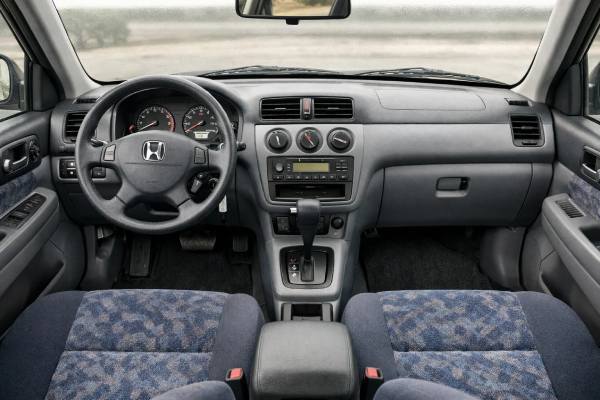
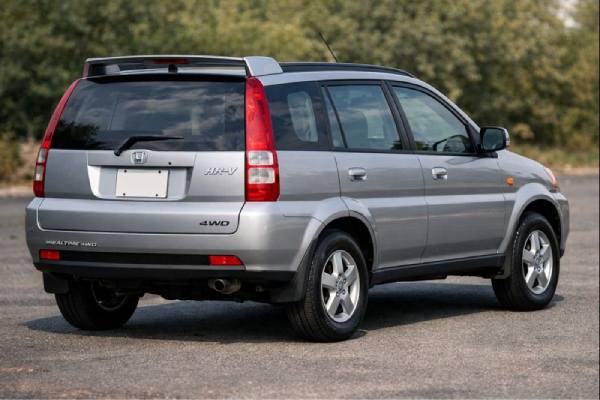
The 1999–2001 Honda HR-V GH2 with Real Time 4WD and the D16W5 1.6 VTEC engine is a small SUV that behaves more like a tall hatchback—until the road turns slick. Its dual-pump, on-demand rear drive gives you extra traction without the constant drag of full-time AWD, and the VTEC 124 hp tune adds the top-end pull the early 105 hp cars can’t match. The appeal today is simple: compact exterior size, practical seating and cargo flexibility, and a drivetrain that’s durable when serviced correctly. The trade-off is age. Most issues now are not “design failures” as much as deferred maintenance—fluids, rubber parts, and corrosion control. If you buy one with records and you keep its 4WD and cooling system happy, this HR-V can still be an easy, trustworthy daily.
At a Glance
- Confident all-weather traction from Real Time 4WD without full-time AWD fuel penalty.
- Stronger mid-to-high rpm response from the 1.6 VTEC D16W5 compared with the 105 hp version.
- Compact footprint makes it city-friendly while staying useful for light outdoor gear.
- Rear differential behavior depends heavily on correct Dual Pump Fluid servicing—ignore it and noise/shudder follows.
- Plan a baseline fluid reset within 1,000 km (620 mi) after purchase if service history is unclear.
Quick navigation
- HR-V GH2 VTEC 4WD explained
- D16W5 specs and dimensions
- Trims, options, and safety gear
- Reliability weak spots and fixes
- Long-term care and buying strategy
- Snow traction and daily manners
- Competitor check: small 4x4s
HR-V GH2 VTEC 4WD explained
Honda built the first HR-V around a “small outside, roomy inside” idea that now feels normal—but in 1999 it was forward-thinking. The GH2 Real Time 4WD version matters because it’s not a truck-based 4×4. It’s a unibody, independent-suspension, compact SUV aimed at mixed use: commuting, winter roads, and light gravel—without the weight, noise, and running costs of a traditional off-roader.
The Real Time 4WD system is the key engineering story. In normal driving the car behaves like a front-wheel-drive HR-V. When the front wheels begin to spin faster than the rear (a traction loss signal), two hydraulic pumps in the rear differential create pressure and progressively couple drive to the rear. You don’t press a button, and there’s no driver-selectable mode. It’s reactive, automatic, and designed to be transparent. That makes it excellent for rain, slush, and changing grip on mixed surfaces, but it also means tire matching and fluid quality matter more than owners expect.
The D16W5 1.6 VTEC engine is the second half of the formula. Compared with the 105 hp 1.6, the VTEC tune gives the HR-V noticeably better passing power and keeps it from feeling strained at motorway speeds. It still isn’t fast by modern standards, but it’s more relaxed when loaded with passengers or climbing long grades. Importantly, it remains a simple, naturally aspirated Honda four-cylinder: no turbo heat load, no direct-injection carbon buildup, and generally forgiving of regular use—assuming the cooling system and timing belt service are kept up.
Ownership reality in 2026 is mostly about condition. These cars are old enough that “nice” examples tend to be owned by people who already know what they are. The best HR-Vs are the ones with boring paperwork: regular oil changes, cooling system attention, correct 4WD fluid, and evidence that the timing belt interval wasn’t ignored. The worst ones usually have mismatched tires, unknown 4WD fluid, and a history of short trips that accelerate rust and sensor issues. If you’re choosing between two cars, pick the cleaner underside and the more complete service story—even if the paint is less shiny.
D16W5 specs and dimensions
Below are practical, model-specific specs for the 1999–2001 HR-V with Real Time 4WD and the 1.6 VTEC D16W5 output class (commonly listed around 124 hp). Some figures vary by market, body style (3-door vs 5-door), and transmission (5MT vs CVT), so treat them as a “quick engineering sheet,” then confirm by VIN when ordering parts.
Powertrain and efficiency
| Item | Specification |
|---|---|
| Code | D16W5 |
| Engine layout and cylinders | Inline-4, SOHC VTEC, 4 cylinders |
| Valves | 4 valves/cyl (typical for this VTEC family; verify by market) |
| Bore × stroke | 75.0 × 90.0 mm (2.95 × 3.54 in) |
| Displacement | 1.6 L (1,590 cc) |
| Induction | Naturally aspirated |
| Fuel system | PGM-FI electronic fuel injection |
| Fuel | Unleaded 95 RON |
| Max power | 124 hp (92 kW) @ ~6,700 rpm |
| Max torque | 144 Nm (106 lb-ft) @ 4,900 rpm |
| Timing drive | Belt |
| Rated efficiency (EU cycle, typical) | Combined ~8.6 L/100 km (32.8 mpg US / 38.1 mpg UK) |
| Real-world highway @ 120 km/h | ~9.0–10.0 L/100 km (26–23 mpg US) depending on tires, load, and wind |
| Aerodynamics | Cd / frontal area not consistently published for this generation |
Transmission and driveline
| Item | Specification |
|---|---|
| Transmission | 5-speed manual (common) or CVT (market-dependent) |
| Drive type | Real Time 4WD (on-demand AWD) |
| Differential | Open front; rear coupling via dual-pump hydraulic unit |
Chassis and dimensions
| Item | 3-door | 5-door |
|---|---|---|
| Length | 4,010 mm (157.9 in) | 4,110 mm (161.8 in) |
| Width | 1,695 mm (66.7 in) | 1,695 mm (66.7 in) |
| Height | 1,675 mm (65.9 in) | 1,675 mm (65.9 in) |
| Wheelbase | 2,350 mm (92.5 in) | 2,450 mm (96.5 in) |
| Ground clearance | ~175 mm (6.9 in) | ~175 mm (6.9 in) |
| Turning circle (kerb-to-kerb) | ~10.2–10.6 m (33.5–34.8 ft), market-dependent | ~10.6–11.0 m (34.8–36.1 ft), market-dependent |
| Kerb weight (typical range) | ~1,180–1,250 kg (2,601–2,756 lb) | ~1,244–1,269 kg (2,743–2,798 lb) |
| GVWR (max permissible) | ~1,580–1,640 kg (3,483–3,615 lb) | ~1,640 kg (3,615 lb) |
| Fuel tank | 55 L (14.5 US gal / 12.1 UK gal) | 55 L (14.5 US gal / 12.1 UK gal) |
| Cargo volume (VDA) | 285 L (10.1 ft³) seats up | 285 L (10.1 ft³) seats up |
Suspension layout is typically MacPherson strut front with a five-link rear arrangement, which is a big reason the HR-V feels composed on uneven roads compared with simpler torsion-beam rivals. Tire sizing varies by trim (many are 195/70 R15).
Performance and capability
| Metric | Typical figure (1.6 VTEC 4WD) |
|---|---|
| 0–100 km/h (0–62 mph) | ~10.7–11.2 s (body style dependent) |
| Top speed | ~170 km/h (106 mph) |
| Towing capacity | Often not rated or very limited in many markets; confirm locally |
| Roof load | Typically ~50–75 kg (110–165 lb) depending on rails and market |
Fluids, service capacities, and key torques
Because official service publications vary by market and year, use these as decision-grade “ballparks,” not final workshop numbers.
| Item | Typical spec |
|---|---|
| Engine oil | 5W-30 or 10W-40 depending on climate; ACEA/API per handbook |
| Engine oil capacity | ~3.3–3.6 L (3.5–3.8 US qt) with filter (verify by engine variant) |
| Coolant | Honda-type long-life coolant; 50/50 mix |
| Coolant capacity | ~4.5–5.5 L (4.8–5.8 US qt) depending on heater and radiator |
| CVT fluid | Honda CVT fluid (model-year specific); do not substitute ATF |
| Rear diff (Dual Pump) | Honda Dual Pump Fluid (DPSF) |
| A/C refrigerant | R-134a (typical for the era; check under-hood label) |
Critical fasteners (common Honda practice):
- Wheel nuts: ~108 Nm (80 lb-ft)
- Spark plugs: ~18 Nm (13 lb-ft)
- Oil drain plug: ~39 Nm (29 lb-ft)
Safety and driver assistance
This generation predates modern ADAS. You’re looking at “core safety hardware” rather than automated braking or lane support:
- Front airbags were widely offered and often standard, with seatbelt pretensioners and load limiters in many markets.
- ABS was available, and many cars also list EBD (electronic brakeforce distribution).
- ISOFIX/LATCH availability varies by market and trim; verify in the owner’s handbook for your car.
Trims, options, and safety gear
For 1999–2001 HR-Vs, “trim” often means a mix of body style (3-door vs 5-door), transmission choice (manual or CVT), and equipment packs. The important point for buyers is that mechanical feel can change more with wheels/tires and transmission than with badge names.
Trims and options that matter
3-door vs 5-door: The 5-door is the practical pick. It adds rear-door access and a longer wheelbase, which usually improves ride composure over sharp bumps. If you carry adults in the back more than occasionally, the 5-door is the smarter daily. The 3-door can feel a touch lighter and more “playful,” but it’s the one you buy for style and short-trip use.
Manual vs CVT:
- The 5-speed manual is the durability favorite. It’s straightforward, tends to age well, and makes the most of the VTEC engine’s higher-rpm strengths.
- The CVT can be smooth in gentle driving, but it is more sensitive to fluid quality and can develop judder or “flare” behavior if neglected. If you shop a CVT car, service history is not optional—it’s the whole story.
Wheel and tire packages: Many HR-Vs sit on 15-inch wheels with 195/70 R15 tires, but some markets offered different styling wheels. Larger wheels can sharpen steering response but can also increase road noise and reduce ride comfort. On a Real Time 4WD HR-V, tire matching is not just a handling preference—it is a driveline health strategy. Keep all four tires the same brand/model and similar tread depth.
Convenience and functional equipment: Options to watch for include ABS, air conditioning, heated mirrors, roof rails, and factory fog lights. Interiors vary from basic cloth to sportier seat fabrics on higher-grade models. If you see a factory rear spare mount or unique interior trims, treat them as “collectible details,” not mechanical upgrades.
How to identify what you’re buying
Quick identifiers that help in a parking-lot inspection:
- Body style: 3-door has a longer single door and shorter rear side glass; 5-door is obvious by rear door handles and longer wheelbase stance.
- Transmission: CVT cars often show a PRND-style selector; manuals have a conventional H-pattern and clutch pedal.
- 4WD confirmation: Badging varies, so also check for a rear differential and driveshaft underneath.
- VTEC engine clue: Many VTEC cars show it on engine cover or paperwork; if in doubt, verify via engine code stamping and registration documents.
Safety ratings and what to do with “no data”
Buyers often ask for Euro NCAP or IIHS ratings, but many late-1990s niche crossovers were not tested under the programs consumers recognize today. When an official rating isn’t available, focus on tangible safety hardware and condition:
- Airbag light behavior (it should illuminate at key-on and go out).
- ABS light behavior and a controlled test stop on a safe surface.
- Seatbelt retraction strength and pretensioner-related repairs after prior accidents.
- Tire condition and brake balance (old tires and uneven brakes can erase any “paper safety” advantage).
Driver assistance (ADAS) reality
There is no AEB, no ACC, no lane-keeping. Your “assistance” is good visibility, predictable controls, and the stability you get from a well-sorted suspension and matched tires. The Real Time 4WD system helps you get moving on low grip, but it does not shorten braking distances—winter tires do.
Reliability weak spots and fixes
At this age, the HR-V’s reliability story is best told as a map: what fails often, what fails rarely but expensively, and what fails only because maintenance was skipped. The D16W5 engine itself is usually not the problem; the supporting systems are.
Common and low-cost issues
- Oil leaks (common, low/medium):
Symptoms: oil smell, damp cam cover area, drops on driveway.
Likely cause: valve cover gasket, cam seals, aging PCV hoses.
Remedy: reseal with quality gaskets, confirm PCV function, clean and recheck after 500–1,000 km. - Idle instability (common, low/medium):
Symptoms: hunting idle, stalling when coming to a stop, rough cold start.
Likely cause: dirty idle air control valve (IACV), intake leaks, carbon in throttle body.
Remedy: clean throttle body/IACV, replace brittle vacuum hoses, reset base idle per service method. - Ignition aging (common, medium):
Symptoms: misfire under load, hesitation near VTEC transition, poor wet-weather behavior.
Likely cause: distributor wear, ignition coil/igniter issues (market-dependent), tired plug leads.
Remedy: renew plugs, leads, cap/rotor where applicable; avoid cheap ignition parts.
Occasional but important issues
- Cooling system weak points (occasional, medium/high):
Symptoms: temperature creep in traffic, coolant loss, heater performance changes.
Likely cause: radiator end-tank aging, thermostat sticking, neglected coolant.
Remedy: pressure test, replace suspect components proactively, use correct coolant and bleed air properly. - CVT judder or surge (occasional, medium/high):
Symptoms: shudder on take-off, RPM rises without matching speed, inconsistent feel.
Likely cause: old fluid, start clutch wear (where fitted), calibration/learning issues.
Remedy: correct fluid service first (sometimes multiple drains), then diagnose mechanically. If history is unknown, budget for more than a simple drain-and-fill.
Real Time 4WD-specific risks
This is where ownership habits matter most.
- Rear diff noise, binding, or “crow hop” on tight turns (common if neglected, medium):
Symptoms: groan or chatter on parking-lot turns, shudder after long highway runs, inconsistent rear engagement.
Likely cause: degraded Dual Pump Fluid, mismatched tires, contamination from past incorrect fluid.
Remedy: service with the correct Honda Dual Pump Fluid (often repeated changes), ensure all four tires match closely, and avoid mixing different tread depths. - Driveline vibration (occasional, medium):
Symptoms: vibration at certain speeds, clunk on throttle transitions.
Likely cause: worn propshaft joints, mounts, or uneven tires.
Remedy: inspect mounts and driveline joints, correct tire balance, then reassess.
Recalls, service actions, and how to verify
Recalls vary by market. A practical approach:
- Run a VIN/frame-number check through the official Honda recall tools available in your region.
- Ask for dealer printouts or receipts showing recall completion.
- Inspect for recall stickers/labels where applicable.
One example recall published for HR-V in Japan involved rear door hardware service procedures; it’s a reminder that even “minor” recalls matter because they address safety-related behavior (doors opening unexpectedly). If the seller can’t show recall history, treat it as a negotiation point—not a deal-breaker—because you can still verify and complete it.
Long-term care and buying strategy
Think of HR-V maintenance in two layers: the engine basics (oil, belt, cooling) and the 4WD/CVT specifics (correct fluids, correct tires). If you keep both layers consistent, the car usually rewards you with low drama.
Practical maintenance schedule
Use this as a conservative plan for a 20+ year old HR-V:
- Engine oil and filter: every 7,500–10,000 km (4,700–6,200 mi) or 12 months. If you do mostly short trips, use the shorter interval.
- Air filter (engine): inspect every 15,000 km (9,300 mi), replace ~30,000 km (18,600 mi) depending on dust.
- Cabin filter: if equipped, replace every 15,000–30,000 km (9,300–18,600 mi).
- Coolant: every 3–5 years regardless of mileage, unless the owner’s handbook specifies otherwise for your market coolant type.
- Brake fluid: every 2 years (moisture age matters more than miles).
- Spark plugs: every 60,000–100,000 km (37,000–62,000 mi) depending on plug type and ignition health.
- Timing belt and water pump: every 100,000 km (62,000 mi) or 7 years is a sensible rule if documentation is missing. Include tensioner and inspect cam/crank seals while open.
- Manual gearbox oil: every 60,000–100,000 km (37,000–62,000 mi).
- CVT fluid (if fitted): every 40,000–60,000 km (25,000–37,000 mi); do not stretch intervals on an aging CVT.
- Rear diff (Dual Pump Fluid): every 40,000–60,000 km (25,000–37,000 mi), sooner if you do lots of tight maneuvering, snow work, or mismatched tire history.
- Tire rotation and alignment: rotate every 10,000 km (6,200 mi); align annually or after suspension work.
- 12 V battery test: yearly; replacement commonly every 4–6 years depending on climate.
Fluid choices and “do not improvise” notes
Two fluid rules protect the expensive parts:
- Use the correct Honda-specified Dual Pump Fluid in the rear differential unit.
- Use the correct Honda-specified CVT fluid if you have a CVT—generic ATF can create drivability issues and shorten life.
For engine oil, the key is consistency and correct viscosity for your climate. A high-mileage engine that gets clean oil on schedule will usually behave better than one that gets “the perfect oil” but only when someone remembers.
Buyer’s checklist that actually saves money
Before you buy, do these checks—ideally in this order:
- Cold start: listen for belt squeal, lifter tick that doesn’t fade, and watch for warning lights that stay on.
- Tight-turn test (parking lot): full-lock circles in both directions. Any groan, binding, or hopping suggests rear diff fluid/tire issues.
- Temperature stability: a 20-minute drive with a traffic segment. The needle should stay stable.
- Underside inspection: rear subframe areas, brake lines, fuel lines, and sills for corrosion. Rust repair can exceed the value of the car quickly.
- Service proof: timing belt record is the big one; next is 4WD fluid/CVT fluid evidence.
If you’re choosing between a cleaner car with higher mileage and a rusty car with lower mileage, pick the cleaner one nearly every time.
Snow traction and daily manners
Driven back-to-back with modern crossovers, this HR-V feels light, mechanical, and honest. That can be a compliment if you value predictable controls, but it also means you notice tire choice, alignment, and brake condition more than you would in a newer, heavier vehicle.
Ride, handling, and steering feel
The unibody structure and independent suspension give the HR-V a tidy, balanced character on broken pavement. It doesn’t float like older truck-based 4x4s. The longer-wheelbase 5-door generally rides better over sharp edges, while the 3-door can feel a bit more eager to change direction at city speeds.
Steering tends to be light-to-moderate, with decent accuracy for the era. What owners often interpret as “loose steering” is frequently worn front compliance bushings or tired tires—both fixable. Braking feel is usually progressive when the system is in good condition, but old fluid, seized slider pins, or mismatched tires can make the car feel less secure than it should.
Noise, vibration, and harshness (NVH) is typical late-1990s Honda: acceptable, but not hushed. Wind noise and tire roar are often the main complaints, and both are strongly influenced by tire brand and roof accessories.
Powertrain character
The D16W5 VTEC engine is happiest when you let it rev. Around town it’s perfectly usable, but it won’t produce modern “turbo shove” at low rpm. The reward comes when you accelerate onto a motorway or pass a slower car: it pulls cleanly and feels less strained than the 105 hp versions.
Manual cars feel more direct and generally more durable. CVT cars can feel smooth in steady driving, but they can also feel “elastic” when you ask for quick acceleration. If your CVT HR-V feels jerky or shuddery, assume fluid history first and diagnose from there.
Real-world efficiency
Official combined figures around the high-8s L/100 km make sense for a small AWD vehicle of this era, but real-world results vary widely:
- City-heavy use: ~9.5–11.0 L/100 km (24–21 mpg US)
- Highway 100–120 km/h: ~8.5–10.0 L/100 km (28–23 mpg US)
- Mixed driving: ~8.8–9.8 L/100 km (27–24 mpg US)
Cold weather can raise consumption meaningfully because the engine runs richer during warm-up, winter tires add rolling resistance, and the AWD system may engage more often on slick roads.
Traction and control in winter
Real Time 4WD is most impressive on patchy grip—wet leaves, slush, or icy inclines—because it adds rear assistance without driver effort. Still, treat it as a traction aid, not a substitute for winter tires. The biggest winter performance gains come from:
- Proper winter tires on all four wheels.
- Matching tread depth side-to-side and front-to-rear.
- Fresh rear diff (Dual Pump) fluid so engagement is smooth and predictable.
If you do those three things, the HR-V often feels more capable in winter than many newer FWD crossovers on all-seasons.
Competitor check: small 4x4s
The HR-V’s rivals in the late-1990s and early-2000s market were other compact, practical SUVs that tried to blend city usability with weekend capability. Today, the “right” alternative depends on what you value most: traction, simplicity, space, or parts support.
Toyota RAV4 (XA10)
The first-gen RAV4 is the closest philosophical match: compact, car-like, and available with AWD. It often feels slightly more solid at speed and can have strong long-term durability, but rust is also a common enemy. Some versions have more power than the HR-V, yet the HR-V can feel more nimble in tight urban use. Choose the RAV4 if you want Toyota parts availability and a broader engine range; choose the HR-V if you like the Honda driving feel and want the simplicity of an on-demand system that doesn’t run AWD full-time.
Suzuki Vitara (late 1990s)
Vitara models are often more “4×4 traditional,” with a tougher vibe and, in some versions, more off-road-friendly geometry. The trade-off is refinement: they can be noisier, less composed on broken tarmac, and sometimes thirstier. Pick one if you genuinely need rough-road tolerance and you accept a more utilitarian driving experience.
Daihatsu Terios (first generation)
Terios is compact and genuinely useful, often with a simple, robust feel. Space and comfort can be more limited than the 5-door HR-V, and highway refinement usually trails. It can be a good choice if you prioritize small size and basic mechanical simplicity over motorway comfort.
Subaru Forester (SF)
Forester is a class up in many ways: more stable at speed, often more powerful, and typically full-time AWD. That makes it strong in snow, but it also adds constant mechanical load and can mean higher running costs. Choose it if you want highway stability and AWD confidence as a default; skip it if you want the HR-V’s lighter feel and lower complexity.
How to choose the “best rival” for you
A quick decision guide:
- If you want the most car-like alternative with strong support: consider RAV4.
- If you need more true off-road tolerance and accept compromises: consider Vitara.
- If you want smallest footprint and straightforward utility: consider Terios.
- If winter is extreme and you want full-time AWD: consider Forester.
If you like how the HR-V drives and you’re willing to maintain the Dual Pump system correctly, it remains one of the more satisfying “small SUV” ownership experiences from its era.
References
- HR-V 99 1999 (Press Release)
- Geneva Motorshow 2000 2000 (Press Release)
- HR-Vのリコール | Honda 2005 (Recall Database)
- Takata Airbag Recall – Searching for Vehicles Subject to the Recall 2026 (Recall Database)
- クルマ | 取扱説明書ダウンロード | Honda 日本製品情報サイト 2026 (Owner’s Manual)
Disclaimer
This article is for informational purposes only and is not a substitute for professional inspection, diagnosis, or repair. Specifications, torque values, service intervals, and procedures can vary by VIN, market, production date, and equipment. Always verify details against your vehicle’s official Honda service documentation and labels before purchasing parts or performing work.
If this guide helped, please consider sharing it on Facebook, X (Twitter), or your favorite forum to support our work.