


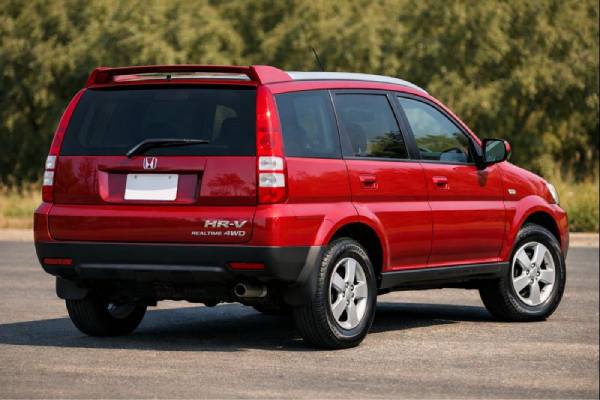
The 2000–2001 Honda HR-V GH4 with Real Time 4WD and the D16W5 1.6 is the “sweet spot” version of the first-generation HR-V: compact footprint, a lively SOHC VTEC engine, and an on-demand AWD system designed for mixed weather rather than heavy off-roading. In daily use, it’s defined by mechanical simplicity, good visibility, and a chassis that feels light on its feet compared with bigger crossovers of the era.
Ownership is usually straightforward when the basics are respected: timing-belt service on schedule, clean fluids, and especially correct maintenance of the Real Time 4WD rear system. Most complaints trace back to age-related rubber, neglected driveline fluids, and cooling or idle-control wear—not exotic failures. If you want a small, honest AWD runabout with Honda parts support and DIY-friendly engineering, this GH4 configuration remains one of the most appealing ways into early HR-V ownership.
Essential Insights
- Strong everyday drivability for the size; the D16W5 feels noticeably more responsive than the lower-output 1.6 variants.
- Real Time 4WD adds confidence on wet roads and light snow without the complexity of a full-time AWD system.
- Budget for age-related suspension and mount refreshes; rubber and bushings are common wear points now.
- Change rear Dual Pump Fluid on a routine cycle (typically every 40,000–60,000 km or 2–3 years depending on use).
- Plan a timing-belt service (belt, tensioner, water pump) around 100,000 km or 5–7 years, market-dependent.
Jump to sections
- What this GH4 124 hp HR-V is
- D16W5 Real Time 4WD specifications
- Trims, safety gear, and options
- Reliability patterns and known faults
- Maintenance plan and buying advice
- Driving feel and real-world economy
- Rivals and smart alternatives
What this GH4 124 hp HR-V is
Think of the GH4 HR-V as Honda’s early answer to the “small crossover” idea—before crossovers became heavy, tall, and tech-loaded. The 2000–2001 Real Time 4WD model keeps the light, car-like feel of a compact hatchback, but adds a higher seating position and an AWD system meant to handle traction surprises. It is not a rock-crawler. It shines on wet highways, broken city streets, gravel roads to a cabin, and winter commutes where front-wheel drive can run out of grip.
The key mechanical trait here is how Honda pairs the D16W5 with the Real Time 4WD hardware. The D16W5 is a 1.6-liter SOHC VTEC four-cylinder tuned for higher output than the base 1.6s. In practical terms, it gives the HR-V enough power to feel willing at higher revs without needing constant full throttle. Because this is a relatively small vehicle, the engine’s responsiveness matters more than headline horsepower numbers.
Real Time 4WD on the GH4 is an on-demand system. Under normal traction it behaves like a front-driver, which reduces driveline drag and keeps the steering feel clean. When the front wheels slip, a pump-and-clutch mechanism in the rear drivetrain transfers torque to the rear wheels. Owners often describe it as “invisible” when healthy—no lights, no drama, just fewer traction moments.
The downsides of this specific setup are mostly about maintenance and age. The 4WD unit depends on the correct rear fluid and reasonable tire matching. Mix tire sizes, ignore rear fluid, or run heavily worn tires, and you can trigger binding, chatter, or pump noise. Also, by now, most examples need attention to bushings, engine mounts, and small vacuum or idle-control leaks.
The advantage is that the platform is still approachable: conventional engine layout, widely available service parts, and a design that rewards careful preventative maintenance. Buy a good one, keep the fluids right, and it’s the kind of Honda that feels mechanically “honest” for years.
D16W5 Real Time 4WD specifications
The exact spec sheet can vary by market, transmission, and emissions equipment, so treat these values as representative for the 2000–2001 GH4 Real Time 4WD with the D16W5. Always confirm by VIN/frame number and under-hood labels.
Powertrain and efficiency
| Item | Specification |
|---|---|
| Engine code | D16W5 |
| Layout | Inline-4, SOHC VTEC, 16 valves |
| Displacement | 1.6 L (1,590 cc) |
| Induction | Naturally aspirated |
| Fuel system | PGM-FI (multi-point injection) |
| Bore × stroke | 75.0 × 90.0 mm (2.95 × 3.54 in) |
| Compression ratio | ~10.6:1 (market-dependent) |
| Max power | 124 hp (91 kW) @ ~6,600 rpm* |
| Max torque | ~144 Nm (106 lb-ft) @ ~5,000 rpm* |
| Timing drive | Belt |
| Rated efficiency | Typically ~7.5–9.0 L/100 km (31–26 mpg US / 38–31 mpg UK)** |
| Real-world highway @ 120 km/h | Often ~7.0–8.5 L/100 km (34–28 mpg US / 40–33 mpg UK)** |
| Aerodynamics | Cd and frontal area not consistently published for this generation |
- Output figures are commonly published in PS/kW depending on region; rpm points can vary slightly by calibration.
** Economy depends heavily on gearing, tire size, and whether the car runs CVT or manual.
Transmission and driveline
| Item | Specification |
|---|---|
| Transmission | 5-speed manual or CVT (market/trim dependent) |
| Drive type | Real Time 4WD (on-demand AWD) |
| Differential | Front open; rear clutch-coupled engagement |
Chassis and dimensions
| Item | Specification |
|---|---|
| Suspension (front/rear) | MacPherson strut / De Dion-type or trailing-arm style rear layout (market-dependent) |
| Steering | Rack-and-pinion; hydraulic assist typical |
| Brakes | Front discs; rear drums or discs (trim-dependent) |
| Wheels/tyres | Commonly 15–16 in rims; tyre sizes vary by grade |
| Length / width / height | ~4,000 / 1,695 / 1,580–1,605 mm (157.5 / 66.7 / 62.2–63.2 in) |
| Wheelbase | ~2,360 mm (92.9 in) |
| Turning circle | ~5.3 m (17.4 ft) |
| Ground clearance | Often ~170–185 mm (6.7–7.3 in), spec varies |
| Curb weight | Commonly ~1,200–1,300 kg (2,646–2,866 lb), spec varies |
| Fuel tank | Typically ~50–55 L (13.2–14.5 US gal / 11.0–12.1 UK gal) |
| Cargo volume | Not consistently reported in VDA/SAE terms for all markets; treat “small wagon practicality” as the safe expectation |
Performance and capability
| Metric | Typical range |
|---|---|
| 0–100 km/h (0–62 mph) | ~10.5–12.5 s (transmission and weight dependent) |
| Top speed | ~165–175 km/h (103–109 mph) |
| Braking distance 100–0 km/h | Not widely standardized for this model; depends on tyres and brake spec |
| Towing | Often not officially rated high; check local documentation |
Fluids and service capacities (decision-grade)
| Fluid | Typical specification |
|---|---|
| Engine oil | 5W-30 or 10W-30 API/ACEA equivalent; capacity ~3.3–3.7 L (3.5–3.9 US qt) |
| Coolant | Honda-type long-life coolant; typically 50/50 mix |
| Manual transmission | Honda MTF; capacity ~1.9–2.1 L (2.0–2.2 US qt) |
| CVT | Honda CVT fluid (exact spec varies by market/year); confirm label |
| Real Time 4WD rear unit | Honda Dual Pump Fluid (DPSF); service interval matters more than quantity |
| A/C refrigerant | R-134a (most markets) |
Key torque specs (common Honda baselines)
| Fastener | Typical torque |
|---|---|
| Wheel lug nuts | ~108 Nm (80 lb-ft) |
| Spark plugs | ~18 Nm (13 lb-ft) |
| Oil drain plug | ~39 Nm (29 lb-ft) |
Use these as guidance only; verify for your exact engine and fastener type.
Trims, safety gear, and options
Because the first-generation HR-V was sold across multiple regions with different naming conventions, “trim” is best approached like a detective: look for mechanical identifiers first, then comfort equipment. For the 2000–2001 GH4 Real Time 4WD, the biggest functional differences tend to be transmission choice, brake spec, wheel/tire package, and whether the car has side airbags or additional restraint hardware.
Quick identifiers that matter
- GH4 frame code usually indicates the Real Time 4WD platform in this generation. Confirm on the chassis plate.
- D16W5 is the higher-output 1.6; confirm with the engine stamp and under-hood label.
- Rear driveline hardware (prop shaft and rear unit) is the easiest physical confirmation of Real Time 4WD.
- CVT vs manual changes both the driving feel and maintenance requirements. A CVT car should shift smoothly with consistent rpm behavior; a manual should have clean engagement and no synchro crunching.
Options and equipment patterns
- Wheel/tire packages often step up with sportier grades, which can improve turn-in but make the ride busier over broken pavement.
- Brake hardware can vary; higher trims may bring rear discs. Drums are not automatically “bad,” but they can be more sensitive to neglected adjustment and old fluid.
- Interior practicality tends to be consistent: good seating flexibility for the footprint, plus an airy cabin with good sightlines.
Safety ratings reality check
If you’re shopping for a 2000–2001 HR-V, it’s important to align expectations with the era. Many modern rating systems and test protocols (and the cars designed around them) changed substantially after the early 2000s. Depending on market, you may not find a clean, apples-to-apples star rating for this specific generation and year.
Instead, evaluate safety by equipment and condition:
- Airbags: dual front airbags are common; side airbags may be optional depending on market/grade.
- ABS: commonly available; confirm by dash light on key-on and ABS hardware at the hubs.
- Stability control: generally not part of this generation’s typical equipment set. If your use case demands stability control, consider newer rivals.
- Child seats: ISOFIX/LATCH availability varies; check rear seat anchors rather than assuming.
Driver assistance (ADAS)
This HR-V predates modern ADAS. Expect no AEB, lane-keep assist, or adaptive cruise. The practical “driver assistance” is good visibility, manageable dimensions, predictable controls, and a drivetrain that behaves consistently when healthy. For many owners, that simplicity is the point—just be honest about what you’re giving up compared with newer vehicles.
Reliability patterns and known faults
A well-kept D16W5 HR-V can be durable, but at 20+ years old, reliability is less about the original design and more about accumulated neglect. The good news: most issues are familiar Honda-era problems—sensors, rubber, mounts, and fluids—rather than catastrophic engine failures.
Below is a practical map by prevalence and cost tier.
Common (low to medium cost)
- Rear Real Time 4WD shudder or chatter on tight turns
Symptoms: binding, judder, or “hopping” when parking-lot turning.
Likely cause: old/incorrect Dual Pump Fluid, mismatched tires, or long intervals.
Remedy: correct fluid service (often multiple drain/fill cycles), match tires (same brand/size/wear), and verify no mechanical damage. - Idle instability and cold-start quirks
Symptoms: hunting idle, stalling when coming to a stop, uneven cold idle.
Likely cause: dirty throttle body, IACV (idle air control valve) contamination, vacuum leaks, tired PCV system.
Remedy: intake cleaning, vacuum hose refresh, correct base idle procedure per service info. - Engine mount wear
Symptoms: vibration at idle, clunk on throttle transitions.
Likely cause: aged rubber mounts.
Remedy: replace the worst mounts first; re-check exhaust flex section and heat shields. - Suspension consumables
Symptoms: clunks, wandering alignment, uneven tire wear.
Likely cause: front lower arm bushings, ball joints, rear bushings, tired dampers.
Remedy: address play systematically; align after any bushing or arm work.
Occasional (medium cost)
- Cooling system fatigue
Symptoms: slow overheating, coolant smell, loss of heat, unstable temperature gauge.
Likely cause: old radiator, tired thermostat, weak cap, aging hoses, or water pump at the end of belt life.
Remedy: treat cooling as a system; ideally bundle with timing-belt service if history is unknown. - CVT-specific drivability (if equipped)
Symptoms: judder on takeoff, flare, sluggish engagement, fluid darkening quickly.
Likely cause: incorrect fluid, overdue service, or wear.
Remedy: correct CVT fluid service and adaptation procedures where applicable; avoid “universal” fluids.
Rare (higher cost, but not typical)
- Internal engine problems (low compression, heavy oil consumption)
These are uncommon on D-series engines unless maintenance was severely neglected.
Remedy: compression/leak-down test before purchase if the car smokes, burns oil, or misfires under load.
Recalls, service actions, and how to verify
Honda issued recalls affecting GH3/GH4 HR-V production ranges, including early build years. The practical approach is simple:
- Run the chassis/frame number through official recall databases for your market.
- Ask a dealer to confirm completion in their system if you have access.
- Keep documentation; future buyers value proof.
Pre-purchase checks that actually prevent regret
- Confirm four matching tires (size and similar tread depth).
- Test full-lock turns in a parking lot after the car is warmed up (listen/feel for 4WD bind).
- Check for coolant stability (no bubbling, no oily residue, steady temperature).
- Verify timing-belt history (receipts matter more than verbal claims).
- Scan for rust on subframes, rear mounts, and brake lines in salted climates.
Maintenance plan and buying advice
If you maintain this HR-V like a drivetrain-first Honda—fluids, belt intervals, and rubber—you’ll get the ownership experience people remember. If you treat it like a “just add fuel” beater, the Real Time 4WD system and age-related wear will punish you with noise and vibration.
Practical maintenance schedule (distance/time)
| Item | Interval (typical) | Notes |
|---|---|---|
| Engine oil and filter | 8,000–10,000 km or 12 months | Short trips: lean toward the shorter interval |
| Air filter (engine) | Inspect every oil service; replace 20,000–30,000 km | Dusty roads shorten life |
| Cabin filter (if fitted) | 15,000–30,000 km or yearly | Some markets/trims vary |
| Coolant | 3–5 years | Use correct Honda-type coolant; avoid mixing types |
| Brake fluid | Every 2 years | Critical for pedal feel and corrosion prevention |
| Spark plugs | 40,000–100,000 km (type dependent) | Confirm plug type and gap spec |
| Valve clearance (adjustable) | 40,000–60,000 km | Helps idle quality and long-term valve health |
| Timing belt, tensioner, water pump | ~100,000 km or 5–7 years | If history is unknown, do it immediately |
| Manual transmission fluid | 60,000–80,000 km | Earlier if shifting feels notchy |
| CVT fluid (if equipped) | 40,000–60,000 km | Use only the specified fluid |
| Real Time 4WD rear fluid (DPSF) | 40,000–60,000 km or 2–3 years | More often with lots of tight turns or mixed tires history |
| Tire rotation | 10,000–12,000 km | Important for AWD tire matching |
| Alignment check | Yearly or after suspension work | Protects tires and stability |
| 12 V battery test | Yearly; replace ~4–6 years typical | Weak batteries can mimic charging issues |
Fluids and specs: what matters most
- Use the correct rear Dual Pump Fluid: this is non-negotiable for Real Time 4WD behavior. If you feel binding, service the fluid first before chasing mechanical parts.
- Avoid “universal” CVT fluids: if the car has a CVT, use the exact spec fluid recommended for that unit.
- Don’t skip valve clearance checks: many D-series engines run best when valves are set correctly, especially as they age.
Buyer’s guide: inspection checklist
Body and chassis
- Check rear arch and sill areas, lower doors, and underbody seams for rust.
- Inspect subframes and suspension mounts for corrosion or repairs.
Engine bay
- Look for coolant residue around the radiator end tanks and hoses.
- Confirm stable idle with A/C on and off.
- Listen for belt noise; check for oil leaks that can contaminate the timing belt area.
Driveline
- Perform tight-turn test for 4WD chatter.
- Ensure matching tires and even wear—budget tires plus mismatched tread depth can cause expensive-seeming symptoms that are actually tire/fluid related.
Road test
- Brakes should be straight and consistent; a pulsing pedal suggests warped rotors or old fluid.
- Steering should track straight; wander often means bushings and alignment.
Best ownership strategy for a 20+ year HR-V
A smart plan is to “baseline” the car in your first 60–90 days:
- All fluids (engine, brake, transmission, rear DPSF).
- Full inspection of belts, hoses, mounts, and bushings.
- Catch up timing-belt service if any doubt exists.
- Fresh tires matched as a set, then alignment.
Do that, and the car usually settles into predictable, low-drama running.
Driving feel and real-world economy
The 124 hp D16W5 changes the HR-V’s character more than you might expect on paper. In a compact, relatively light body, the extra output shows up as better midrange and less strain on inclines. It still feels like a small-displacement engine—you’ll use revs when you want quick acceleration—but it doesn’t feel “overwhelmed” in normal traffic the way lower-output variants can.
Ride, handling, and NVH
- Ride: firm enough to feel controlled, especially on higher-trim wheel packages. Over sharp potholes, the short wheelbase and older damping can feel busy, which is why fresh dampers and bushings matter.
- Handling: the HR-V’s small footprint and upright cabin make it easy to place. It turns in willingly, and the Real Time 4WD system does not usually interfere with the steering feel.
- NVH (noise, vibration, harshness): expect more road and tire noise than modern crossovers. Aged door seals and worn mounts amplify it, so condition is everything.
Powertrain character
- Throttle response: generally crisp for an early-2000s naturally aspirated Honda, especially above midrange.
- Manual vs CVT:
- The manual suits the engine’s revvy nature and tends to be the “enthusiast pick” for feel and control.
- The CVT can be smooth when healthy, but it is sensitive to fluid condition; a neglected unit can feel rubbery or shuddery.
Real-world efficiency (what owners actually see)
Real-world economy is strongly influenced by tire choice, transmission, and whether you do steady highway miles or short cold trips.
- City: often ~9.0–11.0 L/100 km (26–21 mpg US / 31–26 mpg UK)
- Highway (100–120 km/h): often ~7.0–8.5 L/100 km (34–28 mpg US / 40–33 mpg UK)
- Mixed: commonly ~8.0–9.5 L/100 km (29–25 mpg US / 35–30 mpg UK)
Cold weather can increase consumption noticeably because the engine runs richer during warm-up and the driveline fluids are thicker.
Key performance metrics that shape expectations
- 0–100 km/h: typically around the low-to-mid 11-second range, with transmission and weight making the difference.
- Passing: the car rewards a downshift (manual) or deliberate throttle (CVT) rather than lazy roll-on.
- Braking: more dependent on tire quality and brake maintenance than “spec,” because many examples now run mixed pads, old fluid, or cheap tires.
Traction and control in bad weather
Real Time 4WD is at its best in:
- heavy rain and standing water situations where front tires can unload,
- slick city snow where you want predictable pull-away traction,
- gravel inclines and uneven driveways.
It’s less suited to deep mud, repeated high-heat slipping, or off-road abuse. If you want a “go-anywhere” AWD, you’ll be happier with more rugged rivals. If you want calm traction support in normal life, this Honda system delivers—when maintained.
Rivals and smart alternatives
The GH4 HR-V occupies a specific niche: small exterior size, simple mechanicals, and AWD that’s more about traction insurance than adventure marketing. When comparing rivals, focus on what you value most—size, comfort, winter traction, or ruggedness—because early crossovers vary a lot in personality.
If you want more space and comfort
- Honda CR-V (late 1990s/early 2000s)
More interior room, more relaxed highway manners, and often broader parts availability in some markets. You give up the HR-V’s compact “city-friendly” footprint and nimble feel. - Toyota RAV4 (same era)
Typically strong reliability reputation and practical packaging. AWD systems vary by generation; some are very good in winter use. Ride and noise levels depend heavily on condition and tires.
If you prioritize winter traction and AWD behavior
- Subaru Forester (early 2000s)
Often the go-to for predictable full-time AWD feel. Trade-offs can include higher fuel use and potentially more expensive engine/sealing work depending on engine family and maintenance history. - Nissan X-Trail (early 2000s, where sold)
Often offers a more “SUV-like” stance and traction tools, but long-term durability depends heavily on drivetrain and rust history.
If you want something more rugged
- Suzuki Vitara/Grand Vitara (era dependent)
More off-road-friendly hardware in many trims. You may face more truck-like ride and higher wear in steering/suspension, depending on use.
Why the GH4 D16W5 still makes sense
Choose this HR-V when you want:
- a small AWD vehicle that fits tight streets and parking,
- a drivetrain that’s serviceable without exotic tools,
- a driving feel that stays light and direct compared with heavier rivals,
- and a platform where “reliability” mostly comes down to maintenance discipline.
Skip it if you need modern crash-test ratings, stability control, or driver assistance tech as a baseline requirement. In that case, the right rival is usually a newer vehicle, not a different 2000-era model.
References
- クルマ | 取扱説明書ダウンロード | Honda 日本製品情報サイト 2026 (Owner’s Manual Portal)
- HR-Vのリコール | Honda 2005 (Recall Database)
- 守る(JNCAP)/独立行政法人自動車事故対策機構 ナスバ(交通事故) 2026 (Safety Rating Body)
- Check for Recalls: Vehicle, Car Seat, Tire, Equipment | NHTSA 2026 (Recall Database)
Disclaimer
This article is for informational purposes only and is not a substitute for professional diagnosis, inspection, or repair. Specifications, torque values, service intervals, and procedures can vary by VIN/frame number, market, model year, and equipment. Always verify details using your vehicle’s official service documentation and manufacturer guidance.
If you found this guide useful, please consider sharing it on Facebook, X (Twitter), or your favorite forum to help others find reliable ownership information.