


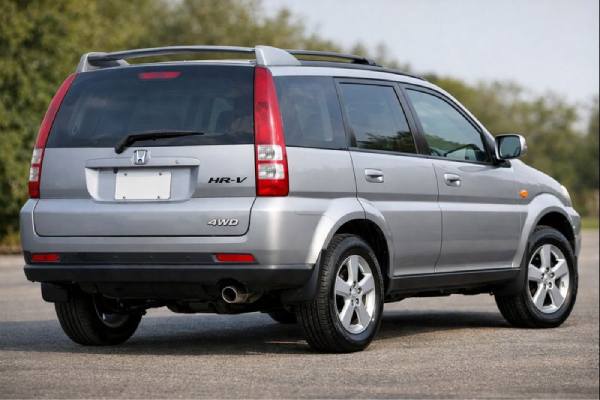
The facelift-era GH2 Honda HR-V with Real Time 4WD and the D16W1 1.6 is a practical reminder that “small crossover” did not always mean heavy, overpowered, or complicated. This version pairs a simple, belt-driven SOHC VTEC four-cylinder with an on-demand AWD system that stays mostly front-driven until the front tyres slip, then sends torque rearward through a dual-pump rear differential. In daily use, that means predictable manners, decent fuel economy for the era, and noticeably better winter traction than the FWD car—without the full-time AWD drag and noise.
If you’re shopping or maintaining one today, the big story is age. Rubber parts, timing-belt intervals, and neglected fluids (especially CVT and rear diff) matter more than the badge on the grille.
Owner Snapshot
- Real Time 4WD adds meaningful wet and snow traction with minimal driver input.
- D16W1 is durable when kept on clean oil and not overheated.
- Compact size and tall seating make it easy to place in tight cities and narrow roads.
- CVT-equipped cars can develop shudder if fluid service history is weak.
- Plan rear differential fluid service about every 30,000–40,000 km (or sooner if it chatters in tight turns).
Contents and shortcuts
- Facelift GH2 4WD at a glance
- D16W1 4WD specs and measures
- Equipment levels and safety gear
- Reliability patterns on 4WD HR-V
- Maintenance plan and buyer checks
- How it drives in reality
- Rivals in small AWD class
Facelift GH2 4WD at a glance
Think of the 2002–2005 facelift GH2 HR-V Real Time 4WD as a light-duty, real-world traction upgrade rather than a “go anywhere” off-roader. The system is designed to be quiet and automatic: in steady cruising it behaves like a front-wheel-drive car, then engages the rear axle when the front wheels rotate faster than the rears. That engagement happens mechanically in the rear differential via a dual-pump setup, so there’s no driver switch and usually no warning light—just a subtle push from the back when you need it.
That layout fits the HR-V’s mission. Ground clearance is useful for rough tracks, snow ruts, and steep driveways, but approach and departure angles are still limited by the bumpers and the long overhangs typical of a city-friendly body. The chassis is tuned more for stability and predictability than for sharp turn-in, and the wheel-and-tyre package matters a lot: a good winter tyre transforms this model more than most “power” upgrades.
The facelift years generally brought small refinements rather than a total mechanical reset. Where buyers benefit today is parts commonality: the D-series engine family is widely understood, the driveline is straightforward, and most servicing is accessible without exotic tools. What owners must respect is time-based wear. Cooling-system plastics, suspension bushings, and drivetrain mounts can be as important as mileage. Many examples are now on their third or fourth owner, and service records often thin out right where they matter—timing belt, water pump, CVT fluid changes, and rear differential servicing.
If you want the HR-V’s classic strengths—compact footprint, tall seating, and simple mechanicals—this version is one of the most usable. If you want modern crash structure, stability control, and current driver assistance, no amount of maintenance can “retrofit” the platform into a new car. A clean, correctly serviced one can be a reliable daily tool; a neglected one can become a steady stream of small, annoying fixes.
D16W1 4WD specs and measures
The tables below focus on the GH2 facelift HR-V with the D16W1 1.6 and Real Time 4WD. Exact figures can vary by market, body style (3-door vs 5-door), transmission, wheel size, and equipment, so use this as a decision-making baseline and confirm against your VIN and service documentation.
Powertrain and efficiency (typical)
| Item | Specification |
|---|---|
| Engine code | D16W1 |
| Layout | Inline-4, transverse |
| Valvetrain | SOHC VTEC, 4 valves/cyl (16V) |
| Displacement | 1.6 L (1,590 cc) |
| Bore × stroke | 75.0 × 90.0 mm (2.95 × 3.54 in) |
| Induction | Naturally aspirated |
| Fuel system | PGM-FI (multi-point injection) |
| Max power | 105 hp (78 kW) @ ~6,200 rpm (market-dependent) |
| Max torque | ~138 Nm (102 lb-ft) @ ~3,400 rpm (market-dependent) |
| Timing drive | Belt |
| Rated efficiency | ~7.2–8.2 L/100 km (33–28 mpg US / 39–34 mpg UK) |
| Real-world highway @ 120 km/h | ~8.0–9.0 L/100 km (29–26 mpg US / 35–31 mpg UK) |
Transmission and driveline
| Item | Specification |
|---|---|
| Transmission | 5-speed manual or CVT (market/trim dependent) |
| Drive type | Real Time 4WD (on-demand AWD) |
| Differential | Open front; dual-pump rear differential unit |
Chassis and dimensions (common ranges)
| Item | Specification |
|---|---|
| Suspension (front/rear) | MacPherson strut / trailing arm (layout varies by market) |
| Brakes | Front discs; rear drums or discs (trim-dependent) |
| Wheels/tyres | Commonly 195/70 R15 or similar (varies) |
| Ground clearance | ~170–190 mm (6.7–7.5 in) |
| Length / width / height | ~4,000–4,150 / ~1,695 / ~1,580–1,600 mm |
| Wheelbase | ~2,460 mm (96.9 in) |
| Turning circle | ~10.0–10.6 m (33–35 ft) |
| Kerb weight | ~1,200–1,320 kg (2,645–2,910 lb) |
| Fuel tank | ~55 L (14.5 US gal / 12.1 UK gal) |
| Cargo volume | Varies widely by body style and measurement method |
Performance (realistic expectations)
| Metric | Typical |
|---|---|
| 0–100 km/h (0–62 mph) | ~12.5–14.0 s (manual often quicker than tired CVT) |
| Top speed | ~160–170 km/h (99–106 mph) |
| Braking 100–0 km/h | ~42–46 m (tyres and brake condition dominate) |
| Towing | Often modest or not rated in some markets—verify locally |
Fluids, service capacities, and key torques (common values)
| Item | Typical spec |
|---|---|
| Engine oil | 5W-30 (API SJ/SL era) ~3.3–3.7 L with filter |
| Coolant | Long-life type, 50/50 mix ~4.5–5.5 L |
| Manual gearbox | Honda MTF-type fluid ~1.8–2.0 L |
| CVT | Honda CVT fluid; capacity varies—service by drain/fill intervals |
| Rear differential | Dual Pump Fluid (DPSF); typically around ~1.0–1.2 L |
| A/C refrigerant | R134a; charge varies by market and body style |
| Wheel nuts | ~108 Nm (80 lb-ft) typical Honda range |
If you’re building a maintenance plan, treat the driveline fluids as “cheap insurance.” A smooth CVT and quiet rear differential are usually the result of correct fluid type and consistent drain-and-fill timing, not luck.
Equipment levels and safety gear
Trim names vary a lot by country, but the facelift HR-V lineup usually splits into a few practical buckets: base models focused on price and simplicity, mid trims with comfort and appearance upgrades, and higher trims that bundle alloy wheels, upgraded audio, and sometimes different brake or tyre packages. Because this platform spans multiple regions, the safest way to identify what you’re looking at is with physical cues plus documentation rather than trim badges alone.
Quick identifiers that matter
- Real Time 4WD hardware: rear differential casing and rear driveshaft are the obvious tells underneath. A road test on a loose surface can also reveal gentle rear engagement when the fronts slip.
- Transmission type: CVT cars often have different shifter gates and can behave very differently at low speed (creep, step-off, and hill starts).
- Brake package: some cars use rear drums, others rear discs. This affects servicing cost, parts availability, and braking feel under repeated stops.
- Wheel size and tyre profile: larger wheels can sharpen steering response slightly but may increase road noise and reduce ride comfort.
Options worth seeking (or at least understanding)
- ABS: not universal in all early-2000s markets. If you drive in wet or winter conditions, ABS is a meaningful safety layer on this chassis.
- Side airbags: some markets offered them, many did not. If fitted, confirm the airbag light behavior at key-on and check for correct seat or pillar trim.
- Air conditioning performance: compressors and condensers are normal wear items now; a strong, stable A/C system can indicate good overall care.
Safety ratings and what to do with them
For this specific GH2 facelift configuration, published crash-test ratings can be inconsistent by region and test protocol, and they may not map neatly to your exact year or trim. Even when a model name matches, the tested structure, airbags, and restraint tuning can differ. In practice, treat formal ratings as background information and focus on what you can verify on the car in front of you:
- Restraints and belts: check belt retraction speed, fraying, and pretensioner indicators if present.
- Airbag system health: ensure the airbag warning light performs a normal self-check and goes out; persistent lights deserve diagnosis, not tape.
- Child-seat provisions: many markets adopted ISOFIX/LATCH gradually. If you need child-seat anchors, confirm their presence physically, not by assumption.
- Lighting: headlamp haze is common; restoring lens clarity can improve real safety more than many owners expect.
Driver assistance (ADAS) in the modern sense is generally absent here—no radar cruise, no lane support, no automatic emergency braking. That’s not a flaw; it’s the era. It does mean tyres, brakes, and driver attention carry more of the safety burden, so buying decisions should prioritize the best-maintained example you can find.
Reliability patterns on 4WD HR-V
At its core, the D16W1 HR-V is mechanically conservative, and that’s good news. Most reliability problems today come from deferred maintenance, incorrect fluids, or age-related wear rather than fundamental design flaws. Use the guide below to separate “normal old-car stuff” from issues that can become expensive.
Common and usually low-to-medium cost
- Oil leaks and seepage (valve cover gasket, cam seals):
Symptoms: oil smell, wet engine edges.
Cause: hardened gaskets and seals.
Remedy: reseal; confirm PCV valve function to avoid pressure buildup. - Idle control and intake deposits:
Symptoms: hunting idle, stalling on cold start, inconsistent low-speed response.
Cause: dirty throttle body, idle air control valve contamination, vacuum leaks.
Remedy: correct cleaning procedure, replace aging hoses, confirm no coolant leaks into idle circuits where applicable. - Cooling system aging:
Symptoms: gradual overheating, coolant smell, fans running more often.
Cause: tired radiator, thermostat drift, brittle hoses, old coolant.
Remedy: refresh components proactively; overheating is one of the few things that can truly shorten D16 life.
Occasional, but important on 4WD models
- Rear differential chatter on tight turns:
Symptoms: shudder, binding, or groaning during slow, tight parking-lot turns.
Cause: old or incorrect dual-pump fluid; sometimes mismatched tyre sizes front-to-rear.
Remedy: drain and refill with the correct fluid (often multiple short-interval changes), match tyre brand/model and circumference, and avoid mixing heavily worn tyres with new ones. - CVT shudder or delayed engagement (if equipped):
Symptoms: judder on take-off, flare, sluggish response.
Cause: degraded CVT fluid, worn start clutch behavior (design varies by unit), or neglected service.
Remedy: correct fluid service first; then diagnose further only if symptoms remain. Many CVT complaints improve significantly with proper maintenance, but not all.
Rare, but higher cost when it hits
- Driveline vibration under load:
Symptoms: vibration on acceleration, sometimes speed-dependent.
Cause: worn engine mounts, prop shaft joints, or rear driveline components.
Remedy: inspect mounts first (cheap), then progress to driveline checks. - Rust in structural areas (market-dependent):
Symptoms: bubbling paint, soft seams, corrosion around suspension mounting points.
Cause: winter salt exposure and poor previous repairs.
Remedy: walk away from advanced structural rust unless you’re prepared for proper welding and rust-proofing.
Recalls and service actions
Because these cars are older and often imported, recall completion can be hard to confirm casually. The best approach is to run an official recall lookup for the market where the car was originally sold, then compare that with dealer service records and any paperwork the seller can provide. If the seller can’t show records, price the car as if overdue items will be required.
Maintenance plan and buyer checks
A well-kept HR-V Real Time 4WD can age gracefully, but only if you treat maintenance as a system: engine health, cooling, transmission, and rear differential all matter. The schedule below is practical for 2002–2005 cars today; adapt it to your climate, driving pattern, and service history.
Practical maintenance schedule (distance/time)
- Engine oil and filter: every 7,500–10,000 km or 12 months (5,000–7,500 km for short trips, extreme heat/cold, or high idle time). Use the correct viscosity for your climate and keep the level topped up.
- Air filter (engine): inspect every 15,000 km; replace about every 30,000 km (sooner in dusty areas).
- Cabin filter (if fitted): every 15,000–30,000 km or annually for allergy-prone drivers.
- Coolant: every 4–5 years, then every 2–3 years thereafter (unless your official coolant spec states otherwise). Never ignore small leaks.
- Brake fluid: every 2 years regardless of mileage.
- Spark plugs: typically 40,000–50,000 km for standard plugs; up to 80,000–100,000 km for long-life types if correctly specified. Replace sooner if misfire appears.
- Timing belt and water pump: treat as critical. If history is unknown, assume overdue. Many owners plan every ~100,000 km or ~7 years as a conservative interval.
- Valve clearance (if applicable): check if you hear ticking, have rough idle, or at major service intervals (~40,000–60,000 km).
- CVT fluid (if equipped): drain and fill on a consistent cycle (often ~30,000–40,000 km). Avoid “universal” fluids.
- Manual gearbox fluid: about every 60,000–100,000 km, sooner if shifting feels notchy.
- Rear differential (Dual Pump) fluid: about every 30,000–40,000 km, or immediately if you get chatter in tight turns.
- Tyres: rotate every 8,000–10,000 km and keep all four tyres matched in size and wear to protect the 4WD system.
Buyer’s inspection checklist (what experienced owners look for)
- Cold start behavior: steady idle, no heavy valve clatter, no smoke.
- Cooling-system condition: clean coolant, stable temperature, no crusted hose joints.
- Transmission feel: smooth take-off; no harsh shudder; consistent response in reverse.
- 4WD health check: on full steering lock at low speed, note any binding or groaning; mild noise can point to overdue rear diff service.
- Suspension and steering: clunks over bumps suggest tired links/bushes; uneven tyre wear suggests alignment or worn components.
- Rust scan: sills, rear arches, underbody seams, and suspension mounting points.
- Electrical basics: window regulators, central locking, blower speeds, and charging voltage.
Long-term durability outlook
If you keep it cool, keep it lubricated, and keep the driveline fluids correct, the D16W1 platform tends to reward owners with consistent, predictable service. The cars that become money pits are usually the ones with unknown belt history, persistent overheating, mismatched tyres on the 4WD system, and years of skipped fluid changes.
How it drives in reality
With 105 hp and a relatively tall body, the HR-V Real Time 4WD is not quick by modern standards, but it can feel willing and usable when it’s healthy. The engine is happiest spinning, and it responds best to smooth throttle rather than lugging in high gear. In city traffic, the seating position and compact footprint make it feel more agile than the numbers suggest. On narrow roads, the view out and short overall length reduce driver fatigue.
Ride, handling, and NVH
The suspension tuning leans toward stability and compliance. You’ll feel bumps more on worn dampers or stiff aftermarket tyres, but a good stock setup rides with a controlled, slightly firm feel. Body roll is present, yet predictable. Steering is light and easy at parking speeds, and while feedback is limited, it’s consistent—an underrated trait on slippery roads.
Noise, vibration, and harshness (NVH) depends heavily on tyres and bushings. A fresh set of quality tyres and renewed suspension bushings can make the cabin feel a full generation newer. Conversely, cheap tyres and tired mounts can add droning and vibration that owners sometimes misdiagnose as “driveline problems.”
Powertrain character and traction
The D16W1 delivers its best work in the midrange and upper revs, and it tolerates daily use well if oil changes are steady. Manual cars feel more direct and often a little quicker. CVT cars can feel smooth and relaxed when properly serviced, but they can also feel “rubbery” under sudden acceleration. If a CVT car shudders off the line, treat it as a service-history warning sign, not a personality trait.
Real Time 4WD is most noticeable when you don’t want drama: pulling away on wet leaves, climbing a snowy hill, or accelerating out of a slick side street. It’s not a rock-crawling system, but for normal winter and bad-weather driving it can be the difference between progress and wheelspin. Tyres remain the limiting factor. A matched set of winter tyres will outperform AWD on all-seasons every time.
Real-world economy
Expect economy to vary widely with speed. Around-town driving can be reasonable if the engine is tuned and the tyres are properly inflated. Sustained 120 km/h cruising typically pushes consumption into the higher end of the normal range for a small petrol crossover of this era. If you want the best economy, keep speeds moderate, maintain alignment, and avoid roof racks when you don’t need them—drag hurts these tall shapes.
Rivals in small AWD class
The HR-V Real Time 4WD sits in a niche that modern buyers sometimes forget: compact, light crossover utility with modest power. Comparing it fairly means looking at what else was available in the early 2000s and what those vehicles feel like to own today.
Where the HR-V GH2 4WD wins
- Simplicity and serviceability: the D-series engine layout is straightforward, and many repairs are routine for experienced independent shops.
- City usability: compact dimensions, good visibility, and a practical cabin make it easy to live with in dense areas.
- Bad-weather confidence: Real Time 4WD adds traction with minimal complexity compared with some full-time AWD systems.
- Running costs (when maintained): parts availability and general robustness can keep ownership predictable.
Common rivals and how they differ
- Toyota RAV4 (older generations): often feels more “SUV-like” and can be more robust in rough use, but may cost more to buy in good condition and can suffer from its own age-related issues (rust and suspension wear).
- Suzuki Vitara / Grand Vitara: typically more off-road oriented in some trims, but ride and refinement can be more utilitarian, and corrosion can be a concern in salty climates.
- Daihatsu Terios: simple and compact, sometimes surprisingly capable at low speeds, but generally less refined and can feel underpowered depending on engine.
- Subaru Forester (early 2000s): stronger AWD pedigree and often better traction behavior, but engine and maintenance considerations can be more demanding depending on the exact powertrain.
- Honda CR-V (same era): roomier and often more comfortable on longer trips, but larger, heavier, and typically more expensive to run and park.
Buying guidance: who should choose what?
Choose the HR-V Real Time 4WD if you value compact size, light-duty AWD for real weather, and mechanical straightforwardness over modern safety tech and strong acceleration. Consider a larger rival if you regularly carry adults in the back, tow (where rated), or spend long hours on fast motorways where extra power and cabin insulation matter. Most importantly, compare condition rather than model names. A well-maintained HR-V will beat a neglected “better” rival every time in day-to-day satisfaction.
References
- Check for Recalls: Vehicle, Car Seat, Tire, Equipment | NHTSA 2026 (Recall Database)
- Euro NCAP | Latest Safety Ratings 2026 (Safety Rating)
- Vehicle ratings 2026 (Safety Rating)
- リコール・改善対策の届出(令和7年分) – 国土交通省 2025 (Recall Database)
Disclaimer
This article is for informational purposes only and is not a substitute for professional inspection, diagnosis, or repair. Specifications, torque values, service intervals, and procedures can vary by VIN, market, and equipment. Always verify details using the correct official owner’s manual and service documentation for your exact vehicle.
If you found this guide useful, consider sharing it on Facebook, X (Twitter), or your favorite forum to support our work.