

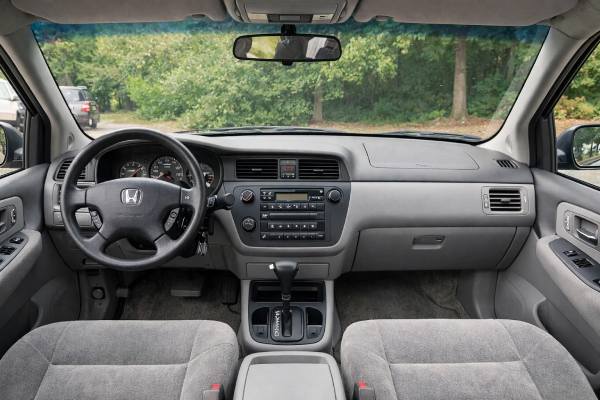

The 1999–2001 Honda Odyssey (RL1) is the generation that turned the Odyssey into a “real” family minivan: wider, heavier, and far more capable than the earlier compact versions. In this early RL1 form, it pairs the J35A1 3.5-liter V6 with a 4-speed automatic and a front-wheel-drive layout that prioritizes packaging and predictable road manners over outright sportiness. The payoff is easy everyday torque, a low step-in height, and a cabin that’s genuinely usable for three rows—especially when you keep on top of cooling and transmission health.
If you’re shopping today, the Odyssey’s strengths are still clear: practical space, sensible controls, and a drivetrain that can run for a long time when serviced on schedule. The key is buying based on condition, not mileage, because age-related hoses, mounts, and electrical wear matter as much as odometer readings.
Fast Facts
- Strong low- and mid-range pull from the 3.5-liter V6 makes highway merging and full-load driving easy.
- Family-first packaging: wide openings, usable third row, and a low floor for child seats and cargo.
- Parts availability is generally good, and many repairs are straightforward for independent shops.
- Budget for transmission upkeep; neglected fluid and heat exposure are the big risk multipliers.
- Typical baseline interval: engine oil every 8,000–10,000 km (5,000–6,000 mi) or 6 months, depending on use.
Jump to sections
- Odyssey RL1 ownership profile
- J35A1 specs and dimensions
- Trims, safety, and driver tech
- Reliability, faults, and recalls
- Maintenance plan and buying advice
- Real-world driving and economy
- How it stacks up to rivals
Odyssey RL1 ownership profile
Think of the 1999–2001 Odyssey RL1 as a “torque-and-space” minivan with a simple mission: carry people and gear without drama. The J35A1 V6 gives it the relaxed power delivery that families notice immediately—especially compared with many four-cylinder minivans of the era. It doesn’t need to rev hard to move a full cabin, which helps drivability and reduces day-to-day strain. In traffic, the Odyssey’s size is obvious, but visibility is generally good and the seating position feels natural rather than “bus-like.”
The engineering story is mostly about packaging and load control. The front-wheel-drive layout keeps the cabin floor low and frees up interior width. That matters for child seats, third-row access, and cargo loading. Suspension tuning is aimed at stability with a full load, not sharp handling. The Odyssey is at its best on ordinary roads—city streets, ring roads, and long motorways—where its longer wheelbase and compliant ride help it feel settled.
Where ownership gets serious is heat management and fluid condition. These early RL1 vans are known to be sensitive to neglected cooling components and transmission servicing. That does not mean they are “bad” vehicles; it means you should treat them like a heavy-duty appliance. If you keep fresh fluids in it, ensure the cooling system is healthy, and address small leaks before they become big ones, the Odyssey tends to reward you with predictable service.
For buyers today, the best examples usually come from owners who did boring maintenance on time. Look for documentation showing regular oil changes, recent timing-belt service (if applicable to the engine’s schedule in your market), transmission fluid changes, and cooling work like radiator or hose replacement. The worst examples often have shiny paint but poor mechanical history—especially if they were used for repeated short trips, frequent towing, or long summer highway runs with an overloaded cabin.
J35A1 specs and dimensions
Below is a practical spec set for the 1999–2001 Odyssey RL1 with the J35A1 3.5 V6 and FWD. Exact figures can vary by trim, market, tire size, and equipment (roof rails, seating configuration, and options), but these are the numbers and formats that matter for ownership decisions.
Powertrain and efficiency
| Item | Spec |
|---|---|
| Code | J35A1 |
| Engine layout and cylinders | V6, 6 cylinders, SOHC, 24 valves |
| Displacement | 3.5 L (3,471 cc) |
| Bore × stroke | 89 × 93 mm (3.50 × 3.66 in) |
| Induction | Naturally aspirated |
| Fuel system | Multi-point fuel injection (PFI/MPFI) |
| Compression ratio | 9.4:1 |
| Max power | 210 hp (157 kW) @ 5,200 rpm |
| Max torque | 229 lb-ft (311 Nm) @ 4,300 rpm |
| Timing drive | Belt |
| Rated efficiency (example) | EPA-style figures commonly land around ~14.7 L/100 km (16 mpg US) city and ~10.2 L/100 km (23 mpg US) highway (trim/tires/conditions apply) |
| Real-world highway @ 120 km/h | Plan roughly 11–13 L/100 km depending on load, tires, wind, and temperature |
Transmission and driveline
| Item | Spec |
|---|---|
| Transmission | 4-speed automatic |
| Drive type | FWD |
| Differential | Open (traction depends heavily on tires and alignment) |
Chassis and dimensions (typical ranges)
| Item | Spec |
|---|---|
| Suspension (front/rear) | Independent front; rear tuned for load stability (exact layout varies by market description) |
| Brakes | 4-wheel disc is common on many trims; verify by VIN/trim |
| Wheels and tyres | Many trims run 16-inch wheels; sizes vary (verify door placard) |
| Length / width / height | Expect a footprint around ~4.8 m long and ~2.0 m wide (varies by year/trim) |
| Wheelbase | Typically ~2.83 m |
| Turning circle | Often ~11.5–12.0 m kerb-to-kerb depending on wheels/tires |
| Kerb weight | Commonly ~1,950–2,050 kg depending on equipment |
| Fuel tank | Commonly ~76 L (market-dependent) |
| Cargo volume | Highly configuration-dependent; usability is the real win (flat load floor, wide opening) |
Performance and capability (realistic expectations)
| Item | Spec |
|---|---|
| 0–100 km/h (0–62 mph) | Typically ~9–10 seconds depending on load and conditions |
| Top speed | Usually limited by gearing/aerodynamics; expect ~175–185 km/h in healthy condition |
| Towing capacity | Some trims are rated up to ~1,600 kg (3,500 lb) in certain markets with the right equipment—verify for your VIN |
Fluids and service capacities (ownership-relevant)
Capacities and fluid standards vary by market and service literature, so treat these as decision guidance—not a substitute for your manual.
- Engine oil: typically 5W-20 or 5W-30 depending on climate/market; capacity often around ~4.3 L with filter.
- Coolant: long-life ethylene-glycol coolant; capacity varies with radiator and heater core.
- ATF: Honda-spec automatic transmission fluid; capacity depends on drain-and-fill vs overhaul.
- A/C refrigerant: varies by system and year; verify under-hood label.
Electrical
- 12V battery: size and CCA vary; choose a quality unit and keep terminals clean.
- Charging system: alternator output varies by year/options; dimming lights at idle can point to alternator or belt issues.
Trims, safety, and driver tech
Trims on the early RL1 Odyssey tend to be straightforward: the big mechanical pieces are shared, while comfort and convenience features separate the grades. When shopping, the trick is to identify what actually changes your ownership costs (tires, brakes, cooling package, and towing equipment) versus what simply changes daily comfort (seating materials, audio system, and convenience add-ons).
Trims and options that matter
Common differences you’ll see across years and markets:
- Seating and interior equipment: cloth vs leather, power sliding doors on some versions, and varying second-row flexibility. For family use, seat condition matters more than the badge—worn seat tracks, broken latches, and missing trim can turn into time-consuming fixes.
- Climate control: some trims add upgraded HVAC control. Make sure every fan speed works and that the A/C holds temperature at idle—weak performance in traffic often points to condenser/radiator airflow problems or a tired compressor.
- Audio and electrical features: older minivans can develop intermittent door switches, window regulators, and sliding-door wiring issues. Test everything, because “small” electrical problems are where labor costs hide.
Safety ratings and what they mean
For this generation, one of the most useful public data points is the IIHS moderate overlap front test, where the Odyssey platform earned a Good overall evaluation, with detailed notes on structure and restraint performance. That’s meaningful because the test emphasizes occupant compartment integrity and dummy injury measures rather than just a single-number score.
If you see conflicting safety claims online, remember that safety results can depend on:
- Test version and year: protocols evolve.
- Exact body style and equipment: airbags and seatbelt pretensioners can vary.
- Tire condition and brake health: stopping and stability in real life often comes down to maintenance.
Safety systems and driver assistance
Early RL1 models are from an era before modern camera/radar driver assistance. Expect:
- Core passive safety: front airbags (and possibly side airbags on some trims/years, depending on market). Verify by looking for SRS tags and trim-specific documentation.
- ABS and traction aids: ABS is common; traction control availability varies by year/trim/market. Confirm by dashboard indicators and a VIN build sheet if available.
- Child-seat provisions: check for proper anchor points and that seat belts retract smoothly. In a family vehicle, belt condition is as important as engine condition.
Bottom line: buy the safest example by condition—good tires, strong brakes, intact belts, and functioning airbags/ABS—then verify recall status and repair history before you commit.
Reliability, faults, and recalls
A well-maintained Odyssey RL1 can be a long-term workhorse, but this generation has a few known weak spots. Use the list below to prioritize what to inspect and what to budget for. The goal is not perfection—it’s avoiding the expensive failures that come from heat, old rubber, and neglected fluids.
Common, lower-cost issues (often age-related)
- Engine mounts (low–medium cost):
Symptoms: vibration at idle, clunk when shifting into Drive/Reverse.
Cause: rubber aging plus drivetrain torque.
Fix: replace worn mounts; confirm exhaust flex section isn’t strained. - Valve cover and oil seepage (low–medium):
Symptoms: oil smell, seepage around covers, occasional misfire if oil contaminates plugs.
Cause: aging gaskets.
Fix: gaskets and grommets; clean and recheck PCV function. - Cooling system plastics and hoses (medium):
Symptoms: coolant smell, slow loss, overheating in traffic.
Cause: old hoses, tired radiator end tanks, stuck thermostat.
Fix: pressure test, replace weak parts proactively; verify fans cycle correctly.
Common, higher-impact issues (watch closely)
- Automatic transmission stress (high if neglected):
Symptoms: flare on shifts, harsh engagement, delayed Drive, shudder, burnt-smelling fluid.
Cause: heat and fluid degradation over time; heavy vehicle loads amplify it.
Fix: conservative fluid service using the correct Honda-spec ATF; diagnose solenoids and internal wear early. If you test-drive, do repeated gentle accelerations and a few moderate ones—bad units often show themselves when warm. - EGR and intake deposits (medium):
Symptoms: stumble, pinging, uneven idle, reduced economy.
Cause: deposit buildup and older emissions components.
Fix: proper cleaning and correct replacement of failed parts; avoid “quick fix” chemicals as a first move.
Occasional or trim-dependent issues
- Sliding door mechanisms and wiring (medium):
Symptoms: intermittent door operation, warning chimes, doors that reverse.
Cause: worn rollers, dirty tracks, wiring fatigue.
Fix: clean/inspect tracks, service rollers, and repair wiring properly. - Power steering leaks (medium):
Symptoms: whine, fluid drops, heavy steering at low speed.
Cause: hose and seal aging.
Fix: replace leaking hoses/seals; use the correct fluid type.
Recalls, TSBs, and how to verify
Because recall coverage depends on VIN, market, and prior completion, the most reliable approach is:
- Run an official VIN recall check.
- Ask for dealer history or paperwork showing completion.
- Treat “I think it was done” as “not done” until you see proof.
This is especially important on older vans, where recalls may have been completed years ago—or missed entirely if the vehicle changed hands often.
Maintenance plan and buying advice
A minivan’s reliability is mostly a maintenance story. The Odyssey RL1 rewards owners who service it like a heavy, family-loaded vehicle rather than a light commuter car.
Practical maintenance schedule (owner-focused)
Use this as a conservative baseline, then match it to your official service documentation.
- Engine oil and filter: every 8,000–10,000 km (5,000–6,000 mi) or 6 months. Short trips and cold climates justify the shorter interval.
- Air filter (engine): inspect every oil change; replace about 20,000–30,000 km depending on dust.
- Cabin filter: if equipped, replace about 15,000–25,000 km or annually.
- Coolant: refresh per your Honda coolant type and interval; on older vehicles, condition matters more than calendar. If history is unknown, consider a full service and inspect the radiator and hoses.
- Spark plugs: replace around 160,000 km (100,000 mi) if long-life plugs are specified; sooner if misfires or heavy deposits appear.
- Timing belt system (critical): many Honda V6 engines of this era use a belt. If your belt history is unknown, treat it as due. Replace the belt, tensioner, and water pump as a set.
- Automatic transmission fluid: do regular drain-and-fill services with the correct Honda ATF; avoid “flushes” unless a qualified shop confirms it’s appropriate for your transmission’s condition.
- Brake fluid: every 2 years is a sensible safety interval.
- Brakes and tires: inspect at least every 10,000–15,000 km; rotate tires and check alignment to prevent uneven wear that can make the van feel nervous on the highway.
- Power steering and accessory belt: inspect annually; replace at the first sign of cracking, noise, or seepage.
Essential fluids and torque values (decision-level)
Because torque specs and capacities vary by VIN and manual edition, the best ownership move is to buy based on service evidence rather than memorizing numbers. Ask for:
- proof of correct ATF type used,
- proof of timing belt kit replacement (not just “belt done”),
- recent cooling system parts and pressure-test results.
Buyer’s guide: what to check before purchase
Bring a checklist and be systematic:
- Cold start: listen for rattles, belt squeal, and idle stability.
- Warm test drive (15–25 minutes): transmission behavior often worsens when hot. Check for flare, harsh shifts, or delayed engagement.
- Cooling performance: verify steady temperature in traffic; confirm both radiator fans work.
- Leaks: check front of engine, valve covers, and under the transmission.
- Electrical sweep: windows, locks, HVAC modes, door operation, and all dash lights.
- Tires and alignment: uneven wear suggests neglected suspension or alignment issues.
- Rust and structural points: inspect sills, subframe areas, and suspension mounting points if the van lived in salted climates.
Long-term durability outlook
If you buy an example with documented transmission and timing-belt care, the RL1 Odyssey can still be a dependable family hauler. If you buy one with unknown service history and “it drives fine,” assume you’ll be catching up on deferred maintenance immediately.
Real-world driving and economy
On the road, the early RL1 Odyssey feels like what it is: a wide, stable, front-wheel-drive minivan designed to carry people comfortably. The steering is typically light to moderate, with a priority on easy low-speed maneuvering rather than crisp feedback. At city speeds, the Odyssey’s mass shows up in gentle body motions over bumps, but the suspension is tuned to keep it composed when loaded with passengers. On the highway, the longer wheelbase helps straight-line stability, and the van generally tracks confidently as long as tires and alignment are correct.
Powertrain character
The J35A1 V6 is the highlight. It delivers usable torque without constant downshifts, which matters when you have a full cabin or a cargo-heavy trip. Throttle response is smooth and predictable rather than punchy, and the engine tends to feel relaxed in normal driving. The 4-speed automatic is geared for comfort; kickdown can feel deliberate, and the engine note is more noticeable under heavy acceleration, but the drivetrain is well matched for steady cruising.
If you’re evaluating one on a test drive, focus on consistency:
- Does it shift the same cold and warm?
- Does it hold gears without hunting on small hills?
- Does it engage Drive quickly and smoothly after selecting it?
Those answers tell you more than a single 0–100 time.
Ride, handling, and NVH
- Ride: generally compliant, especially with correct tire pressure and quality tires.
- Handling: safe and predictable; it will understeer when pushed, which is normal for FWD minivans.
- Braking feel: should be stable and straight. Pulsation suggests warped rotors or neglected brake service.
- Cabin noise: expect more wind and road noise than modern vans, but loud droning can indicate worn tires, wheel bearings, or exhaust issues.
Real-world efficiency
For a 3.5-liter V6 minivan of this era, fuel use depends heavily on speed and load. In mixed driving, many owners see consumption that makes sense for a two-ton family vehicle:
- City use rises quickly with short trips and cold starts.
- Highway use improves noticeably at steady speeds, but climbs again above ~120 km/h due to aerodynamics and gearing.
A good rule: if your highway economy is poor, first suspect tire pressure, alignment, dragging brakes, old spark plugs, and O2 sensor health—not the engine design.
Load and towing behavior
When properly equipped, the Odyssey can tow moderate loads, but heat is the enemy. If towing is part of your plan:
- ensure cooling is excellent,
- service ATF more frequently,
- and keep speeds and grades realistic for an older 4-speed automatic.
How it stacks up to rivals
The early RL1 Odyssey sits in a competitive era for minivans, and the “best” choice depends on whether you value drivetrain simplicity, interior flexibility, or long-term repair risk.
Versus Toyota Sienna (late 1990s–early 2000s)
- Odyssey advantage: strong, smooth V6 power and very usable cabin packaging.
- Sienna advantage: often perceived as conservative and durable with fewer drivetrain horror stories in some years.
- Decision tip: compare based on service history. A well-kept Odyssey usually beats a neglected Sienna and vice versa.
Versus Chrysler/Dodge minivans of the era
- Odyssey advantage: typically more cohesive road feel and a reputation for strong engines.
- Chrysler advantage: some models offered clever seating and features earlier, and parts can be widely available.
- Decision tip: if you want the least surprise long-term, prioritize the van with the best maintenance documentation and the cleanest mechanical behavior—especially transmissions.
Versus Honda’s own earlier Odyssey (RA-series)
- RL1 advantage: far more space, more power, and more “true minivan” comfort.
- Older advantage: smaller footprint and sometimes simpler ownership depending on exact configuration.
- Decision tip: if you need three real rows and highway comfort, RL1 is the clear fit.
Who should choose the 1999–2001 Odyssey RL1?
Pick this Odyssey if you want:
- a practical family hauler with strong everyday torque,
- a simple FWD layout with predictable handling,
- and a vehicle that responds well to proactive maintenance.
Skip it (or buy only at a steep “project” price) if:
- the transmission shifts poorly when warm,
- the cooling system history is unknown and the van runs hot,
- or you can’t verify major services like timing-belt work and consistent fluid changes.
References
- Used 2001 Honda Odyssey Specs & Features | Edmunds 2001 (Specifications) ([Edmunds][1])
- Fuel Economy of the 2000 Honda Odyssey 2000 (Fuel Economy Data) ([Fuel Economy][2])
- 2001 Honda Odyssey 2001 (Safety Rating) ([IIHS HLDI][3])
- Check for Recalls: Vehicle, Car Seat, Tire, Equipment | NHTSA 2025 (Recall Database) ([NHTSA][4])
- Honda J engine – Wikipedia 2025 (Engine Reference) ([Wikipedia][5])
Disclaimer
This article is for informational purposes only and is not a substitute for professional inspection, diagnosis, or repair. Specifications, torque values, service intervals, and procedures can vary by VIN, market, model year, and equipment. Always verify details using your vehicle’s official service documentation and labels before purchasing parts or performing work.
If this guide helped, please consider sharing it on Facebook, X (Twitter), or your favorite forum to support our work.