


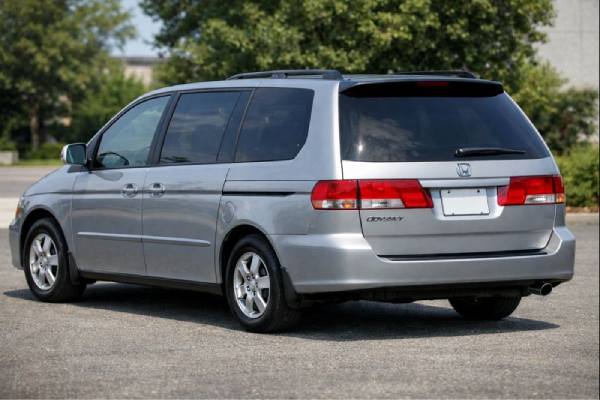
The 2002–2004 facelift Honda Odyssey (RL1) is the “mature” version of the first North American-style Odyssey: more power, more usable features, and small refinements that make it feel less like a tall wagon and more like a true long-haul family tool. With the J35A4 3.5-liter V6 rated at 240 hp and a front-wheel-drive layout, it’s built for effortless merging, stable cruising, and day-to-day hauling—often with a full cabin and cargo.
As an ownership proposition today, it’s best approached like a light-duty fleet vehicle. When the cooling system is healthy and the transmission is serviced with the correct fluid at conservative intervals, the drivetrain can stay smooth and dependable. Where owners get burned is deferred maintenance: old hoses, tired radiators, neglected ATF, and worn mounts turn a “great van” into a costly project. Buy on condition and service history first, and the facelift RL1 remains one of the most practical used family vehicles of its era.
Quick Specs and Notes
- Strong real-world pull when loaded; the 240 hp V6 makes highway driving feel easy and calm.
- Very usable interior width and low floor; child-seat access and third-row practicality are standout strengths.
- Simple FWD layout keeps running costs predictable when suspension and brakes are kept fresh.
- Transmission health is the big variable—avoid examples with unknown ATF history or hot-shift issues.
- Baseline interval to plan around: automatic transmission fluid drain-and-fill about every 40,000–50,000 km (25,000–30,000 mi) under mixed family use.
Navigate this guide
- Facelift RL1: what changed
- J35A4 specs, dimensions, and capacities
- Trims, equipment, and safety setup
- Reliability issues and service actions
- Maintenance plan and buyer’s checklist
- Driving performance and fuel use
- Comparison with minivan rivals
Facelift RL1: what changed
The 2002–2004 facelift Odyssey RL1 is the same core platform as the earlier 1999–2001 van, but it’s the version many owners prefer because the updates align with how families actually use a minivan. The headline change is the J35A4 3.5-liter V6, bringing a healthier power margin for full-load driving. That matters on real roads: a minivan spends a lot of time carrying passengers, cargo, and sometimes a roof box, which turns modest horsepower into constant downshifts. The facelift’s stronger output reduces that strain and makes the Odyssey feel less “busy” on motorways.
Honda also leaned into convenience and livability. Depending on trim and market, you’ll see upgrades like more available comfort features, improved interior materials, and option packages that target long trips (rear entertainment, upgraded audio, navigation on some versions). Those items don’t change the basic mechanical character, but they can change how you feel about the vehicle every day—especially if you’re buying it as a primary family car rather than an occasional hauler.
The driving personality is stable and predictable, with the chassis tuned to remain calm under load. That calmness is partly geometry and partly weight. At nearly two tons in many configurations, the Odyssey is not a “point and shoot” vehicle, and it’s not trying to be. Instead, it aims for smoothness, a confident straight-line feel, and predictable braking—so long as tires, alignment, and suspension bushings are in good shape.
The important ownership takeaway is that the facelift doesn’t make the RL1 immune to age. Rubber, plastics, fluids, and electrical connectors are now old enough that condition matters more than badges. A van with fresh cooling components, clean transmission behavior when hot, and documented major services will feel remarkably modern in daily use. One with unknown history can quickly become a cycle of overheating scares, shifting complaints, and frustrating electrical gremlins. Treat the facelift RL1 as a well-engineered tool that still requires disciplined upkeep, and it can be an excellent value.
J35A4 specs, dimensions, and capacities
This section focuses on the 2002–2004 Odyssey RL1 facelift with J35A4 and FWD. Some figures vary by trim, market, and equipment, so use your VIN-specific labels and service literature for final confirmation.
Powertrain and efficiency
| Item | Specification |
|---|---|
| Code | J35A4 |
| Engine layout and cylinders | V6, 6 cylinders, SOHC, 24 valves |
| Valvetrain notes | VTEC-equipped variants are common for this era; confirm by engine ID and service literature |
| Bore × stroke | 89 × 93 mm (3.50 × 3.66 in) |
| Displacement | 3.5 L (3,471 cc) |
| Induction | Naturally aspirated |
| Fuel system | PFI/MPFI |
| Compression ratio | Typically around 10:1 (market-dependent) |
| Max power | 240 hp (179 kW) @ ~5,400 rpm |
| Max torque | ~242 lb-ft (328 Nm) @ ~4,500 rpm |
| Timing drive | Belt |
| Rated efficiency | Varies by test standard; expect minivan-typical consumption for a 3.5 V6 with a 4-speed automatic |
| Real-world highway @ 120 km/h | Commonly 11–13.5 L/100 km (17–21 mpg US / 21–26 mpg UK) depending on load, tires, and wind |
| Aerodynamics | Cd and frontal area are rarely published in owner-facing data; treat economy as speed- and load-sensitive |
Transmission and driveline
| Item | Specification |
|---|---|
| Transmission | 4-speed automatic (verify code by VIN plate/service data) |
| Drive type | FWD |
| Differential | Open |
Chassis and dimensions (typical for RL1)
| Item | Specification |
|---|---|
| Suspension (front/rear) | Independent layouts tuned for load stability (exact details vary by market descriptions) |
| Steering | Power-assisted rack; ratio varies by year/trim |
| Brakes | 4-wheel disc is common; verify by trim and wheel size |
| Wheels and tyres | Many trims use 16-inch wheels; tire size depends on trim and market placard |
| Length / width / height | Approximately 4,840 / 1,995–2,000 / 1,740–1,760 mm (190.5 / 78.5–78.7 / 68.5–69.3 in) |
| Wheelbase | Approximately 2,830 mm (111.4 in) |
| Turning circle | Often around 11.4–11.9 m (37–39 ft) depending on tires and alignment |
| Kerb weight | Roughly 1,950–2,050 kg (4,300–4,520 lb) depending on equipment |
| Fuel tank | Commonly ~75–76 L (19.8–20.1 US gal / 16.5–16.7 UK gal) |
| Cargo volume | Highly configuration-dependent; practical usability is the main advantage (wide opening, low floor) |
Performance and capability (ownership-relevant)
| Item | Typical expectation |
|---|---|
| 0–100 km/h (0–62 mph) | About 8.5–9.5 s depending on load and conditions |
| Top speed | Generally limited by gearing/aerodynamics; expect ~180 km/h (112 mph) range in healthy condition |
| Towing capacity | Ratings vary widely by market/equipment; confirm by VIN and hitch/cooling setup |
Fluids, service capacities, and key torque specs
These are practical planning figures; always verify for your exact VIN and service manual edition.
| Item | Guidance |
|---|---|
| Engine oil | Often 5W-20 or 5W-30 depending on climate/market; capacity typically ~4.3 L (4.5 US qt) with filter |
| Coolant | Long-life ethylene glycol; capacity varies with radiator/heater circuit |
| Transmission fluid | Use the correct Honda ATF specification for your transmission; drain-and-fill quantity is much less than total capacity |
| A/C refrigerant | Usually R-134a; charge varies by system label |
| Lug nuts | Common Honda spec is 108 Nm (80 lb-ft) (verify for wheel type) |
| Spark plugs | Often ~18 Nm (13 lb-ft) (verify plug type and manual) |
| Engine oil drain plug | Often ~39 Nm (29 lb-ft) (verify pan and plug type) |
Electrical and safety snapshot (spec format)
| Item | Guidance |
|---|---|
| Alternator output | Varies by year/options; confirm by part number if diagnosing charging issues |
| 12V battery | Size/CCA varies; choose a quality battery and keep terminals clean |
| Crash ratings | Check the exact year on IIHS or local bodies; test protocols differ by year |
| ADAS suite | This era predates modern AEB/ACC/LKA; expect core ABS and airbag systems, with trim-dependent add-ons |
Trims, equipment, and safety setup
For the 2002–2004 facelift Odyssey RL1, trims usually separate into “core mechanical sameness with equipment differences.” That’s good news for used buyers: you’re not chasing rare driveline variants, but you do need to match the van’s features to your household and your tolerance for age-related electrical work.
Trims and options that affect ownership
Typical trim structure in many markets includes value-focused trims and higher trims that bundle family conveniences:
- Seating and interior: Cloth vs leather, power adjustments, and second-row flexibility vary. What matters most is condition: worn seat tracks, broken recline mechanisms, and missing latch covers can be surprisingly annoying and time-consuming to fix.
- Sliding doors: Power sliding doors (where equipped) improve daily life but add moving parts and wiring. Test them repeatedly: open/close cycles, obstruction reversal, and remote or switch operation. Sticky tracks and tired rollers are common, and electrical issues can be intermittent.
- Climate control and rear HVAC: Rear climate capability is a major comfort factor. Confirm strong airflow from front and rear, stable temperature control, and consistent A/C performance at idle. Weak idle cooling can hint at condenser airflow problems, tired fans, or system wear.
- Audio and travel tech: Premium audio, rear entertainment, and navigation (where available) can be valuable, but factor in aging screens, dead pixels, and obsolete media formats. Consider these “nice to have,” not reasons to overpay.
Mechanically, wheel and tire packages can change how the van rides and how expensive it is to keep aligned. Heavier wheels and low-quality tires often produce vibration complaints that owners mistake for driveline problems. If you test-drive a van with steering shake at 90–120 km/h, assume tires/wheels and alignment until proven otherwise.
Safety ratings and what to look for
Safety ratings for this era often come from IIHS front-offset testing and other regional programs. The key practical point is that protocols evolve, so a “Good” in one test category doesn’t automatically mean modern-level protection in every scenario. For the used buyer, the most meaningful safety improvements come from:
- Functioning airbags and intact SRS system: No warning lights, no taped-over bulbs, no salvaged airbag modules.
- Healthy ABS braking: Confirm ABS light behavior at startup and confirm stable braking on a safe surface.
- Tires and brakes: The best crash avoidance tool on an older minivan is still grip and predictable braking.
Safety systems and driver assistance
This Odyssey is from before widespread camera- and radar-based assistance. Expect the fundamentals:
- Airbags: Front airbags are standard; side airbags may be trim- or market-dependent.
- ABS: Common across trims.
- Stability and traction control: Availability depends on year and trim. Confirm by dashboard indicators and the build sheet if possible.
- Child-seat provisions: Verify anchors and belt function. Smooth retractors and secure latch points matter as much as having them.
If you’re choosing between trims, prioritize the one with the best mechanical history first, then pick the features that match your daily routine.
Reliability issues and service actions
The facelift RL1 Odyssey can be very reliable, but only if you treat it like a heavy, heat-generating vehicle. Most costly problems trace back to heat, fluid condition, and deferred rubber/plastic replacement. Below is a practical map of issues by prevalence and cost tier.
Common issues (watch these first)
- Automatic transmission wear (high severity, high cost):
Symptoms: shift flare, harsh 2–3 or 3–4 shifts, delayed Drive/Reverse engagement, shudder when warm, burnt-smelling ATF.
Likely cause: heat and fluid breakdown over time; heavy loads and frequent stop-and-go accelerate wear.
Remedy: regular drain-and-fill services with the correct Honda ATF, early diagnosis of solenoids and pressure issues, and avoiding “drive it until it fails” logic. When test-driving, insist on a fully warm drive; many problem transmissions behave acceptably when cold. - Cooling system aging (medium–high severity, medium cost):
Symptoms: temperature creep in traffic, coolant smell, slow loss, heater performance changes, fan cycling issues.
Cause: radiators, hoses, and thermostats age out; fans and relays can also weaken.
Remedy: pressure test, replace tired hoses and radiator proactively if history is unknown, confirm fans run correctly, and keep the system clean with the proper coolant. - Engine mount wear (medium severity, medium cost):
Symptoms: vibration at idle, clunk when shifting, harshness on throttle tip-in.
Cause: torque load and rubber aging.
Remedy: replace worn mounts as a set when needed; check exhaust flex sections and heat shields that can mimic mount noises.
Occasional issues (still important)
- EGR and intake deposit problems (medium severity, medium cost):
Symptoms: hesitation, pinging under load, rough idle, certain emissions faults.
Cause: deposit accumulation and aging emissions hardware.
Remedy: correct cleaning and component replacement; avoid guessing with random additives as a first step. - Power steering leaks and noise (medium severity, medium cost):
Symptoms: whining, heavy steering at low speed, fluid seepage.
Cause: hose and seal aging, sometimes pump wear.
Remedy: replace leaking components and use the correct fluid type. - Sliding door hardware and wiring (medium severity, medium cost):
Symptoms: doors that stop/reverse, intermittent switches, warning chimes.
Cause: roller wear, dirty tracks, harness fatigue.
Remedy: clean tracks, service rollers, and repair wiring properly (not temporary splices that fail again).
Recalls, TSBs, and verification
On a 2002–2004 vehicle, recall and campaign history can be long and inconsistent across owners. Practical steps:
- Run an official VIN recall check for your country.
- Ask for documentation showing completion (dealer invoices or printouts).
- If the vehicle has SRS or ABS warning lights, treat that as a non-negotiable fix item—not a “later” job.
Pre-purchase checks to request
- Full service history focusing on ATF service, coolant service, and timing-belt history.
- Evidence of recent radiator/hoses/thermostat work if mileage is high or history is unclear.
- A warm test drive long enough to reveal shifting and cooling behavior.
If you get those right, the facelift RL1 tends to be a stable, predictable long-term family vehicle.
Maintenance plan and buyer’s checklist
A good maintenance plan for the facelift RL1 is built around two truths: it’s heavy, and it runs warm when loaded. Conservative intervals often cost less than “factory maximum” schedules once the vehicle is older.
Practical schedule (distance and time)
Use this as a sensible baseline for mixed family use, then align it with your official documentation:
- Engine oil and filter: every 8,000–10,000 km (5,000–6,000 mi) or 6 months. Choose the shorter interval for short trips, cold starts, or hot climates.
- Engine air filter: inspect at each oil change; replace about 20,000–30,000 km depending on dust.
- Cabin air filter (if equipped): every 15,000–25,000 km or annually.
- Coolant: follow the correct Honda coolant type and interval. If history is unknown, treat a full coolant service plus a pressure test as an early priority.
- Spark plugs: many setups use long-life plugs; plan around 150,000–160,000 km (90,000–100,000 mi) unless symptoms demand earlier.
- Timing belt system: if your engine uses a belt (common for this era), replace at the official interval or immediately if history is unknown. Do the belt, tensioner, and water pump together.
- Automatic transmission fluid: prefer regular drain-and-fill service about every 40,000–50,000 km (25,000–30,000 mi). If the van tows, idles heavily, or sees lots of city use, tighten the interval.
- Brake fluid: every 2 years.
- Brake inspection: pads/rotors and caliper slide pins every 10,000–15,000 km.
- Tire rotation and alignment: rotate every 10,000–12,000 km; align whenever tires show uneven wear or after suspension work.
- Accessory belt and hoses: inspect annually; replace at the first sign of cracking, glazing, or seepage.
- 12V battery testing: test yearly; many batteries need replacement in the 4–6 year window depending on climate and usage.
Fluids and parts: what “correct” looks like
- Use the correct ATF specification for your transmission. Wrong fluid can create shudder, harshness, or accelerated wear.
- Use the correct coolant type, mixed properly, and keep the system sealed and pressurized.
- Choose quality engine mounts and suspension bushings; cheap rubber parts can make the van feel worn out quickly.
Essential torque values (decision-making only)
- Lug nuts: often around 108 Nm (80 lb-ft) (verify for your wheels).
- Spark plugs: often around 18 Nm (13 lb-ft) (verify plug type and head).
- Engine oil drain plug: often around 39 Nm (29 lb-ft) (verify pan/plug type).
Buyer’s checklist: avoid the expensive surprises
- Warm transmission test: drive until fully warm; check for flare, harsh shifts, or delayed engagement.
- Cooling system proof: ask what was replaced and when (radiator, hoses, thermostat, fans).
- Timing belt evidence: invoice or documentation that includes the water pump and tensioner.
- Electrical sweep: HVAC modes, windows, locks, door functions, and dash lights.
- Tire and alignment clues: uneven wear suggests suspension or steering play.
- Rust and structure: inspect sills, subframe areas, and suspension mounts—especially if the vehicle lived in salted climates.
A well-documented facelift RL1 often feels “sorted.” A poorly documented one may become an ongoing catch-up project.
Driving performance and fuel use
The facelift RL1 Odyssey’s driving experience is defined by smooth torque, stable road manners, and family-friendly control effort. It’s not sporty, but it’s confident—especially when the suspension, tires, and brakes are in good shape.
Real-world impressions: ride, handling, and NVH
- Ride quality: generally comfortable, with a “settled” feel on highways. Over sharp bumps, you may feel the weight, but the chassis is tuned to avoid nervousness. If it feels jittery, suspect worn dampers, tired bushings, or low-quality tires rather than “normal minivan behavior.”
- Handling balance: predictable understeer at the limit, as expected for a wide, FWD minivan. In everyday driving, it tracks straight and changes lanes confidently, especially with a proper alignment.
- Braking feel: should be stable and consistent. A long pedal can point to old brake fluid or air in the system. Pulling under braking often means uneven caliper operation or alignment issues.
- Noise levels: road and wind noise are higher than modern vans. A loud drone often indicates cupped tires, wheel bearing wear, or exhaust leaks rather than just age.
Powertrain character and passing performance
The J35A4’s stronger output is noticeable in how lightly it works. It doesn’t need constant high rpm, which helps long-trip comfort. The 4-speed automatic is tuned for smoothness, not rapid response; downshifts are deliberate. When you test-drive:
- check that it responds smoothly to moderate throttle without shudder,
- confirm it doesn’t “hunt” between gears on gentle hills,
- and verify it doesn’t slam or flare between shifts once fully warm.
Passing performance is typically strong for this class. Even when loaded, the van should feel comfortable making 80–120 km/h motorway passes, assuming the transmission is healthy.
Real-world efficiency
Fuel consumption depends heavily on speed and load. A practical planning range many owners see:
- City-heavy use: often 14–16.5 L/100 km (14–17 mpg US / 17–20 mpg UK) depending on trip length and idle time.
- Highway steady-state: often 11–13.5 L/100 km (17–21 mpg US / 21–26 mpg UK).
- Winter/cold starts: expect a noticeable penalty, especially on short trips.
If economy is worse than expected, look first at the basics: tire pressure, alignment, dragging brakes, old spark plugs, dirty air filter, tired oxygen sensors, and whether the transmission is slipping or hunting.
Traction and control in poor weather
FWD traction is usually adequate with good tires. The single biggest improvement for snow and wet grip is a high-quality tire set, not a mechanical tweak. If your trim has traction or stability control, confirm it works and that warning lights are not hidden or bypassed.
Load and towing notes
If towing is part of your plan, heat management is everything. Keep the cooling system excellent, shorten ATF service intervals, and drive with realistic expectations for an older 4-speed automatic.
Comparison with minivan rivals
The facelift RL1 Odyssey competes well as a used minivan because it combines strong everyday power with practical packaging. But it’s not the automatic best choice for every buyer. Here’s how it typically compares.
Toyota Sienna (early 2000s)
- Odyssey strengths: strong V6 pull, wide and usable cabin, family-focused packaging, and a generally “cohesive” driving feel.
- Sienna strengths: a reputation for conservative durability in many owners’ experiences, and often a calmer long-term ownership profile in some years.
- What decides it: condition and maintenance history. A well-serviced Odyssey can be an excellent daily vehicle, but a neglected transmission can erase any purchase-price advantage.
Chrysler/Dodge minivans of the era
- Odyssey strengths: engine smoothness, straightforward usability, and a sense of solidity on the highway when sorted.
- Chrysler/Dodge strengths: clever seating solutions and features in certain trims, often widely available parts and strong aftermarket support.
- What decides it: your tolerance for feature complexity and the specific vehicle’s mechanical condition. For long-term predictability, the cleanest drivetrain and best paperwork usually wins.
Nissan Quest and Kia Sedona (early 2000s)
- Odyssey strengths: strong market support, familiar service knowledge, and a proven family-vehicle formula.
- Quest/Sedona strengths: sometimes cheaper entry prices and different feature mixes.
- What decides it: parts access in your area and whether the example you’re looking at has documented, disciplined maintenance.
Why buyers still choose the 2002–2004 facelift RL1
Choose this Odyssey if you want:
- strong, relaxed performance with family loads,
- a wide and practical cabin that still works for real three-row use,
- and a minivan that can be dependable when maintained conservatively.
Consider alternatives if:
- you can’t verify transmission servicing and the van shows warm-shift problems,
- the cooling system history is unclear and temperature behavior isn’t rock-solid,
- or you prefer a platform with a different long-term transmission reputation.
In short: the facelift RL1 is often a great value when you buy a maintained example. It’s a risky purchase only when you buy blind and hope it “works itself out.”
References
- 2004 Honda Odyssey 2004 (Safety Rating)
- Fuel Economy of the 2004 Honda Odyssey 2004 (Fuel Economy Data)
- Check for Recalls: Vehicle, Car Seat, Tire, Equipment 2025 (Recall Database)
- Owner’s Manuals 2025 (Owner’s Manual)
Disclaimer
This article is for informational purposes only and is not a substitute for professional inspection, diagnosis, or repair. Specifications, torque values, service intervals, and procedures vary by VIN, market, model year, and equipment. Always confirm details using your official owner’s manual, service documentation, and vehicle labels before purchasing parts or performing work.
If you found this guide useful, please consider sharing it on Facebook, X (Twitter), or your preferred social platform to support our work.