

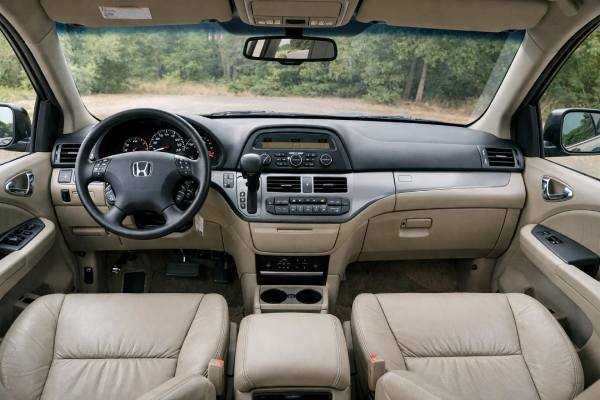
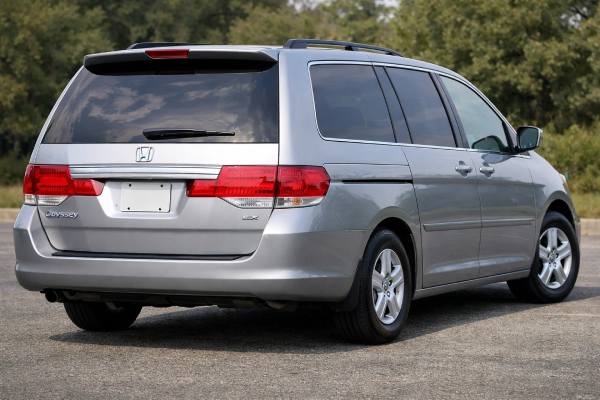
The 2005–2007 Honda Odyssey FWD in RL4 form pairs family-minivan packaging with a V6 that was tuned as much for smoothness and everyday efficiency as for outright power. The 3.5-liter J35A7 (244 hp) is best known for its broad torque, quiet cruising manners, and (on many trims) Variable Cylinder Management (VCM), which can deactivate cylinders on steady highway runs. The platform itself feels unusually “car-like” for its size thanks to disciplined body control and predictable steering, yet it still delivers the practical wins owners shop for: wide-opening doors, a low load floor, and real 3-row usability.
For long-term ownership, the Odyssey’s strengths come from consistent engineering choices—simple, naturally aspirated power, familiar Honda service routines, and strong passive safety design—while the main risks concentrate in a handful of systems (power sliding doors, transmission heat, and age-related rubber and hydraulic wear). Buy smart, maintain on schedule, and it’s a capable, durable people-mover.
Key Takeaways
- Smooth, torquey 3.5-liter V6 makes highway merging and full-load driving feel effortless.
- Practical cabin packaging and cargo volume stay competitive even by modern standards.
- Many trims add VCM for better steady-speed economy, but it adds complexity as the van ages.
- Plan for power sliding door upkeep (rollers, cables, latches) as mileage climbs.
- Replace engine oil about every 8,000–10,000 miles (13,000–16,000 km) or 12 months, sooner for short trips.
Jump to sections
- RL4 Odyssey in context
- J35A7 technical specifications
- Equipment, trims, and safety tech
- Reliability patterns and service bulletins
- Maintenance schedule and purchase checklist
- Driving impressions and fuel use
- RL4 vs key minivan rivals
RL4 Odyssey in context
If you’re shopping the 2005–2007 Odyssey family, the RL4/J35A7/244 hp combination is the “mature” version of Honda’s third-generation minivan formula: strong acceleration when you ask for it, calm behavior when you don’t, and a cabin that’s designed around real people rather than brochure bullet points. In daily use, the big story is how normal it feels to drive. The steering is light but accurate, the chassis is composed over broken pavement, and the braking system is sized for repeated stops with passengers on board.
The J35A7’s personality is classic Honda V6: smooth, eager midrange, and a refined sound under load. In many trims, VCM (Variable Cylinder Management) allows the engine to run on fewer cylinders during gentle cruising. When it’s working as intended, it can shave fuel use on long highway trips without changing the basic character of the van. The tradeoff is added hardware and control logic—engine mounts, noise-canceling, and monitoring—that can become an ownership variable at high mileage.
As a family tool, the Odyssey’s advantages are practical and measurable. Cargo space behind the third row is big enough for strollers or grocery runs without playing Tetris, and the “seats-down” volumes are strong for home-improvement errands. Seating capacity depends on trim (some are 8-passenger, Touring is commonly 7), and the second-row layout is designed so you can actually access the third row without a full unload.
The RL4-era Odyssey also has a clear ownership rhythm. Do routine fluids on time, keep the cooling system healthy, and treat the transmission kindly—especially if you tow, drive in mountains, or do heavy city traffic. When problems happen, they tend to cluster in known areas (power sliding doors, mounts, and age-related leaks) rather than random electronic chaos, which is good news for budgeting and diagnosis.
J35A7 technical specifications
Below are practical, shop-useful specifications for the 2005–2007 Odyssey FWD with the J35A7 3.5-liter V6 rated at 244 hp. Exact details can vary by market and trim, so treat these as the core baseline for RL4-type setups.
Powertrain and efficiency
| Item | Specification |
|---|---|
| Code | J35A7 |
| Engine layout and cylinders | V6, 6 cylinders, SOHC, 4 valves/cyl (24-valve) |
| Bore × stroke | 89 × 93 mm (3.50 × 3.66 in) |
| Displacement | 3.5 L (3471 cc) |
| Induction | Naturally aspirated |
| Fuel system | Multi-point fuel injection (PFI/MPFI) |
| Compression ratio | 10.0:1 |
| Max power | 244 hp (182 kW) @ 5750 rpm |
| Max torque | 325 Nm (240 lb-ft) @ 4500 rpm (often VCM trims); some non-VCM listings show peak at 5000 rpm |
| Timing drive | Belt |
| Rated efficiency (typical) | 8.7 L/100 km (27 mpg US / 32.4 mpg UK) highway; 12.4 L/100 km (19 mpg US / 22.8 mpg UK) city |
| Real-world highway @ 120 km/h | Often ~9.5–11.0 L/100 km depending on load, tires, wind, and roof gear |
| Aerodynamics | Cd and frontal area not consistently published for this model/trim set |
Transmission and driveline
| Item | Specification |
|---|---|
| Transmission | 5-speed automatic |
| Drive type | FWD |
| Differential | Open |
| Gear ratios | 1st 2.697; 2nd 1.606; 3rd 1.071; 4th 0.766; 5th 0.538; Reverse 1.889 |
| Final drive | 4.312 |
Chassis and dimensions
| Item | Specification |
|---|---|
| Suspension (front/rear) | MacPherson strut / multi-link double wishbone |
| Steering | Variable power-assisted rack-and-pinion |
| Steering ratio | 16.2:1 (typical listing) |
| Brakes | Front ventilated disc / rear solid disc; 295/312 mm (11.6/12.3 in) |
| Wheels/tires | Commonly 235/65 R16; some Touring setups use a different system/size |
| Length / width / height | 5105 mm (201.0 in) / 1958 mm (77.1 in) / up to 1778 mm (70.0 in) depending on trim |
| Wheelbase | 3000 mm (118.1 in) |
| Turning circle (kerb-to-kerb) | 11.2 m (36.7 ft) |
| Fuel tank | 80 L (21.0 US gal / 17.5 UK gal) |
| Cargo volume (SAE) | 1087 L (38.4 ft³) behind 3rd; 2579 L (91.1 ft³) behind 2nd; 4173 L (147.4 ft³) behind 1st |
| Towing capacity (braked) | 1588 kg (3500 lb) |
Performance and capability (real-world expectations)
Official performance numbers vary by publication and setup, so focus on what changes the ownership experience:
- 0–100 km/h (0–62 mph): typically high-7 to low-8 seconds in good condition
- Passing power: strong midrange response from ~40–100 km/h; feels confident even with passengers
- Top speed: usually electronically limited; not a meaningful buying factor for this van
- Towing behavior: stable when correctly loaded; transmission heat management becomes the main limiter
Fluids and service capacities (with key specs)
| Item | Specification |
|---|---|
| Engine oil | API 5W-20; oil change capacity incl. filter: 4.3 L (4.5 US qt) |
| Oil drain bolt torque | 39 Nm (29 lb-ft) |
| Coolant | Honda Long-life Antifreeze/Coolant Type 2, 50/50 premix; total system varies by drain method |
| Transmission/ATF | Honda ATF-Z1 specified for this era (later superseded by newer Honda ATF in many markets); capacity varies by service method |
| Brake fluid | DOT 3 preferred; DOT 3 or DOT 4 temporary acceptable; replace every 3 years |
| Power steering fluid | Honda PSF (do not substitute ATF as a general practice) |
| A/C refrigerant | HFC-134a; charge typically ~700–750 g (24.7–26.5 oz) depending on configuration |
| A/C compressor oil | ND-OIL8; typical charge ~180 mL (6.1 fl oz) |
| Wheel nut torque | 127 Nm (94 lb-ft) |
Electrical (typical service-relevant items)
| Item | Specification |
|---|---|
| 12V battery | 12V, 60 Ah or 72 Ah depending on trim/market |
| Spark plugs | NGK IZFR5K11 or DENSO SKJ20DR-M11; gap 1.0–1.1 mm (0.039–0.043 in) |
Safety and ratings (high-level)
| Item | Result / equipment note |
|---|---|
| IIHS crashworthiness | Strong “Good” results in key original frontal and side tests for 2005–2010 applicability; head restraint/seat score is often weaker |
| Airbags | Dual-stage front airbags, front side airbags, and full-length curtain airbags (trim/market dependent details) |
| Stability and braking | ABS, EBD, brake assist, and stability control (VSA) are common equipment in this generation |
Equipment, trims, and safety tech
For 2005–2007, Odyssey trims differ more in convenience and seating configuration than in core mechanical hardware. That’s good news for used buyers: you can choose features you’ll actually use without worrying that the “wrong trim” is secretly the fragile one. The main mechanical split to understand is whether your van uses VCM-related systems, because those add components (active mounts and noise cancellation) that can influence how the van feels as it ages.
Trim and option snapshot (typical North American lineup)
- LX: The simplest ownership play. You generally get the same basic V6 and 5-speed automatic behavior, with fewer powered features to maintain. Great if you want durability and don’t need premium audio or leather.
- EX: Adds convenience upgrades many families consider “must-have,” often including enhanced audio and more comfort features. A common sweet spot for value.
- EX-L: Often brings leather, heated seats, and—on many configurations—VCM plus the supporting systems (active control engine mounts and active noise cancellation). This is the “quiet cruiser” version when everything is healthy.
- Touring: Usually the feature flagship, often with navigation and additional convenience tech. Some Touring configurations used specialized tire systems, which can change tire availability and cost.
How to identify what you’re looking at (quick tells)
- VCM-equipped vans often have trim-level cues (EX-L/Touring) and may feel slightly different at steady cruise: lower rpm noise and a “softer” engine note when it transitions to reduced-cylinder operation.
- Seating capacity is an easy identifier: many trims are 8-passenger, while some Touring setups are 7-passenger.
- Tire setup matters: check the sidewall and spare-tire arrangements. A non-standard tire system can affect ride, replacement cost, and roadside repair options.
Safety equipment and child-seat practicality
This generation was engineered around strong passive safety structure and family use. Expect:
- Multi-row airbag coverage: front airbags plus side-impact and curtain protection depending on market/trim.
- LATCH/ISOFIX-style anchors: typically in second-row outboard positions, with additional tether provisions that help with forward-facing seats.
- Stability control and brake systems: ABS with electronic brake distribution and stability control are common and meaningful in a tall, heavy vehicle—especially in rain, snow, or evasive maneuvers.
Crash ratings: how to interpret them correctly
When you see crash-test results for 2005–2007, pay attention to which test version is being referenced. The Odyssey performed strongly in widely cited tests of its era, but later test updates across the industry can change comparisons (newer test protocols can expose weaknesses that older protocols did not measure). For a buyer today, that means two practical actions matter more than the headline score:
- Confirm all airbags, seat belts, and sensors are intact (no SRS light, no missing trim, no salvage repairs in the front corners).
- Inspect tires and brakes carefully because stability and stopping performance are heavily tire- and maintenance-dependent, especially on a used minivan.
Finally, remember that this Odyssey era has essentially no modern ADAS (advanced driver assistance systems) by today’s standards. You’re relying on structure, belts, airbags, ABS, and stability control—so keeping those systems healthy is the safety strategy.
Reliability patterns and service bulletins
A well-kept 2005–2007 Odyssey can run for a long time, but reliability is not “set and forget.” The ownership experience improves dramatically when you treat known weak points as scheduled maintenance rather than surprises. Below is a practical map of what tends to happen, when it tends to happen, and how expensive it usually is.
Common issues (high prevalence)
- Power sliding doors (medium cost, high annoyance):
Symptoms: door reverses, beeps, won’t latch, intermittent operation.
Likely causes: roller wear, cable issues, dirty tracks, failing latch microswitches, or tired motors.
Remedy: clean and lubricate tracks correctly, inspect rollers, adjust alignment, replace cables/rollers/latch parts as needed. - Transmission fluid stress (medium to high cost if ignored):
Symptoms: delayed engagement, flare on shifts, shudder, harsh downshifts, overheating when towing or in mountains.
Likely causes: old ATF, heat cycling, worn clutch material, or valve-body/pressure-control wear.
Remedy: maintain ATF quality (more frequent changes under severe use), ensure cooling system health, and diagnose early if shudder appears. - Engine mount wear on VCM setups (medium cost):
Symptoms: vibration at idle, a “buzz” at steady cruise, clunks on shift engagement.
Likely causes: worn hydraulic mounts; on VCM-equipped vans the active mount system is doing more work.
Remedy: confirm mount condition, fix vacuum or control issues, replace mounts if leaking or collapsed.
Occasional issues (moderate prevalence)
- Oil consumption or plug fouling patterns (cost varies):
Symptoms: dropping oil level between changes, misfire under load, rough running.
Likely causes: aging rings/valve-stem seals on high-mileage engines, or operating patterns that don’t suit the cylinder-deactivation strategy.
Remedy: shorten oil intervals, monitor level, inspect plugs/coils, and address PCV and leak issues before assuming internal engine wear. - Cooling system aging (medium cost):
Symptoms: slow coolant loss, overheating in traffic, sweet smell, crusty residue near hoses/radiator.
Likely causes: old coolant, tired hoses, radiator end-tank seepage, thermostat wear.
Remedy: use correct premix coolant, keep caps/hoses fresh, and treat any overheat as urgent. - Power steering leaks (medium cost):
Symptoms: whining pump, heavy steering, fluid drops, wet hoses.
Likely causes: hose seepage, o-ring hardening, pump wear.
Remedy: fix leaks early to avoid pump damage; use the correct Honda-spec fluid.
Rare but expensive (low prevalence, high impact)
- Major transmission failure: usually the end result of long-term heat and neglected fluid, not a sudden random event.
- Electrical network gremlins after poor repairs: aftermarket wiring for entertainment systems, remote starts, or trailer wiring is a frequent root cause of “mystery” issues.
Recalls, TSBs, and service actions: how to handle them safely
Because recall coverage and completion depend on VIN, region, and prior owner history, don’t buy based on assumptions. Do this instead:
- Run the VIN through an official recall database and print/save the results.
- Ask the seller for dealer service records or proof of recall completion.
- Verify warning lights (SRS/ABS/VSA) are off at startup and remain off after a road test.
If the van drives well but has incomplete recall history, that’s not automatically a deal-breaker—but it should influence price and your first-week ownership plan.
Maintenance schedule and purchase checklist
The Odyssey rewards owners who maintain it like a working vehicle: fluids, belts, and wearable hardware on time, plus earlier service for severe use (short trips, heavy city driving, mountains, towing, extreme temperatures). Use the checklist below as a practical baseline, then align it with the vehicle’s maintenance minder prompts and any region-specific service notes.
Practical maintenance schedule (distance and time)
| Item | Normal use | Severe use notes |
|---|---|---|
| Engine oil and filter (5W-20) | Every 8,000–10,000 mi (13,000–16,000 km) or 12 months | 5,000–7,500 mi (8,000–12,000 km) for short trips, heavy idle time, or high load |
| Check oil level | Monthly | Every 2 fuel fills if high-mileage or known consumption |
| Air filter (engine) | Inspect at each oil service; replace as needed | In dust: replace about every 15,000 mi (24,000 km) |
| Cabin filter | Annually or as airflow drops | In heavy soot/urban conditions: about every 15,000 mi (24,000 km) |
| ATF (5AT) | Follow maintenance minder | If towing/mountains/low-speed heat: about every 30,000 mi (48,000 km) |
| Brake fluid | Every 3 years | Same (time-based) |
| Coolant (Type 2 premix) | Follow maintenance minder; commonly long-life intervals | Shorten interval if any overheating history or unknown coolant type |
| Spark plugs | Follow maintenance minder; commonly long interval | Replace sooner if misfires, oil fouling, or poor service history |
| Timing belt and water pump inspection | Follow maintenance minder | In extreme hot/cold climates: shorten (some guidance points to ~60,000 mi / 100,000 km) |
| Accessory/drive belt | Inspect at each oil service | Replace earlier if cracking/noise; heat accelerates wear |
| Tires and alignment | Rotate as prompted; align if uneven wear | Check pressures monthly; correct toe wear early to save tires |
| Battery test | Yearly after 4 years of age | Replace proactively if winter starting is weak |
Fluid specs and “decision-making” capacities
- Engine oil: 5W-20; oil change about 4.3 L (4.5 US qt) including filter.
- ATF: Honda ATF-Z1 era spec (many markets use a later Honda ATF equivalent now); do not mix unknown fluids if you can avoid it—plan a proper service if history is unclear.
- Brake fluid: DOT 3 preferred; replace every 3 years to protect ABS components.
- Coolant: Honda Long-life Type 2 premix (50/50). Avoid stop-leak additives.
Essential torque values (owner-relevant)
| Fastener | Torque |
|---|---|
| Wheel nuts | 127 Nm (94 lb-ft) |
| Engine oil drain bolt | 39 Nm (29 lb-ft) |
Pre-purchase inspection checklist (what to request and what to test)
Service history and paperwork
- Evidence of regular oil changes (more important than perfect intervals).
- Transmission service history, especially if the van towed or lived in mountains.
- Proof of timing belt service if mileage/time suggests it is due.
- Recall completion proof or a plan to complete outstanding items immediately.
Physical checks (walk-around and under-hood)
- Sliding doors: open/close multiple times, listen for strain, and confirm smooth latching.
- Cooling system: check for dried coolant residue, hose swelling, and consistent cabin heat.
- Oil level and condition: confirm level is correct and not fuel-diluted or heavily sludged.
- Power steering: look for wet hoses and check for pump whine at full lock (don’t hold full lock).
Road test (10–20 minutes, mixed conditions)
- Transmission: smooth engagement, no flare, no persistent shudder under light throttle.
- Brakes: straight stops, no pulsing, stable pedal feel.
- Steering: no clunks over bumps; consistent assist.
- VCM behavior (if equipped): mild changes are normal; harsh surging or persistent vibration is not.
Long-term durability outlook
If you buy a clean example and keep fluids fresh, the RL4 Odyssey is typically a “predictable” long-term vehicle: fewer surprises, more wear-and-tear. The biggest durability separator is whether the previous owner treated the transmission and cooling system conservatively, and whether sliding-door hardware was serviced before it failed completely.
Driving impressions and fuel use
The best way to describe the RL4 Odyssey’s road manners is “competent, quiet, and surprisingly car-like.” It’s not trying to be sporty, but it avoids the floaty, detached feeling that older minivans can have. That matters when you’re driving tired, in rain, with a full cabin—because predictable responses reduce workload.
Ride, handling, and NVH
- Ride quality: Firm enough to control body motion, soft enough to feel appropriate for family duty. Expansion joints and broken city pavement are handled with a single, well-damped movement rather than repeated bouncing.
- Steering and stability: Light steering effort with decent on-center stability. Highway tracking is strong for the class, and crosswinds are manageable for a tall vehicle.
- Cabin noise: Wind and tire noise are reasonable, and the V6 is smooth under acceleration. VCM-equipped vans often feel quieter at steady cruise—when the system is healthy and mounts are doing their job.
Powertrain character (J35A7 + 5AT)
The 244 hp rating doesn’t tell the whole story. What you feel is torque delivery that suits real driving: brisk launch when merging into traffic, confident midrange for passing, and relaxed rpm on long highway grades. The 5-speed automatic is tuned for smoothness, and it generally behaves best when fluid condition is excellent. With worn fluid, you may notice more hunting or harsher downshifts, especially with hills and a full load.
If your van has VCM, you’ll occasionally sense transitions during gentle cruising—often as a subtle change in engine note or a faint shift in vibration. It should not feel like a surge, stumble, or repeated cycling. If it does, treat it as a diagnostic clue (mounts, plugs, or control issues) rather than “normal.”
Real-world fuel economy (what owners can expect)
Factory ratings are helpful, but a minivan’s real consumption is heavily affected by load, speed, and trip length.
- City driving: commonly 12–14+ L/100 km (roughly 17–20 mpg US), especially with short trips and winter warmups.
- Highway at 100–110 km/h: often 9–11 L/100 km (roughly 21–26 mpg US), depending on tires and passengers.
- Highway at 120 km/h: expect a noticeable penalty, especially with roof boxes or headwinds.
VCM can help on steady highway runs, but it won’t “fix” stop-and-go commuting. For many owners, the most effective fuel-saving habits are simple: keep tires at correct pressure, avoid unnecessary roof accessories, and keep up with ATF and engine oil service.
Load and towing behavior
With the correct hitch setup and sensible loading, the Odyssey tows confidently within its rating. The limiting factor is rarely engine power—it’s heat management. If you tow regularly, shorten ATF service intervals, keep the cooling system pristine, and watch for early signs of transmission strain (odor, shift quality changes, or delayed engagement).
RL4 vs key minivan rivals
In the 2005–2007 used-minivan space, most shoppers cross-shop the Odyssey against the Toyota Sienna, Chrysler Town and Country/Grand Caravan variants, and (depending on region) the Kia Sedona. Each has a different “ownership personality,” and knowing that helps you pick the right compromise.
Versus Toyota Sienna (similar years)
- Why choose the Odyssey: more connected driving feel, strong braking and stability behavior, and a very usable cargo layout. Many owners also prefer the Odyssey’s steering and chassis composure.
- Why choose the Sienna: reputation for powertrain durability and a simpler long-term rhythm in some markets. If you prioritize “appliance reliability” over road feel, Sienna is a rational alternative.
- Decision tip: buy the best-maintained example, but if both are equal, pick Odyssey for driving dynamics and interior cleverness; pick Sienna for conservative ownership priorities.
Versus Chrysler/Dodge minivans (Town and Country, Grand Caravan)
- Why choose the Odyssey: generally tighter build feel, stronger chassis discipline, and a more refined V6 character.
- Why choose the Chrysler/Dodge: often lower purchase price and sometimes very convenient seating systems depending on year and trim.
- Decision tip: if budget is tight and you can verify strong maintenance history, a Chrysler/Dodge can work. If you want the lower-drama long-term play, the Odyssey is usually the safer bet.
Versus Kia Sedona (where applicable)
- Why choose the Odyssey: deeper parts ecosystem, widely understood service routines, and strong real-world practicality.
- Why choose the Sedona: sometimes better value on the used market and different feature packaging.
- Decision tip: Sedona can be attractive on price, but the Odyssey’s community knowledge, parts availability, and proven service patterns often make ownership easier.
The RL4 Odyssey advantage in one line
If you want a minivan that feels engineered rather than merely assembled—good road manners, strong packaging, and predictable maintenance—the RL4 Odyssey remains a compelling pick, provided you buy one with clean service history and you’re prepared to maintain doors, fluids, and mounts proactively.
References
- OD_07_fact.indd 2007 (Specification Sheet)
- 2005 Honda Odyssey 2005 (Safety Rating)
- Check for Recalls: Vehicle, Car Seat, Tire, Equipment | NHTSA 2026 (Recall Database)
- Vehicle Detail Search – 2005 HONDA ODYSSEY 4 DR FWD | NHTSA 2026 (Recall and Ratings Portal)
- Fuel Economy of the 2005 Honda Odyssey 2005 (EPA Fuel Economy)
Disclaimer
This article is for informational purposes only and is not a substitute for professional inspection, diagnosis, or repair. Specifications, torque values, service intervals, and procedures can vary by VIN, market, model year, and installed equipment; always verify details using the official owner’s manual and service documentation for your exact vehicle.
If you found this guide useful, consider sharing it on Facebook or X (Twitter) to help others maintain and buy these vehicles more confidently.