
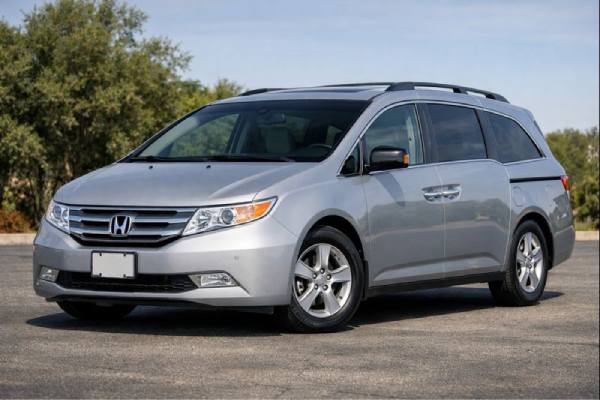
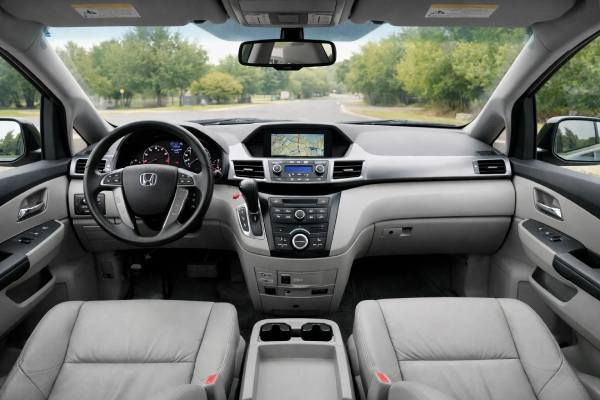
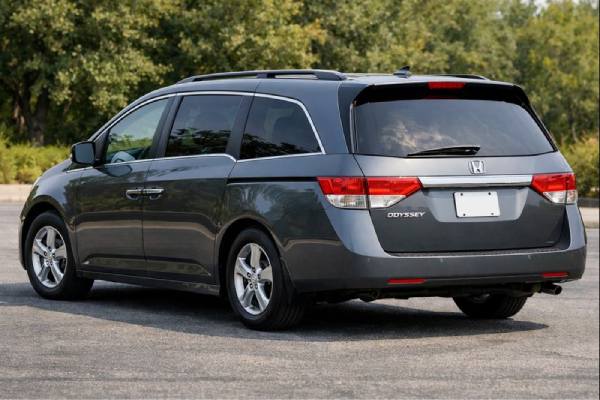
The 2011–2013 Honda Odyssey (RL5) is the fourth-generation Odyssey, and it’s the version most buyers think of when they want a “modern” minivan without the complexity of newer driver-assist systems. The J35Z8 3.5-liter V6 is smooth, strong at highway speeds, and well matched to the Odyssey’s family-duty mission—especially when fully loaded. Where this RL5 stands out is refinement: stable straight-line tracking, low cabin fatigue on long trips, and a chassis tuned for predictable responses rather than sporty feel.
Ownership is usually straightforward if you treat it like a high-mileage work vehicle: stay on top of fluids, keep the cooling system healthy, and be disciplined about the timing belt interval. Do that, and the RL5 can be a long-term, high-utility people mover with few surprises.
What to Know
- Strong highway passing and calm cruising even with 6–7 passengers.
- Useful interior packaging: wide doors, low step-in, and easy third-row access.
- Proven V6 layout with widely available parts and service knowledge.
- Budget for timing belt service on schedule; skipping it is the expensive mistake.
- Plan engine oil changes every 8,000–12,000 km (5,000–7,500 mi) or 12 months, depending on usage.
Section overview
- Odyssey RL5 J35Z8 at a glance
- Specs and capacities 2011–2013
- Trims, options, and safety gear
- Reliability issues, recalls, and fixes
- Maintenance plan and buying checklist
- Driving feel and real-world economy
- RL5 Odyssey versus key rivals
Odyssey RL5 J35Z8 at a glance
This 2011–2013 Odyssey is built around a simple idea: carry a full family and their gear without feeling like you’re “driving a bus.” The RL5 platform is wider and stiffer than the prior generation, which helps ride quality and crash performance, but it still keeps the everyday ergonomics that matter—big glass, a low hood line, and doors that make child-seat life easier.
The J35Z8 V6 is naturally aspirated (no turbo heat management, no direct-injection carbon concerns in typical use), and it delivers its best work in the midrange. You feel it most on highway merges and passing: the Odyssey doesn’t need heroic throttle to keep pace when loaded. Depending on trim, you’ll encounter either a 5-speed automatic (common on lower trims) or a 6-speed automatic (typically higher trims). The 6-speed tends to keep the engine in a better part of the torque curve and can be slightly more efficient on steady highway runs.
Where owners usually win (or lose) is maintenance discipline. This is a family hauler that often lives a hard life—short trips, heavy city use, heat-soak, and constant stop-start. If you stay ahead of fluid aging (engine oil, ATF, brake fluid, coolant) and treat the timing belt service as non-negotiable, the RL5’s mechanical core is capable of high mileage. If you ignore those basics, the Odyssey can punish your budget with misfires, overheating, and transmission drivability problems that often start as “just a small shudder.”
Advantages that still matter today:
- Refinement for the class: stable at speed, low wind noise for a minivan, and good brake feel when serviced properly.
- Family-first packaging: easy access to the third row and a useful cargo well behind it.
- Service ecosystem: many independent shops know this platform well, and parts availability is strong.
Trade-offs to accept upfront:
- It is not a light vehicle, so tires, brakes, and suspension wear are normal consumables—not rare events.
- Some trims pack more tech (power doors, screens, cameras), which adds convenience but increases the number of aging components to inspect.
Specs and capacities 2011–2013
Below are practical, ownership-focused specifications for the 2011–2013 Odyssey (RL5) with the J35Z8 3.5 l V6 in FWD form. Exact figures can vary by trim, wheel package, and market, so treat the tables as a decision guide and verify with VIN-specific documentation.
Powertrain and efficiency
| Item | Specification |
|---|---|
| Code | J35Z8 |
| Engine layout and cylinders | V6, 6 cylinders, SOHC i-VTEC, 4 valves/cyl |
| Bore × stroke | 89.0 × 93.0 mm (3.50 × 3.66 in) |
| Displacement | 3.5 L (3,471 cc) |
| Induction | Naturally aspirated |
| Fuel system | PGM-FI (multi-point fuel injection) |
| Compression ratio | ~10.5:1 |
| Max power | 248 hp (185 kW) @ ~5,700 rpm |
| Max torque | ~339 Nm (250 lb-ft) @ ~4,800 rpm |
| Timing drive | Belt |
| Rated efficiency (typical EPA, varies by transmission) | ~11.2–10.7 L/100 km (21–22 mpg US) combined |
| Real-world highway @ 120 km/h (75 mph) | ~10.0–11.5 L/100 km (20–24 mpg US), load and wind dependent |
Transmission and driveline
| Item | Specification |
|---|---|
| Transmission | 5-speed automatic (some trims) or 6-speed automatic (some trims) |
| Drive type | FWD |
| Differential | Open (traction control via brake intervention) |
Chassis and dimensions (typical RL5 range)
| Item | Specification |
|---|---|
| Suspension (front/rear) | MacPherson strut / multi-link |
| Steering | Electric power steering; rack-and-pinion |
| Brakes | 4-wheel discs; ABS with EBD and brake assist (trim-dependent details) |
| Wheels and tyres (common) | 235/65 R17 or 235/60 R18 |
| Ground clearance | ~115–130 mm (~4.5–5.1 in), trim/load dependent |
| Length / width / height | ~5,160 / 1,995 / 1,735 mm (~203.1 / 78.5 / 68.3 in) |
| Wheelbase | ~3,000 mm (~118.1 in) |
| Turning circle (kerb-to-kerb) | ~11.3 m (~37 ft) |
| Kerb (curb) weight | ~1,970–2,120 kg (~4,340–4,670 lb), trim dependent |
| Fuel tank | ~79.5 L (21.0 US gal / 17.5 UK gal) |
| Cargo volume | Market-method dependent; strong real-world space behind 3rd row plus deep well |
Performance and capability (typical)
| Item | Specification |
|---|---|
| Acceleration 0–100 km/h (0–62 mph) | ~7.8–9.0 s (trim/traction/load dependent) |
| Top speed | ~175–190 km/h (~109–118 mph), often limited |
| Towing capacity | Up to ~1,588 kg (3,500 lb) braked (equipment and market dependent) |
| Payload | Often ~550–700 kg (1,200–1,540 lb), verify door placard |
Fluids and service capacities (ownership-useful)
| Item | Specification |
|---|---|
| Engine oil | 0W-20; ~4.3 L (4.5 US qt) with filter (typical) |
| Coolant | Honda-type long-life coolant; capacity varies by market, typically ~6–8 L total system |
| Transmission/ATF | Honda ATF DW-1; drain-and-fill quantity commonly ~3–3.5 L (total capacity higher) |
| Differential / transfer case | Not applicable (FWD) |
| A/C refrigerant | R-134a; charge varies by equipment, commonly ~500–650 g (~18–23 oz) |
| Key torque specs | Oil drain plug ~39 Nm (29 lb-ft); wheel lug nuts ~127 Nm (94 lb-ft) |
Electrical
| Item | Specification |
|---|---|
| Alternator output | Trim dependent; typically in the 100–130 A class |
| 12 V battery | Group/CCA varies by market; expect 500–700 CCA range in many setups |
| Spark plugs | Long-life iridium type; gap is plug-specific—use OE spec |
Safety and driver assistance (era-correct)
| Item | Specification |
|---|---|
| Crash ratings | Vary by agency and year; IIHS results apply to 2011–2013 under the same structure/test family |
| ADAS suite | Pre-modern era: stability control, traction control, ABS; limited camera/parking aids by trim, not modern AEB/ACC |
Trims, options, and safety gear
For 2011–2013, Odyssey trim strategy is best understood as “comfort and family tech layers” rather than mechanical variations. The core hardware—J35Z8 V6 and FWD layout—stays consistent, while transmissions and equipment content can change your ownership experience.
Trims and options that matter in real life
Most markets cluster around variants similar to LX/EX/EX-L and higher-spec “touring-style” trims. Practical differences to watch:
- Transmission pairing: lower trims often use the 5-speed automatic; higher trims frequently get the 6-speed. In day-to-day driving, the 6-speed typically feels less busy at highway speed and can reduce fuel use slightly when cruising.
- Wheel and tire package: 17-inch setups tend to ride more softly and cost less over time; 18-inch packages can sharpen steering response slightly but increase tire cost and road-noise risk as tires age.
- Sliding door and tailgate equipment: power doors are a major convenience win for families, but inspect them carefully. Listen for strain, watch for uneven travel, and verify all handles and sensors behave consistently.
- Infotainment and rear entertainment: higher trims may include multiple screens, headphones, DVD systems, and more speakers. These features age like consumer electronics—some last, some become “intermittent,” and diagnosing them can be time-consuming.
- Seating configurations: check for second-row flexibility, removable or slide features (market dependent), and make sure seat latches operate smoothly. Family wear often shows up here first.
Quick identifiers when shopping used:
- Steering-wheel and dash controls: higher trims usually have more integrated controls and display menus.
- Parking sensors and camera presence: verify actual function, not just that the camera image appears.
- Wheel size and brake feel: a short test drive can reveal warped rotors (pulsation) and tired suspension bushings (clunks, steering wander).
Safety ratings in context
Safety ratings depend on the testing body and protocol year, and they’re not always comparable across generations. For RL5, the important point is that the structure and restraint strategy were designed for modern-era expectations, and many results for 2011–2013 are treated as a single group in some rating systems.
If you’re comparing vehicles, focus on what affects injury outcomes in everyday crashes:
- Seatbelt geometry and pretensioners: confirm belts retract crisply and lock under a sharp pull.
- Airbag coverage: verify that the vehicle has the full set of airbags you expect for your market (front, side, and curtain coverage).
- Child-seat systems: check lower anchors and top tethers for damage and for easy access behind trim panels.
Safety systems and “early assist” tech
This era predates widespread automatic emergency braking, adaptive cruise, and lane-keeping assist. What you typically get instead is a strong foundation of:
- ABS, brake assist, electronic brake distribution (EBD)
- Stability control and traction control
- Tire pressure monitoring (market dependent)
If the Odyssey has camera-based aids (rear camera, parking sensors), treat them like convenience features rather than safety guarantees. Also remember calibration realities: after body work, bumper removal, or sensor replacement, confirm everything still triggers correctly and that wiring has not been spliced or strained.
Reliability issues, recalls, and fixes
A well-kept 2011–2013 Odyssey can be durable, but it’s also a vehicle that often accumulates “family miles”—short trips, lots of idling, and frequent stop-start. That usage pattern exposes weak points faster than gentle commuting. Below are the most common ownership issues, grouped by prevalence and cost tier, with clear symptoms and remedies.
Common issues (high prevalence)
- Active engine mount wear (medium cost):
- Symptoms: vibration at idle in gear, “buzz” through the steering wheel, worse with A/C on.
- Cause: hydraulic/electronic mount fatigue from age and heat.
- Remedy: replace the failed mount(s), then re-check idle speed and misfire counts.
- Brake pulsation and rotor wear (low-to-medium cost):
- Symptoms: steering shake or pedal pulsation during braking from speed.
- Cause: rotor thickness variation from heat cycling, stuck slide pins, or pad deposits.
- Remedy: service caliper hardware, correct pad choice and bedding, and replace rotors if out of spec.
- Sliding door and latch issues (medium cost, sometimes high):
- Symptoms: door reverses, beeps, struggles near full open/close, intermittent “door open” warning.
- Cause: worn rollers, tired motor/cable mechanism, misaligned track, or latch sensor faults.
- Remedy: inspect tracks and rollers first; confirm proper alignment; replace failing motors or latch assemblies when needed.
Occasional issues (moderate prevalence)
- Transmission drivability from old ATF (medium cost if early):
- Symptoms: shudder on light acceleration, harsh or delayed shifts, flare between gears.
- Cause: degraded ATF, overdue fluid service, or adaptive shift logic reacting to slip.
- Remedy: correct fluid (Honda ATF DW-1) and staged drain-and-fill service; confirm no pending codes; avoid “power flush” shortcuts on neglected units.
- Front suspension clunks and wandering (low-to-medium cost):
- Symptoms: clunk over bumps, vague steering on center, uneven tire wear.
- Cause: worn sway-bar links, control arm bushings, ball joints, or tired dampers.
- Remedy: inspect systematically; prioritize safety items (ball joints) and align after repairs.
- Cooling system aging (medium to high if ignored):
- Symptoms: slow coolant loss, sweet smell, temperature creep in traffic.
- Cause: hose aging, radiator seepage, or cap weakness; less often water pump issues.
- Remedy: pressure test, replace weak components early, and keep coolant fresh.
Rare but high-severity risks
- Timing belt overdue (high cost if it fails):
- Symptoms: often none before failure; sometimes chirping or visible cracking.
- Cause: delayed belt service.
- Remedy: replace timing belt, tensioner, and water pump at the recommended interval. This is the single most important “avoid catastrophe” service on the J35.
Recalls, TSBs, and service actions
Recall activity varies by year and market. The right approach is consistent:
- Run the VIN through an official recall database and print the results.
- Confirm completion with dealer records (a “closed” recall is what matters).
- Treat open recalls as a purchase-condition item—especially if they relate to safety systems, airbags, or structural components.
Software updates and calibrations also matter more than many owners expect. If you notice odd shift behavior or persistent warning lights, ask whether an official reflash or update exists for your VIN. When a manufacturer’s fix is “update software,” repeated parts swapping is rarely a good plan.
Maintenance plan and buying checklist
Think of the RL5 Odyssey as a high-duty cycle vehicle: it works like a small shuttle. Maintenance that’s “optional” on a lightly used car becomes mandatory here, especially if it has seen city driving, heavy loads, or towing.
Practical maintenance schedule (distance or time)
Use this as a conservative plan if you do not have full history:
- Engine oil and filter: every 8,000–12,000 km (5,000–7,500 mi) or 12 months. Short-trip or hot-climate use: aim toward the shorter end.
- Cabin air filter: every 20,000–30,000 km (12,000–18,000 mi) or yearly if dusty.
- Engine air filter: every 25,000–40,000 km (15,000–25,000 mi); inspect sooner if roads are dirty.
- Brake fluid: every 3 years regardless of mileage (moisture is the enemy).
- Coolant: typically 5 years / 160,000 km (100,000 mi) then every 3 years / 80,000 km (50,000 mi), but verify by market spec.
- Spark plugs: often 160,000 km (100,000 mi) class service; replace earlier if misfires appear or if oil contamination is present.
- Transmission fluid (ATF): every 40,000–60,000 km (25,000–37,000 mi) for mixed or heavy use; earlier if towing or if you feel shudder. Drain-and-fill is the safer approach for unknown-history vehicles.
- Timing belt, tensioner, and water pump: commonly around 170,000 km (105,000 mi) or 7 years (whichever comes first). Treat as mandatory unless proven recently completed.
- Serpentine belt and hoses: inspect every oil change; expect replacement around 100,000–160,000 km (60,000–100,000 mi) depending on climate and noise.
- Tires: rotate every 8,000–10,000 km (5,000–6,000 mi); align annually or after any suspension work.
- 12 V battery: test yearly; many last 4–6 years depending on climate and accessory load.
Fluids, specs, and a few torque values to remember
- Engine oil: 0W-20; service fill commonly ~4.3 L (4.5 qt) with filter.
- ATF: use the correct Honda-spec fluid; wrong ATF can create shift quality problems that look like mechanical failure.
- Brake torque essentials: wheel lug nuts around 127 Nm (94 lb-ft); oil drain plug around 39 Nm (29 lb-ft).
Buyer’s checklist (what to inspect before you commit)
- Service proof: timing belt documentation (invoice with parts listed), ATF service history, and coolant changes.
- Driveline behavior: light-throttle shudder, harsh 2–3 shifts, or delayed engagement into Drive/Reverse.
- Cooling health: stable temperature under long idle with A/C on; no coolant odor; clean reservoir level behavior.
- Sliding doors and tailgate: smooth operation, consistent latch behavior, no repeated beeps or reversals.
- Brake feel: no pulsation; firm pedal; even braking without pulling.
- Tire wear pattern: uneven wear suggests alignment or bushing issues; budget accordingly.
- Rust and corrosion: inspect rear subframe areas, brake lines (where used in salted climates), and door sills.
Long-term outlook: a maintained RL5 can be a dependable 300,000 km-class family vehicle. The vehicles that become “problem Odysseys” usually share the same story: overdue timing belt service, neglected ATF, and ignored cooling leaks.
Driving feel and real-world economy
The RL5 Odyssey drives more like a large crossover than older minivans. It is not sporty, but it is predictable, and that predictability is a real advantage when you’re carrying passengers. The steering is light at parking speeds and steadies up on the highway. Feedback is limited, but the van tracks straight and resists crosswinds reasonably well for its size.
Ride, handling, and NVH
- Ride quality: 17-inch wheel setups tend to feel more composed over sharp edges and expansion joints. 18-inch packages can transmit more impact harshness when tires age or pressures drift.
- Cornering balance: mild understeer, as expected. The chassis feels stable rather than eager, and stability control tuning is generally unobtrusive unless you push hard.
- Braking feel: when the calipers slide freely and the fluid is fresh, pedal response is confident. Pulsation usually points to rotor issues or hardware neglect, not “bad brakes by design.”
- Cabin noise: tire choice matters more than most owners expect. A quiet touring tire can make the Odyssey feel one class more refined; aggressive tread can make it sound worn even when it isn’t.
Powertrain character
The J35Z8 is best described as “effortless.” It doesn’t need turbo boost to move a load, so response is linear and predictable. At low rpm, it’s smooth rather than punchy; in the midrange, it pulls strongly. Kickdown is decisive when the transmission is healthy, and the van feels most confident at highway passing speeds.
If you feel hesitation, flare, or hunting, don’t assume the transmission is “going out.” Start with basics:
- correct ATF condition and level
- no engine misfires (even small ones)
- clean throttle behavior and no vacuum leaks
- up-to-date software/calibrations where applicable
Real-world efficiency (what owners actually see)
Real fuel use depends heavily on load and trip profile:
- City-heavy, short trips: commonly 12–14.5 L/100 km (16–19 mpg US).
- Steady highway 100–120 km/h (60–75 mph): often 9.5–11.5 L/100 km (20–25 mpg US).
- Mixed driving: frequently lands around 11–12.5 L/100 km (19–21 mpg US).
Cold weather increases consumption more than many expect, mostly due to longer warm-up time, denser air, and winter tires. If you tow or carry a full load, plan on a noticeable penalty—often +10–25% fuel use depending on speed and terrain. The Odyssey remains stable under moderate towing when properly equipped, but transmission temperature management and fluid freshness become more important.
RL5 Odyssey versus key rivals
Cross-shopping usually includes the Toyota Sienna of the same era, the Dodge/Chrysler minivan family, and sometimes the Kia Sedona. The best choice depends on what you value: long-term durability, driving feel, repair cost, or interior features.
Versus Toyota Sienna (similar years)
- Odyssey strengths: more car-like steering feel, often easier third-row access, and a strong “refined highway” character.
- Sienna strengths: strong reliability reputation and, in many markets, available AWD (not relevant if you only want FWD).
- Ownership takeaway: if you keep up with the timing belt and fluids, the Odyssey holds its own. If you want the simplest long-term routine, some buyers prefer Sienna’s maintenance story.
Versus Chrysler Town and Country / Dodge Grand Caravan
- Odyssey strengths: typically tighter chassis feel, strong crash-test reputation for the era, and a powertrain many shops understand well.
- Chrysler/Dodge strengths: often cheaper to buy used and can offer family-friendly features (like seat-stow systems) that some owners love.
- Ownership takeaway: the Odyssey often costs more upfront but can repay that with refinement and stability—provided it is not neglected.
Versus Kia Sedona (same era)
- Odyssey strengths: large service knowledge base, strong parts availability, and a driving experience many owners describe as “less tiring.”
- Sedona strengths: sometimes better value on the used market and a straightforward feature set on certain trims.
- Ownership takeaway: condition matters more than badge here. A well-documented Odyssey generally feels like the safer bet, but a carefully maintained Sedona can be a smart value.
Who the RL5 Odyssey fits best
Choose the 2011–2013 Odyssey if you want:
- a refined family hauler that behaves confidently at highway speed
- a proven V6 with predictable maintenance needs
- a minivan that rewards careful servicing with long life
Look elsewhere if you strongly need:
- AWD (in markets where competitors offered it)
- newer-generation ADAS like AEB and lane centering
- the lowest possible running costs regardless of ride quality and refinement
References
- 2012 Honda Odyssey 2012 (Safety Rating)
- Gas Mileage of 2012 Honda Odyssey 2012 (Official Fuel Economy Data)
- Vehicle Detail Search – 2012 HONDA ODYSSEY | NHTSA 2012 (Recall Database)
- Owner’s Manual & Warranty | Honda | Honda Owners Site 2026 (Owner’s Manual)
- Honda Information Center – Owner Resources 2026 (Owner Resources)
Disclaimer
This article is for informational purposes only and is not a substitute for professional diagnosis, inspection, or repair. Specifications, torque values, service intervals, and procedures can vary by VIN, market, production date, and installed equipment. Always verify details using official Honda service information and your vehicle’s documentation.
If you found this guide useful, please consider sharing it on Facebook, X (Twitter), or your favorite forum to help others find reliable ownership information.