


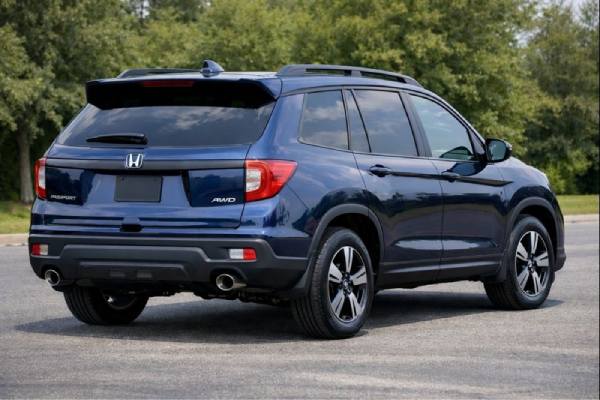
The 2019–2021 Honda Passport AWD (YF8) sits in a sweet spot: a two-row midsize SUV with genuine V6 torque, a strong towing ceiling, and Honda’s i-VTM4 torque-vectoring AWD system that behaves more like a traction tool than a marketing badge. The J35Y6 3.5-liter V6 is smooth and quick for the class, while the 9-speed automatic prioritizes fuel economy and relaxed cruising—though it benefits from clean fluid and up-to-date calibrations.
Where this Passport shines is everyday usability: a wide cabin, a large cargo area, and an “easy-to-own” layout with sensible service access. The AWD model also gains extra ground clearance and better approach/departure angles than the 2WD version, which matters if your roads include snow ruts, steep driveways, or rough tracks.
Quick Specs and Notes
- Strong real-world towing capability for a two-row SUV (up to 2,268 kg / 5,000 lb when properly equipped).
- i-VTM4 AWD adds confident traction and stable handling on wet roads and snow.
- Big cargo bay for the segment (1,166 L / 41.2 ft³ behind the rear seats).
- Ownership caveat: the rear differential fluid on i-VTM4 vehicles is sensitive to heat and shear—service it on time to avoid shudder.
- If a “Maintenance Due Now” message doesn’t appear, change engine oil at least every 12 months.
Section overview
- Honda Passport YF8 AWD essentials
- Honda Passport YF8 AWD specs and fluids
- Honda Passport YF8 trim cues and safety systems
- Trouble spots and service bulletins
- Ownership maintenance roadmap
- Driving feel and AWD behavior
- Against key midsize rivals
Honda Passport YF8 AWD essentials
Think of the 2019–2021 Passport AWD as the “shorter Pilot” with a more purpose-built attitude. It uses the same basic architecture—front MacPherson struts, a multi-link rear suspension, and a transverse 3.5-liter V6—then trims the third row out of the equation. The result is a cabin and cargo area that feel generous without becoming minivan-large, plus a chassis that generally feels more tied down than three-row competitors when driven briskly.
The key technical distinction for this article is AWD. The Passport’s i-VTM4 system is not a simple on-demand coupling that only wakes up when the front wheels spin. In normal cruising it behaves front-biased for efficiency, but it can send meaningful torque rearward when it predicts or detects slip. More importantly, it can vector torque across the rear axle, pushing more torque to the outside rear wheel in a corner to help the vehicle rotate and feel more stable. In bad weather, that translates to less “one-wheel peel” and more predictable pull from a stop.
The J35Y6 V6 is the second anchor of the Passport’s character. It’s not a turbo engine that needs boost to feel alive; it makes usable torque low in the rev range, stays smooth under load, and rarely feels strained even when the vehicle is full of people and gear. The 9-speed automatic is tuned for economy and low RPM on the highway. When everything is healthy and up to date, the drivetrain is refined. When fluid ages or software is behind, owners sometimes describe low-speed shift quirks or hesitation—usually fixable with service, resets, or updated calibration.
Ownership priorities tend to cluster into three groups:
- Towing and hauling: AWD models can reach 5,000 lb (2,268 kg) when properly equipped, which is enough for many small campers, utility trailers, and watercraft.
- All-weather commuting: the AWD system’s composure on wet and snowy roads is one of the model’s strongest reasons to choose it over 2WD.
- Long-term durability: the platform is generally robust, but the Passport rewards owners who stay ahead on fluids—especially the rear differential—and who address early symptoms instead of “driving through” them.
If your use case is mostly dry highways, you may not need AWD. But if you regularly face slick hills, snow, dirt access roads, or tow frequently, the AWD Passport’s hardware is more than a checkbox—it changes what the vehicle can do calmly and repeatedly.
Honda Passport YF8 AWD specs and fluids
Below are practical, ownership-relevant specifications for the 2019–2021 Passport AWD (YF8) with the J35Y6 3.5-liter V6 and 9-speed automatic. Values can vary slightly by trim and equipment, so treat these as a configuration guide and confirm against your VIN-specific documentation.
Powertrain and efficiency (AWD)
| Item | Specification |
|---|---|
| Engine code | J35Y6 |
| Layout and valvetrain | V6, SOHC i-VTEC (cylinder deactivation on many builds) |
| Displacement | 3.5 L (3,471 cc) |
| Induction | Naturally aspirated |
| Fuel system | Direct injection |
| Max power | 280 hp (209 kW) @ rpm (varies by market documentation) |
| Max torque | 355 Nm (262 lb-ft) @ rpm (varies by market documentation) |
| Timing drive | Belt (service interval depends on climate and duty) |
| Rated efficiency (EPA, AWD) | 11.2 L/100 km combined (21 mpg US) |
| Rated efficiency (EPA, AWD) | 12.4 city / 9.8 highway L/100 km (19 / 24 mpg US) |
| Real-world highway @ 120 km/h | ~9.5–10.8 L/100 km (22–25 mpg US), depending on tires, wind, and load |
| Aerodynamics | Cd not consistently published in owner-facing spec sheets |
Transmission and driveline
| Item | Specification |
|---|---|
| Transmission | 9-speed automatic |
| Drive type | AWD (Honda i-VTM4 torque-vectoring rear drive unit) |
| Differential behavior | Electronically controlled rear torque vectoring; no mechanical lockers |
Chassis and dimensions (AWD)
| Item | Specification |
|---|---|
| Suspension (front / rear) | MacPherson strut / Multi-link |
| Steering | Electric rack-and-pinion; AWD ratio about 15.76:1 |
| Turning circle (kerb-to-kerb) | 12.0 m (39.3 ft) |
| Brakes (front / rear) | Discs 320 mm / 330 mm (12.6 in / 13.0 in) |
| Wheels/tires (typical) | 245/50R20 (many trims) or 265/45R20 (upper trims, market-dependent) |
| Ground clearance (unladen) | 206 mm (8.1 in) |
| Approach / departure (AWD) | 21.4° / 27.6° |
| Length / width / height (AWD) | 4,839 / 1,996 / 1,834 mm (190.5 / 78.6 / 72.2 in) |
| Wheelbase (AWD) | 2,817 mm (110.91 in) |
| Curb weight (AWD) | ~1,882–1,922 kg (4,149–4,237 lb) depending on trim |
Cargo and capacity
| Item | Specification |
|---|---|
| Fuel tank | 73.8 L (19.5 US gal) |
| Cargo volume (seats up) | 1,166 L (41.2 ft³) |
| Cargo volume (seats down) | 2,206 L (77.9 ft³) |
Performance and capability (realistic owner range)
| Item | Typical result (AWD) |
|---|---|
| 0–100 km/h (0–62 mph) | ~6.5–7.0 s (tire and test method dependent) |
| Highway passing (80–120 km/h) | Strong for class; downshift-dependent |
| Braking (100–0 km/h) | Often ~36–40 m on quality tires |
| Towing capacity (AWD) | 2,268 kg (5,000 lb) when properly equipped |
| Payload / roof load | Varies by trim and market; confirm on door-jamb label |
Fluids and service capacities (use as a planning guide)
Because capacities and specifications can vary by VIN, cooler setup, and service method (drain-and-fill vs total fill), use the table below for decision-making, then verify before purchase or service.
| System | Typical specification (confirm by VIN) |
|---|---|
| Engine oil | Honda-spec full synthetic; viscosity commonly 0W-20 |
| Engine oil capacity | ~5.4 L (5.7 US qt) with filter (verify) |
| Coolant | Honda Type 2 / long-life premix (verify) |
| ATF | Honda-spec ATF for 9-speed applications (verify exact type) |
| Rear differential (i-VTM4) | Honda dual-pump style fluid (verify exact type) |
| A/C refrigerant | Often R-1234yf; charge varies—verify under-hood label |
Electrical (typical)
| Item | Typical |
|---|---|
| 12 V battery | Size and CCA vary by market/trim |
| Spark plugs | Iridium-type; gap and part number vary by VIN |
| Alternator | Output varies by equipment load |
Safety and driver assistance (headline hardware)
| Category | What to expect (2019–2021) |
|---|---|
| Core active safety | AEB/CMBS, lane keeping support, adaptive cruise, road departure mitigation (availability varies by region/trim) |
| Stability and braking | ABS, ESC/VSA, traction control standard |
| Child seats | LATCH/ISOFIX provisions; confirm anchors and tether locations by market |
| Crash ratings | Published by local test bodies; always verify by year and configuration |
Honda Passport YF8 trim cues and safety systems
For 2019–2021, the Passport lineup typically follows a straightforward ladder: a value-focused entry trim, one or two mid trims that add comfort and driver aids, and a top trim that bundles premium features. Exact names and packaging vary by market, but the mechanical core—J35Y6 V6, 9-speed automatic, and i-VTM4 AWD—remains consistent across AWD versions. That makes this a “choose your equipment” vehicle more than a “choose your engine” vehicle.
Trims and options that matter mechanically
Even when powertrain is shared, certain options change how the Passport tows, rides, and holds up over time:
- Tow package and hitch wiring: If towing is part of the plan, prioritize a vehicle that has the correct hitch hardware and cooling strategy for sustained load. Also check for a trailer brake controller solution if your trailer requires it.
- Wheel and tire package: Larger wheels look great, but they can increase tire cost and reduce ride compliance over rough pavement. On a used vehicle, tire quality affects braking distance and wet traction more than most owners expect.
- Roof rails and crossbars: Helpful for cargo boxes and outdoor gear, but confirm the load rating for your market and don’t assume “SUV = unlimited roof load.”
- Brake and suspension condition: Two Passports with the same trim can feel completely different if one has fresh dampers and quality tires and the other is riding on hardened tires and worn bushings.
Quick identifiers when shopping used
When you’re scanning listings or walking a lot, focus on “fast tells”:
- Instrument cluster and infotainment: upper trims often add larger displays, more speakers, navigation or premium audio, and additional camera views.
- Driver-assistance buttons: steering wheel and dash switchgear can hint at whether adaptive cruise and lane support were fitted for that market.
- Parking sensors and cameras: front sensors and multi-angle camera systems are typically upper-trim signals.
- Exterior cues: wheel design, roof rails, and trim-specific accents often correlate with equipment.
Safety ratings and what they really mean
Crash-test ratings are useful, but they are not universal truths across all model years and trims. They can shift due to:
- Different test protocols over time
- Headlight performance differences by trim
- Optional safety equipment that changes scoring
When researching a specific vehicle, match year + trim + drivetrain as closely as possible. Use official databases and testing bodies for your region, and avoid assuming that a 2021 rating automatically applies to a 2019 vehicle.
Safety systems and ADAS considerations
Most modern “Honda Sensing”-type packages combine camera and radar (or camera-only, depending on market) for:
- Automatic emergency braking (AEB): designed to reduce crash severity, not to override physics on ice.
- Adaptive cruise control (ACC): convenient on highways, but can feel abrupt if cut-ins are frequent.
- Lane support (LKAS/LKA): helpful for fatigue reduction, but it’s not self-driving and needs clear lane markings.
After windshield replacement, alignment work, or front-end repairs, these systems may require calibration. If you’re buying used, ask for documentation that camera/radar calibration was performed correctly—especially after collision repair.
Trouble spots and service bulletins
Overall, the 2019–2021 Passport AWD has a strong durability reputation, but it has a few patterns worth knowing. The best approach is to separate issues by how often they happen and how expensive they become if ignored.
Common: AWD rear differential fluid deterioration (medium cost if late)
- Symptoms: low-speed shudder or vibration during tight turns (parking lots), occasional “binding” feeling, or a pulsing sensation under light throttle.
- Likely cause: degraded rear differential fluid in the i-VTM4 rear drive unit, often accelerated by towing, mountainous driving, repeated short trips, or aggressive launches.
- Remedy: service with the correct fluid; in persistent cases, a repeat drain-and-fill sequence and a learned-value reset may be needed. The best fix is prevention: keep the fluid fresh.
Common to occasional: 9-speed shift behavior and calibration sensitivity (low to medium)
- Symptoms: hesitation off the line, an odd shift at low speed, “busy” downshifts, or harsh engagement.
- Likely cause: a mix of adaptive learning, fluid age, and software calibration. Driving patterns can also influence the transmission’s learned behavior.
- Remedy: ensure fluid is serviced at reasonable intervals and confirm software updates were applied during dealership visits. A reset/relearn can improve behavior after service.
Occasional: infotainment glitches and connectivity annoyances (low)
- Symptoms: Bluetooth drops, delayed Apple CarPlay/Android Auto connection, screen freezes, camera lag.
- Likely cause: software bugs, phone compatibility changes, or a weak 12 V battery affecting boot stability.
- Remedy: update infotainment software where available, test with another phone, and confirm battery health.
Occasional: 12 V battery weakness and stop-start irritations (low to medium)
- Symptoms: slow cranking, warning messages, stop-start disabled frequently, or random electronic hiccups.
- Likely cause: battery aging, high accessory load, many short trips, or marginal charging behavior.
- Remedy: load-test the battery, clean terminals and grounds, and verify charging output. Replace with the correct spec battery rather than the cheapest match.
Rare but important: recall-related items (severity varies)
For any used Passport, treat recalls as a VIN-specific checklist, not a rumor. Items that have affected similar Honda platforms in these years can include:
- Fuel system / fuel pump campaigns: potential stalling risk in certain production ranges.
- Hood latch/striker or body fit issues: potential for abnormal vibration and, in extreme cases, latch concerns.
- Camera or sensor-related recalls: rearview camera display failures have appeared in multi-model campaigns.
- Seat belt or seat sensor campaigns: occupant protection components sometimes trigger large population recalls.
How to verify completion: run the VIN through the official recall database, then confirm with dealer service records. A clean “no open recalls” screen is good; a printed service invoice showing the recall remedy performed is better.
Pre-purchase checks to request (high value)
- Full maintenance history, especially rear differential services
- Proof of transmission fluid service (or budget to do it)
- A test drive that includes tight turns, low-speed stop-and-go, and highway merging
- A scan for stored drivetrain and ADAS-related codes (even if the dash is clear)
Ownership maintenance roadmap
A Passport AWD that’s serviced on schedule is usually a low-drama vehicle. The trick is choosing intervals that match reality: towing, hills, heat, and city driving all shorten fluid life. Use the Maintenance Minder as the baseline, then tighten intervals if your duty cycle is hard.
Practical schedule (distance/time)
Use whichever comes first: mileage, time, or a Maintenance Minder prompt.
| Item | Baseline guidance | Heavy-use guidance |
|---|---|---|
| Engine oil and filter | Follow Maintenance Minder; at least every 12 months | Short trips/towing: shorten interval |
| Tire rotation | About every 8,000–12,000 km (5,000–7,500 mi) | Same, especially with AWD |
| Cabin and engine air filters | Inspect yearly; replace as needed | Dusty areas: replace more often |
| Brake fluid | Every 3 years is a smart rule even if mileage is low | Same |
| Rear differential fluid (AWD) | Follow Maintenance Minder | Towing/mountains: early service, then more frequent |
| Transmission fluid | Follow Minder or service strategy | If towing/heat: shorten interval |
| Coolant | Long-life coolant; follow official interval | Inspect yearly for leaks/level |
| Spark plugs | Often around 100,000 miles / 160,000 km depending on market | Earlier if misfire symptoms appear |
| Timing belt service | Required at interval (market/temperature dependent) | Earlier in extreme hot/cold duty |
Fluid specs and capacities (what to confirm before service)
Before you buy fluids, confirm the exact specification for your VIN:
- Engine oil: correct viscosity and Honda-approved spec for your market.
- 9-speed ATF: the correct fluid is critical; “universal ATF” is a false economy.
- Rear differential (i-VTM4): use the correct Honda fluid; wrong fluid often creates shudder complaints.
- Transfer/gear fluids: some driveline components may have separate gear oil requirements—confirm.
Essential torque values (critical fasteners only)
These are commonly referenced planning values; always verify with your service documentation:
- Wheel lug nuts: 127 Nm (94 lb-ft)
- Engine oil drain bolt: commonly around 30–40 Nm (22–30 lb-ft) depending on bolt design
- Spark plugs: commonly around 18–25 Nm (13–18 lb-ft) depending on plug type
Buyer’s guide: what to inspect on a used AWD Passport
Underbody and chassis
- Look for scrapes on the front subframe and underbody panels (off-road use clue)
- Inspect CV boots and clamps for grease sling
- Check for uneven tire wear (alignment or bushing wear)
Driveline
- In a tight parking lot, do slow circles in both directions. Any repeated shudder may indicate overdue rear diff fluid.
- Confirm smooth engagement from Park to Drive/Reverse.
- On a highway, check for stable RPM and clean downshifts during passing.
Cooling and leaks
- Check coolant level and look for dried residue near hoses and the radiator end tanks.
- Inspect the serpentine belt area for noise or wobble.
Electronics
- Verify camera feed, parking sensors, and all driver-assistance alerts.
- Make sure the 12 V battery tests healthy; a weak battery can create false “system” warnings.
Long-term durability outlook (plain answer)
If you stay ahead on fluids—especially rear differential and transmission—and avoid overheating the drivetrain during repeated heavy towing without proper equipment, the Passport AWD is typically a durable, high-mileage SUV. Most expensive outcomes come from neglected maintenance rather than a fundamentally fragile design.
Driving feel and AWD behavior
The Passport AWD’s driving personality is defined by two traits: a naturally aspirated V6 that feels immediate and an AWD system that adds confidence without constant driver input.
Ride, handling, and NVH
The ride is generally composed for a midsize SUV, especially on stock wheel sizes with quality tires. Impacts are rounded off rather than sharp, and the body structure feels stiff over broken pavement. On higher-trim wheel-and-tire packages, the ride can become firmer and more sensitive to pothole edges—still controlled, but less forgiving.
Noise levels are usually well managed at highway speeds. Wind noise can rise if door seals are worn or if the vehicle has aftermarket roof accessories. Tire choice is a major variable: aggressive all-terrain tires often add a noticeable hum at 100–120 km/h.
Powertrain character: what it feels like day to day
The J35Y6 V6 is linear. You get predictable response with no turbo delay, and the engine rarely needs to rev hard unless you’re accelerating uphill or passing at speed. The 9-speed automatic typically keeps RPM low during cruising. Kickdown can sometimes feel like a short “pause” while it selects the right ratio—normal for many multi-gear automatics—but it should not feel like a slip or flare.
If you test-drive one, do three things:
- Roll into the throttle from 40–60 km/h and feel for smooth, clean shifts.
- Do a brisk merge onto a highway and check for decisive kickdown.
- Drive in stop-and-go traffic and confirm low-speed smoothness.
Real-world efficiency (AWD)
Owners often see a spread depending on weather and route:
- City: higher consumption in short trips, especially in winter or heavy traffic.
- Highway (100–120 km/h): often settles into a reasonable range for a V6 AWD SUV when tires and alignment are right.
- Mixed: a good predictor of your long-term average; track it over multiple tanks.
If fuel economy is a top priority, remember this is a V6 AWD midsize SUV—its advantage is effortless power under load, not hybrid-level consumption.
i-VTM4 AWD behavior: traction you can feel
In rain or snow, the Passport tends to launch with less drama than many front-biased crossovers. The rear drive unit can actively support the front tires instead of waiting for them to spin. In corners, the system can add stability by pushing torque to the outside rear wheel, which helps the vehicle feel less nose-heavy.
For light off-pavement use—gravel, forest roads, muddy fields—the Passport’s AWD system is effective as long as you keep expectations realistic. It’s not a low-range 4×4. Ground clearance is respectable, and the approach/departure angles are useful, but tire choice and driver judgment still matter most.
Towing notes (AWD)
The Passport is a confident tow vehicle for its size when set up correctly. Expect:
- Stable tracking with proper tongue weight and trailer balance
- A noticeable fuel-economy penalty (often significant) as speed and trailer frontal area rise
- The need for more frequent fluid service if towing regularly—especially rear differential fluid
Against key midsize rivals
The Passport AWD competes in a crowded space: two-row midsize SUVs that promise family comfort but also need to handle bad weather and occasional towing. Here’s how it generally stacks up in real ownership terms.
Versus Toyota 4Runner
- Passport advantages: more modern road manners, stronger on-road comfort, and a more contemporary cabin feel. The AWD system is excellent for slick pavement.
- 4Runner advantages: body-on-frame toughness, true low-range 4WD on many trims, and strong off-road aftermarket support.
- Verdict: choose Passport for daily comfort and towing practicality; choose 4Runner if rugged off-road use is a core requirement.
Versus Jeep Grand Cherokee (similar years)
- Passport advantages: typically lower ownership complexity and a straightforward V6 character.
- Grand Cherokee advantages: broader powertrain range and, on some trims, more serious off-road capability.
- Verdict: Passport is often the calmer long-term bet; Grand Cherokee can offer higher peak capability depending on trim, with more variance in upkeep.
Versus Ford Edge and Nissan Murano
- Passport advantages: towing ceiling (when equipped), a strong V6 feel, and AWD hardware that’s very confidence-inspiring.
- Edge/Murano advantages: often quieter ride quality on certain trims; Murano’s CVT can feel smooth in gentle driving (though long-term opinions vary).
- Verdict: Passport is the better pick if you tow, carry heavy loads, or want a drivetrain that feels unstrained under work.
Versus Hyundai Santa Fe / Kia Sorento (non-hybrid focus)
- Passport advantages: naturally aspirated V6 response and a simple power delivery under load; strong cargo utility.
- Korean rivals’ advantages: newer tech in certain years, often better fuel economy with smaller turbo engines, and sometimes longer warranties (market dependent).
- Verdict: Passport is a “buy for the long haul” choice if you value V6 smoothness and steady towing more than the newest cabin gadgets.
The Passport’s best-fit buyer profile
Pick the Passport AWD (YF8) if you want:
- A two-row SUV with real space and strong power
- Confident snow-and-rain behavior without needing a truck-based 4×4
- A platform that rewards consistent fluid service with long life
Consider alternatives if you need:
- Low-range 4WD and frequent rock/mud work
- Hybrid-level fuel economy
- A smaller footprint for tight-city parking
References
- Specifications – 2021 Honda Passport 2021 (Specifications)
- EPA Fuel-Economy Ratings – 2021 Honda Passport 2021 (Fuel Economy)
- Vehicle Detail Search – 2021 HONDA PASSPORT SUV AWD | NHTSA 2021 (Safety Rating and Recall Database)
- Check for Recalls: Vehicle, Car Seat, Tire, Equipment | NHTSA 2026 (Recall Database)
Disclaimer
This article is for informational purposes only and is not a substitute for professional inspection, diagnosis, or repair. Specifications, torque values, fluid types, capacities, service intervals, and procedures can vary by VIN, market, model year, and equipment. Always verify details using your official service documentation and labels on the vehicle, and consult a qualified technician when needed.
If you found this guide useful, please consider sharing it on Facebook, X (Twitter), or your favorite forum to support our work.