

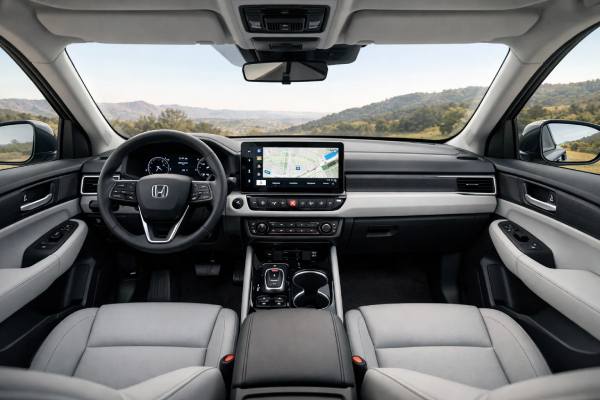
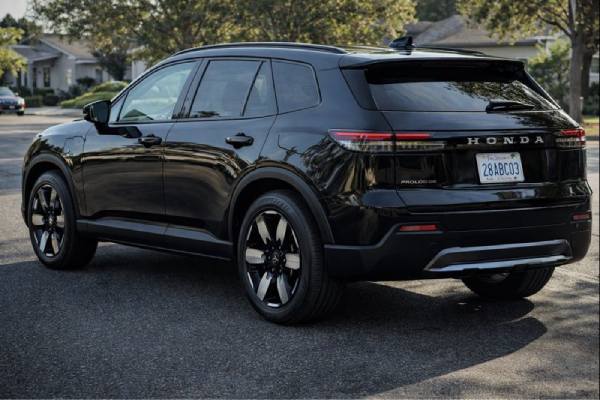
The 2025–present Honda Prologue single-motor model is the “everyday” Prologue: front-wheel drive, a large 85 kWh battery, and a power level (220 hp) that favors smoothness over theatrics. For owners, the big story is balance. You get midsize-SUV space, a long wheelbase that helps ride comfort, and an EPA range rating that’s competitive for the class. The tradeoffs are also clear: it’s a heavy vehicle, and EV ownership habits (charging routine, tire choices, software updates) matter more than many first-time EV buyers expect.
If you’re shopping this version specifically, focus on three things: how it charges in your typical week, how the driver-assistance features behave on your roads, and how well the dealer network near you handles EV software and warranty work.
Owner Snapshot
- Strong EPA range for a midsize EV SUV, with a large 85 kWh battery and calm highway manners.
- Spacious cabin layout and a long wheelbase that supports ride comfort on rough pavement.
- Standard driver-assistance suite covers the essentials for commuting and family driving.
- Expect higher tire wear than a typical gas SUV if you use the instant torque aggressively.
- Rotate tires about every 12,000 km (7,500 mi) to keep wear even and noise down.
Guide contents
- Honda Prologue single-motor: what it is
- Honda Prologue single-motor specs and data
- Honda Prologue trims, options, and safety tech
- Reliability issues, recalls, and software fixes
- Maintenance plan and used-buying tips
- Driving, range, and charging in real life
- How Prologue FWD stacks up against rivals
Honda Prologue single-motor: what it is
The single-motor Prologue is the front-wheel-drive (FWD) entry to the Prologue lineup. In daily driving terms, that means one motor powering the front axle, a large battery pack (85 kWh), and tuning that prioritizes predictable response and quiet cruising over “sport SUV” theatrics. Output is 220 hp and 243 lb-ft (329 Nm), which is enough to feel quick off the line—especially around town—without making the traction control work overtime the way some high-output dual-motor EVs do.
From an ownership standpoint, the Prologue’s strengths show up in routine use:
- Commuting comfort: A long wheelbase (121.8 in / 3094 mm) helps the chassis feel settled, especially on expansion joints and broken pavement. This matters because EVs are heavy, and short-wheelbase EVs can feel choppier over the same roads.
- Realistic daily range: The FWD Prologue carries an EPA range rating of 308 miles (496 km). In practice, that supports a very easy “charge every few days” routine for many drivers, especially if you can home-charge.
- Practical packaging: Cargo space is strong for the class (especially with the rear seat folded), and the cabin is sized like a true midsize SUV rather than a compact crossover pretending to be bigger.
The compromises are typical EV realities rather than “bad engineering” problems:
- Weight influences everything. At roughly 4,932 lb (2,237 kg) in FWD form, tire choice, tire pressure, and alignment have an outsized effect on noise, efficiency, and steering feel.
- Front-drive traction limits. In rain or cold weather, a strong throttle stab can spin the front tires more easily than you might expect from a modern SUV. The car manages this well, but your right foot still sets the tone.
- Software matters. This is a modern, connected EV. Updates can improve charging behavior, driver-assistance calibration, and infotainment stability. Treat software updates like maintenance, not like optional gadget tweaks.
If you want the Prologue feel without paying the AWD price and efficiency penalty, this single-motor version is the one that makes the most “SUV as an appliance” sense.
Honda Prologue single-motor specs and data
Powertrain, battery, and efficiency
| Spec | Value |
|---|---|
| Drivetrain | Front-wheel drive (single motor, front axle) |
| Max power | 220 hp (164 kW) |
| Max torque | 243 lb-ft (329 Nm) |
| Battery capacity | 85 kWh |
| EPA range rating | 308 mi (496 km) |
| EPA efficiency (combined) | 104 MPGe |
| EPA efficiency (city / highway) | 113 / 94 MPGe |
| Rated energy use (combined) | 33 kWh/100 mi (20.5 kWh/100 km) |
| Electric motor rating (EPA listing) | 180 kW ACPM |
Charging and replenishment
| Spec | Value |
|---|---|
| 240V Level 2 rate (Honda metric) | 34.1 miles per hour of charging (54.9 km/h) |
| 240V time to charge (EPA listing) | 9.5 hours at 240V |
| DC fast charge gain (Honda metric) | 65 miles in 10 minutes (105 km in 10 minutes) |
| DC fast charge time (Honda metric) | 20% to 80%: 35 minutes |
Chassis, steering, and brakes
| Spec | Value |
|---|---|
| Suspension (front / rear) | Multi-link / Multi-link |
| Steering | Electric power steering |
| Steering ratio | 18.6:1 |
| Steering turns lock-to-lock | 3.5 |
| Turning diameter (curb-to-curb) | 39.6 ft (12.1 m) |
| Brakes (front / rear) | 12.6 in / 13.6 in (320 mm / 345 mm) |
| Wheels | 19 x 8.5 in |
| Tires | 255/60R19 109H |
Dimensions, angles, weights, and capacity
| Spec | Value |
|---|---|
| Length | 192.0 in (4,876.8 mm) |
| Width | 78.3 in (1,988.8 mm) |
| Height | 64.7 in (1,643.4 mm) |
| Wheelbase | 121.8 in (3,093.7 mm) |
| Ground clearance (unladen) | 7.9 in (200.7 mm) |
| Approach / departure angles | 17.0° / 18.0° |
| Curb weight | 4,932 lb (2,237 kg) |
| Max towing capacity | 1,500 lb (680 kg) |
| Cargo volume (behind 2nd row / behind 1st row) | 25.2 / 57.7 ft³ (713.6 / 1,633.9 L) |
Safety and driver assistance
| Spec | Value |
|---|---|
| IIHS small overlap front (driver-side) | Good (rating applies to 2024–2026) |
| IIHS small overlap front (passenger-side) | Acceptable (rating applies to 2024–2026) |
| IIHS moderate overlap front (updated test) | Good (rating applies to 2024–2026) |
| IIHS side (updated test) | Good (rating applies to 2024–2026) |
Honda Prologue trims, options, and safety tech
For 2025–present shopping, the most important “trim truth” is simple: EX and Touring can be single-motor FWD, while Elite is positioned as the higher-spec model and is typically paired with AWD. That matters because it changes not only price, but also how the vehicle feels and how it uses energy at highway speeds.
Trim lineup, how to spot them, and what changes
- EX (single-motor FWD available): The value-focused choice. Look for smaller wheels (typically 19-inch), and a feature set that covers the basics without the “luxury garnish.” For many buyers, EX is the sweet spot because it keeps the efficiency and ride comfort benefits of the smaller wheel-and-tire package.
- Touring (single-motor FWD available): The “comfort and tech” middle trim. Touring usually adds convenience features you’ll feel every day: upgraded interior touches, additional parking assists, and more premium audio/infotainment execution depending on market package structure.
- Elite (generally paired with AWD): The feature-max trim. It tends to bring the largest wheels (often 21-inch), more camera coverage, and additional driver aids and parking assistance. The tradeoff is typically more road noise and a firmer impact feel over sharp edges because low-profile tires have less sidewall to absorb hits.
If you’re buying used, quick identifiers that usually help:
- Wheel size and tire profile are the fastest “at a glance” clue.
- Camera count and parking assist behavior (how confidently it self-parks or guides you) often separates the top trim from the others.
- Interior tells like seat material, speaker branding, and the presence of a surround-view camera view can confirm you’re looking at the intended trim.
Option strategy that improves ownership
For most owners, the best options are the ones that reduce friction:
- Home charging capability (or a bundled charging package): This determines whether the Prologue feels effortless or “always needing planning.”
- Driver-assistance features you’ll actually trust: Adaptive cruise control and lane support are most valuable when they behave smoothly on your local highways. A demo drive on the same roads you commute is more informative than any brochure.
- Wheel-and-tire choice: If you can choose, smaller wheels usually mean better ride comfort, lower replacement tire costs, and a better chance of matching the EPA range in real life.
Safety ratings and what they mean here
The IIHS results for the Prologue family are reassuring overall: top marks in several key crash tests, with a notable nuance in the passenger-side small overlap evaluation (rated Acceptable in the test setup IIHS lists). In plain language: the structure performs well, but the passenger-side small-overlap scenario is a tough test, and it highlights how occupant motion and airbag timing can affect a single category even when the structure is strong.
Driver assistance and ADAS details to pay attention to
The Prologue’s standard suite covers the core functions most buyers expect today: forward collision alert and automatic emergency braking, pedestrian braking, lane keep assist, adaptive cruise control, blind-spot monitoring behaviors (including steering assist in certain scenarios), rear cross-traffic alerts, and traffic sign recognition. The ownership tip is to treat ADAS like a system, not a checkbox:
- Calibration matters after repairs. Windshield replacement, bumper work, alignment changes, and some suspension repairs can require sensor recalibration.
- Tire mismatches can affect behavior. Uneven tread depth or mixed tire models can change braking feel and stability control intervention timing in low-grip conditions.
- Learn the “limits vocabulary.” If the car frequently asks you to take over in rain, glare, or poor lane markings, that’s not a defect—it’s a cue to adjust expectations and settings.
Reliability issues, recalls, and software fixes
Because the 2025–present single-motor Prologue is still early in its lifecycle, reliability is best understood as a mix of hardware durability, software maturity, and owner-use patterns. The good news: EV drivetrains remove many failure points associated with engines and transmissions. The less-good news: modern EVs add new “ownership variables” like charging behavior, sensor calibration, and update cadence.
Common, occasional, and rare issues (and how expensive they get)
Common (low to medium cost):
- Tire wear and noise rise: Symptoms include a growing hum at 60–110 km/h (35–70 mph) and steering that feels less crisp. Likely cause is normal EV torque plus weight, amplified by under-rotation or incorrect pressure. Remedy: rotate on schedule, keep pressures correct, and align if you see uneven wear.
- Brake rust or roughness (regen-heavy driving): If you use strong regenerative braking most of the time, friction brakes can see less regular “scrub,” especially in wet climates. Remedy: periodic firm stops from speed in a safe area (when conditions allow) and routine brake inspections.
Occasional (medium cost):
- Charging interruptions or slow DC sessions: Symptoms include unexpected tapering early in the session or a “charging reduced” message. Likely causes range from cold battery temperature to station limits to software logic. Remedy: precondition when possible (often by navigating to a fast charger), start charging at a lower state of charge when practical, and keep vehicle software current.
- Infotainment or connectivity glitches: Symptoms include delayed boot-up, intermittent audio, or dropped connectivity features. Remedy: software updates first; module resets second; hardware replacement only when persistent and documented.
Rare (high cost but usually warranty-managed):
- High-voltage component faults: These present as warning messages, reduced power, or “service vehicle soon” alerts that don’t clear. Causes can include sensor faults, coolant loop issues, or isolation monitoring triggers. Remedy: dealer diagnosis is the correct path—high-voltage safety is not a DIY domain.
Software and calibration updates: what they typically improve
With early-life EVs, software updates often target:
- Charging behavior (how the car ramps power, tapers, and protects the pack)
- Thermal management logic (how aggressively it heats/cools the battery and cabin)
- ADAS refinements (lane-centering smoothness, false alerts, sensor confidence thresholds)
- Infotainment stability (reboots, Bluetooth behavior, navigation performance)
A practical rule: if you experience a repeated issue that feels “logic-based” rather than mechanical—charging curve oddities, persistent warnings that vanish after a restart, inconsistent driver-assist behavior—ask about updates before authorizing parts replacement.
Recalls, service actions, and how to verify completion
Even a small recall matters on a heavy EV SUV because loads are higher and components work hard. A real example in the Prologue family is a recall campaign involving a suspension-related component inspection and replacement for affected vehicles. The right approach as an owner or buyer is consistent:
- Run an official VIN recall check and save the result.
- Ask the selling dealer for a repair order showing recall completion (not just “we did it” verbally).
- Confirm that any post-repair alignment and ADAS calibration steps were performed if they apply.
Pre-purchase checks worth requesting (used EV focus)
- A battery health or diagnostic report (state of health where available)
- Evidence of completed recalls and any related alignment/calibration work
- Charging history cues (frequent DC fast charging isn’t automatically bad, but you want to see that charging behavior is normal and consistent)
- A test drive that includes: low-speed parking maneuvers (listen for clunks), highway tracking (lane stability), and a charging session if possible (even a short plug-in test)
Maintenance plan and used-buying tips
EV maintenance is simpler than gas maintenance, but it is not “nothing.” The Prologue’s long-term happiness depends on a few high-impact routines: tires, brakes, the 12-volt system, and staying current on service actions and software.
A practical maintenance schedule you can follow
Use this as a real-world baseline; keep your official maintenance minder and service documentation as the final authority.
- Tire rotation: every 12,000 km (7,500 mi) or 12 months.
Severe use (hard launches, lots of tight turns, rough roads): every 8,000 km (5,000 mi). - Wheel alignment check: every 24,000 km (15,000 mi) or 24 months, and any time you see uneven wear or after a hard pothole strike.
- Brake inspection (pads, rotors, corrosion): every 12,000 km (7,500 mi) or 12 months.
Add a deliberate friction-brake “scrub” routine in wet climates. - Brake fluid: every 36 months, sooner in high-humidity or heavy mountain use.
- Cabin air filter: every 24,000 km (15,000 mi) or 24 months (more often in dusty or smoky conditions).
- 12 V battery test: yearly after 3 years, and proactively replace around 4–6 years if your climate is hot/cold-extreme or you see slow wake-ups.
- Cooling system visual inspection (battery and power electronics loops): every 24,000 km (15,000 mi) or 24 months for leaks, hose condition, and radiator blockage. Coolant replacement should follow the official interval for your market/VIN.
- Drive unit fluid service: only if your official service information specifies it as serviceable; otherwise treat it as inspection-only unless a leak/repair requires service.
Consumables and “hidden” EV wear items
- Tires are the big one. EV torque and weight can shorten tire life. Budget for it. Also, tire choice can swing road noise dramatically—especially on coarse asphalt.
- Wiper blades and washer fluid matter more than people admit because ADAS cameras and driver visibility are tied together in real life.
- Brake hardware can age oddly. Heavy regen can preserve pads but still allow rotor surface corrosion if you rarely use friction brakes.
Buyer’s guide: how to shop a used single-motor Prologue wisely
Battery health and usable range
- Ask the seller how they charge day-to-day. Frequent 100% charges aren’t fatal, but for daily use many owners set a lower limit and only go to 100% when needed.
- On a test drive, compare the “guess-o-meter” range with your expected consumption: high speeds, cold temperatures, and roof racks all reduce range sharply.
Charging hardware
- Inspect the charge port door and seals. Look for cracks, misalignment, or signs of water intrusion.
- If possible, do a quick public charge session: confirm the car initiates charging cleanly and doesn’t throw interruptions or warnings.
Thermal management
- Run HVAC in both heating and cooling modes. Listen for unusual fan cycling or compressor noise.
- After a spirited drive, watch for warnings or reduced power messages that could hint at thermal control issues.
Chassis and body
- Check for underbody damage and bent pinch welds (common on SUVs that have been improperly jacked).
- Listen for front-end clunks over sharp bumps—on a heavy EV, worn links and bushings announce themselves.
Electronics and ADAS
- Confirm cameras and parking sensors work consistently.
- Ask for proof of software updates and any service bulletins performed.
Which version to seek
- If comfort and range matter most, prioritize the FWD trims with smaller wheels. They usually deliver the most relaxed ride and the best chance of matching official efficiency.
Driving, range, and charging in real life
The single-motor Prologue’s driving personality is best described as “quiet competence.” It doesn’t feel like a sports EV, but it does feel like a mature midsize SUV that happens to be electric.
Ride, handling, and NVH
The long wheelbase pays off immediately on highways. The Prologue tracks steadily and doesn’t feel nervous over surface changes. Around town, it’s easy to place, but you will feel the mass when you brake hard or change direction quickly—physics doesn’t negotiate. Steering is tuned for calm, not chatter; it’s light enough for parking lots and stable enough at speed.
Noise-wise, EV silence can be deceptive: because the powertrain is quiet, tire noise becomes the main soundtrack, especially on rough pavement. That’s why wheel-and-tire choice (and keeping tires rotated) matters more than it might on a gas SUV.
Power delivery and regen behavior
With 220 hp and 243 lb-ft (329 Nm) going to the front wheels, the Prologue responds quickly from a stop. The key is modulation: a smooth pedal foot keeps traction clean in the wet and avoids the “front tires scrambling” feel that some FWD EVs can show when you punch it mid-corner.
Regenerative braking is where you’ll form habits fast:
- In traffic, stronger regen can reduce brake pedal use and make the SUV feel easier to drive.
- On slippery surfaces, be ready for the car to blend regen and friction braking differently as traction changes. Most drivers adapt quickly, but it’s worth practicing on a quiet road to learn the transitions.
Real-world efficiency and what moves it most
The EPA combined figure (33 kWh/100 mi, or about 20.5 kWh/100 km) is a useful baseline. In real life, three variables swing consumption the most:
- Speed: The jump from 105 km/h to 125 km/h can cost you a surprising chunk of range because aerodynamic drag rises fast.
- Temperature and cabin comfort: Heating demand in cold weather can be a major range hit, especially on short trips where the cabin never stabilizes.
- Tires and alignment: Aggressive tread, low pressures, and toe misalignment can quietly drain range and add noise.
A practical approach is to track efficiency over a few weeks in your normal routine. Once you learn your “personal kWh/100 km,” trip planning becomes easy and predictable.
Charging performance you can plan around
For home charging, the story is straightforward: if you have a 240V Level 2 setup, the Prologue can add meaningful range per hour (Honda lists 34.1 miles of range per hour on Level 2). That makes overnight charging the most comfortable ownership pattern.
For DC fast charging, the Prologue can add a useful amount of range quickly, but don’t shop it like a “peak kW headline.” What matters is how the charge curve behaves from 20% to 80%, because that’s the window most people use on road trips. Honda’s published metric of 20–80% in 35 minutes is the planning number to keep in mind. Also, arriving at a fast charger with a lower state of charge often improves the session, because you spend more time in the higher-power portion of the curve.
How Prologue FWD stacks up against rivals
In the midsize electric SUV space, the Prologue single-motor competes less on “wow” and more on livability: space, comfort, usable range, and a driver-assistance package that can reduce stress on long drives.
Where the Prologue FWD wins
- Range-focused balance: An EPA-rated 308 miles is a strong headline in this size class, and it supports real, practical road-trip planning when paired with reliable home charging.
- Midsize packaging: The long wheelbase and cabin volume deliver true family-SUV proportions, not a compact crossover stretched thin.
- Approachable driving behavior: Some rivals chase sharp handling or aggressive regen feel; the Prologue is tuned to feel familiar to SUV drivers moving to EVs.
Where rivals can be stronger
- Performance per dollar: Many competitors offer quicker acceleration (often with AWD) for similar money, depending on incentives and local pricing.
- Charging ecosystem advantages: Some EV brands pair strong charging curves with very consistent route planning and charger integration. If you road-trip constantly, that ecosystem experience can matter as much as the vehicle itself.
- Sportier steering and body control: If you value playful handling, lighter or more performance-oriented EVs can feel more engaging—though they often trade away ride softness.
Which buyer the single-motor Prologue suits best
Choose this Prologue if you want:
- A calm, spacious EV SUV that behaves like a “normal” vehicle day-to-day
- Strong rated range without moving up to AWD
- A straightforward home-charging-centered ownership routine
Consider alternatives first if you need:
- Maximum acceleration or sporty feel
- Frequent, time-critical DC fast charging on long routes
- The very best “software-first” ecosystem experience
References
- 2025 Prologue Features & Specs 2025 (Manufacturer Specifications)
- 2025 Honda Prologue FWD 2025 (Official EPA Fuel Economy Data)
- 2025 Honda Prologue 2025 (Safety Rating)
- Part 573 Safety Recall Report 24V-540 2024 (Recall Document)
- Combined Charging System (CCS) (Prologue) 2025 (Charging Standard Reference)
Disclaimer
This article is for informational purposes only and is not a substitute for professional diagnosis, inspection, or repair. Specifications, torque values, service intervals, and procedures can vary by VIN, market, software version, and equipment; always verify details using official manufacturer documentation for your specific vehicle.
If this guide helped, please consider sharing it on Facebook, X (Twitter), or your favorite forum to support our work.