
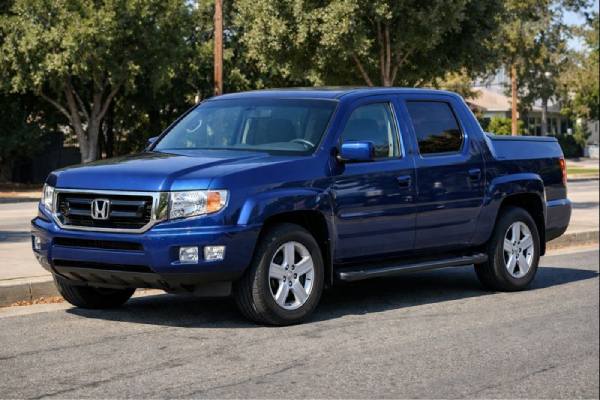
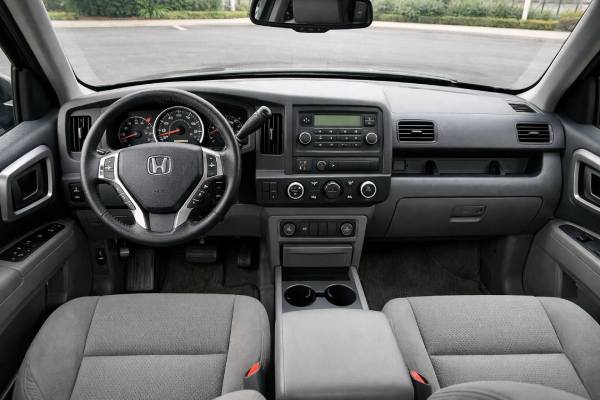
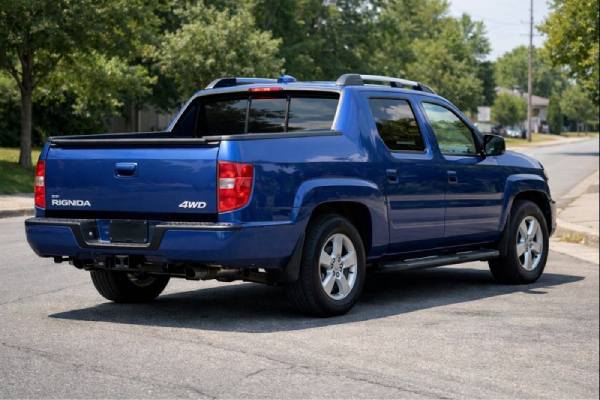
Honda’s facelift-era first-generation Ridgeline (YK1) sits in a rare niche: a mid-size pickup that drives more like a crossover, yet still handles real hauling and towing with fewer compromises than many body-on-frame rivals. Under the hood is the 3.5-liter J35Z5 V6, rated at 250 hp, paired to a 5-speed automatic and Honda’s VTM-4 all-wheel-drive system. The engineering story is simple but effective—unit-body construction for stiffness and ride quality, fully independent suspension for control, and practical utility features like the in-bed trunk and dual-action tailgate.
For owners, the appeal is day-to-day refinement with honest capability: stable highway manners, predictable winter traction, and a cabin that ages well if maintained. The trade-off is that upkeep matters—especially timing-belt service, fluid condition, and corrosion vigilance in salted climates.
Quick Specs and Notes
- Smooth, torque-rich V6 with a relaxed highway feel and strong towing manners for a mid-size truck.
- Unibody ride comfort and independent suspension make it easier to live with than many traditional pickups.
- Smart utility features (in-bed trunk, dual-action tailgate) add real-world convenience.
- Plan for timing-belt service and proactive fluid changes to avoid expensive powertrain wear.
- Typical oil change interval: 8,000–12,000 km (5,000–7,500 mi) or 12 months, depending on use.
What’s inside
- Honda Ridgeline facelift big picture
- Honda Ridgeline facelift specs and measurements
- Honda Ridgeline facelift trims and safety tech
- Known problems and recall lookup
- Service plan and smart shopping
- Road manners and real-world economy
- Rivals and best alternatives
Honda Ridgeline facelift big picture
The 2008–2014 facelift-era Ridgeline keeps the same core idea as the original 2006 launch: build a pickup around a rigid unit-body platform rather than a separate body-on-frame chassis. That choice shapes everything you feel behind the wheel. The Ridgeline tends to ride flatter, track straighter on rough highways, and stay calmer over mid-corner bumps than many leaf-spring competitors. It also helps cabin refinement—less shake through the steering column, fewer squeaks over time, and more “SUV-like” comfort in daily use.
The facelift model years brought incremental updates rather than a full redesign. The J35Z5 3.5-liter V6 is the headline for most shoppers: 250 hp, broad midrange pull, and a reputation for long service life when fluids and timing-belt maintenance are handled on schedule. It’s matched to a 5-speed automatic that prioritizes smoothness over sportiness. In normal driving, it upshifts early and keeps revs low; under load or towing, it will hold gears longer and rely on engine torque rather than hunting.
Traction and light-duty off-road confidence come from Honda’s VTM-4 system. It’s not a rock-crawling transfer case, but it’s effective for poor weather, boat ramps, gravel climbs, and muddy job sites—especially when paired with appropriate tires. A key point for owners: it’s a system that rewards correct fluid and tire maintenance. Keep tire sizes matched and change the rear differential fluid at sensible intervals, and it tends to stay quiet and predictable.
Where the Ridgeline truly differentiates is functional design. The dual-action tailgate is more than a party trick—it makes loading long items or stepping into the bed easier in tight spaces. The in-bed trunk can be the safest “cargo box” you’ll ever have in a pickup, keeping tools dry and out of sight. If your priorities are daily comfort, secure storage, and occasional towing rather than extreme off-road articulation, this generation of Ridgeline often feels like the most rational truck you can buy used.
Honda Ridgeline facelift specs and measurements
Below is a practical spec set focused on the facelift YK1 with the J35Z5 3.5-liter V6 (250 hp). Exact figures can vary by year, trim, and market equipment, so treat these as the most useful “owner-level” baseline.
Powertrain and efficiency
| Item | Specification |
|---|---|
| Code | J35Z5 |
| Engine layout and cylinders | V6, 6 cylinders, SOHC, 24 valves (4 valves/cyl) |
| Bore × stroke | 89.0 × 93.0 mm (3.50 × 3.66 in) |
| Displacement | 3.5 L (3,471 cc) |
| Induction | Naturally aspirated |
| Fuel system | PGM-FI (multi-port fuel injection) |
| Compression ratio | 10.0:1 (typical for this engine family) |
| Max power | 250 hp (186 kW) @ 5,700 rpm |
| Max torque | ~339 Nm (250 lb-ft) @ ~4,300 rpm (varies slightly by year rating method) |
| Timing drive | Belt |
| Rated efficiency (typical EPA) | ~15.7 / 11.2 / 13.8 L/100 km (15/21/17 mpg US) city/highway/combined |
| Real-world highway @ 120 km/h (75 mph) | Commonly ~11–13 L/100 km (18–21 mpg US), wind/tires/load dependent |
Transmission and driveline
| Item | Specification |
|---|---|
| Transmission | 5-speed automatic |
| Drive type | AWD (Honda VTM-4) |
| Differential | Rear differential with VTM-4 control; locking function for low-speed traction support |
Chassis and dimensions
| Item | Specification |
|---|---|
| Suspension (front/rear) | Independent / independent |
| Steering | Power-assisted rack-and-pinion (ratio varies by year) |
| Brakes | 4-wheel disc with ABS, EBD, Brake Assist (diameters vary by year) |
| Wheels and tyres (common) | 245/65 R17 or 245/60 R18 (trim dependent) |
| Ground clearance (typical) | ~205 mm (~8.1 in) |
| Length / width / height (typical) | ~5,254 / 1,933 / 1,819 mm (206.9 / 76.1 / 71.6 in) |
| Wheelbase (typical) | ~3,099 mm (~122.0 in) |
| Turning circle (typical) | ~12.6 m (~41 ft) |
| Curb weight (typical) | ~2,040–2,110 kg (~4,500–4,650 lb), equipment dependent |
| GVWR (typical) | ~2,730 kg (~6,020 lb), market dependent |
| Fuel tank | ~83 L (~22 US gal / ~18 UK gal) |
Performance and capability
| Item | Specification |
|---|---|
| Acceleration 0–100 km/h (0–62 mph) | ~8.5–9.5 s (conditions and tyres matter) |
| Top speed | ~175–185 km/h (~109–115 mph) (governed/condition dependent) |
| Braking distance | Typically competitive for class; varies strongly by tyres and brake condition |
| Towing capacity | 2,268 kg (5,000 lb) braked (equipment dependent) |
| Payload | Up to ~700 kg (~1,500+ lb) depending on configuration |
Fluids and service capacities (owner-useful baselines)
| Item | Specification |
|---|---|
| Engine oil | 5W-20 or 0W-20 (market dependent); capacity varies by service method |
| Coolant | Honda-type long-life coolant; 50/50 mix typical |
| Transmission fluid | Honda ATF (spec varies by year); drain-and-fill preferred over power flush |
| Rear differential | Honda VTM-4 fluid (use correct spec for the system) |
| A/C refrigerant | Vehicle and market dependent; verify under-hood label |
| Key torque specs (common “decision” fasteners) | Wheel lug nuts ~108 Nm (~80 lb-ft); always confirm for your wheels |
If you’re comparing listings, focus on what truly changes the ownership experience: wheel/tire size, tow equipment, whether the truck has been used for heavy towing, and whether it has consistent drivetrain-fluid service history. On this platform, “specs that matter” are usually about condition and maintenance, not just numbers on paper.
Honda Ridgeline facelift trims and safety tech
Facelift-era Ridgelines are relatively easy to shop because the mechanical package is consistent: one body style (crew cab), one core powertrain, and one AWD approach. Differences show up in wheels, interior materials, convenience tech, and a few functional items tied to towing and daily comfort.
Trims and options: what changes in real use
Most markets offered trims that map roughly to an entry model (often “RT”), mid-level convenience (commonly “RTS” or “Sport”), and an upscale version (often “RTL”), sometimes with navigation as a separate step.
Practical shopping differences to watch:
- Wheels and tyres: 17-inch setups often ride a touch softer and cost less to replace; 18-inch packages look sharper but can be firmer and more sensitive to alignment.
- Interior durability: Leather-trimmed models can age very well if conditioned, but neglected leather shows cracks sooner than cloth shows wear.
- Audio and infotainment: Navigation-era head units and factory Bluetooth vary by year; confirm that phone pairing, steering-wheel controls, and speakers function as intended.
- Towing readiness: Some trims include more towing-related hardware from the factory; others rely on dealer-installed equipment. Always verify the presence and condition of the hitch, wiring, and any transmission cooling provisions if the truck has a towing history.
- Rearview camera: Some models integrate a camera into the mirror or head unit. Test it—intermittent or fogged camera images can indicate wiring or moisture issues.
Quick identifiers in listings and walkarounds:
- Sport appearance cues often include dark trim elements and distinct wheel finishes.
- RTL cues commonly include leather seating, heated front seats, and more brightwork.
- Navigation typically adds a screen-based system and extra steering-wheel controls.
Safety ratings and structural strengths
This generation benefits from a stiff structure and consistent safety equipment across years. IIHS results for 2006–2014 Ridgeline models are strong in core crashworthiness categories, which aligns with the platform’s rigid cabin structure and standard stability control. Where shoppers should be realistic is crash avoidance: modern automatic emergency braking and lane-keeping systems were not part of this era’s mainstream equipment.
Safety systems and driver assistance (what you actually get)
Expect a well-rounded “classic safety” set:
- ABS with electronic brake distribution and brake assist for controlled stops.
- Stability control and traction control that helps keep the truck composed on wet or icy roads.
- Airbags: front airbags plus side and side-curtain airbags are common; confirm presence and warning-light behavior during the key-on self test.
- Child-seat provisions: rear seat LATCH/ISOFIX anchors are typically present; check anchor covers and ensure the rear seat folds and latches correctly.
After any collision repair, alignment work, or airbag-related service, confirm there are no warning lights and that steering remains centered. On older trucks, the safest Ridgeline is usually the one with intact structure, correct tyres, healthy brakes, and no ignored dashboard warnings—not the one with the fanciest trim badge.
Known problems and recall lookup
A well-kept facelift Ridgeline can run for a very long time, but it’s not a “set and forget” truck. The best way to think about reliability here is systems-based: the engine is durable, the AWD system is dependable when serviced correctly, and most expensive failures come from neglected maintenance, corrosion exposure, or repeated heavy towing without fluid discipline.
Below is a prevalence-and-severity map that matches what owners and technicians typically see.
Common (expect to inspect) — low to medium cost
- ATF aging and shift quality
Symptoms: shudder on light throttle, harsh 2–3 shift, delayed engagement when cold.
Likely cause: old or incorrect transmission fluid, or overdue service.
Remedy: drain-and-fill with correct Honda ATF on a sensible interval; avoid aggressive power flushing on high-mile trucks. - Rear differential (VTM-4) fluid condition
Symptoms: groan or chatter in tight turns, vibration on takeoff, occasional binding feeling.
Likely cause: overdue VTM-4 fluid or mismatched tyre sizes causing driveline stress.
Remedy: correct fluid service; keep all four tyres matched in size and wear. - Suspension wear items
Symptoms: clunks over bumps, uneven tyre wear, steering shimmy, wandering.
Likely cause: aging bushings, ball joints, or alignment drift.
Remedy: inspect systematically; correct alignment after parts replacement.
Occasional — medium to high cost depending on labor
- Timing-belt service overdue
Symptoms: no warning until it’s too late; belt age and miles are the risk.
Likely cause: skipped interval due to cost.
Remedy: replace timing belt, tensioner, and water pump at the interval—this is a priority service. - Cooling system aging
Symptoms: slow coolant loss, overheating under load, sweet smell after shutdown.
Likely cause: hose aging, radiator end-tank seepage, tired water pump.
Remedy: pressure test; replace components proactively during timing-belt service if needed. - A/C performance decline
Symptoms: weak cooling at idle, cycling, or noisy compressor.
Likely cause: refrigerant loss, compressor wear, condenser damage.
Remedy: leak test and correct repair; avoid repeated “top-offs” without diagnosis.
Rare but important — high severity
- Corrosion in salted climates (frame and underbody areas)
Symptoms: heavy scaling, soft metal, unusual noises from rear, visible deterioration around mounts.
Likely cause: long-term exposure to road salt and trapped debris.
Remedy: thorough underbody inspection, especially rear structure areas; address recall/service actions and consider professional rust mitigation early. - Airbag-related recall campaigns by year and region
Symptoms: recall notice history, open campaign status, warning lights (in some fault cases).
Likely cause: supplier inflator campaigns affecting many vehicles of the era.
Remedy: verify completion and replace components through official recall channels.
Software and calibration notes
This generation doesn’t rely on modern ADAS calibration, but it does rely on correct powertrain behavior. If a truck shows persistent shift oddities, driveline warning lights, or emissions-related faults after mechanical repairs, a dealer-level scan for stored codes and applicable updates can prevent repeat visits.
Pre-purchase checks to request (high value for the money)
- Documented timing-belt replacement history with date and mileage.
- Proof of transmission and rear differential fluid services.
- Evidence that any recalls were completed (paperwork or dealer printout).
- An underbody inspection focused on corrosion and the rear structure area.
- A test drive that includes low-speed tight turns, moderate acceleration, and highway cruising to reveal vibration, shudder, or bearing noise.
If you only do one “extra” step before buying, make it a lift inspection. These trucks can hide corrosion and leaks remarkably well until they become expensive.
Service plan and smart shopping
Owning a facelift Ridgeline cheaply usually comes down to doing the expensive items on your schedule, not the truck’s schedule. Below is a practical service plan that fits how these trucks age, plus a buyer’s checklist that helps you avoid the most costly surprises.
Maintenance schedule you can actually follow
| Item | Interval (distance) | Interval (time) | Notes |
|---|---|---|---|
| Engine oil and filter | 8,000–12,000 km (5,000–7,500 mi) | 12 months | Short trips, towing, or hot climates justify shorter intervals |
| Engine air filter | 24,000–40,000 km (15,000–25,000 mi) | 24 months | Inspect more often in dusty areas |
| Cabin air filter | 24,000–40,000 km (15,000–25,000 mi) | 24 months | Affects HVAC odor and airflow |
| Automatic transmission fluid | 40,000–60,000 km (25,000–37,000 mi) | 24–36 months | Drain-and-fill is a common best practice |
| Rear differential (VTM-4) fluid | 30,000–50,000 km (18,000–31,000 mi) | 24–36 months | Tight-turn groan often improves after correct service |
| Coolant | 80,000–160,000 km (50,000–100,000 mi) | 5 years | Use the correct long-life coolant spec |
| Brake fluid | — | 2–3 years | Moisture control matters more than mileage |
| Spark plugs | 160,000 km (100,000 mi) | — | Verify for your exact year and plug type |
| Timing belt + water pump | — | 7 years | Also mileage-based (commonly ~105,000 mi / ~168,000 km) |
| Serpentine belt and hoses | Inspect each service | Replace as needed | Cracks, glazing, or seepage justify replacement |
| Tyre rotation and alignment check | 8,000–12,000 km (5,000–7,500 mi) | — | Keeps AWD happy and reduces driveline stress |
| 12 V battery test | — | Annually after year 4 | Replace on weak tests to avoid no-start events |
Fluid specifications and “don’t improvise” rules
- Use the correct Honda ATF specification for the model year, and avoid mixing generic fluids “that claim compatibility” unless you trust the supplier and have evidence it meets the spec.
- Use the correct VTM-4 rear differential fluid. Using the wrong gear oil can cause chatter and premature wear.
- Keep all four tyres matched in size and similar wear. AWD driveline systems dislike rolling-radius mismatch.
Essential torque values for decision-making
You don’t need a full workshop chart to be safer as an owner. A few commonly referenced values help you avoid stripped threads and loose wheels:
- Wheel lug nuts: ~108 Nm (~80 lb-ft)
- Engine oil drain plug: commonly around the high-20s to low-40s Nm range depending on plug and pan design
(Always confirm for your exact VIN, especially if wheels or pans have been changed.)
Buyer’s guide: what to prioritize in listings
Best signs:
- Timing belt documented within the last 5–7 years.
- Clean ATF service record (not just “transmission checked”).
- Even tyre wear, quiet tight turns, and no driveline vibration.
- Underbody that looks cared for (clean, treated, not freshly sprayed to hide issues).
Red flags worth walking away from:
- No proof of timing-belt service on a high-mile or older truck.
- Persistent shudder on light throttle (could be fluid-related, but may indicate deeper wear).
- Visible heavy corrosion scaling, especially near rear structure areas.
- Multiple electrical warning lights, especially SRS, ABS, or stability-control indicators.
Long-term durability outlook is strong when the truck is maintained like a machine, not like an appliance. Do that, and the Ridgeline often returns the favor with years of predictable service.
Road manners and real-world economy
The facelift Ridgeline’s driving personality is the reason many owners keep it longer than they planned. It feels “together” in a way many mid-size pickups of the era don’t—less bounce, less steering correction on broken pavement, and fewer abrupt motions over bridge joints. The unibody structure helps here, but the fully independent suspension is the real day-to-day win: it controls wheel movement better when the bed is empty, and it stays more composed when you hit rough surfaces mid-corner.
Ride, handling, and noise
- Ride comfort: generally closer to a large SUV than a traditional pickup. You still feel sharp impacts (especially on 18-inch tyres), but the body doesn’t pogo.
- Steering feel: light to moderate effort with stable on-center tracking. If the truck wanders, suspect tyres and alignment first.
- Braking feel: solid and predictable when the brake fluid is fresh and the calipers slide freely. Pulsation often points to rotor condition or uneven pad deposits.
- NVH (noise, vibration, harshness): wind noise is usually modest; tyre choice can dramatically change cabin drone. Worn engine mounts can add vibration at idle.
Powertrain character
The J35Z5 V6 is smooth, responsive, and happiest in the midrange. Around town it feels effortless rather than fast; on ramps and passing maneuvers are confident because the engine doesn’t need extreme rpm to make useful torque. The 5-speed automatic aims for smoothness. Expect:
- early upshifts in gentle driving,
- a deliberate downshift when you ask for passing power,
- better behavior when the ATF is clean and the throttle body is kept in good condition.
Real-world efficiency
Official ratings vary by year and test method, but a typical facelift-era baseline is around 15/21/17 mpg US city/highway/combined (about 15.7/11.2/13.8 L/100 km). In daily life:
- City driving: heavy stop-and-go can push into the mid-to-high teens L/100 km, especially with short trips and cold starts.
- Highway at 100–120 km/h (60–75 mph): many owners see low-to-mid teens L/100 km depending on wind, tyres, and load.
- Towing: expect a meaningful penalty. A moderate trailer often raises consumption by 20–40%, and a near-max load can push it higher, especially in hilly terrain.
Load, towing, and stability
With a proper hitch setup and healthy brakes, the Ridgeline tends to tow in a calm, confidence-inspiring way for its size. The platform’s stiffness reduces the “tail wag” feeling some trucks develop when the trailer isn’t perfectly balanced. Still, good towing practice matters:
- Use a quality brake controller where applicable.
- Keep tyre pressures correct and don’t overload the rear axle.
- Change ATF and rear differential fluid more frequently if you tow regularly.
If you want a pickup that feels normal on weekday commutes and still behaves responsibly with a weekend trailer, this Ridgeline generation remains a standout.
Rivals and best alternatives
The facelift YK1 Ridgeline doesn’t win by being the “most truck.” It wins by being the easiest truck to own if your real life includes commuting, family duties, wet-weather driving, and only occasional heavy-duty work. To compare fairly, choose rivals based on what you actually do with a pickup.
If you prioritize off-road angles and aftermarket support
Traditional body-on-frame mid-size pickups often offer better approach/departure angles, more underbody clearance options, and deeper aftermarket lift/armor ecosystems. If you routinely drive rutted trails, need a true low-range transfer case, or want heavy modifications, a conventional 4×4 platform can be a better starting point.
Ridgeline trade-off: you give up some trail geometry and extreme-duty hardware, but you gain road comfort and interior practicality.
If you tow heavy, often, and in harsh conditions
Some rivals can feel more “built for tow” when you’re near maximum capacity every week. Cooling packages, rear axle designs, and brake sizing can favor trucks designed around constant load. That said, the Ridgeline’s rated towing is honest for its class, and it often feels stable within its limits.
Smart decision point: if your routine is near-max towing, pick the truck that matches that mission. If towing is occasional, the Ridgeline is usually the more comfortable daily driver.
If you want the best daily-driver pickup
This is the Ridgeline’s home field. Its unit-body platform, independent suspension, and clever storage make it feel less like a compromise. Many competitors of the era ride more firmly, bounce more when empty, and ask more from you on long highway days.
Ridgeline advantages that still matter used:
- car-like stability and ride comfort,
- secure in-bed trunk storage,
- dual-action tailgate convenience,
- consistent safety structure and predictable handling.
The short verdict
Choose the facelift Ridgeline if you want a mid-size pickup that behaves like a refined vehicle first and a utility tool second—without losing the utility you actually use. Choose a body-on-frame rival if your priorities are frequent heavy towing, extreme off-road use, or deep aftermarket modification plans. The right answer depends on which compromises you want to live with for the next 5–10 years.
References
- Ridgeline 2014 (Manufacturer Fact Sheet)
- 2014 Honda Ridgeline 2014 (Safety Rating)
- Fuel Economy of the 2011 Honda Ridgeline Truck 4WD 2011 (Official Fuel Economy Data)
- Owner’s Manual & Warranty 2026 (Owner’s Manual Portal)
Disclaimer
This article is for informational purposes only and is not a substitute for professional diagnosis, inspection, or repair. Specifications, torque values, service intervals, and procedures can vary by VIN, market, model year, and equipment. Always verify details using official owner and service documentation for your specific vehicle.
If you found this guide useful, consider sharing it on Facebook, X (Twitter), or your favorite forum to help others maintain their Ridgeline responsibly.