
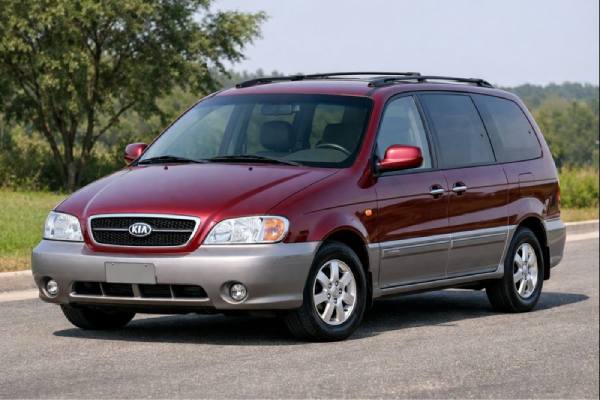
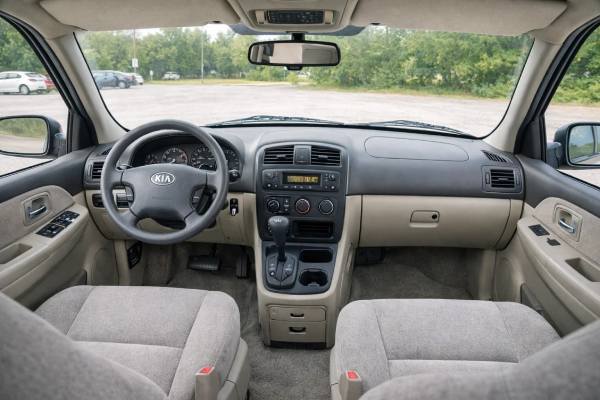
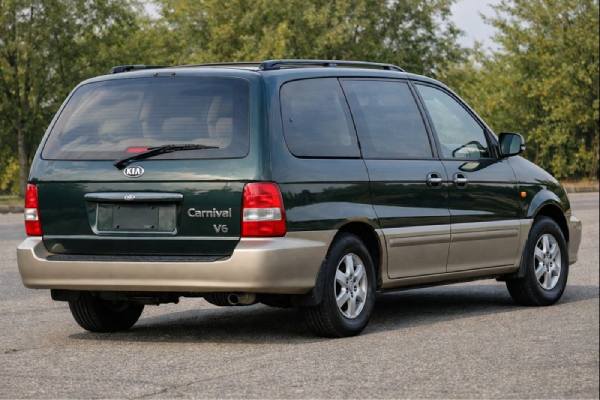
The first-generation Kia Carnival (KV-II) with the 2.5-liter KV6 petrol V6 sits in an interesting sweet spot: a genuinely spacious people-mover with a smooth, rev-happy engine, simple front-wheel-drive packaging, and running costs that can still make sense today—if you buy carefully. In 1998–2000 form, the Carnival’s strengths are practical rather than flashy: a long wheelbase for stable highway manners, a tall cabin with useful seating geometry, and mechanical systems that are serviceable without exotic tools.
Ownership, however, is defined by preventive maintenance. This KV6 uses a timing belt, and cooling-system health matters more than many buyers expect on an older minivan. If you treat it like a “set and forget” appliance, it can become expensive. If you treat it like a maintained drivetrain in a heavy vehicle, it can be a dependable family hauler.
What to Know
- Strong cabin space and a long wheelbase make it an easy long-distance people carrier.
- The KV6 petrol V6 is smooth at speed and generally tolerant of regular-use driving.
- Parts availability is often better than you’d expect for a late-1990s MPV.
- Timing belt and cooling-system neglect can turn into high-cost repairs.
- Plan engine oil service about every 10,000 km (6,000 mi) or 12 months, depending on use.
Guide contents
- Kia Carnival KV-II model profile
- Kia Carnival KV-II KV6 specs and measures
- Kia Carnival KV-II trims, safety and equipment
- Reliability and known weak points
- Maintenance plan and buying tips
- Driving feel and real-world economy
- Rivals: where it fits today
Kia Carnival KV-II model profile
The 1998–2000 Kia Carnival (KV-II) was designed around one clear mission: carry people and their gear with less stress than a sedan or wagon. You feel that intent in the packaging. A long wheelbase gives the cabin a “bus-like” calm on the highway, and the tall roofline improves real comfort—not just headroom numbers, but easier entry, better sightlines, and a more natural seating posture for adults.
This specific version pairs the platform with the 2.5-liter KV6 petrol V6. It’s a naturally aspirated 24-valve engine that prefers clean airflow, steady cooling, and regular oil service. In daily use, it behaves more like a refined passenger-car V6 than a commercial van engine: smooth, willing to rev, and happiest when the transmission is kept in the right gear on grades. The trade-off is that it’s moving a fairly heavy vehicle, so “adequate” power on paper can feel modest with seven people aboard, luggage loaded, and the A/C working hard.
From an engineering perspective, the Carnival’s age shows in two places. First is safety design: late-1990s MPVs generally lack the structural and airbag coverage you see after the mid-2000s, and advanced driver assistance systems (ADAS) aren’t part of the era. Second is lifecycle maintenance: rubber hoses, cooling components, and belt-driven timing hardware all become decision points after two decades.
As a used buy today, the best examples are the boring ones—clean service history, stable temperatures, predictable shifting, and no “mystery” electrical behavior. When those basics are right, the KV-II Carnival remains one of the more practical ways into true three-row space on a budget.
Kia Carnival KV-II KV6 specs and measures
Below are practical, ownership-focused specifications for the 1998–2000 KV-II Carnival with the 2.5 KV6 petrol V6. Because equipment and calibrations varied by market, treat exact values as “typical,” then confirm against your VIN plate, under-hood labels, and the correct service documentation for your region.
Powertrain and efficiency (KV6 2.5 petrol)
| Item | Typical specification |
|---|---|
| Code | KV6 (2.5 petrol) |
| Engine layout and cylinders | V6, 6 cylinders, DOHC, 4 valves/cyl |
| Bore × stroke | 80.0 × 82.8 mm (3.15 × 3.26 in) |
| Displacement | 2.5 L (2,497 cc) |
| Induction | Naturally aspirated |
| Fuel system | Multi-point fuel injection (MPFI) |
| Compression ratio | ~10.4–10.5:1 (market dependent) |
| Max power | 161 hp (120 kW) @ ~6,500 rpm |
| Max torque | ~222 Nm (164 lb-ft) @ ~4,100 rpm |
| Timing drive | Belt |
| Rated efficiency (typical) | ~11.0–11.5 L/100 km (21 mpg US / 25 mpg UK) combined |
| Real-world highway @ 120 km/h (75 mph) | ~10.5–11.8 L/100 km (20–22 mpg US / 24–27 mpg UK), load and wind dependent |
Transmission and driveline
| Item | Typical specification |
|---|---|
| Transmission | 5-speed manual (common) or 4-speed automatic (optional in many markets) |
| Drive type | FWD |
| Differential | Open |
Chassis, brakes, and dimensions
| Item | Typical specification |
|---|---|
| Suspension (front/rear) | Independent front; rear multi-link/independent setup (market dependent) |
| Steering | Power-assisted rack-and-pinion (typical) |
| Brakes | Front discs / rear discs or drums (varies by trim/market) |
| Common tyre size | 195/70 R15 or similar (varies by wheel package) |
| Ground clearance | ~160–175 mm (6.3–6.9 in), tyre dependent |
| Length / width / height | ~4,890 / 1,900 / 1,740 mm (192.5 / 74.8 / 68.5 in) |
| Wheelbase | ~2,900 mm (114.2 in) |
| Turning circle | ~11.5–12.0 m (37.7–39.4 ft), market dependent |
| Kerb (curb) weight | ~1,700–1,850 kg (3,750–4,080 lb), spec dependent |
| Fuel tank | ~60–70 L (15.9–18.5 US gal / 13.2–15.4 UK gal), market dependent |
Performance and capability (realistic expectations)
| Metric | Typical result |
|---|---|
| 0–100 km/h (0–62 mph) | ~13.5–14.5 s (gearbox and load dependent) |
| Top speed | ~180–185 km/h (112–115 mph) |
| Braking distance 100–0 km/h | Often not formally published; expect ~45–48 m on good tyres and healthy brakes |
| Towing capacity | Commonly ~1,200–1,500 kg (2,650–3,300 lb) braked; confirm by VIN/plate |
| Payload | Often ~550–650 kg (1,210–1,430 lb), trim dependent |
Fluids and service capacities (decision-grade)
| System | Typical specification |
|---|---|
| Engine oil | API SG/SH era spec; common viscosity 10W-30; capacity ~5.3 L (5.6 US qt) |
| Coolant | Ethylene glycol, typically 50/50 mix; capacity ~8–9 L (8.5–9.5 US qt) |
| Transmission/ATF | Spec varies by market and transmission; confirm on dipstick/label; capacity varies by drain vs total fill |
| A/C refrigerant | R134a; charge varies by system and rear A/C fitment |
Safety and driver assistance (era-appropriate)
| Item | Notes for 1998–2000 KV-II |
|---|---|
| Crash ratings | Formal ratings may not exist for this exact year/engine/trim in your market; later first-gen Carnival/Sedona tests highlight limitations vs modern MPVs |
| Airbags | Typically dual front airbags; side airbags often absent or trim-dependent |
| ADAS | None in period (no AEB/ACC/LKA as factory systems) |
If you want one takeaway from the numbers: this Carnival is a space-and-comfort vehicle first. Performance is “adequate,” and longevity depends less on heroic engineering and more on whether belt-driven timing and cooling maintenance were respected.
Kia Carnival KV-II trims, safety and equipment
Because the KV-II Carnival was sold across many markets, trim names can be inconsistent. Instead of relying on badges alone, focus on the equipment that changes ownership cost, comfort, and safety.
Trims and options that matter in real life
Most 1998–2000 Carnivals were offered with a practical base specification and then optioned upward with convenience features. The key split is often manual vs automatic and standard A/C vs dual-zone or rear A/C (where fitted). Rear A/C improves comfort but adds refrigerant lines, extra seals, and more aging components—fine when maintained, annoying when neglected.
Other ownership-relevant options include:
- Seating configuration: Some versions prioritize a “people shuttle” layout with easier third-row access; others use heavier seat modules that are harder to remove. If you plan to carry cargo often, confirm how quickly you can reconfigure the cabin.
- Sliding door design: Power features are uncommon in this era, but the condition of rollers, tracks, and latches matters. A smooth sliding door is a sign of a cared-for vehicle.
- Audio and infotainment: Period head units and amplifiers are simple, but wiring hacks are common. Aftermarket stereos can be fine—unless they introduce parasitic battery drain or intermittent speaker faults.
Quick identifiers when shopping
If the seller can’t clearly describe the trim, use these checks:
- Brakes: Look for rear discs vs drums. Rear discs can be a plus for feel and consistency, but condition matters more than hardware.
- Airbag indicators: Count airbags by the steering wheel marking and any seat/roof labels. Don’t assume side airbags exist.
- A/C lines and rear vents: Rear A/C presence is visible—extra lines under the vehicle and rear vents in the cabin.
- Transmission behavior: A calm, predictable automatic matters more than the badge. Harsh engagement, delayed drive, or flare on shifts is a budget warning.
Safety ratings and what they mean for this generation
For late-1990s MPVs, safety is best discussed as equipment and structure, not modern-star comparisons. Many examples have dual frontal airbags and seatbelt pretensioners, but fewer have side airbags or modern compatibility with newer crash protocols.
A later first-generation Carnival/Sedona Euro-style test report (same general generation) is often cited because it highlights structural and restraint limitations compared to newer vans. The practical lesson for owners is simple: prioritize tyres, brakes, and attentive driving habits, and don’t treat the vehicle like it has modern crash avoidance technology.
Safety systems and child-seat practicality
What the KV-II typically does well is space and child-seat packaging. You can usually achieve good child-seat fitment with careful belt routing and sensible seat choice. What it typically lacks is the later-era convenience of multiple ISOFIX/LATCH anchors and sophisticated seatbelt reminders.
If you regularly carry children, verify seatbelt condition (retraction and locking), inspect anchor points for corrosion, and confirm that the center rear position provides the restraint type you expect in your market.
Reliability and known weak points
A 1998–2000 Carnival can be reliable, but it’s rarely “maintenance indifferent.” Think of it as a heavy vehicle powered by a relatively refined V6: when supporting systems are healthy, it feels smooth and competent; when they’re not, the problems can cascade.
Common issues (higher prevalence)
- Timing belt age-out (high severity/cost):
Symptoms: No warning until it fails, or you may hear belt-area noise from tensioners.
Likely cause: Missed interval, old idlers/tensioner, water pump drag.
Remedy: Replace timing belt kit (belt, tensioner, idlers) and strongly consider the water pump at the same time. Document the date and mileage. - Cooling-system weak points (medium to high severity):
Symptoms: Temperature creep in traffic, heater performance changes, coolant smell, unexplained coolant loss.
Likely cause: Aging radiator, thermostat issues, tired hoses, coolant neglected.
Remedy: Pressure test, refresh hoses/clamps as needed, replace thermostat if behavior is unstable, and keep coolant at the correct mix ratio. - Automatic transmission shift quality (medium severity):
Symptoms: Shift flare, delayed engagement, harsh 2–3 or 3–4, overheating smell after heavy loads.
Likely cause: Old ATF, heat stress, internal wear, or poor prior servicing.
Remedy: Verify correct fluid spec, service fluid if condition is unknown, and test-drive fully warmed up. - Door hardware wear (low to medium severity):
Symptoms: Sliding door rattle, hard closing, misalignment, water leaks.
Likely cause: Worn rollers/tracks, tired seals, prior minor impacts.
Remedy: Inspect rollers and tracks, lubricate correctly, and address alignment early to avoid track damage.
Occasional issues (watch-list)
- Ignition components and sensors: Misfires under load, intermittent stalling, or hard starting can trace to coils, crank/cam sensors, or aging connectors.
- Power steering seepage: Older hoses and seals can weep, especially if fluid was never serviced.
- Electrical aging: Window regulators, central locking, and aftermarket alarm/stereo splices can create intermittent faults and battery drain.
Rare but expensive (verify before buying)
- Chronic overheating history: Repeated overheating can warp components and turn a “cheap van” into a major engine job. Look for evidence of repeated coolant top-ups, stained expansion tanks, or uneven heater performance.
- Structural corrosion in key areas: Rust isn’t just cosmetic when it hits suspension mounts, subframe areas, or seatbelt anchor points. Inspect underneath, not just wheel arches.
Recalls, service actions, and how to verify
For a vehicle this old, records matter more than online rumor. Use official recall/VIN checks where available, and confirm with dealer history if possible. Even if no active recalls apply, the process is valuable because it validates the VIN and can reveal campaign work done years ago.
Pre-purchase request list that actually helps:
- Proof of timing belt service (invoice, date, mileage).
- Cooling-system service evidence (coolant type, date).
- Transmission fluid service documentation (especially for automatics).
- A clean scan for stored fault codes if the seller allows it.
Maintenance plan and buying tips
A good maintenance plan for the KV-II Carnival is less about perfection and more about removing the big failure risks first. Use time-based intervals as seriously as distance, because rubber parts and fluids age even when mileage is low.
Practical maintenance schedule (distance or time, whichever comes first)
- Engine oil and filter: every 10,000 km (6,000 mi) or 12 months; shorten to 7,500 km (4,500 mi) for frequent short trips, heavy city use, or high heat.
- Engine air filter: inspect every oil service; replace about 20,000–30,000 km (12,000–18,000 mi) depending on dust.
- Cabin air filter (if fitted): 15,000–20,000 km (9,000–12,000 mi) or yearly for odor control.
- Coolant: refresh every 2–3 years unless your factory documentation specifies longer; always keep correct mix ratio.
- Spark plugs: typically 60,000–100,000 km (37,000–62,000 mi) depending on plug type; replace sooner if misfires appear under load.
- Timing belt: follow the manufacturer interval for your market; for safety on an older vehicle, treat 5 years as a practical maximum even if mileage is low.
- Aux/serpentine belts and hoses: inspect every oil service; replace at first signs of cracking, glazing, or seepage.
- Brake fluid: every 2 years.
- Brake pads/rotors: inspect every 10,000–15,000 km (6,000–9,000 mi) or at tyre rotations.
- Tyre rotation and alignment: rotate every 10,000–12,000 km (6,000–7,500 mi); align if you see uneven wear or steering pull.
- ATF (automatic): if history is unknown, service after purchase using the correct spec; then typically every 40,000–60,000 km (25,000–37,000 mi) depending on heat/load.
- 12 V battery test: annually; many older vans benefit from preemptive replacement around 4–6 years depending on climate.
Fluids and specs you should treat as non-negotiable
- Engine oil: use the viscosity and service category appropriate to climate and availability, but don’t chase “thin modern oil” blindly on an older engine. Consistency matters.
- Coolant: keep the correct coolant chemistry and concentration; mixing random coolants is a common cause of corrosion and deposits.
- Transmission fluid: match the spec—not just “red ATF.” Wrong ATF can create shift problems that look like mechanical failure.
Essential torque values (decision-making only)
These are typical ranges; confirm for your exact variant:
- Wheel nuts: ~90–110 Nm (66–81 lb-ft)
- Engine oil drain plug: ~30–40 Nm (22–30 lb-ft)
- Spark plugs: ~20–25 Nm (15–18 lb-ft)
Buyer’s guide: what to inspect in 30 minutes
- Cold start: Listen for uneven idle, misfire, or belt-area noise.
- Temperature behavior: Ensure it reaches normal temp and stays stable in traffic.
- Transmission test (automatic): Warm it fully; check for flare, harsh engagement, or delayed drive/reverse.
- Brakes: Pedal should feel firm; steering should remain stable under braking.
- Underside corrosion: Focus on subframe areas, suspension mounts, and fuel/brake lines.
- Electrical sanity: Windows, locks, blower speeds, and charging voltage should behave consistently.
Long-term outlook: a well-maintained KV-II Carnival can still be a useful family tool. The bad ones are rarely worth rescuing, because deferred timing and cooling work can exceed the value of the vehicle.
Driving feel and real-world economy
The KV-II Carnival’s driving character is shaped by mass, wheelbase, and its “car-like” V6. You don’t buy it for sharp handling; you buy it because it’s calm, roomy, and predictable when everything is healthy.
Ride, handling, and NVH
On the move, the long wheelbase helps the van track straight at highway speed, especially with good tyres and a tight front suspension. Ride quality is typically tuned for comfort, but age changes the experience: worn dampers and bushings can make it floaty over undulations and clunky over sharp edges. If you hear knocks over small bumps, assume suspension wear until proven otherwise.
Noise levels are acceptable for the era. Wind noise can rise around the mirrors and door seals as rubber hardens, and road noise depends heavily on tyre type. A “quiet” test drive on fresh touring tyres can feel like a different vehicle compared with an example running old, noisy rubber.
Powertrain character (KV6 V6)
The 2.5 KV6 is smooth and generally refined, but it does its best work above low rpm. With light loads, it feels relaxed. With passengers and cargo, you’ll notice it needs revs on hills and during overtakes. That’s normal. What’s not normal is hesitation, repeated hunting between gears, or a feeling that it’s “holding back,” which can point to ignition issues, airflow problems, or transmission behavior that needs attention.
Manual versions often feel more direct and can mask the “heavy vehicle” effect. Automatics trade that for ease of use, but they need clean fluid, good cooling, and healthy shift control to feel confident.
Real-world efficiency
Expect fuel economy to be driven more by speed and load than by careful “hypermiling” tricks. Practical ranges many owners see:
- City: ~13.5–16.0 L/100 km (15–17 mpg US / 18–21 mpg UK)
- Highway (100–120 km/h / 60–75 mph): ~10.0–11.8 L/100 km (20–24 mpg US / 24–28 mpg UK)
- Mixed: ~11.5–13.5 L/100 km (17–20 mpg US / 21–25 mpg UK)
Cold weather and short trips can increase consumption noticeably, because enrichment and heater load hit a petrol V6 harder in a heavy chassis. If your economy is far worse than these ranges, suspect tyre pressure, dragging brakes, misfires, or transmission slip.
Load carrying and towing behavior
With a full cabin, the Carnival remains stable, but braking distance and transmission heat become more important. If you tow (where legal and rated), treat transmission fluid condition and cooling capacity as first-class maintenance items. A healthy cooling system and correct tyre load rating make the difference between a relaxed tow and a stressful one.
Rivals: where it fits today
When the 1998–2000 Carnival KV-II was new, it competed on space and value more than cutting-edge engineering. That positioning still defines it today—especially if you’re shopping older MPVs on a budget.
Versus Toyota Previa/Tarago (and similar Toyota vans)
Toyota alternatives often win on “appliance reliability,” especially drivetrain longevity with less drama. Where the Carnival can still compete is cabin packaging per dollar and a surprisingly comfortable long-wheelbase feel. If you find a clean Toyota at the same price, it’s usually the safer bet. If the Toyota premium pushes you into neglected examples, a well-maintained Carnival can be the smarter buy.
Versus Honda Odyssey of the era
Odyssey models often feel more car-like in steering and drivetrain response, with strong everyday usability. The Carnival counters with a big-cabin sensation and value-focused parts pricing in many regions. The deciding factor is usually condition: a cared-for Odyssey can feel tighter, but a neglected one can be expensive in its own ways.
Versus Chrysler Voyager/Grand Voyager
Chrysler vans often offer excellent seating practicality and comfort, but ownership experience varies widely by engine and transmission pairing. The Carnival’s advantage is simplicity (FWD, naturally aspirated petrol V6) and, in many markets, easier parts sourcing than some imported trims. Chrysler may win on interior cleverness; the Carnival often wins on straightforward maintenance if the basics are kept up.
Versus Ford Galaxy/VW Sharan/Seat Alhambra (Euro MPVs)
These can feel more European in steering and high-speed stability, and some trims offer strong diesel efficiency. They can also bring more complex component sourcing and higher repair variance depending on region. The Carnival’s appeal is being a “big box” family vehicle with fewer specialized systems.
The honest verdict
The KV-II Carnival KV6 is best for buyers who want maximum cabin space for minimal purchase price and are willing to maintain proactively. It’s not the best pick if you want modern crash avoidance, late-model safety engineering, or a vehicle that tolerates skipped servicing.
If you buy one, buy the owner—not the odometer. A high-mileage van with excellent records is often a better long-term bet than a low-mileage example with missing history and old fluids.
References
- euroncap_kia_carnival_2003_2stars.pdf 2003 (Safety Rating)
- Engine Oil Grades and Capacities 2023 (Service Information)
- Car Safety Recalls | What They Are & What To Do | Kia UK 2025 (Recall Checker)
- Check for Recalls: Vehicle, Car Seat, Tire, Equipment 2025 (Recall Database)
Disclaimer
This article is for informational purposes only and is not a substitute for professional inspection, diagnosis, or repair. Specifications, torque values, service intervals, and procedures can vary by VIN, market, and equipment, so always verify details using the correct official service and owner documentation for your exact vehicle.
If this guide helped, please consider sharing it on Facebook, X (Twitter), or your favorite forum to support our work.