
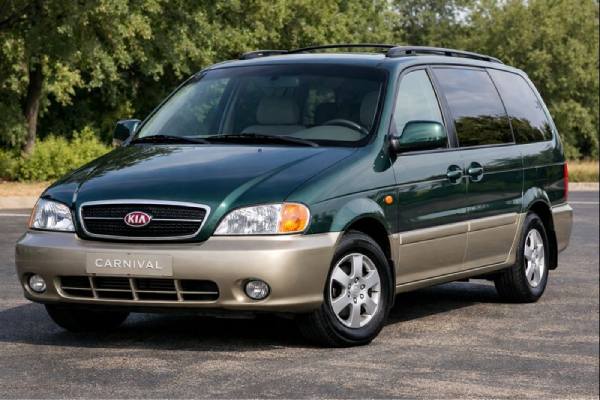
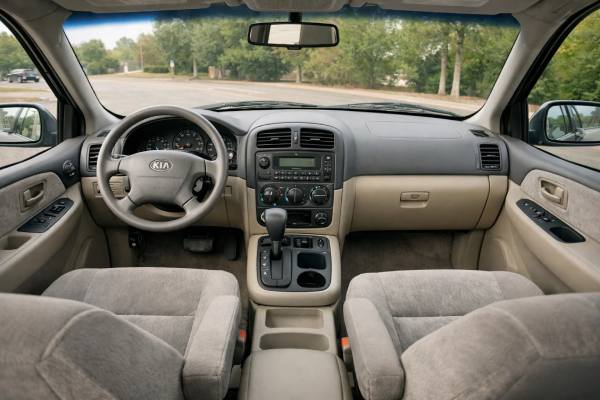
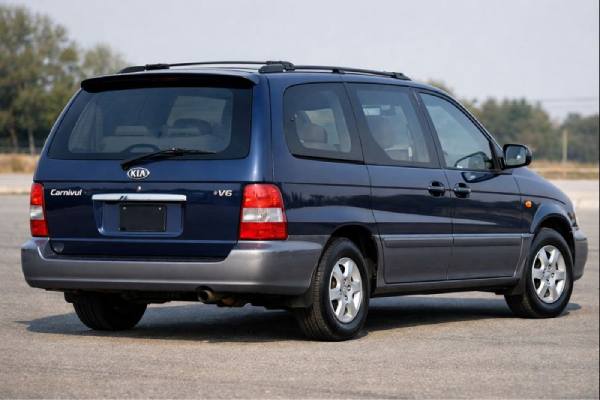
The 1998–2000 Kia Carnival (KV-II) with the 2.9-liter J3 diesel is the “workhorse” version of the first-generation Carnival: built to move seven people without feeling fragile, and tuned around low-end pulling power rather than high-rev performance. The big advantage is the diesel’s torque delivery in a heavy MPV—useful in city traffic, on hills, and when the cabin is full. The trade-off is that this era of diesel technology rewards owners who stay ahead of maintenance, especially fuel filtration, timing-belt service, and cooling-system health.
As a used buy, the J3 Carnival can be an excellent value because it delivers real space, simple front-wheel-drive packaging, and predictable road manners. But age matters. Vacuum hoses, turbo plumbing, rubber bushings, and electrical connectors are now as important as engine compression. Buy on condition and records, not mileage alone.
Fast Facts
- Strong low-rpm torque makes it calmer with passengers and luggage than many petrol rivals.
- Long wheelbase and tall cabin deliver true adult-friendly seating in all rows.
- Diesel economy is a genuine advantage on steady highway runs.
- Neglected timing belt, fuel filtration, or overheating history can turn into high-cost repairs.
- Plan fuel filter replacement about every 20,000 km (12,000 mi) or 12 months, depending on fuel quality.
Jump to sections
- Kia Carnival KV-II J3 diesel explained
- Kia Carnival KV-II J3 spec tables
- Kia Carnival KV-II diesel trims and safety
- Known problems and recalls
- Service schedule and ownership tips
- On-road performance and economy
- How it stacks up
Kia Carnival KV-II J3 diesel explained
The J3 2.9 diesel Carnival is easiest to understand as a heavy family vehicle tuned like a light commercial: it’s happiest pulling from low rpm, sitting at steady speed for long distances, and doing repeatable daily work. In the late 1990s, that meant a turbo-diesel with relatively simple electronics (compared with later common-rail systems), plus a service schedule that assumes owners will keep filters and belts current.
In real ownership terms, the J3 diesel changes the Carnival’s personality. It feels less “revvy” than the petrol V6 versions and more like it has a strong, usable midrange—especially when the cabin is full. That matters because an MPV’s worst-case scenario is not a solo commute; it’s seven seats occupied, luggage onboard, and the A/C running on a warm day. The diesel’s advantage is that it doesn’t need to be worked as hard to keep the vehicle moving.
The J3’s other advantage is fuel economy. In steady highway use, a well-sorted diesel Carnival can return consumption figures that make sense even today. The limitation is that older diesel hardware can be sensitive to neglect and poor fuel quality. Fuel filtration is not an “optional” service on these vehicles; it’s the first line of defense for injection components and driveability.
The chassis side of the story is equally important. The KV-II Carnival uses a long wheelbase and front-wheel drive to create a roomy cabin with stable straight-line behavior. That’s good for families. But it also means that suspension bushings, steering joints, and braking hardware do a lot of work. When those parts age, the van can feel loose or noisy—sometimes blamed on the engine when the real cause is worn dampers, tired mounts, or neglected brake service.
The bottom line: the J3 diesel Carnival is a practical tool. Treat it like a maintained drivetrain in a heavy vehicle—filters, belts, fluids, cooling, and brakes—and it can be dependable. Treat it like a disposable appliance, and small issues will stack up quickly.
Kia Carnival KV-II J3 spec tables
The tables below focus on the 1998–2000 Kia Carnival (KV-II) with the 2.9-liter J3 diesel rated around 124 hp. Exact figures can vary by market, gearbox, emissions calibration, and seating/A/C configuration, so use these as a practical baseline and confirm against your VIN plate and correct service documentation.
Powertrain and efficiency (J3 2.9 diesel)
| Item | Typical specification |
|---|---|
| Code | J3 (2.9 diesel) |
| Engine layout and cylinders | Inline-4, 4 cylinders, head and valvetrain vary by market; commonly 4 valves/cyl |
| Bore × stroke | 97.1 × 98.0 mm (3.82 × 3.86 in) |
| Displacement | 2.9 L (2,902 cc) |
| Induction | Turbocharged (intercooler fitment varies) |
| Fuel system | Conventional diesel injection (market dependent) |
| Compression ratio (ICE) | ~18.9:1 (typical) |
| Max power | 124 hp (92 kW) @ ~3,600–3,800 rpm |
| Max torque | ~330–340 Nm (243–251 lb-ft) @ ~1,900–2,000 rpm |
| Timing drive | Belt |
| Rated efficiency | ~8.0–9.0 L/100 km (26–29 mpg US / 31–35 mpg UK) combined |
| Real-world highway @ 120 km/h (75 mph) | ~7.2–8.4 L/100 km (28–33 mpg US / 34–39 mpg UK), load and wind dependent |
Transmission and driveline
| Item | Typical specification |
|---|---|
| Transmission | 5-speed manual (common); 4-speed automatic available in some markets |
| Drive type | FWD |
| Differential | Open |
Chassis and dimensions
| Item | Typical specification |
|---|---|
| Suspension (front/rear) | Front wishbone/strut type (market dependent); rear coil spring layout (varies) |
| Steering | Hydraulic power-assisted rack-and-pinion |
| Brakes | Front ventilated discs; rear drums (many trims) |
| Wheels and tyres (popular size) | 215/65 R15 (rim 15 in) |
| Ground clearance | ~150–170 mm (5.9–6.7 in), tyre and trim dependent |
| Length / width / height | ~4,890 / 1,900 / 1,730 mm (192.5 / 74.8 / 68.1 in) |
| Wheelbase | ~2,905 mm (114.4 in) |
| Turning circle (kerb-to-kerb) | ~11.5–12.0 m (37.7–39.4 ft) typical |
| Kerb (curb) weight | ~2,050–2,220 kg (4,520–4,895 lb), equipment dependent |
| GVWR | ~2,545 kg (5,610 lb) typical (market dependent) |
| Fuel tank | ~75 L (19.8 US gal / 16.5 UK gal) |
Cargo and seating practicality
| Item | Typical specification |
|---|---|
| Seating | Usually 7 seats (config varies by market) |
| Cargo volume | ~344 L (12.1 ft³) seats up; up to ~1,159 L (40.9 ft³) seats folded/removed (method varies) |
Performance and capability
| Metric | Typical result |
|---|---|
| 0–100 km/h (0–62 mph) | ~17.0–18.5 s (gearbox and load dependent) |
| Top speed | ~165–170 km/h (103–106 mph) |
| Braking distance 100–0 km/h | Not consistently published for this exact variant; expect mid-40 m range with healthy brakes and quality tyres |
| Towing capacity | Often ~1,200–1,500 kg (2,650–3,300 lb) braked; confirm by VIN/plate |
| Payload | Often ~550–650 kg (1,210–1,430 lb), spec dependent |
Fluids and service capacities (verify by VIN)
| System | Typical specification |
|---|---|
| Engine oil | Diesel-rated oil (ACEA B3/B4 era equivalent); common viscosity 5W-40 or 10W-40; capacity ~6.0–7.0 L (6.3–7.4 US qt) |
| Coolant | Ethylene glycol, typically 50/50 mix; capacity often ~9–10 L (9.5–10.6 US qt) |
| Transmission/ATF | Spec varies by gearbox; confirm on label/service manual; capacity varies (drain vs total fill) |
| Differential / transfer case | Not applicable for FWD-only versions |
| A/C refrigerant | R134a; charge depends on rear A/C fitment |
| Key torque specs | Wheel nuts ~90–110 Nm (66–81 lb-ft); oil drain plug often ~30–45 Nm (22–33 lb-ft) |
Safety and driver assistance (period-correct)
| Item | Notes |
|---|---|
| Crash ratings | Some markets have published Euro NCAP results for a similar-generation Carnival/Sedona diesel; protocol differs from modern star systems |
| IIHS | Generally not applicable to this model in most markets |
| Headlight rating (IIHS) | Not applicable |
| ADAS suite | None in this era (no factory AEB/ACC/LKA as we define them today) |
These numbers tell the real story: the diesel Carnival is not quick, but it is workable under load and can be economical if it’s mechanically healthy.
Kia Carnival KV-II diesel trims and safety
For the 1998–2000 KV-II Carnival, trim names vary widely by country, importer, and year. Instead of chasing badge labels, focus on the equipment differences that affect maintenance cost, safety, and daily usability—especially in a diesel MPV that may have lived a hard life (airport runs, school transport, or long-distance family travel).
Trims and options that change ownership
Key “value” features on these vans often include:
- Gearbox choice: A manual gearbox usually offers simpler long-term ownership and better engine-braking on descents. Automatics can be very pleasant in traffic, but they are more sensitive to fluid condition and heat.
- A/C configuration: Rear A/C improves comfort for the third row, but it adds lines, seals, and another set of aging components. If rear cooling is weak, assume leaks or compressor performance issues until tested.
- Seating layout: Some trims have seat designs that are easier to remove (useful for cargo), while others prioritize integrated comfort seats that are heavier and slower to reconfigure. Test this if your use includes DIY hauling.
- Brake and wheel packages: Many diesels use rear drums and 15-inch wheels. That can be completely fine, but it places more importance on brake adjustment, quality shoes/pads, and fresh fluid.
Quick identifiers during inspection
If a seller is vague about trim, use these “quick tells”:
- ABS presence: An ABS lamp on the cluster at key-on is normal; the system should pass its self-check and go out. Permanently lit ABS usually means sensor wiring, hub tone rings, or hydraulic unit faults.
- Airbag coverage: Many examples have dual front airbags; side airbags are uncommon in early builds and market dependent. Confirm via steering wheel markings and cabin labels.
- Rear A/C: Look for rear vents and control panels. Rear A/C is valuable, but only if it still works properly.
- Door hardware condition: Smooth sliding doors with no sag or binding suggest the vehicle has not lived a purely commercial life.
Safety ratings: what to expect from this generation
Safety should be framed honestly: late-1990s MPVs generally do not meet modern crash standards. Even if a similar-generation Carnival/Sedona has a published rating, it reflects a test protocol of its time, and it may not match your exact year, structure, or restraint spec.
Practical safety advice for owners is more actionable than star-count comparisons:
- Tyres matter more than most upgrades. Use the correct load rating and replace aged tyres even if tread looks acceptable.
- Brake condition is a safety system. Drums and discs both work well when maintained; either can be unsafe when neglected.
- Seatbelts and anchors deserve attention. Aged belts that don’t retract smoothly, or corroded anchor points, should be treated as repair items—not cosmetic issues.
Driver assistance and stability systems
Most 1998–2000 examples do not have modern driver aids. If the van has ABS, it’s a meaningful safety feature for wet roads. Electronic stability control (ESC) is uncommon in early versions, and advanced driver assistance systems (AEB, adaptive cruise, lane support) are not part of the factory equipment for this era.
If you want a simple verdict: buy the best-condition example you can, then invest first in tyres, brakes, and lighting. Those upgrades deliver more real safety than almost anything else you can do to a 25-year-old MPV.
Known problems and recalls
Reliability on the J3 diesel Carnival is best approached as a checklist of age-sensitive systems. The engine itself can be durable, but the surrounding parts—belts, hoses, mounts, sensors, and fuel plumbing—decide whether ownership feels simple or stressful.
Common issues (high prevalence)
- Timing belt overdue (high severity):
Symptoms: Often none until failure; sometimes belt-area chirps or a rough idle if timing is off.
Likely cause: Age-out, worn tensioner/idlers, water pump drag, oil contamination.
Remedy: Replace belt, tensioner, and idlers as a kit; strongly consider water pump at the same time. Treat time as seriously as mileage. - Fuel filter restriction and air ingress (medium severity):
Symptoms: Hard starting, hesitation under load, uneven idle, stalling after filter change.
Likely cause: Dirty fuel, overdue filter, cracked primer bulb/hoses, loose clamps.
Remedy: Replace filter on schedule, inspect lines for seepage, and bleed the system properly after service. - Turbo hoses and boost leaks (medium severity):
Symptoms: Sluggish acceleration, smoke under load, “whoosh” noises, oily residue on hoses.
Likely cause: Aging rubber, loose clamps, split intercooler plumbing.
Remedy: Pressure-test intake tract; replace soft hoses and clamps before they strand you. - Cooling system fatigue (medium to high severity):
Symptoms: Temperature creep in traffic, heater performance changes, coolant smell, slow loss of coolant.
Likely cause: Old radiator, thermostat issues, weak cap, tired hoses.
Remedy: Pressure test, refresh hoses/clamps, and keep coolant mix correct.
Occasional issues (watch-list)
- Glow plug or glow control faults: Rough cold starts and excessive white smoke at start-up can point to glow system weakness or low battery voltage.
- EGR and intake deposits: Depending on configuration, exhaust gas recirculation can contribute to soot build-up and reduced airflow, especially with short-trip use.
- Clutch wear (manual): A heavy MPV driven in city traffic can eat clutches. A high bite point, slip under load, or judder deserves a close look.
Rare but expensive (verify before buying)
- Overheating history: Repeated overheating can cause long-term engine damage. Look for coolant staining, mixed coolants, or signs of repeated top-ups.
- Electrical “patchwork”: Old alarms, stereo wiring, and improvised repairs can create parasitic battery drain and intermittent faults that are time-consuming to diagnose.
- Rust in structural zones: Check sills, subframe areas, suspension mounts, and seatbelt anchor points—not just visible body panels.
Recalls, service actions, and how to verify completion
Rather than guessing which recalls apply to a 1998–2000 van, use official VIN and registration-based recall checks and ask for proof of completed campaign work (dealer printout or invoices). Even when no open recalls exist, the verification step helps confirm the vehicle’s identity and service trail.
Pre-purchase checks worth requesting:
- Written proof of timing belt replacement (date and mileage).
- Evidence of recent fuel filter and air filter service.
- Cooling system work history (coolant type, radiator/thermostat replacements).
- A warm test drive long enough to confirm stable temperature and predictable shifting.
The pattern is consistent: a maintained J3 diesel Carnival can be dependable, but a neglected one can quickly exceed its purchase price in deferred maintenance.
Service schedule and ownership tips
A smart maintenance plan for the J3 diesel Carnival focuses on preventing the failures that strand vehicles: belt-driven timing components, fuel delivery, cooling stability, and braking consistency. Use distance-and-time intervals, because many older MPVs have low annual mileage but high calendar age.
Practical maintenance schedule (whichever comes first)
- Engine oil and filter: every 10,000 km (6,000 mi) or 12 months. If you do frequent short trips, idle time, or heavy urban use, shorten to 7,500 km (4,500 mi). Use a diesel-rated oil suitable for your climate.
- Fuel filter: every 20,000 km (12,000 mi) or 12 months (shorter if fuel quality is uncertain). Replace sooner if you see hesitation under load or hard starting.
- Engine air filter: inspect every oil change; replace typically 20,000–30,000 km (12,000–18,000 mi) depending on dust.
- Cabin filter (if fitted): 15,000–20,000 km (9,000–12,000 mi) or annually for blower performance and odor control.
- Coolant: refresh every 2–3 years unless your official documentation specifies otherwise. Maintain the correct mix ratio and don’t mix random coolant chemistries.
- Timing belt: follow the official interval for your market; as a practical rule on an older diesel, treat 5 years as a sensible maximum even if mileage is low.
- Accessory belts and hoses: inspect at every oil change; replace at first cracking, glazing, or swelling.
- Brake fluid: every 2 years.
- Brakes: inspect pads, discs, and rear drum condition every 10,000–15,000 km (6,000–9,000 mi); ensure rear drums are properly adjusted where applicable.
- Manual gearbox oil (manual): inspect for leaks; consider replacement about every 80,000–120,000 km (50,000–75,000 mi) depending on use.
- ATF (automatic): if history is unknown, service after purchase with the correct fluid spec; then typically every 40,000–60,000 km (25,000–37,000 mi).
- Battery and charging: test annually. Diesel glow systems demand good voltage, so weak batteries show up as “engine problems” in cold weather.
Fluids and capacities: practical guidance
Because market specs vary, treat labels and correct manuals as final authority. Still, these guidelines help you plan:
- Oil: a diesel-rated oil (common choices are 5W-40 or 10W-40) that matches local climate and availability.
- Coolant: 50/50 ethylene glycol mix unless specified otherwise; prioritize corrosion protection and stable temperature control.
- Fuel system: avoid “mystery” additives. The best protection is clean fuel, correct filter changes, and leak-free lines.
Essential torque values (decision-grade only)
These ranges are commonly appropriate for this class of vehicle; verify exact values for your VIN:
- Wheel nuts: ~90–110 Nm (66–81 lb-ft)
- Oil drain plug: ~30–45 Nm (22–33 lb-ft)
Buyer’s guide: what to check before you commit
- Cold start quality: A healthy diesel should start cleanly for its age. Excessive cranking, heavy smoke, or rough idle suggests glow/battery/fuel issues.
- Temperature stability: Drive it until fully warm. Any temperature creep in traffic is a red flag.
- Load test: Find a hill and accelerate. It should pull steadily without surging or cutting power.
- Brake feel: The pedal should be firm and the vehicle should track straight during braking.
- Underside inspection: Look for rust in structural areas and leaks at the engine, gearbox, and steering system.
If you want the most durable ownership outcome, prioritize a van with documented belt service, recent filters, stable temperatures, and original-looking wiring.
On-road performance and economy
The J3 diesel Carnival is about steady progress, not speed. When driven as intended—low to mid rpm, smooth throttle, and early gear selection—it feels composed and capable. When driven like a petrol car (high rpm, frequent kickdowns, and abrupt throttle changes), it often feels noisy and slower than expected.
Ride, handling, and NVH
The KV-II platform’s long wheelbase is a real asset. On the highway it tends to track straight and feel stable, especially with quality tyres and fresh dampers. In town, the van’s height and mass are more noticeable. Worn suspension bushings and tired dampers can create a floaty feel over undulations and clunks over sharp bumps. These symptoms are common “age wear,” not necessarily signs that the chassis is inherently poor.
Noise levels depend heavily on engine mounts, exhaust condition, and door seals. A well-maintained example can feel surprisingly calm at 90–110 km/h (55–70 mph), while a neglected one can feel harsh due to vibration transfer through aged mounts.
Powertrain character: diesel strengths and limits
The best part of this diesel setup is usable torque. With passengers onboard, the engine feels more willing at low rpm than many petrol alternatives of the era. That makes stop-and-go driving easier and reduces the need for constant downshifts on hills.
The limitation is overtaking performance. Expect deliberate planning for passes, especially on two-lane roads. If the van feels dramatically weaker than expected, look for boost leaks, restricted fuel filtration, a dragging brake, or an air filter that hasn’t been changed in years.
Manual gearboxes often suit the J3 well because you can keep the engine in its torque band. Automatics can be comfortable, but they must shift cleanly and keep temperatures under control.
Real-world economy: what owners typically see
A healthy diesel Carnival can deliver strong economy for its size:
- City: ~9.5–12.0 L/100 km (20–25 mpg US / 24–30 mpg UK)
- Highway (100–120 km/h / 60–75 mph): ~7.2–8.4 L/100 km (28–33 mpg US / 34–39 mpg UK)
- Mixed: ~8.0–9.0 L/100 km (26–29 mpg US / 31–35 mpg UK)
Cold weather can worsen economy and drivability because glow time increases and diesel combustion is less efficient until fully warm. Short-trip use also accelerates soot build-up in intake and EGR-related components where fitted.
Load and towing notes
If you tow within the vehicle’s rated limits, the diesel’s torque helps—but your limiting factors are usually braking, cooling, and transmission heat. For towing-friendly ownership:
- Keep cooling system performance “boringly stable.”
- Service transmission fluids more frequently under heavy use.
- Use tyres with correct load ratings and keep pressures accurate.
Driven with mechanical sympathy, the J3 diesel Carnival remains a practical long-distance carrier. Its strengths are most obvious when the vehicle is loaded, not when it’s empty.
How it stacks up
The 1998–2000 J3 diesel Carnival occupies a specific niche: maximum cabin space for a modest purchase price, with diesel economy and torque as the key advantages. To decide if it’s the right choice, compare it to rivals through a “use case” lens rather than brand reputation alone.
Versus VW Sharan / Ford Galaxy / SEAT Alhambra (diesel MPVs)
These Euro MPVs often feel more car-like in steering and handling, and many were sold with very efficient diesel engines. Where they can become challenging is parts complexity and repair variance depending on engine and gearbox. The Carnival’s advantage is straightforward packaging and a heavy-duty feel under load. The European vans often win on driving feel and efficiency; the Carnival often wins on cabin space-per-dollar and “simple enough to keep going” ownership.
Versus Toyota Previa / Tarago and similar Toyota people carriers
Toyota options usually lead in long-term predictability when maintained, and they often age gracefully. The downside is that good examples can be priced above their age because of reputation. If the Toyota premium forces you into a neglected vehicle, the better-bought Carnival can be the smarter decision. Condition beats badge at this age.
Versus Chrysler Voyager / Grand Voyager diesels
These can offer excellent seating practicality and comfort, but ownership outcomes depend heavily on engine/transmission pairing and maintenance history. The Carnival’s diesel appeal is its low-rpm usability and a generally robust “working vehicle” attitude. Chrysler may win on interior cleverness; the Carnival often wins on straightforward day-to-day usability when it’s mechanically sorted.
Versus large wagons and SUVs of the era
If you only need five seats most days, a wagon can be cheaper to run and easier to park. The Carnival earns its place when you regularly use the third row, carry bulky items, or want a tall cabin for easier entry.
The modern verdict
Choose the J3 diesel Carnival if:
- You genuinely need three-row space and want diesel torque and economy.
- You can verify timing belt history and fuel-filter discipline.
- You’re willing to refresh age-related items (hoses, mounts, suspension, brakes) to restore the original “tightness.”
Skip it if:
- You want modern crash avoidance and late-model safety engineering.
- You don’t have maintenance records and don’t want a “catch-up” service budget.
A well-maintained J3 diesel KV-II is still a useful family tool. The bad ones are rarely worth saving, because deferred belt, cooling, and fuel-system work adds up fast.
References
- euroncap_kia_carnival_2003_2stars.pdf 2003 (Safety Rating)
- K2700-brochure.pdf 2010 (Brochure)
- Kia Recalls | Kia Europe 2026 (Recall Checker)
- Check if a vehicle, part or accessory has been recalled – GOV.UK 2026 (Recall Database)
Disclaimer
This article is for informational purposes only and is not a substitute for professional inspection, diagnosis, or repair. Specifications, torque values, service intervals, and procedures can vary by VIN, market, and equipment, so verify details using the correct official service and owner documentation for your exact vehicle.
If you found this guide useful, please consider sharing it on Facebook, X (Twitter), or your preferred community to support our work.