
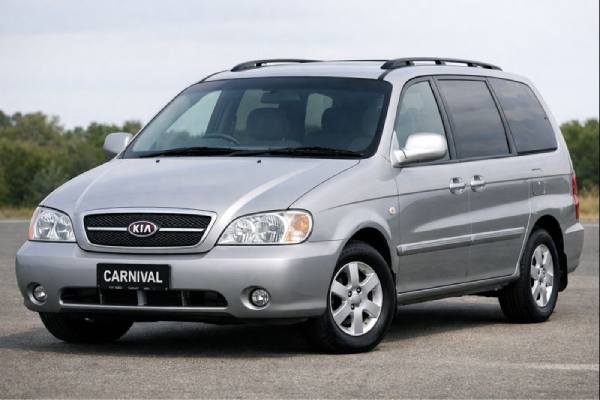
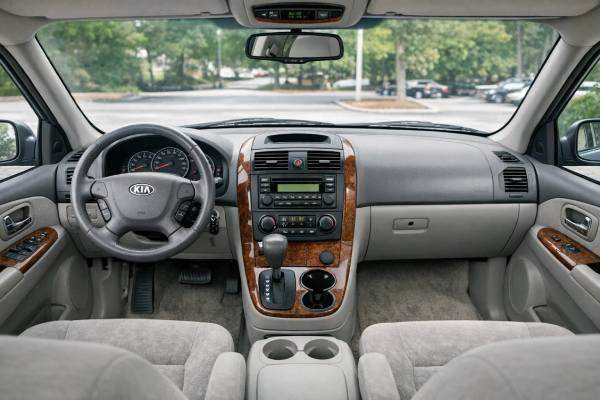
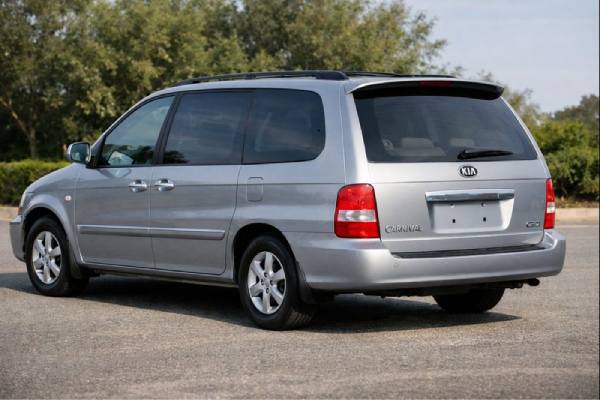
The facelifted 2001–2005 Kia Carnival (KV-II) with the KV6 2.5-liter petrol V6 is the more “car-like” take on the early Carnival formula. Where the diesels lean on low-end pull, the KV6 version trades some of that shove for smoother revs, quieter cruising, and simpler cold-weather behavior—especially for drivers who do short trips or mixed urban use. It is still a heavy MPV, so the engineering story is less about outright speed and more about heat management, automatic-transmission care, and keeping suspension and brakes tight as the vehicle ages.
As a used buy today, the facelift matters because it tends to bring small but meaningful improvements in cabin ergonomics, trim durability, and day-to-day usability. The big ownership question is not “Is the KV6 powerful enough?”—it is—but whether the van has been kept cool, serviced on time, and repaired with the correct fluids. This guide focuses on what changes your long-term outcome most.
At a Glance
- Smooth, naturally aspirated V6 suits relaxed highway and family use better than its size suggests.
- Facelift models often feel more refined inside, with better daily ergonomics than early builds.
- Strong cabin space-per-dollar for seven-seat use, even by modern standards.
- Cooling-system neglect or wrong ATF can trigger expensive, repeat faults in heavy MPV duty.
- Plan engine oil and filter service about every 10,000 miles (12 months), whichever comes first.
Section overview
- Kia Carnival KV-II facelift guide
- Kia Carnival KV-II 2.5 KV6 data
- Kia Carnival KV-II equipment and safety
- Reliability hot spots
- Maintenance plan and buying
- Driving feel and economy
- Rivals and alternatives
Kia Carnival KV-II facelift guide
The 2001–2005 facelift of the first-generation Carnival (KV-II) is best understood as a refinement pass on a practical, heavy-duty MPV. The basic architecture stays the same: front-wheel drive, long wheelbase, a tall roofline for real three-row room, and a drivetrain designed to move a full cabin without constant strain. What changes with the facelift is the “ownership texture”—how the interior wears, how the controls feel, and how well the vehicle fits modern traffic conditions.
With the KV6 2.5-liter V6, the Carnival’s personality shifts toward smoothness. It is a naturally aspirated engine (no turbo), so the power delivery builds progressively and feels predictable. In a people carrier, that predictability is useful: gentle throttle inputs make the van easy to drive with passengers, and the engine doesn’t demand perfect boost control or a narrow torque band. The flip side is that the Carnival is still heavy, so the V6 will happily consume fuel if you drive it like a light hatchback. The winning strategy is to drive it like an MPV: steady inputs, early planning for passes, and keeping the drivetrain cool.
The facelift era also tends to correlate with more “complete” family equipment in many markets: features like rear air conditioning, more robust audio and cabin trim, and improved seating hardware appear more often on later examples. That matters because many Carnivals lived hard lives—airport runs, school transport, long highway trips—and the best-used buys are typically the ones that were treated like family vehicles, not commercial shuttles.
From an engineering and maintenance perspective, the facelift KV6 Carnival has three recurring themes:
- Heat is the enemy. Any history of overheating (even “just once”) deserves serious scrutiny because heavy MPVs stress cooling systems.
- Fluid correctness matters. Wrong engine oil grade or incorrect automatic transmission fluid (ATF) can create problems that feel “electrical” but are actually hydraulic and thermal.
- Chassis wear is normal, not optional. Bushings, dampers, and brakes work hard. Replacing tired parts restores safety and calmness more than chasing engine mods ever will.
If you approach a KV6 Carnival with that mindset, it can be a dependable and comfortable family tool, even at high mileage.
Kia Carnival KV-II 2.5 KV6 data
The tables below focus on the facelift 2001–2005 Kia Carnival (KV-II) with the KV6 2.5-liter petrol V6 rated around 161 hp. Exact values can vary by emissions level, market calibration (kW/PS ratings), transmission, and seating or rear A/C configuration. Use these as decision-grade guidance, then verify against your VIN plate and the correct service documentation for your region.
Powertrain and efficiency
| Item | Typical specification (facelift 2001–2005) |
|---|---|
| Code | KV6 (often listed as Sigma 2.5 V6 in some markets) |
| Engine layout and cylinders | V6, 6 cylinders, DOHC, 4 valves/cyl (24-valve) |
| Bore × stroke | ~80.0 × 82.5 mm (3.15 × 3.25 in) |
| Displacement | 2.5 L (2,497 cc) |
| Induction | Naturally aspirated |
| Fuel system | MPFI / MPI (multi-point injection) |
| Compression ratio (ICE) | ~10.0–10.5:1 (market dependent) |
| Max power | 161 hp (120 kW) @ ~5,500–5,800 rpm (varies by rating system) |
| Max torque | ~220–230 Nm (162–170 lb-ft) @ ~3,500–4,000 rpm |
| Timing drive | Belt |
| Rated efficiency | ~10.5–12.5 L/100 km (19–22 mpg US / 23–27 mpg UK) mixed (typical) |
| Real-world highway @ 120 km/h (75 mph) | ~9.5–11.0 L/100 km (21–25 mpg US / 26–30 mpg UK), load and wind dependent |
Transmission and driveline
| Item | Typical specification |
|---|---|
| Transmission | 5-speed manual (less common) or 4-speed automatic (common) |
| Drive type | FWD |
| Differential | Open |
Chassis and dimensions
| Item | Typical specification (varies by market) |
|---|---|
| Suspension (front/rear) | Front strut-based layout; rear coil-spring layout (design varies by region) |
| Steering | Hydraulic power-assisted rack-and-pinion |
| Brakes | Front ventilated discs; rear discs or drums depending on trim/market |
| Wheels and tyres (popular size) | 215/65 R15 or 225/60 R16 (trim dependent) |
| Ground clearance | ~150–170 mm (5.9–6.7 in), tyre and trim dependent |
| Length / width / height | ~4,890–4,930 / ~1,900 / ~1,740–1,770 mm (192–194 / 75 / 69–70 in) |
| Wheelbase | ~2,905 mm (114.4 in) |
| Turning circle (kerb-to-kerb) | ~11.5–12.1 m (37.7–39.7 ft) typical |
| Kerb (curb) weight | ~1,850–2,050 kg (4,080–4,520 lb), equipment dependent |
| GVWR | ~2,500–2,600 kg (5,510–5,730 lb), market dependent |
| Fuel tank (ICE) | ~75 L (19.8 US gal / 16.5 UK gal) typical |
Cargo and seating practicality
| Item | Typical specification |
|---|---|
| Seating | Commonly 7 seats (some markets vary) |
| Cargo volume | Highly configuration-dependent; many examples offer modest luggage behind row 3 and large volume with seats folded/removed |
Performance and capability
| Metric | Typical result (healthy drivetrain) |
|---|---|
| 0–100 km/h (0–62 mph) | ~11.5–13.0 s (gearbox and load dependent) |
| Top speed | ~175–185 km/h (109–115 mph) |
| Braking distance 100–0 km/h | Often mid-40 m range with quality tyres and fresh brakes (varies) |
| Towing capacity | Commonly ~1,200–1,600 kg (2,650–3,530 lb) braked; verify by VIN plate |
| Payload | Often ~550–650 kg (1,210–1,430 lb), spec dependent |
Fluids and service capacities (verify by VIN)
| System | Practical guidance |
|---|---|
| Engine oil | Petrol-rated oil; many markets specify 10W-30 or similar for the era; capacity commonly ~5.0–5.5 L (5.3–5.8 US qt) |
| Coolant | Ethylene glycol coolant, typically 50/50 mix; capacity often ~9–10 L (9.5–10.6 US qt) |
| Transmission/ATF | Correct spec is critical; capacity varies by drain vs total fill |
| A/C refrigerant | R134a; charge varies with rear A/C fitment |
| Key torque specs | Wheel nuts commonly ~90–110 Nm (66–81 lb-ft); confirm by model-year manual |
Safety and driver assistance
| Item | What to expect |
|---|---|
| Crash ratings | Some markets published Euro NCAP results for the first-gen Carnival/Sedona; protocol differs from modern star systems |
| ADAS | This era predates modern AEB/ACC/LKA; features are primarily ABS and possibly traction control depending on market/trim |
Kia Carnival KV-II equipment and safety
Trim naming for the 2001–2005 facelift Carnival is inconsistent worldwide. A “GS” in one country may resemble an “LX” elsewhere, and importers sometimes bundled options differently year to year. For buyers and owners, the smarter approach is to focus on the equipment that changes reliability risk, service cost, and real safety.
Trims and options that matter most
Key features that can genuinely change ownership outcomes include:
- Automatic vs manual transmission: Automatics are common and comfortable, but they must be serviced with the correct ATF and should shift cleanly under load. Manuals are usually simpler long-term, but clutch wear can be high in city use.
- Rear air conditioning: Great for third-row comfort and resale value, but it adds hoses, seals, and an additional evaporator. Expect higher A/C maintenance risk on neglected examples.
- Brake specification: Some markets and trims moved toward better rear braking hardware. Regardless of disc or drum, what matters is condition: fresh fluid, even pad wear, and straight tracking under hard stops.
- Wheel and tyre package: Larger wheels can sharpen steering feel but may increase ride harshness and tyre cost. Always prioritize the correct load rating.
Quick identifiers when you are inspecting
If the trim badge is unclear, use these practical checks:
- ABS function: The ABS lamp should illuminate at key-on and then go out after the system self-check. A permanently lit lamp is usually a wiring/sensor issue, but it can also point to hydraulic-unit faults.
- Airbag count and location: Many facelift vehicles have dual front airbags; side airbags are less common and market dependent. Confirm via markings and labels rather than seller claims.
- Rear A/C confirmation: Look for rear roof vents and controls. Then test actual vent temperature after a full warm-up.
- Sliding-door feel: Smooth operation without sag or binding suggests the vehicle has not been abused as a shuttle.
Safety ratings: how to interpret them
It is important to set expectations. Early-2000s MPVs do not perform like modern vehicles in crash tests, and test protocols evolved substantially. Even if your market references a published rating for a similar Carnival/Sedona generation, the result may not perfectly match your exact year, body structure, restraint configuration, or tested engine variant.
More actionable safety improvements for real-world driving include:
- Tyres with correct load index and fresh rubber. Old tyres can look “fine” and still be unsafe, especially in wet braking.
- Brake-fluid renewal every two years. A heavy MPV builds heat; fresh fluid helps consistent pedal feel.
- Headlight restoration and correct aiming. Visibility upgrades are often more meaningful than chasing optional features.
Driver assistance and stability systems
Most facelift KV-II Carnivals predate the modern ADAS toolbox. If equipped, ABS is the big baseline safety feature. Some versions offer traction control, but you should not expect factory autonomous emergency braking, adaptive cruise control, or lane-keeping in this era. If you are shopping specifically for crash avoidance tech, you are better served by a newer generation.
The takeaway: pick the best-maintained example, then invest in tyres, brakes, and lighting. That is where safety returns are highest on a 20+ year-old MPV.
Reliability hot spots
The KV6 2.5 V6 can be a durable engine when it is kept cool and serviced on schedule, but the Carnival’s reliability story is broader than the engine block. In a heavy MPV, small neglected items—old coolant, weak radiator caps, tired engine mounts—turn into repeated “mystery” problems because they amplify vibration, heat, and electrical stress. The list below is organized by prevalence and typical cost tier.
Common issues (high prevalence)
- Timing belt overdue (high severity):
Symptoms: Often none until it is too late; sometimes belt-area chirps or rough running if timing slips.
Root cause: Age, worn tensioner/idlers, oil contamination, or water-pump drag.
Remedy: Replace belt, tensioner, and idlers as a kit. Many owners replace the water pump at the same time because labor overlaps and it reduces risk. - Cooling-system fatigue (medium to high severity):
Symptoms: Temperature creep in traffic, heater performance changes, coolant smell, intermittent overheating under load.
Root cause: Aging radiator, thermostat sticking, weak cap, degraded hoses, or trapped air after poor service.
Remedy: Pressure test, refresh hoses/clamps, ensure correct coolant mix, and confirm fans cycle properly. - Automatic transmission shift quality changes (medium severity):
Symptoms: Flare on shifts, delayed engagement, shudder, or overheating smell after towing.
Root cause: Old or incorrect ATF, heat stress, clogged cooler, or internal wear.
Remedy: Verify correct fluid spec, check for leaks, and service fluid responsibly (avoid aggressive “flushes” on unknown-condition gearboxes unless advised by a specialist). - Engine mounts and exhaust flex wear (low to medium severity):
Symptoms: Harsh vibration at idle, clunks on take-off, rattles under load.
Root cause: Aged rubber mounts, cracked exhaust hangers, or tired flex joints.
Remedy: Replace mounts and fix exhaust supports; it often makes the whole vehicle feel “younger.”
Occasional issues (watch-list)
- Ignition-system wear: Coil packs, leads, or plugs can cause misfires that feel like transmission problems. Under load, a weak ignition will reveal itself first.
- Vacuum leaks and intake plumbing: Small leaks can raise idle, reduce response, and increase fuel consumption. On older vans, rubber and plastic harden and crack.
- Power steering seepage: Aging hoses and seals can cause fluid loss and pump noise. Address early; running low damages the pump.
Rare but expensive (verify before buying)
- Overheating history with secondary damage: Repeated overheating can stress head gaskets, warp components, and bake wiring and sensors.
- Electrical “patchwork” repairs: Old alarms, improvised stereo wiring, and poor grounds can create battery drains and intermittent faults that are time-consuming to isolate.
- Structural corrosion: Focus on sills, subframe mounts, suspension attachment points, and seatbelt anchors—not just visible outer panels.
Recalls, TSBs, and verification
Because recalls vary by country and importer, the best practice is simple: verify by VIN using official recall databases and request proof of completion (dealer printouts or dated invoices). If a seller cannot provide basic evidence for timing belt work, cooling repairs, and transmission servicing, assume you will need to do catch-up maintenance and price the van accordingly.
Maintenance plan and buying
A facelift KV6 Carnival rewards owners who run a disciplined maintenance plan. That does not mean expensive “extra” work; it means doing the boring fundamentals on time, with correct parts and fluids, so the vehicle does not accumulate heat- and vibration-related problems.
Practical maintenance schedule (whichever comes first)
- Engine oil and filter: every 10,000 miles (12 months) for many service schedules; shorten to 6,000–8,000 miles if you do short trips, heavy city use, or frequent idling.
- Air filter: inspect at every oil change; replace about every 20,000–30,000 miles depending on dust and driving environment.
- Cabin filter (if fitted): typically 12 months for airflow and odor control.
- Coolant: refresh every 2–3 years unless your official documentation specifies a longer interval. Bleed air carefully after service.
- Spark plugs: many V6 setups benefit from replacement about every 60,000 miles (100,000 km) for consistent ignition under load (verify plug type for your VIN).
- Timing belt: follow official interval; as a real-world guideline on older vehicles, treat 5 years as a sensible maximum even if mileage is low.
- Accessory belts and hoses: inspect every service; replace at first signs of cracking, glazing, or swelling.
- Brake fluid: every 2 years.
- Brakes (pads, rotors, drums): inspect every 10,000–15,000 miles; heavy MPVs can wear front brakes quickly in city use.
- Transmission service:
- Automatic: service interval depends on spec; in practical terms, plan a cautious fluid service if history is unknown, and shorten intervals if towing.
- Manual: consider gearbox oil replacement around 60,000–80,000 miles if the vehicle sees hard use.
Fluid choices that prevent repeat problems
- Engine oil: Use the correct viscosity and quality level for your climate and the engine’s condition. Older engines sometimes prefer slightly heavier hot viscosity if oil consumption appears.
- Coolant: Maintain a consistent coolant type and mixture. Mixing random chemistries is a common cause of sludge and corrosion.
- ATF: Treat ATF as a critical component, not a “lifetime” fluid. Correct specification and temperature control matter more than brand marketing.
Essential torque values (decision-grade)
Exact values vary by VIN and wheel type, but these are common ranges used on vehicles of this class:
- Wheel nuts: ~90–110 Nm (66–81 lb-ft)
- Oil drain plug: ~30–45 Nm (22–33 lb-ft)
Buyer’s guide: inspection checklist that saves money
- Start cold and listen: A healthy KV6 should idle smoothly without heavy vibration. Rough idle can be mounts, vacuum leaks, or ignition.
- Confirm temperature stability: Drive until fully warm, then sit in traffic. Any temperature creep is a major red flag.
- Transmission behavior under load: On an automatic, test gentle and firm acceleration. Delays, flare, or harsh shifts should be investigated before purchase.
- Brake test: The van should stop straight with a firm pedal. Pulsation suggests rotor issues; pull can indicate caliper or hose problems.
- Underside scan: Look for oil/coolant leaks and rust near structural mounts.
- Door and seat mechanisms: Broken sliding-door rollers and seat hardware are common “annoyance costs” that add up.
Long-term durability outlook
A KV6 facelift Carnival with documented belt service, stable cooling performance, and correct fluid history can be a dependable family carrier. The poor examples are usually not “bad designs”—they are neglected heat and maintenance cases. Buy the best-maintained van you can find, then baseline it with fluids, belts, tyres, and brakes.
Driving feel and economy
The facelift KV6 Carnival is most enjoyable when you accept its natural role: a stable, comfortable carrier rather than a quick-responding sports van. The V6 helps because it smooths out power delivery, especially at highway speeds and when climbing with passengers. But the vehicle’s mass means driving technique has a direct effect on both performance and fuel consumption.
Ride, handling, and NVH
The long wheelbase gives the Carnival a steady, confidence-inspiring feel on the highway. Crosswinds still move a tall MPV, but a healthy suspension keeps it predictable rather than nervous. In town, the weight shows up in braking demand and in how the front tyres work during slow, tight turns.
Noise, vibration, and harshness (NVH) depend heavily on condition:
- Fresh engine mounts reduce idle vibration dramatically.
- Tired dampers make the van feel floaty and can increase tire noise.
- Worn door seals and aging sliding-door hardware create wind noise that owners often mistake for drivetrain issues.
If your test drive feels “busy” or harsh, do not assume that is normal. Many vans are simply overdue for suspension and mount refresh.
Powertrain character and real-world pace
The KV6’s naturally aspirated response is linear: it does not surge like a turbo, and it does not deliver big diesel-style torque at very low rpm. Instead, it builds power as revs rise, which suits predictable merging and steady overtakes—if you plan them.
On automatics, kickdown should be decisive and clean. If you feel hunting between gears on mild hills, it can be normal behavior for a 4-speed trying to hold speed, but it can also indicate low ATF quality or sensor-related issues. The key is repeatability: consistent behavior is usually “character,” while inconsistent behavior is often a fault.
Real-world fuel economy ranges
Expect the KV6 to be fuel-sensitive because it is moving a large body:
- City: ~13.0–16.0 L/100 km (15–18 mpg US / 18–22 mpg UK)
- Highway (100–120 km/h / 60–75 mph): ~9.5–11.5 L/100 km (20–25 mpg US / 25–30 mpg UK)
- Mixed: ~10.5–12.5 L/100 km (19–22 mpg US / 23–27 mpg UK)
Best practices for economy that do not reduce safety:
- Keep tyre pressures correct and alignments in spec.
- Use gentle throttle to get the van moving, then hold steady speed.
- Fix small faults early (vacuum leaks, weak oxygen sensors, dragging brakes).
Load and towing behavior
If you tow within rated limits, the Carnival can do it, but the priorities shift:
- Cooling health comes first. Heat is the common failure amplifier.
- Brakes and tyres must be “as new” quality. Heavy loads punish marginal components.
- Expect a consumption penalty. A 15–30% increase under load is common in real use, depending on speed and terrain.
Driven with mechanical sympathy, the KV6 facelift Carnival delivers relaxed highway comfort and predictable family performance. If it feels stressed in normal driving, something is likely overdue.
Rivals and alternatives
To judge the facelift KV6 Carnival fairly, compare it through real family use: passenger comfort, long-distance stability, running costs, and how it behaves when fully loaded. At this age, condition and maintenance history often matter more than the badge—but design differences still shape your ownership experience.
Versus Honda Odyssey and Toyota Previa (similar-era MPVs)
Many Honda and Toyota MPVs of the era feel more refined in steering response and interior fit. They can also hold value better. The trade-off is purchase price and, in some markets, parts cost. If a higher-priced rival forces you into a neglected example, the “better badge” does not help. A well-maintained Carnival can be the smarter buy if it comes with verified belt and cooling history.
Versus VW Sharan / Ford Galaxy / SEAT Alhambra (Euro MPVs)
These often feel more car-like and may offer efficient engines, especially in diesel form. They can also come with more complex systems depending on year and trim. The Carnival’s advantage is straightforward packaging and a roomy, practical cabin. The Euro vans often win on driving feel; the Carnival often wins on space and value.
Versus Chrysler Voyager / Grand Voyager
Voyager models are often strong on seating flexibility and cabin comfort. Ownership outcomes depend heavily on drivetrain pairing and service history. The Carnival’s KV6 offers naturally aspirated simplicity, but it still needs disciplined cooling and transmission care. Choose based on which specific example has the cleaner history.
Versus SUVs and large wagons
If you rarely use the third row, a wagon can be cheaper to run and easier to park. The Carnival justifies itself when you regularly carry people, large items, or both. The sliding doors and tall roofline are daily conveniences that many SUVs cannot match.
The practical verdict
Choose the facelift KV6 Carnival if you want:
- Real three-row space and easy family entry.
- A smooth petrol V6 without turbo complexity.
- A vehicle that can still be sensible value when bought on condition.
Look elsewhere if you need:
- Modern crash avoidance systems and late-model safety engineering.
- Best-in-class fuel economy.
- A “set-and-forget” ownership plan without catch-up maintenance.
A strong facelift KV6 Carnival is not about perfection. It is about honest, usable family transport that stays dependable when you respect belts, fluids, and heat control.
References
- euroncap_kia_carnival_2003_2stars.pdf 2003 (Safety Rating)
- Engine Oil Grades and Capacities 2023 (Service Guide)
- Service Intervals V25.1 2025 (Service Guide) ([Kia][1])
- Check for Recalls: Vehicle, Car Seat, Tire, Equipment | NHTSA 2026 (Recall Database) ([NHTSA][2])
Disclaimer
This article is for informational purposes only and is not a substitute for professional inspection, diagnosis, or repair. Specifications, torque values, service intervals, and procedures can vary by VIN, market, and equipment, so verify all details using the correct official service and owner documentation for your exact vehicle.
If this guide helped you, please consider sharing it on Facebook, X (Twitter), or your preferred forum or community to support our work.