
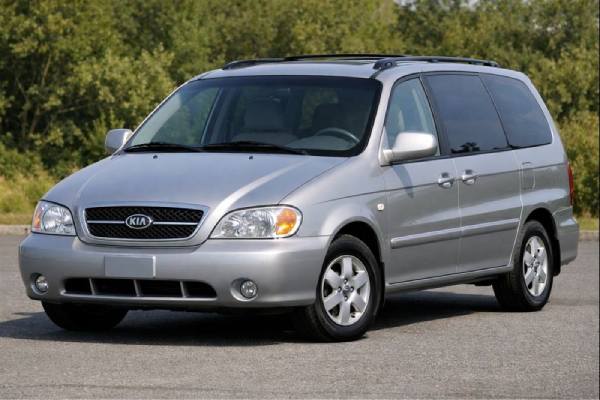
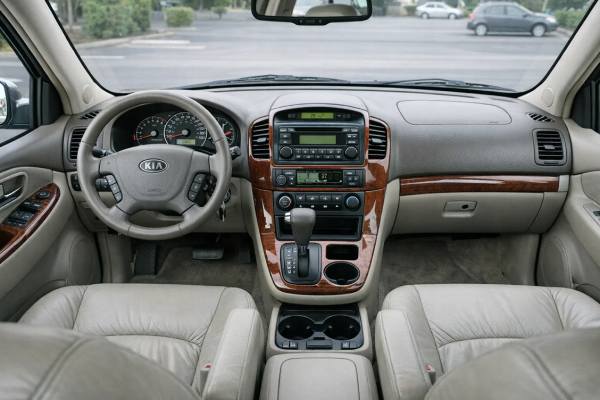
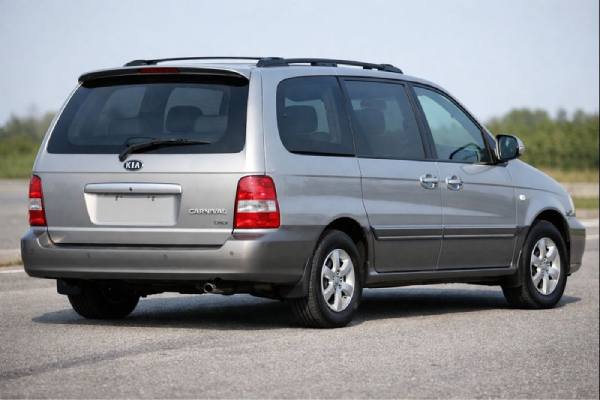
The facelift-era Kia Carnival (KV-II) with the 2.9-liter J3 diesel is the “torque-first” version of this roomy MPV. With 142 hp on paper, it is not quick, but the real story is mid-range pull that suits full passenger loads, long motorway grades, and everyday family duty. The facelift years also tend to feel more modern inside, and many markets saw stronger equipment levels, especially around comfort and convenience.
Ownership today is mostly about condition and maintenance history. The J3 CRDi (common-rail diesel) can be durable, but only if it gets clean oil, correct fuel filtration, and timely belt service. Cooling system health matters, too, because heavy vehicles punish weak radiators and tired hoses. If you want a practical 7- or 8-seat van with simple hardware and strong low-rpm torque, this configuration remains worth a careful look.
Owner Snapshot
- Strong low-rpm torque makes it feel calmer with 6–8 people aboard than the power figure suggests.
- Big cabin and sliding doors suit child seats and daily family logistics.
- Many parts are shared across markets (Carnival/Sedona), improving serviceability.
- Timing belt service is a must-have history item; treat an unknown belt as urgent.
- Plan engine oil and filter every 10,000–12,000 km (6,000–7,500 mi) or 12 months, whichever comes first.
Navigate this guide
- Kia Carnival facelift J3 diesel
- Kia Carnival J3 142hp specs and dimensions
- Kia Carnival equipment and safety layout
- Reliability weak points and service actions
- Maintenance plan and smart buying tips
- On-road feel and real-world economy
- How this Carnival stacks up against rivals
Kia Carnival facelift J3 diesel
The 2001–2005 facelift Kia Carnival (KV-II) with the 2.9 J3 diesel is best understood as a heavy, comfort-oriented people mover that was engineered for real passenger loads, not just occasional seven-seat use. The tall roof, sliding rear doors, and wide cabin make it easy to live with, especially when you are moving adults, child seats, or bulky gear. In most markets the Carnival was sold as a 7- or 8-seater, often with removable or foldable rear seats that trade ultimate cargo volume for flexibility.
The facelift years matter because Kia improved perceived quality and, depending on market, offered better standard equipment. You’ll see more power convenience features, better trim, and sometimes improved sound insulation. Mechanically, the front-drive layout and straightforward suspension tuning are aimed at stable cruising rather than sharp handling. It is also a vehicle that rewards tires in good shape: the Carnival’s mass and tall profile can amplify sloppy alignment or old, soft sidewall tires.
The J3 2.9 CRDi diesel (142 hp) is the value proposition here. Power is modest, but torque delivery is the part you feel: it helps the Carnival move without constantly chasing revs, and it reduces driver workload in city traffic and on inclines. This is especially relevant with the automatic gearbox option, which can otherwise feel “busy” in a heavy MPV. The diesel also tends to be the better match for towing small trailers or carrying full loads, as long as cooling, brakes, and transmission health are not ignored.
As a used buy today, this Carnival is less about mileage and more about service discipline. The biggest ownership wins come from (1) documented timing belt work, (2) clean fuel system care, (3) cooling system condition, and (4) rust control on older examples. If those are solid, the Carnival can still deliver a genuinely practical, family-sized cabin at a cost that undercuts many European MPVs of the era.
Kia Carnival J3 142hp specs and dimensions
Below are practical, ownership-focused specifications for the facelift 2001–2005 KV-II Carnival with the J3 2.9 CRDi 142 hp diesel. Exact figures can vary by market, gearbox, seating configuration, and VIN, so treat the numbers as typical ranges unless your local documentation states otherwise.
Powertrain and efficiency (typical for 142 hp CRDi)
| Item | Specification |
|---|---|
| Code | J3 (2.9 CRDi) |
| Engine layout and cylinders | Inline-4, DOHC, 4 valves/cyl (16V) |
| Bore × stroke | 97.1 × 98.0 mm (3.82 × 3.86 in) |
| Displacement | 2.9 L (2902 cc) |
| Induction | Turbocharged + intercooler |
| Fuel system | Common-rail diesel injection (CRDi) |
| Compression ratio | ~18:1–19:1 (varies by calibration) |
| Max power | 142 hp (106 kW) @ ~3800 rpm |
| Max torque | ~310 Nm (229 lb-ft) @ ~2000 rpm |
| Timing drive | Belt |
| Rated efficiency | ~8.0–9.0 L/100 km combined (varies by gearbox/market) |
| Real-world highway @ 120 km/h (75 mph) | ~8.5–9.5 L/100 km (typical, load and wind sensitive) |
Transmission and driveline
| Item | Specification |
|---|---|
| Transmission | 5-speed manual or 4-speed automatic (market dependent) |
| Drive type | FWD |
| Differential | Open |
Chassis and dimensions (typical EU-spec ranges)
| Item | Specification |
|---|---|
| Suspension (front/rear) | MacPherson strut / multi-link or trailing-arm type (market dependent) |
| Steering | Hydraulic power steering (ratio varies) |
| Brakes | 4-wheel discs common; exact diameters vary by trim |
| Wheels/tyres (popular size) | Commonly 215/65 R15 or 225/60 R16 (market dependent) |
| Ground clearance | ~160–175 mm (6.3–6.9 in) |
| Length / width / height | ~4925 / 1900 / 1760–1780 mm (193.9 / 74.8 / 69.3–70.1 in) |
| Wheelbase | ~2900 mm (114.2 in) |
| Turning circle (kerb-to-kerb) | ~11.5–12.0 m (37.7–39.4 ft) |
| Kerb (curb) weight | ~2050–2250 kg (4520–4960 lb) |
| GVWR | ~2600–2800 kg (5730–6170 lb) |
| Fuel tank | ~75 L (19.8 US gal / 16.5 UK gal) |
| Cargo volume | Highly seat-config dependent; verify by seat layout and rail system |
Performance and capability (realistic expectations)
| Item | Typical result |
|---|---|
| 0–100 km/h (0–62 mph) | ~14.5–16.5 s (manual faster than auto) |
| Top speed | ~165–175 km/h (103–109 mph) |
| Braking distance (100–0 km/h) | ~45–50 m (tire and brake condition matter a lot) |
| Towing capacity | Commonly ~1500–2000 kg (3300–4400 lb) braked (market dependent) |
| Payload | Often ~500–650 kg (1100–1430 lb) (depends on GVWR and seating) |
Fluids and service capacities (verify by VIN)
| Item | Typical specification |
|---|---|
| Engine oil | Diesel-rated 5W-30 or 5W-40 meeting regional diesel specs; capacity often ~6.5–6.7 L (6.9–7.1 US qt) |
| Coolant | Ethylene glycol long-life coolant; mix 50/50; capacity often ~9–10 L (9.5–10.6 US qt) |
| Transmission/ATF (auto) | Hyundai/Kia SP-III type fluids are common for this era; capacity varies by service method |
| Brake fluid | DOT 4 |
| A/C refrigerant | Usually R134a; charge varies with rear A/C and lines |
| Key torque specs (critical only) | Wheel nuts commonly ~90–110 Nm (66–81 lb-ft); verify others by service manual |
Safety and driver assistance (period-correct reality)
| Item | Notes |
|---|---|
| Crash ratings | Euro NCAP tested the Carnival/Sedona 2.9D and awarded 2 stars (period test protocol). |
| ADAS | Generally none: no AEB/ACC/lane assist in this era; focus is on belts, airbags, and ABS systems. |
Kia Carnival equipment and safety layout
Trim strategy for the facelift Carnival varies widely by country, but the pattern is consistent: most markets offered a base trim aimed at fleet or budget family use, then one or two comfort-heavy trims with more convenience features. Because the Carnival often moved between “Carnival” and “Sedona” badging depending on market, you should decode equipment by physical cues, not just the badge.
Trims and options that change ownership feel
Common comfort and usability upgrades you’ll want to identify on a viewing include:
- Seating layout: 7 seats (often captain’s chairs in the middle) versus 8 seats (bench middle row). The 7-seat layout can be more comfortable and easier for third-row access.
- Rear climate system: Some vans have rear A/C controls and additional lines. It improves passenger comfort but adds components (rear evaporator, extra piping) that can leak with age.
- Sliding door hardware: Power-assisted or upgraded latches were offered in some markets; manual doors are simpler and often age better if rollers are maintained.
- Audio and infotainment: Period head units are dated; the key is whether the wiring has been hacked for aftermarket systems (a common source of parasitic battery drain and intermittent faults).
- Tow preparation: Look for factory tow wiring and cooling upgrades if your plan includes towing; a retrofit tow bar without proper wiring and cooling margin is a red flag.
Quick identifiers: Higher trims often show alloy wheels, body-color mirror caps, more steering wheel controls, and upgraded interior fabrics. However, many older vans are “mix and match” after repairs, so confirm by VIN option codes where possible.
Safety ratings and what they mean here
The Carnival/Sedona was tested under older Euro NCAP rules and scored 2 stars. The results highlight a key reality for early-2000s MPVs: size does not guarantee strong crash structure. The test notes emphasize high injury risk in frontal impact and structural instability in the safety cell. That does not mean every crash outcome is bad, but it does mean the van’s passive safety margin is behind later MPVs.
Safety systems and what you should verify
Expect basic systems for the era:
- Airbags: Driver and passenger frontal airbags are common. Side airbags are often absent, especially on lower trims. Confirm whether your van has side torso bags or curtain bags by checking seat tags and pillar trim.
- Seatbelts: Some configurations used a two-point center rear belt on certain seating setups, which is meaningfully less protective than a three-point belt. If you regularly carry a passenger in that position, treat it as a decision factor.
- Child seat provisions: ISOFIX/LATCH availability depends on market and year. If child seats are part of your use case, physically confirm anchor points and top-tether routing.
- ABS and stability control: ABS is common; stability control (ESC) is less consistent in this era and may be absent even on higher trims. Confirm by cluster lights at key-on and by a diagnostic scan if possible.
Because this generation has no modern driver assistance, your best “safety upgrade” is condition: fresh tires, healthy brakes, correct alignment, and fully functioning seatbelts and airbags (no warning lights).
Reliability weak points and service actions
A facelift KV-II Carnival with the J3 2.9 CRDi can be dependable, but it is not forgiving of skipped maintenance. Below is a practical map of the most common failure areas, grouped by how often they show up and how expensive they tend to be.
Common issues (plan for them)
- Timing belt and related hardware (high severity): Symptoms include chirping, belt dust, or unknown history. Root cause is simply age and mileage. Remedy is a full belt service with tensioners and idlers; many owners also replace the water pump “while you’re in there.” Treat this as urgent if undocumented because the J3 is typically considered an interference engine (belt failure can bend valves).
- EGR and intake soot (medium severity): Symptoms are flat acceleration, smoke, rough idle, or recurring fault codes. Root cause is soot buildup from EGR operation and short-trip use. Remedy ranges from cleaning the EGR and intake tract to replacing a tired EGR valve.
- Cooling system wear (medium to high severity): Symptoms include temperature creep in traffic, coolant smell, or oily residue at hose junctions. Root causes include aging radiator cores, tired caps, swollen hoses, and sticky thermostats. Remedy is to restore the cooling system as a system, not one part at a time.
Occasional issues (depend on use and service quality)
- Common-rail fuel system sensitivity (medium to high): Symptoms include hard starts, uneven idle, or limp mode under load. Root cause can be injector wear, rail pressure control issues, or contaminated fuel. Remedy often starts with filtration checks and diagnostic data (rail pressure, correction values), then targeted replacement.
- Turbo and boost leaks (medium): Symptoms include whistling, oily pipes, smoke, or low power. Root cause may be tired hoses, clamps, intercooler leaks, or turbo wear. Remedy is pressure testing and replacing weak charge pipes before condemning the turbo.
- Automatic transmission shift quality (high): Symptoms include flare shifts, harsh engagement, or shudder. Root cause is old fluid, overheating, or internal wear. Remedy begins with correct fluid service (proper spec) and cooling margin; severe cases require rebuild.
Rare but worth checking (can be costly if ignored)
- Electrical drain and intermittent faults (low to medium): Symptoms include a dead battery after sitting, random warning lights, or locking glitches. Root cause is often aftermarket wiring, tired alternators, door harness fatigue, or corroded grounds. Remedy is to return wiring to clean, fused, OEM-like routing.
- Rust in hidden seams (medium to high): Look for corrosion around sills, rear arches, subframe mounts, and under sliding door tracks. Root cause is age, road salt, and trapped moisture. Remedy is early treatment; advanced rust becomes structural and expensive.
Recalls, TSBs, and how to verify completion
Because these vehicles were sold globally under different names, recall scope varies by market. The best practice is consistent everywhere:
- Run an official VIN check (national authority or manufacturer portal).
- Ask for dealer printouts or invoices showing recall completion.
- Inspect the fix where practical (updated parts, stickers, or revised routing).
If you are buying a used Carnival/Sedona, do not rely on “it drives fine” as proof. For this platform, the difference between a good van and a money pit is usually paperwork and preventive work.
Maintenance plan and smart buying tips
A well-kept J3 CRDi Carnival responds best to a “shorter-than-minimum” maintenance mindset. The vehicle is heavy, often fully loaded, and frequently driven in short urban cycles that are hard on oil, brakes, and cooling.
Practical maintenance schedule (distance or time)
Use this as a conservative plan unless your official schedule states otherwise:
- Engine oil and filter: every 10,000–12,000 km or 12 months. If used for short trips, towing, or hot climates, tighten to 8,000–10,000 km. Use a quality diesel-rated oil in the correct viscosity range for your climate.
- Fuel filter: every 20,000–30,000 km (or annually in markets with variable fuel quality). This is cheap protection for injectors and pumps.
- Air filter: inspect every 15,000 km, replace by 30,000 km (sooner in dusty regions).
- Cabin filter: every 15,000–20,000 km or annually.
- Coolant: every 4–5 years (or per coolant type). Replace hoses and cap if age-hardened; pressure stability matters on these engines.
- Brake fluid: every 2 years regardless of mileage.
- Brake inspection: every 10,000–15,000 km; caliper slide pins and rear mechanisms should be checked for free movement.
- Transmission fluid:
- Automatic: service every 40,000–60,000 km, especially if it tows or runs hot.
- Manual: consider 60,000–100,000 km intervals depending on use.
- Timing belt system: replace at the official interval for your VIN; if unknown, treat as immediate. Replace tensioners and idlers, and consider the water pump at the same time.
- Accessory belt and pulleys: inspect annually; replace if cracked, noisy, or glazed.
- Glow plugs: test before winter; replace as a set if multiple are weak.
- 12 V battery: expect 4–6 years typical life; test before cold season.
Fluids and specs (decision-ready guidance)
- Engine oil: choose a reputable diesel-rated oil; many owners use 5W-30 or 5W-40 depending on climate.
- Coolant: use a compatible long-life coolant and maintain the correct mix ratio.
- ATF: do not improvise—use the correct spec for the transmission family used in your market.
Essential torque values (verify by service manual)
- Wheel nuts: often 90–110 Nm (66–81 lb-ft)
- Oil drain plug: commonly ~30–40 Nm (22–30 lb-ft)
These are typical ranges; confirm for your exact hardware.
Buyer’s guide: what to check before paying
Bring a flashlight and a scanner if you can:
- Timing belt proof: invoice with date and mileage, not just a verbal claim.
- Cold start behavior: it should start cleanly without long cranking or heavy smoke.
- Cooling system stability: confirm steady temperature and no pressure spikes or bubbling in the expansion tank.
- Transmission behavior: smooth engagement, no flare, no harsh shifts, no delayed drive/reverse.
- Suspension and steering: listen for clunks over bumps and check for uneven tire wear.
- Rust hotspots: sliding door tracks, sills, rear arches, subframe mounts.
- Electrical sanity: windows, locks, HVAC modes, charging voltage, and any aftermarket wiring quality.
Long-term outlook: With disciplined maintenance, the J3 CRDi can handle high mileage. Without it, repairs become stacked and expensive—especially fuel system, cooling, and transmission.
On-road feel and real-world economy
The facelift Carnival drives like a large, tall MPV should: stable in a straight line, comfort-biased, and happiest when you treat it as a passenger carrier rather than a sporty vehicle. The seating position is upright, visibility is generally good, and the long wheelbase helps smooth out broken pavement. Body roll is present in corners, but predictable, and the steering is tuned for easy control rather than feedback.
Ride, handling, and NVH
- Ride quality: The suspension is typically soft enough to absorb bumps with a full load, but worn dampers can make it floaty and unsettled at speed.
- Steering feel: Light at low speeds, more weighted on the move. If it feels vague, check alignment first, then suspension bushings and tire condition.
- Braking feel: A healthy system should stop confidently, but these vans can suffer from caliper slide issues and heat buildup if pads are low-quality or the van is repeatedly loaded and driven fast downhill.
- Cabin noise: Expect diesel clatter at idle and some wind noise at motorway speeds. Aging door seals and worn engine mounts can raise NVH noticeably.
Powertrain character
The 2.9 CRDi’s strength is usable torque around typical road speeds. In everyday driving it feels stronger than the hp number suggests, especially when pulling away with passengers aboard. The manual gearbox usually feels more decisive and keeps the engine in its torque band. The 4-speed automatic prioritizes smoothness, but it can feel short on ratios on hills or at high motorway speeds.
Real-world efficiency
Your real consumption depends heavily on speed and load:
- City: often 10–12 L/100 km for short-trip urban use.
- Highway (100–120 km/h): typically 8.5–9.5 L/100 km in good condition.
- Mixed driving: commonly 9–10.5 L/100 km.
Cold weather, short trips, roof boxes, and underinflated tires can add a meaningful penalty.
Load and towing behavior
With passengers and luggage, the Carnival remains composed if tires, brakes, and shocks are healthy. If you tow, pay attention to cooling margin and transmission health. A good tow setup is less about the tow bar itself and more about wiring quality, brake condition, and keeping temperatures under control on long grades.
If you want a relaxed long-distance family van, the J3 diesel fits the vehicle’s mission well—provided the mechanical condition matches the weight it is expected to carry.
How this Carnival stacks up against rivals
The early-2000s MPV market had two main camps: European “car-like” MPVs that drove neatly but were often tighter inside, and larger vans that prioritized space and value. The Carnival sits firmly in the second camp.
Where the Carnival wins
- Space per dollar: Even today, it often undercuts rivals for the amount of usable cabin you get. If you truly need 7–8 seats regularly, that matters.
- Torque-focused drivetrain: The 2.9 CRDi’s low-rpm pull suits full loads better than some smaller diesels of the era, especially when you are climbing or carrying.
- Straightforward hardware: No complex modern driver-assistance systems, and fewer “must calibrate” components after repairs.
Where rivals can be better
- Safety performance: Many European MPVs improved rapidly in crash structure and restraint design through the 2000s. The Carnival’s older test results highlight its weaker passive safety margin compared with newer designs.
- Driving dynamics: Models like the VW Sharan/Ford Galaxy/SEAT Alhambra often feel more car-like, with sharper steering and less float at speed—though they can be tighter in the third row.
- Fuel economy: Some smaller European diesels (for example 1.9–2.0 TDIs and HDi units) can beat the Carnival in consumption, especially in lighter vehicles.
Short rival guide (use-case matching)
- VW Sharan / Ford Galaxy / SEAT Alhambra (diesel): Better “car feel,” often better efficiency; typically less roomy in the third row than the Carnival.
- Renault Espace (diesel): Comfortable and often well-packaged, but can be more complex and maintenance-sensitive depending on engine and electrics.
- Chrysler Voyager (diesel in some markets): Spacious like the Carnival, but check transmission history carefully; ownership experience varies widely by condition.
- Peugeot 807 / Citroën C8 / Fiat Ulysse (HDi/JTD): Efficient and practical, often with good seating flexibility; watch for typical French MPV electrical quirks and suspension wear.
- Hyundai Trajet (diesel): Similar value logic and parts availability in some regions, but not always as spacious or as strong under load.
Bottom line: Choose the facelift Carnival J3 diesel if your priority is space, torque, and value—and you are willing to buy based on service history and condition. Choose a European MPV of the same era if you prioritize car-like handling, potentially better crash performance, and slightly better fuel economy, even if it costs more to purchase.
References
- euroncap_kia_carnival_2003_2stars.pdf 2003 (Safety Rating)
- Vehicle Detail Search – 2004 KIA SEDONA 4 DR page_action | NHTSA 2004 (Recall Database)
- Kia Recalls | Kia Europe 2026 (Recall Database)
- Manuals 2026 (Owner’s Manual Portal)
Disclaimer
This article is for informational purposes only and is not a substitute for professional diagnosis, inspection, or repair. Specifications, torque values, service intervals, and procedures can vary by VIN, market, model year, and equipment. Always verify details against your official owner’s manual and service documentation for your exact vehicle.
If you found this guide helpful, please consider sharing it on Facebook, X (Twitter), or your favorite forum to support our work.