

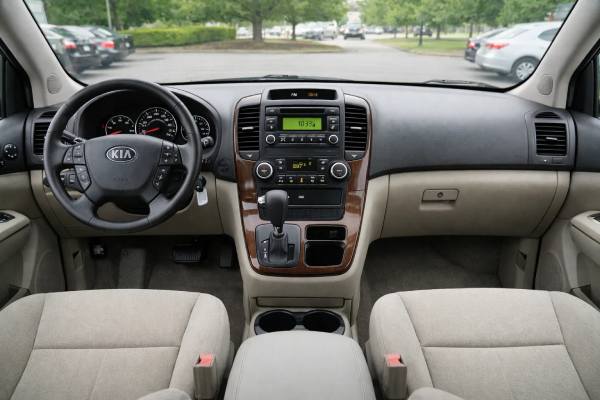

The 2010–2012 facelift Kia Sedona (VQ) with the 2.2 CRDi D4HB diesel is the “workhorse” version of this big people-mover: strong low-rpm pull, long-legged cruising, and enough mass and wheelbase to feel stable when fully loaded. It is also a vehicle that rewards owners who think like fleet managers—keep on top of fluids, filters, and cooling-system health, and it tends to age gracefully. The D4HB’s modern common-rail hardware and emissions equipment bring diesel-specific responsibilities (DPF, EGR, boost plumbing), but they also deliver the torque that makes the Sedona feel relaxed with seven passengers and luggage. If you want a practical, comfortable family van with a diesel’s towing and highway strengths—and you are willing to maintain it on schedule—this facelift Sedona can be a smart, undervalued choice.
What to Know
- Strong mid-range torque suits full loads, highway cruising, and moderate towing.
- Big-cabin practicality: easy long-trip comfort and family-friendly seating flexibility.
- Stable ride at speed thanks to long wheelbase and substantial kerb weight.
- Budget for diesel emissions upkeep (DPF/EGR cleaning or replacement as mileage climbs).
- Plan oil and filter service every 10,000 miles (16,000 km) or 12 months, whichever comes first.
Guide contents
- Kia Sedona VQ facelift explained
- Kia Sedona VQ 2.2 CRDi specs
- Kia Sedona VQ trims and safety
- Reliability issues and campaigns
- Maintenance schedule and buyer tips
- Real-world driving and economy
- How it stacks up to rivals
Kia Sedona VQ facelift explained
The facelifted 2010–2012 Sedona (VQ) is a classic “large MPV” built around a simple mission: carry people and gear comfortably, all day, without drama. The changes for the facelift years were mainly about keeping the design current and improving day-to-day usability rather than reinventing the vehicle. That matters for owners because it means most of what you’re buying is proven hardware—good for parts availability and predictable maintenance—while the diesel powertrain gives it the long-distance temperament many big families appreciate.
The 2.2 CRDi D4HB diesel is the heart of this version. In real use, you feel torque more than horsepower: it pulls cleanly from low revs, keeps the automatic (or manual, depending on market) from hunting, and makes merging with a full cabin feel less strained than smaller diesels. The trade-off is that “modern diesel rules” apply: short trips and stop-start urban use accelerate soot loading and EGR fouling, and neglected oil quality can turn into turbo and timing-chain wear. If your driving is mostly school runs and 10-minute hops, you need a maintenance plan that compensates.
On the road, the Sedona’s size works in your favor. The long wheelbase and substantial weight help straight-line stability and give it a calm ride over broken surfaces. It is not sporty—and it does not try to be. Instead, it’s tuned for predictable steering, steady braking, and low stress at motorway speeds. The wide body and tall doors also shape ownership: parking sensors and mirrors become “must-have” items in tight cities, and tyre choice matters for wet braking and road noise.
From a durability perspective, think in systems: diesel fuel quality, cooling health, and transmission fluid condition are the big levers. The best Sedonas are the ones that received timely fluid services and had small issues (boost leaks, sticky calipers, worn links) fixed early instead of driven “until it’s a problem.” Treat it like a family vehicle that does commercial duty—and it tends to respond in kind.
Kia Sedona VQ 2.2 CRDi specs
Specs vary by market (Europe, UK, Middle East) and by seating layout, so use the figures below as the most common “facelift diesel” baseline. If you are comparing listings, treat VIN-specific documentation as the final authority—especially for towing limits, wheel sizes, and brake packages.
Powertrain and efficiency (D4HB 2.2 CRDi)
| Item | Typical specification (2010–2012 facelift diesel) |
|---|---|
| Code | D4HB (2.2 CRDi “R”) |
| Layout | Transverse inline-4, DOHC, 16 valves (4/cyl) |
| Bore × stroke | 85.4 × 96.0 mm (3.36 × 3.78 in) |
| Displacement | 2.2 L (2,199 cc) |
| Induction | Turbocharged (VGT) with intercooler |
| Fuel system | Common-rail direct injection |
| Compression ratio | ~16.0:1 (varies by calibration) |
| Max power | 189 hp (139 kW) @ ~3,800 rpm (market dependent) |
| Max torque | typically 392–440 Nm (289–325 lb-ft) @ ~1,800–2,500 rpm |
| Timing drive | Chain |
| Rated efficiency (typical) | ~7.0–8.5 L/100 km (34–27 mpg US / 40–33 mpg UK) |
| Real-world highway @ 120 km/h | ~7.8–9.0 L/100 km (30–26 mpg US / 36–31 mpg UK) |
Transmission and driveline
| Item | Typical specification |
|---|---|
| Transmission | 6-speed automatic (common) or 6-speed manual (market dependent) |
| Drive type | FWD |
| Differential | Open |
Chassis and dimensions
| Item | Typical specification |
|---|---|
| Suspension (front/rear) | MacPherson strut / multi-link or trailing-arm multi-link (market dependent) |
| Steering | Hydraulic or electric assist (market dependent); family-van tuning |
| Brakes | Ventilated front discs / rear discs (sizes vary by market) |
| Wheels and tyres (common) | 16–18 in wheels; popular sizes include 225/70 R16 or 235/60 R17 (by trim) |
| Ground clearance | ~150–165 mm (5.9–6.5 in), tyre dependent |
| Length / width / height | ~4,810 / 1,985 / 1,760–1,805 mm (189.4 / 78.1 / 69.3–71.1 in) |
| Wheelbase | ~3,020 mm (118.9 in) |
| Turning circle | ~11.5–12.0 m (37.7–39.4 ft) |
| Kerb (curb) weight | typically ~2,050–2,200 kg (4,520–4,850 lb) |
| GVWR | often ~2,700–2,900 kg (5,950–6,400 lb), market dependent |
| Fuel tank | commonly ~75 L (19.8 US gal / 16.5 UK gal) |
Performance and capability (typical)
| Metric | Typical value |
|---|---|
| 0–100 km/h (0–62 mph) | ~9.5–11.0 s (trim and gearbox dependent) |
| Top speed | ~180–190 km/h (112–118 mph) |
| Braking 100–0 km/h | ~38–42 m (driver, tyre, and load dependent) |
| Towing capacity | commonly up to ~2,000 kg (4,409 lb) braked (market dependent) |
| Payload | typically ~600–750 kg (1,323–1,653 lb), seating dependent |
Fluids and service capacities (decision-level)
These are practical planning numbers; always verify the exact spec for your VIN, climate, and emissions calibration.
| System | Typical specification |
|---|---|
| Engine oil | ACEA C3 (low-SAPS), usually 5W-30; capacity about 6.2 L (check filter type) |
| Coolant | Ethylene glycol long-life coolant; typical 50/50 mix |
| Transmission (AT) | ATF per Kia spec for the fitted 6-speed unit; service method varies (drain-fill vs exchange) |
| A/C refrigerant | R134a (most markets for these years); charge varies by rear A/C fitment |
Key torque specs (critical fasteners, typical ranges):
- Wheel nuts: 90–110 Nm (66–81 lb-ft)
- Engine oil drain plug: 30–40 Nm (22–30 lb-ft)
- Brake caliper bracket bolts: commonly 90–120 Nm (66–89 lb-ft)
(These are guidance ranges—confirm the exact values in official service information for your VIN.)
Kia Sedona VQ trims and safety
Trim naming for the Sedona varies widely by region, but the underlying pattern is consistent: base grades focus on seating capacity and essentials, while upper trims add convenience features that matter in a large MPV (parking aids, power doors, climate control upgrades, and higher-grade upholstery). When shopping, focus less on the badge and more on the functional equipment list and wheel/tyre package.
Trims and options that change ownership
Common facelift-era equipment “separators” include:
- Sliding door type: manual vs power sliding doors. Power doors add convenience but also add motors, latches, and sensors that must be kept aligned and clean.
- Seating configuration: most are 7-seat (2-2-3) in many markets; some offer different second-row layouts. Check whether the second-row seats are removable, fold-flat, or “tip and slide,” because that affects cargo flexibility and how often you’ll actually reconfigure it.
- Climate system: dual-zone front is common; rear A/C is the big comfort feature for families. Verify rear blower operation on all speeds—rear HVAC repairs can be annoying rather than catastrophic.
- Parking assistance: rear sensors and a camera are high-value on this wide body. If fitted, check sensor consistency in rain and that the camera image is clear (hazy lenses are common with age).
- Infotainment and audio: head units vary; look for factory Bluetooth stability, steering-wheel button function, and whether navigation units still boot quickly.
- Wheels and tyres: larger wheels can look better but may add road noise and reduce ride compliance. For a family van, the “quietest tyre” often beats the “sportiest.”
Quick identifiers when viewing listings
- Look at the door handles and buttons near the B-pillar or dash to confirm power sliding doors.
- Check the rear roof vents and control panel to confirm rear climate fitment.
- Verify the spare wheel type (full-size vs space-saver) and jack tools—small details that matter on road trips.
Safety ratings and what they mean here
The Sedona’s core safety story is structural: it is heavy, has a long wheelbase, and (in most markets) includes stability control and multiple airbags depending on trim. However, it is from an era before widespread advanced driver assistance. So you should expect strong passive safety for its time, but not modern crash-avoidance technology.
What to look for on a specific vehicle:
- Airbag coverage: confirm front, side-torso, and curtain airbags if advertised; don’t assume every trim has the same count.
- ISOFIX/LATCH: check for ISOFIX points in the second row (and sometimes third-row outboard positions depending on market). Physically inspect the anchor points and plastic guides.
- Stability and braking systems: ABS is common; ESC may be standard or optional by year/market. ESC matters in emergency manoeuvres with a tall, loaded vehicle.
Driver assistance (ADAS) expectations
For 2010–2012, typical “driver assistance” is limited to:
- Parking sensors and/or reversing camera
- Cruise control on many trims
- Basic traction and stability control (if equipped)
If you need AEB (automatic emergency braking), lane centering, or modern blind-spot monitoring, you are shopping the wrong generation. The best safety upgrade you can make on this Sedona is often excellent tyres, correctly maintained brakes, and ensuring ESC is functioning with no warning lights.
Reliability issues and campaigns
The facelift VQ Sedona can be durable, but reliability depends heavily on maintenance discipline and how it’s used. Below is a practical “what fails, when, and what it feels like” map. Mileage bands are approximate; age, climate, and driving pattern can move them earlier or later.
Common (high prevalence)
- EGR and intake soot build-up (diesel use pattern related)
Symptoms: hesitant low-rpm response, more smoke under load, reduced economy, occasional limp mode.
Root cause: soot and oil vapour combine in EGR passages and intake.
Remedy: EGR cleaning or replacement; inspect boost hoses; use correct low-SAPS oil and give the engine regular fully-warm runs. - DPF loading on short trips (common in city-driven vans)
Symptoms: frequent regenerations, rising oil level (fuel dilution on some patterns), warning lights, loss of power.
Root cause: incomplete regenerations due to short journeys.
Remedy: driving pattern changes (longer steady runs), forced regen where appropriate, check differential pressure sensor and temperature sensors. - Turbo and boost plumbing leaks
Symptoms: whooshing under load, sluggish pull, oily residue at hose joints.
Root cause: aged hoses, loose clamps, intercooler seepage.
Remedy: pressure test the charge-air system, replace tired hoses, clean and reseal joints.
Occasional (medium prevalence)
- Timing chain stretch or tensioner wear (higher mileage, poor oil history)
Symptoms: rattly start-up noise, rough running, timing correlation faults.
Root cause: long oil intervals, wrong oil spec, repeated cold starts and short trips.
Remedy: inspect promptly; if noise or correlation faults appear, address before it escalates. - Injector sealing and fuel system seepage
Symptoms: diesel smell, chuffing sound, carbon build-up around injectors, hard starting.
Root cause: injector seal degradation or fuel line issues.
Remedy: replace seals correctly, clean seats, verify leak-off balance and rail pressure stability. - Brake caliper slide sticking (age and corrosion related)
Symptoms: uneven pad wear, hot wheel, steering pull, poor economy.
Root cause: dry or corroded slide pins and boots.
Remedy: service slide pins, replace boots, refresh fluid, consider caliper rebuild where needed.
Rare but important (higher severity or cost)
- Fuel-rail cracking and fire risk (campaign/recall-type issue in some markets)
Symptoms: fuel smell in the engine bay, visible seepage, dampness around rail area.
Remedy: treat as urgent—do not ignore fuel smell. Verify whether your vehicle has had any fuel-system campaign work completed and inspect immediately. - Automatic transmission shift quality decline (fluid condition dependent)
Symptoms: shudder on light throttle, delayed engagement, harsh downshifts.
Root cause: aged ATF, overheating, valve-body wear.
Remedy: correct fluid service method for the unit, check cooler condition, and address early before friction material is damaged.
Pre-purchase checks to request (worth paying for)
- Full service history with oil spec noted (low-SAPS diesel oil matters).
- Evidence of DPF-friendly driving (regular longer trips) or documented DPF servicing.
- Cooling system health: stable temperature, clean coolant, no pressure anomalies.
- Transmission behaviour on a hot test drive: smooth engagement, no flare, no shudder.
- Underside corrosion inspection (subframes, brake lines, rear suspension mounts), especially in salted-road climates.
If you buy the “cleanest history” example, you avoid most of the scary stories. If you buy the cheapest example, plan to spend the difference on catching up maintenance—and do it immediately.
Maintenance schedule and buyer tips
A big diesel MPV stays cheap to own only if you run it on a clear schedule. The key is to separate routine (predictable consumables) from conditional (items you inspect and address based on symptoms and testing).
Practical maintenance schedule (distance or time, whichever comes first)
Every 10,000 miles (16,000 km) or 12 months
- Engine oil and filter (use the correct low-SAPS diesel oil)
- Multi-point inspection: leaks, boost hoses, coolant level, belt condition
- Brake inspection: pad thickness, slide pin movement, disc condition
- Tyre rotation (if wear pattern allows) and pressure check
Every 20,000 miles (32,000 km) or 24 months
- Cabin air filter
- Engine air filter (more often in dusty areas)
- Brake fluid check; replace if dark or moisture is high (many owners do it every 2 years as a best practice)
Every 40,000–60,000 miles (64,000–96,000 km)
- Fuel filter (diesel fuel cleanliness protects injectors and pump)
- Inspect EGR system, intake tract, and intercooler pipes for soot and oil build-up
- Alignment check (big vans chew tyres when toe is off)
Every 60,000–80,000 miles (96,000–128,000 km)
- Automatic transmission fluid service (method depends on the unit; avoid “one-size-fits-all” advice)
- Coolant service if not proven long-life and tested healthy
- Accessory belt and tensioner inspection; replace if cracking or noisy
As needed (condition-based)
- DPF cleaning or replacement (driving-pattern dependent)
- Battery testing; many vans need a 12 V battery every 4–6 years
- Suspension links and bushings (listen for clunks over bumps)
Fluids and specs that matter
- Engine oil: use the correct low-SAPS spec for DPF-equipped diesels; a typical planning capacity is about 6.2 L including filter.
- Coolant: stick to the correct long-life coolant chemistry and replace before it becomes acidic or contaminated.
- ATF: match the exact transmission requirement. The wrong fluid can cause shift quality issues.
Buyer’s guide: what to seek and what to avoid
Seek
- Evidence of regular oil services (not stretched) and documented filter changes
- Vans used for mixed and motorway driving (diesels prefer heat and steady loads)
- Working rear A/C, clean cabin electrical operation, and smooth sliding doors
- Tyres from reputable brands with even wear (a proxy for careful maintenance)
Be cautious
- Repeated short-trip use with no record of DPF attention
- Persistent warning lights (engine, ABS, ESC) or intermittent electrical faults
- Strong diesel smell, damp fuel components, or bodged hose repairs
- “Recently serviced” with vague details (ask what oil spec, what filters, what fluids)
Long-term outlook
A well-kept facelift Sedona diesel can run deep into high mileage because the chassis and cabin are fundamentally robust. The usual ownership killers are avoidable: neglected diesel emissions hardware, delayed cooling fixes, and transmission fluid ignored “for life.” If you plan ahead, the van behaves like a dependable tool.
Real-world driving and economy
The Sedona’s driving experience is defined by mass, wheelbase, and diesel torque. You don’t drive it like a tall car; you drive it like a stable platform designed to keep passengers comfortable.
Ride, handling, and NVH
- Ride: Generally supple at city speeds, with a heavier “thump” over sharp edges when running larger wheels. Good examples feel settled rather than floaty. Worn dampers and tired anti-roll bar links show up as extra bounce and clunks.
- Handling: Predictable and safe. Body roll is present (it’s a tall MPV), but the chassis is tuned to build grip progressively. In wet conditions, tyre quality makes a bigger difference than almost anything else.
- Steering: Light to moderate effort, aimed at easy manoeuvring. You should not expect much feedback. If it feels vague or wanders, check alignment, front control-arm bushings, and tyre condition.
- Cabin noise: Diesel clatter is usually well contained at cruise, but you may hear more road noise from rear wheel arches and tyres as the vehicle ages. Door seals and worn suspension bushes can also add “hollow” noises over rough surfaces.
Powertrain character
The D4HB diesel’s best trait is how it carries load:
- Low-rpm pull: Strong torque from around 1,500–2,000 rpm means fewer downshifts when climbing or overtaking.
- Turbo behaviour: Expect some lag below the main torque band, then a clean surge. A “flat” feeling often points to boost leaks, sticky EGR, or a DPF that is struggling.
- Transmission logic (automatic): A healthy unit shifts smoothly and keeps revs low. Harshness, shudder, or hesitation should be treated as a service and diagnostic item—not “they all do that.”
Real-world efficiency
For a large, heavy MPV, economy is respectable when driven like a diesel:
- City: commonly ~9.0–11.0 L/100 km (26–21 mpg US / 31–26 mpg UK), depending on traffic and trip length.
- Highway 100–120 km/h: often ~7.8–9.0 L/100 km (30–26 mpg US / 36–31 mpg UK).
- Mixed use: typically ~8.5–10.0 L/100 km (28–24 mpg US / 33–28 mpg UK).
Cold weather and short trips can push consumption up sharply because the diesel needs time to warm up and complete DPF regens.
Load, passengers, and towing
With seven aboard, the Sedona remains composed—this is where it beats many crossovers. For towing, the torque is the good news; the “watch-outs” are:
- Keep the cooling system in top condition (radiator, hoses, coolant health).
- Use correct towball nose weight and ensure rear suspension is not sagging.
- Expect a 20–35% fuel-use increase when towing moderate loads, more with high speeds or hills.
Overall, the facelift diesel Sedona is best described as “relaxed competence.” It will not entertain you, but it will carry people and gear in a calm, confidence-building way when maintained properly.
How it stacks up to rivals
The 2010–2012 Sedona diesel competes with a mix of classic MPVs and early large crossovers. Its value is usually strongest when you compare cabin space per euro and how it behaves under load.
Versus Volkswagen Sharan and Ford Galaxy (diesel MPVs)
Where the Sedona wins
- Often better purchase value for similar passenger capacity.
- Strong, effortless torque feel in a heavy, stable body.
- Simple “family tool” packaging with generous space.
Where it loses
- Sharan and Galaxy often feel more car-like to drive and park.
- Some rivals offer more modern interiors and, depending on year, more safety tech.
- Parts and specialist knowledge for some VW/Ford diesel systems may be easier in certain regions.
Versus Chrysler Grand Voyager (diesel or petrol, market dependent)
Sedona advantages
- Typically more straightforward day-to-day reliability when maintained.
- Often better control feel and less “float” at speed.
- Lower risk of complex luxury options becoming expensive age-related failures.
Grand Voyager advantages
- Sometimes offers clever seating and storage solutions.
- Depending on engine, can be strong for towing (but ownership varies widely by condition).
Versus Toyota Previa (and similar Toyota people-movers)
Toyota advantage
- Reputation for durability and strong resale, often backed by parts support.
Sedona advantage
- Often cheaper to buy with similar usable space.
- Diesel torque character can feel more effortless at motorway speeds.
Versus large 7-seat crossovers of the era
Crossovers can offer AWD options and a “tall SUV” image, but:
- They often have less third-row space and less cargo room with all seats up.
- Under full family load, the Sedona’s long wheelbase and van proportions can feel calmer and more comfortable.
- If you mainly do motorways and family travel, the Sedona’s shape is simply more efficient at being a people carrier.
The practical verdict
Choose the facelift Sedona diesel if you want:
- Maximum interior usefulness for the money
- Strong long-distance comfort and stable load carrying
- A vehicle you can keep reliable with disciplined maintenance
Choose a rival if you want:
- More modern driver assistance features
- A smaller, more car-like feel in tight urban areas
- Specific brand or parts-network advantages in your region
In short: the Sedona is rarely the “flashiest” option, but it is often one of the most rational—especially for owners who maintain proactively and value space, torque, and calm motorway manners over fashionable badges.
References
- Service Intervals V25.1 2025 (Service Schedule)
- Engine Oil Grades and Capacities 2016 (Maintenance)
- RENOTIFICATION IMPORTANT SAFETY RECALL (NHTSA Recall Number: 20V-101) 2022 (Recall Notice)
- Kia Carnival | Safety Rating and Report 2006 (Safety Rating)
Disclaimer
This article is for informational purposes only and is not a substitute for professional inspection, diagnosis, or repair. Specifications, torque values, service intervals, and procedures can vary by VIN, market, emissions calibration, and fitted equipment; always verify details using your official owner’s manual and service documentation before purchasing parts or performing work.
If this guide helped you, please consider sharing it on Facebook, X (Twitter), or your favorite forum to support our work.