

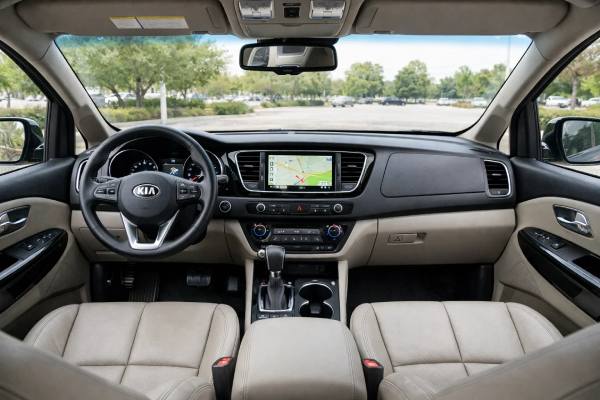

The Kia Sedona (YP) with the G6DH 3.3-liter V6 is a practical “big family” minivan built around a strong, naturally aspirated engine and a conventional 6-speed automatic. In day-to-day use, it feels more like a comfortable long-wheelbase crossover than a commercial van: stable at speed, quiet for the class, and easy to live with thanks to sliding doors and a low step-in height. The V6’s direct injection (GDI) brings good passing power for a fully loaded cabin, but it also means your maintenance choices matter more—especially oil quality, intake cleanliness, and cooling-system health. Across 2015–2018, the Sedona’s value comes from space efficiency (real adult third-row usability), sensible ergonomics, and a safety story that improves notably when the right driver-assistance options are fitted. The key is buying the right trim, then servicing it on a schedule that matches how families actually drive.
Owner Snapshot
- Strong, smooth V6 power for full loads and highway merging, without turbo heat management.
- Excellent cabin packaging: usable third row, wide doors, and family-friendly storage.
- Good long-trip comfort and straight-line stability for a tall, heavy vehicle.
- Plan for GDI realities: keep up with oil services and consider periodic intake cleaning on short-trip use.
- Typical interval: change engine oil every 8,000–12,000 km (5,000–7,500 mi) or 6–12 months based on duty cycle.
Navigate this guide
- Kia Sedona YP 2015–2018 in depth
- Kia Sedona YP 3.3 specs
- Kia Sedona YP trims and safety tech
- Reliability patterns and known fixes
- Maintenance plan and buying checks
- Road manners and real economy
- Sedona YP versus alternatives
Kia Sedona YP 2015–2018 in depth
The 2015–2018 Sedona (platform code YP) is the “modern” Sedona: longer, wider-feeling inside, and tuned to behave like a refined family vehicle rather than a utility box. Its engineering priorities are clear. First, it’s built to carry people comfortably—often seven or eight—while keeping the driver’s workload low. Second, it aims for predictable durability with familiar hardware: a naturally aspirated V6 (G6DH) and a traditional torque-converter automatic, both chosen for smoothness and low-stress cruising.
The G6DH 3.3 is part of Kia’s Lambda V6 family and uses direct fuel injection (GDI). In real terms, that means crisp throttle response once rolling, strong midrange pull at highway speeds, and fewer “busy” gear changes than smaller turbo engines when the cabin is full. The tradeoff is that driving style and service history matter: short trips and long oil intervals can accelerate intake deposits and oil dilution. If you treat the vehicle like many families do—lots of cold starts, school runs, and idle time—then “severe service” intervals are the smart baseline.
Chassis-wise, the Sedona’s long wheelbase helps stability and ride comfort, especially on motorways. It’s not sporty, but it is composed: it settles quickly after bumps, tracks straight, and resists the floaty feel older minivans can have. Higher trims may feel slightly tighter due to wheel and tire packages and damper tuning, but the core personality remains comfort-first.
Ownership satisfaction usually comes down to three things:
- Door and seat hardware: sliding doors, rollers, latches, and seat-release mechanisms need clean tracks, proper adjustment, and gentle operation.
- Electronics and convenience features: power door modules, sensors, and infotainment age like any family car—fine when maintained, frustrating when neglected.
- Cooling and fluids: the engine is robust, but it rewards consistent fluid service, especially if you tow or drive in heat.
If you want the Sedona at its best, choose a trim with the safety tech you value, verify recall completion, and buy based on service evidence rather than mileage alone.
Kia Sedona YP 3.3 specs
Below are key specifications for the Sedona (YP) with the G6DH 3.3 V6 as commonly configured in North America for 2015–2018. Exact figures can vary by market, trim, wheel package, and emissions certification, so treat these as a baseline and confirm against your VIN-specific documentation.
Powertrain and efficiency
| Item | Specification |
|---|---|
| Code | G6DH (Lambda V6, GDI) |
| Engine layout and cylinders | V6, 6 cylinders, DOHC, 24 valves (4 valves/cyl) |
| Bore × stroke | 92.0 × 83.8 mm (3.62 × 3.30 in) |
| Displacement | 3.3 L (3,342 cc) |
| Induction | Naturally aspirated |
| Fuel system | Gasoline direct injection (GDI) |
| Compression ratio | 11.5:1 |
| Max power | 276 hp (206 kW) @ 6,000 rpm |
| Max torque | 336 Nm (248 lb-ft) @ 5,200 rpm |
| Timing drive | Chain (verify by VIN/service manual) |
| Rated efficiency | EPA commonly ~18–25 mpg (US) depending on trim/year |
| Real-world highway @ 120 km/h | Typically ~9.5–10.8 L/100 km (24–20 mpg US) depending on load, tires, and wind |
Transmission and driveline
| Item | Specification |
|---|---|
| Transmission | 6-speed automatic (torque-converter) |
| Drive type | FWD |
| Differential | Open |
Chassis and dimensions
| Item | Specification |
|---|---|
| Suspension (front/rear) | Independent front; multi-link rear (market-dependent details vary) |
| Steering | Power steering (system type varies by year/trim) |
| Brakes | 4-wheel disc (diameters vary by trim; confirm with parts catalog) |
| Wheels/tyres (common) | 235/65 R17 (lower trims) or 235/60 R18 (mid/high trims) |
| Ground clearance | 170 mm (6.7 in) |
| Length / width / height | 5115 / 1984 / 1740 mm (201.4 / 78.1 / 68.5 in) |
| Wheelbase | 3061 mm (120.5 in) |
| Kerb weight | Roughly 2000–2070 kg (trim dependent) |
| Fuel tank | 79.9 L (21.1 US gal) |
| Cargo volume | Up to ~4020 L (142 ft³) behind 1st row; ~2220 L (78.4 ft³) behind 2nd row |
Performance and capability (typical)
| Item | Typical range (varies by trim and test method) |
|---|---|
| Acceleration 0–100 km/h (0–62 mph) | ~8.5–9.5 s |
| Top speed | ~185–195 km/h (115–121 mph), often electronically limited |
| Braking 100–0 km/h | Minivan norms; depends heavily on tires and brake condition |
| Towing capacity | Often up to ~1580 kg (3,500 lb) when properly equipped; verify label and market rules |
| Payload | Typically ~550–700 kg depending on seating and trim (check door-jamb label) |
Fluids and service capacities (decision-grade)
| Fluid | Practical guidance |
|---|---|
| Engine oil | Use the OEM-required spec for your market; common viscosities include 5W-20 or 5W-30. Capacity varies by drain vs dry fill; plan roughly ~5–6.5 L and verify at service. |
| Coolant | Use the correct long-life coolant type for Kia/Hyundai applications; verify mix ratio per manual |
| Transmission/ATF | Use OEM-specified ATF for the 6-speed automatic; service approach depends on usage (see maintenance section) |
| A/C refrigerant | Typically R-134a for this era (confirm under-hood label) |
Key torque specs (common critical fasteners, verify by VIN): wheel lug nuts commonly ~90–110 Nm (66–81 lb-ft); engine oil drain plug commonly ~25–35 Nm (18–26 lb-ft).
Kia Sedona YP trims and safety tech
Trim strategy on the 2015–2018 Sedona is mostly about comfort, doors, seating, and driver-assistance availability. Mechanically, you’re generally getting the same core powertrain: the 3.3 V6 and 6-speed automatic driving the front wheels. The big differences show up in wheels/tires, seat configurations, and how much safety technology is fitted from the factory.
Common trims and what they mean
- L / LX: The value core. Sliding doors, practical cloth seating, and a comfort-oriented wheel/tire package that keeps ride quality smooth and tire costs reasonable.
- EX: Often the best balance. More comfort and convenience features, and more frequent availability of safety packages.
- SX / SX Limited: The most feature-rich. Larger wheels, upgraded interior, and the highest likelihood of having advanced driver-assistance features.
Seating configurations to watch
You’ll commonly see 7-passenger captain’s chairs in the second row, but some configurations allow 8-passenger seating. If you need three child seats across, verify second-row belt geometry, tether anchor placement, and whether the seat cushions allow a stable base for your child seat model.
Safety ratings and what they really tell you
This generation generally performs well in key crashworthiness tests for its era, but award-level outcomes often depend on equipment such as headlight performance and the presence of front-crash prevention. Treat safety ratings as a starting point, then confirm which safety technology your specific trim actually has.
ADAS availability and service implications
Depending on trim and year, Sedona can offer:
- Forward collision warning and autonomous emergency braking (AEB)
- Blind-spot monitoring and rear cross-traffic alert
- Parking sensors and rear camera
If a Sedona has camera or radar-based systems, treat windshield replacement, bumper repairs, and some alignments as “calibration events.” When shopping used, confirm there are no warning lights and verify features operate normally on a test drive.
Reliability patterns and known fixes
The Sedona YP’s durability is anchored by a straightforward drivetrain, but real ownership costs depend on how it was driven. Think in three buckets: sliding-door systems, GDI-engine housekeeping, and family-car electronics.
Common, usually low-to-medium cost
- GDI intake deposits (common on short trips)
Symptoms: rough idle, reduced low-speed smoothness, occasional misfire codes.
Likely cause: intake valve deposits from GDI (fuel does not wash valves), amplified by short-trip use and long oil intervals.
Remedy: intake cleaning when symptoms appear; keep oil changes conservative and include periodic longer highway runs to fully warm the engine. - Door track and roller wear
Symptoms: sliding door gets noisy, hesitates, or needs extra force near latch points.
Cause: dirt in tracks, worn rollers, or slight misalignment after bumps.
Remedy: clean and lubricate tracks, replace rollers if worn, and correct alignment before the door motor becomes strained. - HVAC blend door actuator wear
Symptoms: clicking behind dash, inconsistent temperature.
Cause: small actuator gears wear with age.
Remedy: replace actuator and verify proper calibration.
Occasional, medium-to-high cost
- High-pressure fuel system sensitivities (GDI)
Symptoms: extended crank, hesitation under load, fuel pressure codes.
Cause: pump wear, sensor faults, or injector issues.
Remedy: diagnose with proper fuel pressure data and replace failed components with OEM-quality parts. - Cooling system wear items
Symptoms: slow coolant loss, overheating under load, heater performance changes.
Cause: thermostat wear, hose aging, radiator seams, or water pump seepage.
Remedy: fix leaks early; avoid driving through overheating events.
Recalls and service actions
Some 2015–2018 Sedonas are subject to a safety recall related to power sliding door behavior and obstruction detection, typically addressed by a software update. Always verify open campaigns by VIN through official databases and request proof of completion from the seller or dealer.
Maintenance plan and buying checks
A Sedona can be a low-drama long-term vehicle if you maintain it like a heavily used family machine, not like a light commuter. The schedule below is conservative and designed to prevent the most common expensive surprises.
Practical maintenance schedule
- Engine oil and filter: every 8,000–12,000 km (5,000–7,500 mi) or 6–12 months. Use the shorter interval for short trips, heavy city use, heat, or frequent idling.
- Engine air filter: inspect every 15,000 km (10,000 mi); replace around 30,000 km (20,000 mi) or earlier in dust.
- Cabin air filter: every 15,000–20,000 km (10,000–12,000 mi) to maintain HVAC airflow.
- Coolant: follow the official interval for your VIN; refresh sooner if the coolant is contaminated or the vehicle has had cooling repairs.
- Spark plugs: often long-life; typically around 160,000 km (100,000 mi), sooner if misfires appear.
- Transmission fluid:
- Normal duty: consider 80,000–100,000 km (50,000–60,000 mi).
- Severe duty: 50,000–80,000 km (30,000–50,000 mi).
Prefer staged drain-and-fills for unknown-history vehicles. - Brake fluid: every 2 years, regardless of mileage.
- Brake inspections: at every tire rotation; minivans often wear front pads quickly in city use.
- Tire rotation and alignment: rotate every 8,000–12,000 km; align annually or when uneven wear appears.
- 12 V battery: test annually after year 3; replacement commonly needed in the 4–6 year window.
Fluid choices that pay off
- Use the correct oil spec and viscosity for your market and climate; avoid stretching intervals if the vehicle sees many short trips.
- Keep the cooling system clean; do not mix unknown coolants.
- Use OEM-grade ignition components; repeated misfires can damage catalytic converters.
Buyer’s guide: what to inspect
Service history requests:
- Oil change records showing consistent intervals
- Any transmission fluid service records
- Proof of recall completion and campaign paperwork
Walk-around checks:
- Sliding doors: smoothness, noise, and final-latch effort
- Tailgate (if powered): consistent speed and no hesitation
- Tires: even wear and matched sizes
Test drive checks:
- Cold start: smooth idle after a brief settle
- Light throttle at 40–60 km/h: no shudder
- Stop-to-go: no harsh engagement
- A/C at idle: steady cooling, no repeated cycling
Road manners and real economy
The Sedona YP is tuned for the driving families actually do: errands, school runs, and long highway trips. The chassis prioritizes stability, predictable braking, and comfort over sportiness.
Ride, handling, and NVH
- Ride is calm and compliant; the long wheelbase helps it glide over road joints.
- Handling is safe and predictable; it resists excessive lean when the suspension is healthy.
- Steering is light to moderate; easy in parking lots and relaxed at speed.
- Cabin noise is generally good for the class, but tire choice can raise or lower road noise dramatically.
Powertrain character
The 3.3 V6 is smooth and linear. It does not have the low-rpm surge of a turbo engine, but it maintains steady pull when loaded. The 6-speed automatic usually downshifts cleanly for passing, and the drivetrain is generally less “busy” than smaller engines that must work harder under load.
Real-world efficiency
Expect fuel economy to vary sharply with speed, wind, and passenger load:
- City-heavy use: ~12.5–14.5 L/100 km (19–16 mpg US)
- Highway 100–120 km/h: ~9.5–10.8 L/100 km (25–22 mpg US)
- Mixed driving: ~11.5–13.5 L/100 km (20–17 mpg US)
Cold weather increases consumption due to warm-up time and cabin heating demand. Proper tire pressures and alignment can noticeably improve both economy and stability.
Load and towing notes
With full passengers and luggage, braking distances grow and tire quality matters more. If you tow, shorten transmission service intervals, keep coolant fresh, and confirm your hitch and wiring match the vehicle’s rated setup.
Sedona YP versus alternatives
A 2015–2018 Sedona buyer typically cross-shops other mainstream minivans. The Sedona’s strongest case is value and comfort with a conventional V6 powertrain, while rivals may win on resale, AWD availability, or newer safety tech (depending on model year).
Versus Honda Odyssey
Odyssey often offers a sharper driving feel and strong resale, but it may cost more used. The Sedona can deliver more features per dollar, especially in mid-to-high trims, and it tends to feel relaxed on long trips.
Versus Toyota Sienna
Sienna has a strong durability reputation and, in certain years, AWD availability. If you do not need AWD, the decision often comes down to price and condition: a well-maintained Sedona can be a very sensible buy if it has documented service and clean door operation.
Versus Chrysler Pacifica and Dodge Grand Caravan
These can offer excellent deals and useful features depending on trim, but reliability can vary more by specific vehicle history. The Sedona’s appeal is a balanced package: modern feel, strong V6, and generally predictable ownership when maintained.
Best-fit buyer profile
Choose the Sedona YP if you want:
- A conventional V6 and automatic without turbo or hybrid complexity
- Real third-row usability for adults
- Comfort and value over maximum resale
For the best ownership outcome, prioritize a trim with the safety features you want, verify recall completion by VIN, and buy the cleanest, best-documented example you can.
References
- 2018 Kia Sedona Specifications 2017 (Manufacturer Specifications)
- Manuals 2026 (Owner’s Manual Portal)
- 2015 Kia Sedona 2025 (Safety Rating)
- Part 573 Safety Recall Report 18V-338 2018 (Recall Database)
- Gas Mileage of 2016 Kia Sedona 2026 (Official Fuel Economy)
Disclaimer
This article is for informational purposes only and is not a substitute for professional diagnosis, repair, or safety advice. Specifications, torque values, fluid capacities, maintenance intervals, and procedures can vary by VIN, market, production date, and equipment. Always verify details using official owner and service documentation for your specific vehicle and follow qualified technician guidance when needed.
If this guide helped, please consider sharing it on Facebook, X/Twitter, or your favorite forum to support our work.