


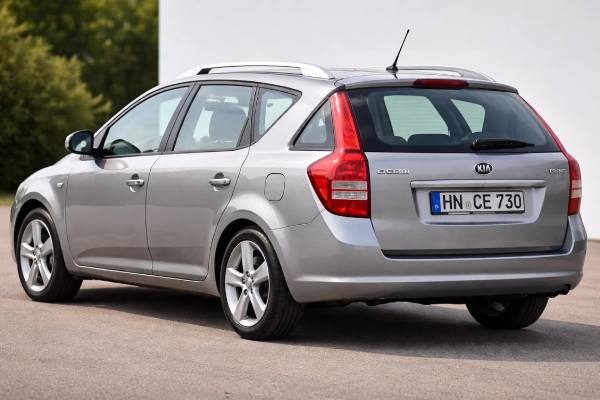
The 2007–2009 Kia Cee’d SW (ED) with the 1.6 CRDi 90 hp diesel (engine code D4FB) is a practical, long-roof family car built around efficient torque, strong packaging, and straightforward mechanicals. In Sporty Wagon form it adds genuinely useful cargo space without turning into a bulky estate: it stays easy to park, stable on the motorway, and predictable on winter tyres. The 90 hp tune is not a fast variant, but the diesel’s low-rpm pull makes it relaxed in real traffic, especially when loaded.
Ownership tends to be about condition and maintenance history rather than “bad design.” A clean service record, correct oil spec, and careful attention to intake and turbo plumbing matter more than chasing the newest features. If you buy well, the Cee’d SW can be a low-stress daily that still feels honest and mechanical in the best way.
Owner Snapshot
- Strong everyday torque for a 90 hp tune, especially useful with passengers and luggage.
- Big, square cargo area for the class; roof rails and long load floor suit family use.
- Simple, predictable road manners and stable motorway tracking on sensible tyres.
- Caveat: diesel short-trip use can accelerate soot and EGR/intake issues over time.
- Practical interval: change engine oil and filter every 12 months (or sooner in city/short-trip use).
Guide contents
- Kia Cee’d SW ED diesel essentials
- Kia Cee’d SW ED D4FB spec sheet
- Kia Cee’d SW ED trims and safety tech
- Common diesel issues and service actions
- Service plan and used buying tips
- Real-world performance and economy
- Rivals and best alternatives
Kia Cee’d SW ED diesel essentials
Think of the 1.6 CRDi 90 as the “workday” version of the Cee’d SW. It focuses on usable mid-range torque and fuel efficiency rather than punchy acceleration. For many owners that is exactly the point: the car feels willing at low rpm, keeps revs modest on the motorway, and does not punish you at the pump. In wagon form, the ED platform also makes sense dynamically—longer rear overhang adds cargo volume, but the car still drives like a compact hatch at normal speeds.
What the 90 hp tune does well
- Loaded driving: With passengers, child seats, and luggage, the diesel’s low-rpm torque helps the Cee’d move without constant downshifts.
- Motorway stability: The chassis is predictable and calm in crosswinds compared with taller MPVs of the same era.
- Running costs: In many markets this engine sits in a cheaper tax/insurance bracket than higher-output diesels.
Where expectations should be realistic
- Acceleration is modest. You can merge safely, but it rewards planning—especially when overtaking uphill.
- Urban short trips can be hard on older diesels. Soot load increases, EGR and intake deposits build faster, and neglected vacuum hoses or boost leaks become more noticeable.
- Noise and vibration (NVH): It is not harsh, but it is clearly a diesel of its time—especially cold.
The SW advantage (why the wagon matters)
The Cee’d SW’s big win is packaging. The boot is wide, the opening is useful, and the rear seats fold to create a long, fairly flat load floor. For owners who haul strollers, tools, or hobby gear, that matters more than a small difference in 0–100 km/h.
Who this specific variant suits
- Drivers who do regular mixed or highway mileage and want low fuel consumption without hybrid complexity.
- Families who want hatchback footprint with estate practicality.
- Buyers who prefer a car that is mechanically understandable and not overloaded with early ADAS tech.
If you mainly drive short city hops, don’t rule it out—but budget for more frequent oil services and be picky about maintenance history.
Kia Cee’d SW ED D4FB spec sheet
Below is a practical spec snapshot for the 2007–2009 Cee’d SW (ED) 1.6 CRDi 90 hp (D4FB). Exact figures can vary slightly by market, wheel/tyre package, and emissions equipment (some regions offered particulate filter options on certain diesels).
Powertrain and efficiency
| Item | Specification |
|---|---|
| Engine code | D4FB (1.6 CRDi “U” diesel family) |
| Layout | Transverse front engine, inline-4 |
| Valvetrain | DOHC, 16 valves (4/cyl) |
| Displacement | 1.6 L (1,582 cc) |
| Induction | Turbocharged (VGT in many markets) |
| Fuel system | Common-rail direct injection (CRDi) |
| Max power | 90 hp (66 kW) @ ~4,000 rpm (market-dependent) |
| Max torque | ~235 Nm (≈173 lb-ft) @ ~1,750–2,000 rpm (typical for this tune) |
| Timing drive | Chain (inspect for noise/correlation issues rather than fixed replacement) |
| Emissions | Euro 4 era; DPF may be optional/market-specific on some diesels |
Efficiency (typical owner reality):
- Mixed driving commonly lands around 5.0–6.0 L/100 km, depending on speed and tyre choice.
- Steady motorway cruising at ~120 km/h often sits around 5.0–5.8 L/100 km if the engine and tyres are healthy.
Transmission and driveline
| Item | Specification |
|---|---|
| Drive type | FWD |
| Common gearbox | 5-speed manual (market-dependent) |
| Differential | Open (traction control and ESC, where equipped, manage wheelspin) |
Chassis and dimensions
| Item | Specification (typical) |
|---|---|
| Front suspension | MacPherson strut |
| Rear suspension | Multi-link (common for this platform in many markets) |
| Steering | Electric assist (MDPS), rack-and-pinion |
| Brakes | Disc brakes front; rear disc or drum depending on trim/market |
| Length | ~4,470–4,480 mm |
| Width | ~1,790 mm |
| Height | ~1,490 mm |
| Wheelbase | ~2,650 mm |
| Turning circle | ~10.3 m (kerb-to-kerb, typical) |
| Fuel tank | ~53 L |
| Cargo volume | ~534 L seats up / ~1,664 L seats folded (typical SW figures) |
Performance and capability
| Metric | Typical figure |
|---|---|
| 0–100 km/h (0–62 mph) | ~14.0–14.5 s (gearbox/market dependent) |
| Top speed | ~170–175 km/h (≈106–109 mph) |
| Towing (braked) | Often up to ~1,200–1,400 kg depending on homologation |
| Payload | Varies widely by trim; check door-jamb plate for GVWR |
Fluids and service capacities (decision-useful)
| Fluid | Practical guidance |
|---|---|
| Engine oil | 5W-30 is common; always match the required ACEA/API spec for your market |
| Oil capacity | ~5.3 L (drain and refill, typical listing for this model/era) |
| Coolant | Ethylene glycol-based coolant for aluminum engines; use correct spec and mix ratio |
| Brake fluid | DOT 4 (typical) |
| A/C refrigerant | Varies by system; verify under-hood label |
Key torque specs (common “must-know” fasteners): Because torque specs can vary by engine variant and repair procedure, treat these as “verify-before-tightening” items in official service info: wheel bolts, brake caliper bracket bolts, drain plug, and engine mount fasteners.
Kia Cee’d SW ED trims and safety tech
Trim structure for the Cee’d SW (ED) varies by country, but the pattern is consistent: a value-focused base, a mid-trim with comfort features, and a higher trim that bundles wheels, climate, and audio upgrades. The diesel 90 hp often appears in practical trims rather than sport-focused ones, which is good news if you want durability and lower tyre costs.
Trims and options that matter mechanically
1) Wheels and tyres
- Smaller wheel packages (often 15–16 inch) generally ride better, cost less to replace, and are kinder to suspension bushings.
- If you see larger factory wheels, confirm the correct load-rated tyres. Estates can be sensitive to under-rated tyres when fully loaded.
2) Brakes and stability systems
- Some markets offered rear disc brakes on higher trims and drums on lower ones. Both can work well when maintained; rear discs are easier to inspect visually, while drums can last a long time but need periodic cleaning and adjustment checks.
- ESC (stability control) was not universal across all early trims in every market. If you drive in snow or heavy rain, prioritize a car with ESC.
3) Comfort features that influence ownership
- Automatic climate control adds comfort but introduces additional actuators and sensors. Not a deal-breaker—just ensure all vents switch correctly and the A/C blows cold at idle.
- Heated seats and mirrors are genuinely useful on a diesel in cold climates because cabin heat may take longer on short trips.
Quick identifiers when shopping
- Badging: “CRDi” usually denotes the diesel; power output may not be obvious from exterior badges.
- Interior tells: Higher trims often have steering wheel audio controls, upgraded head unit, and more complete trip computer displays.
- VIN/build plate checks: Use the door-jamb plate for GVWR and axle loads—handy for judging payload and towing suitability.
Safety ratings and core safety equipment
The Cee’d earned a top Euro NCAP result for the era, and Kia highlighted strong performance across front and side impacts. Typical safety equipment on many European-market cars included:
- Six airbags (front, side, and curtain) commonly standard across much of the range.
- ABS with electronic brakeforce distribution (EBD) widely fitted.
- ISOFIX/LATCH child-seat points on the rear seats (confirm presence and condition of covers/anchors).
Driver assistance (ADAS) reality
In 2007–2009 you should not expect modern ADAS features like automatic emergency braking or lane centering. Safety is primarily structural plus basic electronic stability aids where equipped. That simplicity can be an advantage: fewer cameras and radar units to calibrate after windshield replacement or suspension work. The key is to ensure ABS/ESC warning lights behave correctly at start-up and that tyre sizes match across an axle (important for stability systems).
Common diesel issues and service actions
Most problems on the 1.6 CRDi 90 fall into a familiar “old diesel” pattern: air leaks, soot management, and maintenance shortcuts. The good news is that many issues give warnings long before they become catastrophic—if you know what to look for.
Common (more frequent) issues
Boost leaks and vacuum control faults (low to medium cost)
- Symptoms: Slower-than-normal acceleration, flat midrange, occasional limp mode, hissing under load.
- Likely causes: Split intercooler hoses, tired clamps, cracked vacuum lines, sticky turbo actuator control.
- Remedy: Smoke-test the intake, replace aged hoses, verify vacuum supply and actuator movement.
EGR and intake soot buildup (medium cost, higher if ignored)
- Symptoms: Rough idle, hesitation at low rpm, increased smoke, reduced economy.
- Likely causes: Short trips, low-quality oil, extended service intervals, clogged EGR passages.
- Remedy: Clean EGR/intake as needed and adjust driving pattern—an occasional longer run helps reduce soot accumulation.
Glow plugs and cold-start behavior (low to medium cost)
- Symptoms: Hard starting in cold weather, uneven idle for the first minute, glow plug light behavior inconsistent.
- Likely causes: Aging glow plugs, glow control relay/module issues.
- Remedy: Test glow circuit properly; replace as a set when appropriate.
Occasional issues (depending on mileage and care)
Injector sealing and fuel system sensitivity (medium to high cost)
- Symptoms: Diesel smell, ticking noise, oily residue around injectors, rough running.
- Likely causes: Injector washer leakage, fuel contamination, high-mileage wear.
- Remedy: Address early—leaks can carbon up the injector seat and raise labor significantly.
Turbo wear from oil neglect (high cost)
- Symptoms: Whine, oil consumption, smoke under load, boost deviations.
- Likely causes: Wrong oil spec, long intervals, frequent hot shut-downs after hard driving.
- Remedy: Correct oil and filter discipline; let the turbo cool briefly after sustained load.
Rare but expensive (avoid with inspection)
Overheating and head gasket risk (high cost)
- Symptoms: Temperature spikes, coolant loss, pressurized hoses, heater performance changes.
- Likely causes: Cooling system neglect, stuck thermostat, failing radiator fans.
- Remedy: Cooling system must be boringly reliable—fix small leaks immediately.
Recalls, campaigns, and how to verify
Because recall coverage is VIN-specific and varies by country, treat online lists as a starting point. The correct process is:
- Run the VIN through an official recall portal for your region.
- Ask the seller for dealer invoices showing completion of campaigns.
- Confirm warning lights are not masking faults (no removed bulbs; no hidden codes).
Pre-purchase checks you should request (high value)
- Cold start test (engine stone cold).
- Scan for stored codes, especially boost, EGR, rail pressure, and glow circuit.
- Inspect intake hoses, intercooler area, and vacuum lines.
- Check clutch take-up and listen for dual-mass flywheel chatter (if equipped).
- Look underneath for oil leaks around turbo feed/return and crank seals.
If the car feels “fine but a bit lazy,” assume an air/boost control issue until proven otherwise—these engines should feel torque-forward even at 90 hp.
Service plan and used buying tips
A Cee’d SW diesel can be a bargain, but only if you buy one that has been serviced like a diesel—not like a disposable commuter. Use the schedule below as a practical baseline, then tighten it if the car lives in traffic, does short trips, or sees very cold winters.
Practical maintenance schedule (distance/time)
Engine oil and filter
- Normal use: every 12 months (or the manufacturer’s distance interval for your market).
- Harsh use (short trips, cold starts, heavy city): every 8,000–12,000 km is a sensible protective interval.
- Always use the correct spec oil, not just the right viscosity.
Air filtration
- Engine air filter: inspect every 15,000 km, replace as needed (often 30,000 km in clean environments).
- Cabin filter: every 12 months (or sooner if airflow drops or odors appear).
Fuel system
- Fuel filter: commonly 30,000–60,000 km depending on region and fuel quality. If you don’t know when it was done, budget to do it early.
Cooling system
- Coolant: typically every 4–5 years. Replace sooner if contamination is visible or if the wrong coolant was used.
- Inspect hoses, thermostat behavior, radiator fans, and expansion tank condition annually.
Belts and timing components
- Accessory/serpentine belt: inspect every 15,000–30,000 km, replace if cracked or noisy.
- Timing drive: commonly chain on this engine family; focus on inspection—listen for rattle at start-up, check for timing correlation codes, and address oil quality issues that accelerate chain/tensioner wear.
Transmission
- Manual gearbox oil: many owners ignore it; a preventative change around 100,000–150,000 km can improve shift feel and longevity.
- Clutch and flywheel: assess by feel and sound; a slipping clutch under load is a negotiating point.
Brakes
- Brake fluid: every 2 years regardless of mileage.
- Pads/rotors: inspect at every tyre rotation; watch for rear brake seizure on cars that sit.
Chassis and tyres
- Tyre rotation: every 10,000–12,000 km.
- Alignment: check after kerb strikes or uneven wear; estates are often loaded and can wear rear tyres faster when alignment is off.
Battery and electrical
- 12 V battery test: annually before winter. Older diesels are sensitive to weak cranking voltage.
Fluids and decision-making (what to confirm)
Ask for documentation showing:
- Oil spec and quantity used at service.
- Fuel filter replacement dates.
- Brake fluid change intervals.
If paperwork is thin, budget a “baseline service” immediately after purchase.
Buyer’s guide: what to seek, what to avoid
Seek
- Full service history with correct oil spec.
- Mixed-use mileage (not pure short-trip city life).
- Working climate control and stable coolant temps.
- Clean boost delivery without limp mode.
Avoid (or price accordingly)
- Unknown oil history on a turbo diesel.
- Persistent smoke under load, rough idle, or repeated glow/engine lights.
- Overheating history or coolant loss.
- Modified EGR/DPF setups that create inspection or reliability headaches.
Long-term durability is mainly about heat control, oil discipline, and air-tight boost plumbing. Get those right and the car can feel dependable well past the age where many estates become “one more problem away” vehicles.
Real-world performance and economy
The best way to understand the 1.6 CRDi 90 is to drive it like an owner, not like a reviewer chasing numbers. It is at its best when you surf torque, keep momentum, and let the turbo do steady work rather than repeated full-throttle bursts.
Ride, handling, and NVH
Ride: On standard wheels, the SW is composed and forgiving over broken pavement. The rear can feel a touch firmer when unladen, but it settles nicely with cargo or passengers—one of the benefits of an estate tuned for load capacity.
Handling: Steering is typically light and consistent rather than “talkative.” The chassis is neutral at normal speeds and prefers smooth inputs. With quality tyres, it tracks confidently in rain and crosswinds.
Braking feel: Pedal feel is usually straightforward. If the brakes feel wooden or inconsistent, suspect cheap pads, old fluid, or rear brake issues before blaming the design.
Cabin noise: Expect diesel clatter at idle when cold. At cruising speed, wind and tyre noise matter more than the engine. Tyre choice can noticeably change perceived refinement.
Powertrain character in daily use
The 90 hp tune is not about top-end power. The useful band is low-to-mid rpm, where the car feels cooperative in traffic and on gentle inclines. If you keep the engine in its torque window, it feels stronger than the power figure suggests. If you lug it too low, it may shudder; if you rev it high, it simply runs out of enthusiasm.
Passing and overtaking: Plan overtakes with space. A clean example should still build speed smoothly from 80–120 km/h, but it won’t do it quickly when loaded.
City driving: It can be economical, but only if the engine gets fully warm regularly. If it never reaches stable operating temperature, soot and condensation-related wear become a bigger theme.
Real-world economy (what most owners see)
While official figures vary by market and tyre size, practical ranges are more useful:
- City: ~5.5–7.0 L/100 km depending on warm-up time and traffic.
- Highway (100–120 km/h): ~5.0–5.8 L/100 km with steady speed and correct tyre pressures.
- Mixed: ~5.0–6.0 L/100 km.
Cold weather often adds 0.5–1.0 L/100 km due to longer warm-up and heavier electrical loads (heated glass, blower, lights).
Load carrying and towing notes
The SW stays stable with a family load if tyres are properly inflated and suspension bushings are not worn. If you tow, pay attention to:
- Cooling system health (fans, radiator condition, correct coolant).
- Clutch condition on manuals.
- Brake condition and fluid freshness.
In short: it is a calm, economical estate when treated like a torque diesel. It becomes frustrating only when you expect it to drive like a higher-output variant.
Rivals and best alternatives
The Cee’d SW 1.6 CRDi 90 sits in a crowded late-2000s European estate segment. Its main competitive advantages are packaging value, straightforward ownership when maintained, and a generally solid safety story for the era. Where it can lose ground is refinement versus newer diesels and outright performance versus higher-output rivals.
Similar-era rivals worth cross-shopping
Ford Focus Estate 1.6 TDCi (approx. 90–110 hp)
- Pros: Sharp steering, good chassis balance, lots of parts availability.
- Cons: Some variants are sensitive to oil and turbo service discipline; check history carefully.
Volkswagen Golf Variant 1.9 TDI / 2.0 TDI
- Pros: Strong drivetrains, stable cruising, broad specialist support.
- Cons: Often costs more used; condition varies widely; avoid neglected high-mileage examples.
Opel/Vauxhall Astra Caravan 1.7 CDTi
- Pros: Practical and often inexpensive; decent motorway manners.
- Cons: Can feel less refined; ensure EGR and intake condition is acceptable.
Renault Mégane Estate 1.5 dCi
- Pros: Very efficient; often good ride comfort.
- Cons: Service history is everything—oil and timing component discipline matter.
Where the Cee’d SW stands out
1) Cargo usefulness per footprint
The Cee’d SW gives you real estate practicality without the bulk of a larger wagon. For many owners, that is the deciding factor.
2) “Simple enough” electronics
You get the safety essentials without a heavy layer of early driver-assist complexity.
3) Value play
In many markets, it undercuts the most famous badges while offering comparable daily function.
When a rival may be the smarter pick
- If you do frequent high-speed overtakes on two-lane roads, a higher-output diesel (or the 1.6 CRDi 115) can feel safer and less tiring.
- If your driving is mostly short city hops, a petrol Cee’d or a simpler non-DPF diesel strategy (market dependent) can reduce soot-related headaches.
- If you want the most “modern” safety tech, you need a newer generation—this era won’t deliver AEB or lane support.
Bottom-line comparison advice
If you find a well-documented Cee’d SW 1.6 CRDi 90 with clean boost delivery, stable temperatures, and correct oil history, it can be one of the more sensible “buy it and use it” estates of its age. If the history is unclear, it is rarely worth gambling—because diesel catch-up maintenance can erase the purchase-price advantage quickly.
References
- cee’d product Guide 2007 (Product Guide)
- Engine Oil Grades and Capacities 2023 (Service and Maintenance)
- Kia Recalls | Kia Europe 2026 (Recall Database)
- Kia cee’d wins 5-Star Euro NCAP safety rating – Kia Slovakia s.r.o. 2007 (Safety Rating)
Disclaimer
This article is for informational purposes only and is not a substitute for professional inspection, diagnosis, or repair. Specifications, torque values, service intervals, and procedures can vary by VIN, market, engine revision, and installed equipment—always verify details using official Kia documentation for your specific vehicle and consult a qualified technician when needed.
If you found this guide useful, consider sharing it on Facebook, X/Twitter, or your favorite forum to support our work.