


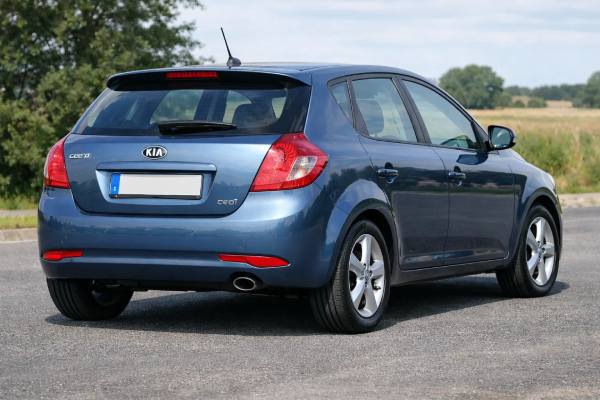
The facelifted 2009–2012 Kia Cee’d with the 1.6 CRDi (D4FB) 90 hp diesel is a “do the basics well” C-segment hatch and estate: compact outside, easy to place in traffic, and genuinely economical when it’s used for longer runs. This engine’s character is more about mid-range pull than outright speed, and it rewards smooth driving with stable fuel use and low running costs.
Ownership satisfaction usually comes down to matching the car to the right duty cycle. If you drive mostly short trips, the emissions hardware common on many markets (EGR and often a diesel particulate filter) can become the limiting factor. If you cover mixed or motorway miles, the package makes sense: comfortable ride, predictable handling, and a straightforward mechanical layout that most independent shops know well.
What to Know
- Strong real-world economy on steady-speed driving, especially on longer trips.
- Simple, confidence-building chassis with stable braking and steering feel for the class.
- Practical cabin and boot packaging, particularly in the SW estate.
- Short-trip use can accelerate EGR and (where fitted) DPF soot-loading problems.
- Plan engine oil service at 15,000 km (10,000 mi) or 12 months for conservative longevity.
Navigate this guide
- Kia Cee’d facelift diesel profile
- Kia Cee’d 1.6 CRDi core specs
- Kia Cee’d equipment and safety
- Common faults and recalls
- Service plan and buyer checklist
- Real driving and fuel use
- Rivals and value verdict
Kia Cee’d facelift diesel profile
The 2009–2012 facelift Cee’d (ED) sits in the sweet spot of “modern enough, not overcomplicated.” You get the key structural benefits of a European-developed compact Kia—tidy body control, a planted motorway stance, and ergonomics that feel conventional in a good way—without the layer of modern driver-assist sensors that can turn an older used car into an electrical treasure hunt.
With the D4FB 1.6 CRDi in 90 hp tune, expectations should be set correctly. This is not the sporty diesel in the range; it’s the efficiency-led option. It delivers its best work in the mid-range, where you can hold a gear and surf torque rather than constantly chasing revs. In day-to-day driving that often feels easier than the numbers suggest, especially with light loads and gentle throttle inputs.
The facelift matters in small, ownership-relevant ways: incremental NVH (noise, vibration, harshness) improvements, detail trim changes, and—depending on market—updates to emissions calibration. That last point is important. Many examples use EGR (exhaust gas recirculation) aggressively for emissions, and some have a DPF. Those systems are not inherently bad, but they dislike repeated cold starts and short journeys. For buyers who do mostly city miles, the smartest “advantage” is actually choosing a car whose previous life included regular longer drives.
Where the 90 hp version tends to shine is total cost per kilometer: lower fuel burn, usually cheaper tyres, and often less stress on clutches than higher-output diesel variants that encourage torque-heavy driving. If your priority is a durable commuter, a simple family car, or a budget motorway tool, the Cee’d 1.6 CRDi 90 can be a rational pick—provided you verify maintenance history and that any recall work is complete.
Kia Cee’d 1.6 CRDi core specs
Specs can vary by market, body (hatch vs SW), wheel size, and emissions level. Use the tables below as the typical configuration for a 2009–2012 facelift Cee’d with the D4FB 1.6 CRDi in 90 hp form, then verify against the car’s VIN build data and local handbook.
Powertrain and efficiency (typical)
| Item | Specification |
|---|---|
| Code | D4FB (1.6 CRDi) |
| Engine layout and cylinders | Inline-4, DOHC, 16 valves (4 valves/cyl) |
| Bore × stroke | 77.2 × 84.5 mm (3.04 × 3.33 in) |
| Displacement | 1.6 L (1,582 cc) |
| Induction | Turbocharged, intercooled |
| Fuel system | Common-rail direct injection |
| Compression ratio | ~17.3:1 (varies by emissions version) |
| Max power | 90 hp (66 kW) @ ~4,000 rpm |
| Max torque | ~235 Nm (173 lb-ft) @ ~1,750–2,500 rpm |
| Timing drive | Chain |
| Rated efficiency (typical combined) | ~4.6–5.2 L/100 km (51–45 mpg US / 61–54 mpg UK) |
| Real-world highway @ 120 km/h | ~5.4–6.2 L/100 km (44–38 mpg US / 52–46 mpg UK) |
Transmission and driveline (typical)
| Item | Specification |
|---|---|
| Transmission | Manual (commonly 5-speed on lower outputs; some markets 6-speed) |
| Drive type | FWD |
| Differential | Open |
Chassis and dimensions (typical hatchback)
| Item | Specification |
|---|---|
| Suspension (front/rear) | MacPherson strut / multi-link |
| Steering | Electric power steering; ratio varies by market |
| Brakes | Front ventilated discs / rear discs (spec varies by trim) |
| Wheels and tyres (common) | 195/65 R15 or 205/55 R16 |
| Ground clearance | ~150 mm (5.9 in) (market dependent) |
| Length / width / height | ~4,235 / 1,790 / 1,480 mm (166.7 / 70.5 / 58.3 in) |
| Wheelbase | ~2,650 mm (104.3 in) |
| Turning circle (kerb-to-kerb) | ~10.4–10.6 m (34–35 ft) |
| Kerb weight | ~1,300–1,420 kg (2,866–3,131 lb) depending on body and spec |
| Fuel tank | ~53 L (14.0 US gal / 11.7 UK gal) |
| Cargo volume | Hatch ~340 L seats up; SW typically higher (method varies by market) |
Performance and capability (typical)
| Item | Specification |
|---|---|
| 0–100 km/h (0–62 mph) | ~13.5–14.5 s |
| Top speed | ~170–175 km/h (106–109 mph) |
| Towing | Market dependent; often ~1,200–1,400 kg braked (verify) |
| Payload | Typically ~450–550 kg (verify by VIN plate) |
Fluids and service capacities (typical guidance)
| Fluid | Specification (typical) |
|---|---|
| Engine oil | ACEA C3, 5W-30 commonly used; capacity typically ~5.3 L (5.6 US qt) with filter |
| Coolant | Ethylene glycol OAT-type common; mix 50/50; capacity varies (verify) |
| Manual gearbox oil | Often ~1.8–2.0 L (verify by transmission code) |
| A/C refrigerant | Type and charge vary by market; check under-hood label |
Safety and driver assistance (era-typical)
| Item | What to expect |
|---|---|
| Crash ratings | Euro NCAP rating exists for the model generation; check year and protocol version |
| Core safety systems | ABS and stability control often fitted (varies by year/market/trim) |
| ADAS | Modern AEB/ACC/lane centering generally not available on this generation |
Kia Cee’d equipment and safety
Trim structure varies widely across Europe (and even within the same country over time), so the most useful approach is to focus on what changes ownership outcomes: wheels and brakes, cabin features that date poorly, and the safety equipment that affects real-world protection.
Trims and options that matter in practice
Most 2009–2012 facelift cars were sold in a ladder that roughly maps to entry, mid, and high trims. The names differ (and special editions are common), but these patterns repeat:
- Entry trims: smaller wheels (often 15-inch), simpler audio, fewer convenience features. The advantage is lower tyre cost and often less electrical complexity.
- Mid trims: typically the best used-car value—better sound insulation, more steering wheel controls, and commonly air conditioning (manual or automatic).
- High trims: extra comfort and cosmetics (larger wheels, upgraded upholstery, sometimes navigation). On a car of this age, these features can age into liabilities if the infotainment is slow or if climate control actuators fail.
Practical identifiers when viewing a car:
- Wheel size and brake feel: larger wheels can sharpen response but worsen ride on rough roads.
- Cabin switchgear: check every button, especially window switches, mirror controls, and HVAC direction/temperature changes.
- If fitted, test heated seats and rear window defrost—small items, but they reveal electrical health.
Safety ratings and what they mean on a 2009–2012 used car
A key point with safety ratings is the test protocol. A good score in an older protocol still indicates strong structure for its time, but it does not imply modern active-safety performance. For a buyer today, the more relevant question is: does the car have the basics working correctly?
Prioritize:
- Airbags: Many Cee’d variants were equipped with front, side, and curtain airbags. Confirm the airbag warning light behaves correctly at start-up (on briefly, then off).
- ISOFIX/LATCH: Typically present on rear outboard seats. Confirm the plastic guides (if fitted) are intact and that the seat belt buckles are not buried.
- ABS and stability control: If stability control is fitted, verify the dashboard indicator lights up at ignition and then goes out. A permanently lit ABS/ESC lamp can turn into a larger repair than it seems (wheel speed sensor vs module issues).
Driver assistance and visibility
Don’t expect modern ADAS here. Instead, look for the fundamentals:
- Good headlight lens condition (haze reduces night safety).
- Tyres that match quality brands and correct load rating.
- Even braking and stable straight-line tracking (a proxy for suspension and alignment condition).
If you want the safest experience from this platform, the “option package” that matters most is not a gadget: it’s good tyres, fresh brake fluid, and properly serviced brakes.
Common faults and recalls
A well-kept 1.6 CRDi Cee’d can be dependable, but age and usage profile decide everything. The issues below are grouped by prevalence and cost severity, with the typical trigger conditions.
Common, usually moderate cost
- EGR soot build-up (common, medium):
Symptoms: hesitant acceleration, uneven idle, limp mode, smoke under load.
Likely cause: EGR valve and intake contamination from short trips and low exhaust temperatures.
Remedy: proper diagnostics first; cleaning may help, but sticky valves sometimes need replacement. A driving pattern that includes regular longer runs helps prevent recurrence. - Boost leaks (common, low to medium):
Symptoms: flat power, whistle, oily mist around hoses/intercooler.
Likely cause: split intercooler hoses, loose clamps, intercooler seepage.
Remedy: pressure-test intake tract; replace degraded hoses and clamps. - Glow plug and control faults (common, low to medium):
Symptoms: hard cold starts, warning lights, rough first minute of running.
Likely cause: ageing glow plugs or relay/control module issues.
Remedy: replace failed components; avoid forcing stuck plugs out without proper technique.
Occasional, can become expensive
- DPF loading (occasional, medium to high where fitted):
Symptoms: rising fuel use, frequent regeneration behavior, warning light, limp mode.
Likely cause: repeated short trips, failed thermostat (engine runs cool), injector issues causing soot.
Remedy: confirm live data, exhaust temps, and differential pressure readings. Avoid “parts darts.” Fix underlying causes before any forced regeneration. - Injector sealing and combustion blow-by (occasional, medium):
Symptoms: chuffing noise, diesel smell, tar-like residue around injectors.
Likely cause: injector copper washer leakage.
Remedy: reseal promptly; delayed repair can complicate removal. - Clutch and dual-mass flywheel wear (occasional, high):
Symptoms: vibration at idle, rattling, slipping under load, harsh engagement.
Likely cause: city driving, torque-lugging, age.
Remedy: replace clutch kit and DMF as needed; check engine mounts at the same time.
Rare, but worth screening on a test drive
- Turbo actuator or vane control issues (rare to occasional, high):
Symptoms: intermittent limp mode under load, inconsistent boost.
Remedy: diagnose vacuum supply, solenoids, and actuator movement before condemning the turbo. - Timing chain stretch (rare, high if ignored):
Symptoms: rattle at start-up, correlation faults (if scanned), rough running.
Remedy: treat as a measured condition—confirm with diagnostics rather than guessing.
Recalls, service actions, and how to verify
Don’t rely on seller claims. Use official recall lookups and request documentation showing completion. If the seller cannot provide proof, assume you must verify through a dealer record check. For a buyer, the best habit is simple: make recall completion a condition of purchase.
Service plan and buyer checklist
Below is a practical schedule that suits real-world used-car ownership. Some markets allowed longer intervals, but older diesels with EGR and (often) a DPF generally live longer with conservative servicing.
Maintenance schedule (practical)
- Engine oil and filter: every 15,000 km (10,000 mi) or 12 months. If you do many short trips, reduce to 10,000–12,000 km.
- Air filter: inspect every service; replace typically 30,000 km (more often in dusty areas).
- Cabin filter: 15,000 km or 12 months for HVAC performance.
- Fuel filter: 30,000–40,000 km is a sensible interval; water contamination is a bigger enemy than mileage.
- Brake fluid: every 2 years, regardless of mileage.
- Coolant: commonly 5 years, then every 3–5 years depending on coolant type and local guidance.
- Manual gearbox oil: not always listed as routine, but a preventive change around 120,000–160,000 km can help shift quality and bearing life.
- Accessory belt and pulleys: inspect every service; plan replacement on condition (cracking, noise).
- Timing chain: no routine replacement interval; inspect by symptoms and data, especially at higher mileage.
Fluids and specs (decision-level)
- Choose engine oil that matches the emissions hardware: ACEA C3 5W-30 is common for DPF-compatible setups.
- Use coolant that matches the system’s corrosion protection requirements; do not mix chemistries unless the product explicitly allows it.
Buyer’s guide: what to check before you commit
1) Cold start behavior
- Should start cleanly and settle quickly. Excess cranking, heavy smoke, or uneven idle suggests glow, injector, or compression-related issues.
2) Temperature stability
- On a test drive, the coolant temperature should reach normal and stay steady. A diesel that runs too cool can overwork EGR and DPF systems.
3) Clutch and flywheel
- Feel for vibration at idle and listen for rattles when engaging/disengaging the clutch. Budget for this if symptoms exist.
4) Boost and smoke under load
- A healthy 90 hp setup won’t be fast, but it should pull smoothly without sudden flat spots. Smoke under moderate load can indicate airflow or fueling issues.
5) Underbody and corrosion hotspots
- Check rear suspension mounting points, brake lines, and subframe areas. Corrosion is market- and climate-dependent, so inspect rather than assume.
6) Paperwork that matters
- Evidence of regular oil changes, fuel filter changes, and any emissions-related repairs. Also confirm recalls are completed.
Long-term outlook: treated as a long-distance commuter and maintained conservatively, this powertrain can offer a long service life. Treated as a short-trip city diesel, it can become a cycle of EGR/DPF-related fixes that erase the fuel savings.
Real driving and fuel use
The Cee’d chassis is one of the reasons this generation built a good reputation. It’s predictable and stable, with a ride that generally favors comfort over sharpness—exactly what most buyers of the 90 hp diesel want.
Ride, handling, and NVH
- Ride: On 15–16 inch wheels the car typically absorbs broken pavement well for a compact. Larger wheels can introduce sharper impacts, especially as suspension bushes age.
- Handling: Safe and neutral. The rear multi-link helps the car feel composed in faster bends and on uneven mid-corner surfaces.
- Steering: Light at parking speeds and steady on the motorway. Feedback is adequate rather than sporty.
- NVH: Expect diesel clatter at idle and during cold running, then a calmer cruise. Wind noise depends heavily on door seals and tyre choice.
Powertrain character
The 90 hp tune is best driven like a torque engine:
- Use the mid-range rather than revving it out.
- Avoid lugging at very low rpm in a high gear, which can stress the clutch/DMF and increase soot output.
- The gearbox choice matters: a 6-speed (where fitted) can reduce motorway rpm and noise, while a 5-speed can feel busier at higher speeds.
Real-world efficiency
Economy is where this variant earns its place, but only if the usage pattern fits:
- City (short trips): ~6.0–7.2 L/100 km (39–33 mpg US / 47–39 mpg UK) depending on warm-up time.
- Mixed driving: ~5.0–6.0 L/100 km (47–39 mpg US / 56–47 mpg UK).
- Motorway cruise: ~5.4–6.2 L/100 km at 120 km/h, with higher figures in winter or strong headwinds.
Cold weather penalty is real: longer warm-up, higher idle fuel, and (where fitted) more frequent regeneration behavior. If your driving is mostly under 10 km per trip, the best “performance upgrade” is not a tune—it’s choosing a petrol engine instead.
Rivals and value verdict
In the 2009–2012 used-car space, the Cee’d competes with some excellent diesels—and a few famously expensive ones. Your best choice depends on what you value more: driving feel, cabin polish, parts cost, or the simplest route to reliable emissions behavior.
Key rivals in the same role
- Volkswagen Golf 1.6 TDI (90–105 hp):
Often feels more solid inside and can hold resale value better, but repairs can be pricier and some versions have complex emissions hardware. Great if you want the premium feel and have a maintenance budget. - Ford Focus 1.6 TDCi (90–109 hp):
Typically the handling benchmark. However, diesel variants can bring their own EGR/DPF and injector-related headaches if maintenance was skipped. Choose on condition, not reputation. - Opel/Vauxhall Astra 1.7 CDTI:
Strong motorway engine options and common parts availability, but check for clutch/DMF wear and electrical gremlins depending on year. - Renault Mégane 1.5 dCi:
Very efficient and often cheaper to buy. Condition matters heavily; service history is non-negotiable. - Toyota Auris D-4D:
Usually the conservative reliability pick, but may feel less engaging and can be priced higher in some markets.
Where the Cee’d 1.6 CRDi 90 stands out
- Value per mile: Often excellent, especially if you find a car with documented servicing and motorway-biased use.
- Chassis comfort: More composed than many budget compacts of the era.
- Ownership simplicity: Fewer high-end systems than some German rivals, which can reduce age-related surprises.
Who should buy it
Choose this Cee’d if you want a practical diesel for regular longer drives, prefer predictable behavior over sporty performance, and you’re willing to do a careful pre-purchase inspection focused on emissions hardware and driveline wear.
If your use is mostly short urban trips, the smartest comparison is not “which diesel,” but “diesel vs petrol.” In that scenario, the best rival to this car may be the petrol version of the same model.
References
- Käyttöohjekirjat | Kia Finland 2026 (Owner’s Manual Library)
- Kia Recalls | Kia Europe 2026 (Recall Database)
- Check if a vehicle, part or accessory has been recalled – GOV.UK 2026 (Recall Database)
- Kia cee’d wins 5-Star Euro NCAP safety rating – Kia Slovakia s.r.o. 2007 (Safety Rating)
Disclaimer
This article is for informational purposes only and is not a substitute for professional diagnosis, inspection, or repair. Specifications, torque values, service intervals, and procedures can vary by VIN, market, model year, and equipment, so always verify details using the correct official documentation for your specific vehicle and consult a qualified technician when needed.
If this guide helped, please consider sharing it on Facebook, X/Twitter, or your favorite forum to support our work.