
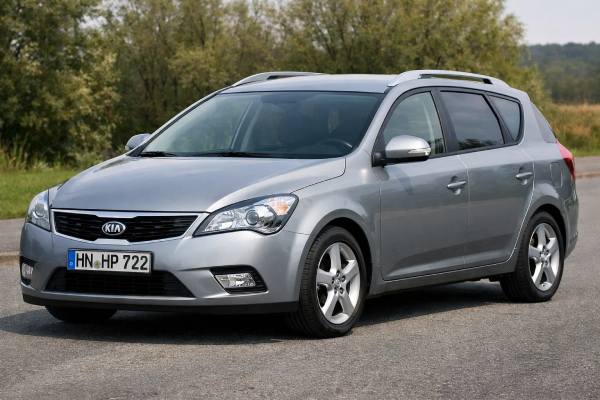
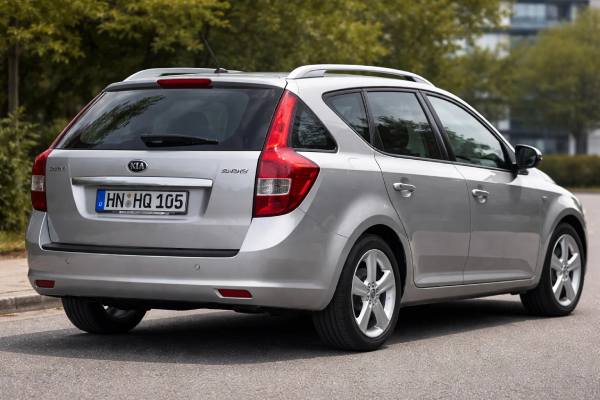
The facelift Kia Cee’d SW (ED) with the 1.6 G4FC (126 hp) sits in a practical sweet spot: it’s a compact wagon that carries family-duty loads without the running costs, complexity, or thirst of larger estate cars. The G4FC “Gamma” petrol is a simple naturally aspirated engine that rewards steady maintenance—especially clean oil, good ignition parts, and an intact cooling system. In daily use, the Cee’d SW’s strengths are predictable handling, honest fuel economy for its age, and a chassis that tolerates rough roads better than many low-profile rivals when you keep sensible tyre sizes.
As a used buy, the biggest difference between a “cheap wagon” and a “good wagon” is condition: suspension wear, corrosion hotspots, and electrical niggles matter more than the badge. If you shop carefully and budget for catch-up servicing, this Cee’d can be a durable long-haul tool.
What to Know
- Strong value as a compact wagon: big boot, straightforward petrol engine, and low parts cost in most markets.
- The 1.6 G4FC suits mixed driving better than the 1.4; it feels less strained with passengers and luggage.
- Best comfort-to-cost setup is usually 15–16 inch wheels with taller tyres; it protects the suspension on poor roads.
- Watch for age-related items: front suspension joints, A/C performance, and intermittent electrical faults (windows, locks, sensors).
- Plan engine oil and filter service every 12 months or ~20,000 km (12,500 mi), sooner for short trips.
Jump to sections
- Kia Cee’d SW ED 1.6 strengths
- Kia Cee’d SW ED 1.6 G4FC specs
- Kia Cee’d SW ED equipment and safety
- Known issues and recalls
- Service schedule and buying tips
- On-road performance and economy
- Rivals: which wagon wins
Kia Cee’d SW ED 1.6 strengths
The facelift Cee’d SW (2009–2012) is the kind of wagon that earns trust through normal, repeatable behavior. It starts easily, warms up quickly, and—when maintained—doesn’t surprise you with “personality.” For owners who want one car to commute, do school runs, and carry weekend gear, that predictability is a real advantage.
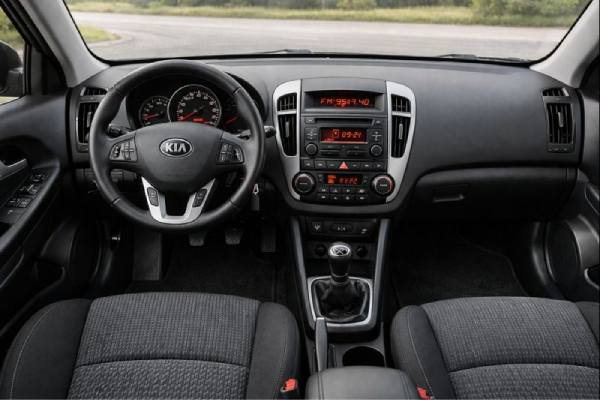
Packaging is the headline. The SW body delivers a tall, square boot opening and a long load floor. With the rear seats up it swallows bulky shopping, strollers, or tool cases without forcing you to play luggage Tetris. Fold the seats and you get a near-van level of usefulness for bikes (front wheel off), flat-pack furniture, and house projects. The cabin is also more “adult” than many small wagons of the era: the driving position is upright, visibility is good, and controls are simple enough that you do not need a tutorial every time you switch cars.
The 1.6 G4FC is the right petrol choice for the SW body. In a wagon, the 1.4 can feel busy when loaded or on fast motorways. The 1.6 doesn’t turn the Cee’d into a rocket, but it gives you a calmer engine note at the same real-world speeds and more flexibility when you need to merge or pass without dropping multiple gears.
Chassis tuning is more mature than you might expect. The Cee’d SW tracks straight on highways and doesn’t get nervous in crosswinds the way some tall small wagons do. The rear suspension is set up for stability with a load, and the steering is light but consistent. On rougher roads, the car benefits massively from sensible tyre sidewalls (15–16 inch wheels), because the suspension can only do so much if the tyre is too stiff.
Ownership upside: parts supply is generally good, most repairs are conventional, and independent shops are comfortable working on it. The “best” example is usually the one with boring paperwork: regular fluids, documented brake work, and a calm history—not the one with the biggest wheels.
Kia Cee’d SW ED 1.6 G4FC specs
Below are practical, owner-relevant specifications for the facelift Cee’d SW (ED) with the 1.6 G4FC petrol. Exact numbers can vary by market, wheel and tyre package, and gearbox, so treat these as typical ranges for the 2009–2012 SW.
Powertrain and efficiency
| Item | Specification |
|---|---|
| Code | G4FC |
| Engine layout and cylinders | I-4, DOHC, 16 valves (4/cyl) |
| Displacement | 1.6 L (1,591 cc) |
| Bore × stroke | 77.0 × 85.4 mm (3.03 × 3.36 in) |
| Induction | Naturally aspirated |
| Fuel system | MPI (multi-point injection) |
| Compression ratio | ~10.5:1 (market dependent) |
| Max power | 126 hp (93 kW) @ ~6,300 rpm |
| Max torque | ~157 Nm (116 lb-ft) @ ~4,200 rpm |
| Timing drive | Chain |
| Rated efficiency (typical) | ~6.4–6.9 L/100 km (37–32 mpg US / 44–41 mpg UK) mixed |
| Real-world highway @ 120 km/h | ~7.2–7.9 L/100 km (33–30 mpg US / 39–36 mpg UK) |
Transmission and driveline
| Item | Specification |
|---|---|
| Transmission (common) | 5-speed manual; 4-speed automatic (some markets) |
| Drive type | FWD |
| Differential | Open |
Chassis and dimensions
| Item | Specification |
|---|---|
| Suspension (front/rear) | MacPherson strut / multi-link (typical ED setup) |
| Steering | Electric assist; ratio varies by market |
| Brakes | Front ventilated discs / rear discs (sizes vary) |
| Wheels and tyres (popular) | 195/65 R15 or 205/55 R16 |
| Ground clearance | ~145–155 mm (~5.7–6.1 in) |
| Length / width / height | ~4,505 / 1,790 / 1,490 mm (~177.4 / 70.5 / 58.7 in) |
| Wheelbase | ~2,650 mm (~104.3 in) |
| Turning circle (kerb-to-kerb) | ~10.6–10.9 m (~34.8–35.8 ft) |
| Kerb (curb) weight | ~1,300–1,420 kg (~2,866–3,131 lb) |
| GVWR | ~1,800–1,950 kg (~3,968–4,299 lb) (market dependent) |
| Fuel tank | ~53 L (14.0 US gal / 11.7 UK gal) |
| Cargo volume | ~534 L (18.9 ft³) seats up / ~1,664 L (58.8 ft³) seats down (VDA, typical) |
Performance and capability
| Item | Specification |
|---|---|
| 0–100 km/h (0–62 mph) | ~11.0–12.5 s (gearbox dependent) |
| Top speed | ~185–195 km/h (~115–121 mph) |
| Braking 100–0 km/h | ~39–42 m (test and tyres dependent) |
| Towing capacity | Often ~1,200–1,300 kg braked / ~500–650 kg unbraked (check VIN plate) |
| Payload | Often ~450–600 kg (trim dependent) |
Fluids and service capacities
| Item | Specification (typical) |
|---|---|
| Engine oil | API SJ/SL class in period; common viscosity 5W-30 or 5W-40 (climate dependent) |
| Engine oil capacity | ~3.3 L (3.5 US qt) with filter |
| Coolant | Ethylene glycol long-life coolant; 50/50 mix typical |
| Manual gearbox oil | MTF per Kia spec (capacity varies by gearbox) |
| Automatic ATF (if fitted) | ATF per Kia spec (capacity varies) |
| A/C refrigerant | Often R134a (charge varies by market) |
| Key torque specs | Always verify by VIN/service manual before tightening critical fasteners |
Safety and driver assistance
| Item | Specification |
|---|---|
| Crash ratings | Euro NCAP: Cee’d achieved high ratings in period testing (protocol differs by year) |
| ADAS suite | Typically ESC, ABS, EBD; AEB and modern lane support generally not present on ED |
The takeaway from the spec sheet is simple: the 1.6 G4FC Cee’d SW is built around conventional, fixable hardware. If you want an older wagon that a general workshop can keep alive, that matters more than a single headline number.
Kia Cee’d SW ED equipment and safety
Trim names vary a lot by country, so it helps to focus on what actually changes the ownership experience: wheels and tyres, climate and infotainment, and the safety baseline.
Common trims and what they usually mean (market dependent):
- Base/Entry: manual A/C or basic climate, smaller wheels (often 15 inch), simpler audio, fewer cosmetic upgrades. The upside is cheaper tyres and often less abuse from “style” modifications.
- Mid trims: better seat fabric, steering-wheel controls, upgraded audio, often 16 inch wheels, and sometimes parking sensors. This is typically the best used-market balance.
- High trims: 17 inch wheels, sportier bumpers, sunroof on some cars, and more convenience features. These can be great, but they are also more likely to hide ride quality complaints (stiffer tyres) and cost more in suspension refresh parts.
How to identify equipment quickly during inspection:
- Wheel size is obvious and tells you a lot about prior owner priorities.
- Automatic climate control (if fitted) suggests higher spec and adds HVAC complexity.
- Factory parking sensors and steering-wheel controls often indicate mid-to-high trims.
- Check the spare wheel area: a full-size spare vs space saver can hint at market and trim.
Safety structure and systems (what you should expect):
- Many ED Cee’d models were sold with multiple airbags (front and side/curtain in many markets), ABS, and ESC increasingly common by the facelift years. Still, you must confirm what is actually on the car: some markets de-contented safety features in low trims.
- Child-seat provisions are typically ISOFIX/LATCH on outer rear positions. Verify the ISOFIX guides are intact and not bent from repeated use.
Driver assistance reality check: On a 2009–2012 ED, “driver assistance” usually means stability control and good basic braking—not modern AEB, adaptive cruise, or lane centering. That is not a flaw; it is just the era. The practical implication is that tyre quality and brake condition matter more than on a newer car that can mask poor grip with advanced intervention.
Crash-test nuance: Euro NCAP scoring methods changed significantly around 2009. Older results often use different categories (and not the same percentage breakdown you see today). When comparing safety to rivals, compare within the same testing era when possible, and prioritize the real-world basics you control: good tyres, correct pressures, fresh brake fluid, and properly functioning ABS/ESC.
If safety is your top priority, a well-maintained Cee’d SW with ESC on quality tyres is a safer car than a newer-but-neglected rival on mismatched budget tyres.
Known issues and recalls
This generation is not defined by one catastrophic weakness; it’s defined by age, mileage, and maintenance shortcuts. The best approach is to sort issues by likelihood and cost impact.
Common (expect to see eventually)
- Front suspension wear (low–medium cost):
Symptoms: clunks over bumps, vague steering, uneven tyre wear.
Likely cause: worn drop links, control arm bushes, ball joints, or strut top mounts.
Remedy: replace worn joints in pairs, then align the car. If tyres are cupped, budget for tyres too. - Brake system aging (low–medium cost):
Symptoms: soft pedal, vibration under braking, sticking rear calipers in salty climates.
Likely cause: old brake fluid, seized slide pins, corrosion.
Remedy: service calipers, replace fluid, and don’t ignore dragging brakes—they hurt fuel economy and ABS performance. - A/C performance decline (medium cost):
Symptoms: weak cooling, intermittent compressor cycling, oily residue on lines.
Likely cause: slow refrigerant leaks, tired condenser, pressure switch faults.
Remedy: proper leak test and repair before re-gassing; repeated re-gas without fixing leaks is wasted money.
Occasional (depends on use and maintenance)
- Ignition-related misfires (low–medium cost):
Symptoms: rough idle, flashing check engine, hesitation under load.
Likely cause: worn spark plugs, failing coil pack(s), or poor-quality aftermarket parts.
Remedy: use correct plugs at the right heat range, replace coils only when proven bad, and check for vacuum leaks. - Oil seepage and gasket aging (low–medium cost):
Symptoms: oil smell, light wetness around valve cover or timing cover area.
Likely cause: hardened gaskets after many heat cycles.
Remedy: replace gaskets and verify PCV system operation to prevent pressure buildup. - Sensor and electrical niggles (low–medium cost):
Symptoms: intermittent warning lights, window or lock glitches, random fault codes.
Likely cause: tired battery, corroded grounds, moisture in connectors.
Remedy: start with battery health and charging test; clean grounds and inspect connectors before replacing parts.
Rare but higher impact
- Cooling system neglect (high risk if ignored):
Overheating events can warp components and shorten engine life. Any sign of overheating history (stained coolant, repeated top-ups, bubbling reservoir) deserves caution.
Recalls and service actions
Recalls vary by market and VIN range, so don’t rely on generic lists. Use an official VIN checker and dealer history:
- Run the VIN through the relevant regional recall lookup.
- Ask the seller for proof of completion (invoice or dealer printout).
- During inspection, look for evidence of recall work (updated parts, labels, or paperwork).
A final note: many “problem cars” are simply cars that skipped fluid changes and were driven on worn suspension. With a Cee’d SW, condition is the story.
Service schedule and buying tips
A clean maintenance routine is what makes the 1.6 G4FC feel “easy” at high mileage. Below is a practical schedule that suits most owners; adjust for severe use (short trips, heavy city driving, extreme heat/cold, frequent full loads).
Core maintenance schedule (practical)
- Engine oil and filter: every 12 months or ~15,000–20,000 km (9,000–12,500 mi). If you do short trips, lean toward the shorter interval.
- Air filter (engine): inspect every 15,000 km; replace by 30,000 km (dusty areas sooner).
- Cabin filter: every 15,000–20,000 km or yearly if you want strong HVAC airflow.
- Spark plugs: typically every 60,000–100,000 km depending on plug type and market spec; replace sooner if misfires begin.
- Coolant: every 4–5 years (or per factory spec). Always use the correct coolant type and mix.
- Brake fluid: every 2 years—this protects ABS components and pedal feel.
- Manual gearbox oil: not always listed as routine, but a change around 120,000–160,000 km can improve shift quality.
- Automatic ATF (if fitted): consider 60,000–100,000 km service depending on usage and heat.
- Serpentine/aux belt: inspect yearly; replace if cracked, glazed, or noisy.
- Tyre rotation and alignment: rotate every 10,000–12,000 km; align if you see uneven wear or after suspension work.
- 12 V battery: test yearly after year 4; many last 4–6 years depending on climate.
Fluids and “decision-making” specs
Instead of memorizing one oil brand, focus on the standard and viscosity that match climate and driving. For many markets, a quality 5W-30 is a safe baseline, while hotter climates or higher mileage may benefit from 5W-40 where approved. When in doubt, follow the owner’s manual for your VIN.
Pre-purchase inspection checklist (high value)
- Cold start behavior: listen for abnormal rattles; confirm stable idle and no misfire on first minute.
- Cooling system health: check for dried coolant traces, oily coolant, or a fan that never comes on.
- Suspension and steering: drive over small bumps at low speed; any clunk is a negotiating point.
- Brakes: confirm straight braking, no pedal pulsation, and no dragging feel after a short drive.
- Electrical basics: windows, mirrors, locks, HVAC fan speeds, and instrument cluster illumination.
- Corrosion hotspots: rear wheel arches, underbody seams, subframes, and around the tailgate area (market and road salt matter).
- Service history proof: oil changes, brake fluid, coolant, and any gearbox service are the documents that predict a good owner.
Which version to buy
For most people, the best buy is a mid-trim 1.6 manual with 15–16 inch wheels, a clean service record, and no suspension noise. High-trim cars can be excellent, but only if they were not lowered, not run on oversized wheels, and not ignored when warning lights appeared.
On-road performance and economy
The 1.6 G4FC Cee’d SW is not about thrills; it is about being adequate everywhere and pleasant when driven within its strengths.
Powertrain character
The naturally aspirated 1.6 builds power in a linear way. Around town, it feels responsive enough because throttle response is direct and the engine does not need boost to wake up. On faster roads, you’ll use revs: overtakes often require a downshift to keep the engine in its mid-to-upper band. That is normal for this layout and, importantly, it is consistent—no turbo lag, no sudden torque spike, and no complicated boost controls to age out.
With the manual gearbox, the car generally feels lighter and more alert, especially with a load. The automatic (where offered) tends to be smoother in traffic but can feel slower on kickdown and may hold gears longer on hills.
Ride, handling, and NVH
- Ride: With taller tyres (15–16 inch), the SW rides with a calm, slightly firm European feel. The car can become busy and loud on 17-inch wheels, especially on broken asphalt.
- Handling: Stability is the standout. The wagon body does not feel wobbly, and the rear stays planted when the boot is loaded.
- Steering: Light effort, predictable response. Feedback is modest, but it points where you aim without drama.
- NVH (noise, vibration, harshness): Wind and road noise are the limiting factors on highways, not engine harshness. Fresh door seals and quality tyres make a noticeable difference.
Real-world efficiency
Expect fuel economy to depend more on speed than on traffic. At steady 90–110 km/h, the car can be pleasantly efficient for its age. At 120–130 km/h, consumption rises as you push more air and the engine sits higher in its rev range.
Typical owner patterns:
- City: ~8.0–9.5 L/100 km (29–25 mpg US / 35–30 mpg UK) depending on congestion and winter warm-ups.
- Highway (100–120 km/h): ~6.5–7.9 L/100 km (36–30 mpg US / 43–36 mpg UK).
- Mixed: ~6.8–8.0 L/100 km (35–29 mpg US / 42–35 mpg UK).
Cold weather adds two penalties: longer warm-up time and denser air. Short-trip winter driving is the hardest use case; that’s where shorter oil intervals pay off.
Loaded driving and towing (where permitted)
With passengers and a full boot, the 1.6 remains usable but asks for downshifts on grades. If you tow (within the legal rating), watch coolant condition, brake health, and tyre pressures. Most “towing problems” in older wagons come from neglected cooling or worn rear suspension, not from a lack of horsepower.
Rivals: which wagon wins
In the used market, the Cee’d SW competes with a familiar set of compact wagons and hatch-based estates. The smart comparison is less about brand reputation and more about drivetrain complexity, parts costs, and how the car feels at 120 km/h with a load.
Versus Ford Focus Estate (same era)
The Focus often wins for steering feel and cornering balance. The Cee’d answers with simpler ownership in many markets and a straightforward 1.6 petrol that many workshops know well. If you value driving enjoyment, a good Focus is compelling; if you value calm predictability and wagon usefulness, the Cee’d holds up well.
Versus Volkswagen Golf Variant and Skoda Octavia Combi
These can feel more “solid” inside and may offer stronger engines. However, they often carry higher parts prices and, depending on engine/gearbox choice, more complexity (especially if you drift into turbo + DSG territory). A naturally aspirated Cee’d SW is usually the cheaper long-term bet when you want simple petrol running.
Versus Toyota Auris Touring Sports (newer generation overlap in some markets)
If you can stretch to a newer Auris Touring Sports—especially hybrid—it can be a fuel-economy upgrade in city driving. The trade-off is higher purchase price and different maintenance needs (hybrid-specific checks). The Cee’d remains attractive when budget matters and you prefer conventional mechanical simplicity.
Versus Hyundai i30 CW (close cousin)
This is the most direct alternative because the hardware is closely related. The decision often comes down to: which one has better history, less corrosion, and fewer suspension noises. Buy condition, not the badge.
Bottom line comparison
Choose the Cee’d SW (ED) 1.6 if you want:
- A compact wagon with a genuinely useful boot.
- A conventional petrol drivetrain without turbo or modern ADAS complexity.
- A car that rewards routine maintenance more than “specialist knowledge.”
Choose a rival instead if you:
- Prioritize sharper handling (Focus) or more premium cabin feel (Golf/Octavia).
- Need modern safety tech like AEB and lane support (typically newer cars).
- Want hybrid efficiency for heavy city use (newer Toyota options).
For most buyers shopping a 2009–2012 wagon, the deciding factor is still the same: the best maintained example will beat the “better model” that was neglected.
References
- Kia Recalls | Kia Europe 2026 (Recall Database)
- Check for Recalls: Vehicle, Car Seat, Tire, Equipment | NHTSA 2026 (Recall Database)
- Kia C’eed – Crash Test 2012 2012 (Safety Rating)
- Kia cee’d wins 5-Star Euro NCAP safety rating 2007 (Safety Rating)
- ED English 1.qxd 2011 (Owner’s Manual)
Disclaimer
This article is for informational purposes only and is not a substitute for professional diagnosis, inspection, or repair. Specifications, torque values, fluid types, service intervals, and procedures can vary by VIN, market, model year, and equipment. Always verify details using your vehicle’s official owner’s manual and service documentation, and follow manufacturer procedures.
If this guide helped you, please consider sharing it on Facebook or X (Twitter) to support our work.