
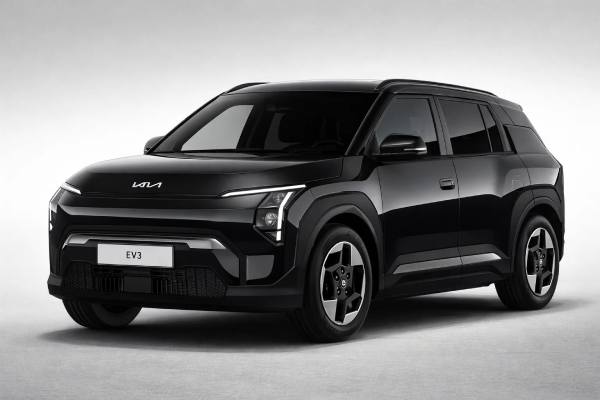

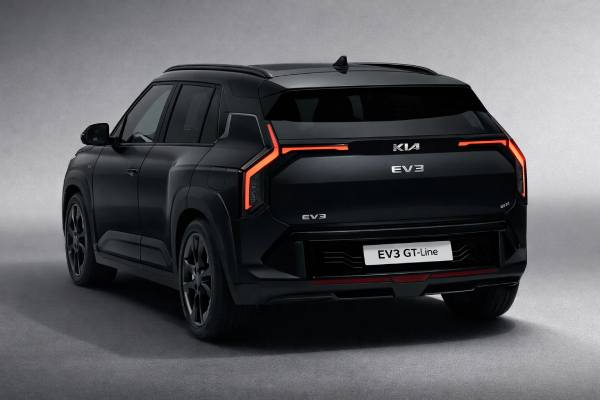
Kia’s EV3 (SV) takes the brand’s latest EV thinking and scales it to a compact footprint that still feels “full size” in day-to-day use. In 58.3 kWh form with the 201 hp front motor, it aims at a sweet spot: enough performance to feel quick in traffic, enough range to cover real commutes without anxiety, and a charging setup that works on typical 400 V fast chargers. The engineering story is less about headline power and more about how the car manages energy—battery temperature, charging limits, and driver-selectable regeneration—because those details decide how relaxing an EV is to own. If you’re cross-shopping small electric SUVs, the EV3’s appeal will come down to predictable efficiency, a practical cabin and cargo layout, and a safety-and-assistance package that can be strong when specified correctly.
Owner Snapshot
- Efficient in mixed driving when you keep speeds sensible, with strong everyday torque for city merges and short highway bursts.
- Practical packaging for a compact SUV: usable rear cargo, tight turning circle, and an easy “EV routine” for home charging.
- Fast-charge capability is competitive for a 400 V class EV when the battery is warm and you arrive at a charger at low state-of-charge.
- Plan on software updates early in ownership; keeping infotainment and driver-assistance systems current matters more on new-model EVs.
- Typical inspection and service cadence is about every 32,000 km or 24 months (market schedule may differ by VIN and region).
Quick navigation
- Kia EV3 (SV) deep dive
- Kia EV3 (SV) specifications
- Kia EV3 (SV) trims, safety, and ADAS
- Reliability, issues, and service actions
- Maintenance and buyer’s guide
- Driving, range, and charging
- How it stacks up
Kia EV3 (SV) deep dive
The 58.3 kWh Kia EV3 (SV) is the “standard range” version of Kia’s compact electric SUV, built around a single front-mounted permanent-magnet motor and a battery pack sized for regular commuting plus weekend use. With 201 hp on tap, it doesn’t need multiple motors to feel lively; what you notice first is the immediate response typical of EVs—especially from 0–50 km/h—where torque arrives without waiting for a downshift.
From an ownership perspective, the EV3’s strongest trait is how easy it is to run like an appliance: plug in at home, pre-condition the cabin while still connected, and rely on predictable efficiency. The 58.3 kWh pack also tends to encourage “right-sized” charging habits. Instead of chasing 100% routinely, most owners will find a comfortable rhythm charging to a moderate state-of-charge for daily use and topping up before longer trips. That matters because battery longevity in modern EVs is influenced less by mileage than by heat and repeated high state-of-charge exposure.
Engineering details that separate a good EV from a frustrating one usually show up in three areas:
- Thermal behavior and charging discipline: Small-pack EVs can still be excellent road-trip cars if they accept and hold decent fast-charge power, but only if the pack reaches the right temperature window. Battery preconditioning support (where fitted) becomes a real quality-of-life feature rather than a tech novelty.
- Regenerative braking calibration: The best systems deliver smooth deceleration and predictable brake blending. In daily use, consistent pedal feel and an intuitive one-pedal mode reduce fatigue more than raw acceleration figures do.
- Software maturity: On new platform launches, owners should expect occasional updates that fine-tune charging logic, driver-assistance behavior, and infotainment stability. Keeping the vehicle updated is part of owning a modern EV—closer to maintaining a smartphone than maintaining a traditional drivetrain.
Advantages of the EV3 (SV) standard-range variant are clear when you use it as intended: city and suburban driving, mixed-speed commutes, and realistic long trips with planned fast charging. The trade-off is simple physics: at sustained high speeds, a 58.3 kWh pack has less energy buffer than the long-range model, so your comfort on long highway runs depends more on your charging strategy and local charger density.
Kia EV3 (SV) specifications
Powertrain, battery, and efficiency
| Spec | Value |
|---|---|
| Motor type | PMSM |
| Motor layout | Single motor, front axle |
| Max power | 201 hp (150 kW) |
| Max torque | 283 Nm |
| High-voltage system (nominal) | 369 V |
| Traction battery (gross) | 58.3 kWh |
| Traction battery (usable) | 55.0 kWh |
| Battery chemistry (cathode) | NMC |
| Efficiency / test standard | WLTP |
| Rated consumption (WLTP combined) | 14.9 kWh/100 km |
| Rated range (WLTP combined) | 436 km (271 mi) |
| Real-world highway @ constant speed | 23.9 kWh/100 km @ 110 km/h |
| Real-world highway range @ constant speed | 230 km @ 110 km/h |
Driveline and charging
| Spec | Value |
|---|---|
| Drive type | Front drive |
| Transmission | 1-speed automatic |
| Charging connector (AC) | Type 2 |
| Charging connector (DC) | CCS |
| Charging port location | Right side, front |
| Onboard charger (AC) | 11 kW |
| DC fast-charge peak | 100 kW |
| Average DC power (10–80%) | 80 kW |
| DC 10–80% | 29 min |
| AC 10–100% (230V / 12A) | 23h 10m |
| AC 10–100% (230V / 16A) | 5h 20m |
| Battery preconditioning for DC charging | Supported |
Performance and capability
| Spec | Value |
|---|---|
| 0–100 km/h (0–62 mph) | 7.5 s |
| Top speed | 170 km/h (105 mph) |
| Maximum braked trailer weight | 500 kg |
| Kerb weight | 1,800 kg |
| Gross vehicle weight | 2,270 kg |
Chassis and dimensions
| Spec | Value |
|---|---|
| Front suspension | MacPherson strut |
| Rear suspension | Multi-link |
| Tyres (common) | 215/60R17 |
| Length | 4,300 mm |
| Width | 1,850 mm |
| Height | 1,560 mm |
| Turning circle radius | 10.4 m |
| Cargo volume (rear, seats up) | 460 L |
| Front cargo volume | 25 L |
Safety ratings
| Spec | Value |
|---|---|
| Euro NCAP (standard equipment) | 4 stars |
| Euro NCAP Adult Occupant | 83% |
| Euro NCAP Child Occupant | 84% |
| Euro NCAP VRU | 78% |
| Euro NCAP Safety Assist | 78% |
Fluids and service intervals
| Spec | Value |
|---|---|
| Service intervals | 20,000 miles or 24 months |
Kia EV3 (SV) trims, safety, and ADAS
In most European markets the EV3 range is structured around a practical entry trim and progressively more premium trims that add larger wheels, upgraded lighting, comfort features, and driver-assistance content. The key point for the 58.3 kWh (SV) variant is that it can appear across more than one trim level depending on the country—so battery size does not always map cleanly to “base” equipment. When you shop, use identifiers that don’t depend on sales names: wheel size (often 17-inch on efficiency-focused versions), the presence of certain ADAS sensors, and whether the car carries a bundled safety pack.
For trims and options, focus on functional differences that change ownership rather than cosmetics:
- Wheel and tyre packages: Larger wheels can raise road noise and typically reduce real-world range, especially at highway speeds. If you prioritize range consistency, the smaller wheel package is usually the safer bet.
- Cabin heating hardware and comfort packs: In colder climates, a heat pump (when offered) can reduce the winter range penalty. Heated seats and steering wheel also let you run the cabin heater less aggressively.
- Charging convenience: Features like route-based battery preconditioning (when supported) and “plug and charge” capability can be meaningful if you fast-charge often.
Safety ratings for the EV3 are notable because Euro NCAP published two star outcomes tied to equipment: one rating with standard safety equipment and a higher rating when equipped with an optional safety pack. The practical takeaway is simple: treat the safety pack as a functional option, not a nice-to-have. If you’re shopping used later, verify the presence of the pack by VIN build data or a dealer printout; don’t rely only on seller descriptions.
On the technology side, expect Kia’s modern driver-assistance suite to include the building blocks most buyers now consider baseline: autonomous emergency braking (AEB) for vehicles and vulnerable road users, adaptive cruise control (ACC), and lane support. Where trims differ is the coverage and refinement—blind-spot functions, rear cross-traffic alert, upgraded lane centering behavior, and whether additional sensors or camera functions unlock stronger performance in certain scenarios.
After service work—windscreen replacement, front bumper removal, alignment changes—plan for ADAS calibration checks. On a car with camera- and radar-based systems, small sensor misalignments can create “phantom” alerts or degraded lane performance. A good shop will document calibrations and confirm the systems pass self-tests without stored faults. That paperwork becomes more important as the vehicle ages and changes hands.
Reliability, issues, and service actions
The EV3 (SV) is still early in its lifecycle, so the most realistic reliability picture is not “known failures” as much as “early ownership patterns” seen on modern EV launches: software stability, charging edge cases, and minor hardware fit-and-finish issues that show up in the first year of production. The smartest way to think about risk is to separate issues by prevalence and by cost tier.
Common (low to medium cost):
- Software-related warnings or feature glitches (infotainment freezes, connectivity dropouts, charging session errors).
Symptoms → likely cause → remedy: intermittent warnings, slow boot, or app sync failures → immature firmware or corrupted settings → update/reflash, reset, or module update where applicable.
Ownership tip: keep a record of update dates and ask the dealer for a printout of applied campaigns. - 12 V system sensitivity (particularly on EVs with lots of connected modules).
Symptoms → likely cause → remedy: random error messages after sitting, “dead” vehicle despite traction battery charge → weak 12 V battery, parasitic draw, or software sleep-state behavior → battery test/replace, firmware update, module sleep-state diagnostics. - Regen-brake corrosion or noise in humid climates with heavy regenerative braking use.
Symptoms → likely cause → remedy: scraping noises after rain, uneven braking feel at first stop → surface rust and low friction-brake use → periodic “brake burnishing” stops, inspection/cleaning; replace pads/rotors if pitted.
Occasional (medium cost):
- Charge-port latch or seal issues (especially with frequent public charging).
Symptoms → likely cause → remedy: latch won’t release, port won’t lock, water/dirt intrusion signs → mechanical wear, misalignment, or damaged seal → adjust/replace latch hardware and seals, confirm port heater/defrost functions if fitted. - Onboard charger (OBC) or DC–DC converter faults (rare in most fleets, but impactful when they happen).
Symptoms → likely cause → remedy: slow/no AC charging, 12 V voltage instability → OBC/DC–DC fault or connector issue → diagnostic isolation tests, repair/replace module under warranty where applicable.
Rare (high cost):
- High-voltage isolation faults or moisture intrusion into connectors or junction boxes.
Symptoms → likely cause → remedy: “EV system” warnings, reduced power, charging disabled → insulation resistance drop due to moisture or damaged harness → isolation testing, sealing repairs, harness or component replacement. - Battery thermal-management component failures (pumps, valves, sensors).
Symptoms → likely cause → remedy: reduced fast-charge rates, abnormal fan behavior, HVAC not conditioning battery → coolant flow problem or sensor fault → scan tool diagnostics, component replacement, coolant service.
Recalls, TSBs, and campaigns: with new EVs, many of the most important “service actions” are software-only. Even when there is no safety recall, a TSB-style update can materially change charging behavior, regen blending, or driver-assistance tuning. For any EV3, verify completion through official VIN checks where available and dealer history. When you test-drive, include at least one AC charge session (even brief) and confirm DC charging initiates normally without repeated handshake errors.
Maintenance and buyer’s guide
A battery-electric vehicle has fewer routine items than an ICE car, but the maintenance that remains is disproportionately tied to safety systems, tyres, and thermal management. For the EV3 (SV), use a schedule that is easy to follow and errs slightly conservative if you do frequent fast charging, drive in extreme heat/cold, or spend winters on salted roads.
Practical maintenance schedule (typical use):
- Every 10,000–15,000 km or 12 months: tyre rotation (if wear pattern suggests), tyre-pressure check, visual brake inspection, software update check.
- Every 20,000–30,000 km or 24 months: cabin air filter replacement, brake fluid condition check (and replacement if moisture content is high), full chassis inspection (bushings, ball joints, boots), steering and alignment check.
- Every 40,000–60,000 km or 48 months: more thorough brake service (clean/lube slide pins), inspect rotors for corrosion/pitting, inspect coolant hoses and radiator fins, confirm heat-pump performance (if equipped) and HVAC efficiency.
- 12 V battery: test annually after year 2; replacement window often 3–5 years depending on climate and usage. EVs can be harder on 12 V batteries because modules cycle more frequently.
- Battery health check: at least every 24 months, request a battery state-of-health (SOH) readout and check for cell balance issues if the diagnostic tool supports it.
Severe-use adjustments:
If you fast-charge multiple times per week, do short trips in cold weather (lots of cabin heat), or drive at sustained high speed, shorten your inspection cadence for tyres and brakes. Also monitor charging performance: repeated thermal throttling at DC chargers can be a clue that the pack isn’t reaching the right temperature or that a cooling component is underperforming.
Fluids and specs to care about:
Even if you never touch a wrench, you want confidence that the shop uses the correct coolant type for the EV thermal circuits and the correct brake fluid specification. Wrong coolant chemistry can reduce corrosion protection and shorten pump or valve life. Likewise, brake fluid quality matters more in EVs that rely heavily on regen, because friction brakes can run cooler and still accumulate moisture over time.
Buyer’s guide (used EV3 strategy):
- Battery health: Ask for an SOH report and compare indicated range at a consistent state-of-charge (for example, 80%) to what the car typically shows for the season. A single number isn’t enough—look for unusual inconsistency across days.
- Fast-charging behavior: On a test day, try a DC charge from a low SOC (around 15–25% if practical). Watch for stable charging power and normal taper, not immediate throttling.
- Charging hardware: Inspect the charge port for wear, confirm the latch works smoothly, and check that the supplied cables/adapters match your home setup.
- Thermal management: Verify HVAC performance, listen for coolant pumps/fans behaving oddly, and check for any coolant smell or residue around hoses and the radiator area.
- Chassis and corrosion: Inspect underbody covers and fasteners; EVs can trap moisture in undertrays. Look at suspension arms and battery-housing perimeter for damage from impacts.
- Electronics and updates: Confirm ADAS works without persistent warnings and ask the seller/dealer to document the latest software status.
Long-term durability outlook is promising if you treat charging and heat as the “big levers.” Use home charging as your default, avoid living at 100% unless you need it, and keep tyres aligned; those habits typically return the highest reliability payoff on modern compact EVs.
Driving, range, and charging
Ride, handling, and noise:
The EV3’s low-mounted battery mass helps it feel planted compared with many small SUVs. In normal driving you should expect stable straight-line behavior and a calm response to mid-corner bumps, with the rear multi-link suspension doing useful work on broken pavement. Steering is usually tuned for ease rather than feedback; the benefit is reduced effort in parking and tight urban maneuvering. Wheel and tyre choice matters: smaller wheels generally ride more quietly and deliver steadier efficiency, while larger wheels can sharpen initial turn-in at the cost of more road noise.
Powertrain character:
The 201 hp front motor provides quick step-off response and strong mid-range pull for city gaps and short highway merges. Because EV torque is immediate, traction management is the real limiter in wet conditions rather than engine output. Drive modes typically adjust throttle mapping and HVAC strategy; if you care about range stability, “Eco” style modes often reduce peak HVAC draw and soften acceleration to limit tyre slip.
Real-world efficiency and range:
With a 58.3 kWh pack, the EV3 is happiest in mixed use where speeds vary and regen can recover energy. In mild temperatures, compact EVs like this can feel surprisingly efficient in city driving. Highway range is more speed-sensitive: sustained high speeds create a larger aerodynamic penalty, so the same car that feels effortless at 90–100 km/h can consume markedly more at 120–130 km/h. Cold weather compounds this with cabin heat demand and reduced battery efficiency until the pack warms.
A practical ownership approach is to learn your “two numbers”: your typical mixed consumption and your typical highway consumption at your real cruising speed. Once you know those, trip planning becomes simple—especially if you keep a comfortable arrival buffer (for example, aiming to reach chargers with 10–20% SOC rather than cutting it close).
Charging performance in daily life:
At home, the EV3’s routine is straightforward: an AC wallbox can restore a meaningful amount of range overnight, and even slower AC charging works if your daily mileage is modest. Public DC fast charging is where preparation matters most. The EV3 can deliver competitive charge times in the right conditions, but like most EVs it performs best when:
- You arrive with a lower SOC (roughly 10–30%).
- The battery is warm enough to accept higher power.
- You choose a charger that can deliver the needed current steadily.
Expect a typical DC session to be fastest in the mid-SOC window and then taper as the pack approaches higher SOC. For road trips, the quickest strategy is often multiple shorter charges rather than one long charge to a very high SOC—especially with a standard-range pack where the last 20% can be relatively slow per kilometer added.
Braking and regen blending:
One-pedal driving is as much about calibration as it is about maximum regen force. The best setup gives you predictable deceleration and a smooth transition when friction brakes join in at low speed or during hard stops. If you feel inconsistency, it may be a software version issue or a brake-hardware conditioning issue (surface rust), both of which are addressable with updates and correct servicing.
How it stacks up
In the compact electric SUV space, rivals tend to separate into three camps: efficiency-first crossovers, performance-forward small EVs, and premium-leaning models that trade value for cabin materials and brand cachet. The EV3 (SV) standard-range version competes best when you prioritize predictable ownership and usable space over maximum power.
Against premium-leaning compact EVs:
Models like the Volvo EX30 can feel more upscale or more aggressive in performance, but the trade-off is often ride firmness, tyre cost, and sometimes less forgiving efficiency at higher speeds. If your driving is mostly urban with occasional longer trips, the EV3’s “calm and efficient” tune is a practical advantage.
Against mainstream efficiency crossovers:
Cars such as the Hyundai Kona Electric or Kia’s own Niro EV (market dependent) can be strong alternatives, especially if you find a trim that matches your comfort and ADAS expectations. The EV3’s advantage is that it is designed as a newer-generation EV with modern charging features and updated driver-assistance integration. Your decision point becomes whether you prefer proven maturity (older models) or the benefits of a newer electrical and software architecture.
Against bigger battery/value plays:
Some rivals win on battery size per dollar, which can make highway trips simpler because you can stretch between chargers. The EV3 standard-range counters with right-sized running costs and a lighter feel, but you should be honest about your travel pattern. If you routinely do long highway legs at 120–130 km/h, you may prefer the EV3 long-range battery—or a different model—simply because energy buffer reduces stress.
Where the EV3 (SV) 58.3 kWh shines:
- Daily commuting and mixed-speed driving where efficiency stays stable.
- Urban usability: turning circle, easy parking, and low-speed torque.
- Owners who want a modern safety-and-assistance suite, especially when the correct safety pack is specified.
Where you may want to rethink the spec:
- Frequent long highway trips at high cruising speeds.
- Cold-climate road trips without reliable fast-charging infrastructure.
- Buyers who expect “hot hatch” acceleration; the EV3 is quick, but not a performance flagship.
If you configure it with the right safety and comfort options for your climate and driving style, the EV3 (SV) standard-range version can be one of the more sensible compact EV buys: easy to live with, efficient when driven realistically, and modern enough to feel current for years.
References
- The Kia EV3 Specifications | Kia UK 2024 (Specifications)
- SV_EV_RHD_25MY 2024 (Owner’s Manual)
- Kia EV3 2025 (Safety Rating)
- Kia EV3 Standard Range (2024-2026) price and specifications – EV Database 2024 (Range and Charging)
- Kia EV3 – Euro NCAP 2025 Results – standard equipment 4 stars and with safety pack 5 stars 2025 (Safety Rating)
Disclaimer
This article is for informational purposes only and is not a substitute for professional inspection, diagnosis, or repair. Specifications, torque values, service intervals, and procedures can vary by VIN, market, model year, and equipment; always verify details using the correct official service and owner documentation for your vehicle. If you found this guide useful, consider sharing it on Facebook, X/Twitter, or your favorite forum to help others find it.