

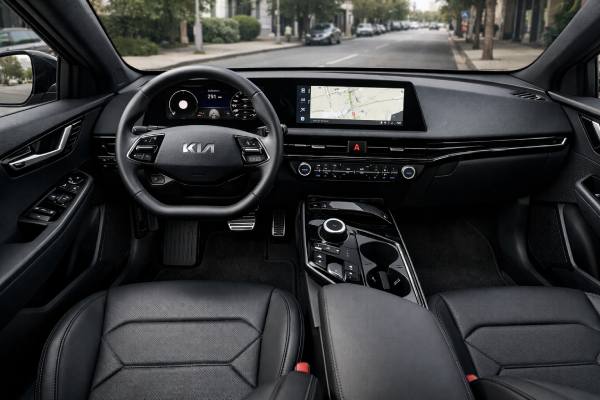

The 77.4 kWh, 225 hp Kia EV6 (CV) is the “sweet spot” EV6 for many owners because it pairs the long-range battery with a simpler single-motor layout. That combo tends to deliver strong real-world efficiency, relaxed highway manners, and fewer moving parts than dual-motor versions—without giving up the EV6’s headline engineering features. The big one is its 800 V-class fast-charging system, which can accept very high DC power when the battery is warm and the charger can supply it. Another ownership highlight is packaging: the flat floor gives the cabin a roomy feel, and the hatchback cargo area works well for daily life.
This guide focuses on what matters in practice: the specs that change how it drives and charges, realistic range expectations, known issues and service actions, and what to look for when buying used.
Quick Specs and Notes
- Fast DC charging is a real advantage on road trips when conditions are right, with short 10–80% stops compared with many 400 V rivals.
- Real highway range at 120 km/h is typically closer to ~340 km than the WLTP headline number, so plan trips around speed and temperature.
- Single-motor RWD keeps the car efficient and predictable, with strong mid-range pull and less complexity than AWD.
- Reliability watch items are mostly electrical and software-related (charging behavior, 12 V system, ICCU-style power electronics issues on some cars).
- Plan on a cabin filter about every 15,000–20,000 km or 12 months, and brake-fluid service around every 2 years in many schedules.
Jump to sections
- Kia EV6 CV long-range profile
- Kia EV6 CV 77 kWh tech specs
- Kia EV6 CV trims, safety, and ADAS
- Reliability, faults, recalls, and updates
- Maintenance routine and used buying tips
- Real-world driving, range, and charging
- Rivals and smart alternatives
Kia EV6 CV long-range profile
Think of this EV6 as the “long legs, clean layout” version of the early EV6 lineup. With the larger battery and a single rear motor, it’s built to cover distance efficiently and charge quickly, rather than chase maximum traction or peak acceleration. In everyday driving, that shows up as smooth, strong torque from low speed, easy one-pedal control, and a calm feel at motorway pace thanks to the heavy battery mounted low in the chassis.
The engineering headline is the E-GMP platform’s 800 V-class electrical architecture. In plain terms, it allows the car to pull very high charging power without needing extreme current, which helps reduce heat in cables and components. When the pack is warm enough and you plug into a high-output charger, the EV6 can add meaningful range in the time it takes to grab a coffee—especially in the 10–60% state-of-charge (SOC) band where charging is usually strongest. Owners who road-trip often feel this advantage more than they feel the difference between 0–100 km/h times.
The 77.4 kWh battery is also a practical sweet spot because it gives you flexibility with charging habits. You can keep a daily charge limit around 70–80% for battery longevity, yet still have enough usable range for a full day of mixed driving. On trips, you can “hop” between fast chargers without routinely charging to 100%, which is slower and less efficient. That charging strategy matters as much as the raw battery size.
Where this version can surprise new EV owners is how sensitive range is to speed and weather. WLTP ratings are achieved at relatively modest speeds with limited HVAC load. At 120 km/h, aerodynamic drag dominates, and cold weather adds both heating demand and battery chemistry losses. The EV6 handles this better than some EVs thanks to strong thermal management, but physics still wins. If you buy the EV6 primarily for motorway commuting, treat real 120 km/h range as your planning baseline, and consider a heat pump if your market offered it on your trim.
Advantages that tend to age well include the spacious cabin, strong safety and driver-assistance suite availability, and the platform’s charging performance. The main ownership downside is that many “issues” people experience are software-and-sensor flavored: charging behavior, warnings, camera and radar calibration, and occasional 12 V battery drama. None of these are guaranteed problems, but they shape what a smart buyer checks before purchase.
Kia EV6 CV 77 kWh tech specs
Powertrain, battery, and efficiency
| Spec | Value |
|---|---|
| Motor type | Permanent-magnet synchronous motor (rear) |
| Motor count and axle | Single motor, rear axle |
| Max power | 225 hp (168 kW) |
| Max torque | 350 Nm (258 lb-ft) |
| Drive type | RWD |
| Battery chemistry | NMC (nickel-manganese-cobalt) lithium-ion |
| Battery gross capacity | 77.4 kWh |
| Battery usable capacity | 74.0 kWh |
| System architecture | 697 V |
| Official test standard (range) | WLTP |
| WLTP range | 528–504 km (328–313 mi) |
| WLTP rated consumption | 14.0–14.7 kWh/100 km |
| EPA range (RWD, comparable configuration) | 310 mi (499 km) |
Real-world highway at 120 km/h
| Spec | Value |
|---|---|
| 120 km/h range (best-case) | 340 km (211 mi) |
| 120 km/h consumption (best-case) | 23.5 kWh/100 km |
Charging hardware and charging performance
| Spec | Value |
|---|---|
| AC charging connector (market dependent) | Type 2 or J1772 |
| DC fast charging connector (market dependent) | CCS2 or CCS1 |
| Onboard AC charger (max acceptance) | 11 kW |
| DC fast-charge peak | 233 kW |
| DC 10–80% time | 16 min 34 s |
| Average power (10–80%) | 187.6 kW |
| Battery preconditioning | Available (feature depends on model year and market software) |
| Heat pump | Optional (market and trim dependent) |
Performance and capability
| Spec | Value |
|---|---|
| 0–100 km/h (0–62 mph) | 7.3 s |
| Top speed | 185 km/h (115 mph) |
| Braked towing capacity (where approved) | 1,600 kg (3,527 lb) |
| Unbraked towing capacity (where approved) | 750 kg (1,653 lb) |
| Payload (approx.) | 515 kg (1,135 lb) |
Dimensions and weights
| Spec | Value |
|---|---|
| Cargo volume (rear) | 480 L (17.0 ft³) |
| Cargo volume (seats folded) | 1,260 L (44.5 ft³) |
| Frunk volume | 20 L (0.7 ft³) |
| Kerb weight (approx.) | 2,015 kg (4,442 lb) |
| GVWR (max vehicle weight) | 2,530 kg (5,578 lb) |
Safety ratings and ADAS (high-level)
| Spec | Value |
|---|---|
| Euro NCAP | 5 stars |
| IIHS (US, model-year dependent) | Strong overall ratings; trims and headlights can change results |
| AEB | Available (often standard in many markets) |
| ACC | Available |
| Lane keeping and lane centering | Available (often bundled with Highway Driving Assist features) |
| Blind-spot monitoring | Optional or standard depending on trim |
Kia EV6 CV trims, safety, and ADAS
Trim names vary by region, but the pattern is consistent: entry trims focus on value and range, mid trims add comfort and tech, and top trims bring larger wheels, upgraded lighting, and more camera-based features. For this 77.4 kWh, 225 hp configuration, you’ll commonly see it paired with “Long Range RWD” badging in North America (often “Light Long Range” or similar) and “Air / GT-Line” style naming in parts of Europe. The important part is not the badge—it’s the equipment that changes daily satisfaction and real range.
The biggest functional differentiator is wheel and tire package. Smaller wheels usually mean less road noise, better ride compliance, and better efficiency at speed. Larger wheels can look great, but they typically cost you real highway range and can increase tire wear cost. If you drive a lot of motorway kilometers, prioritize the most efficient wheel setup available for your preferred cabin spec.
Heat pump and battery conditioning are worth understanding. In colder climates, a heat pump can reduce the energy needed for cabin heat compared with pure resistive heating, which helps winter range. Separately, battery preconditioning (warming the pack before a DC fast charge) can be the difference between “wow” charging and “why is it slow today?” Some markets enabled preconditioning via updates over time, and some trims made it easier to trigger through navigation routing. When shopping used, confirm the car can reliably hit strong DC power in cool weather—this is more meaningful than reading a brochure.
Quick identifiers when viewing a used EV6:
- Check the wheel size and tire brand: it tells you a lot about comfort, noise, and range expectations.
- Verify whether the car has the equipment for higher-level highway assist (lane centering plus adaptive cruise behavior), which is often obvious from the steering-wheel controls and cluster prompts.
- Look for 360-degree camera, parking sensors, and blind-spot camera features if they matter to you; these can be trim-locked in some markets.
On safety, the EV6’s structure and restraint systems have earned strong results in major testing regimes. That’s the good news. The practical news is that driver assistance performance depends on calibration and condition. Windshield replacements, front bumper repairs, wheel alignment changes, or even certain suspension work can affect camera and radar alignment. A proper post-repair calibration is not optional; it’s how you keep AEB and lane support behaving predictably. When buying used, ask for documentation if the car has had front-end work, windshield replacement, or repeated ADAS warnings.
For family use, check for ISOFIX or LATCH points (typically on the outer rear seats) and confirm rear door opening angle works for your child seat. The EV6 is roomy, but the combination of a low roofline and a rising beltline means some rear-facing seats are easier to load than others. A five-minute test with your actual seat beats any online measurement.
Reliability, faults, recalls, and updates
The EV6’s long-range RWD setup is mechanically simple for a modern EV: one main drive unit, a large battery, and a lot of software. Most meaningful issues owners report tend to fall into four buckets: power electronics and charging behavior, 12 V system stability, sensors and driver-assistance warnings, and build-related squeaks or trim wear. Below is a practical way to think about them—by prevalence and cost risk—so you can prioritize what to check.
Common (usually low to medium cost)
- 12 V battery weakness or discharge
- Symptoms: car will not “ready,” intermittent warning messages, odd electrical glitches, repeated jump-start events.
- Likely causes: aging 12 V battery, high parasitic load patterns, DC–DC converter management behavior, or a vehicle that sits unused.
- Remedy: test the 12 V battery properly (capacity and load), replace if marginal, and confirm the DC–DC system charges correctly. If the car has a history of repeated 12 V failures, treat it as a red flag until diagnosed.
- Brake noise or corrosion on lightly used cars
- Symptoms: scraping sounds, uneven braking feel after rain, visible rotor rust.
- Likely causes: heavy regenerative braking reduces friction-brake use, so rotors do not get cleaned.
- Remedy: periodic firm braking, correct pad bedding, and rotor inspection—especially in wet and salty climates.
Occasional (medium cost, sometimes software-led)
- Charging faults or inconsistent DC fast-charge speed
- Symptoms: slow charge rates despite a capable charger, abrupt taper early in the session, charging stops unexpectedly.
- Likely causes: battery temperature (no preconditioning), software strategy updates, charger handshake issues, or charge-port hardware.
- Remedy: verify preconditioning behavior, test across more than one charger network, and ensure software is current. If charging repeatedly stops, inspect port latch and pins, seals, and the onboard charger and related modules.
- ADAS warnings and sensor-related alerts
- Symptoms: lane support unavailable, cruise faults, camera blocked messages in clear weather.
- Likely causes: camera calibration issues, radar alignment after minor bumps, dirt or moisture in sensor areas, software calibration quirks.
- Remedy: clean and inspect sensor areas, check for accident history, and confirm proper calibration after windshield or bumper work.
Rare but high impact (high cost or “do not ignore”)
- Power electronics failures affecting drivability (ICCU-style concerns on some vehicles)
- Symptoms: reduced power, warning lights, inability to charge correctly, or in worst cases loss of motive power.
- Likely causes: faults within integrated charging control and power conversion hardware, related fusing, or software strategies that needed updates.
- Remedy: confirm recall and service campaigns are completed, and ensure the car has documented dealer updates. On a test drive, watch for warning messages, charging irregularities, and abnormal behavior from the 12 V system.
How to map issues to mileage and usage
- Frequent DC fast charging can raise thermal stress over time, but the EV6 is designed for it. The bigger risk is repeated fast charging without proper preconditioning in cold weather, which can lead to “slow charging” complaints and frustration, not necessarily permanent damage.
- Cold climates increase the importance of heat pump (if equipped), battery conditioning, and door and hatch seals. Also pay attention to underbody fasteners and brake corrosion.
- Heavy city use is easy on the powertrain but can accelerate tire wear due to torque and weight. Expect tires to be a real consumable.
Recalls, TSBs, and service verification
When you evaluate any used EV6, treat recall completion as non-negotiable. Use an official VIN lookup and ask the seller for dealer documentation showing completion dates. In many cases, the “fix” is software plus inspection, which is quick at a dealer but easy for owners to postpone. Your best pre-purchase request list:
- Full recall printout and campaign completion records
- Evidence of charging-related module updates, if applicable
- A battery health report or diagnostic summary (even a simple dealer inspection sheet helps)
- Proof of any cooling-system service if your market schedule calls for it
The key mindset: most EV6 reliability stories are “electrical systems plus updates,” not “worn-out engine parts.” That’s good—because software can fix real problems—but it also means you should prefer cars with consistent dealer history or clearly documented update paths.
Maintenance routine and used buying tips
EV maintenance is simpler than combustion cars, but it is not “no maintenance.” The EV6 rewards a steady, checklist-style approach: keep filters fresh, protect the cooling system, keep brakes healthy despite heavy regen use, and treat tires and alignment as your most frequent wear item.
Practical maintenance schedule (typical owner use)
Use this as a planning baseline, then align it with your official market schedule:
- Every 15,000–20,000 km or 12 months
- Cabin air filter replacement (or inspect and replace as needed)
- Tire rotation, tire condition check, and alignment check if wear is uneven
- Brake inspection (pads, rotors, and slide pins), especially if the car sees mostly regen braking
- Suspension and steering inspection for bushing wear and knocks
- Every 2 years
- Brake fluid replacement (hygroscopic fluid ages even if pads do not wear quickly)
- Every 3–5 years (or when test results show weakness)
- 12 V battery test and likely replacement window, depending on climate and usage
- Cooling systems (interval depends on market documentation)
- Inspect coolant condition and level regularly; replace per the official schedule for your VIN and region
- As-needed but important
- Wiper blades and washer fluid (simple, but visibility is safety)
- A/C service checks if performance drops (EVs rely on HVAC for comfort and, indirectly, range)
Fluids, consumables, and “EV-specific” care
- Tires: EV torque plus weight can eat tires faster than new owners expect. Budget accordingly and keep pressures correct.
- Brakes: Make a habit of occasional firm braking (in a safe place) to keep rotors clean.
- Cooling system integrity: The battery, inverter, and motor depend on liquid cooling. Any leak or wrong coolant is not a “small issue.”
- Charge port care: Keep the port clean, check the flap and seals, and make sure the connector latches positively.
Essential torque and service decision values (owner-facing)
Even if you never wrench on the car, a few numbers help you judge shop competence:
- Wheel fasteners should be torqued correctly (incorrect torque can warp rotors and damage studs).
- If a shop touches suspension or steering, insist on proper alignment and, if relevant, ADAS calibration checks afterward.
Used-buyer’s inspection checklist (high value, low fluff)
- Battery health and range reality
- Drive the car at steady speed and compare predicted range behavior to your expectations.
- Ask for a battery diagnostic or state-of-health style report if available.
- On a warm battery, verify DC fast charging can reach strong power (even a short test session tells you a lot).
- Charging hardware
- Inspect charge port pins, latch action, and port-door seals.
- Test AC charging at home or a public Level 2, and confirm it sustains normal power.
- Cooling and thermal management
- Confirm HVAC works strongly in heat and in cold.
- If equipped with a heat pump, make sure it actually produces efficient heat (a weak system can hurt winter comfort and range).
- Chassis and underbody
- Check tire wear pattern and listen for suspension knocks over sharp bumps.
- Inspect for underbody damage—EV battery protection matters.
- Electronics and ADAS
- Confirm cameras, parking sensors, and lane systems behave normally.
- Ask about windshield replacement and front-end repairs, and verify calibrations were performed.
- Which versions to seek
- If your priority is distance and efficiency: smaller wheels, heat pump (if available), and confirmed preconditioning behavior.
- If your priority is comfort and tech: mid trims with the better seat and audio packages, but still keep wheel size sensible.
Long-term durability outlook
The 77.4 kWh EV6 tends to age well when owners keep software current and maintain the cooling and 12 V systems. Expect normal battery degradation over time, with faster apparent losses in very cold climates or at sustained high speeds. The likely “big ticket” risks are power electronics modules and out-of-warranty sensor and camera repairs, not the motor itself.
Real-world driving, range, and charging
On the road, the long-range RWD EV6 feels like a confident grand tourer more than a hot hatch. The battery’s low mounting point gives it a planted, stable feel, especially in fast sweepers and during lane changes at highway speed. Steering is typically light-to-moderate in effort, with good consistency rather than rich feedback. The best compliment you can give it is that it does not feel nervous. It tracks straight, takes crosswinds well for its shape, and the chassis rarely feels surprised by mid-corner bumps.
Ride, handling, and noise
Ride quality depends heavily on wheels and tires. Smaller wheels generally deliver a calmer ride and reduce sharp impacts. Larger wheels can increase road noise and make broken pavement feel busier. Cabin noise at speed is usually more wind-and-tire dominated than powertrain dominated—because the powertrain is quiet. If you test drive one, do at least ten minutes at your typical highway speed and listen for low-frequency tire roar, which can vary dramatically by tire brand.
Powertrain character and regen behavior
The 225 hp rear motor delivers strong, immediate torque without the “double punch” you get from dual motors. That makes it easier to modulate in wet conditions and easier on rear tires than you might expect, though it is still an EV—torque is available instantly if you ask for it. Regen tuning is one of the EV6’s most useful daily features. In heavier regen settings, you can do true one-pedal driving in traffic. The learning curve is short: most drivers adapt within a day or two, and it becomes second nature.
Brake feel is generally predictable, but like many EVs there is a handoff between regenerative and friction braking. A well-maintained EV6 feels smooth here; a neglected one may feel grabby at low speeds or noisy after rain. That’s why brake maintenance matters even when pads last a long time.
Real-world efficiency and range: what to expect
The EV6’s official ratings look great, but your usable range depends on three things you control: speed, temperature, and wheel and tire setup.
- City driving: often efficient because regen recovers energy and speeds are low. Expect strong range and relaxed energy use.
- Mixed driving: typically lands noticeably below WLTP but still comfortable for most daily use.
- Highway at 120 km/h: a realistic planning figure is around ~340 km in favorable conditions, and less in cold weather or with larger wheels.
Cold weather adds two hits: the battery is less efficient when cold, and cabin heat consumes meaningful energy. A heat pump (if equipped) reduces that penalty, but it does not erase it. Also note that repeated short trips in winter can look “worse than expected” because the car spends a lot of time warming the cabin and battery without covering many kilometers.
Charging in daily life and on trips
For home charging, the long-range EV6 is straightforward: an 11 kW AC onboard charger means an overnight session can refill the pack from a moderate state of charge by morning, assuming your home setup can supply it. The daily habit most owners settle into is charging to 70–80% for routine use, then charging to 90–100% only before longer trips.
On road trips, the EV6’s advantage is speed in the mid SOC band. A smart rhythm is:
- Arrive at the charger with a low but comfortable SOC (for example, 10–20%).
- Charge only to the SOC where power starts tapering strongly (often somewhere around 70–80%).
- Drive to the next charger rather than waiting for the slower top-up.
Battery preconditioning is the difference-maker in cool weather. Without it, the car may protect the battery by charging slower until it warms up. With it, the pack can be ready when you arrive, letting the EV6 hit its strong peak and sustain high average power.
If you want one practical metric: judge charging by average power from 10–80%, not the single highest number you see on the screen. The EV6’s reputation comes from strong average power and short stop times when conditions are aligned.
Rivals and smart alternatives
The long-range RWD EV6 competes in a crowded space: practical electric crossovers with enough range for real travel. What makes the EV6 stand out is charging speed and platform maturity, but the best choice depends on your driving pattern and charging access.
If your priority is road-trip time
The EV6’s 800 V-class charging can be a decisive advantage versus many 400 V rivals that peak lower and taper earlier. If you frequently drive long distances and rely on public DC charging, this version of the EV6 can feel like it “shrinks the map.” In this use case, also consider other 800 V-class or high-performance charging competitors, but compare real 10–80% time and average kW, not marketing peaks.
If your priority is maximum efficiency at highway speed
Some rivals trade performance for aerodynamic efficiency and may deliver better consumption at sustained motorway pace, especially if they are lower and narrower. The EV6 is efficient for its size, but it is still a crossover shape. If you drive 120–130 km/h every day, compare:
- Real 120 km/h consumption
- Tire and wheel package availability
- Cabin noise and fatigue factor over long drives
If your priority is comfort and family usability
The EV6 does well here: roomy cabin, hatch practicality, strong safety performance, and often a generous driver-assistance feature set. Still, rivals may offer:
- Softer suspension tuning
- More rear headroom or a squarer cargo opening
- Different infotainment philosophy (some prefer physical controls, others prefer screens)
If your priority is ownership simplicity and service access
Choose the car you can service confidently where you live. EV ownership is easiest when:
- Your local dealer network is competent with EV diagnostics
- Recalls and software updates are handled promptly
- You have dependable home or workplace charging
Where the EV6 77.4 kWh RWD usually wins
- Fast DC charging speed and short stops
- Balanced performance without AWD complexity
- Spacious cabin feel from the flat-floor platform
- Strong safety credentials and modern ADAS availability
Where a rival may fit better
- You want the absolute quietest cabin on coarse roads
- You want maximum winter efficiency without depending on optional equipment
- You need a more upright rear opening or specific interior packaging quirks (child seats, pets, cargo boxes)
The bottom line: if you can use its charging advantage and you buy the right wheel-and-tire setup for your roads, the 77.4 kWh RWD EV6 is one of the most satisfying “do-it-all” EVs from its era. If you rarely fast charge and mostly drive short trips, you may find a less complex or less expensive alternative meets your needs just as well.
References
- Fuel Economy of 2022 Kia EV6 2022 (Official Efficiency Database)
- Kia EV6 2022 (Safety Rating)
- 2022 Kia EV6 2022 (Safety Rating)
- Recalls 2026 (Recall Database)
- Scheduled maintenance service 2026 (Owner’s Manual)
Disclaimer
This article is for informational purposes only and is not a substitute for professional diagnosis, inspection, or repair. Specifications, torque values, service intervals, and procedures can vary by VIN, market, battery and software version, and installed equipment. Always verify details using official manufacturer documentation and the service information specific to your vehicle.
If this guide helped, please consider sharing it on Facebook, X, or your favorite forum to support our work.