
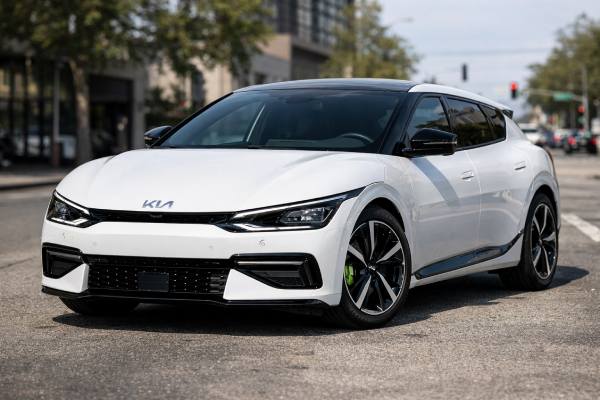
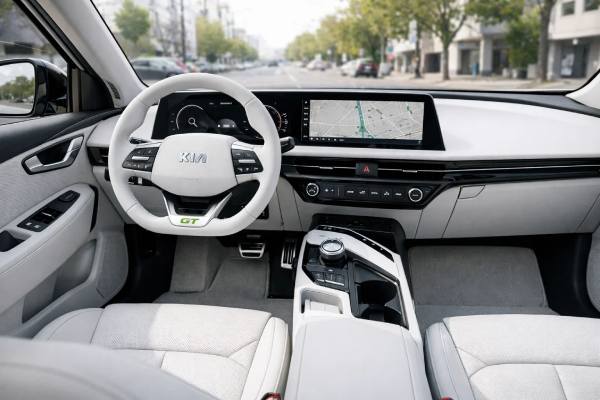

The Kia EV6 GT AWD takes the regular EV6 recipe—clean packaging, fast charging, and strong everyday refinement—and turns the volume up until it’s genuinely quick-car fast. With dual motors and launch-ready output, it delivers instant passing power, a high top speed for an EV crossover, and chassis hardware that’s meaningfully different from lesser trims. You’re not just buying more horsepower; you’re buying stronger brakes, sharper steering calibration, and suspension tuning aimed at controlling a heavy, low-slung battery platform at higher speeds.
Ownership is also a little different. The GT’s 21-inch tire setup, high-energy braking needs, and performance heat loads make maintenance priorities more “sports car” than “family EV.” Get the basics right—software updates, tire strategy, and charging habits—and the EV6 GT can be both thrilling and surprisingly usable.
Top Highlights
- Strong straight-line speed with a high top speed, plus AWD traction that’s easy to access in daily driving.
- 800V-class fast charging capability can make long trips practical when chargers cooperate.
- More focused chassis hardware than standard EV6 trims, including GT-specific suspension and steering tuning.
- Budget for frequent tire spend if you drive it hard; the 21-inch performance tires are not a “set-and-forget” item.
- Rotate and inspect tires about every 13,000 km (8,000 miles) to keep wear even and handling consistent.
Contents and shortcuts
- Kia EV6 GT AWD: what it is
- Kia EV6 GT AWD specs and tech
- Kia EV6 GT AWD trims and safety
- Recalls, issues, and service fixes
- Maintenance plan and buying tips
- Real driving, range, and charging
- How it stacks up against rivals
Kia EV6 GT AWD: what it is
The EV6 GT AWD is the “everything turned up” version of Kia’s E-GMP-based crossover, built around a dual-motor AWD system and a 77.4 kWh battery pack. In practice, it sits in a rare niche: it’s shaped like a compact crossover, charges like a modern road-trip EV, and accelerates like a dedicated performance car when conditions are right.
What makes the GT feel different from a standard EV6 isn’t only peak power. The steering is quicker, the suspension hardware is more serious, and the braking system is designed to deal with repeated high-energy stops. Those changes matter because EVs carry weight low and evenly, which helps grip, but the mass is still mass—once you start pushing hard, damping control and brake stamina become the difference between “fast once” and “fast repeatedly.”
From an ownership perspective, the EV6 GT’s best trait is that it doesn’t require you to live in “track mode” to enjoy it. Around town, the powertrain can be smooth and quiet, with one-pedal driving strong enough to make stop-and-go traffic easier. The cabin and driving position feel modern rather than boy-racer, and you still get the practical advantages of the EV6 platform: a long wheelbase for passenger space, a usable cargo area, and a charging system designed for short stops rather than long waits.
The trade-offs are real, though. The GT’s 21-inch performance tires are a consumable, not just a styling choice. If you drive the car the way its badge suggests—hard launches, aggressive cornering, repeated fast highway work—expect faster wear and a higher chance of uneven shoulder wear if alignment and pressures aren’t kept in check. And while EV maintenance is generally lighter than ICE ownership, the GT adds “performance maintenance,” meaning you’ll care more about tires, brakes, cooling system health, and software updates that influence charging and drivability.
Who is it for? Drivers who want daily usability but refuse to give up acceleration, passing power, and real chassis capability. If you mostly commute gently, a lower EV6 trim is cheaper to run. If you want a one-car garage that can do family duty Monday and feel special on a mountain road Saturday, the EV6 GT is built for exactly that.
Kia EV6 GT AWD specs and tech
Powertrain, battery, and efficiency
| Spec | Value |
|---|---|
| Powertrain layout | Dual-motor AWD |
| Motor type | AC synchronous permanent magnet |
| Battery type | Lithium-ion |
| Battery energy | 77.4 kWh |
| Battery voltage | 697 V |
| Transmission type | Gear reduction unit (single-speed) |
| Final gear ratio | 10.65:1 |
| 12 V battery capacity | 60 Ah |
Charging and replenishment
| Spec | Value |
|---|---|
| On-board charger (AC) | 10.9 kW |
| DC fast charge max input | 240 kW |
| AC charge time (11 kW EVSE) | 7 h 10 m (240 V / 48 A) |
| DC fast charge (50 kW EVSE) | 73 min |
| DC fast charge (350 kW EVSE) | 18 min |
| Low-voltage DC–DC converter | 1.8 kW |
Performance and braking
| Spec | Value |
|---|---|
| 0–60 mph (0–97 km/h) | 3.4 s |
| Max speed | 161 mph (259 km/h) |
| Braking 62–0 mph (100–0 km/h) | 141.0 ft (43.0 m) |
Dimensions and capacities
| Spec | Value |
|---|---|
| Wheelbase | 114.2 in (2,901 mm) |
| Length | 184.8 in (4,694 mm) |
| Width | 74.4 in (1,890 mm) |
| Height | 60.8 in (1,544 mm) |
| Front/rear track (AWD) | 64.1 in / 64.4 in (1,628 mm / 1,636 mm) |
| Minimum ground clearance | 6.1 in (155 mm) |
| Approach angle | 15.2° |
| Departure angle | 21.0° |
| Luggage capacity, seats up (SAE) | 24.4 cu ft (691 L) |
| Luggage capacity, seats folded (SAE) | 50.2 cu ft (1,421 L) |
| Passenger volume (SAE) | 103.8 cu ft (2,939 L) |
Chassis, suspension, steering, and wheels
| Spec | Value |
|---|---|
| Front suspension | MacPherson type |
| Rear suspension | 5 multi-link |
| Shock absorbers | ECS (electronically controlled suspension) |
| Steering type | Rack-mounted electric power steering (R-MDPS) |
| Steering ratio | 12.56:1 |
Fluids and key service capacities
| Spec | Value |
|---|---|
| Front reduction gear fluid type | Kia Genuine ATF SP4M-1 |
| Front reduction gear fluid capacity | 3.2–3.3 L (3.4–3.5 US qt) |
| Rear reduction gear fluid type | Kia Genuine ATF SP4M-1 |
| Rear reduction gear fluid capacity | 3.4–3.5 L (3.6–3.7 US qt) |
| A/C refrigerant | R-1234yf, 850 ± 25 g (29.98 ± 0.88 oz) |
| A/C compressor oil | POE, 180 ± 10 mL (6.09 ± 0.34 fl oz) |
| Wheel nut torque | 11–13 kgf·m (79–94 lb-ft) |
Kia EV6 GT AWD trims and safety
For 2023–2024, “GT” is the key identifier: it’s the factory performance flagship with the highest output and GT-specific chassis calibration. The broader EV6 lineup includes lower-power RWD and optional-AWD trims, but the GT is a different ownership proposition because its hardware choices (wheels, tires, brake capability, steering ratio, and suspension control) assume you may drive it hard.
Trims and options that actually change the driving
Even within GT ownership, the “options” that matter tend to be functional rather than cosmetic:
- Wheel and tire package (GT-standard 21-inch performance fitment): This is the biggest day-to-day lever on ride comfort, road noise, wet grip, and replacement cost. It also affects real range more than many people expect, because wider, stickier tires raise rolling resistance.
- Driver assistance content and sensor suite: The EV6 family offers a strong ADAS package, but you want to verify which features are fitted and working correctly on the specific vehicle. In real ownership, a car with fully functioning adaptive cruise, lane centering, and parking sensors feels like a different vehicle on long trips.
- Heat pump and cold-weather functionality (market-dependent): In colder climates, a heat pump can reduce winter range loss by making cabin heating more efficient and improving battery conditioning behavior in some use cases. If you live where winters are real, this is worth prioritizing at purchase time.
- Infotainment and connectivity: Not performance-critical, but it matters because navigation integration can influence route planning and (in some EV ecosystems) how reliably the car finds and uses high-power chargers.
Quick identifiers when shopping used
Used listings aren’t always accurate, so it helps to confirm GT status with simple cues:
- GT badging and 21-inch wheel design are the obvious tells.
- Interior and seat design tends to be more performance-oriented than standard trims.
- Acceleration behavior should be unmistakable: even a short test drive with a safe, moderate throttle application should feel stronger than a standard AWD EV6.
Safety ratings: what to know
Safety performance for this platform is generally strong, and the EV6 has been evaluated by major safety organizations. When reading ratings, focus on two practical details:
- Test version and year applicability: Some results apply across multiple model years; others are tied to a specific year or equipment set (for example, headlight performance or AEB behavior).
- “As tested” equipment: Headlight ratings and crash avoidance scores can change with wheel/tire size, lighting hardware, or sensor calibration.
Safety systems and ADAS in ownership terms
The EV6’s active safety suite typically covers the features modern buyers expect: automatic emergency braking (vehicle and pedestrian detection), blind-spot monitoring, lane departure support, and adaptive cruise control where equipped. What matters in the real world is not just whether the feature exists, but how confidently it behaves:
- Lane support quality varies by road markings and weather; it’s a helper, not an autopilot.
- AEB performance depends on sensor cleanliness and calibration—windshield replacement, bumper repairs, or suspension changes can affect behavior if calibration is skipped.
- Parking sensors and camera systems matter more than you think on a wide-tire performance EV, where wheel rash and curb impacts are expensive mistakes.
For a GT buyer, the takeaway is simple: the safety baseline is strong, but verify the specific vehicle’s equipment, confirm there are no warning lights, and ensure the ADAS behaves normally on a test drive. If the car has recent bodywork, ask for proof of sensor calibration.
Recalls, issues, and service fixes
The EV6 GT’s platform is modern and relatively robust, but it’s also software-heavy and electrically complex. Reliability is less about oil leaks and more about charge control behavior, 12V system stability, sensor confidence, and whether key updates have been applied. Below is a practical way to think about issues—by prevalence, severity, and the kind of driver most likely to trigger them.
Common (low to medium severity)
- Tire wear and alignment sensitivity (low/medium cost, high frequency): The GT’s 21-inch performance tires can wear quickly, and aggressive driving can accelerate inner-shoulder wear.
- Symptoms: road noise increase, vibration, steering pull, visible shoulder wear.
- Likely causes: toe/camber drift, underinflation, enthusiastic cornering, frequent hard launches.
- Remedy: alignment check, tire rotation strategy where applicable, maintain correct pressures, replace tires before cords show.
- Brake feel changes from regen-to-friction blending (low/medium): Most EVs blend regenerative braking with friction brakes. If pads/rotors develop surface corrosion from light brake use, feel can become inconsistent.
- Symptoms: scrape or grind at low speed, pulsing, reduced bite after rain.
- Likely causes: corrosion or glazing, long regen-heavy driving with minimal friction brake use.
- Remedy: periodic firm braking in a safe area to clean rotors, inspection, pad/rotor service if needed.
Occasional (medium severity, sometimes costly)
- 12V battery events and “no start” behavior (medium cost, high inconvenience): EVs still rely on a 12V battery to boot computers and close high-voltage contactors. If the 12V battery weakens, the car can act “dead” even when the traction battery is charged.
- Symptoms: intermittent warnings, failure to power on, random system faults.
- Likely causes: aging 12V battery, charge control irregularities, repeated short trips with accessory loads, long parking periods.
- Remedy: 12V battery test, replace if marginal, verify updates and charging system behavior.
- Infotainment and connectivity glitches (low/medium):
- Symptoms: Bluetooth drops, navigation lag, camera delay, random reboots.
- Remedy: software updates, system reset, dealer diagnosis if persistent.
High-severity (rare but important)
- Integrated charging control and 12V charging-related failures (high severity, safety-relevant): Industry-wide, the most serious EV complaints involve charge control failures that stop properly maintaining the 12V battery and can lead to reduced propulsion power.
- Symptoms: warning messages, reduced power, inability to maintain 12V, sudden loss of drive power in worst cases.
- Likely causes: charging control unit degradation or related electrical stress over time.
- Remedy: recall inspection, software updates, and component replacement where required.
Software and calibrations: why they matter on a GT
On the EV6 GT, software updates aren’t just “nice to have.” They can change:
- Charging behavior (how reliably the car initiates and sustains fast charging)
- Thermal management logic (how it protects the battery and motors under heavy use)
- ADAS confidence (camera/radar logic and warning thresholds)
- Drive feel (throttle mapping and regenerative braking transitions)
If you buy used, treat “software up to date” like you would treat “timing belt done” on an older performance car: it’s part of basic risk control.
Recalls, TSBs, and how to verify completion
For 2023–2024 EV6 models, the smartest approach is:
- Run the VIN through the official recall database and print/save the results.
- Ask the seller for dealer repair orders showing completion dates and mileage.
- Confirm in-car behavior: no persistent warning lights, stable 12V behavior, normal charging initiation, and no unexplained power-limiting messages on a test drive.
Pre-purchase checks to request (GT-specific)
- Proof of recall completion and any charging-system service actions
- Evidence of regular tire inspections and alignment checks
- A documented battery health snapshot if the seller can provide one
- A test drive that includes steady highway speed, low-speed maneuvering (listen for driveline noises), and a safe, moderate braking check for consistency
If you treat the EV6 GT like a performance car with a battery—rather than a regular EV with more power—you’ll make better decisions and avoid most expensive surprises.
Maintenance plan and buying tips
EV maintenance is often described as “minimal,” but that’s only half-true for a high-performance EV. The EV6 GT removes the engine and transmission service list, then adds performance-consumable reality: tires, brake hardware condition, alignment, cooling system integrity, and software/charging health. A simple plan keeps it predictable.
Practical maintenance schedule (distance and time)
Use this as a baseline, then tighten it if you do frequent high-speed driving, repeated hard launches, heavy city use, extreme heat/cold, or regular DC fast charging.
- Every 13,000 km (8,000 miles) or 12 months
- Tire rotation (where tire setup allows) and tire condition check
- Brake inspection: pad thickness, rotor surface condition, caliper slide health
- Steering and suspension inspection (bushings, ball joints, tie-rod play)
- Check for coolant leaks and radiator/condenser blockage (road debris matters)
- 12V battery test (state-of-health and charging stability)
- Every 26,000 km (16,000 miles) or 24 months
- Cabin air filter replacement (more often in dusty cities or allergy seasons)
- Brake fluid condition check; replace if moisture content is elevated
- Alignment check (especially if you see shoulder wear or steering pull)
- Every 3–4 years (regardless of mileage)
- Brake fluid replacement is a sensible interval for a performance vehicle because moisture lowers boiling margin under repeated braking.
- Around 4–6 years (or sooner if weak)
- Plan for 12V battery replacement if testing shows declining reserve capacity. EVs can be unusually sensitive to a marginal 12V battery.
Fluids, specs, and decision-making numbers
A few specifications help you ask better questions at a shop:
- Wheel nuts: tighten to 11–13 kgf·m (79–94 lb-ft) using a torque wrench. Over-torquing can warp rotors and damage studs.
- Reduction gear fluids: the EV6 uses reduction gear units front and rear on AWD models, with specific fluid type and capacities. This matters if a shop services driveline components or repairs leaks.
- A/C refrigerant: the car uses R-1234yf, and correct charge matters because HVAC performance affects comfort and can influence winter range.
Buyer’s guide: what to inspect on a used EV6 GT
Traction battery health and range behavior
- Ask the seller about typical charging habits (frequent 100% charging and repeated deep cycling can add stress).
- On a test drive, watch for stable state-of-charge behavior and consistent power delivery at highway speed.
Charging hardware
- Inspect the charge port area for damage, loose fitment, or signs of moisture intrusion.
- If possible, test AC charging and confirm the car initiates charging reliably.
Cooling and thermal management
- Verify HVAC works correctly in both heating and cooling modes.
- Look for evidence of proper coolant service practices (correct fluid type and no contamination).
Chassis and body
- Check the inner edges of the tires carefully; performance alignment can hide wear until it’s expensive.
- Listen for clunks over bumps (bushing wear) and humming that changes with speed (wheel bearing or tire noise).
Electronics and ADAS
- Confirm cameras and sensors work with no warnings.
- If the car has had windshield or bumper repairs, ask whether ADAS calibration was performed.
Which years and setups to seek or avoid
- Seek: a GT with documented recall completion, clean alignment/tire history, and no unresolved charging warnings.
- Be cautious with: cars that have been tracked heavily without corresponding tire/brake maintenance documentation, or vehicles with repeated 12V failures that were never traced to a root cause.
Long-term durability outlook
The EV6 GT’s battery and motors are designed for high loads, but heat and repeated high-power use always accelerate wear on supporting systems—tires, brakes, suspension joints, and the 12V ecosystem. If you keep software current, manage tire wear proactively, and treat the braking system like performance equipment, the GT can remain “special” without becoming “fragile.”
Real driving, range, and charging
The EV6 GT’s personality changes depending on how you drive it. In normal commuting, it can feel surprisingly calm—quiet drivetrain, smooth one-pedal modulation, and instant torque that you can use in small, precise doses. Push harder and the car’s mass becomes more apparent, but the low-mounted battery keeps body roll controlled and gives the chassis a planted, confidence-building feel.
Ride, handling, and NVH (noise, vibration, harshness)
- Ride quality: The GT’s suspension control helps, but the 21-inch tires are the limiting factor. Sharp impacts and broken pavement will feel firmer than on smaller wheels.
- Handling balance: AWD traction makes it easy to deploy power early, and the quick steering ratio gives it a more “pointy” front end than you’d expect from a crossover.
- Highway stability: Strong. The long wheelbase and low center of gravity help it track cleanly at speed.
- Cabin noise: Tire roar can become the dominant sound on coarse asphalt, which is normal for wide performance tires.
Powertrain character and drive modes
The GT delivers torque instantly, but it’s not always “on/off.” In gentler modes, throttle response is more progressive, which helps in wet weather and traffic. In the most aggressive settings, response becomes immediate and the car feels far lighter than it is when you punch the accelerator for a pass.
Regenerative braking is one of the most important daily-use features:
- One-pedal driving can reduce brake wear, but it can also lead to rotor corrosion if you never use friction brakes.
- A good habit is to do a few firm friction stops occasionally (in a safe place) to keep the brake surfaces clean.
Real-world efficiency and range (what changes it most)
Official figures are useful for comparison, but your real range is shaped by five big variables:
- Speed: Highway cruising at 120 km/h (75 mph) will cut range meaningfully compared with slower mixed driving.
- Temperature: Cold weather increases consumption, especially if you rely heavily on cabin heat.
- Tires: The GT’s wide performance tires trade efficiency for grip.
- Elevation and wind: Long climbs and headwinds can move consumption far more than people expect.
- Driving style: Repeated hard launches are fun—and expensive in energy.
A realistic ownership mindset is to plan charging stops around comfortable margins rather than chasing the last few percent. The GT is at its best when you use the middle of the battery more often.
Charging performance in daily life
The EV6 platform’s charging advantage is its ability to accept high DC power under the right conditions. In the real world, charging speed depends on battery temperature, starting state of charge (SOC), charger health, and whether the car is properly conditioned for fast charging.
Practical guidance:
- Home charging: An 11 kW-capable setup can refill overnight comfortably, making daily charging easy.
- Fast charging: The best results typically come when you arrive with a low-to-moderate SOC and the battery is warm enough to accept high power.
- Trip planning: Choose reliable high-power sites and treat “charger availability” as part of the travel plan, not an afterthought.
Load, passengers, and towing reality
Even without towing, a full cabin and cargo load increases consumption. If you frequently carry heavy loads or drive fast with passengers, expect a noticeable range penalty. The GT remains stable under load, but physics always wins: more weight and more speed equals more kWh used.
The bottom line: the EV6 GT can be a genuinely usable road-trip EV, but it rewards drivers who plan charging with intention and accept that performance tires and high speed reduce range.
How it stacks up against rivals
The EV6 GT’s real competitors are not “any EV crossover.” They’re the small group of EVs that combine serious acceleration, AWD traction, and everyday usability without turning into a dedicated track toy.
Against Tesla Model Y Performance
- Where the EV6 GT feels stronger: high-speed stability and a more traditional performance feel, plus very high top speed credentials for the class.
- Where the Tesla often wins: charging network simplicity (depending on region), efficiency, and sometimes software ecosystem integration.
- Decision factor: If you want a more “car-like” performance chassis feel and value fast-charge capability across multiple networks, the EV6 GT is compelling. If you want the easiest charging experience and strong efficiency, Tesla remains hard to beat.
Against Ford Mustang Mach-E GT
- EV6 GT advantages: feels sharper and more immediate in response, with a stronger performance identity and very rapid DC charging potential under ideal conditions.
- Mach-E GT strengths: strong brand appeal, engaging dynamics in its own right, and a different interior/infotainment preference profile depending on the buyer.
- Decision factor: The EV6 GT tends to feel more “engineered as a GT car,” while the Mach-E GT can feel more like a performance variant of a mainstream crossover.
Against Hyundai Ioniq 5 performance variants
Because the EV6 and Ioniq 5 share core platform DNA, the comparison comes down to tuning philosophy and packaging:
- EV6 GT: lower, sleeker stance and a more performance-forward calibration.
- Ioniq 5 variants: more upright packaging and a different cabin vibe that some families prefer.
- Decision factor: choose by seating position, visibility, and which cabin layout you actually want to live with.
Against BMW i4 M50 and Polestar 2 Performance
These are more “sport sedan/hatch” oriented, but buyers cross-shop them for performance:
- EV6 GT advantages: crossover practicality and easier daily ingress/egress, with very strong straight-line pace.
- Sedan/hatch advantages: sometimes more precise steering feel and a more traditional sporty driving position.
- Decision factor: If you need crossover utility, the EV6 GT is the performance option that doesn’t force a sedan compromise.
The EV6 GT “why”
The EV6 GT stands out because it blends three things that rarely coexist:
- Serious acceleration that stays impressive beyond city speeds
- Strong fast-charging capability that supports real travel
- Usable space and comfort that make it viable as your only car
If you want a performance EV you can live with daily—and you’re willing to accept tire and brake realities—the EV6 GT is one of the most complete “do-it-all” options in its class.
References
- 2023 Kia EV6 Specifications 2023 (Specifications)
- Kia-EV6-Owners-Manual.pdf 2022 (Owner’s Manual)
- Official Kia EV6 2022 safety rating 2022 (Safety Rating)
- 2023 Kia EV6 4-door SUV 2023 (Safety Rating)
- IMPORTANT SAFETY RECALL 2024 (Recall Notice)
Disclaimer
This article is for informational purposes only and is not a substitute for professional diagnosis, inspection, or repair. Specifications, torque values, service intervals, and procedures can vary by VIN, market, model year, and equipment. Always verify details using official service documentation for your specific vehicle and follow qualified technician guidance when working on high-voltage EV systems.
If this guide helped you, please consider sharing it on Facebook, X (Twitter), or your favorite forum to support our work.